Winter haircuts become easier to compare when the first question is not a style name, but the silhouette itself. Overall length sets the scale, while the lower perimeter, crown shape, and amount of layering decide whether the outline feels continuous, compact, rounded, airy, or deliberately broken up. Those structural choices create useful points of comparison across long, medium, and short cuts without turning any one shape into a rule.
The smaller details matter just as much as total length when comparing haircut ideas. Bangs can sit full, wispy, or divided into curtain pieces; curls and waves can expand the outline, while straighter texture can make the perimeter read more clearly. Face-framing sections, flipped ends, and crown-to-nape contrast also change where the eye lands, giving each cut its own balance and rhythm.
Long Blonde Layers With Soft Face Framing
This very long cut keeps most of its length flowing well past the shoulders, but the front is not left as one uninterrupted curtain. Shorter sections begin around the front and sweep into the longer body of the hair, so the outline changes gradually rather than dropping from one uniform length. For winter haircuts for long hair, that visible transition is the strongest idea here: substantial length remains, while the front gains a softer, more articulated edge.
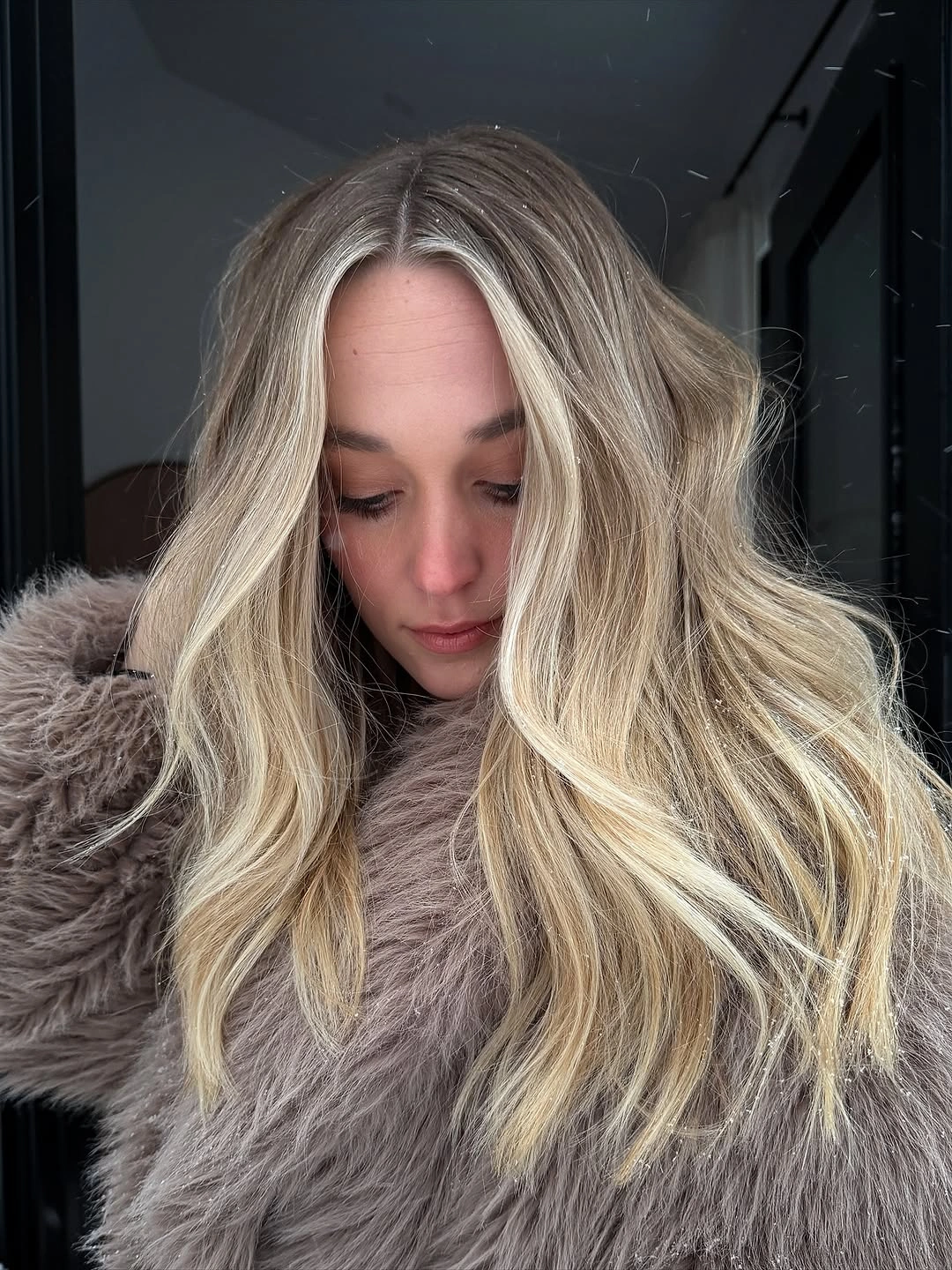
A center part gives the front layers a balanced starting point, and the broad loose waves make the change in length easier to read. The waves open and close the silhouette as they move downward, so the shorter front pieces do not look detached from the rest of the cut. Instead, they blend into the longer sections through a sequence of visible curves, keeping the overall shape elongated while adding movement close to the face.
The lower half of the haircut still reads as decisively long, which keeps the front shaping from taking over the entire silhouette. That balance is useful when comparing long haircut ideas because the cut does not depend on a dramatic fringe or a short crown to create structure. The most noticeable change happens near the front, where the shorter lengths interrupt the otherwise continuous fall of hair. Because those pieces are still relatively long, they create framing without producing a separate bang shape. The result is a long layered outline with movement concentrated where the front meets the main length. The waves reinforce that layered transition, while the overall length remains the dominant visual feature.
Long Curly Shape With Full Natural Volume
The defining feature of this long curly cut is not a sharp lower perimeter but the amount of visible volume carried through nearly the entire silhouette. Dense curls begin close to the crown and continue through the lower lengths, creating a full shape that expands outward as well as downward. That makes the cut read differently from a long layered wave pattern, because curl density is doing much of the structural work.
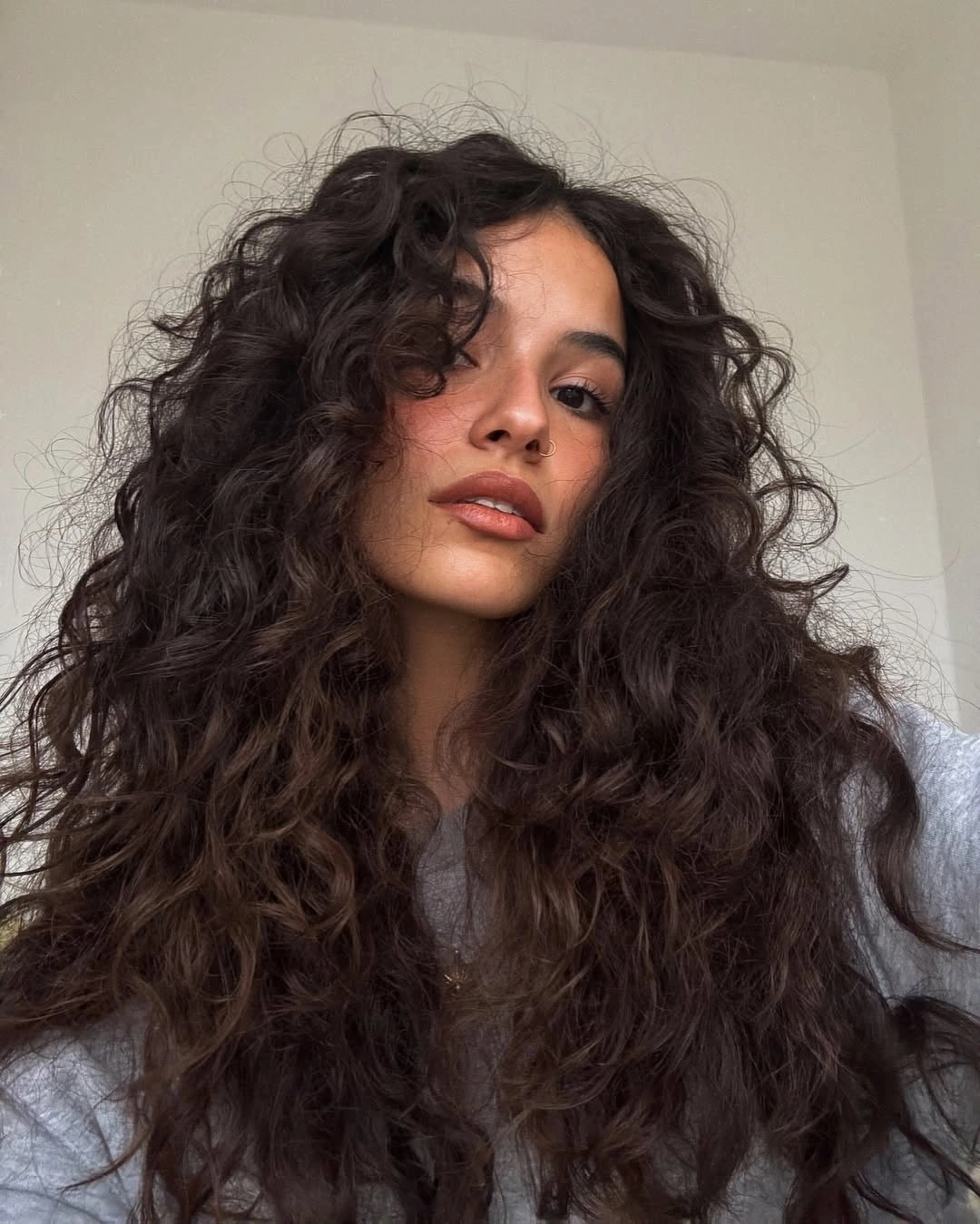
The hair remains very long, yet the eye does not travel only to the ends. Volume near the crown, through the sides, and across the lower lengths keeps the silhouette active from top to bottom, while the defined curls create many small changes in direction. For curly winter haircut ideas, the useful comparison point is how a long cut can hold substantial length without appearing narrow or vertically dominant.
There is no need to assign an exact curl category to understand the haircut's shape. What is clearly visible is a dense pattern of curls that fills the outline and softens any single hard edge at the bottom. The crown has enough lift to keep the upper portion from looking flat against the much longer lengths. That continuity of volume helps the whole cut read as one rounded, expansive silhouette rather than a compact top attached to a long tail. Length is still important, but here it shares attention with texture and width. The cut offers a strong long-and-curly reference because the silhouette stays full through multiple levels instead of concentrating movement only at the ends.
Very Long Straight Length as the Main Statement
This back view makes extreme length the clearest feature of the haircut. The hair is gathered into a ponytail and then falls in a mostly straight, smooth line far down the back, so the overall impression comes from continuity rather than visible fringe or front shaping. Because the tied styling conceals the front and much of the upper structure, the safest reading is length-first rather than an attempt to name hidden layers.
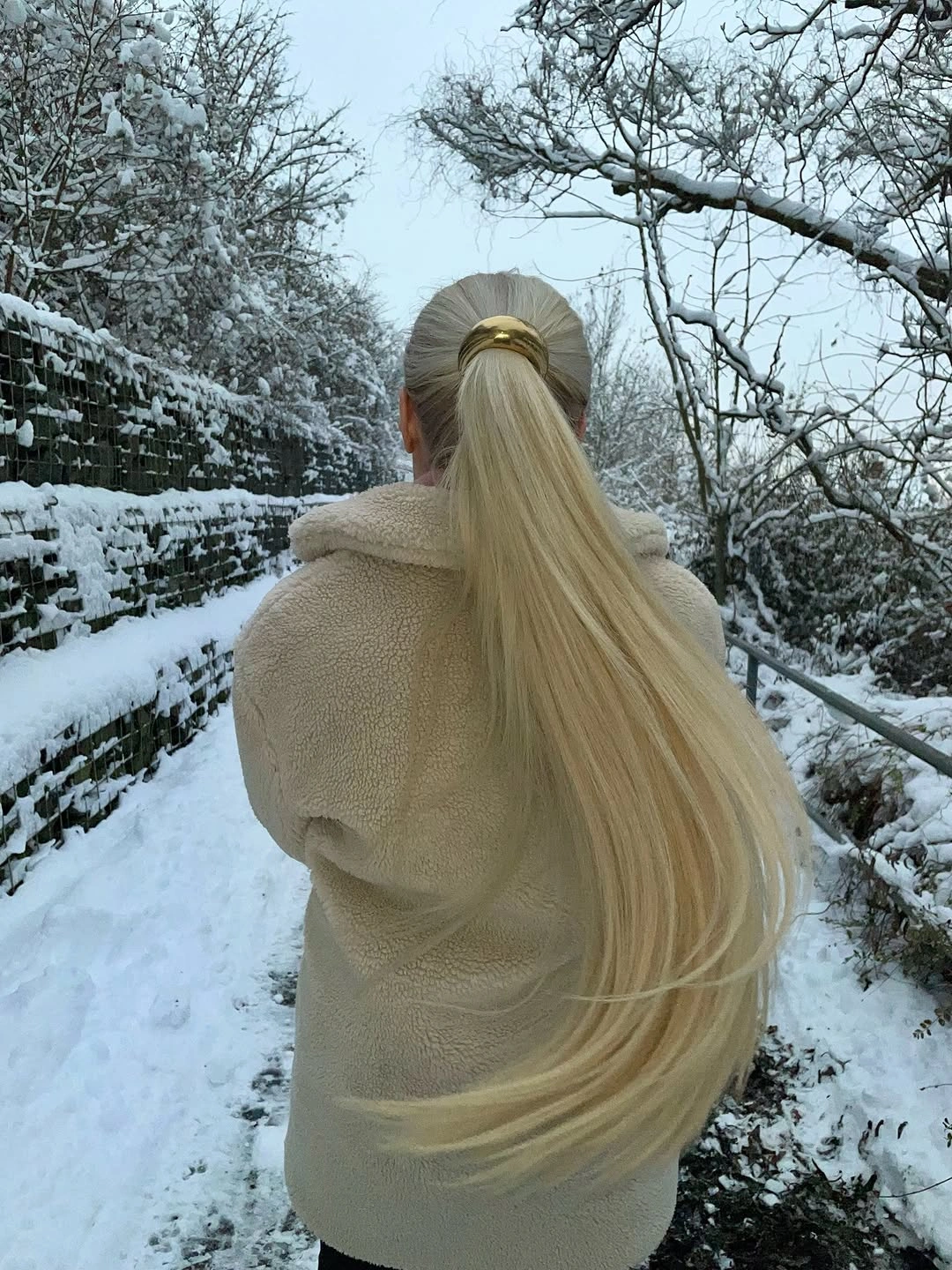
The long tail keeps a relatively narrow vertical silhouette, especially compared with a fuller curly shape. There is slight movement through the lower portion, but the hair does not expand dramatically to the sides, allowing the uninterrupted drop of length to remain visually dominant. For straight long haircut ideas, this is a useful example of how scale alone can create impact even when the visible structure is simple.
The gathered styling limits what can be verified about the front of the cut. No reliable claim about bangs, face-framing pieces, or shorter front layers is possible from this angle, so those details are best left undescribed. What can be compared confidently is the relationship between smooth texture and very long length. The straighter fall keeps the outline streamlined, making the distance from the gathered point to the ends the main visual measurement. This creates a different kind of long silhouette from cuts driven by obvious layers or wide curl volume. Here, the haircut reads through extension and continuity, with the visible length carrying nearly all of the emphasis.
Shoulder-Length Cut With a Clear Blunt Hem
The visible lower half of this cut ends around shoulder level and forms a compact, comparatively blunt edge. That perimeter is the most useful feature to study because it creates a clear stopping point instead of tapering gradually into much longer sections. The mostly straight texture makes the hem easy to read, giving this medium-length shape a more contained and graphic outline than the preceding very long cuts.
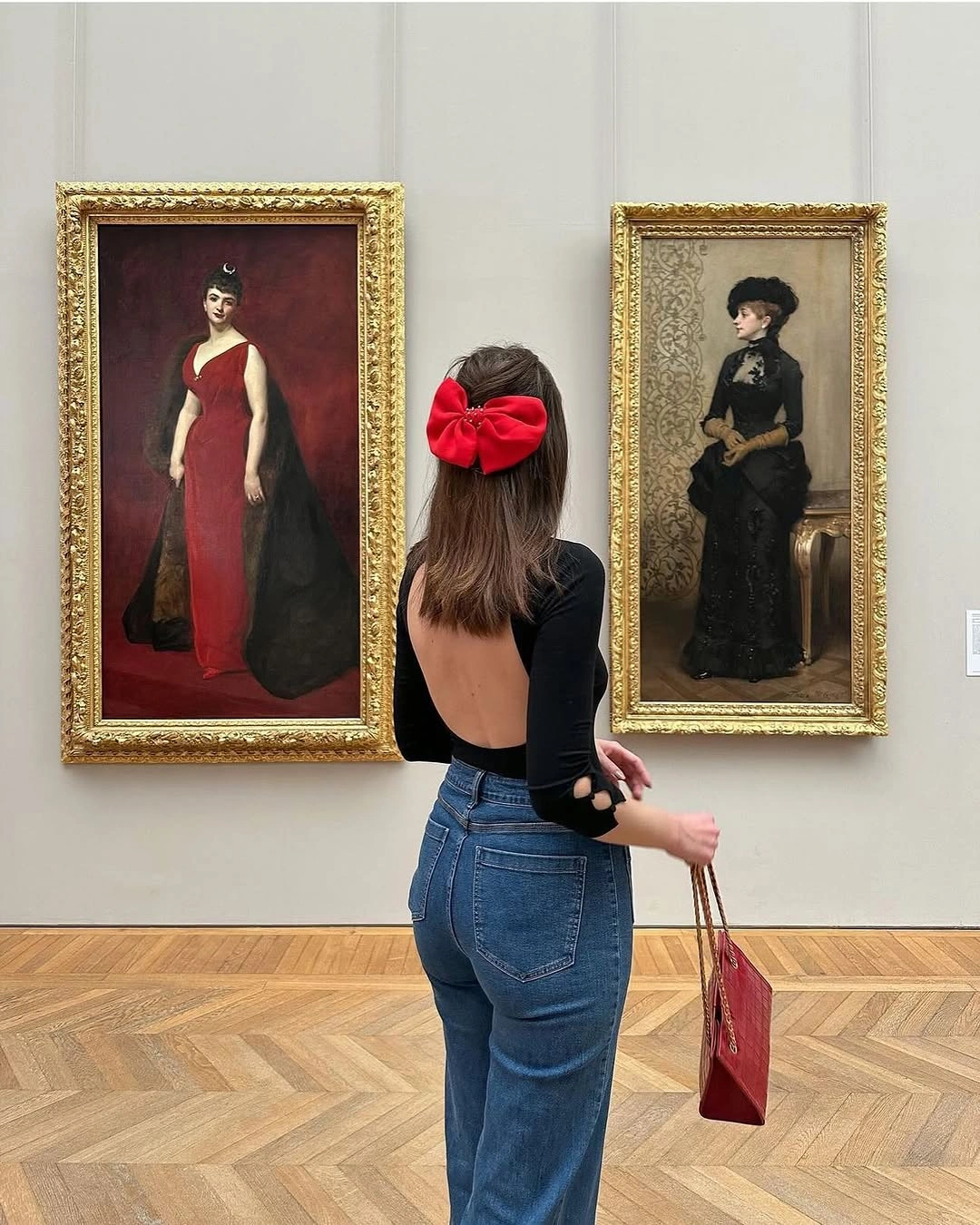
The upper portion is gathered, so the full crown and front structure are not visible enough to support detailed claims about layering or fringe. Even with that limitation, the exposed lengths show a consistent shoulder-level boundary that keeps the silhouette neat and concentrated. For medium haircut ideas, the contrast between a defined lower edge and a longer flowing perimeter is especially useful because it changes the cut's proportions immediately.
The lower edge carries more visual weight here than any individual strand or wave pattern. Because the hair is mostly straight, small variations in the ends do not obscure the strong horizontal finish around the shoulders. The gathered upper section should be treated only as a visibility constraint, not as evidence for a separate haircut feature. What remains exposed is enough to show that the cut is built around a compact medium length rather than an extended back silhouette. The perimeter is therefore the most useful comparison point. The clear hem gives the haircut a controlled endpoint, offering a direct contrast with long shapes whose visual energy continues far below the shoulders.
Short Curly Pixie With Tousled Top Volume
This short curly cut changes the scale completely, with the hair cropped close around the ears and nape while the top keeps noticeably more height and movement. Loose curls gather through the crown and front, creating a textured upper silhouette above the tighter side and back areas. That contrast makes the haircut read as genuinely short without flattening the shape into one uniform close crop.
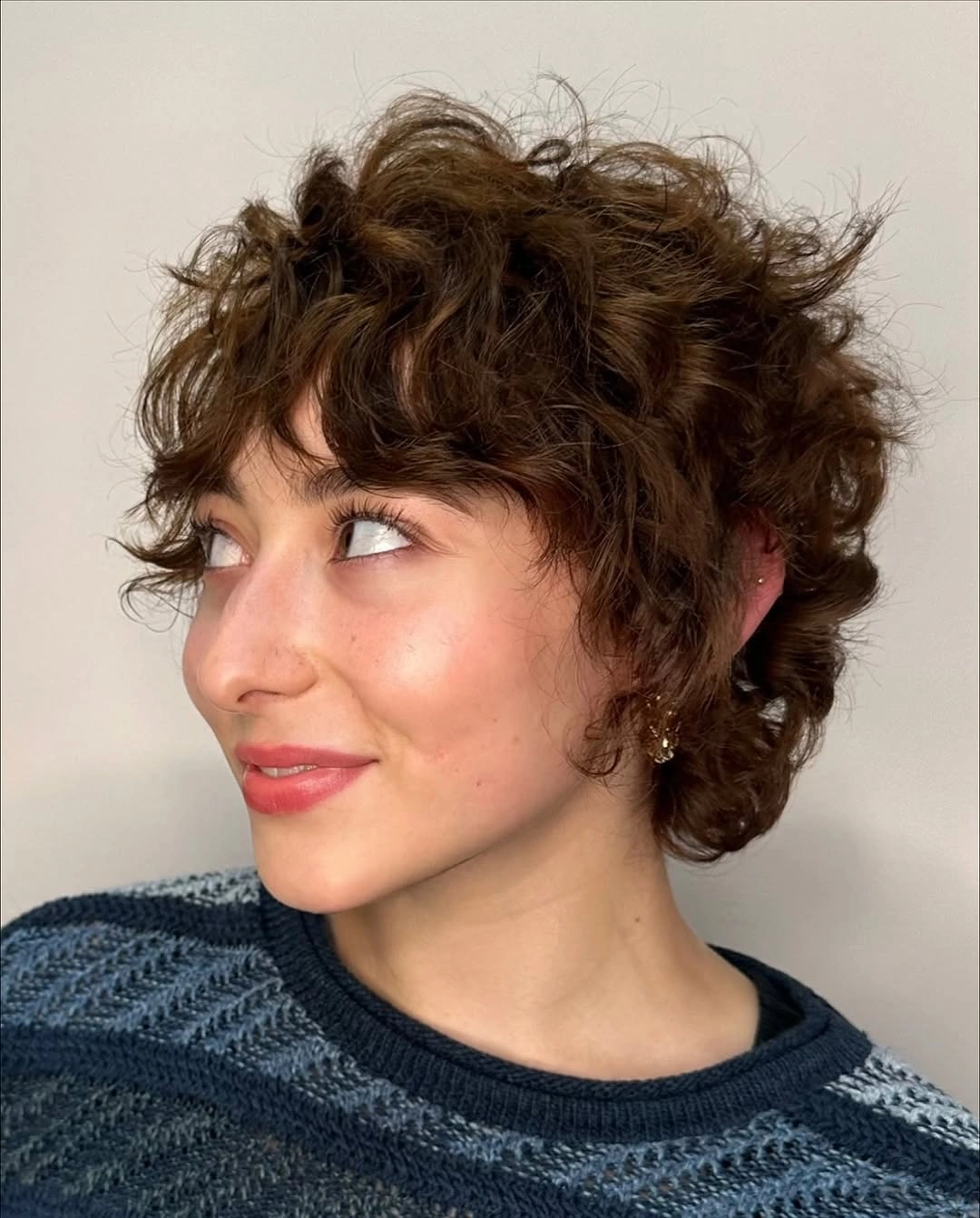
The front has a soft curly fringe rather than a straight, solid bang line, and its uneven movement connects naturally with the fuller top. Because the sides remain compact, the added height through the crown becomes more visible and gives the cut a clear top-to-bottom hierarchy. For short curly winter haircuts, this is a useful reference for how a small overall footprint can still carry substantial texture and volume.
The strongest structural contrast is between the cropped perimeter and the fuller curls above it. That difference keeps the ears and nape areas visually light while concentrating shape through the crown and forehead. The curls do not form one smooth rounded cap. Instead, they break into loose, irregular directions, which gives the top a tousled outline and prevents the fringe from reading as a rigid horizontal band. Compared with a shoulder-length blunt cut, this silhouette relies less on the lower hem and more on crown volume. Its identity comes from compact sides, a short overall length, and visible texture gathered through the upper portion.
Medium Layers With Full Bangs and Flipped Ends
This medium-length cut is shaped by two strong elements working together: a full rounded fringe across the forehead and layered lengths that curve outward near the shoulders. The sides do not fall into a single straight perimeter, because shorter pieces step into longer ones and create visible movement around the cheeks and neck. That combination gives the cut a softer, more feathered outline than a compact blunt bob.
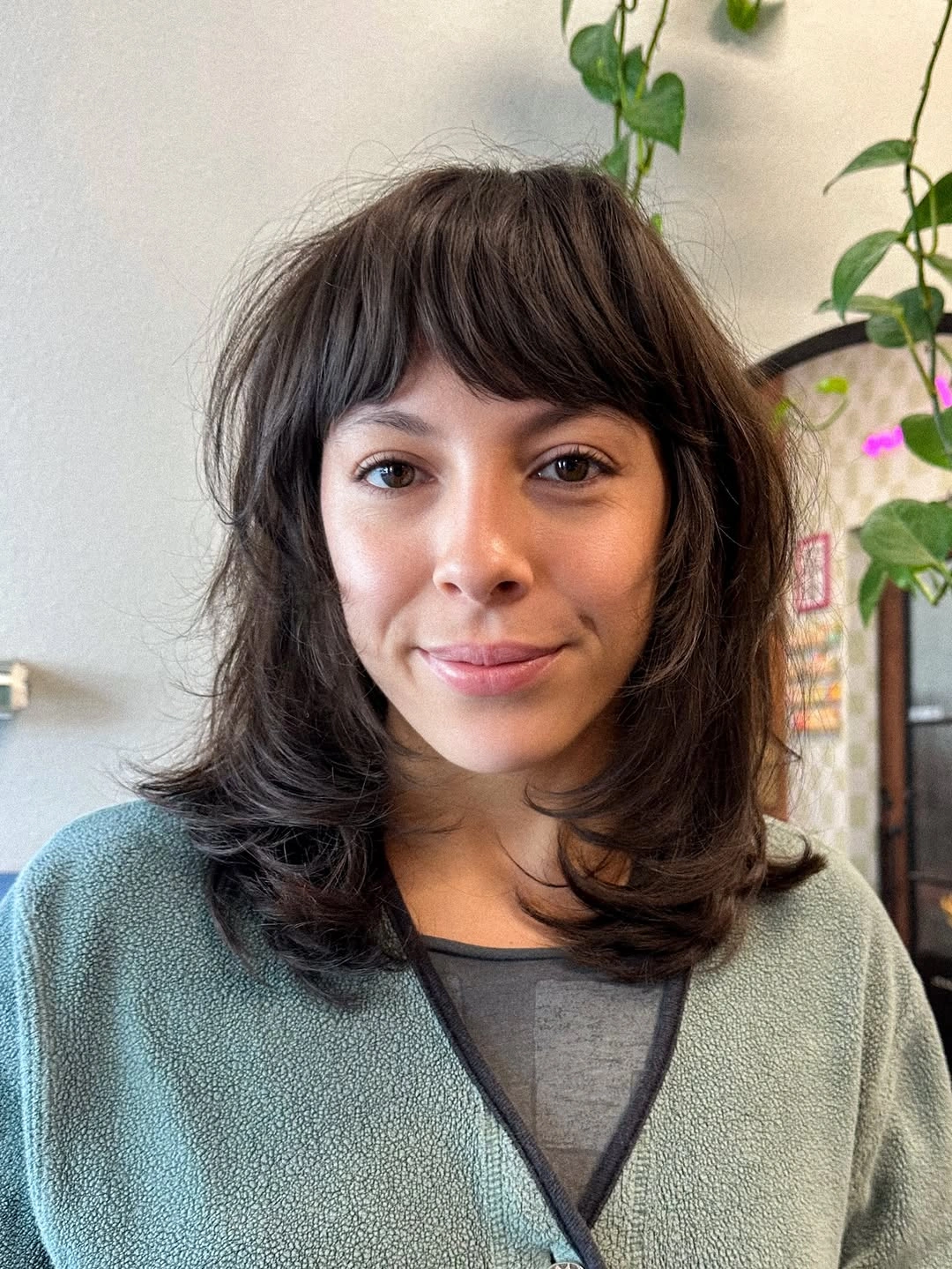
The lower sections are especially important because several ends sweep away from the neck instead of gathering into one horizontal line. Those outward curves give the medium silhouette extra width and movement near the shoulders, while the fuller bangs establish a more solid shape across the upper front. The result is a haircut whose structure comes from repeated changes in direction rather than from one precise perimeter.
The fringe has enough density to read as a distinct part of the haircut rather than as a few loose front pieces. Its rounded edge creates a clear upper boundary before the side layers begin to open outward. Around the lower half, the layered ends shift direction and keep the shoulder area from looking heavy or blocklike. Some pieces curve toward the neck while others turn away, which makes the perimeter visibly less uniform. That contrast between a fuller fringe and mobile lower layers gives this medium cut its character. Instead of relying on crown height or tight curl volume, it builds shape through the relationship between the front edge and the flipped ends.
Blunt Blonde Bob With a Crisp One-Length Edge
This pale blonde bob makes its lower edge the dominant structural feature. From the side, the straight hair descends into a compact line around the jaw-to-neck area, with very little visible breakup at the ends. The nearly one-length perimeter gives the haircut a precise geometric quality, especially after the softer layered movement of a medium cut with flipped sections.
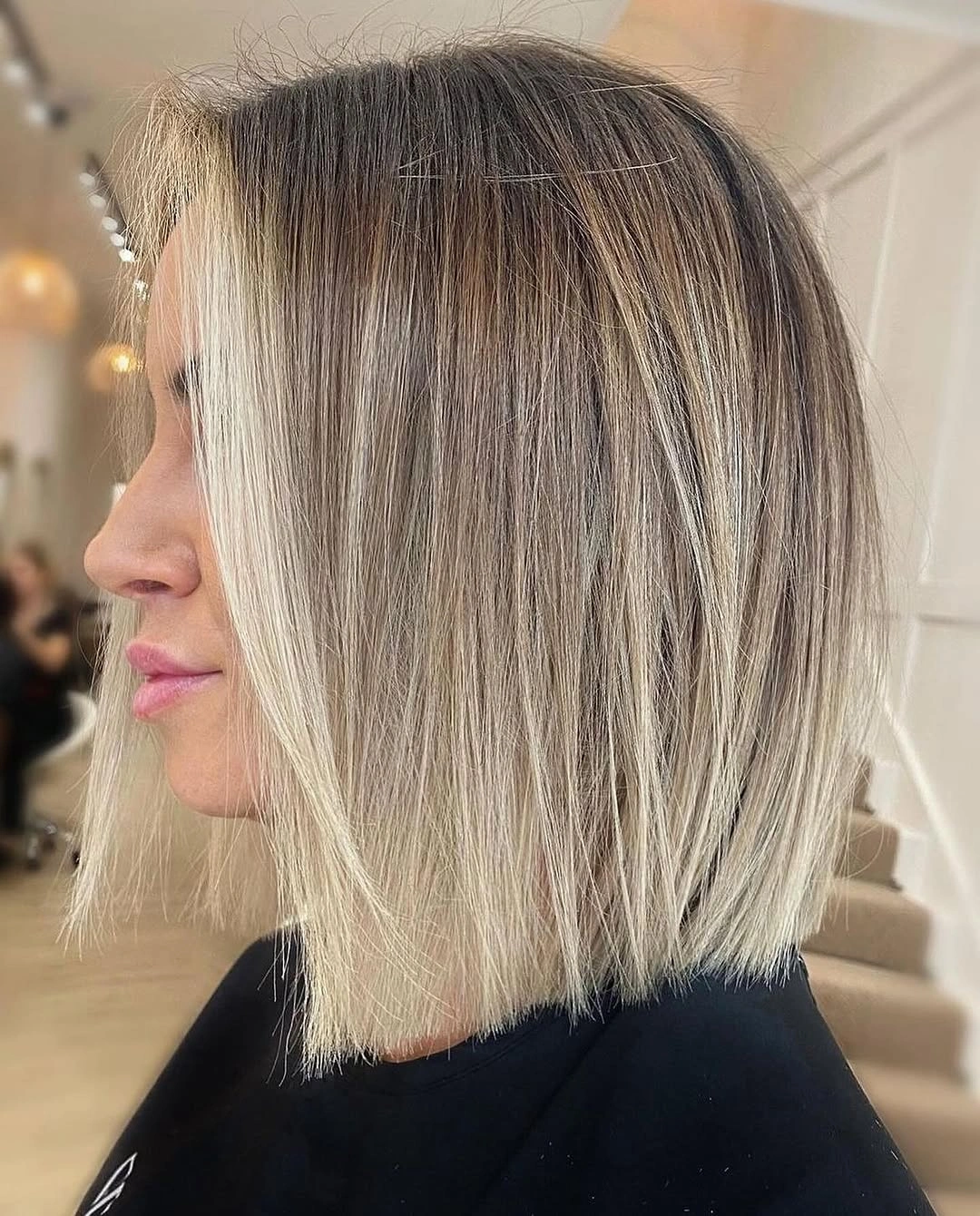
Because the texture lies mostly straight, the bottom line remains easy to follow from front toward the back rather than disappearing into curls or separated layers. The ends form a firm visual boundary, so the eye reads the haircut as a contained block of length instead of a sequence of overlapping pieces. That perimeter precision is the clearest idea to take from this short bob shape.
There is little visible feathering at the bottom to soften the outline. The straight strands meet the lower edge closely enough that the cut reads as deliberate and compact from this angle. The side view also emphasizes how much the shape depends on where the hair stops. Rather than creating drama through a tall crown or long face-framing sections, the haircut concentrates attention along its crisp lower boundary. This makes the bob a strong example of perimeter-led structure. Its visual identity comes from the clean edge and restrained length, not from obvious internal layering or textured movement.
Shaggy Medium Layers With Face-Framing Movement
This dark medium-length cut breaks away from clean geometry through a dense arrangement of visibly different lengths. A heavy, broken-up fringe falls across the forehead, while shorter sections around the upper face project outward before blending into longer hair around and below the shoulders. The silhouette feels deliberately irregular because the layers create several separate points of movement instead of one continuous edge.
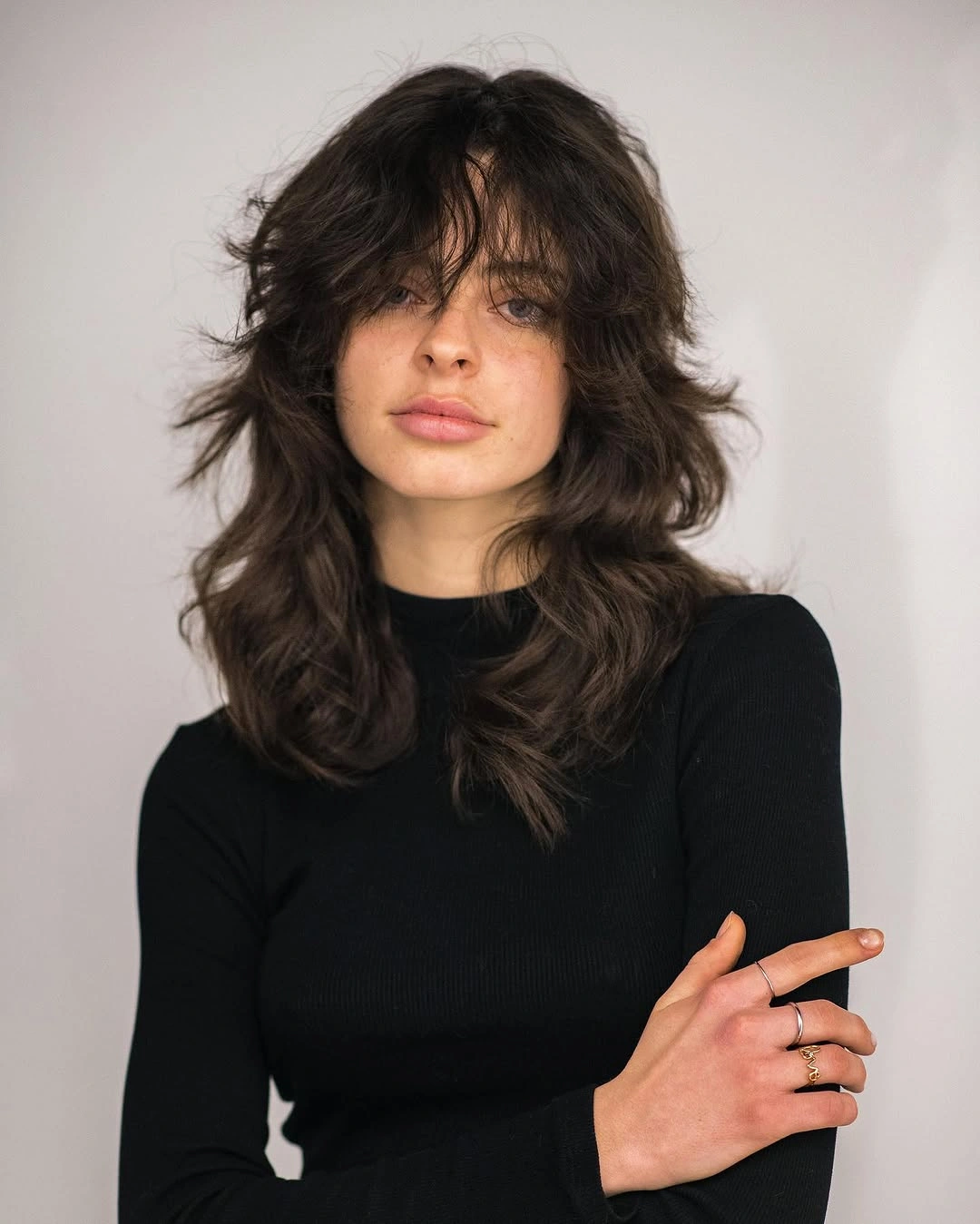
The sides are especially active, with shorter pieces lifting and turning outward around the cheek and jaw area while longer sections continue farther down. Similar movement appears through the ends, where the perimeter separates into tapered pieces rather than forming a blunt horizontal finish. That repeated change in length gives the haircut its shaggy character without requiring a precise salon label or technique.
The fringe is substantial, but it does not form a perfectly solid band. Individual sections separate and fall at slightly different lengths, connecting visually with the broken texture through the sides. Farther down, the haircut expands and contracts as layered pieces turn outward at different levels. This makes the shoulder area feel lighter and more mobile than it would under a dense one-length perimeter. The key comparison is the number of visible length changes within one medium silhouette. Instead of allowing a single edge to define the haircut, the layers distribute attention from the fringe through the face-framing pieces and into the lower ends.
Short Layered Cut With Airy Curtain Bangs
This short dark cut places its strongest detail at the front, where the fringe separates around the center instead of covering the forehead as one dense band. The opening creates two soft sections that sweep toward the sides and connect with the rounded hair around the head. That airy fringe placement gives the compact silhouette a more open upper front than a cut built around heavy, broken bangs.
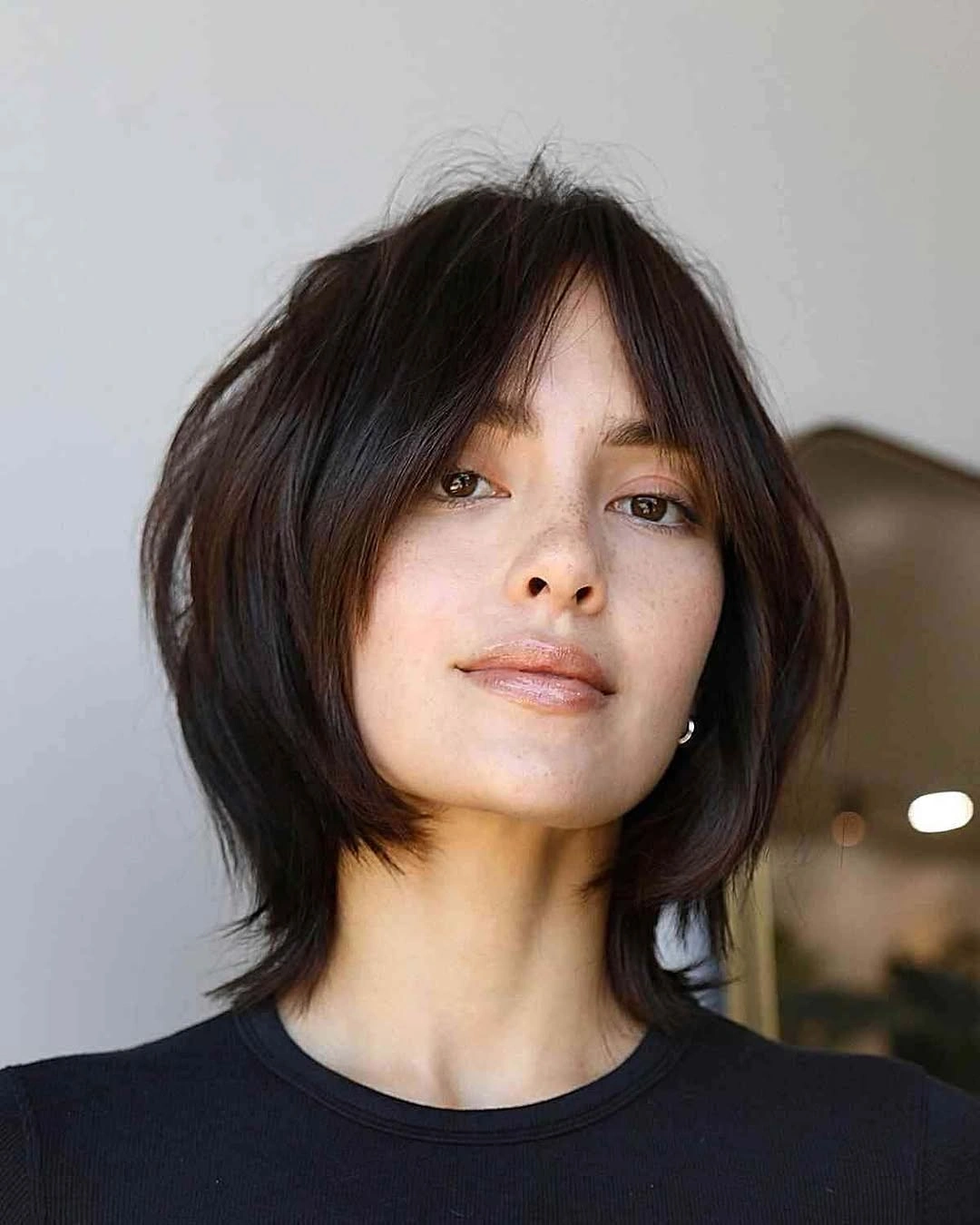
The rest of the haircut stays rounded through the sides, but the outline changes near the lower back where longer pieces extend toward the neck and turn outward. Those flipped nape sections keep the short shape from ending as a perfectly tucked-under bob. The contrast between the smooth center-opening fringe and the outward lower movement gives the haircut structure at both the front and back.
The curtain-like opening is narrow enough that the fringe still feels integrated with the surrounding hair. It does not separate into long face-framing lengths, but instead joins the rounded side shape close to the face. At the nape, a few longer sections interrupt that compact curve and create a small outward kick. This lower extension adds another direction without turning the whole haircut into a broad shaggy silhouette. The most distinctive feature remains the way the fringe opens at the center. It changes how the short cut frames the front while the rounded sides and slightly extended nape preserve a compact overall length.
Long Wavy Length With a Soft Back Outline
From the back, this long brown haircut reads primarily through its flowing length and loose wave pattern. Part of the crown is gathered, so the upper structure is not fully visible, but the exposed hair continues well down the back in broad bends rather than in a narrow straight line. The waves create a softly irregular outer edge, giving the long silhouette movement without requiring assumptions about hidden layers.
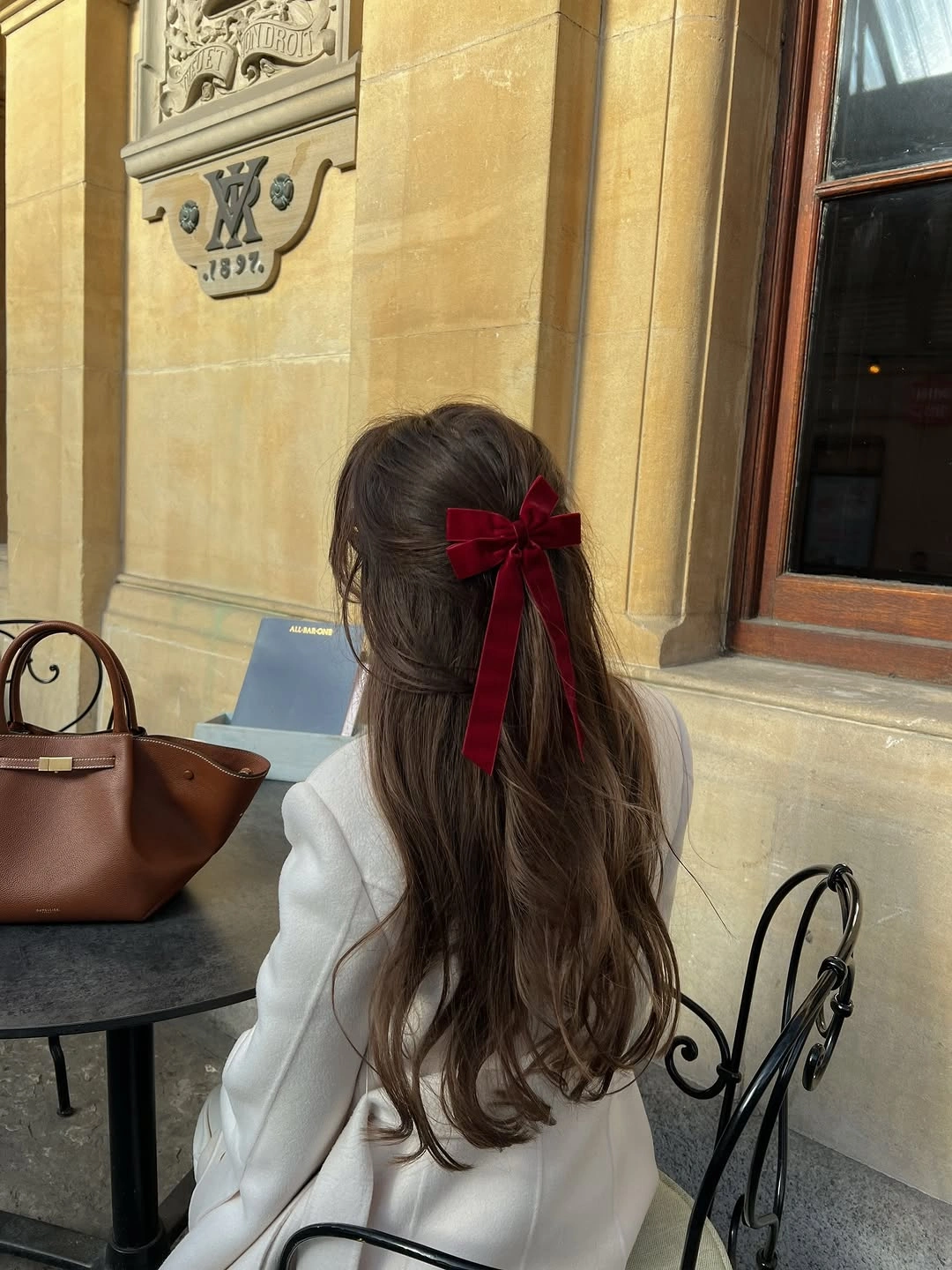
The lower lengths separate into several visible curves, with some sections bending inward and others drifting outward before reaching the ends. That variation keeps the back outline from looking sharply blunt or perfectly symmetrical, even though the exact internal structure of the cut cannot be confirmed from the gathered styling. As a long haircut idea, its clearest visual point is the interaction between extended length and relaxed wave movement.
The gathered crown limits how much can be said about shorter upper sections. It is therefore more accurate to focus on the hair that remains visible below that point and on the shape it creates down the back. Those visible lengths form broad waves rather than tight curls, so the silhouette stays elongated while gaining width at several points. The ends also finish at slightly different visible levels, contributing to the soft outline. This is a length-led shape, but not in the same way as very straight hair falling in one narrow column. Here the waves interrupt the vertical line repeatedly, producing a flowing back silhouette whose movement remains visible all the way into the lower lengths.
Choppy Short Crown With a Longer Nape
This dark cut builds its silhouette from an unusually strong contrast between short upper layers and much longer sections below. The crown and fringe area are cropped into choppy, irregular pieces that sit close to the head, while narrow lengths continue past the shoulders at the sides and back. Instead of forming one continuous long outline, the haircut visibly changes scale between the compact top and the extended lower pieces.
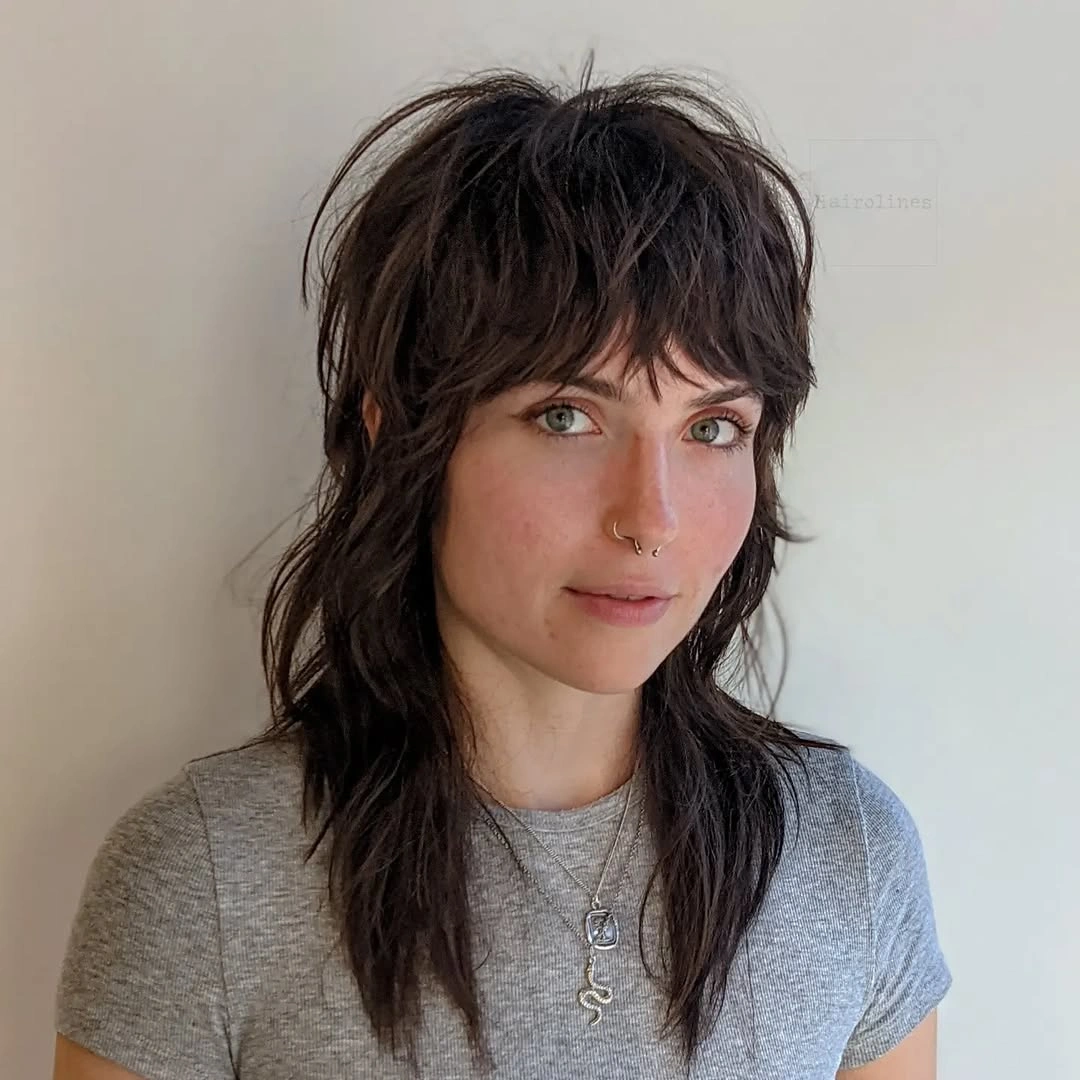
The short crown creates width and texture around the upper head, then gives way abruptly to thinner strands that travel downward along the neck and shoulders. That separation is more important than the exact shape of the ends, because the eye immediately notices where the dense short layering stops and the longer lengths begin. The effect is intentionally broken rather than smoothly graduated from crown to hem.
The fringe participates in the same choppy upper structure, with short pieces falling unevenly across the forehead. Those front sections reinforce the compact scale of the crown before the silhouette stretches downward through the longer back. Below that shorter zone, the extended pieces are comparatively narrow and separated. They do not create the broad continuous mass of a conventional long cut, so the contrast between upper and lower lengths remains visible from several angles. That internal length difference is the defining idea here. The haircut gains its character from placing a short, heavily layered top directly against much longer sections rather than relying on waves or a continuous lower perimeter.
Medium-Long Layers With Sweeping Curtain Pieces
This medium-to-long brown cut uses smoother transitions than the sharply divided shape before it. A center opening leads into broad front pieces that sweep away from the face, while additional curved layers continue through the sides and into the longer body of the hair. The result is a connected layered silhouette in which shorter sections appear to flow gradually into progressively longer ones.
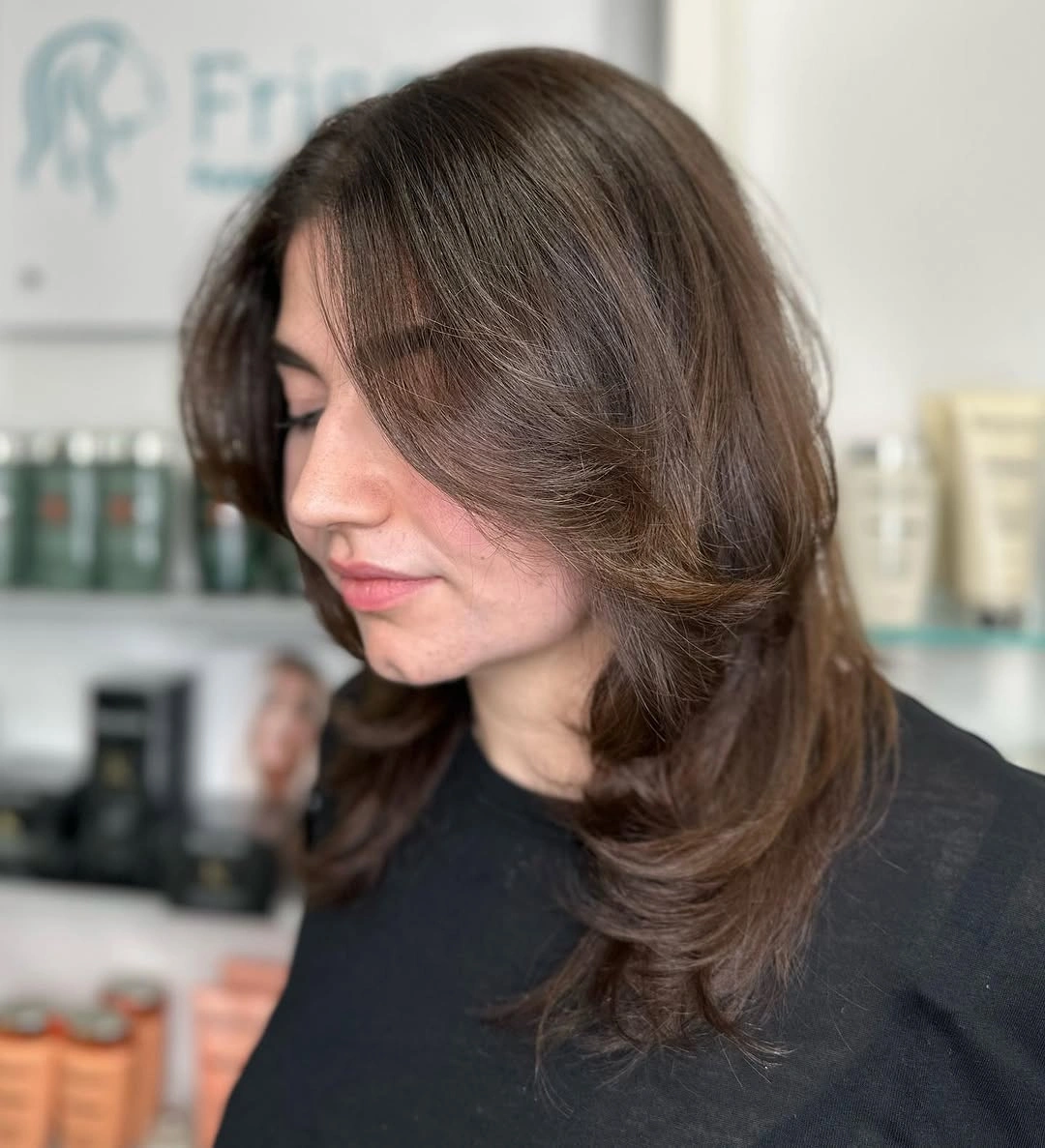
The lower lengths do not fall completely straight, because several visible layers bend inward and outward as they approach the shoulders and chest. Those curved ends give the haircut dimension without breaking the outline into sharply separated pieces. What stands out most is the continuity between the sweeping curtain pieces at the front and the rounded movement farther down, creating one layered rhythm from upper front to lower length.
The center opening gives the front layers room to curve outward on both sides. Rather than forming a dense fringe across the forehead, these longer pieces act as the first visible step in the haircut's progression of lengths. Farther down, the layers continue that curved movement at a larger scale. Some ends turn toward the body while others arc away, so the medium-long silhouette stays fluid instead of finishing as a single heavy line. The strongest idea is therefore connection rather than contrast. The shorter front pieces, middle layers, and longer base remain visibly related, making the cut read as a smooth layered architecture rather than a collection of disconnected lengths.
Micro Bangs With a Longer Mullet-Like Back
This profile view places a very short straight fringe against substantially longer hair running down the back of the neck. The bangs create a compact horizontal edge high across the forehead, while the side area around the ear is much shorter and more open than the softly wavy length behind it. That sharp change in proportion makes front-to-back contrast the most distinctive feature of the haircut.
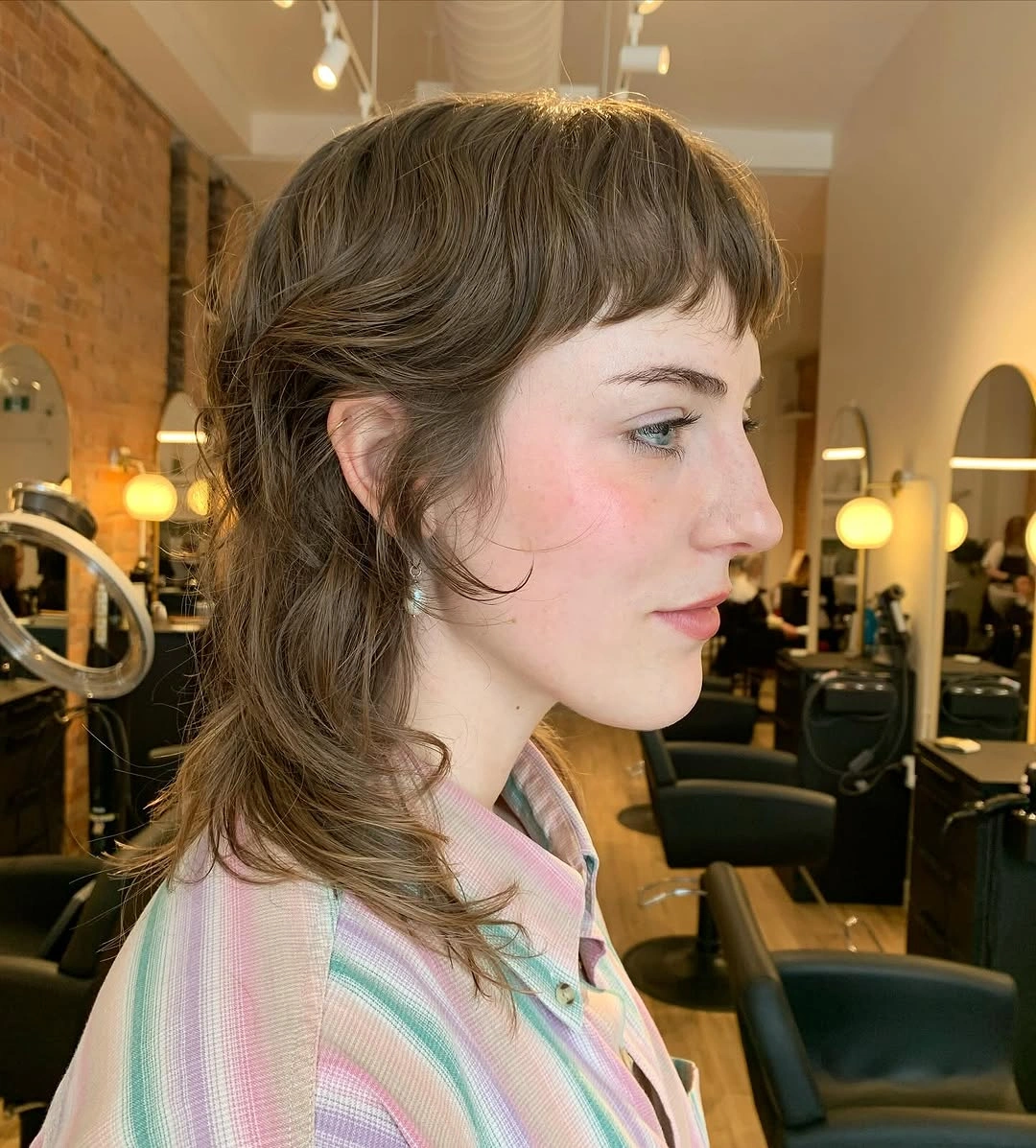
The longer back does not hang as a rigid straight panel, because gentle bends and waves introduce softer movement through the neck-length sections. Against that flowing rear outline, the short fringe and closely shaped side area feel even more deliberate. The visible arrangement can reasonably be described as mullet-like because of the pronounced short-front and long-back relationship, without treating that label as a certain salon classification.
The bangs are especially important because their short, direct line establishes the compact scale at the front. They do not blend gradually into long curtain pieces, so the change toward the back becomes easy to see. Around the ear, the silhouette narrows before the longer hair resumes behind it. That exposed break between short side shaping and extended back length keeps the haircut from reading as a uniformly medium-length style. The softer waves at the back prevent the contrast from becoming entirely geometric. A rigid short fringe and compact side structure meet a longer, more fluid rear section, creating tension between two very different visible lengths.
Geometric Short Bob With a Rounded Blunt Line
This short warm brown bob takes the opposite approach to a haircut built from broken length contrasts. The visible hair forms a highly controlled rounded shape, with a straight blunt fringe at the front and a strong lower edge continuing around the sides and back. Instead of shorter pieces separating from longer ones, the perimeter reads as one continuous geometric boundary around the head.
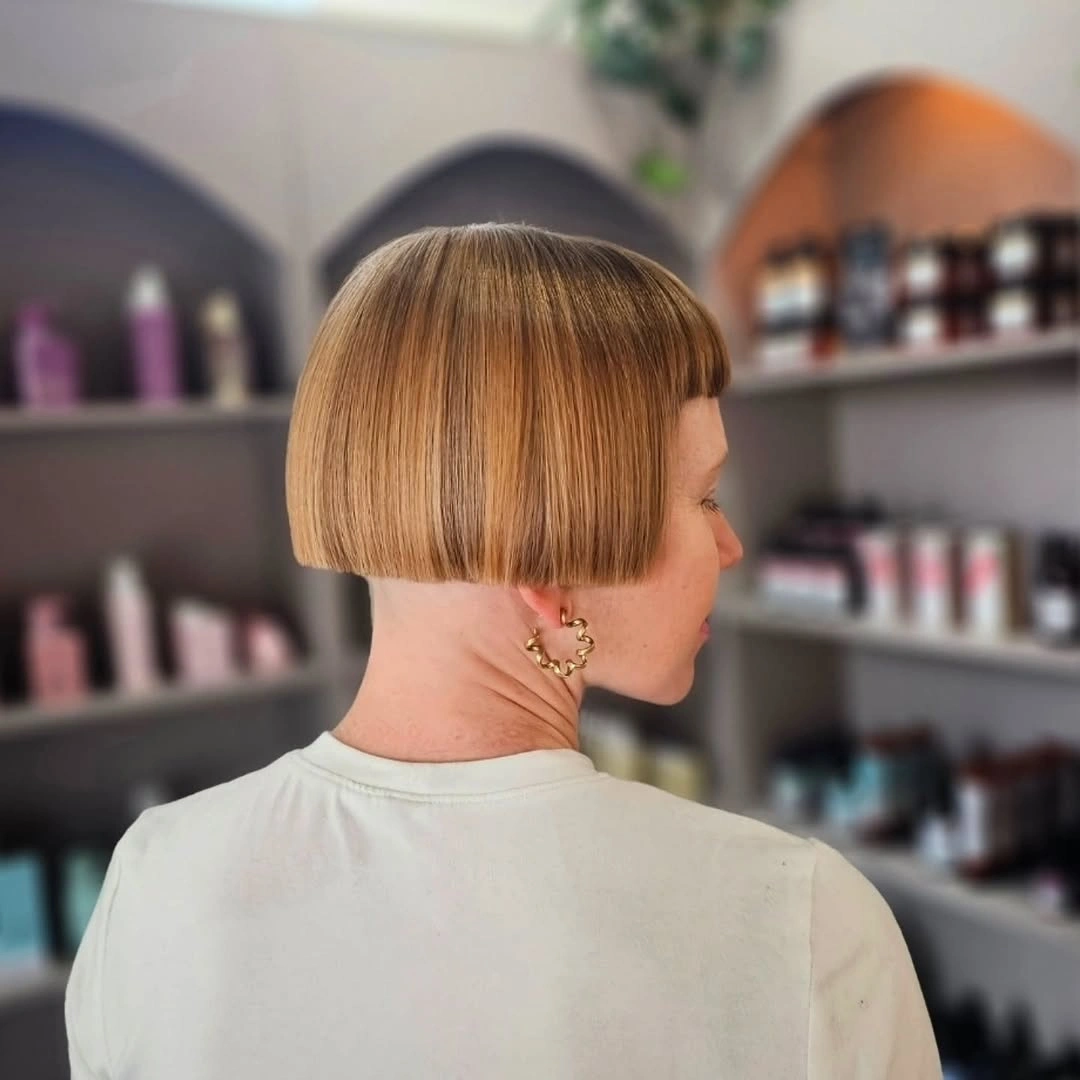
The straight texture makes that outline unusually clear because very little visible wave or feathering interrupts the lower line. From the angled back view, the cut appears to wrap around the head in a smooth arc while maintaining a firm horizontal quality near the bottom. The combination of rounded overall form and blunt termination gives this short bob its distinctive precision.
The fringe belongs to the same geometric language as the lower perimeter. Its direct edge at the front establishes a clean boundary that is echoed by the controlled line running around the rest of the cut. At the back, the hair does not taper gradually into a soft nape or extend into longer pieces. The edge remains compact and clearly defined, allowing the rounded silhouette above it to stay visually intact. This is a short haircut driven by continuity rather than fragmentation. The strength comes from how consistently the fringe, side line, and back perimeter participate in one deliberate rounded shape.
Long Dark Layers With Cascading Face Framing
This very long dark cut keeps substantial overall length while building several clearly visible shorter levels through the front and sides. A center opening leads into sweeping pieces that curve away from the face, followed by progressively longer layers that continue downward before merging with the deepest lengths. That repeated graduation creates a cascading effect without sacrificing the elongated scale of the haircut.
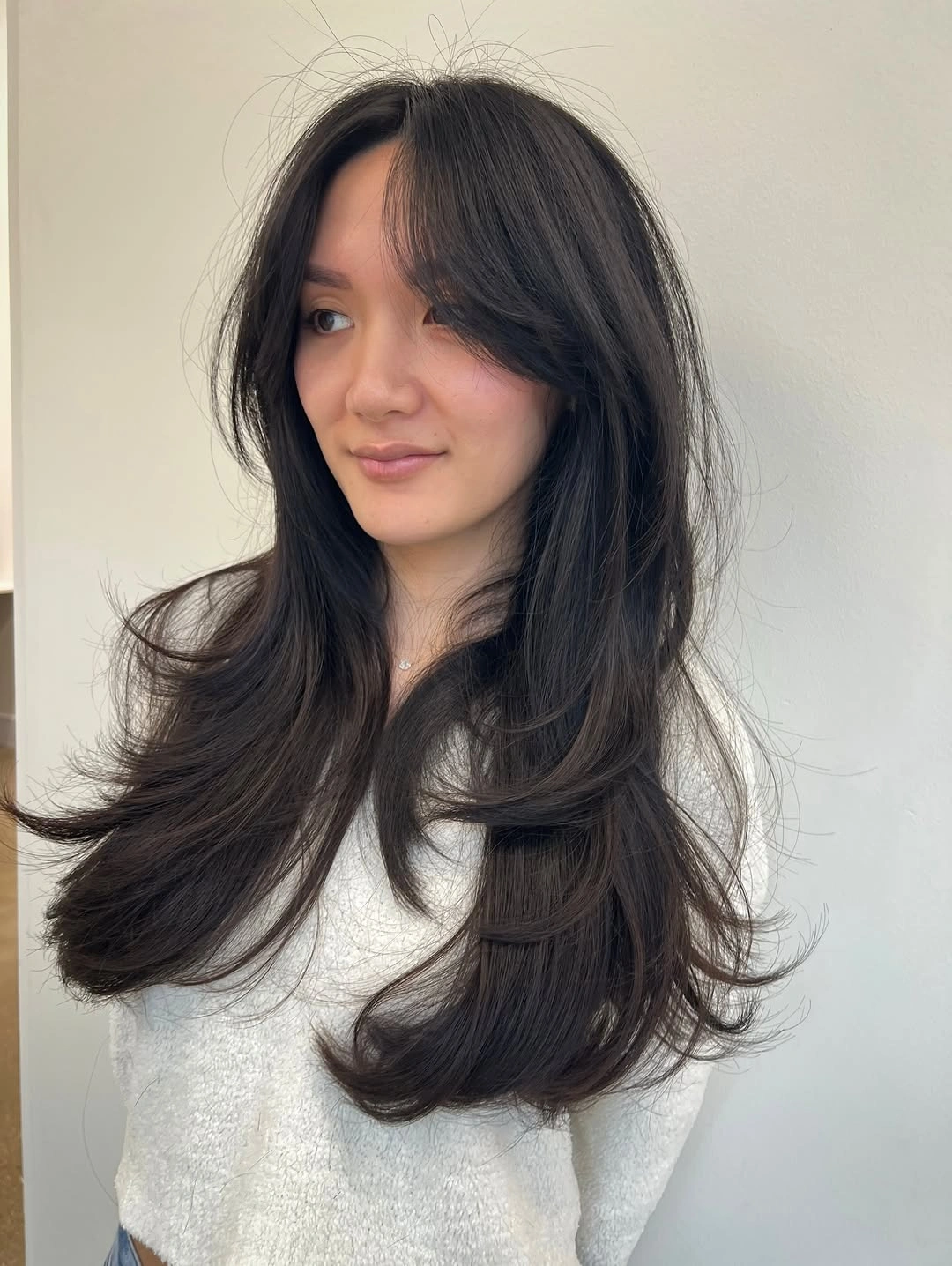
The layers are especially readable because their ends form separate curved arcs at different heights rather than disappearing into one uniform long sheet. Upper sections bend outward near the face, middle sections continue the movement around the shoulders, and the longest hair extends well below them. The cut therefore distributes visual interest through several vertical levels while allowing the lowest lengths to remain a major part of the silhouette.
The front pieces begin the sequence with broad curves that open away from the center. They are long enough to connect naturally with the rest of the hair, but short enough to establish a clear first tier within the layered shape. Below them, additional lengths form larger arcs and overlap the longer body of the cut. This repetition makes the layering visible without turning the outline into the sharper, more fragmented structure of a shag. The longest sections preserve the cut's unmistakably long proportion. What makes this version distinct is the number of graduated curves above that base, creating a cascading front-to-lower-length transition instead of leaving all of the visual weight at the ends.
Piecey Medium Shag With Choppy Fringe Layers
This medium cut is built from visibly separated lengths rather than smooth, cascading arcs. Short irregular layers cluster around the crown and cheeks, while longer, narrower pieces continue toward the shoulders, so the outline changes repeatedly from top to bottom. The broken fringe reinforces that fragmented structure instead of forming one continuous front edge.
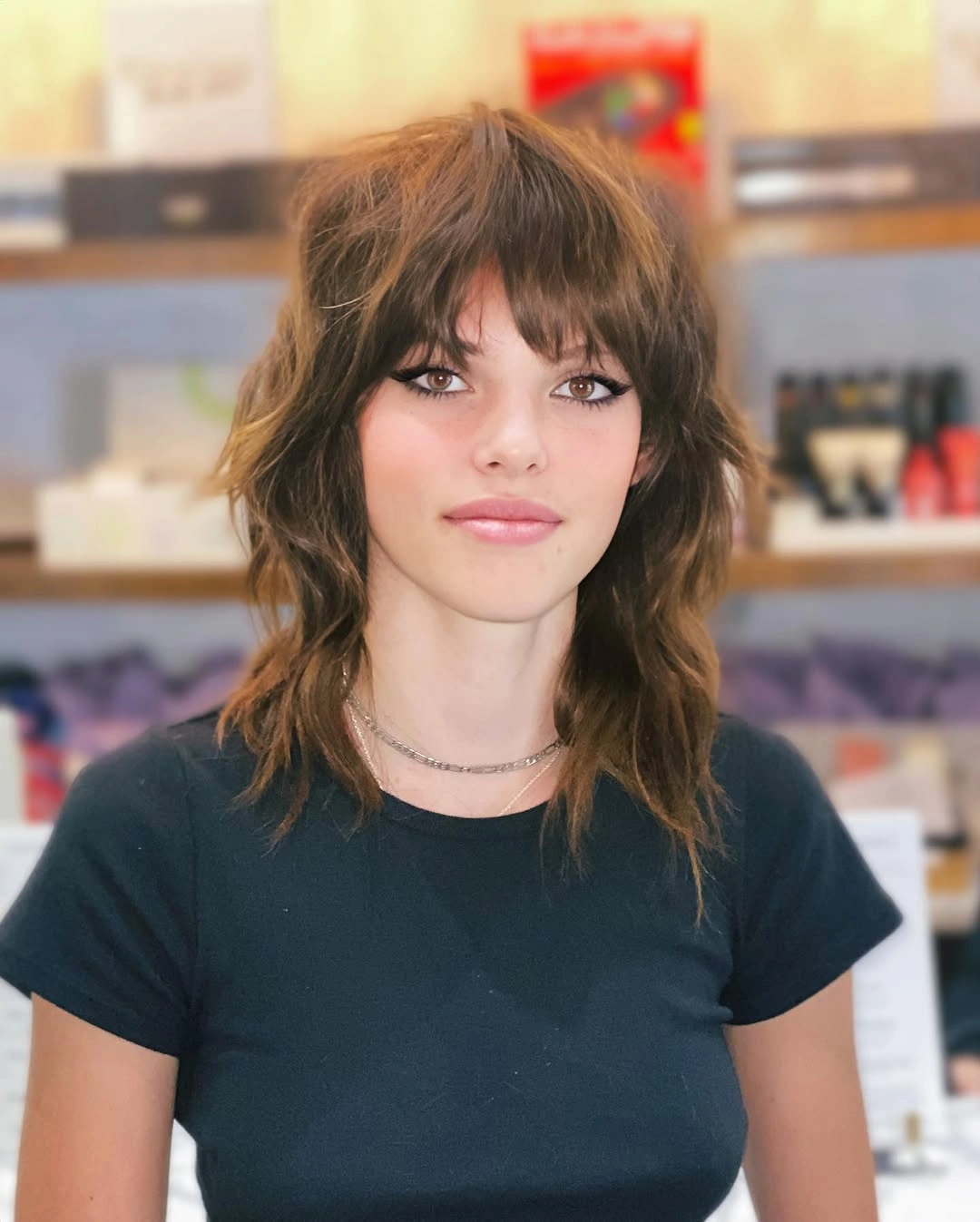
The crown carries a compact, tousled shape, then the sides open into distinct pieces that kick outward or fall in uneven directions near the cheeks and neck. Because several lengths remain clearly independent, the shoulder area never resolves into a single blunt perimeter. The visual interest comes from separation between layers rather than from a polished curve connecting each level.
The fringe is choppy enough to show small gaps and uneven endpoints across the forehead. Those breaks echo the short sections around the crown, making the upper half feel deliberately piecey rather than smoothly rounded. Moving downward, the layers become longer but stay visibly separated. Some sections turn away from the face while others fall closer to the neck, creating a restless outline before the longest pieces reach the shoulders. This medium shape is therefore defined by fragmentation across several levels. The short crown, broken fringe, and longer lower pieces all remain individually readable instead of blending into the kind of continuous cascade seen in a smoother layered cut.
Shoulder-Skimming Layers With Long Curtain Fringe
This shoulder-skimming cut uses a quieter layered structure, with the longest visible sections gathering around the shoulders rather than extending far below them. The fringe opens near the center and sweeps outward in longer pieces, while shorter cheek-framing sections connect that front shape to the lower length. The result is compact and layered without looking heavily broken apart.
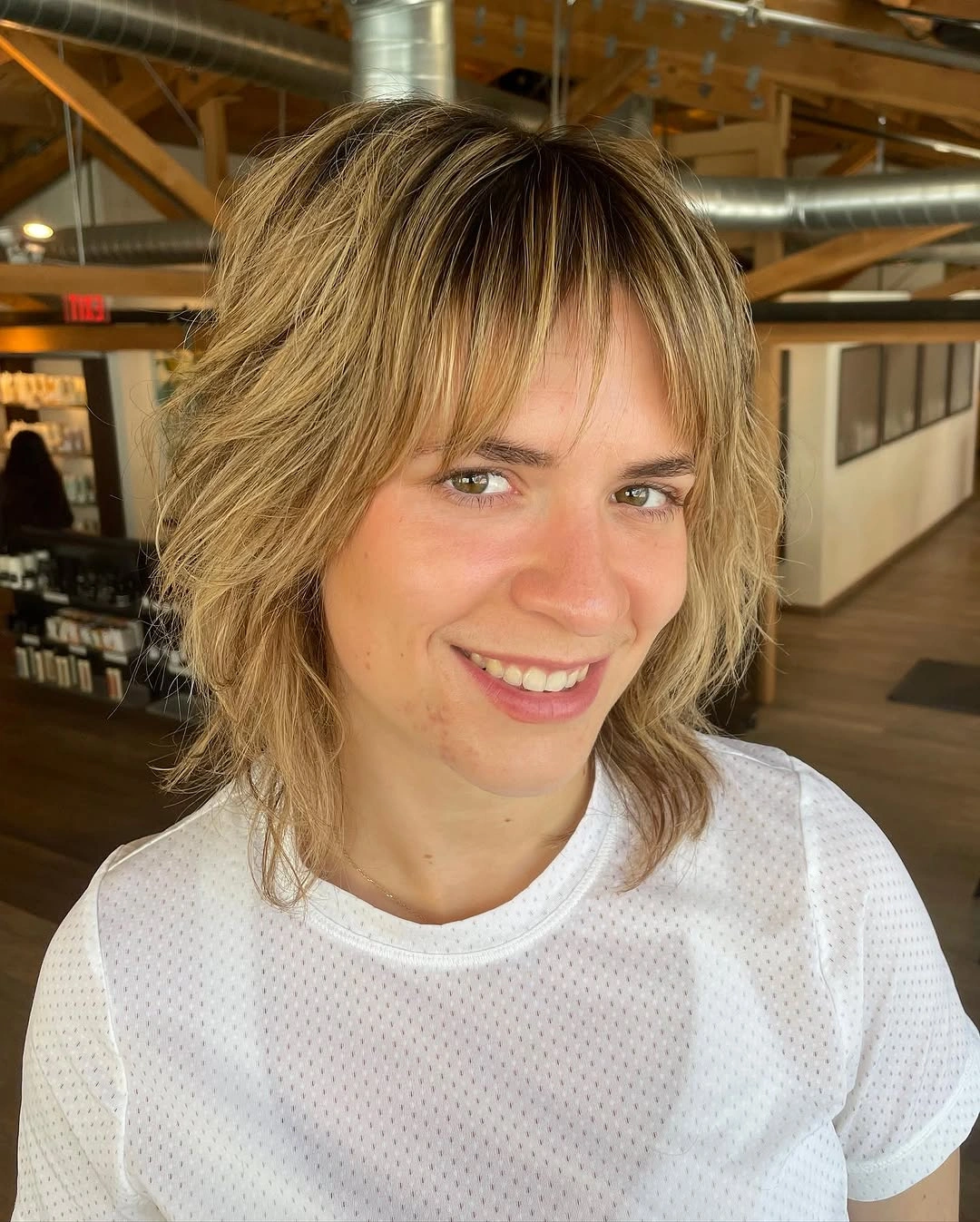
The front pieces are long enough to behave as part of the haircut rather than as a separate dense bang line. They curve away from the center, pass along the cheeks, and gradually meet the shoulder-level sections, giving the silhouette an easy front-to-bottom connection. That relationship is the main visual idea, because the cut keeps its movement concentrated within a relatively contained medium length.
The center opening keeps the fringe light and divided, allowing each side to sweep into the surrounding hair. Its length creates a soft transition rather than a sharp border across the forehead. Around the cheeks, shorter pieces add another step before the hair reaches the shoulders. These sections are visible without becoming sharply disconnected, so the layering reads as measured rather than heavily choppy. The shoulder-skimming endpoint keeps the entire structure compact. Instead of using extreme length or strong perimeter geometry, the cut builds its character through the way the long curtain fringe and cheek-level layers merge into the medium base.
Long Wavy Hair With Soft Full Bangs
This very long cut pairs an elongated wavy silhouette with a full fringe that covers most of the forehead. The waves begin below the upper section and grow into broad curves through the lengths, while the bangs establish a clear horizontal shape at the front. That contrast makes the fringe feel substantial even against hair that extends far beyond the shoulders.
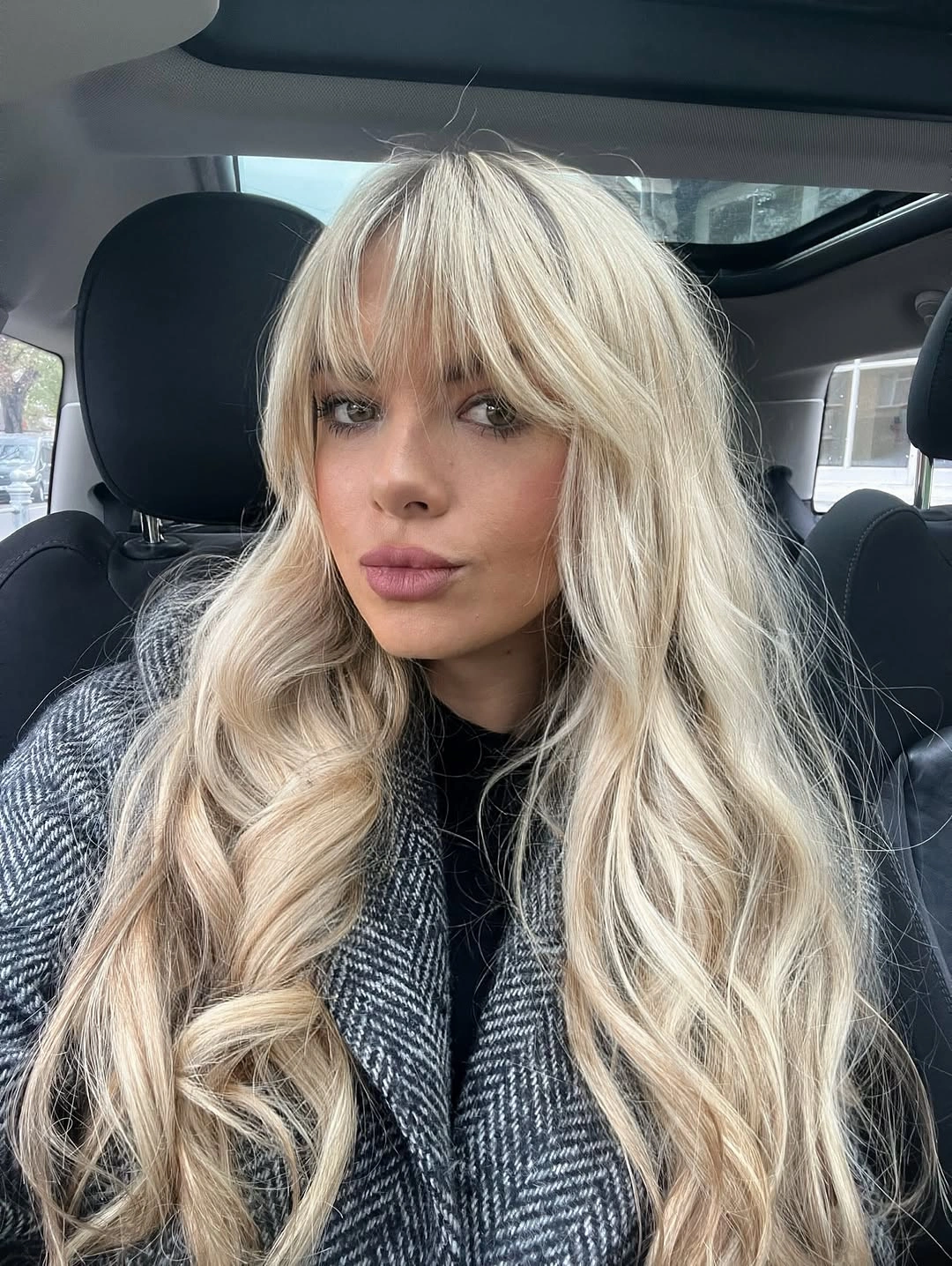
The bangs are fuller than a center-opening curtain fringe, but their lower edge is softly separated rather than perfectly rigid. Behind them, the long hair expands through large loose waves, creating width at several points without losing the overall vertical scale. The haircut therefore balances concentrated front coverage with a much longer, flowing body instead of letting one element visually absorb the other.
The fringe changes the front proportion immediately because it occupies the forehead as a continuous feature. Small separations within it keep the edge soft, but the overall effect is still much fuller than an open, center-divided shape. The long lengths move differently from the bangs. Broad waves create repeated outward and inward curves down the sides, so the silhouette becomes progressively more expansive below the compact front edge. Length remains a major part of the haircut, yet the fringe gives the upper front equal visual importance. The combination works through contrast between a short horizontal element and an extended wavy outline rather than through obvious short layers around the face.
Long Straight Layers With Soft Wispy Bangs
This long cut has a much straighter overall fall, with the hair lying close through the upper and middle lengths before curving softly near the ends. A light fringe crosses the forehead in fine separated pieces, creating coverage without the dense weight of a fuller bang shape. The restrained texture makes the contrast between the wispy front edge and the extended lower line especially clear.
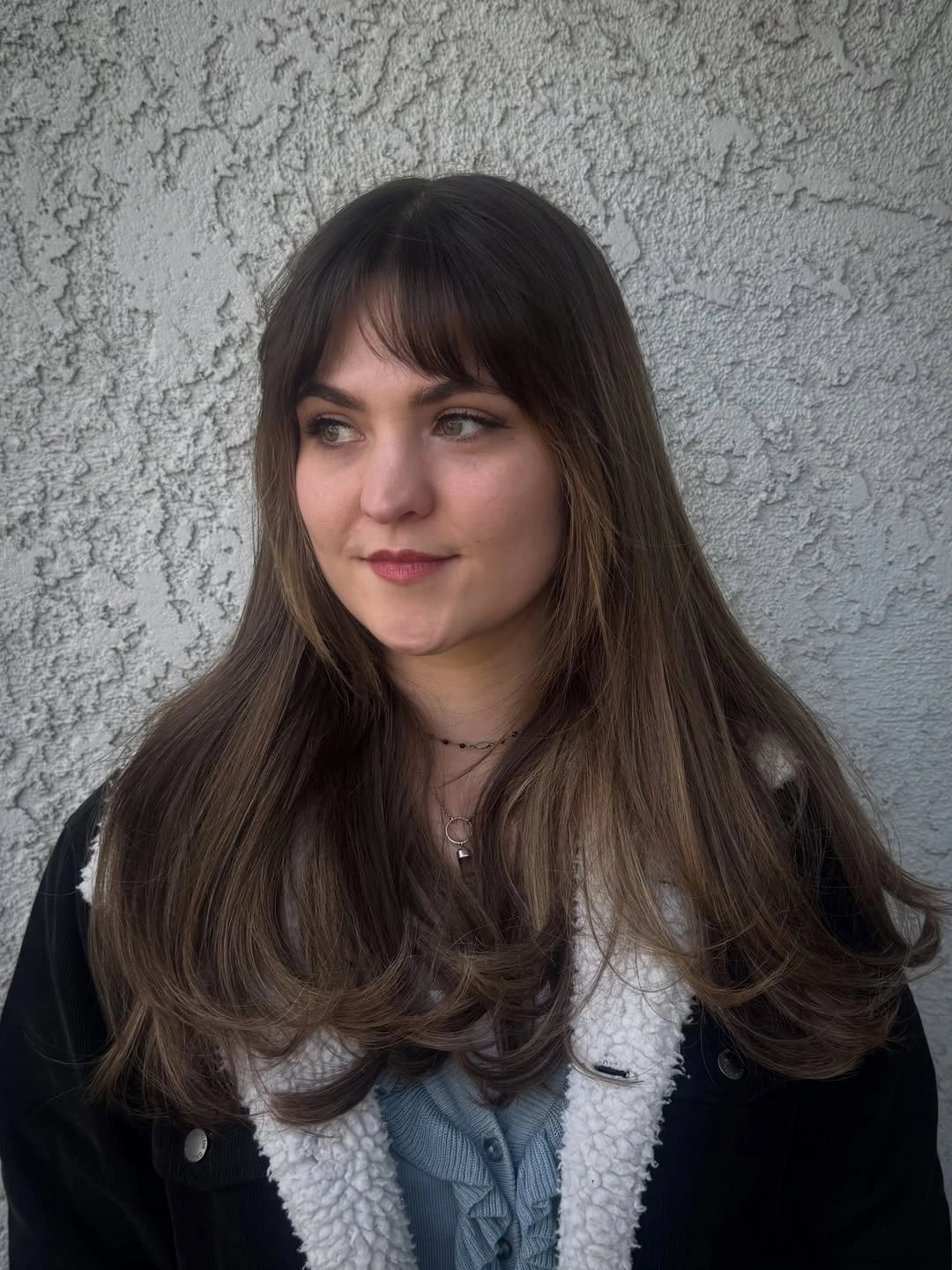
The lower sections show gentle bends and softly curved endpoints rather than large repeated waves. That keeps the silhouette narrow and smooth through most of its length, while subtle variation near the bottom prevents the perimeter from looking completely rigid. The lighter fringe follows the same understated logic, adding a fine front detail without competing with the long, mostly straight body of the cut.
The bangs are thin enough for small spaces to remain visible between individual sections. Their straight-across placement gives the front a defined boundary, but the reduced density keeps that boundary visually light. Below the fringe, the hair falls with relatively little expansion through the sides. Movement becomes more noticeable toward the lower lengths, where the ends curve gently instead of continuing as perfectly straight vertical lines. This makes the haircut distinct from a long shape dominated by broad waves and fuller bangs. Its emphasis is quieter, built from a straighter elongated outline, softly curved ends, and a wispy fringe that adds structure without adding much visual mass.
Wavy Shoulder-Length Cut With Open Face Framing
This shoulder-length cut opens at the center and uses shorter front sections to guide the eye into the loose waves at the sides. Those face-framing pieces curve away from the forehead and cheeks before joining hair that ends around the shoulders, creating a compact silhouette with an open front. The cut feels shaped through movement rather than through a heavy bang line or a sharply defined blunt hem.
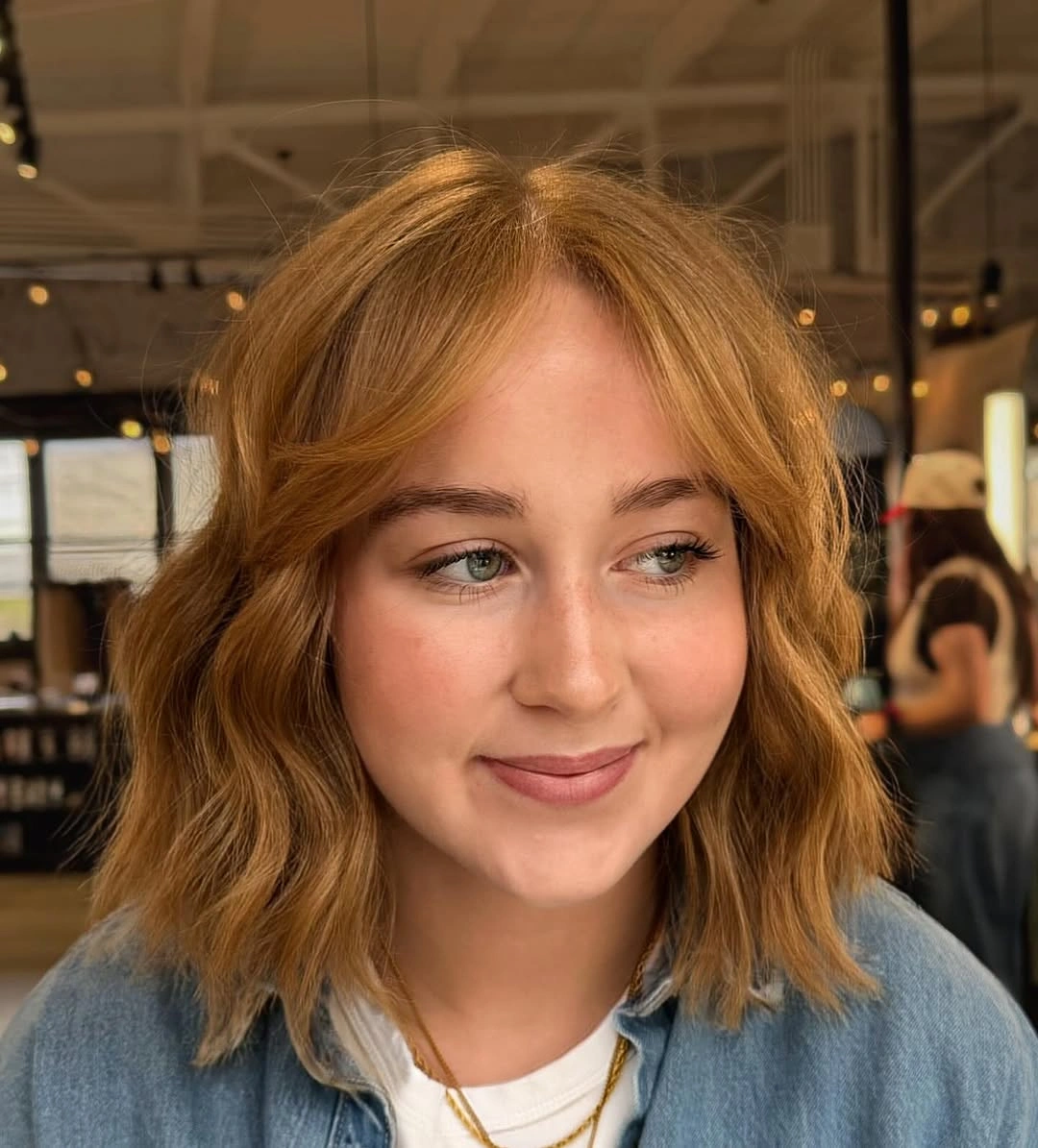
The waves are broad enough to create alternating bends through the sides, but the overall length remains contained close to the shoulders. Shorter curved sections at the front introduce the first change in length, then blend into the fuller side waves without producing an extreme stepped effect. That connection gives this medium haircut a clear proportion: open through the front, softly expanded at the sides, and concise at the bottom.
The center opening keeps the upper front free of a solid fringe. Instead, the nearest pieces sweep outward and begin the haircut's movement at cheek level, where their curves become part of the surrounding wave pattern. At the sides, the waves add width without stretching the silhouette far downward. The ends sit around the shoulders with a softly irregular finish, so the lower edge reads as mobile rather than sharply geometric. The strongest feature is the relationship between the open front and the contained medium length. Face-framing curves lead naturally into the side waves, giving the haircut structure without depending on dramatic layering, full bangs, or an extreme difference between crown and nape.
Close-Cropped Pixie With a Textured Short Fringe
This very short cut is defined by a close perimeter around the sides and nape, with clearly more length left through the top. The hair sits tight above and behind the ear, then expands into a fuller textured surface across the crown, creating a compact silhouette with a noticeable shift in scale. That contrast keeps the haircut visually structured even though the overall length stays minimal.
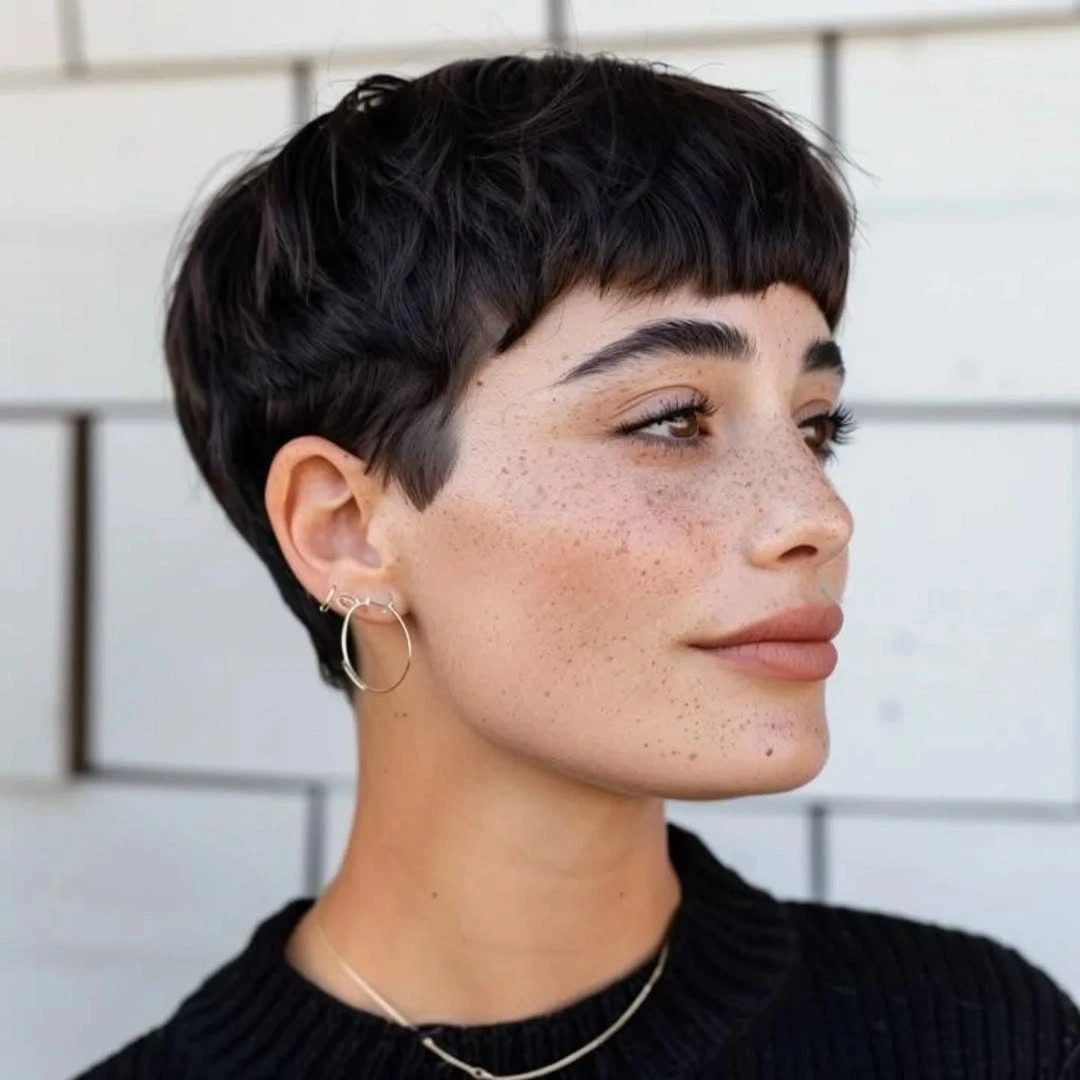
The fringe is short and compact, forming a slightly irregular edge across the forehead rather than extending into longer curtain pieces. Above it, the top breaks into small directional sections that give the surface a piecey, textured finish, while the closely cropped side keeps that movement concentrated higher on the head. The result is a short shape built from controlled contrast rather than from a blunt one-length perimeter.
Along the side, the close crop follows the head and creates a clear arc around the ear. The nape stays similarly compact, so there is no extended back section competing with the longer top. Across the crown, the longer hair does not lie as one smooth cap. Small bends and separated ends break the surface, giving the top visible movement while preserving a close overall outline. At the front, the fringe finishes in short pieces below the longer crown. That change in length adds another level to the silhouette, connecting the cropped sides with the textured top without introducing a full or sweeping bang shape.