September does not require an instant switch from bright polish to the darkest bottle on the shelf. The more interesting transition happens through temperature, depth, and contrast, which can make a familiar red, green, or orange feel newly aligned with early fall. In these September nail colors 2026, lively shades remain in the mix while wine, plum, sage, brown, and softened neutrals change the overall balance. The result is seasonal color with room for light, rather than a collection that becomes heavy before autumn has fully arrived.
A useful early-fall palette can move in several directions at once. Gray can quiet a green, a cool blue can sharpen an orange, and a pale neutral can open space around burgundy without erasing its depth. Nail length and finish matter just as much because short tips contain dark color while a glossy surface returns light to it. Across the following manicures, each shift comes from a specific relationship between hue, value, placement, and shape.
Cobalt and Orange Curves With Negative Space
Short rounded nails give cobalt blue and vivid orange a compact surface for bold curved blocks. Each nail rearranges the two colors, so the orange might fill a tip on one finger while cobalt takes the larger lower section on another. Bare-looking arcs and tiny square gold-toned points interrupt the pair before the contrast becomes visually crowded.
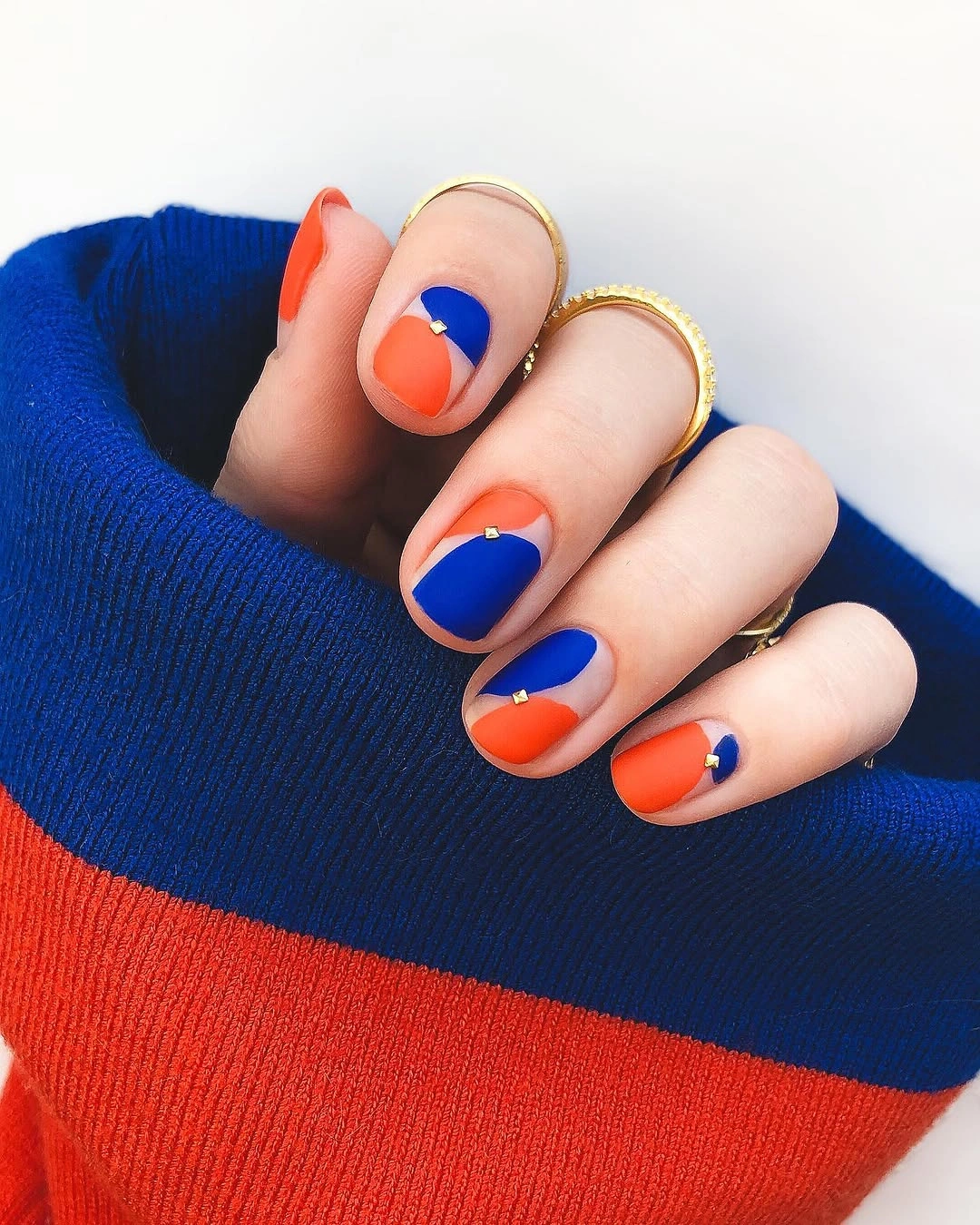
Orange and cobalt sit far apart in temperature, which makes both appear clearer and more saturated. Negative space works like a neutral seam between them, allowing the eye to register the curved geometry instead of seeing one dense field of color. The soft matte or satin surface further limits glare, leaving the color relationship in charge.
For early September, this is a way to keep summer-level energy while changing its structure. The short length contains the saturation, and the small warm accents add polish without introducing a third large color area. A flatter version without the raised-looking squares would preserve the same warm-cool exchange with easier everyday wear.
Burgundy Balanced by Butter Yellow and Blue-Gray
Burgundy, butter yellow, and pale blue-gray divide these medium oval nails into alternating solids and rounded tip blocks. The wine shade establishes depth, but it never occupies every finger or every full nail. Gloss unifies the three colors, even as their values move from dark and saturated to pale and softly muted.
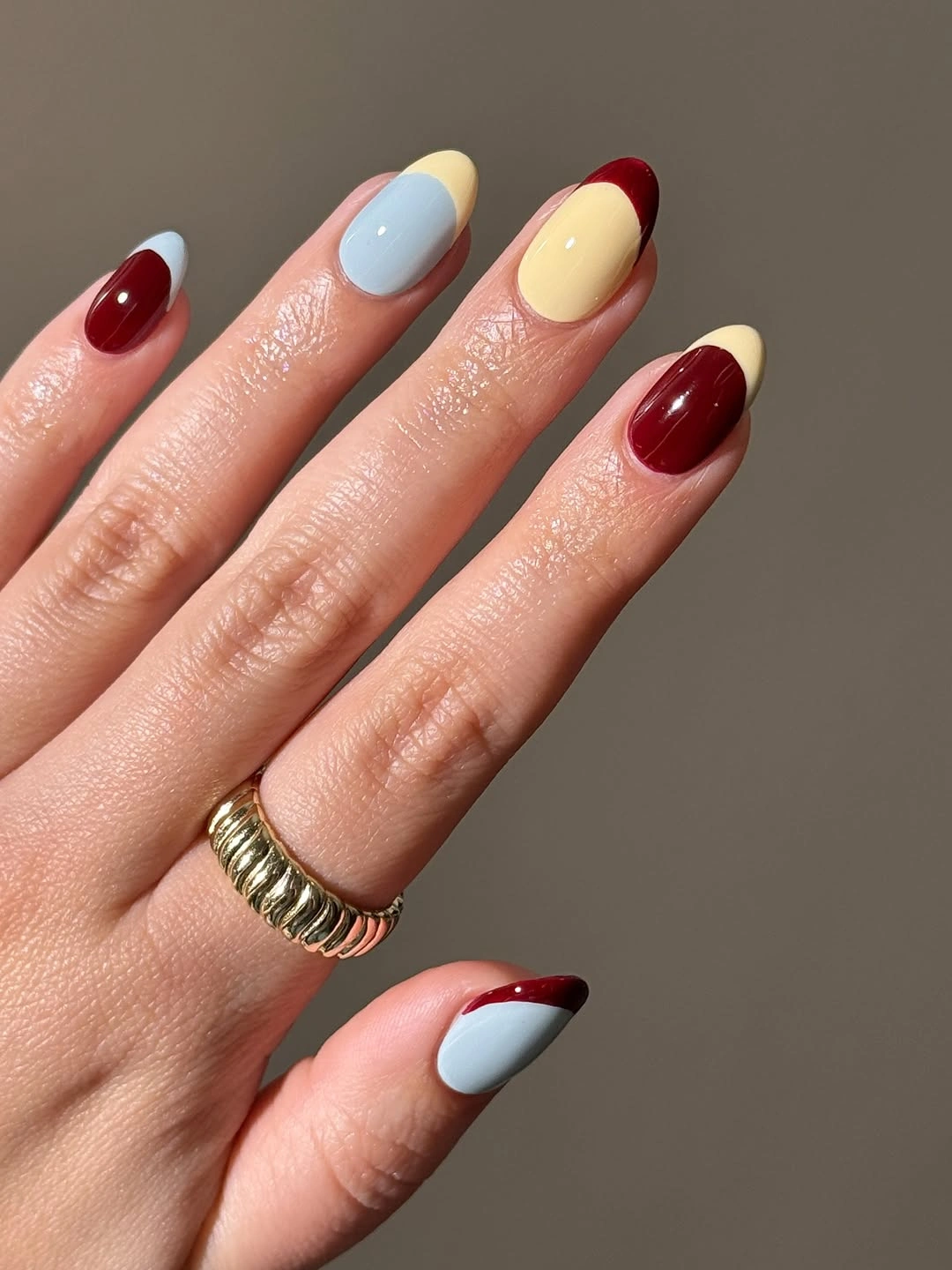
Butter yellow warms the palette without matching burgundy’s intensity, while blue-gray introduces a cool pause. That temperature range is what makes the manicure feel transitional: the light shades recall late summer, yet the wine tips point decisively toward fall. Reversing which color appears at the base and tip also keeps the value pattern moving across the hand.
Medium oval tips leave enough room for the curved divisions to read clearly without requiring an extreme length. Someone who prefers a quieter variation could use burgundy on two nails, blue-gray on two, and reserve butter yellow for one small tip. The three-color mix will pair naturally with denim, cream, charcoal, or camel because it already contains both warm and cool notes.
Olive and Wine Ground a Bright Two-Tone Mix
Long almond nails carry a different pairing on every finger, including sky blue with cream, orange-red with deeper red, pink with olive, and wine with blue. Broad curved wedges follow the pointed shape rather than cutting it into rigid halves. Olive and wine recur as the lower, earthier notes that give the bright assortment a deliberate early-fall direction.
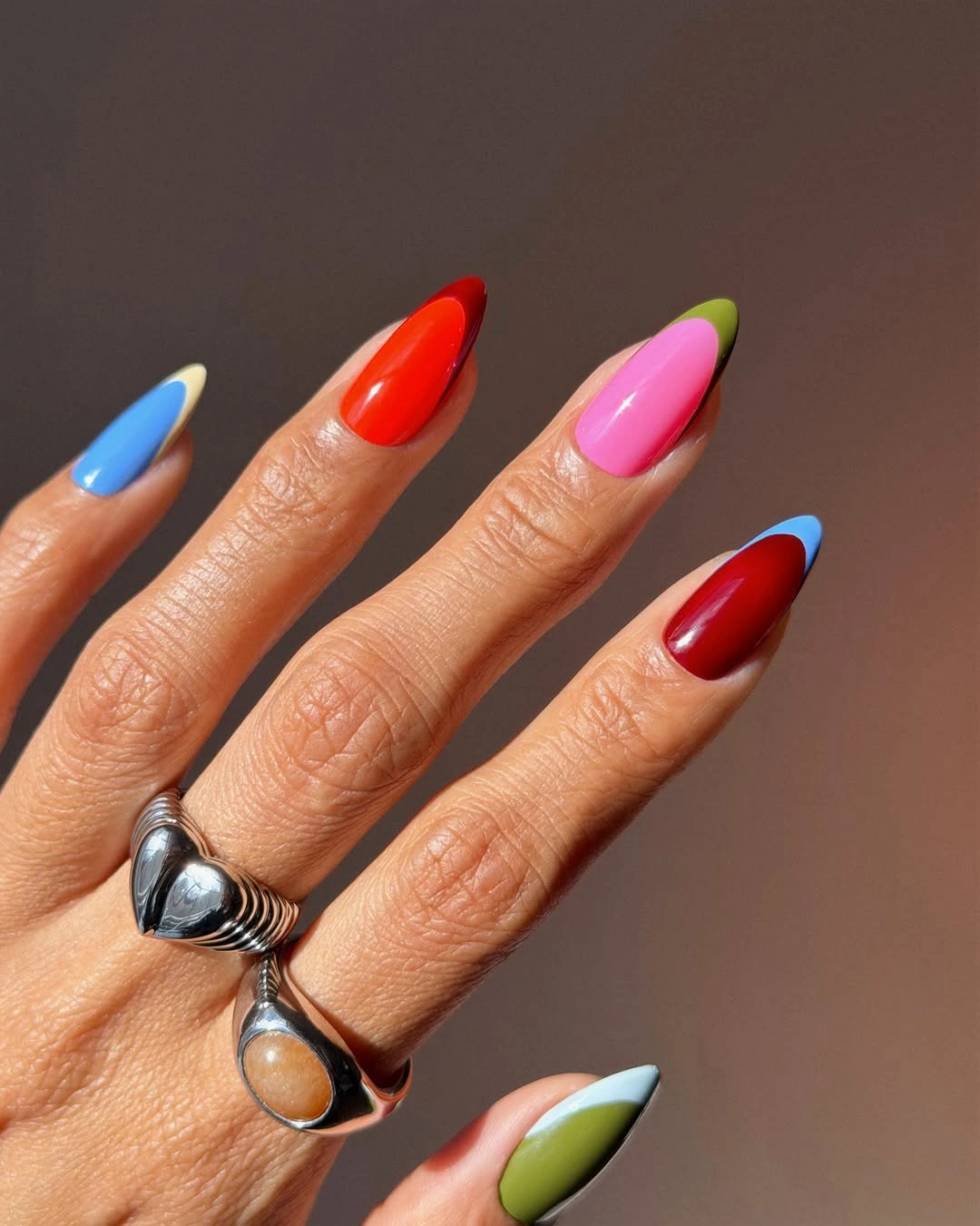
The palette succeeds because its variety is organized by a repeated two-tone idea. Clear pink, blue, and orange-red maintain the brightness associated with warmer months, but olive reduces saturation and wine adds depth at strategic points. Glossy reflections keep those darker sections connected to the lighter colors instead of letting them look flat.
There is no need to reproduce all five pairings to borrow the color logic. Two bright hues plus one olive and one wine accent would create a simpler version with the same movement between seasons. On shorter nails, narrowing each second-color wedge near the tip would preserve the directional effect while reducing visual density.
Hot Pink and Lavender Punctuated by Burgundy
Hot pink, pale lavender, speckled white, and sparkling burgundy form a skittle manicure on medium-long almond nails. The deep shimmer appears on one prominent nail, while the brighter glossy pink carries the highest saturation. Fine dark flecks lower the sweetness of the white and lavender, adding small cool marks without changing their light value.
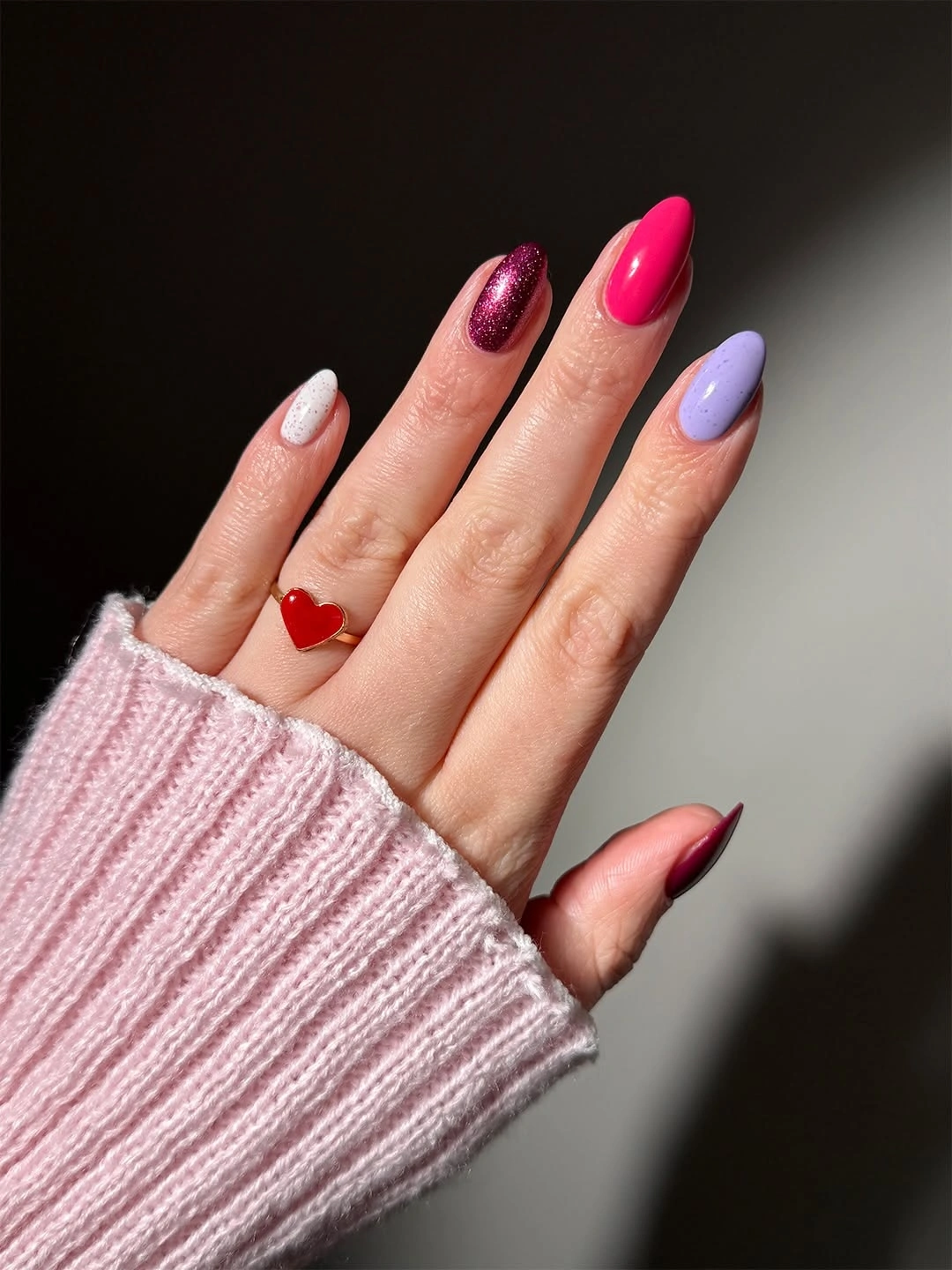
Only a small share of this palette is dark, yet that burgundy accent changes how every neighboring color reads. Pink feels less tropical beside wine, and lavender becomes a cool counterpoint instead of the center of a pastel story. Mixed finishes strengthen the contrast because sparkle, gloss, and speckling give each value a different kind of surface movement.
I would keep the deeper shimmer limited to one or two nails if the goal is an early-fall shift rather than a fully dramatic set. Repeating the dark speckles on both pale colors is enough to connect them across the hand. A single glossy finish could make the manicure easier to recreate, though it would lose some of the texture-based balance that distinguishes this version.
Clear Scarlet on a Long Tapered Shape
Vivid scarlet runs uninterrupted across long oval-almond nails with no accent color or decorative break. The red leans warm and clear rather than brown, purple, or orange, so it retains a direct saturated quality. Narrow white reflections trace the smooth taper and give the solid surface visible dimension.
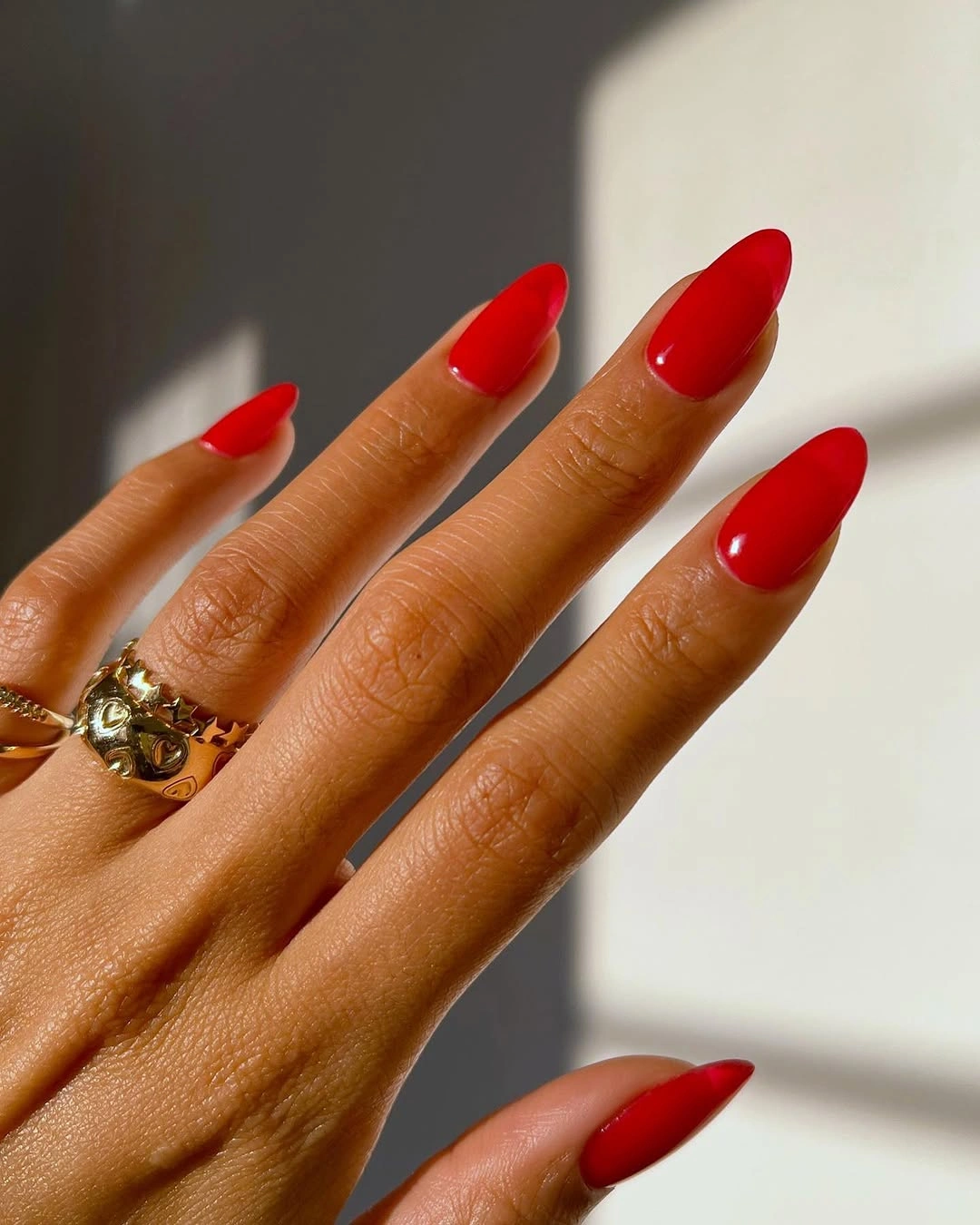
Scarlet can belong in September when the surrounding palette becomes more selective. Here, using one color across the full hand removes the festival-like effect that several competing brights might create. The warmth remains strong, but the disciplined repetition and elongated shape make it feel intentional rather than leftover from midsummer.
A solid shade is simpler to touch up than multi-color placement, although wear at the ends will be obvious on this length. Warm cream, medium denim, olive, or a restrained gold accent would support the red without pushing it toward holiday territory. Shorter oval tips would make the same scarlet more practical while retaining its clean temperature statement.
Sage and Blush Framed With Warm Gold
Long almond nails combine glossy sage, pale blush, and a smoky brown-gray accent with rippled visual texture. Irregular gold-toned borders trace the pink nails instead of following a perfectly even outline. The palette stays muted overall, yet its surfaces move between smooth color, reflective edging, and translucent-looking depth. Nothing relies on a bright seasonal motif to signal the transition.
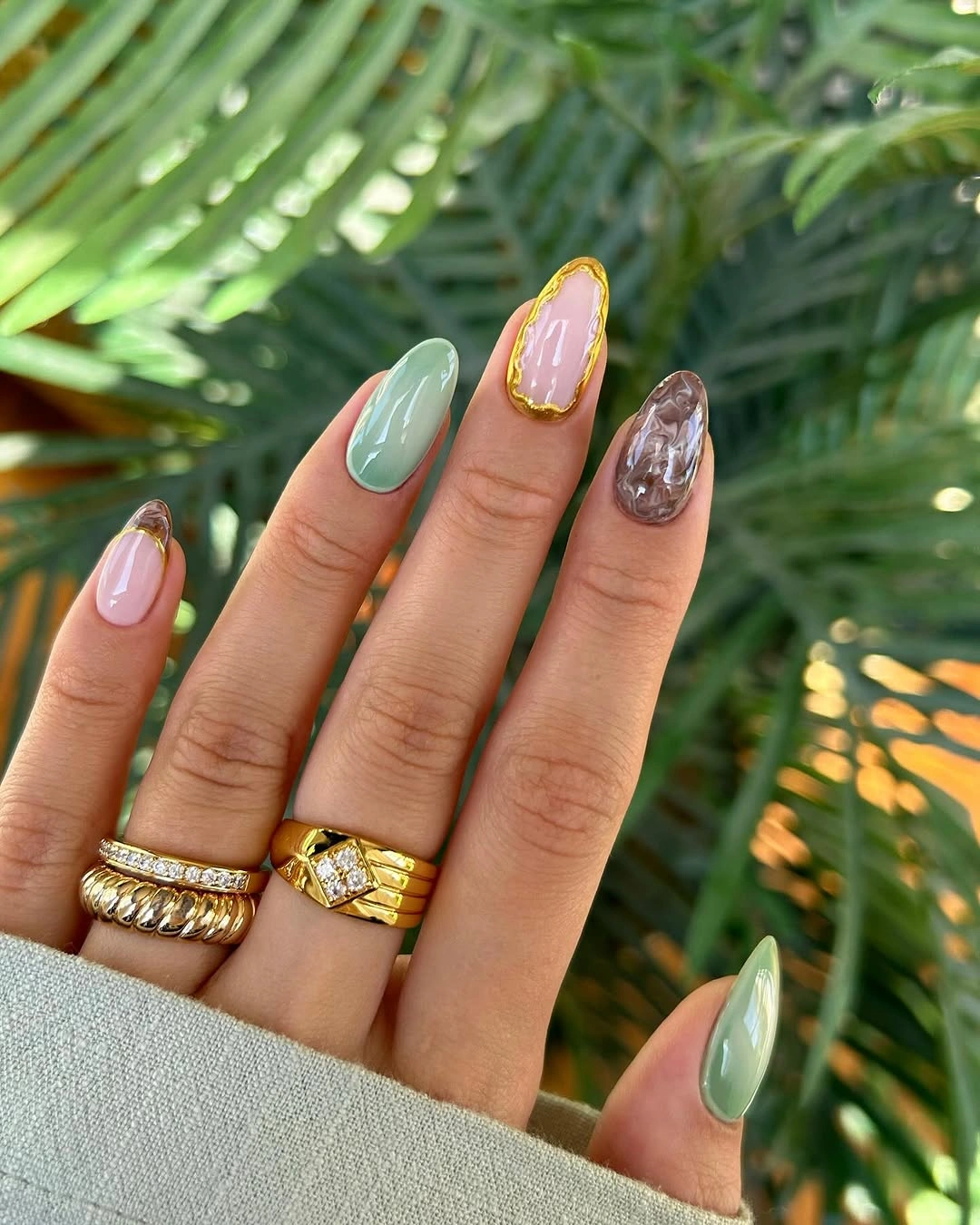
Sage and smoke both lean cool, while blush and gold restore warmth in smaller amounts. That uneven temperature distribution is more nuanced than matching every nail, and the low saturation keeps the contrast calm. The darker textured accent creates depth through broken reflections rather than a flat field of black or brown.
Raised-looking borders and pronounced surface texture may require more care around fabric or hair than a smooth manicure. A flat fine gold line around one blush accent would translate the idea into a simpler version without losing its warm frame. I especially like the way sage remains the largest color area, allowing metallic warmth to read as an accent rather than the theme.
Near-Black Oxblood Kept Short and Glossy
Short rounded-square nails hold an oxblood shade so deep that it approaches black in the shadows. Red-brown undertones remain visible along the glossier edges and highlights, preventing the color from becoming neutral. The uniform manicure has no decorative interruption, so length and finish do all the balancing work.
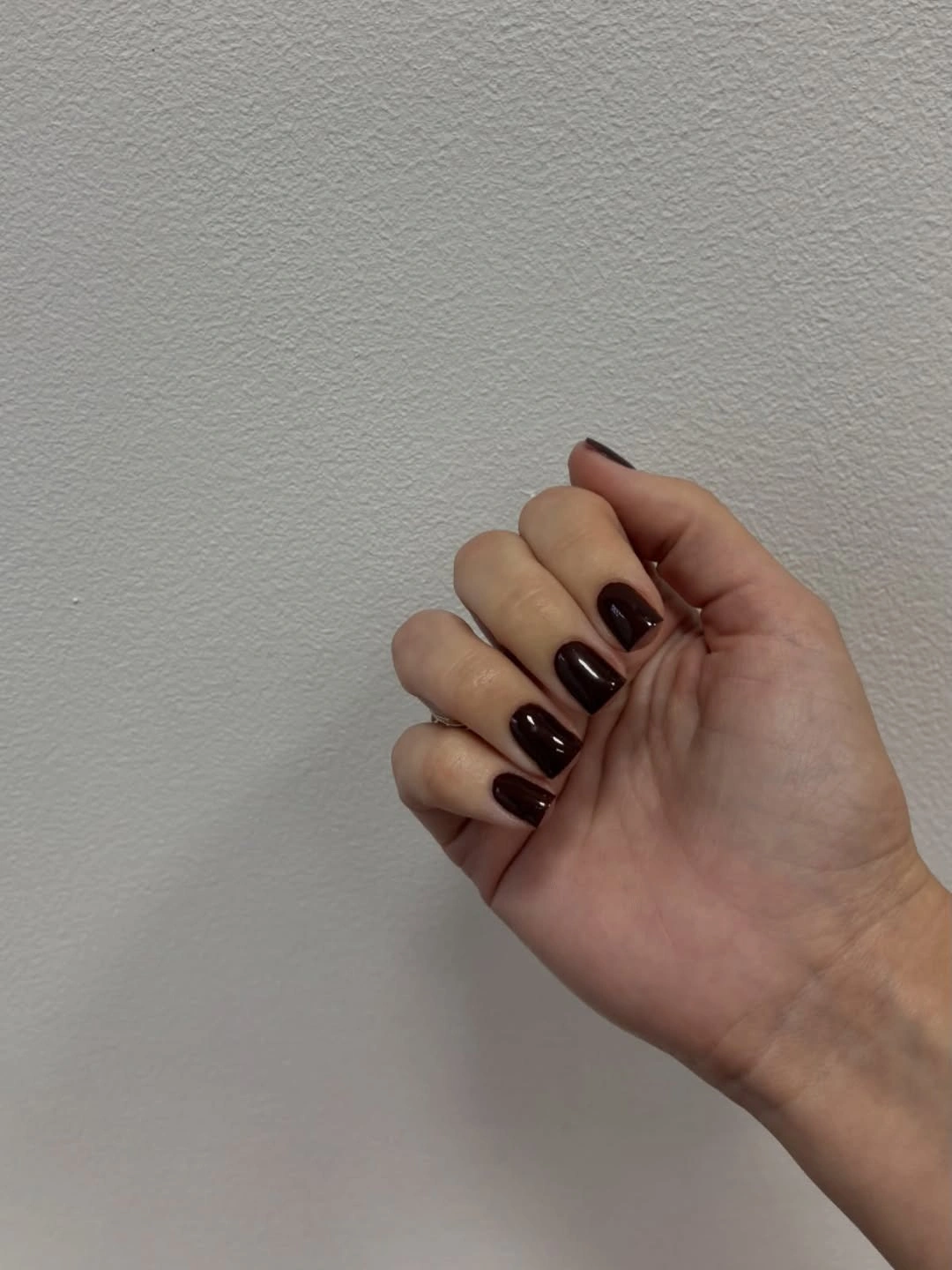
Scale matters when a color carries this much depth. On compact nails, the near-black value appears as a concise accent against the skin rather than a broad dark panel. Gloss is equally important because the narrow reflections reveal curvature and return enough light to separate the five nails.
Dark tip wear will be easy to notice, but the short shape makes routine use more manageable than a long version in the same shade. Oxblood works well with cream, gray, faded blue denim, or muted green when the goal is contrast without adding more saturated color. For the first cool weeks of September, it offers drama in a controlled footprint.
Pale Sage-Gray for a Lighter Fall Shift
Pale sage-gray covers short square nails in a smooth, glossy solid. The green is cool and visibly muted, with enough gray to distinguish it from bright mint. Softly squared tips reinforce the clean geometry while the light value keeps the manicure airy.
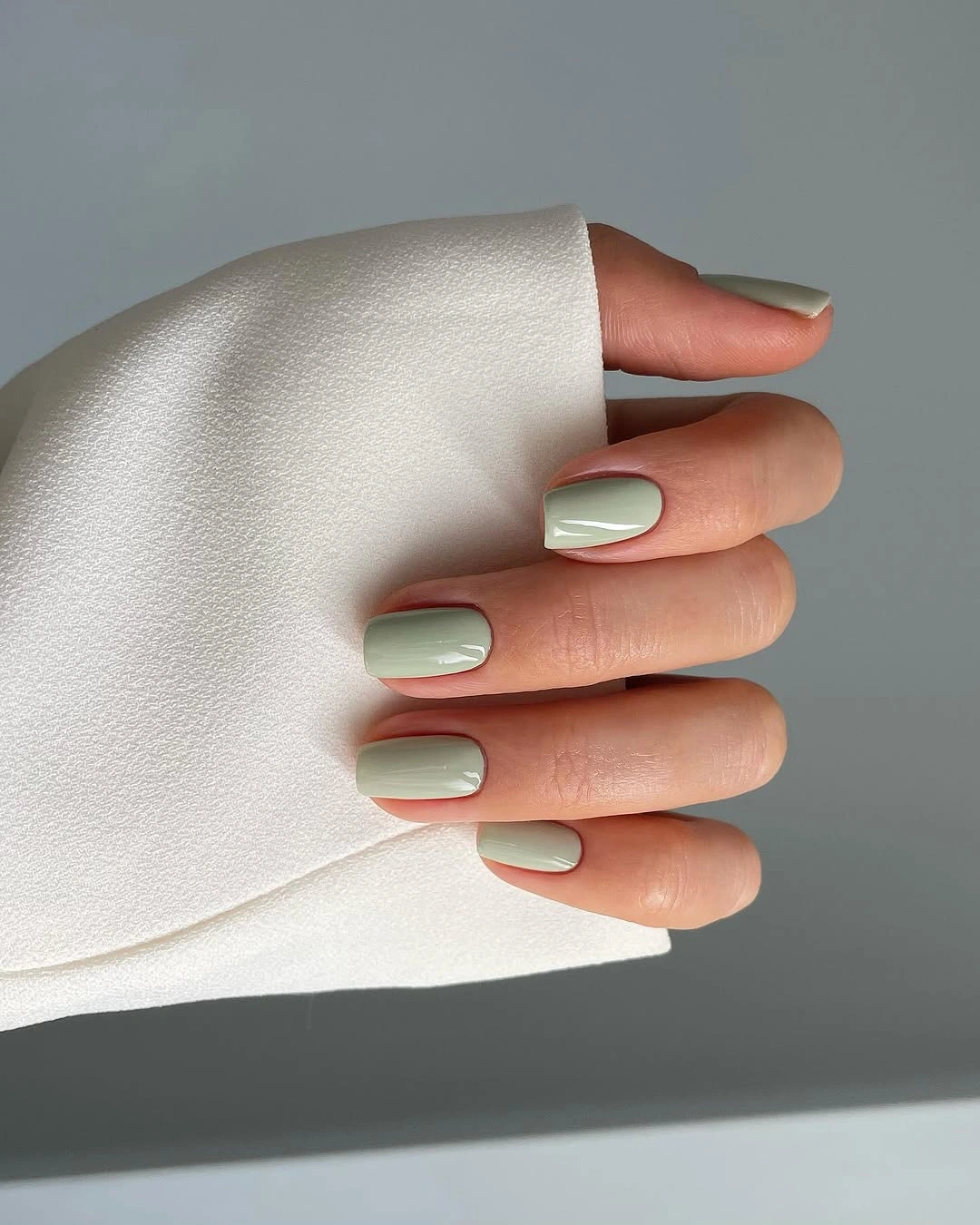
Desaturation supplies the seasonal shift here, not added darkness. Gray removes the juicy quality associated with spring and summer greens, yet the polish still reflects plenty of light. Against a white sleeve and cool background, the shade reads as a gentle color rather than a conventional nude.
Short square nails make this one of the more practical options in the collection. Pale opaque polish rewards even coverage because streaks would be more visible than they are in a sheer neutral. Cream, charcoal, denim, and warm brown could each pull a different aspect from the sage without overwhelming its quiet temperature.
Wine Red Against Cool Gray Layers
Medium almond nails bring wine red into a street-ready palette of gray and black. The polish remains clearly red despite its depth, and bright vertical reflections keep the tapered tips from appearing flat. A nearby burgundy accessory repeats the hue at a larger scale while the gray coat provides cooler separation.
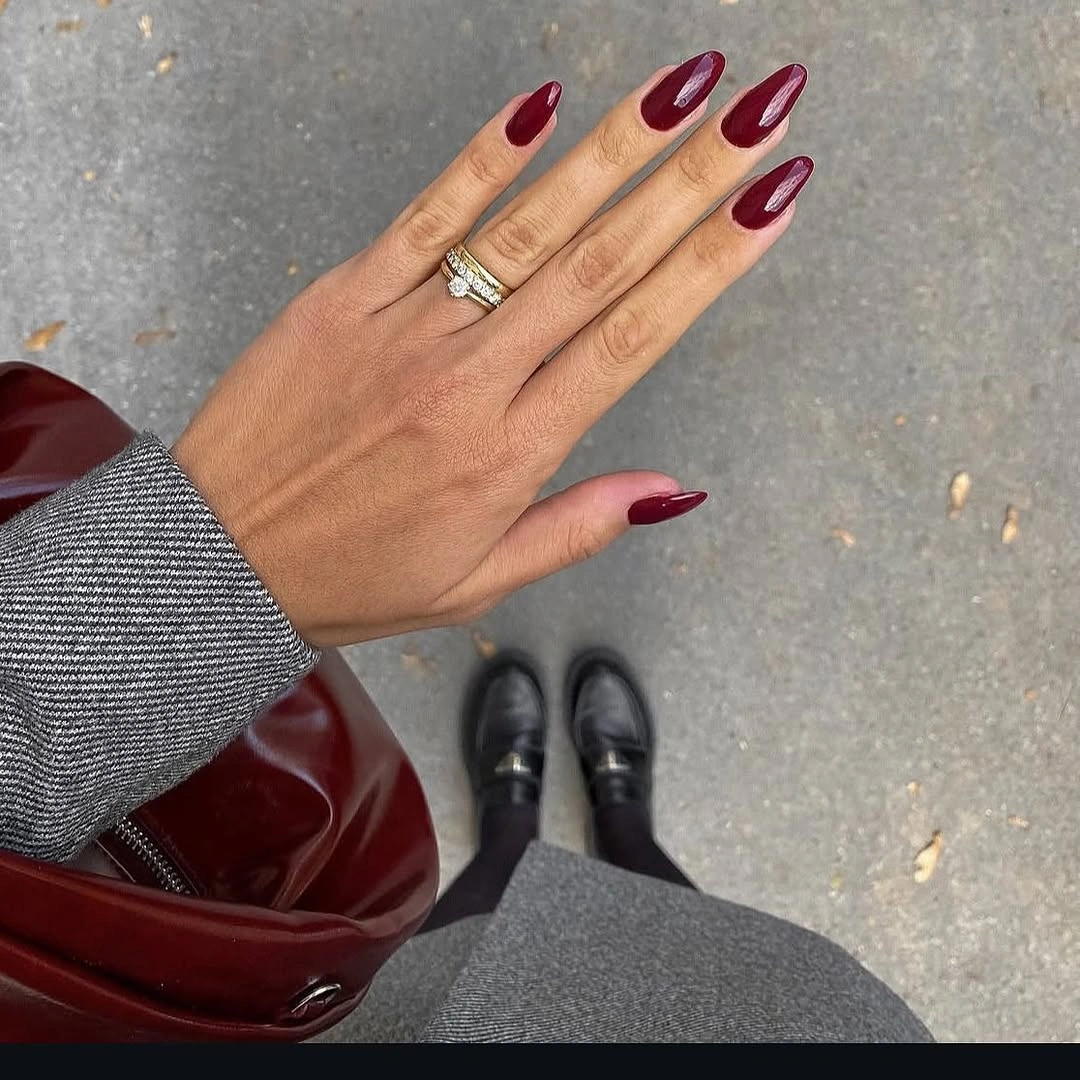
Wine occupies a useful middle point between scarlet and black cherry. It lowers the brightness of red without erasing the color, which makes it compatible with early-fall layers that are still relatively light. Cool gray sharpens the warmth in the polish, while black anchors the outfit without requiring an equally dark manicure.
Repeating the nail color in one accessory is enough to create cohesion, so the remaining pieces can stay neutral. The medium almond length offers more presence than a short squoval shape but remains less demanding than the longest pointed sets. If a tonal match feels too coordinated, replacing burgundy accessories with camel would emphasize warmth through contrast instead.
Vivid Coral-Red With Tiny Metallic Points
A high-chroma coral-red covers medium-long almond nails, with tiny metallic points placed near the side edges. Gloss intensifies the orange-red base and produces crisp highlights along each taper. The small accents interrupt the solid color only at the margins, leaving the saturated center uninterrupted.
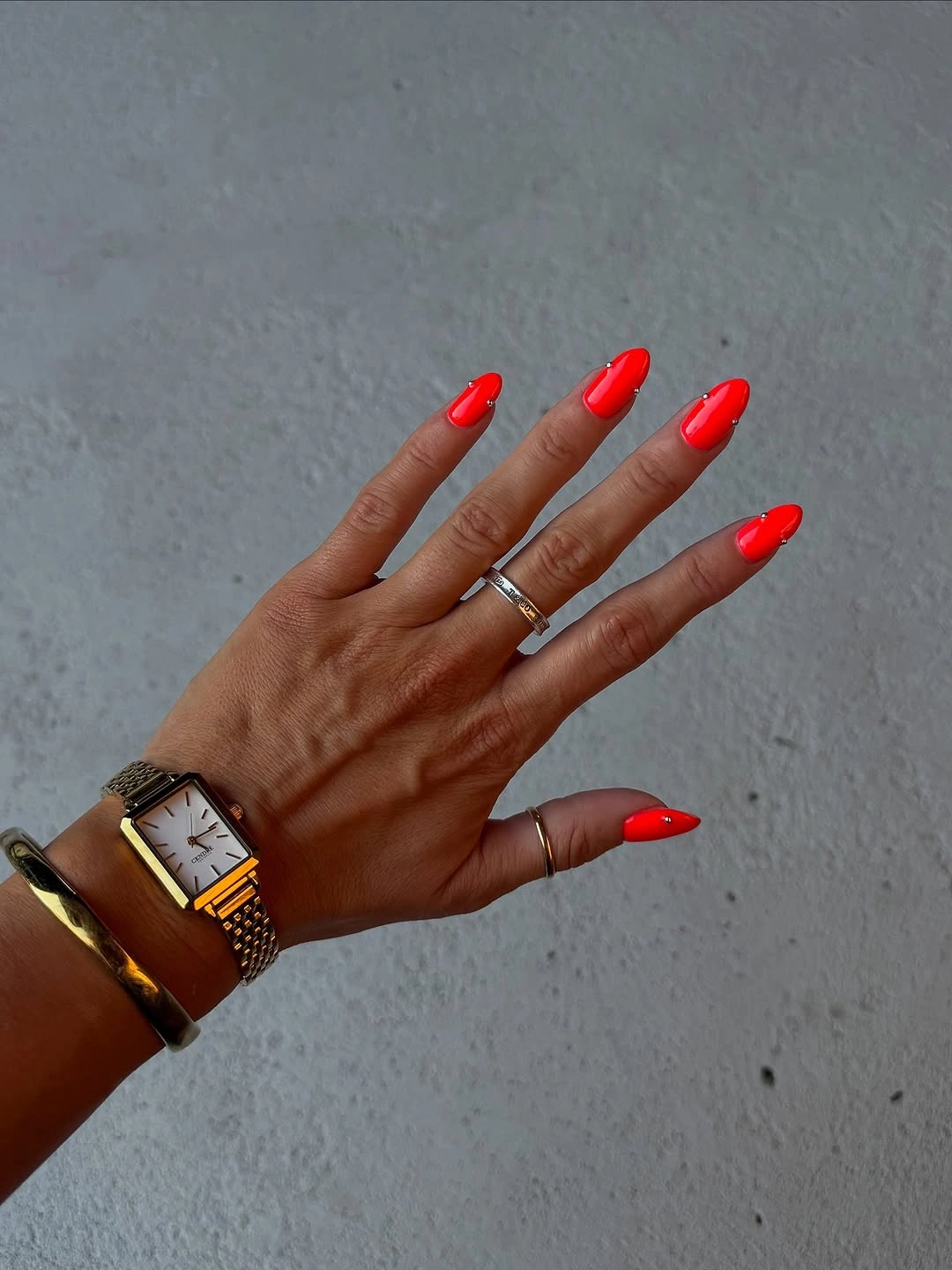
Cool gray surrounding the manicure makes its warmth look especially direct. Because no second polish hue competes with the coral-red, the metallic details act almost like punctuation rather than pattern. Their small scale also prevents gold warmth from turning the whole palette more orange.
The side accents appear raised, so a flat version may be preferable for anyone who regularly handles knits or runs fingers through long hair. Without them, the coral-red would still transition well beside charcoal, steel gray, or dark denim. Keeping jewelry warm and clothing cool creates a useful temperature split that feels appropriate before September reaches its darker phase.
Burgundy Florals Opened Up With Bare Space
Short rounded-square nails alternate between glossy burgundy solids and airy floral accents. On the decorated nails, wine-colored five-petal blooms branch across a clear or sheer nude-looking base with dark stems, muted gray-green leaves, and small white dots. The arrangement changes between fingers and between hands, creating movement without changing the restrained palette.
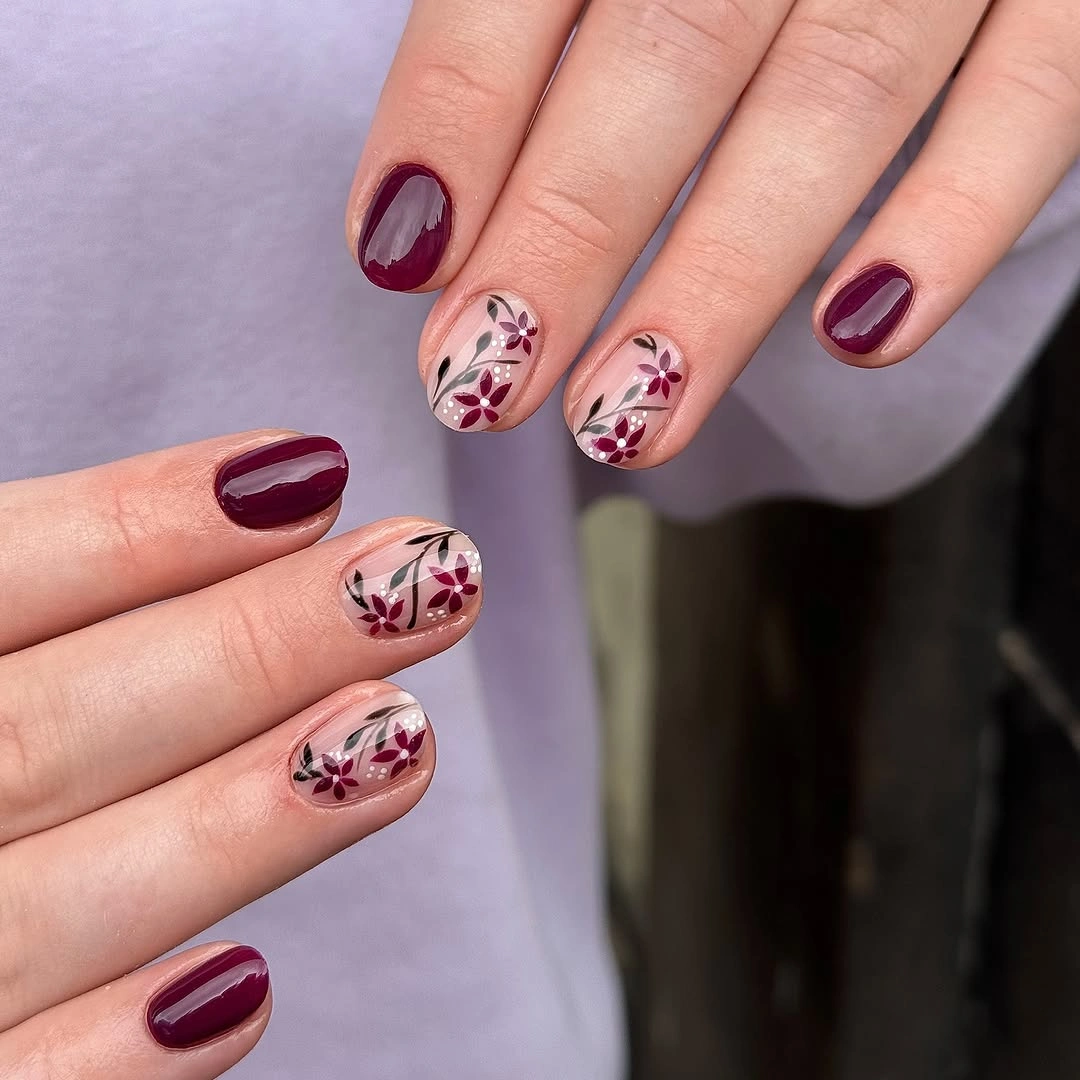
Bare space is the reason the botanical design stays light enough for September. Burgundy supplies seasonal depth, but it appears in compact petals and selected solid nails instead of covering the entire set. Gray-green foliage cools the red and softens the contrast more effectively than a vivid leaf color would.
Detailed stems, dots, and petals demand more precision than the neighboring solid nails, so limiting the pattern to accents is practical as well as visually balanced. One decorated nail on each hand could produce an even quieter interpretation. Keeping the tips short also leaves the floral scale small, which suits the open background and prevents the pattern from becoming dense.
Berry Polish Lit by Cool Reflective Ribbons
Berry-wine polish covers medium almond nails, while pale lilac-silver reflections travel lengthwise through every tip. The light bands are not isolated accents; they repeat across the hand and bend with each glossy surface. Their cool cast brightens the center of the deeper base and draws attention to the tapered silhouette.
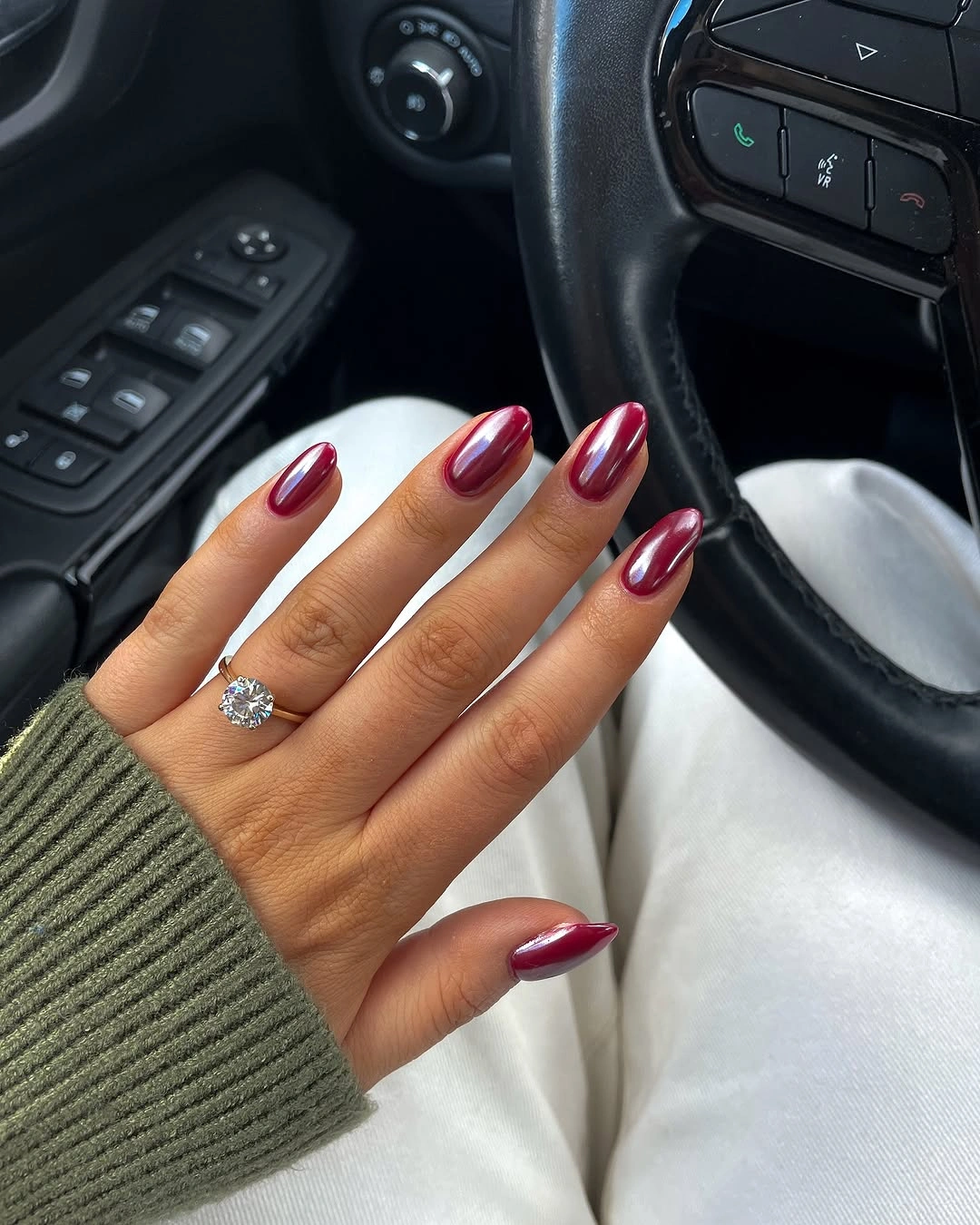
Berry normally reads warmer and denser than the reflective streaks crossing it here. Placing cool light inside the color, rather than beside it on another nail, creates a layered temperature shift. The eye moves along those vertical highlights first, so the manicure feels luminous before it feels dark.
Muted olive knitwear makes a thoughtful companion because green and berry oppose one another without either becoming bright. Achieving a consistent reflective path across several nails may take more precision than applying a standard solid. Even so, the design offers a strong option for anyone who wants burgundy depth but finds a uniform dark surface too still.
Plum to Caramel in a Warm Tonal Sequence
Five long almond nails create an ordered path from plum through red and burnt orange to caramel and taupe-brown. Each finger carries one uninterrupted glossy color, so the progression is easy to read at a glance. The sequence moves in both temperature and value, with cool depth at one side and softened warmth at the other.
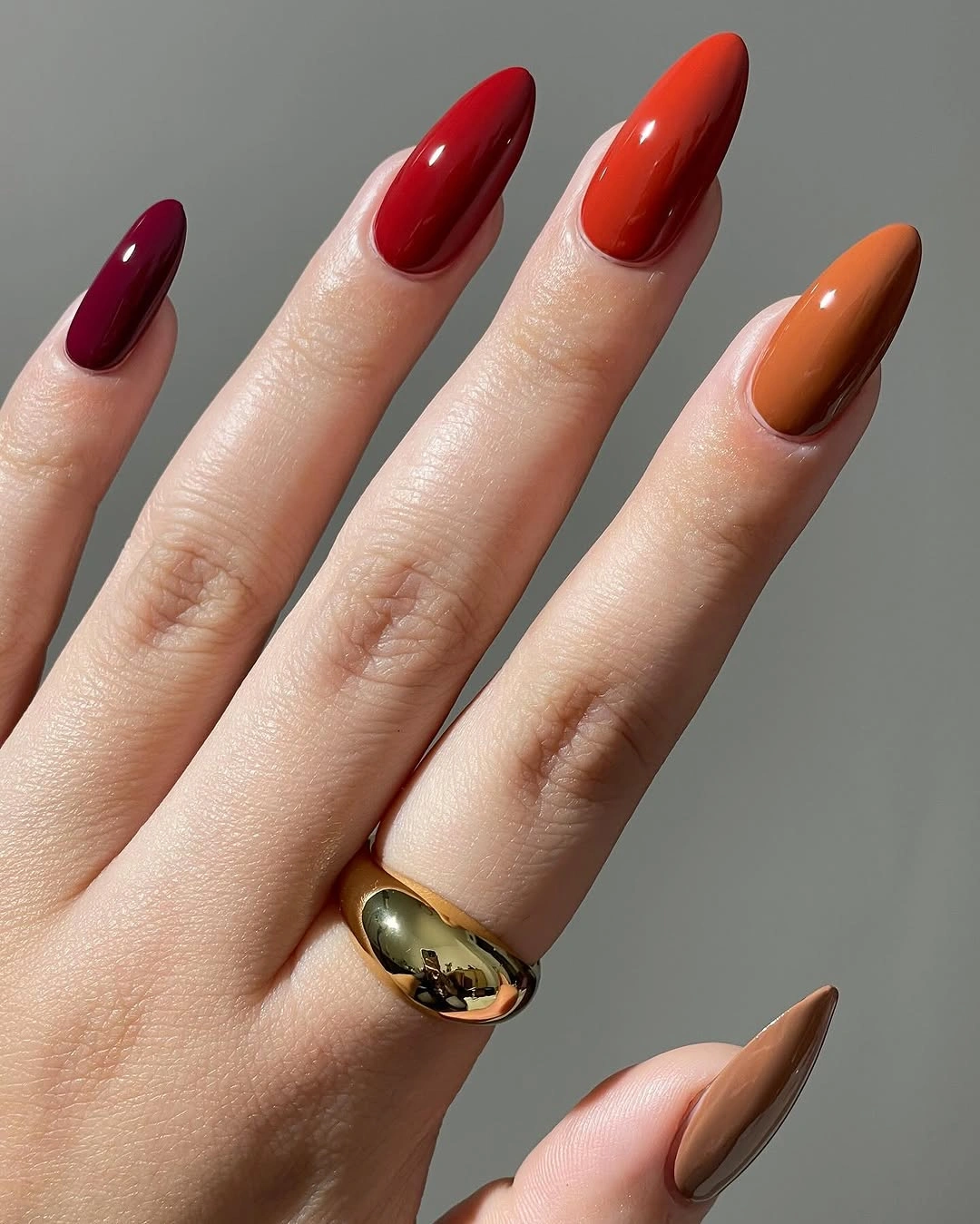
Orange-red performs the crucial middle job because it links saturated red to the brown family without an abrupt jump. Plum gives the palette a cooler shadow, while caramel and taupe keep the outcome from becoming a row of dark jewel tones. Consistent gloss acts as the shared finish that allows five distinct colors to behave like one considered set.
Among the multicolor options, this one offers especially clear guidance for adapting a September palette. Start with a favorite red, choose one deeper neighbor and two progressively browner or lighter companions, then arrange them by visual weight. The concept works equally well on short nails because its impact comes from color order rather than decorative space.
Cherry Wine Softened by Short Oval Tips
Deep cherry-wine polish fills short-to-medium oval nails with a uniform, glassy surface. The color remains redder than oxblood and less purple than plum, particularly where strong highlights pass over the curve. Rounded ends temper its rich value and give the manicure a softer outline than a square or pointed version.
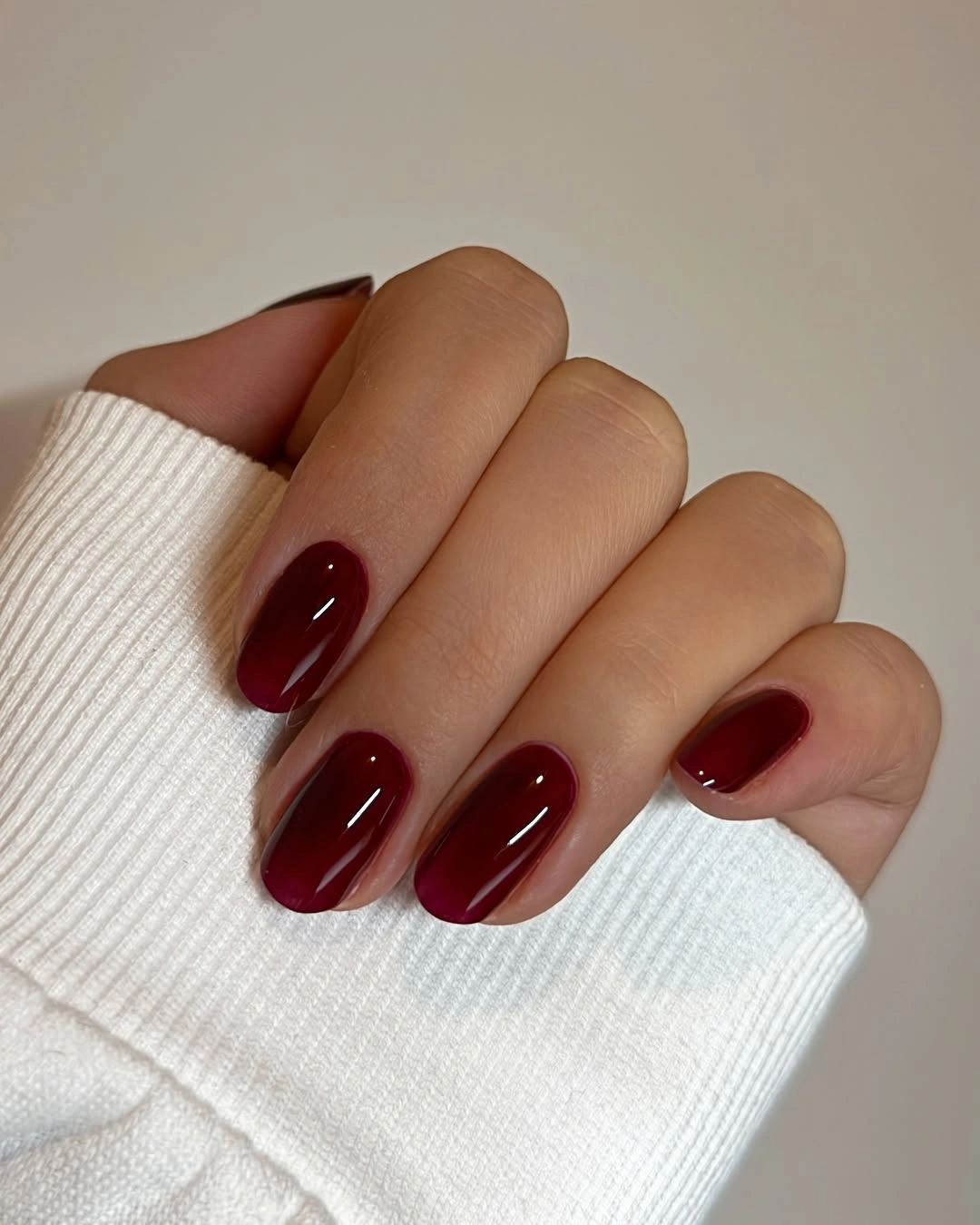
Undertone keeps this deep solid from duplicating the near-black options. Cherry red survives inside the shade, bringing a trace of brightness even when the base appears dense. A cream cuff adds clear value contrast, and its warmth is gentler beside the nails than stark optic white would be.
Moderate length gives enough polish area to appreciate the cherry character without making the dark color dominant. Tip wear will still be visible because the surface is so even and glossy. Pairing this red with cream, soft gray, or faded denim would keep the balance relaxed during early fall rather than pushing it into a formal all-dark scheme.
Brown-Red Wine on Practical Squoval Nails
Short squoval nails wear a medium-deep wine shade with a noticeable brown undertone. The color is quieter than scarlet, lighter than black cherry, and warmer than the berry manicure. Glossy coverage remains uniform across the compact tips, giving the simple shape a tidy finish.
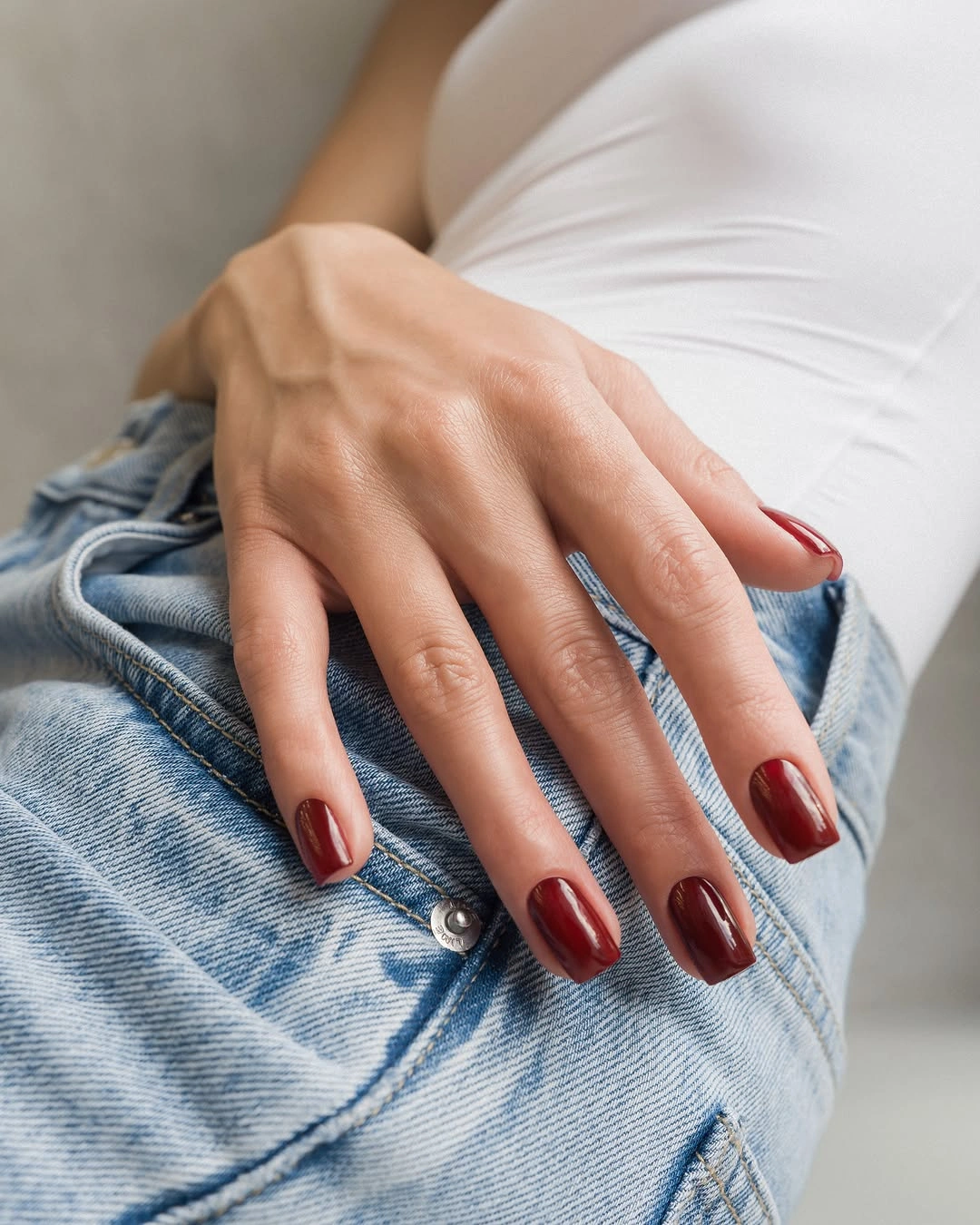
Brown changes red by lowering its apparent energy rather than merely making it darker. Beside light blue denim, that warmth becomes more obvious, and the contrast feels casual rather than dramatic. The shade therefore occupies a useful midpoint for September, when clear summer red may feel too bright but nearly black polish feels premature.
Practicality is central to the appeal of this manicure. Short softened corners are convenient for daily tasks, and a single solid shade is easier to maintain than detailed accents or multi-color blocking. Camel, cream, olive, or more denim would support the brown-red cast while keeping the palette grounded and uncomplicated.
Bright Orange Tempered by Cream Neutrals
Glossy orange fills medium oval nails across both hands with a clear, highly saturated warmth. The color is more direct than burnt orange and less pink than coral, placing it close to the brightest point in the collection. Rounded tips and uninterrupted coverage keep the manicure visually simple even when the hue is impossible to miss.
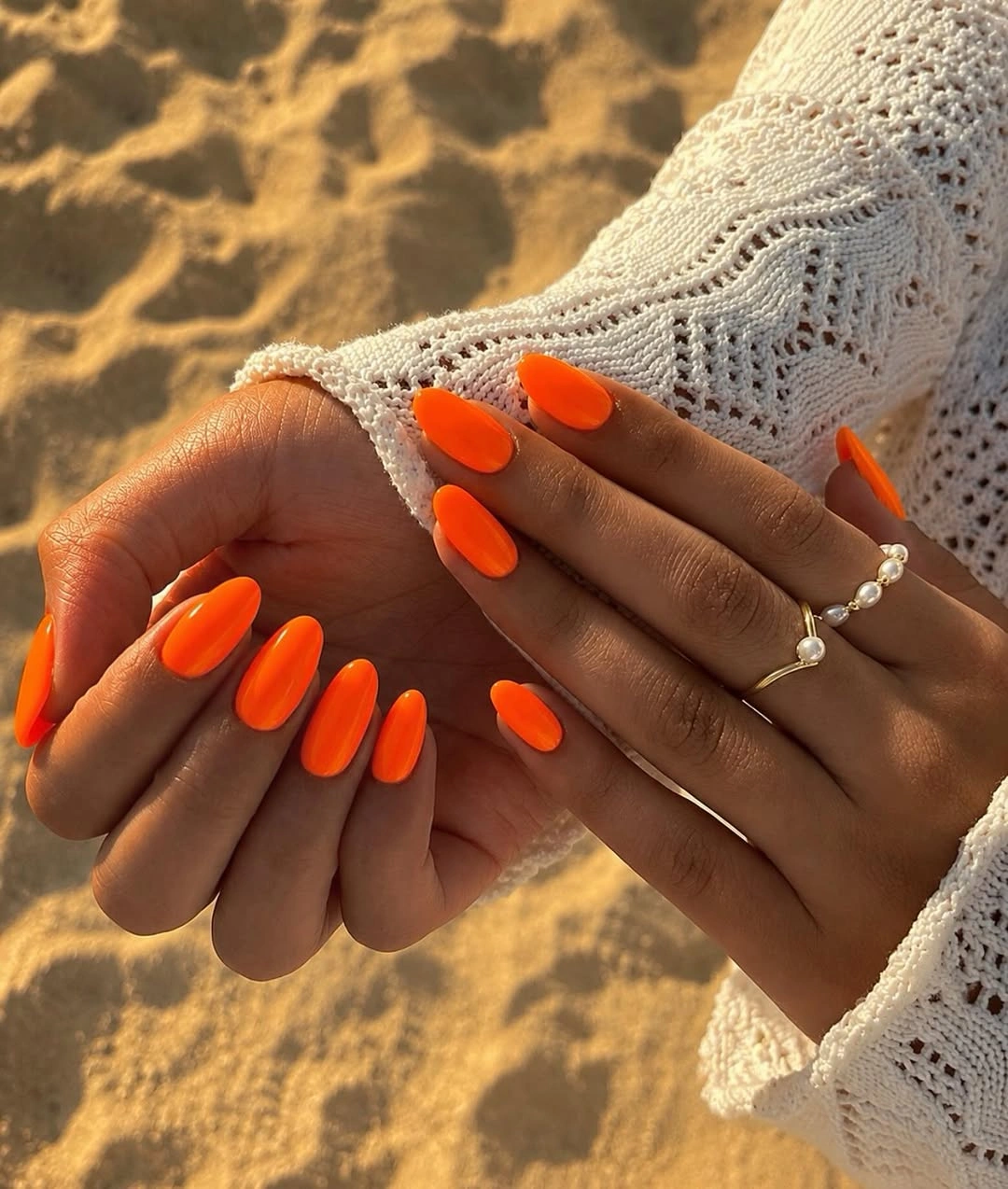
Warm outdoor light brings yellow highlights forward, but the cream open-knit sleeves stop the surrounding palette from becoming equally intense. That neutral contrast is what gives orange a place in September without pretending it is already a subdued autumn shade. One repeated hue across every nail also feels more controlled than adding pink, yellow, or aqua accents.
Orange can move deeper into early fall beside olive, dark denim, warm brown, or the same soft cream. The single-color format is straightforward to refresh, although glossy brightness will expose uneven edges quickly. I would preserve the medium oval shape because it offers enough surface for the color while avoiding the extra drama of a pointed tip.
Long Burgundy Almonds With Unbroken Color
Long narrow almond nails are fully coated in one glossy burgundy from cuticle to pointed end. No negative space, contrasting tip, or accent motif interrupts the color. Broad central reflections travel down each nail, giving the saturated red depth without allowing the surface to disappear into shadow.
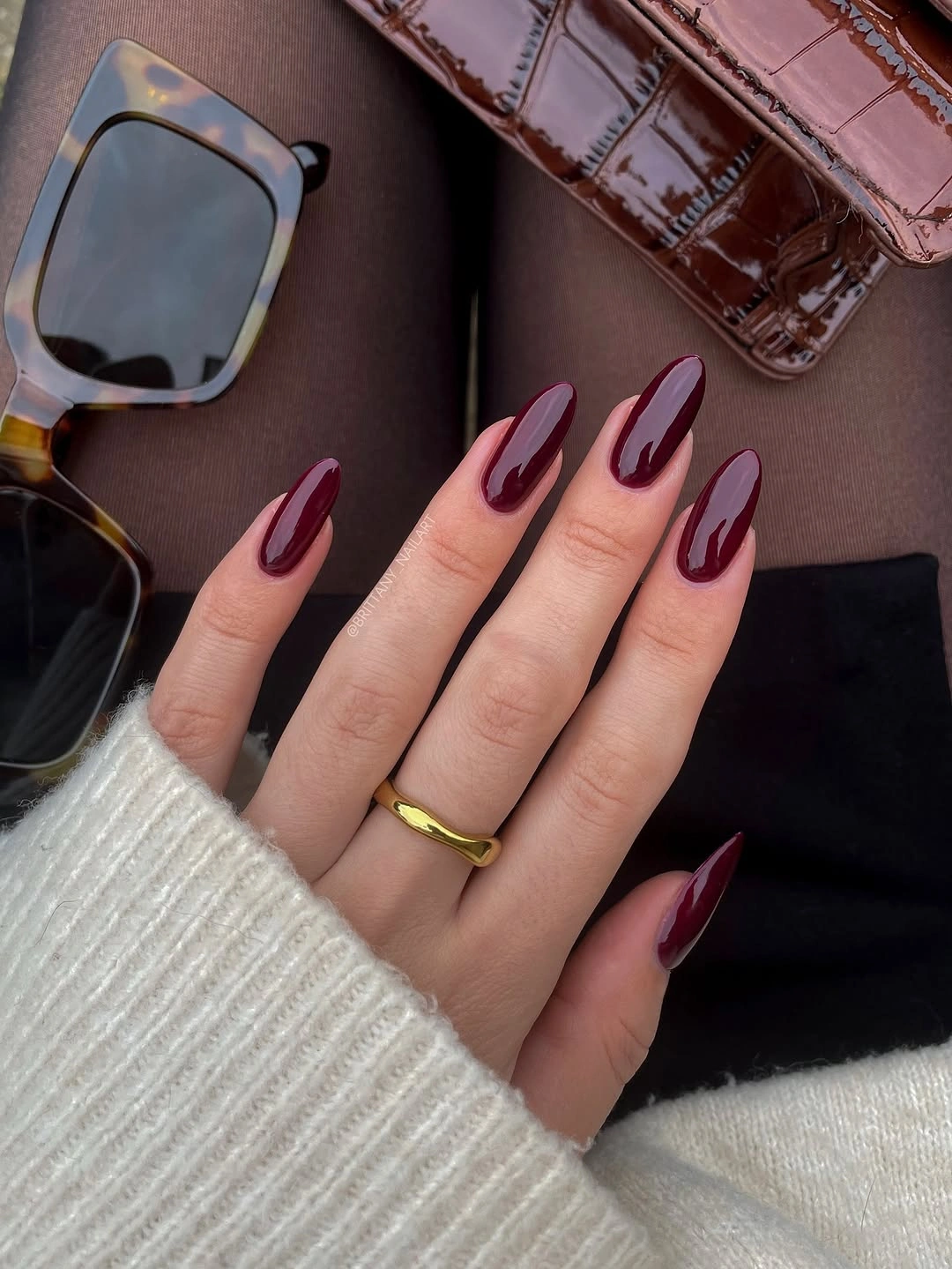
Length changes the character of burgundy more than another decorative element might. On this elongated shape, the shade looks sleek and continuous, while cream knitwear and warm brown accessories supply the light and midtone values that the nails do not contain. The color therefore feels deep but not enclosed in an all-dark composition.
Long almond tips need more careful wear than the compact burgundy options, particularly at their tapered ends. Keeping the polish solid makes small repairs conceptually simple, though an exact color match would matter. Cream and brown are strong companions here because they extend the autumn palette through surrounding layers instead of asking the manicure to carry every seasonal note.
Warm Peach Nude as a Quiet September Neutral
Pale peachy nude covers medium almond-oval nails on both hands with nearly opaque, glossy color. The undertone is warm enough to separate it from cool beige, gray-pink, or transparent neutral polish. Its close value to the skin visually softens the longer tips and gives the set a low-contrast presence.
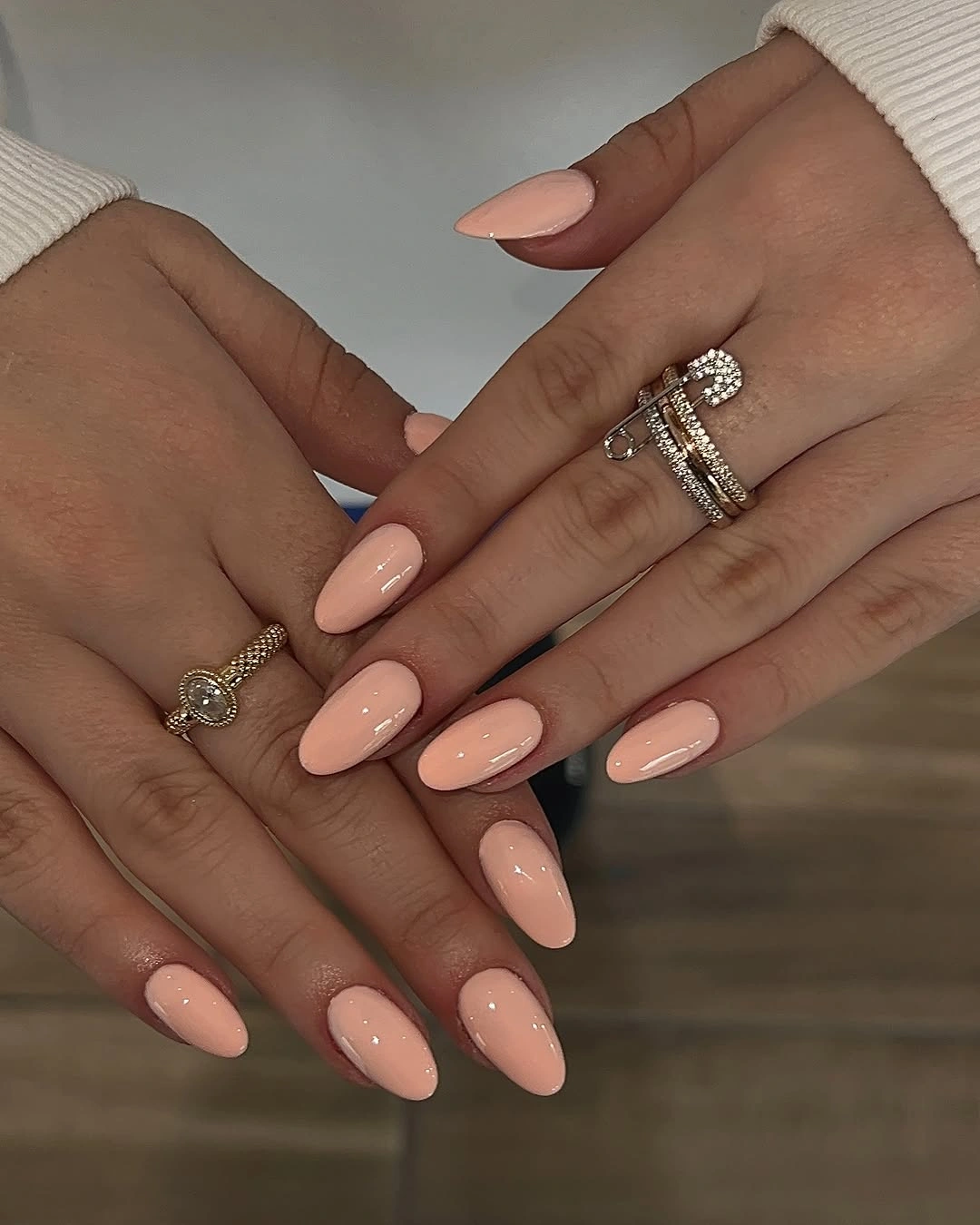
Warmth does all the seasonal work in this section because there is no dark value or earthy pattern. Peach sits comfortably beside camel, cream, olive, and faded denim, colors that begin to return to wardrobes in September. Gloss prevents the pale shade from looking chalky and keeps the simple surface responsive to light.
Low contrast can make regrowth less abrupt than it is with burgundy or black cherry. Even coverage still matters because the color appears opaque enough for thin areas to stand out. For anyone reluctant to darken a manicure early in the month, this is a measured shift that changes temperature while preserving lightness.
Cool Plum Beside a Black Cuff
Deep plum coats medium-long almond nails with a cool purple undertone and a high-gloss surface. Beside a black cuff, the polish remains visibly colored rather than merging with the neutral. Wide window-like reflections add pale vertical structure across each dark tip.
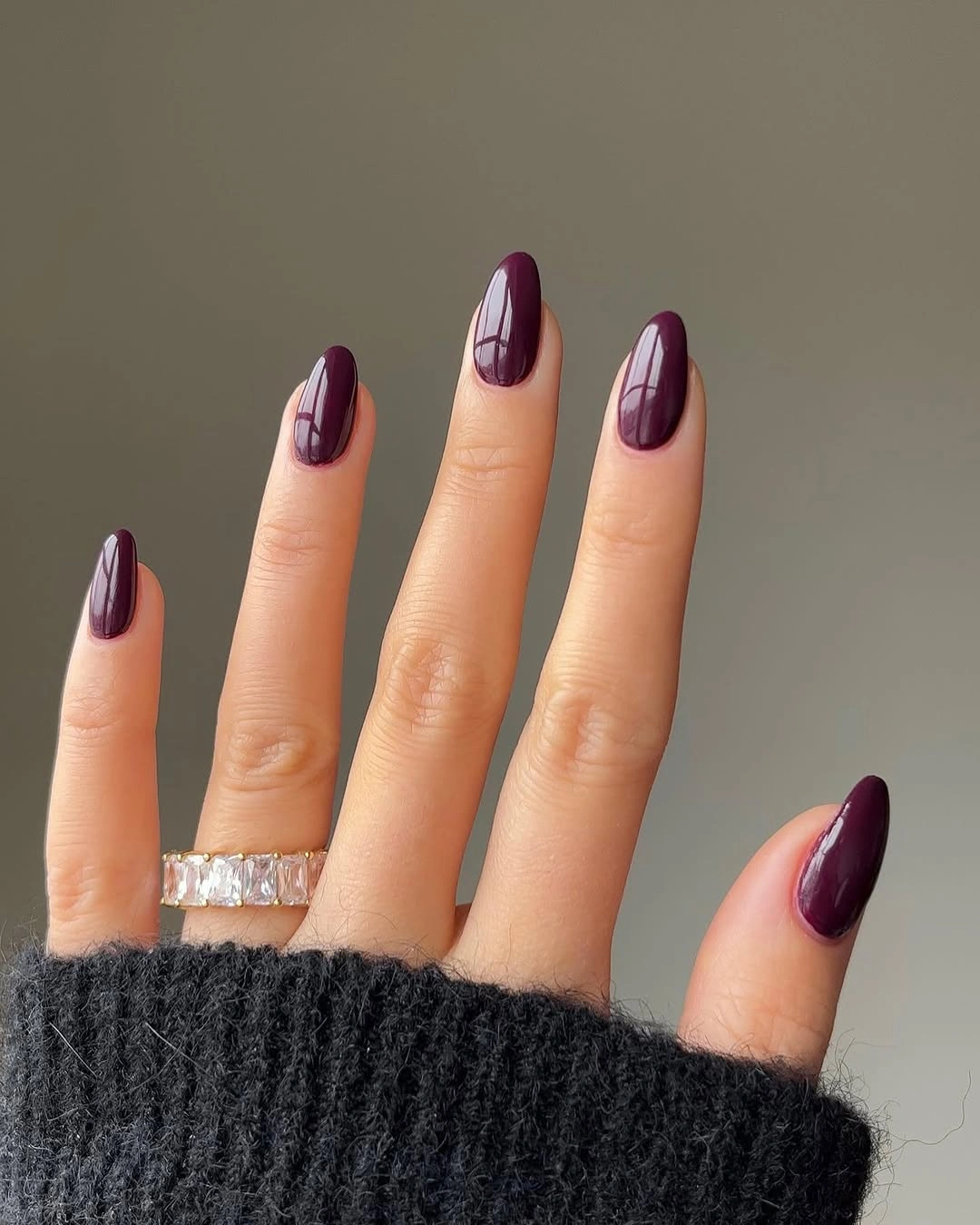
Compared with burgundy, plum changes the temperature before it changes the depth. Its purple cast feels cooler and slightly quieter than wine red, which makes charcoal and black useful comparison colors. The near-value pairing also proves that dark polish does not have to be warm to register as early fall.
Broad shine is valuable on this length because it breaks the plum into illuminated and shadowed zones. Edge wear will remain noticeable, so a shorter almond adaptation would reduce maintenance while preserving the cool undertone. Cream or muted olive could lighten the styling, whereas gray would continue the restrained, cool direction already present.
Orange-Red Heat on Sharp Pointed Almonds
Intense orange-red stretches across long pointed almond nails on both hands with no secondary polish color. The silhouette is sharper than the earlier coral-red set, and the absence of metallic points leaves the glossy hue completely exposed. Repetition across ten nails gives the color a strong rhythm that matches the decisive shape.
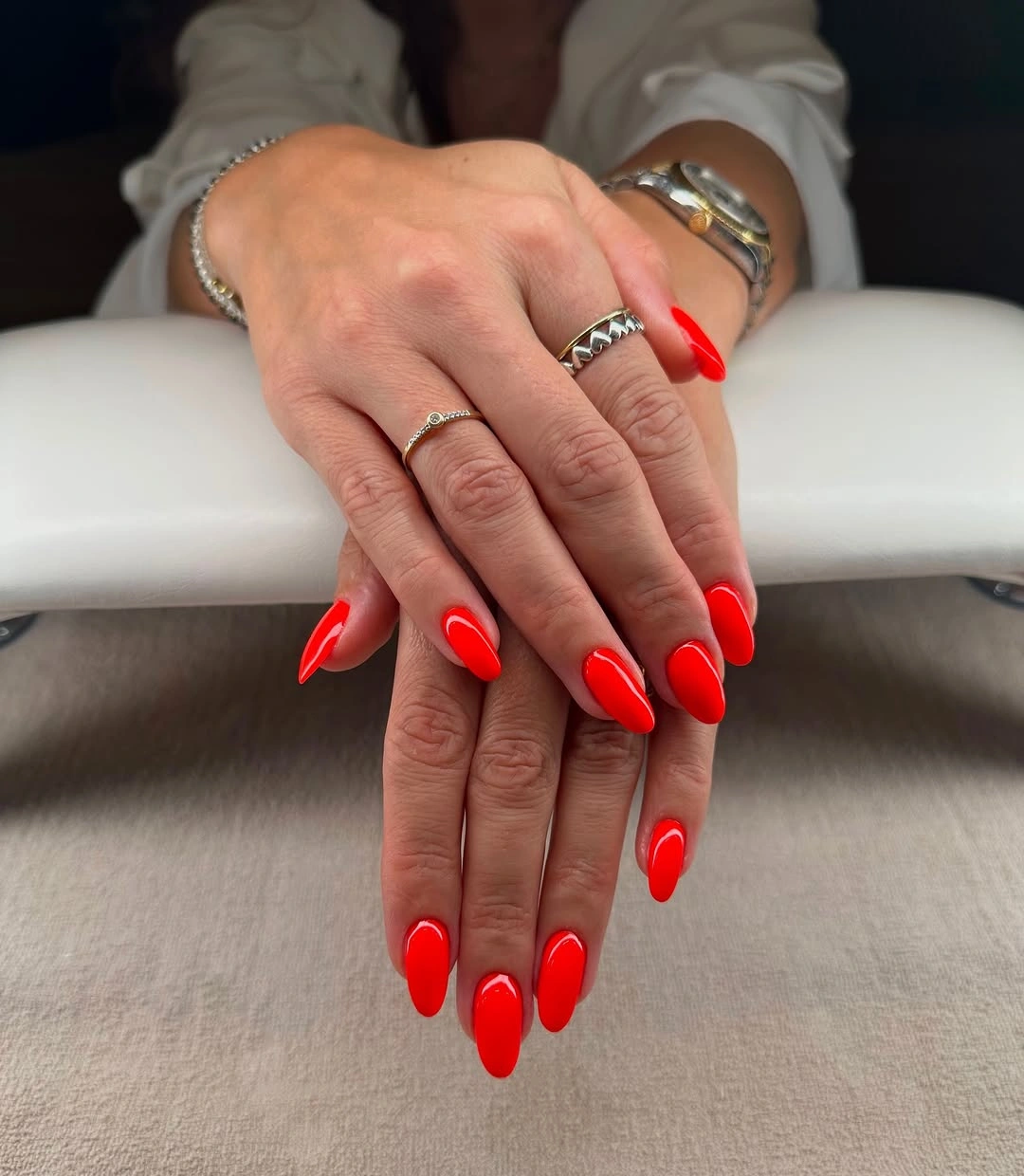
Pale gray, white, and cool-toned jewelry provide enough contrast to redirect the shade away from a beachy palette. Both length and saturation are already assertive, so added art would likely compete rather than contribute. The disciplined solid finish allows temperature and silhouette to carry separate parts of the design.
Pointed length requires the most care in this group during routine tasks. A shorter oval version would keep the orange-red impact while reducing leverage at the tips, but it would also look less graphic. For September, I would pair the original shape with charcoal or medium-wash denim so the warm polish remains the only high-intensity color.
Cool Berry Burgundy on Short Square Tips
Short square nails wear a glossy berry-burgundy that leans cooler and brighter than brown-red wine. Straight tips create a crisp edge beneath the saturated color, while sunlight reveals its magenta-red cast. Consistency across both hands keeps the manicure focused on that specific undertone rather than on art or variation.
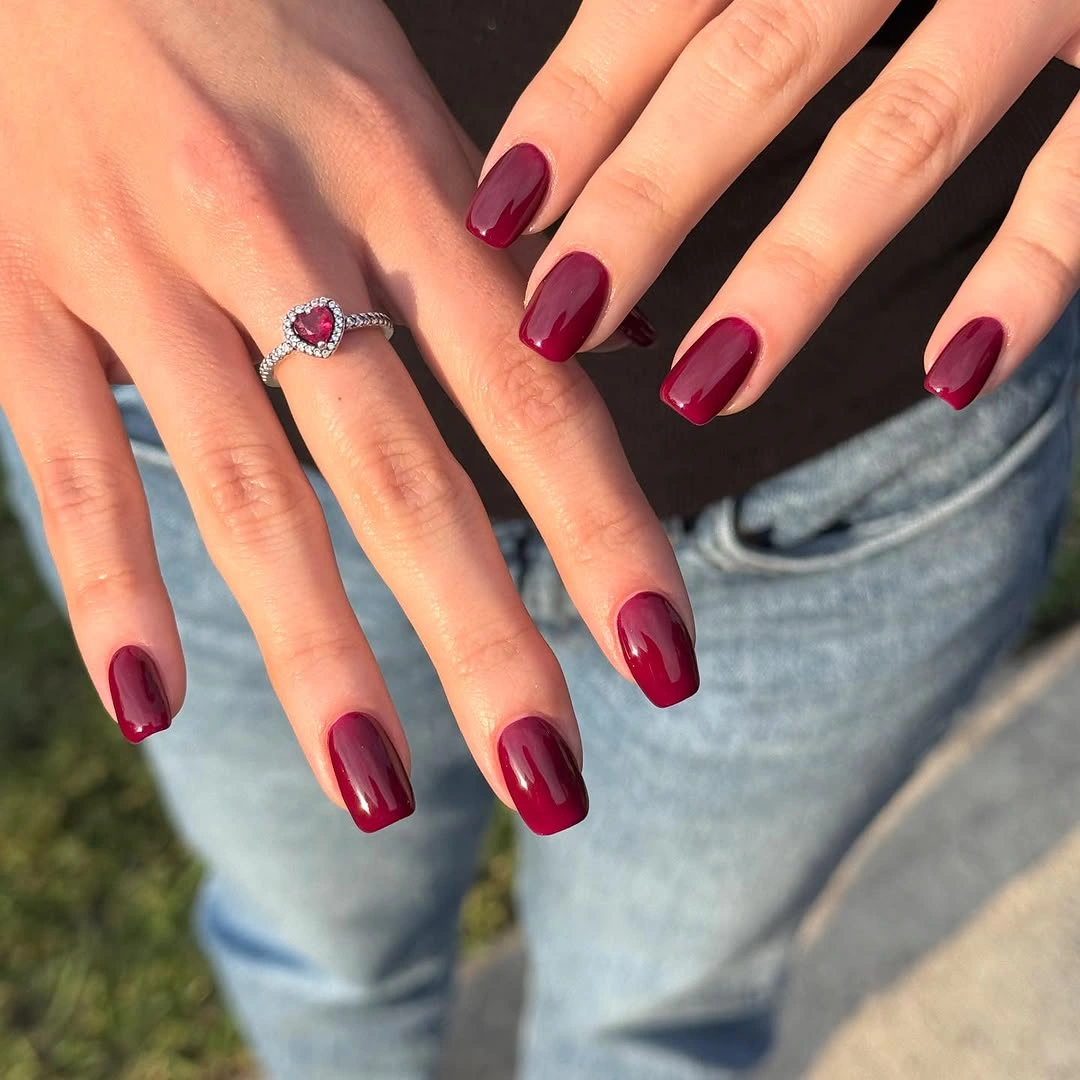
Berry is useful when classic burgundy feels too brown or too solemn for the start of fall. It provides medium depth but retains enough cool chroma to look lively beside light blue denim. The square outline makes the rich shade appear neat and direct, which contrasts with the softer effect of cherry wine on rounded tips.
Compact length makes this saturated option practical for frequent daily use. Small chips will still interrupt the straight dark edge, so careful tip coverage matters. Denim supports the cool side of the polish, while cream or pale gray would give it more value contrast without adding another strong hue.
Black Cherry Depth With Mirror-Like Shine
Near-black cherry-brown covers medium-long almond nails with the deepest solid value in the collection. Thin red edges remain visible around parts of the manicure, confirming that the shade has color beneath its almost-black surface. Large rectangular reflections occupy the center of several nails and produce a mirror-like gloss.
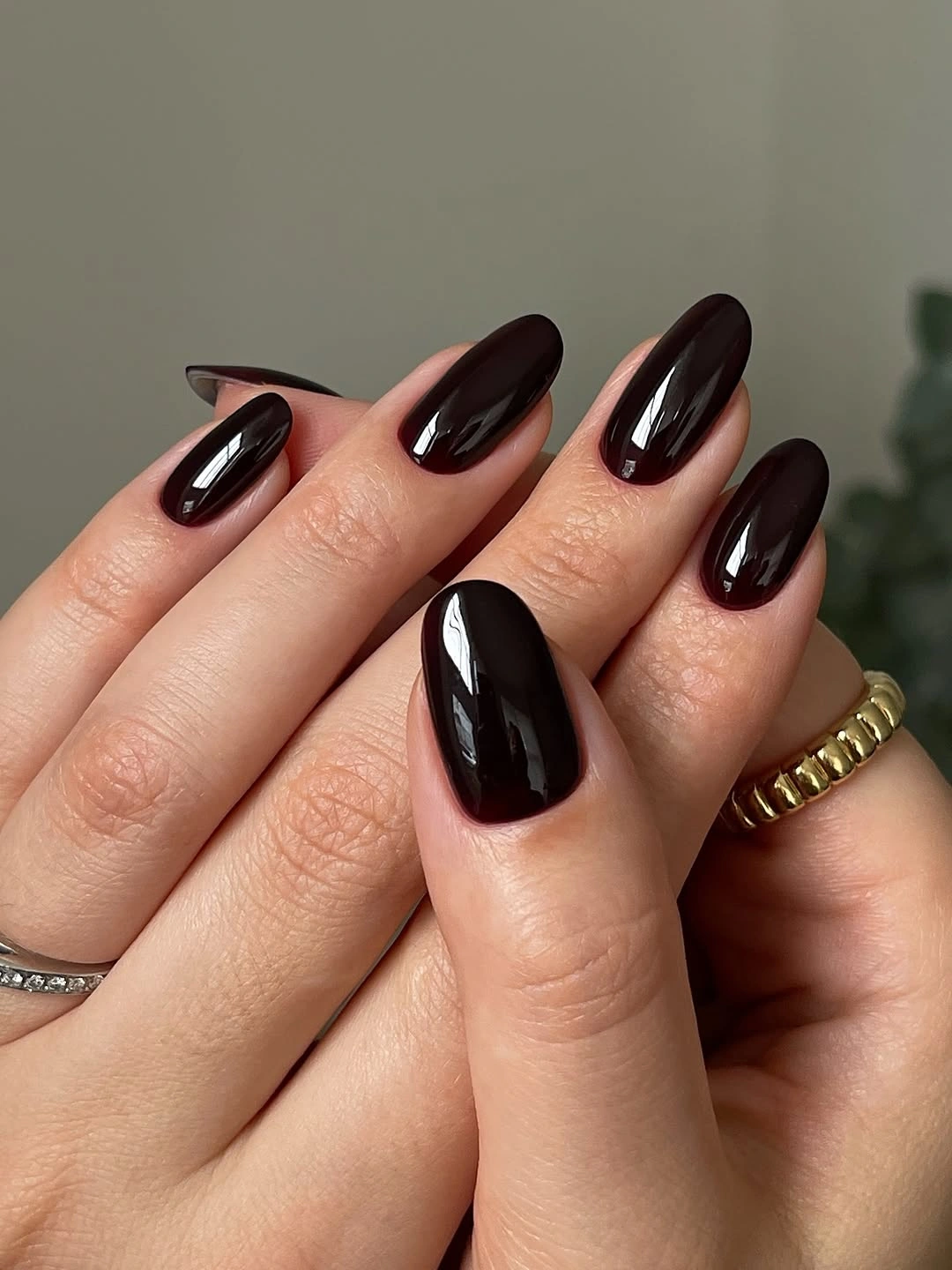
Without those bright reflections, the long dark tips could become visually dense. Shine divides each nail into black-brown shadow, pale highlight, and a narrow cherry border, creating more value range than the base color alone suggests. Small warm and cool metallic accents nearby echo the reflected light rather than competing with the polish.
Growth and wear are likely to stand out quickly against a shade this deep, especially on the longer tips. Shortening the almond shape would make black cherry easier to manage and reduce its overall weight. For anyone choosing the full-length version in September, light knitwear or faded denim would preserve contrast and keep the dark manicure from controlling the entire palette.
Amber Tortoiseshell With Concentrated Dark Patches
Medium almond nails layer irregular dark brown and near-black patches over luminous amber-orange areas. Deeper reddish-brown transitions appear between some of the light and dark sections, giving each nail a different internal map. Gloss amplifies the translucent quality of the amber while keeping the varied pattern visually connected.
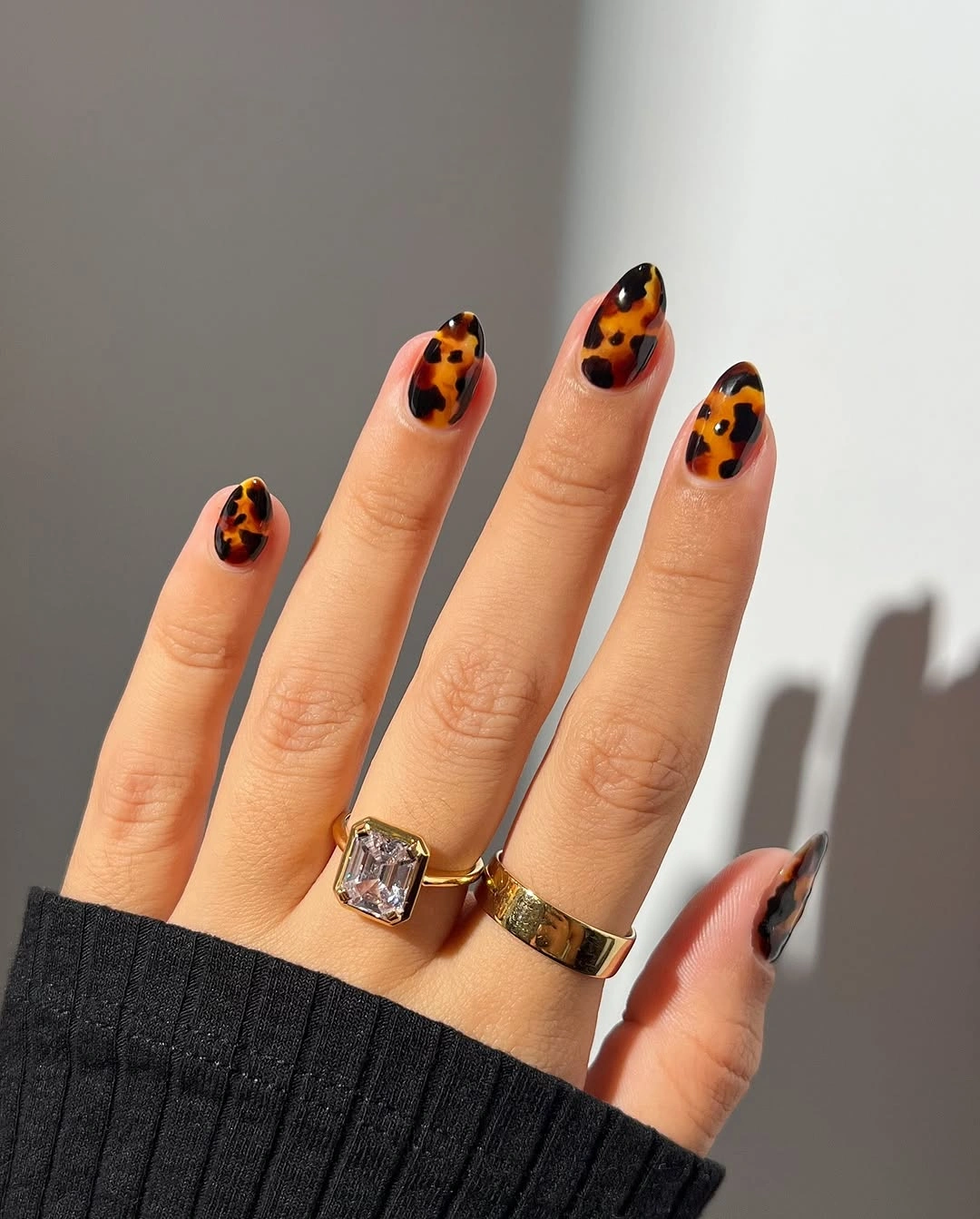
Depth is concentrated instead of spread evenly across the surface. That decision allows unmistakably autumnal black-brown color to coexist with sections that still transmit warmth and light. The asymmetrical placement also keeps the eye moving, so no single nail becomes a solid dark endpoint.
An adapted version does not need identical spots because variation is part of the design’s character. The important practical choice is leaving enough amber between dark patches; reducing those open warm areas would make the manicure much heavier. A black cuff and restrained gold-toned details reinforce both ends of the palette without adding unrelated color.
Muted Coral as a Soft September Bridge
Short rounded nails carry a muted coral-salmon shade with a clean glossy finish. The color stays warmer than pink and lighter than burnt orange, yet it is noticeably softer than the vivid coral-red and orange sets. Uniform coverage and compact length give the manicure an understated scale.
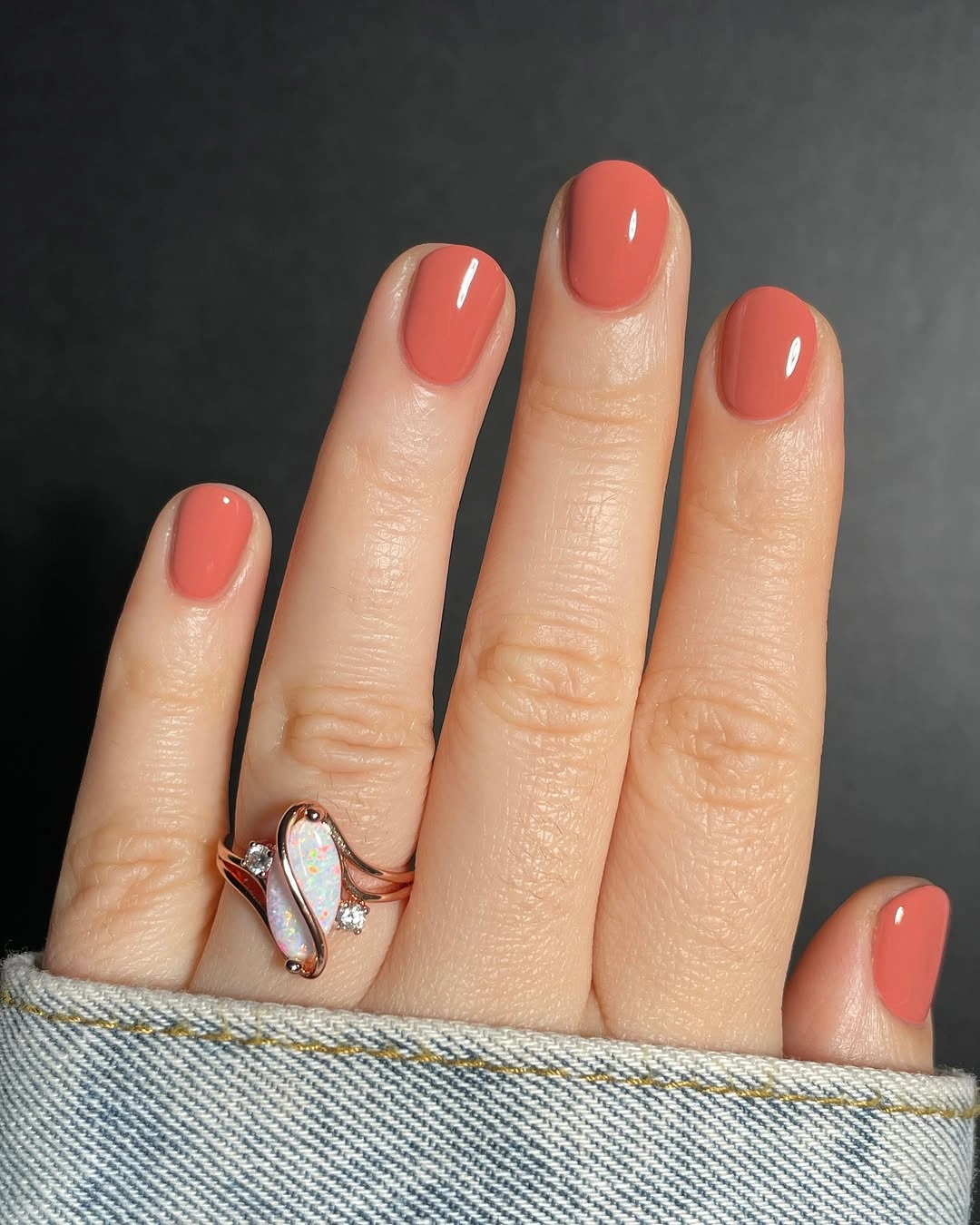
Lower saturation moves coral into September more gently than adding brown or dropping to a dark value. Light denim cools the warm polish, making its salmon undertone easier to see. The combination still retains summer lightness, but the softened chroma removes the sharper tropical quality of brighter coral.
Short rounded tips make this a low-maintenance final option with no pattern to repair. Minor edge wear should be less stark than it would be against black cherry, and the medium-light shade leaves room for deeper clothing colors. Coral, denim, and a small rose-toned accent form a useful early-fall palette for anyone who wants change without visual weight.