Polka dots look freshest when the surrounding space is edited. The ideas here move from brown and white to pale blue, olive, blush, and green, but the clearest reset comes from choosing one dot scale, one open base, or one purposeful accent instead of stacking every possible motif. That is what gives these polka dot fall nails a crisp point of view.
Some sets repeat dots across every nail, while others tuck them into curved tips, reverse the base and dot colors, or pair the pattern with bows, plaid, stripes, and small lines. Shape changes the result too: short rounded nails make dots feel neat, almond tips give them room, and a square edge makes the pattern more graphic. The useful question is always what the dots are allowed to do.
Brown And White Unite Bows Dots And Plaid
Short oval nails combine three motifs – small bow outlines on white, brown dots on pale nails, and brown-and-beige plaid lines – with glossy brown solids between them. The different designs could easily compete, but the limited palette keeps their edges related and the compact shape keeps each motif in proportion. A single brown accent color travels through the entire set.
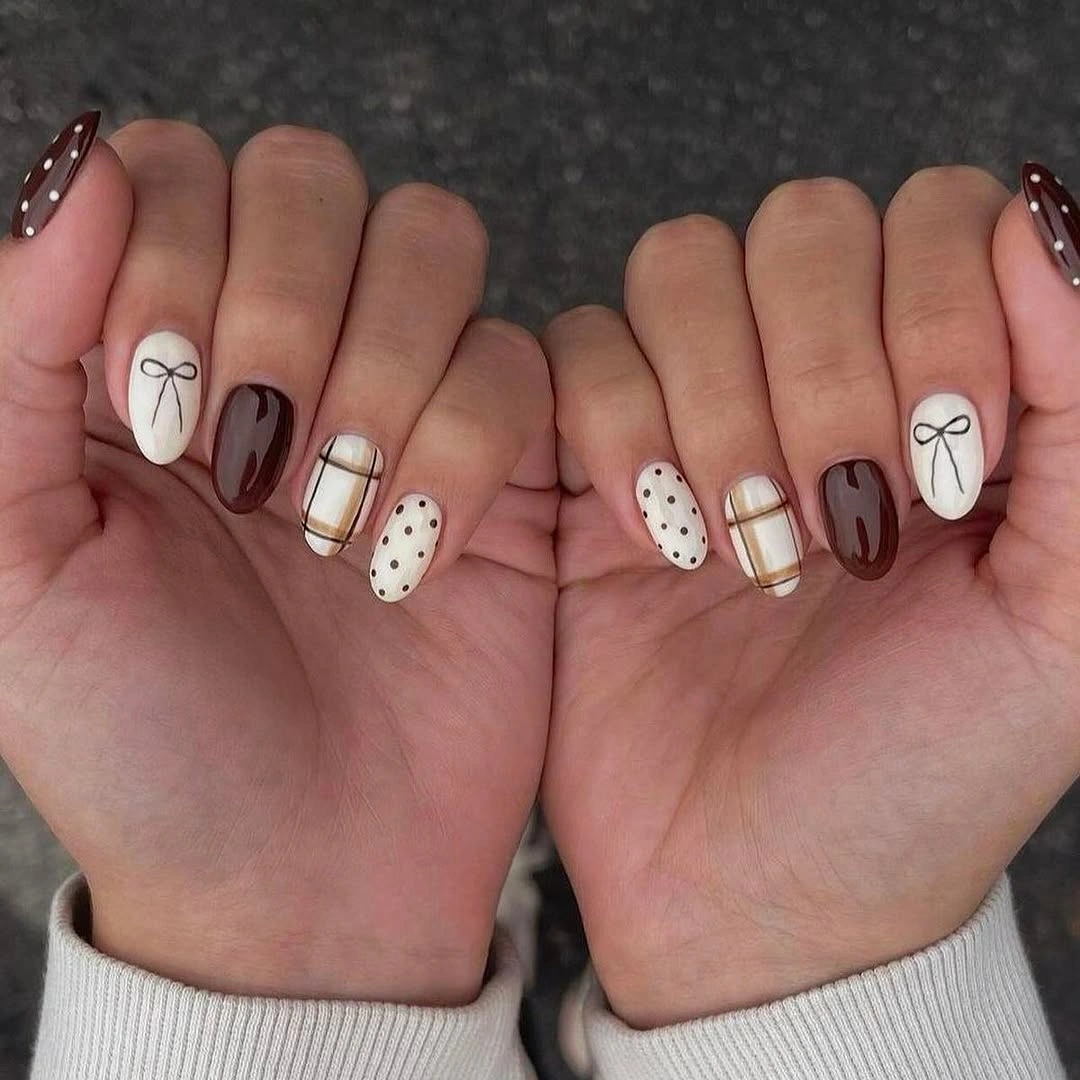
The composition feels clear because the motifs are distributed rather than piled onto one nail. Bows add a delicate mark, dots supply repetition, and plaid brings straight direction; brown solids give all three a visual pause. That is a useful way to approach polka dot fall nails design when you want variety but still need the manicure to read as one collection.
For a cleaner version, choose dots plus either bows or plaid and keep the same brown-and-white relationship. Short oval tips can carry larger, simpler marks, while cream can soften the white ground. Three motifs are the maximum point of interest here, so removing one competing detail will usually improve clarity more than adding another color.
Small Dark Dots Keep Warm Brown Calm
Every short rounded nail uses a warm brown base with small dark dots spaced across the surface. The dots are repeated consistently, but the brown ground remains open enough that the pattern does not become a solid dark block. A soft highlight on the surface adds definition without changing the simple two-color structure.
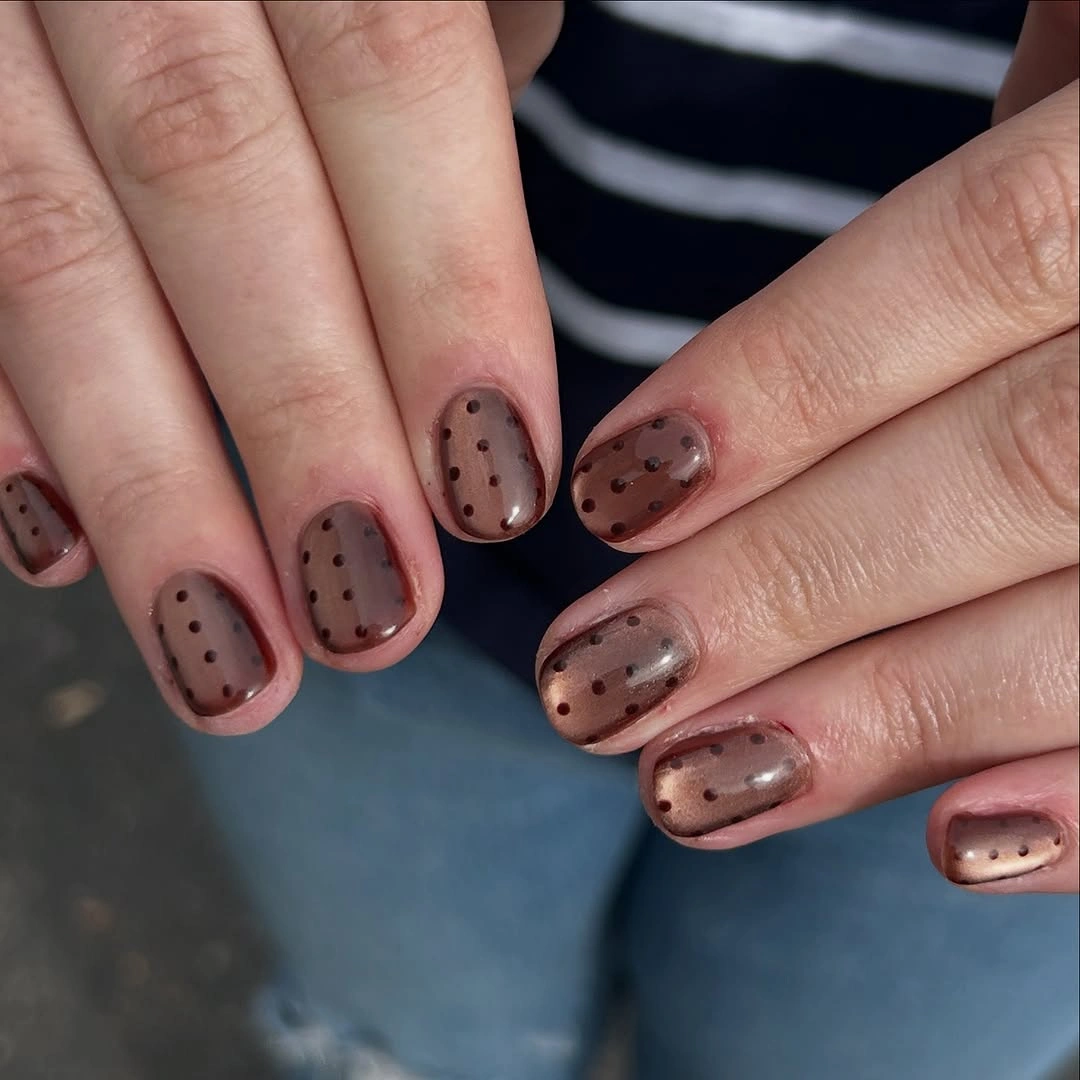
Low contrast does the work of making a full-set pattern feel quiet. Dark dots are visible, yet they sit inside the warm brown field instead of competing against a bright white base, and the rounded tips keep the design compact. The result is easy to understand because there is no second motif asking the eye to change direction.
Keep the dot diameter small and the spacing generous if you adapt this for polka dot fall nails short. A lighter brown or muted taupe can make the base softer, while cream dots will create a little more definition without becoming stark. The practical tradeoff of a full set is that uneven spacing shows across every finger, so consistency matters more than density.
Dense White Dots Follow Chocolate Almonds
Medium almond nails are covered in glossy chocolate brown and dense white dots that run from base to tip. The pattern is full coverage, but the dots sit in loose rows instead of a rigid grid, which lets the tapered shape stay visible underneath. High contrast makes the motif unmistakable and turns the simple repeat into the main visual feature.
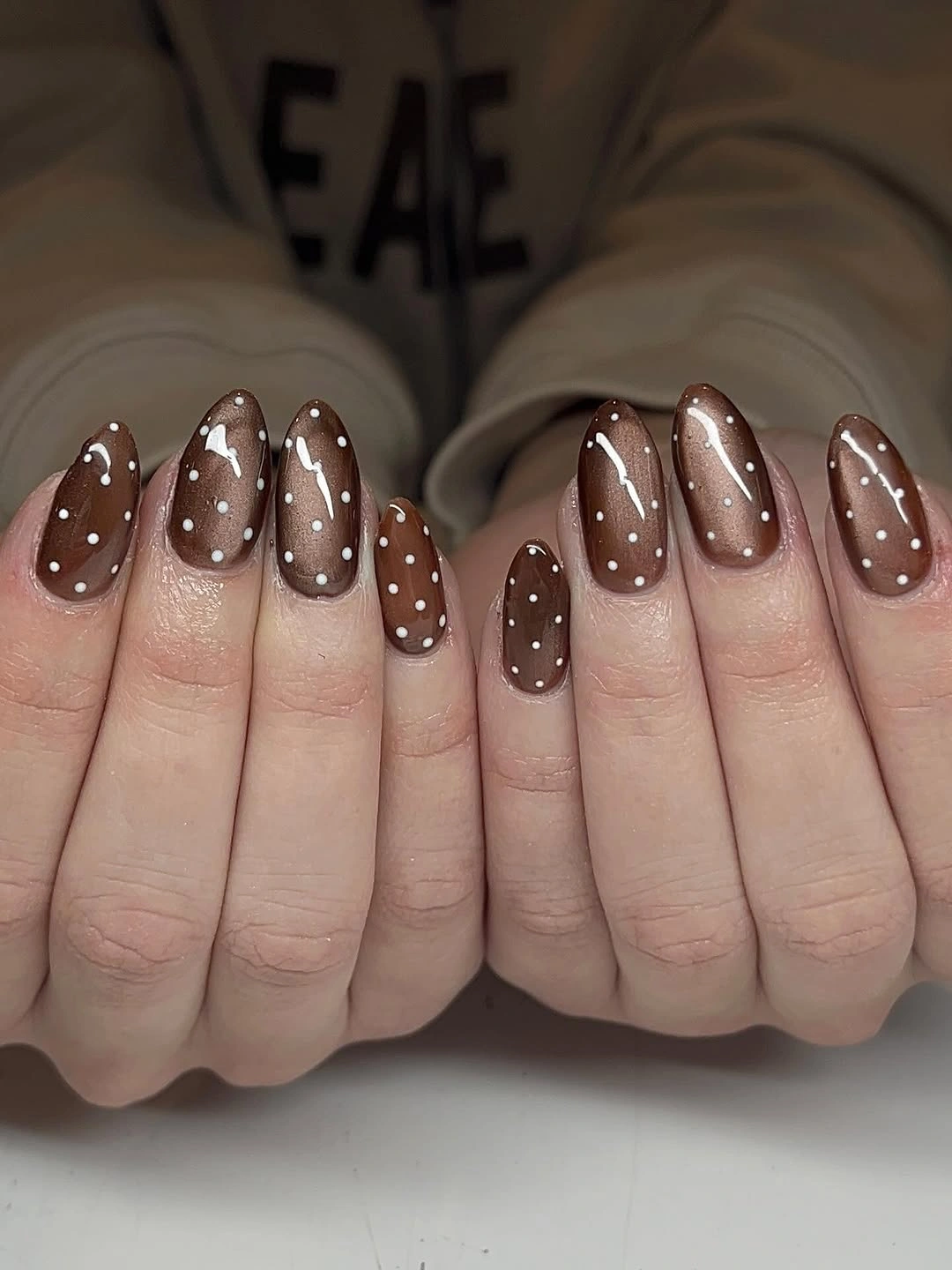
Almond tips soften the geometry by narrowing the outer edge, so the dots feel lively rather than square and blocky. Limiting the palette to chocolate and white keeps the dense pattern under control, while the glossy surface gives small marks a clear finish. A cream dot would lower the contrast, but bright white makes the rhythmic repeat the point of the set.
On a shorter oval, reduce the number of dots rather than squeezing the same rows into a smaller surface. Beige can replace white for a quieter result, and one full dotted accent can stand in for an all-over manicure. This pattern needs even dot size from nail to nail, so the clean reset comes from editing the field, not from adding extra decoration.
Looser Dots Give Cocoa Almonds Breathing Room
Warm glossy cocoa covers medium-long almond nails, with small white dots spaced more loosely than in the dense version. The larger gaps keep the brown field visible and make the full set feel lighter, while the long taper gives each row room to follow the nail without bunching. The pattern is consistent, but it does not insist on perfect grid geometry.
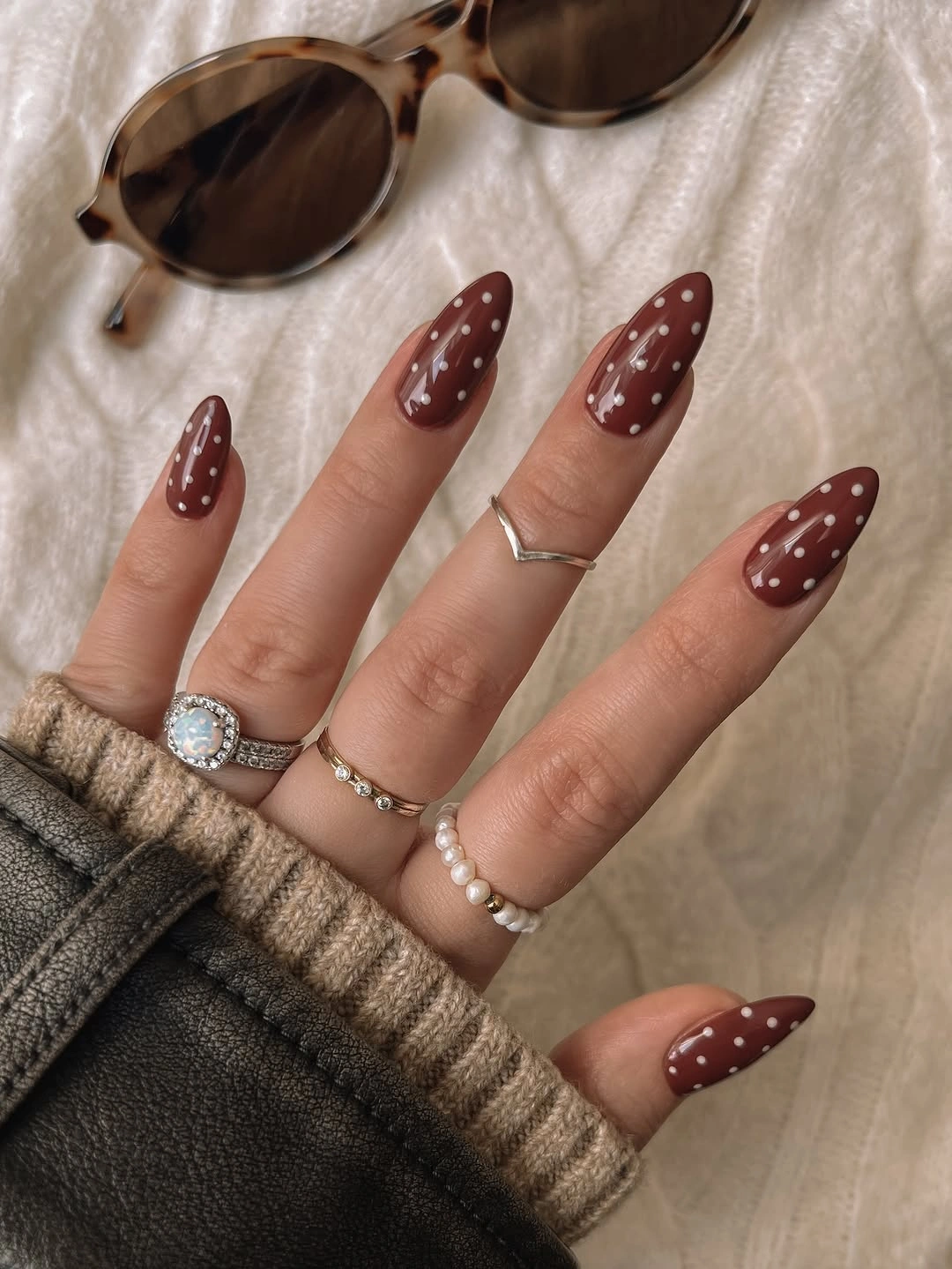
Spacing changes the personality of the same motif. More open areas make the design easier to scan and stop white dots from visually widening the tip, while the warm brown keeps the contrast softer than black would. Knit and neutral surroundings echo the palette, but the manicure is structured by its own repeated intervals.
Use fewer dots on a short shape and keep them slightly farther apart near the edge. A matte cocoa finish will make the dots even more subdued, while a cream color can replace white without losing readability. Longer nails reveal spacing differences clearly, so the honest limitation is that an airy pattern still needs a steady hand to look deliberate.
Varying Dot Scale Creates A Graphic Accent
Short-to-medium rounded nails mix taupe and cream bases with large white dots on some nails and black oval spots on others. The change in scale makes the set more graphic than a standard repeated polka pattern, yet the neutral palette keeps the marks from becoming loud. Rounded tips give the larger shapes room to sit without stretching the fingers visually.
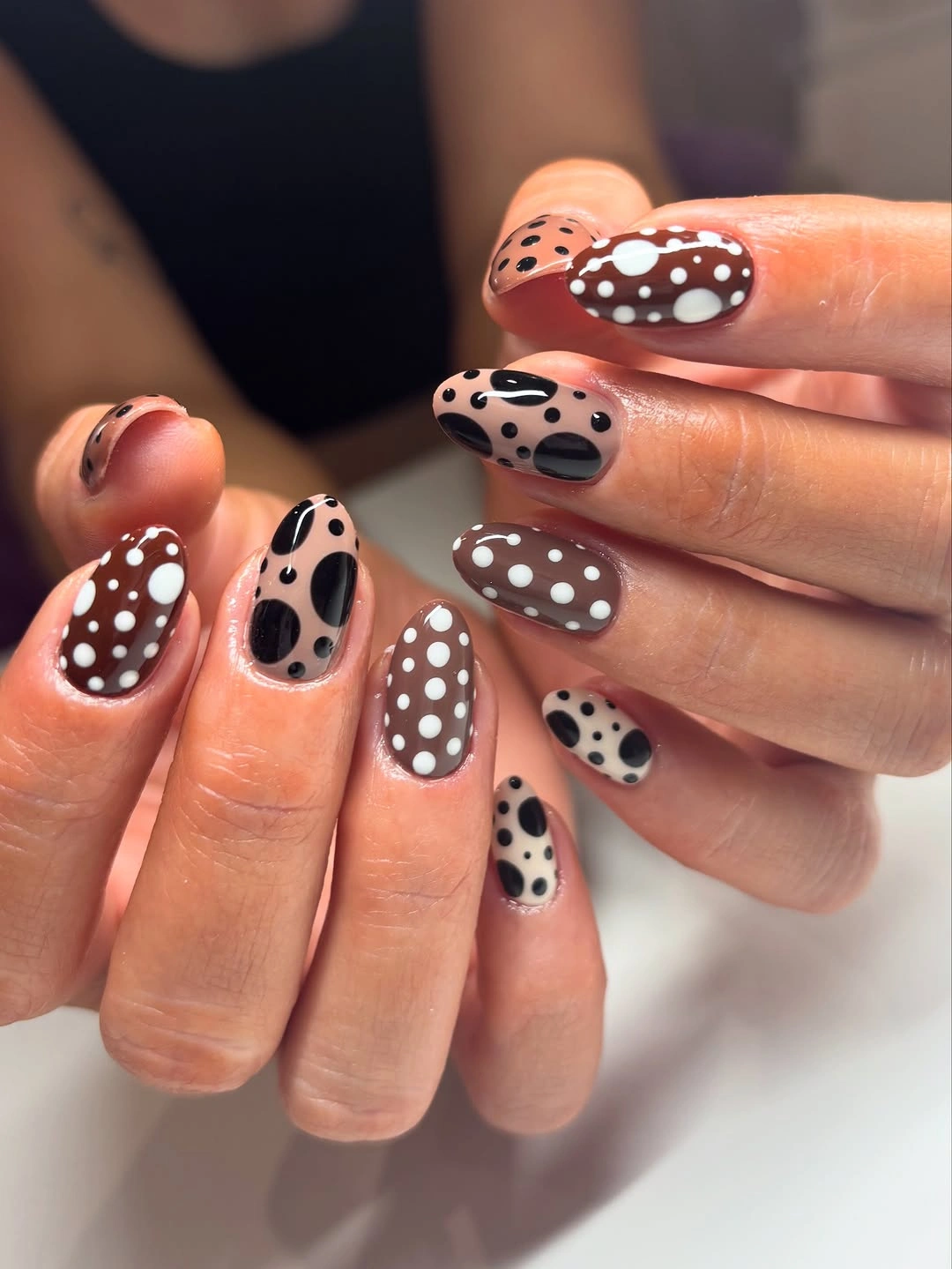
Different mark sizes provide movement while the bases stay quiet. White dots brighten the taupe nails, black spots define the pale ones, and the repeated circular language keeps the two formulas connected. Because the largest marks are reserved for selected nails, the pattern feels edited rather than enlarged everywhere.
Choose one nail for larger spots and keep the remaining dots smaller if you want an easier polka dot fall nails design. On very short tips, place the biggest mark toward the center and leave the edge clear so the nail does not appear shorter. The tradeoff is scale: oversized dots become the focal point quickly, so use them only when that stronger accent is wanted.
Outlined Tips Link Nude Nails With Dots
Sheer nude-looking almond nails use two related details: dark brown nails carry small white dots, while pale nails receive a fine brown edge around the tip. The dot color returns as the outline, creating a connection without spreading pattern across every surface. Medium length and open nude space keep the set delicate rather than busy.
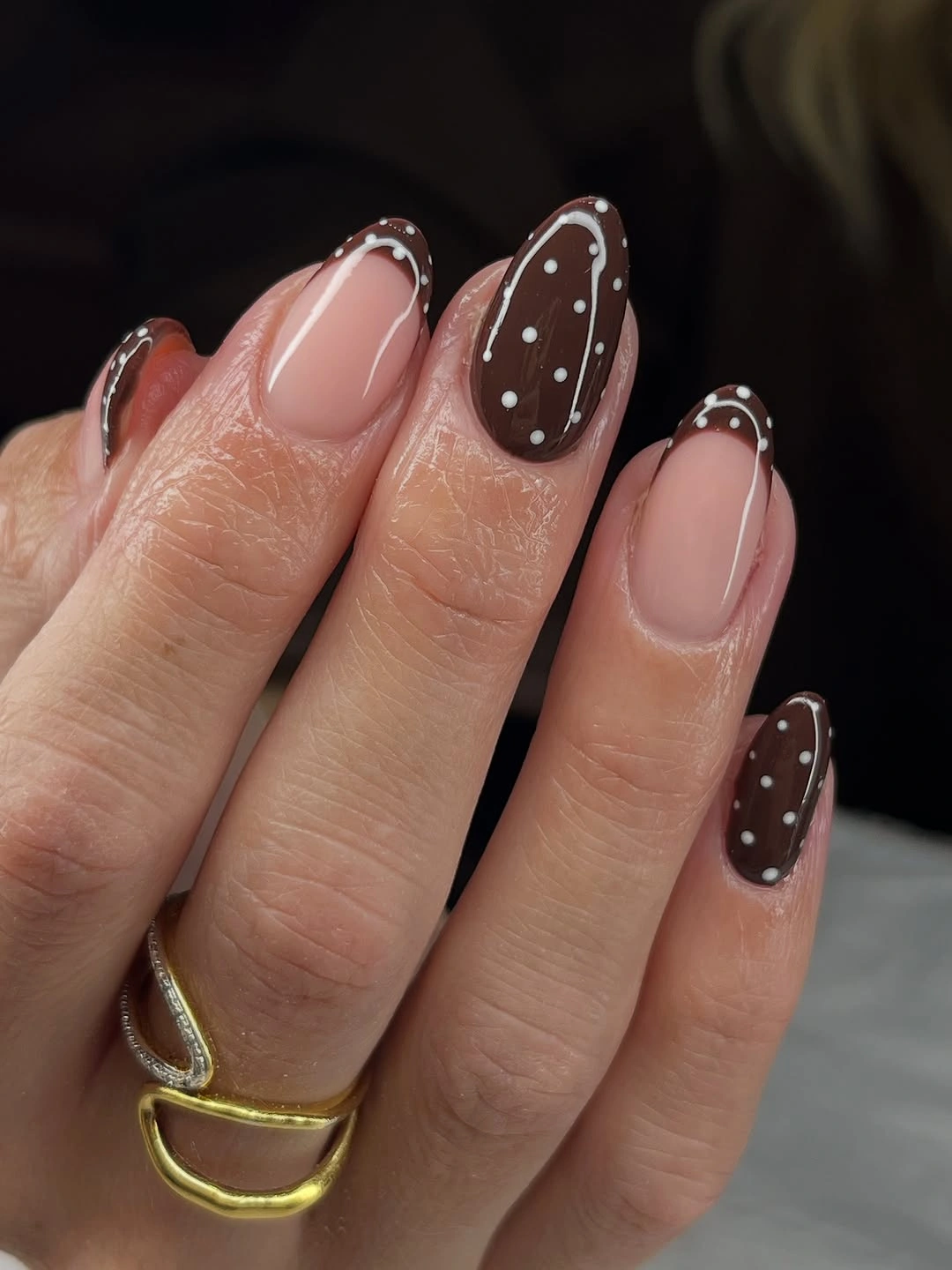
The thin edge is a smart supporting detail because it gives the pale nails definition while leaving their centers open. Dots remain the brighter focal accents, and the shared brown helps the set move from patterned nail to outlined nail without a new motif. A full dotted set would feel more playful, but this split arrangement offers a cleaner visual reset.
Keep dots on two accent nails and repeat the brown as a narrow curved tip on the others. Cream or taupe can replace the nude base, while a shorter oval can use fewer dots and a thicker, simpler edge. Fine outlines show uneven curves easily, so the practical choice is to reduce the line rather than add more detail when the surface is small.
Warm Brown Dots Travel Across Almond Tips
Medium-long almond nails use a warm brown base with small white dots repeated at regular intervals across every visible nail. The base looks slightly open and translucent, so the dots appear integrated rather than stamped onto a heavy block of color. Denim and a brown accessory frame the warm palette, but the pattern itself remains the central structure.
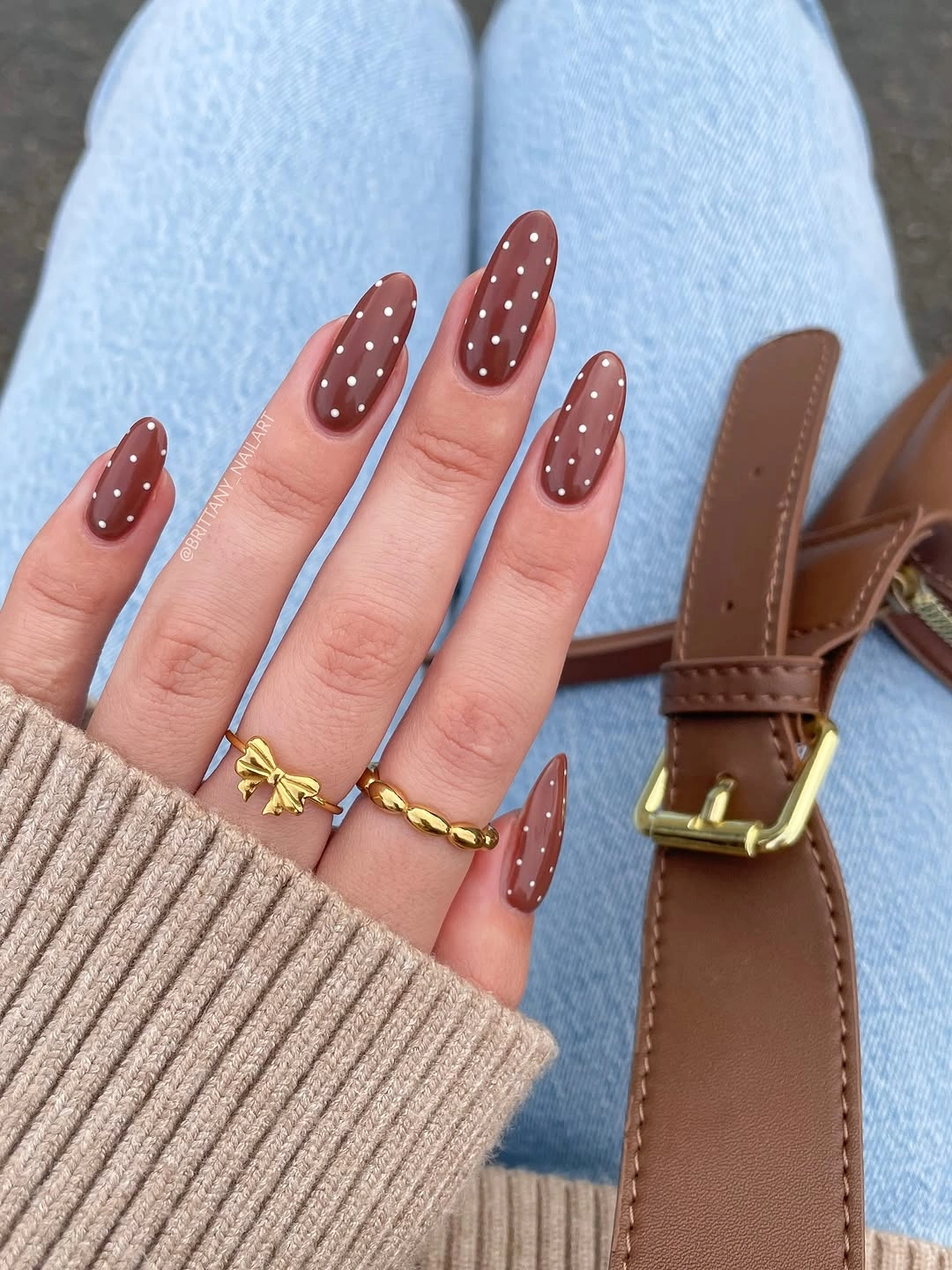
Small dots preserve the almond taper because they do not create a wide band near the free edge. Regular spacing gives the full set a neat rhythm, while the warm brown keeps the contrast approachable and easy to coordinate with neutral clothing. This is a restrained version of polka dot fall nails almond because it relies on one motif and one soft base.
Use fewer rows on shorter oval nails and switch white to cream if you want lower contrast. The best adaptation keeps the dot size consistent while allowing the spacing to open near the tip. A full set requires both hands to follow the same rhythm, so the maintenance concern is not the color but the repeated placement.
Taupe Brown And White Dots Stay Crisp
Short-to-medium oval nails use a glossy taupe-brown base with small white dots repeated across the full surface. The dots are evenly distributed and similar in size, giving the set a clean, patterned rhythm against the soft neutral ground. A bright blue garment nearby makes the warm base look even richer, but the manicure itself remains composed.
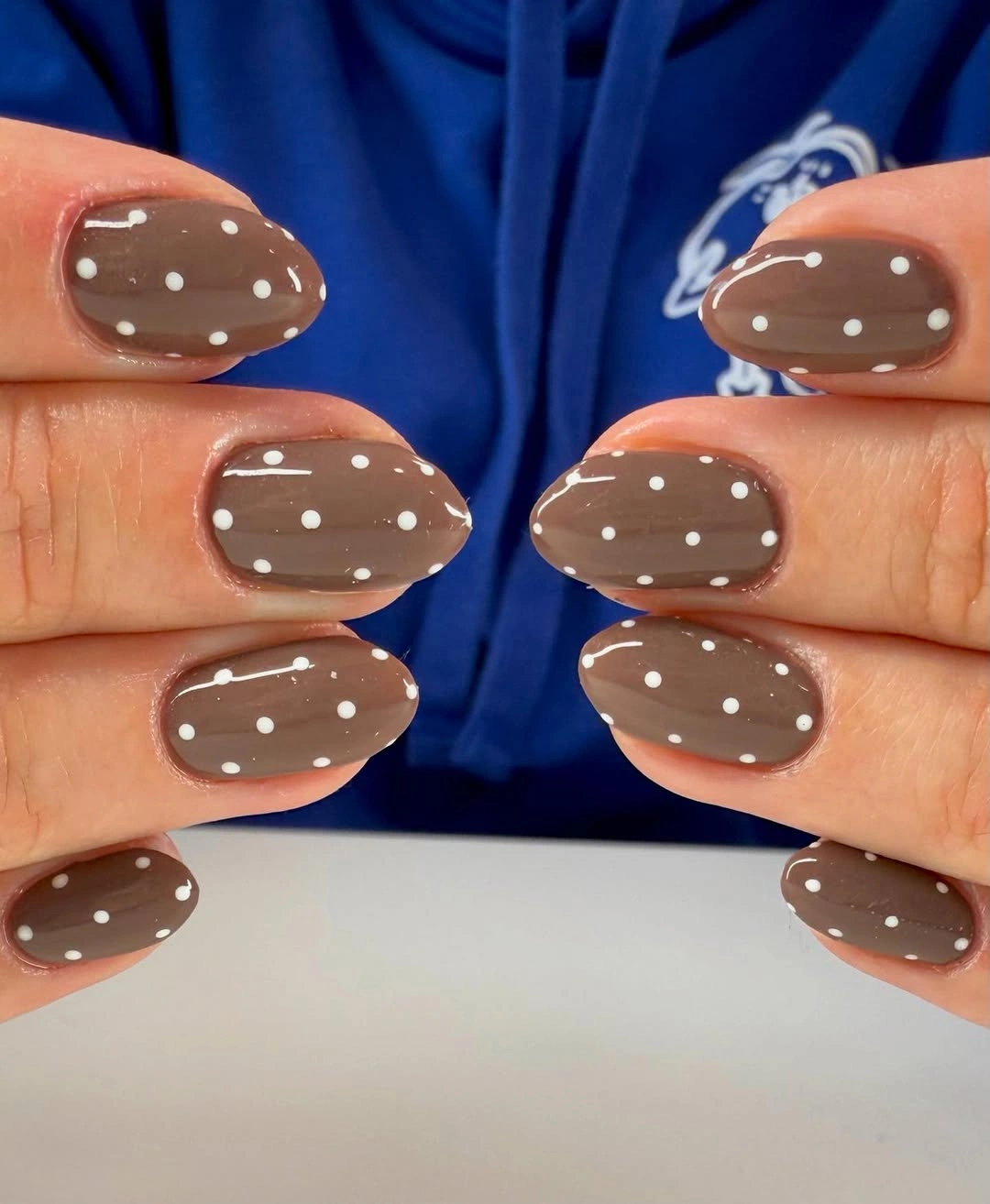
Consistency is the visual feature here. The taupe undertone softens the contrast, while the regular repeat keeps the manicure from looking accidental or overly decorative, and the oval shape prevents the rows from feeling too rigid. Changing the finish to matte would make the pattern quieter, but the gloss currently helps every dot stay distinct.
For polka dot fall nails short, keep the same base and shorten the rows rather than shrinking the dots too far. Cream can replace white for a softer pairing, and a single dotted accent can simplify the set further. Precision is the honest cost of a uniform pattern: small spacing differences are visible because every nail follows the same plan.
Fine Lines Stretch A Short Brown Dot Pattern
Glossy brown rounded nails carry small white dots, while selected fingers add thin pale vertical or curved lines. The line work gives the compact shape a little length and direction, but the dots remain the recognizable motif. Because the extra strokes appear only on some nails, the set gains variation without becoming a two-pattern overload.
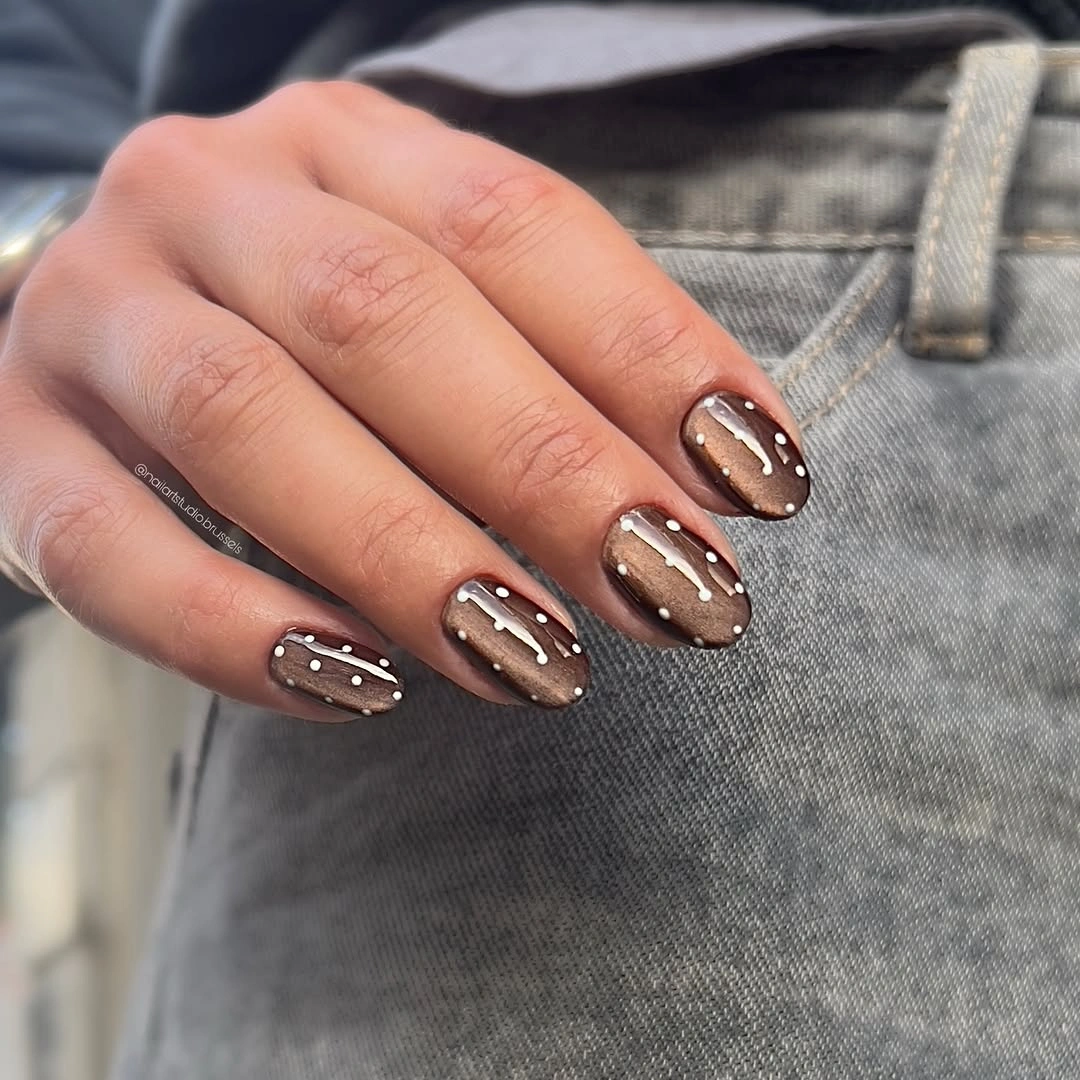
A narrow line changes how the eye reads a rounded tip. It introduces a vertical path that offsets the soft outline, while the dots add the expected circular rhythm and keep the design connected. The warm brown base provides enough contrast for both details, yet its glossy surface prevents the marks from feeling chalky or flat.
Use one line on two nails and leave the rest dot-only if you want a simpler polka dot fall nails design. On a very short shape, keep the line centered and use fewer dots around it so the surface stays open. Combining two motifs requires more space than either one alone, so removing a line is usually more effective than adding another color.
One Pale Yellow Nail Reverses The Dots
Dark brown almond nails carry small cream dots, while one pale yellow nail reverses the arrangement with darker dots on a light base. The motif stays identical even though the background changes, which makes the accent easy to notice without introducing a new pattern. Medium length gives the light nail enough space to show the contrast clearly.
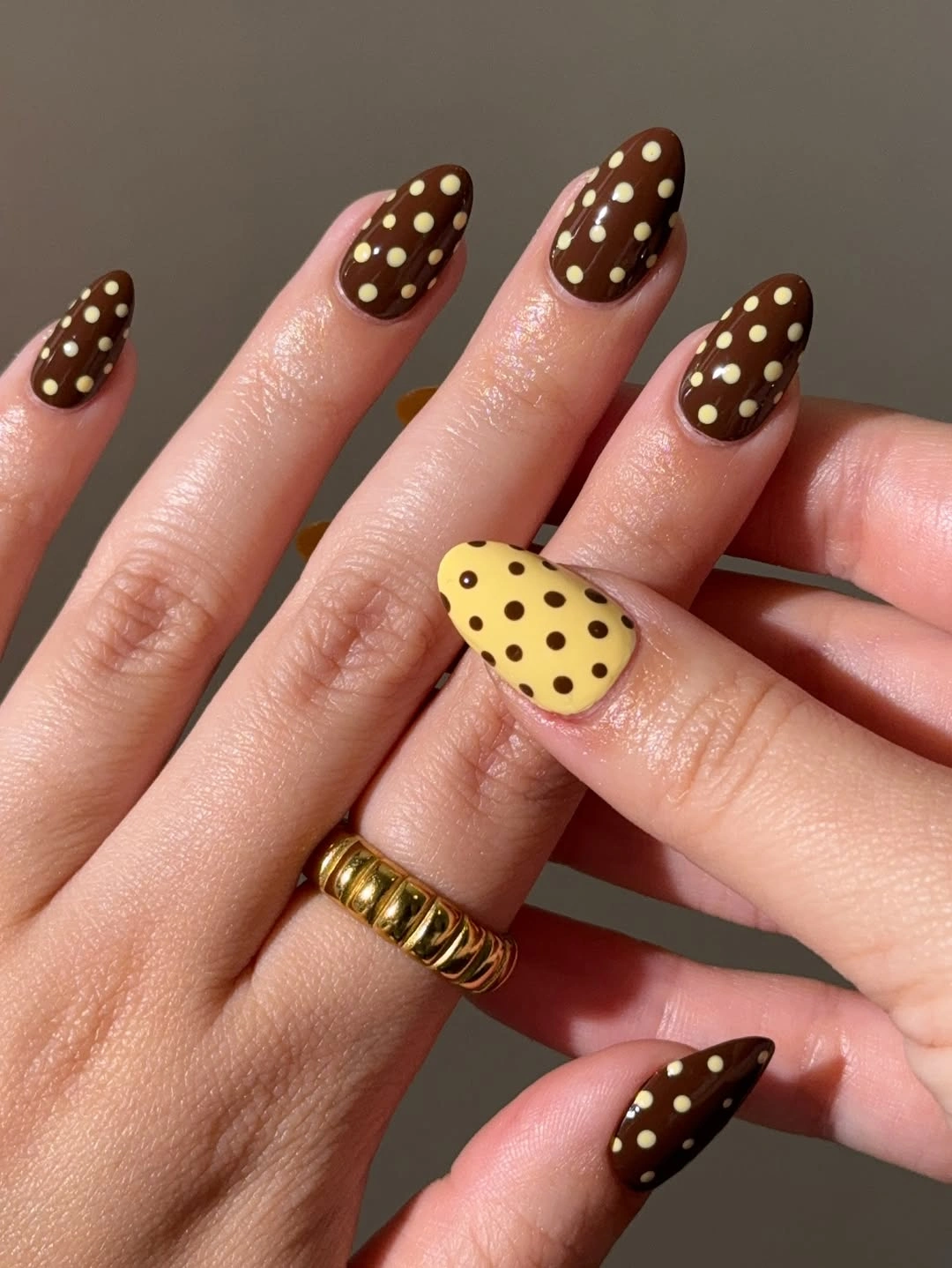
Base reversal is what creates the focal point. The dark nails keep the set grounded, the pale yellow surface brings a warm flash of light, and the repeated dots link both formulas immediately. Because the accent changes only the background and not the motif, the manicure feels fresh without losing its simple structure.
Use cream, muted ochre, or blush if yellow feels too bright, and keep the light base to one nail so brown remains the anchor. A short oval can use larger dots with more space between them, while a medium almond can retain the regular rhythm. Light accents attract attention quickly, so neat dot placement becomes especially important on that one nail.
Dots Stripes And Plaid Share One Palette
Medium almond nails mix cream bases with dark dots, brown and tan stripes, deep brown nails with white dots, and a few plaid-like blocks. The motifs point in different directions, but brown, cream, and tan keep their colors close enough to form one visual language. Stripes add a narrow vertical rhythm that breaks up the round repetition of the dots.
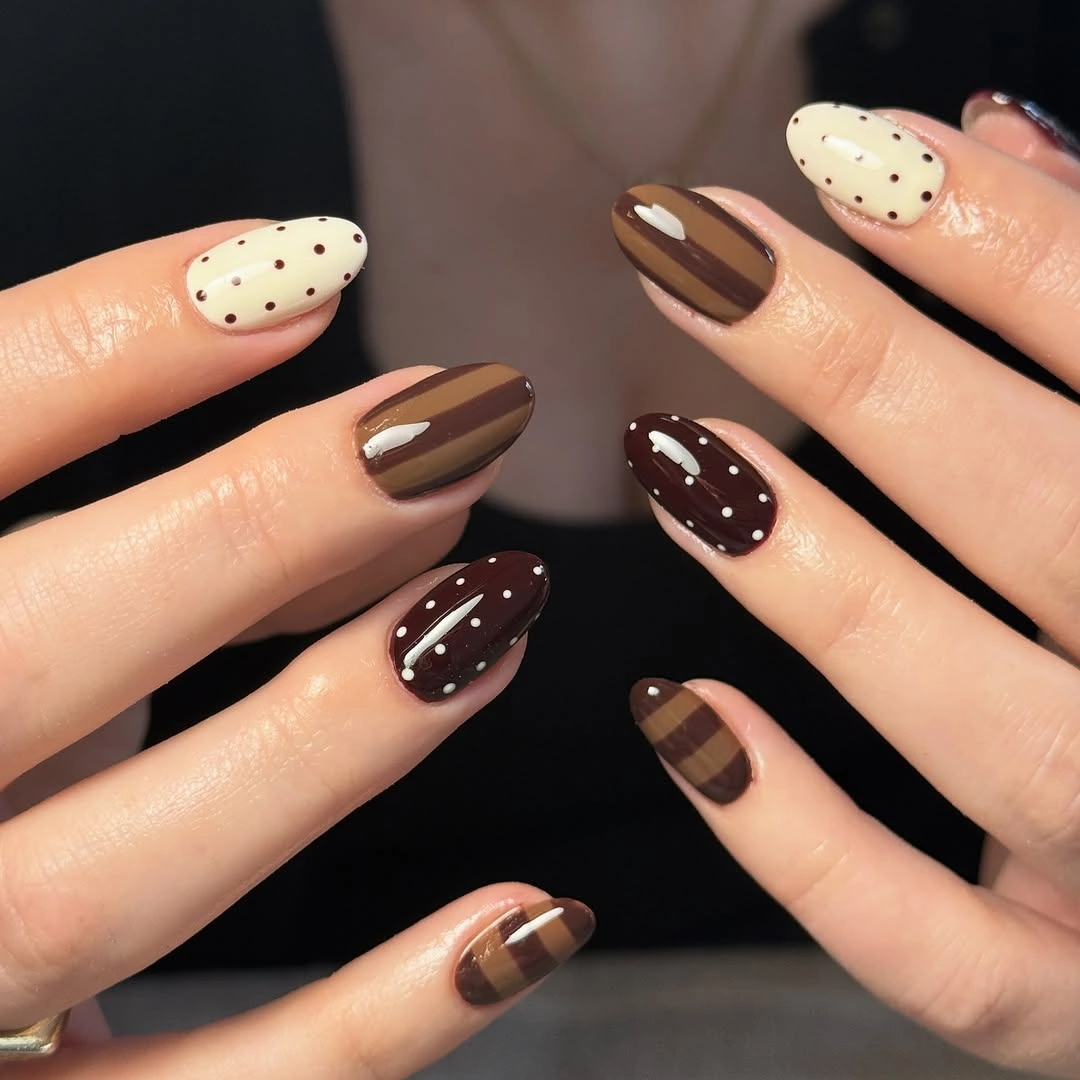
Shared color does the connecting, while distribution keeps the set readable. Dots carry the recurring idea, stripes stretch the almond silhouette, and plaid-like blocks offer a denser accent; each has a distinct role and enough space around it. Adding a fourth bright color would make the mix less clear because the palette is already doing the difficult organizational work.
Choose dots plus one directional motif for an easier polka dot fall nails almond version. Keep stripes on two nails or use a small plaid panel, then let cream and brown repeat throughout. The honest limitation is visual editing: several motifs can look fresh only when their scale and placement are intentionally uneven, not when every nail is equally busy.
Mauve Brown Makes Even Dots Feel Softer
Medium-long almond nails use a mauve-brown translucent-looking base with dark dots repeated across the full set. The berry undertone shifts the pattern away from classic chocolate and gives the warm neutral a softer, slightly cooler direction. Dots are regular but not crowded, so the long shape remains visible through the open spaces.
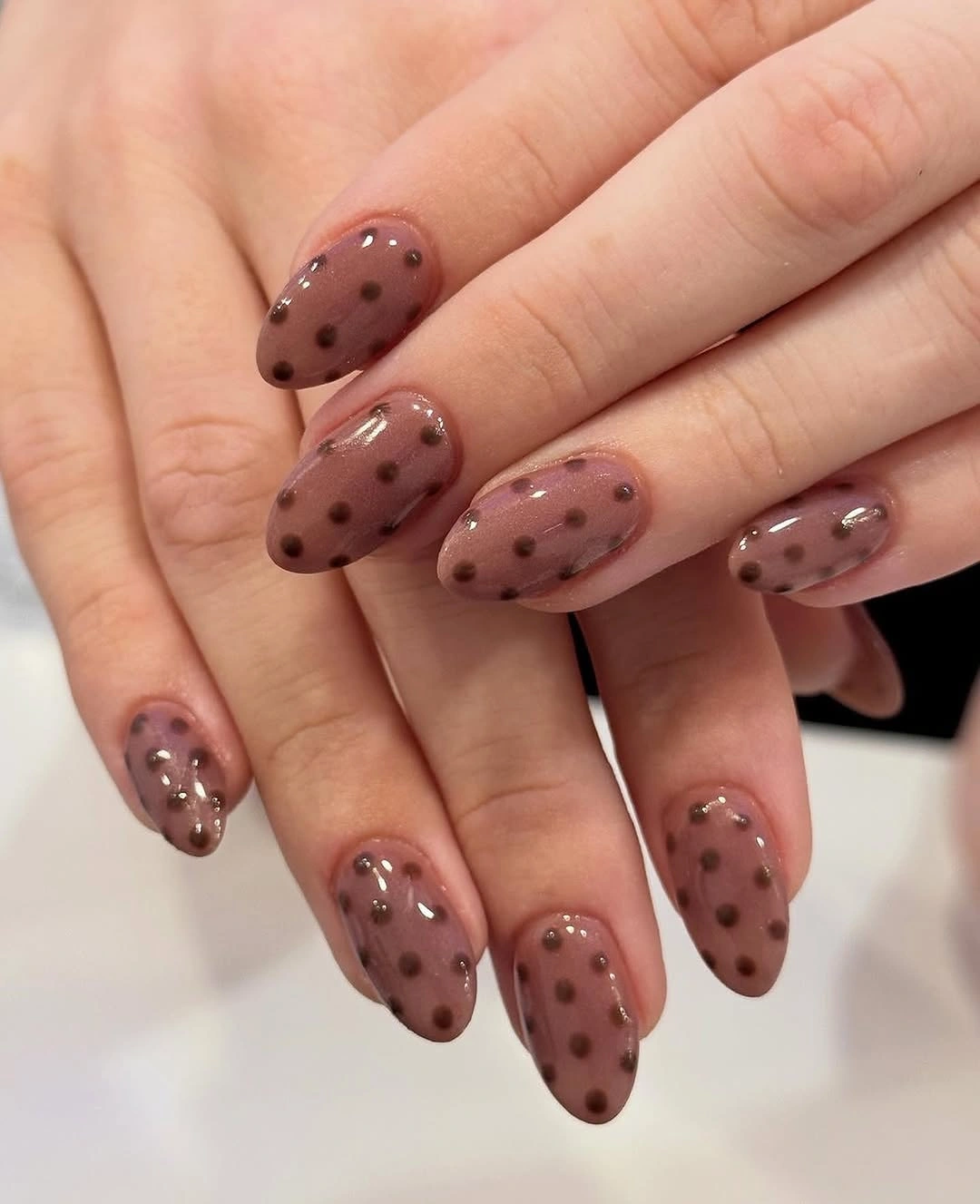
Undertone changes the mood without changing the motif. Mauve brings a quiet berry note, dark dots provide definition, and generous spacing lets the base color remain the first impression. The pattern feels complete because it is consistent, but it never becomes a dense field that would hide the almond taper.
Reduce the dot count on a short shape and keep the same mauve-brown base if you want a calmer result. Cream dots will create a softer contrast, while a deep plum base can make the pattern more dramatic. Longer nails reveal the spacing over more surface, so the practical choice is to open the gaps before making the dots smaller.
Deep Plum Gives The Classic Motif Weight
Medium almond nails use a deep plum-burgundy base with small pale dots repeated across every visible nail. The color is richer and darker than a standard brown, so the simple pattern feels more autumnal even though the dot shape stays familiar. Dark clothing and jewelry reinforce the depth, while the pale marks keep the surface legible.
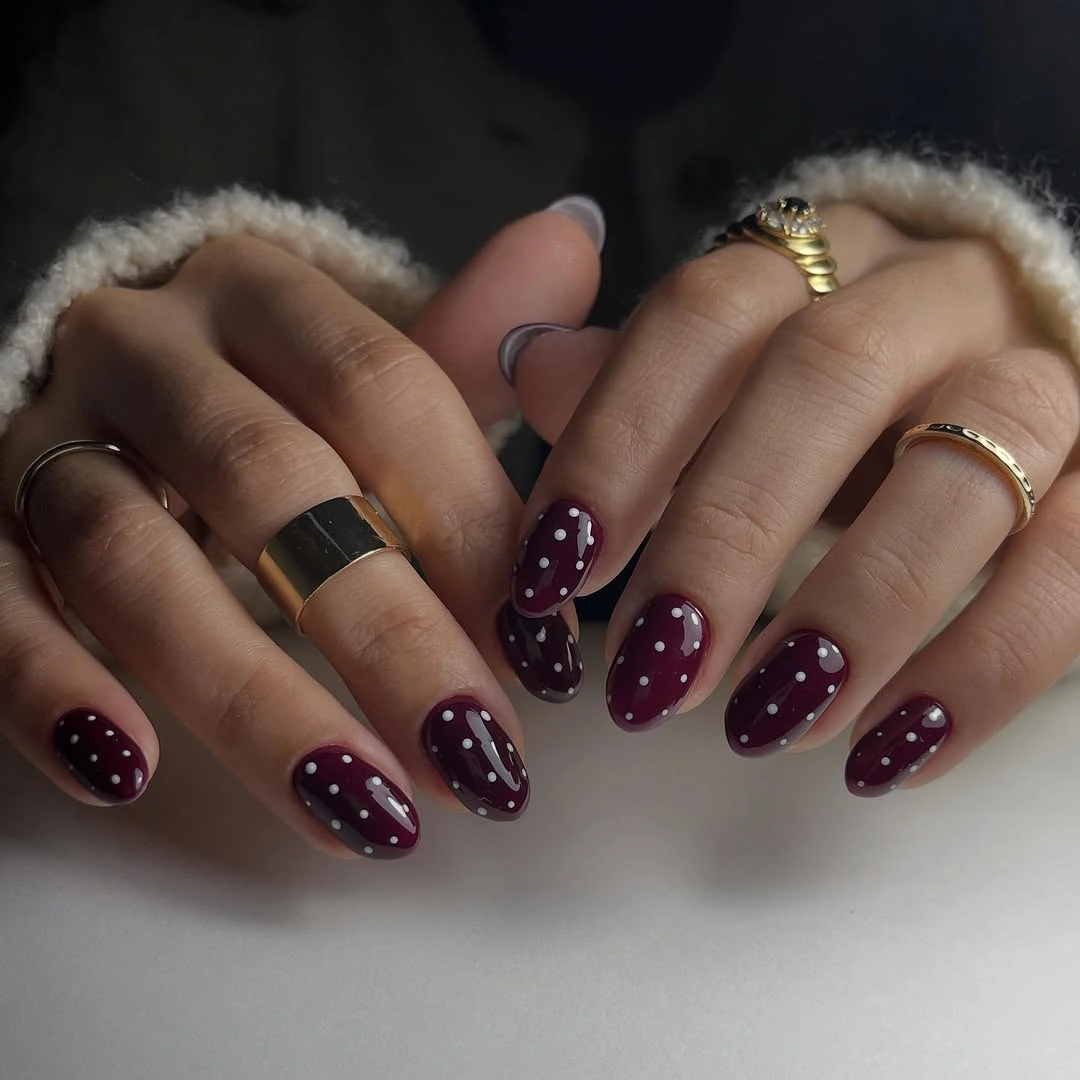
A berry undertone adds weight without requiring larger decorations. The dots preserve the base color between them, and the almond length gives the pattern enough room to avoid looking crowded. The result shows how a change in hue can refresh an established design when spacing and scale remain disciplined.
Use maroon or cocoa if deep plum feels too intense, and keep the dots small enough that the base remains dominant. A shorter oval can reduce the number of marks near the cuticle, while a medium almond can keep the full repeat. Dark bases show pale placement clearly, so the cleanest adaptation uses fewer dots rather than a busier arrangement.
Curved Berry Panels Contain The Dots
Glossy burgundy almond nails alternate with pale nails carrying burgundy panels filled with small white dots. The dots stay inside curved colored areas instead of spreading across the whole nail, and pale space remains visible around the panels. That framing turns the familiar motif into a defined graphic element while keeping the tapered tip open.
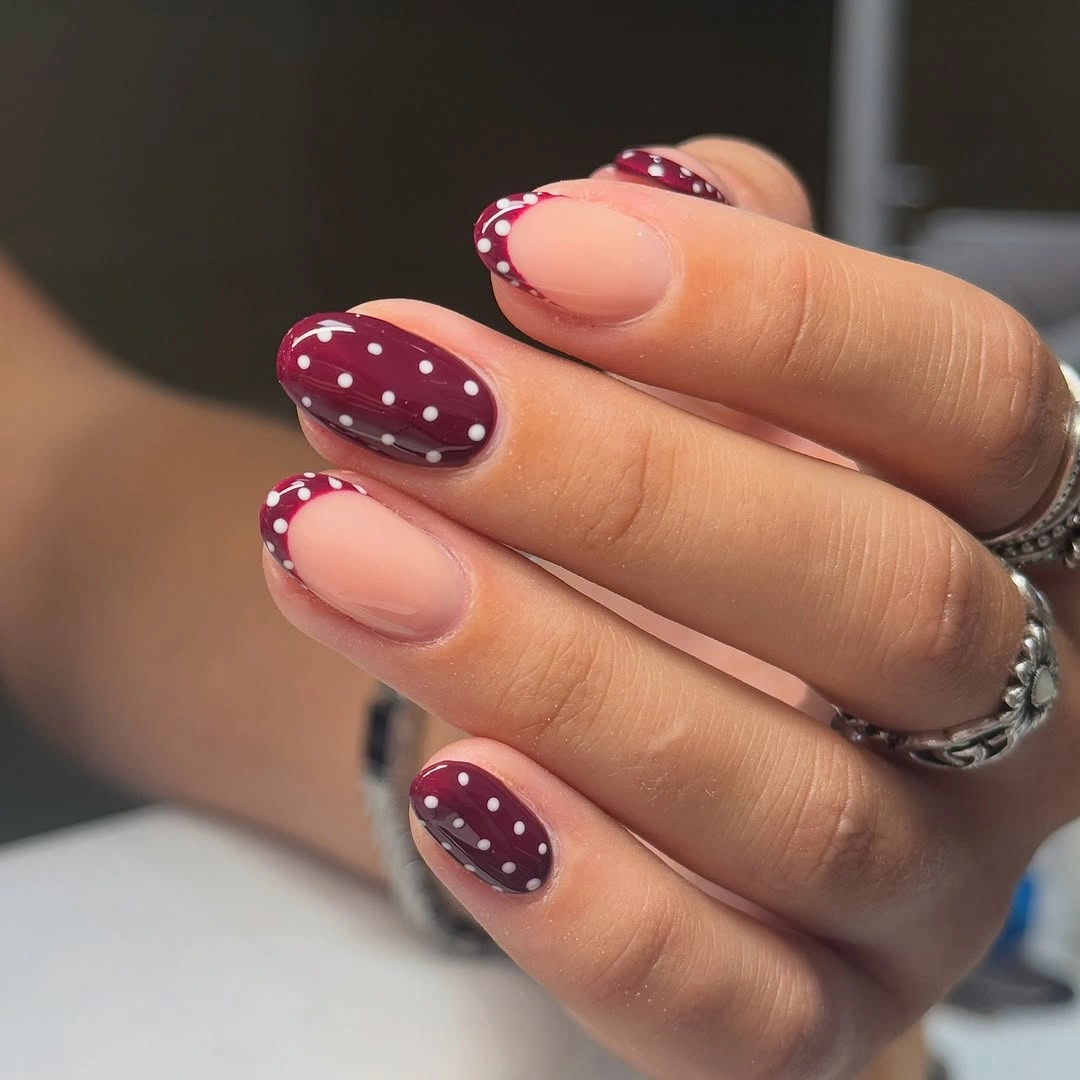
Panel edges give the dots a clear boundary, which is why the design feels more structured than an all-over pattern. Solid berry nails repeat the panel color, while the pale surrounding space lets the curved shapes stand out without closing the nail in. The curve also follows the almond outline, creating a natural visual flow from side to tip.
For polka dot fall nails almond, use one small curved panel near the tip and leave the rest nude or taupe. Alternate panel nails with solid burgundy to keep the hand from becoming repetitive, and reduce the dot count on shorter tips. Curved borders require clean control, so the best simple version uses one strong arc rather than several thin ones.
Taupe Brown Dots Get Occasional Warm Points
Medium oval nails use a warm taupe-brown base with small white dots and a few tiny warm gold-like points mixed into the repeat. The extra points are rare, so they read as a quiet variation rather than a second glitter pattern. Softly glossy surfaces and rounded tips keep the neutral design gentle and easy to scan.
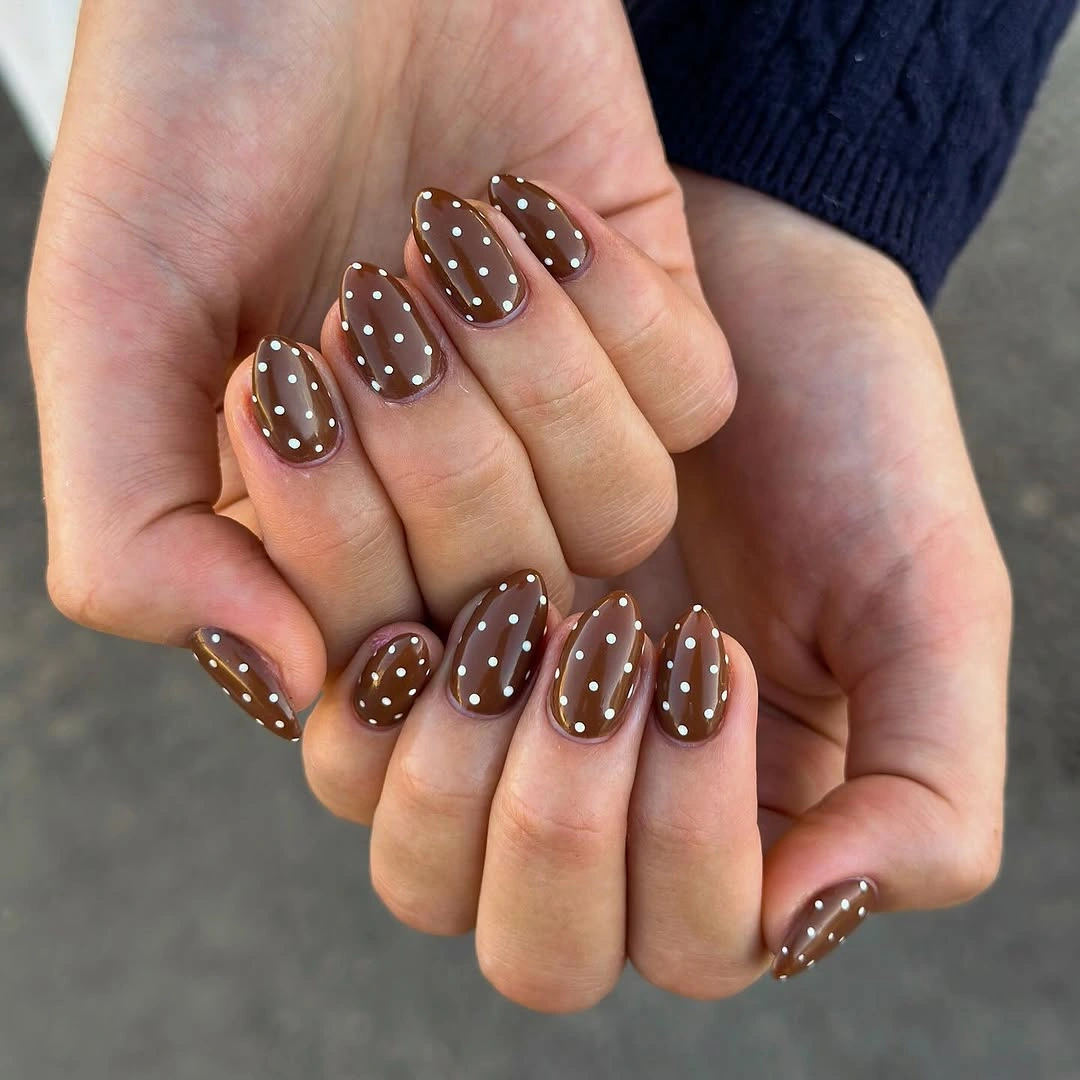
Small variation prevents a full set from feeling mechanically identical, but the main dot rhythm still controls the composition. Taupe keeps the base muted, white defines the pattern, and the occasional warm point brings a little light without taking the place of the dots. If warm points appeared on every nail, the design would lose its clean hierarchy.
Use only a few warm points and place them between dots rather than building a new motif. Cream can replace white for an even softer version, and a short rounded shape can keep the same quiet repeat. Tiny accents may disappear in low light, which is a fair tradeoff when the goal is subtle variation rather than a bright focal nail.
Edge-Set Dots Leave A Nude Center
Short rounded nude nails keep their centers open while small brown dots sit near the tips and thin dark outlines trace selected curved edges. The dots are contained within the border area instead of covering the whole nail, so the manicure feels light and clean even though the motif repeats across both hands. Tiny warm points appear only as supporting details.
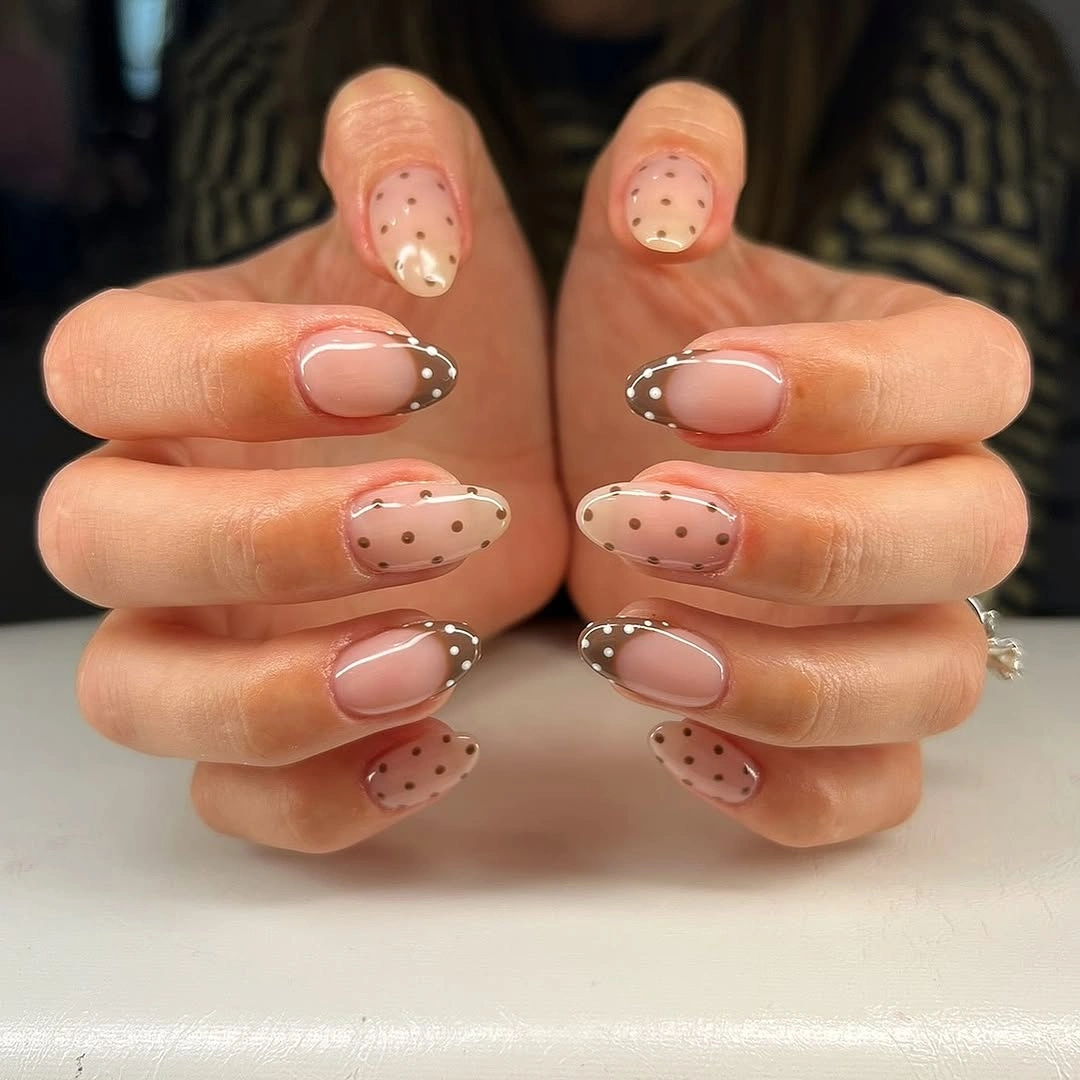
Open centers are the main reason the design looks fresh. The curved edge follows the rounded tip, the dots gain a clear boundary, and the pale base remains visible from cuticle to middle, creating visual breathing room. A full brown field would make the same dots more traditional, but the empty center gives this version its crisp structure.
Keep the dots close to the free edge and use one thin outline if you want a polka dot fall nails french tip variation. A solid brown border can replace the fine line on a shorter nail, while cream or blush can soften the base. Edge details are easy to notice when they wobble, so fewer, cleaner marks are the better adaptation.
Pale Blue And Brown Exchange Their Roles
Short rounded nails use pale blue bases with brown dots on some fingers, then reverse the formula with glossy dark brown nails carrying pale blue dots. The motif stays constant while the colors trade places, creating a cool-warm rhythm without adding another pattern. Rounded tips keep the exchange friendly and compact rather than sharply graphic.
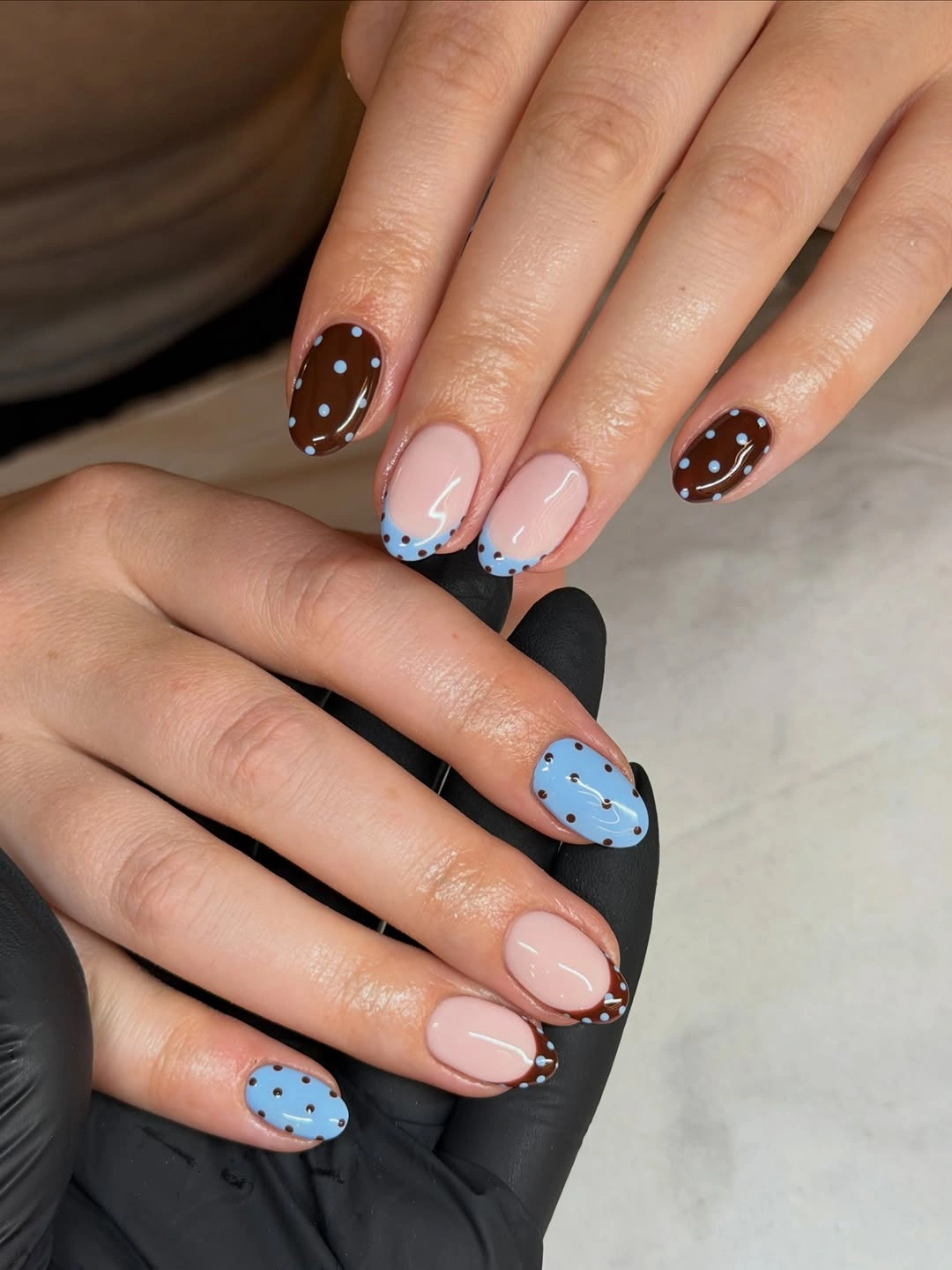
The two-way color relationship makes the set feel more complete than a single accent shade would. Pale blue opens the hand, brown grounds it, and each returns as the other nail’s dot color, so the pairing is balanced rather than split into warm and cool halves. That clarity is the defining decision, not the number of dots.
Use muted teal, cream, or taupe if sky blue feels too bright, and keep the dot diameter identical across both base colors. On shorter tips, reserve the reversal for two accent nails and leave the rest solid. Two strong contrast directions need consistent spacing, so simplify the number of dots before changing the color relationship.
Blush And Burgundy Reverse A Single Motif
Medium oval nails alternate pale pink bases with small burgundy dots and glossy burgundy bases with pale dots. The same circular mark appears in opposite color arrangements, making the manicure varied while staying easy to read. A blue denim background brings out the contrast, but the set itself relies on the warm berry pairing and the rounded shape.
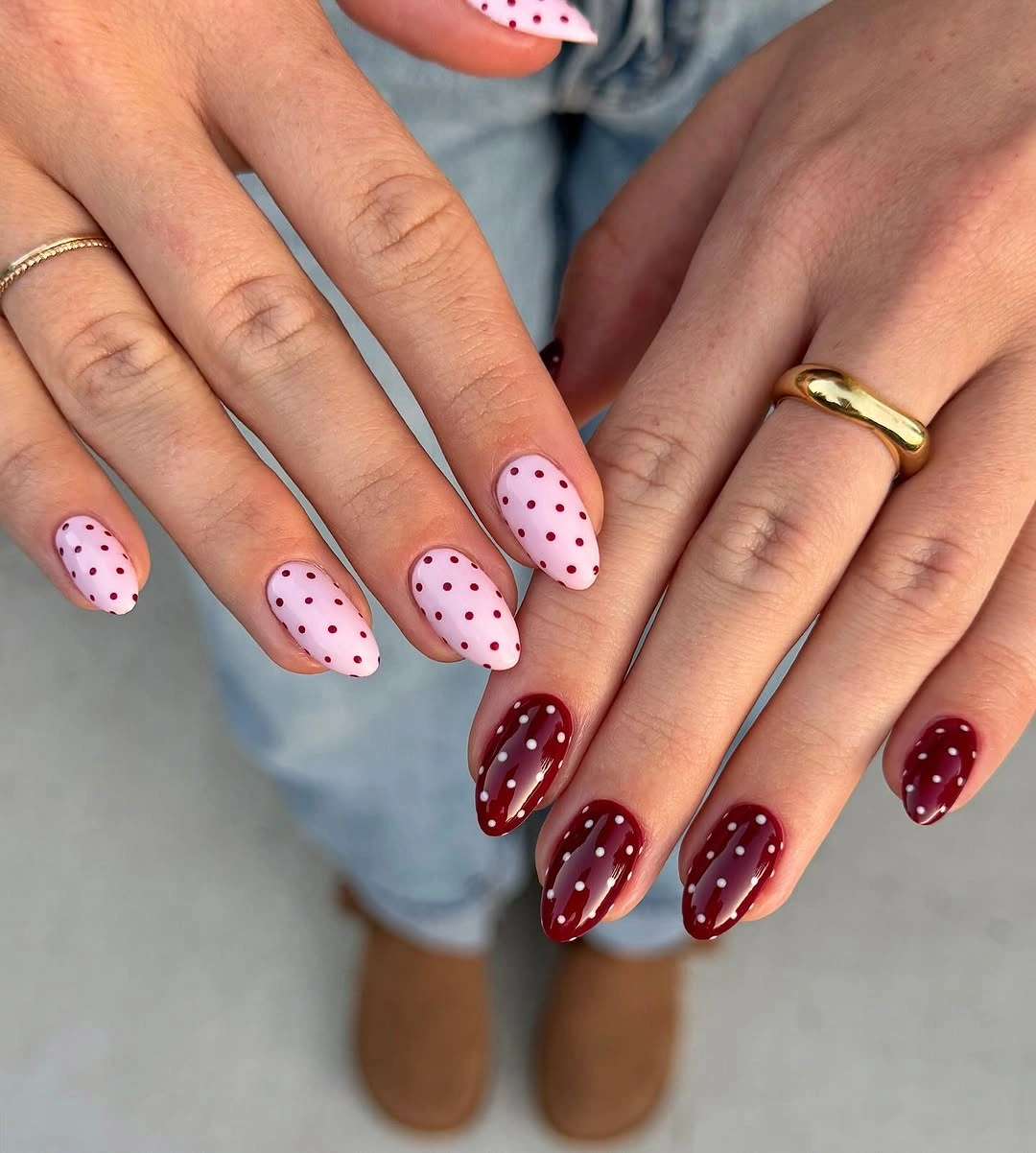
Reversing the colors creates a clear conversation between the nails. Pale pink supplies light space, burgundy adds depth, and each shade becomes both background and detail, which prevents either side from feeling like a random accent. The oval outline softens the contrast and keeps the two formulas from becoming too geometric.
Use the reversal on two accent nails if a full two-tone set feels too active, or substitute cream for pink to make the contrast cleaner. Keep the dot size and spacing consistent across both bases so the relationship remains obvious. The tradeoff is coordination: opposite color directions look intentional only when their pattern rhythm is equally careful.
Matte Olive Gives Polka Dots A Green Reset
Medium soft-square nails use matte olive green as the base and small cream dots as the only decoration. The green replaces the expected brown while still carrying a muted fall quality, and the cream marks keep the contrast softer than bright white. Straight edges give the repeated pattern a stable frame and make the set feel crisp.
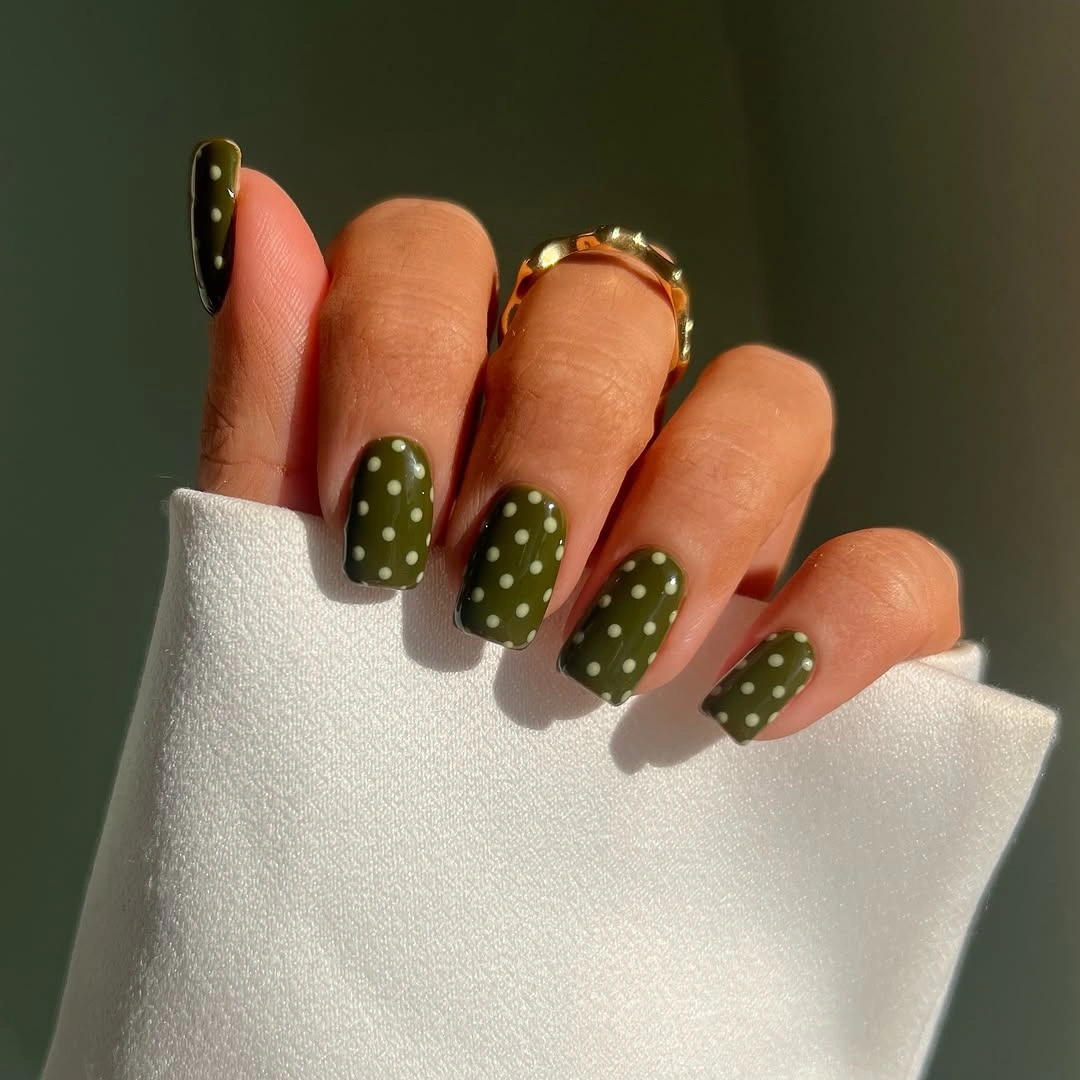
Finish and color work together here. Matte olive quiets the surface, cream dots remain visible without flashing, and the square outline supports the regular rows, so the design feels clean rather than rustic or busy. A glossy olive would make the dots sharper, while the matte version keeps the visual reset understated.
Choose a short square or rounded tip if you want the same idea with less length, and use cream rather than bright white for a calmer result. Keep the dots small enough to leave olive visible around them. The pattern may look softer from a distance on a matte base, which is a useful limitation when the goal is a composed everyday manicure.
Blue And Brown Dots Trade Places Again
Short oval nails pair pale blue bases with brown dots and glossy dark brown bases with pale blue dots, creating a second version of color exchange with a warmer, wood-toned setting. The dots remain the only motif, so the eye can focus on how the two shades support each other. The repeated reversal gives the set a balanced rhythm across both hands.
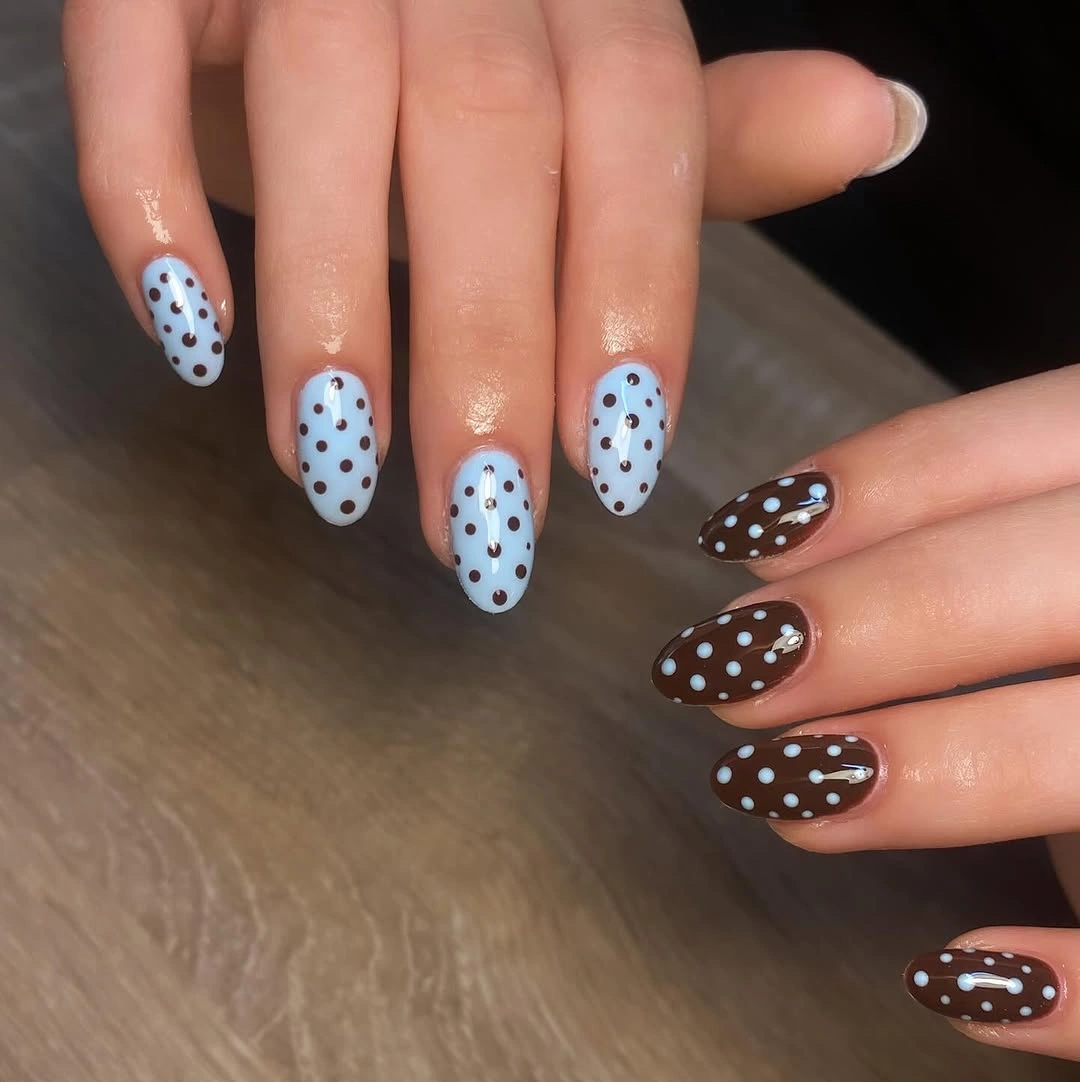
The design is clear because each color appears at two scales. Blue forms an open background on some nails and a small point on others; brown does the same, so neither shade becomes an afterthought. Short oval tips soften the contrast and keep the two-color system wearable even when the bases are glossy.
Use muted blue, dusty teal, or cream if you want a lower-contrast version, and keep the dot scale matched on both sides. A pair of accent nails can carry the reversed formula while the rest stay solid for a simpler polka dot fall nails short look. The practical concern is spacing, because uneven dots can make a carefully mirrored idea look accidental.
Sparse Burgundy Dots Keep Blush Nails Open
Medium almond nails are mostly glossy pale pink, with small burgundy dots limited to two accent nails. The majority color remains open and light, while the sparse berry marks provide enough contrast to define the pattern without turning the whole hand into a dark field. Softly tapered tips make the accents feel delicate and intentional.
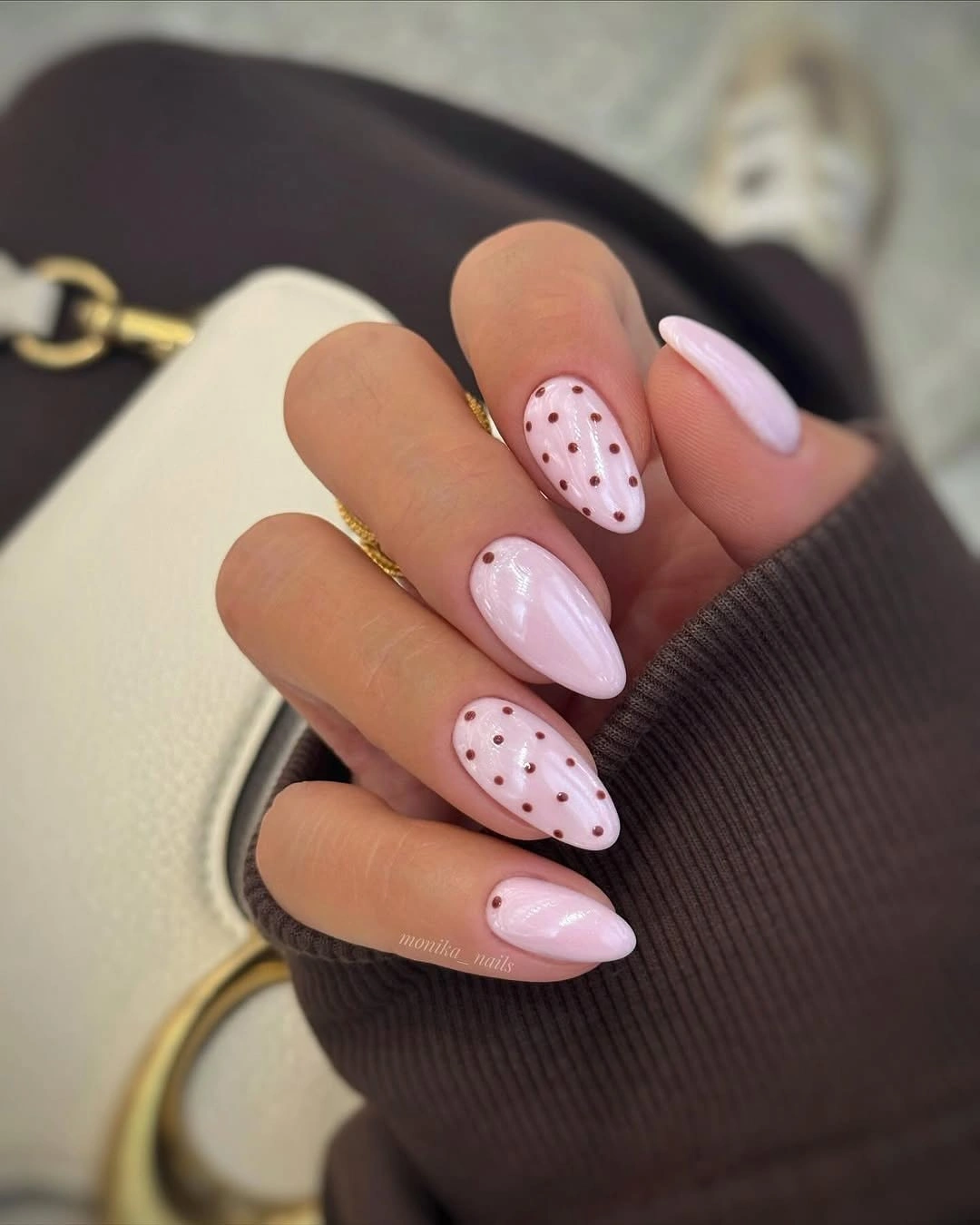
Selective placement is what creates the calm finish. Two dotted nails establish the motif, solid blush nails provide visual breathing room, and burgundy adds a clear point of definition without competing with the pale base. The design does not need a second pattern because the spacing between decorated and undecorated fingers already supplies rhythm.
Use cream or muted brown dots if burgundy feels too strong, and keep the marks small with generous gaps. This is an easy polka dot fall nails almond adaptation because the art can stay on two accents while the rest remains plain. Sparse placement has one honest demand: with fewer dots, every one must be cleanly positioned so the open space feels purposeful.