October nail colours can move well beyond one predictable dark polish. The strongest sets in this edit use cherry, olive, chocolate, berry, blue, and warm yellow in different amounts, so the season reads through contrast, spacing, and finish rather than through a single costume-like motif. It is an edit built around colour relationships that stay legible at a glance and still reward a closer read.
The sequence starts with clean colour decisions, then opens into dots, marbled movement, small illustrated accents, and a few mixed palettes that reward a closer look. Use each set as a visual direction: keep its defining relationship between colours and details, then adjust the length, accent count, or contrast until the manicure feels natural for your own October wardrobe.
Cherry French Tips with a Sheer Pink Base
Deep cherry-burgundy tips turn a sheer pale pink base into a clear October statement without covering the whole nail in dark colour. The long almond silhouette gives the curved edge room to look deliberate, while the glossy surface keeps the wine tone crisp instead of heavy. The dark edge therefore reads as a frame, not a full stop.
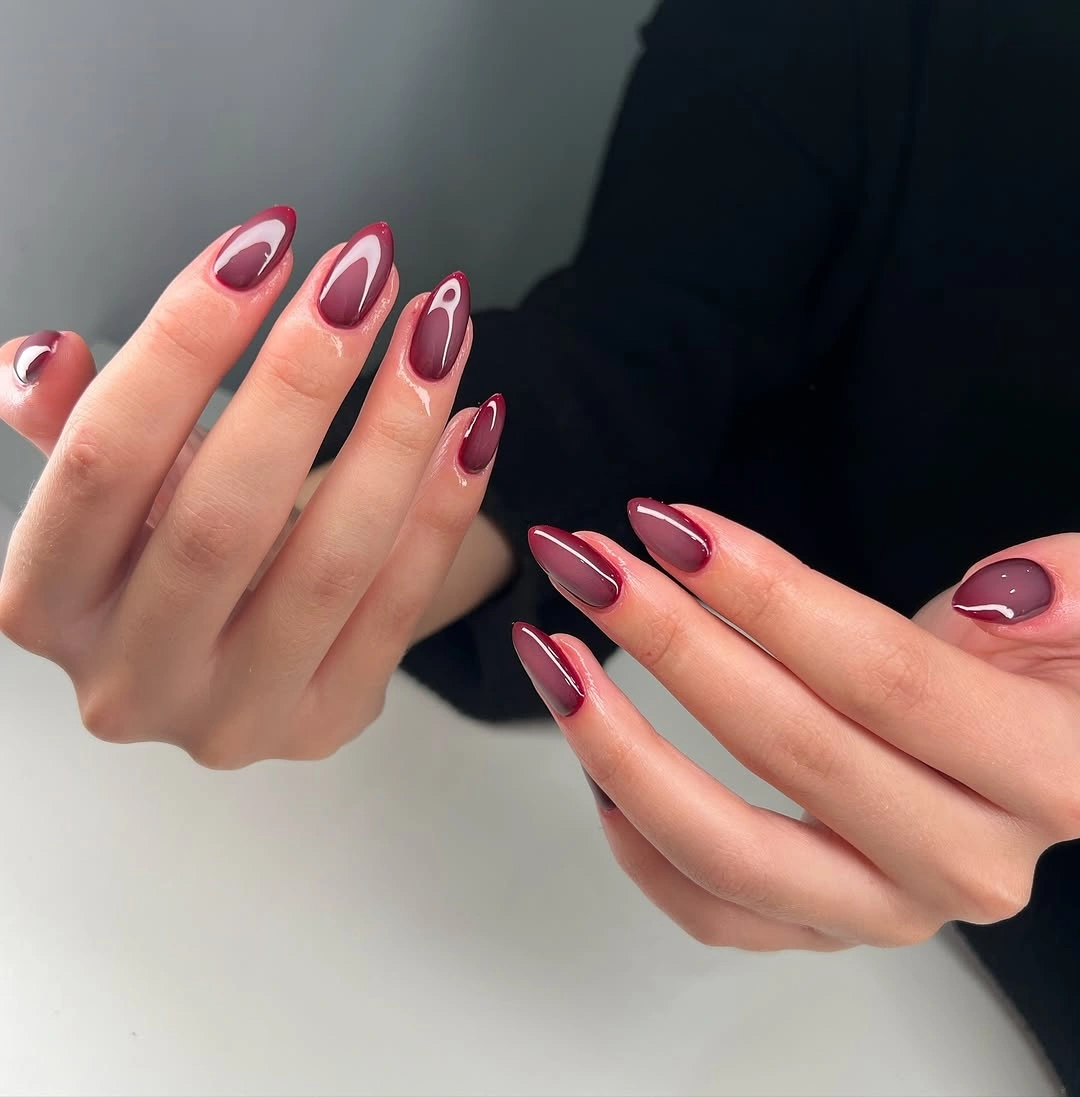
The contrast works because the light center creates breathing room between the skin and the saturated tip. A shorter almond or rounded shape can carry the same idea with a slimmer curve, and a soft berry polish can replace the deepest burgundy when you want less visual weight around the hands. The open base also makes the berry tip feel lighter than a full wine coating.
Growth will show first along the pale base, so the design benefits from a tidy outline and a finish that keeps the boundary sharp. For everyday wear, repeat the cherry only on the tips and leave the accent-free surface alone; the restrained version has more flexibility than a set where every nail is fully dark.
Olive Tips and Tiny Gold-Like Accents
Soft pink nails take an autumn turn through olive-green tips, with narrow gold-like lines and tiny dark star or flower-like marks adding punctuation. The medium almond length keeps the colour story visible, but the pale base prevents the earthy shades from closing in around the fingers. That combination keeps the first impression soft even when the tip is distinctly earthy.
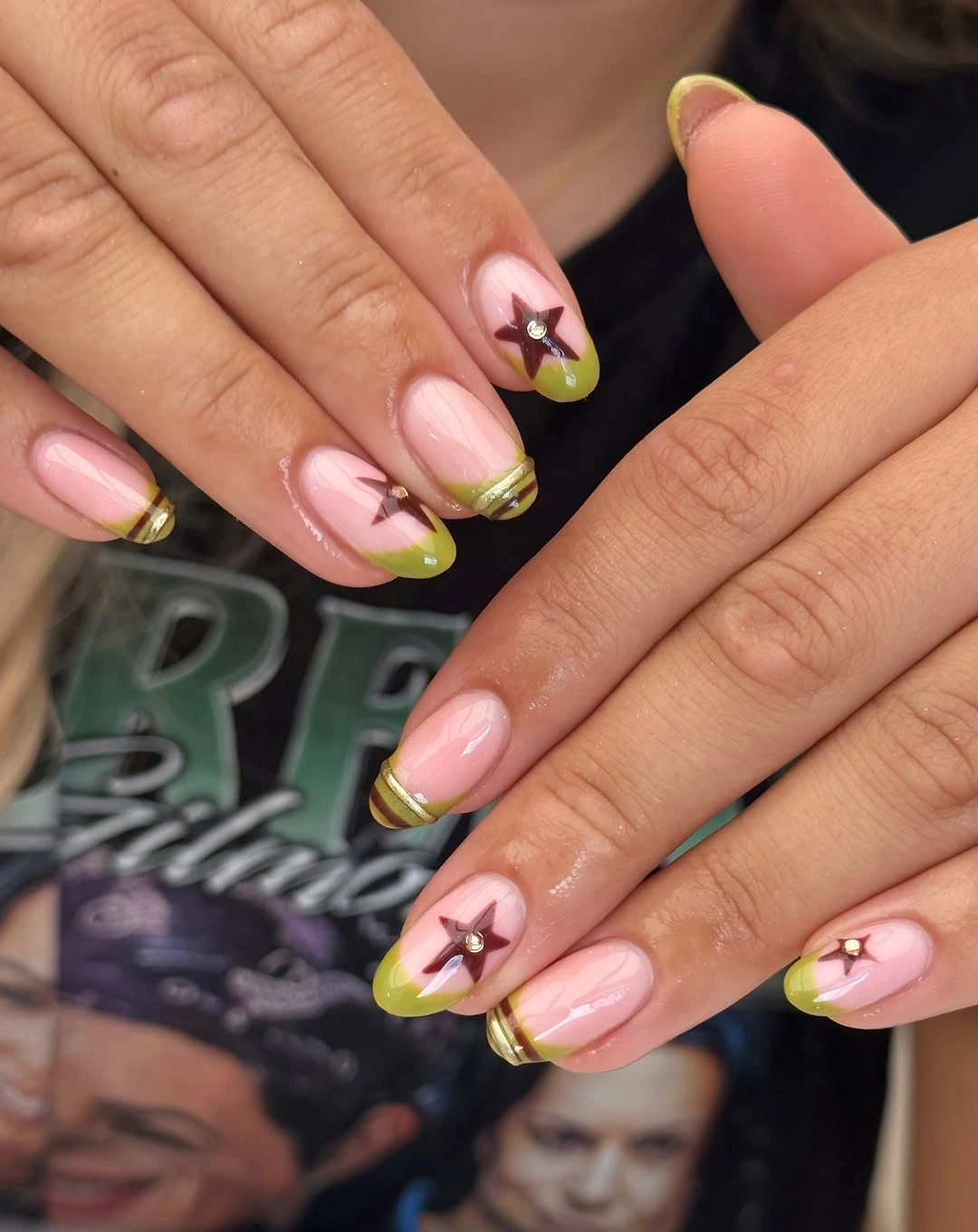
Olive and pink sit opposite enough to create interest, while the thin metallic-looking edge repeats the warm note without becoming a separate focal point. Keep the tiny accents on two or three nails if you prefer a cleaner result, or swap the olive for moss or muted sage while preserving the pale foundation.
The narrow lines and small marks ask for close placement, so uneven spacing will be more noticeable than it would be on a loose abstract set. A practical shorter version can use one olive tip shape across every nail and reserve the star-like detail for one accent, keeping the October mood while reducing visual maintenance.
Glossy Fuchsia in a Rounded Shape
Vivid fuchsia carries this manicure almost entirely on its own. The softly rounded-square shape gives the saturated pink-purple colour a modern frame, and direct highlights across the glossy surface make the solid finish feel dimensional without any added motif. Its simplicity leaves room for the shade to change with daylight and clothing.
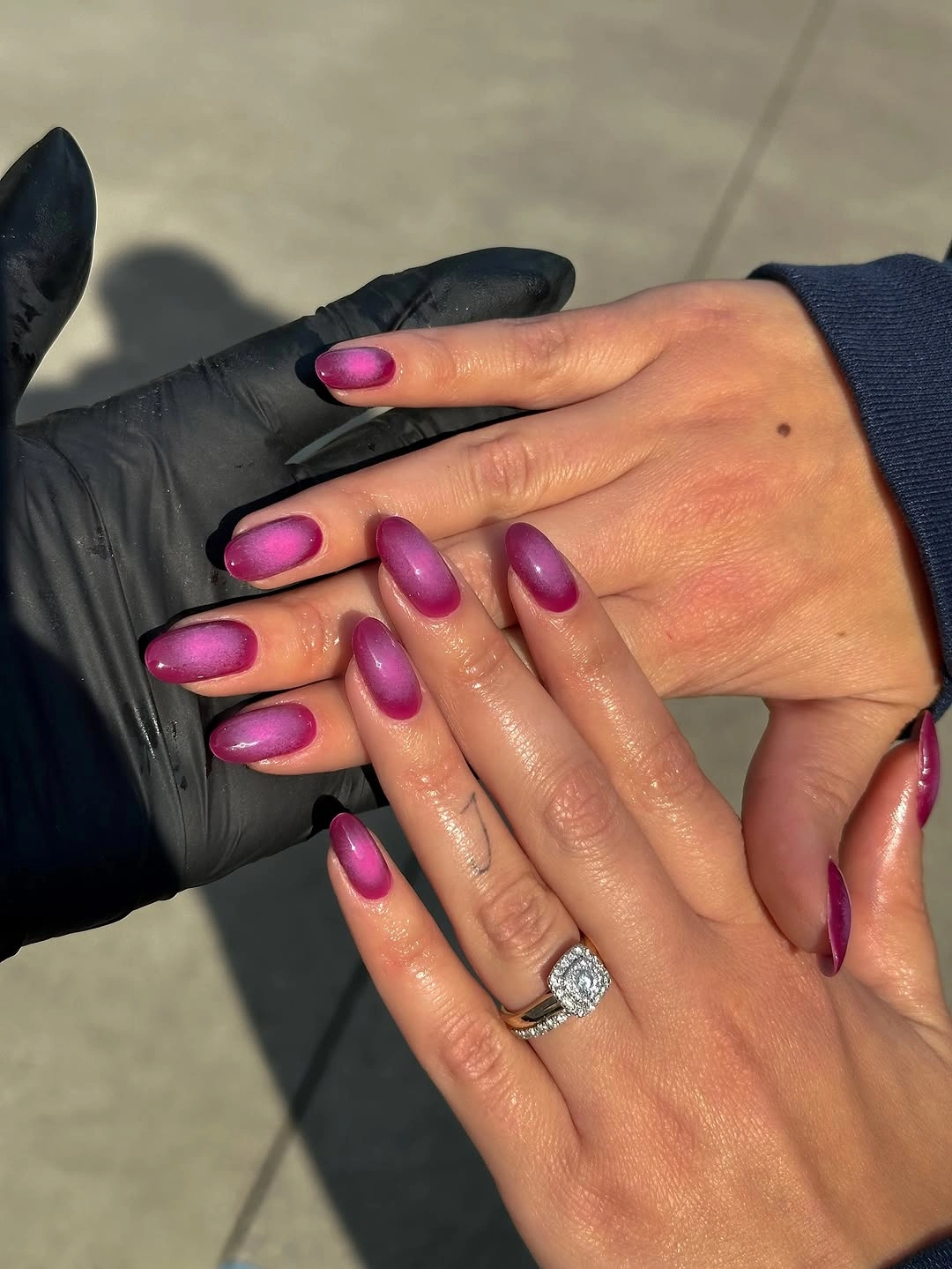
That restraint is exactly why the set reads clearly: there is one colour, one finish, and no competing decoration. If you are collecting nail colours for October but do not want seasonal symbols, this is an easy direction to adapt with raspberry, mulberry, or a cooler magenta while keeping the same uncomplicated block of colour.
Bright fuchsia can draw attention to every edge, especially as the polish grows away from the cuticle, so the rounded outline matters. A shorter length will make the colour feel more casual, while a slightly longer tip will intensify the graphic effect; the tradeoff is visibility versus day-to-day ease.
Chocolate Nails Dotted with Small White Points
Warm chocolate brown becomes playful through small white dots placed close to the edges of the almond nails. Because the base remains glossy and mostly uninterrupted, the repeating points add rhythm rather than turning the manicure into a crowded pattern. The pale points also echo the glossy highlights without competing with them.
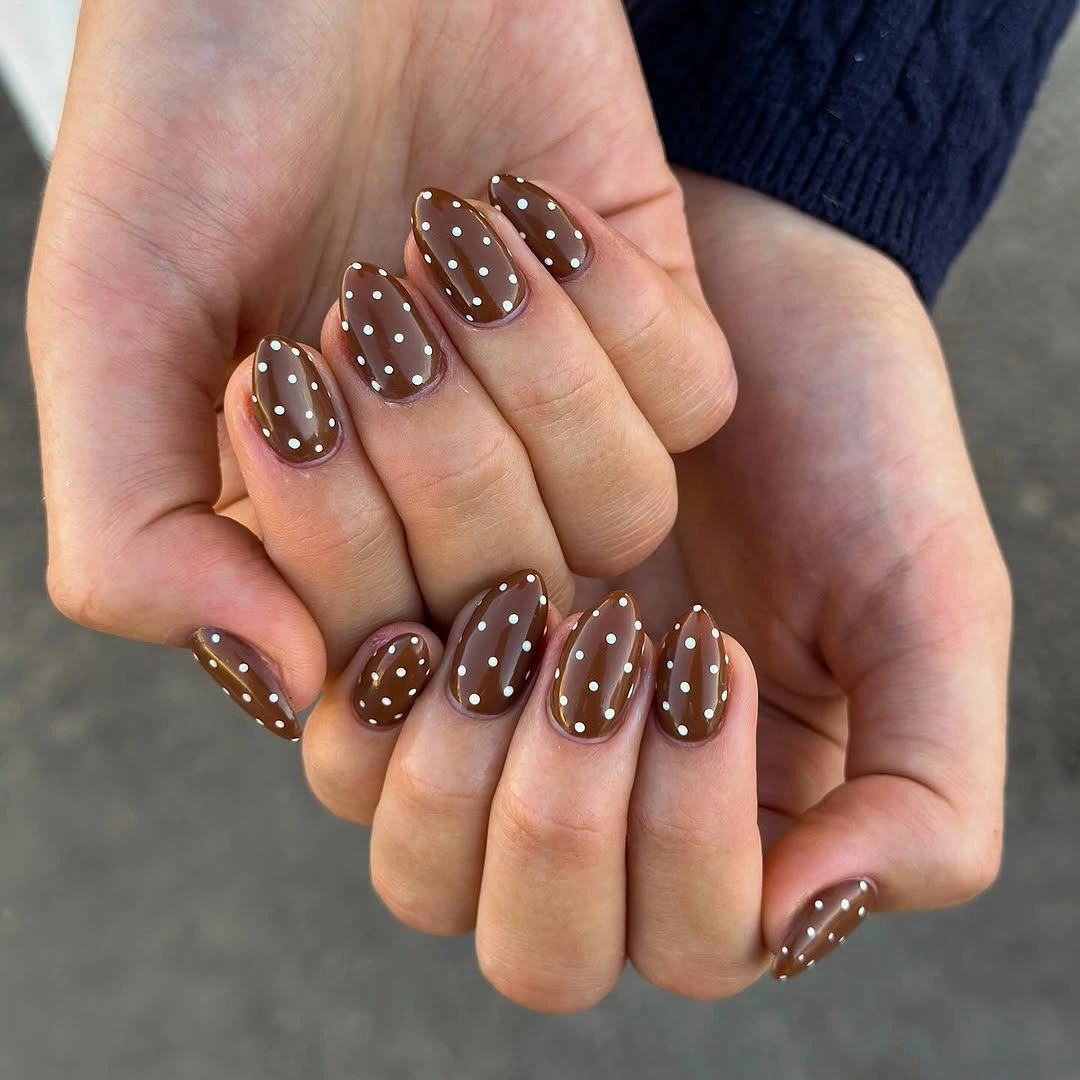
The dots work as a quiet counterpoint to the brown: their light value is strong enough to read from a distance, but their scale leaves the rich base in charge. For a softer October nail colours variation, try cream points instead of bright white or concentrate the pattern on two accent nails while leaving the rest solid.
Small repeated marks can lose their neatness first at the outer edge, where wear and growth change the spacing. Keep the almond length moderate if you want the dots to stay proportional, and remember that a minimal row of points can preserve the idea better than adding extra motifs to fill open areas.
Muted Olive and Slate in Marbled Waves
Olive, brown, slate blue, mustard, and gray share the same muted volume in this long almond set. The colours change from nail to nail, yet soft wavy and marbled surfaces connect them, making the mismatched palette feel edited instead of random. Muted value is what lets the unusual combination stay connected from finger to finger.
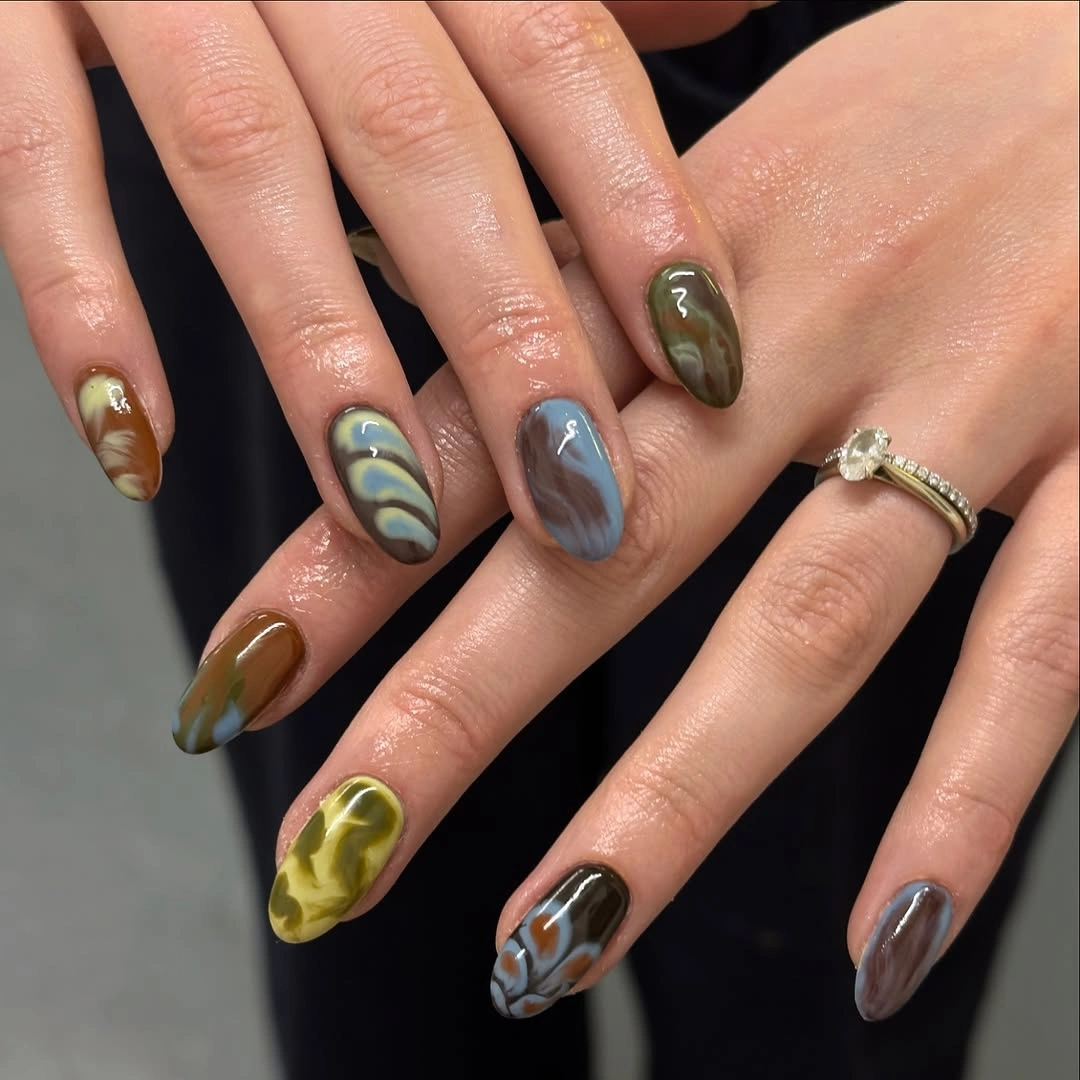
Variation supplies the movement here, so a single repeated pattern would weaken the point. Choose one cool interruption such as slate blue, keep the remaining tones earthy, and let the wavy placement do the work; that approach gives you the same autumn depth without requiring every nail to carry every colour.
The elongated shape supports several colour shifts, but it also makes the set more noticeable as it grows out. On shorter nails, simplify each design to two broad curved fields and keep the palette to olive, brown, and one cooler accent, accepting that the result will look calmer than the full-length version.
Charcoal with One Blush Accent Nail
Glossy charcoal-gray covers most of this short rounded-square manicure, while one pale blush nail introduces a fine-line detail. The dark majority establishes the October direction immediately, and the single light interruption gives the set a clear focal point rather than a scattered collection of accents.
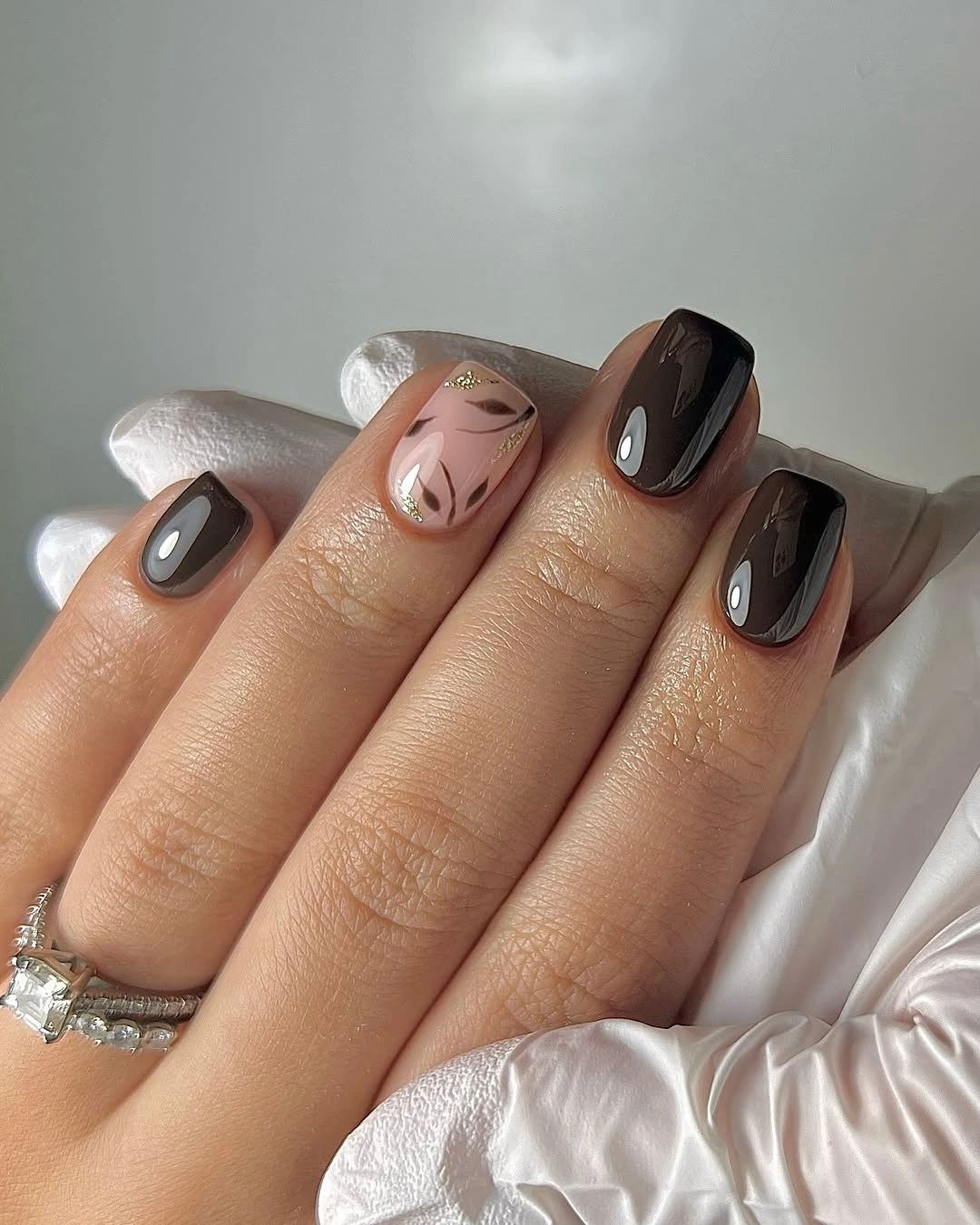
Placement is doing more here than decoration: the blush nail breaks the dark rhythm at one chosen point, so the eye has somewhere to pause. A muted mauve or dusty rose can replace the blush, and a tiny curved mark can stand in for the fine line if you want the accent to remain legible at a shorter length.
Charcoal shows reflected light and small surface changes, which makes a clean glossy finish part of the design rather than a minor detail. Keep the accent isolated if you want the set to stay composed; adding several pale nails would create a different balance and reduce the sharpness of the original dark-to-light exchange.
Translucent Swirls in Bright Autumn Tones
Yellow, orange, coral, pink, and green move through translucent-looking almond nails as flowing bands instead of opaque blocks. The bright palette feels lighter because the pale centers remain visible, while the long tapered shape gives each curved sweep enough room to travel across the nail. The sheerness also gives the warmer colours a little visual air.
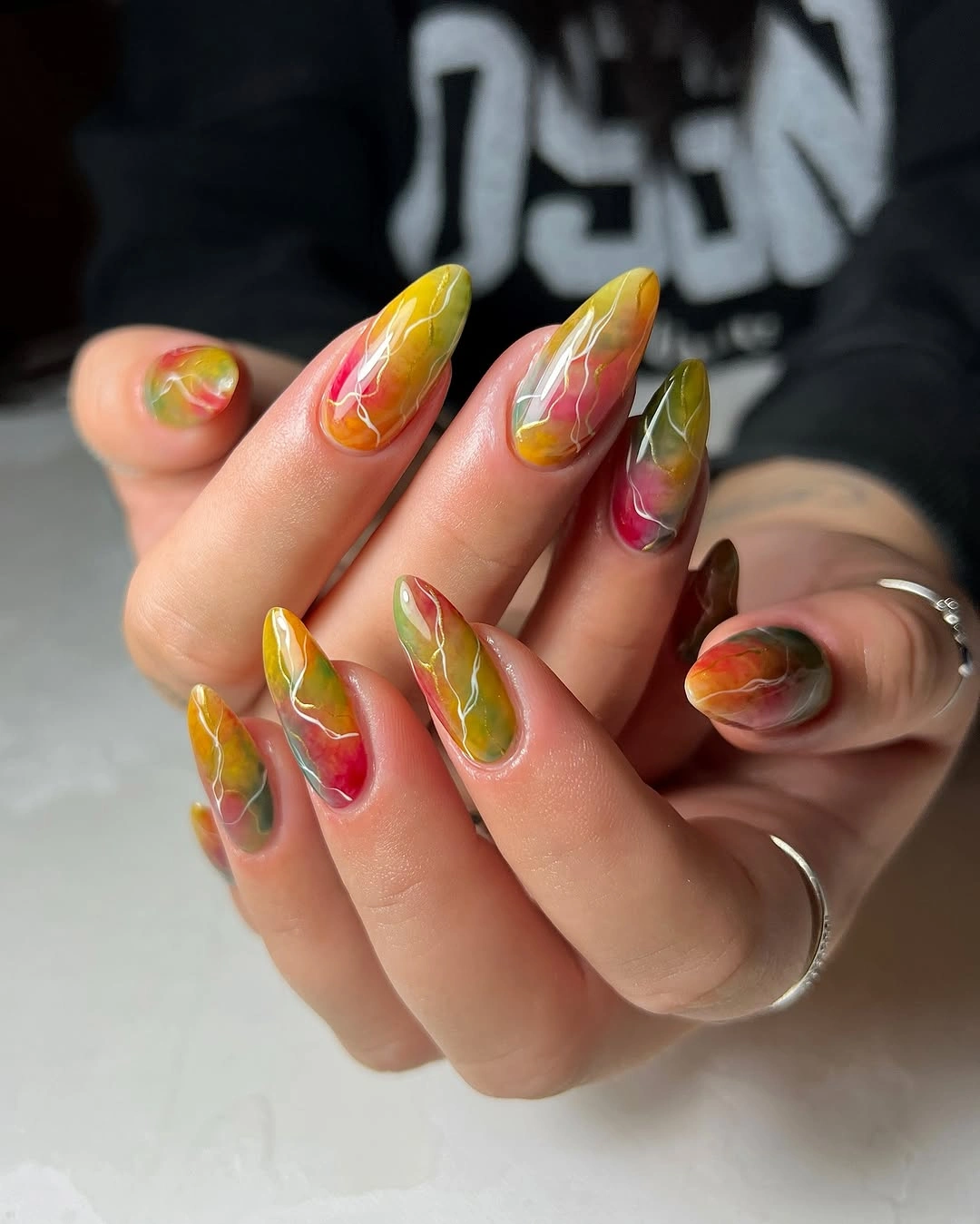
Colour changes create the rhythm, and the repeated glossy surface keeps the many shades from separating into unrelated fragments. For a wearable fall nail idea, choose two warm colours plus one green accent, or keep the full palette but place the strongest coral and yellow only on alternating nails.
Flowing bands are forgiving in concept but demanding in proportion: too many equally bright areas can flatten the sense of movement. A shorter version should use wider, simpler curves and fewer transitions, since a small canvas cannot hold the same number of visible turns without losing the open quality.
Fuchsia Panels with Pale Star-Like Details
Saturated fuchsia becomes more graphic when pale open panels, dark rounded blocks, and star-like shapes interrupt the glossy base. The medium almond form keeps the strongest marks aligned with the length of the nails, so the decoration reads as a controlled layout rather than a full-field print. The result is decorative, but its focal areas remain easy to identify.
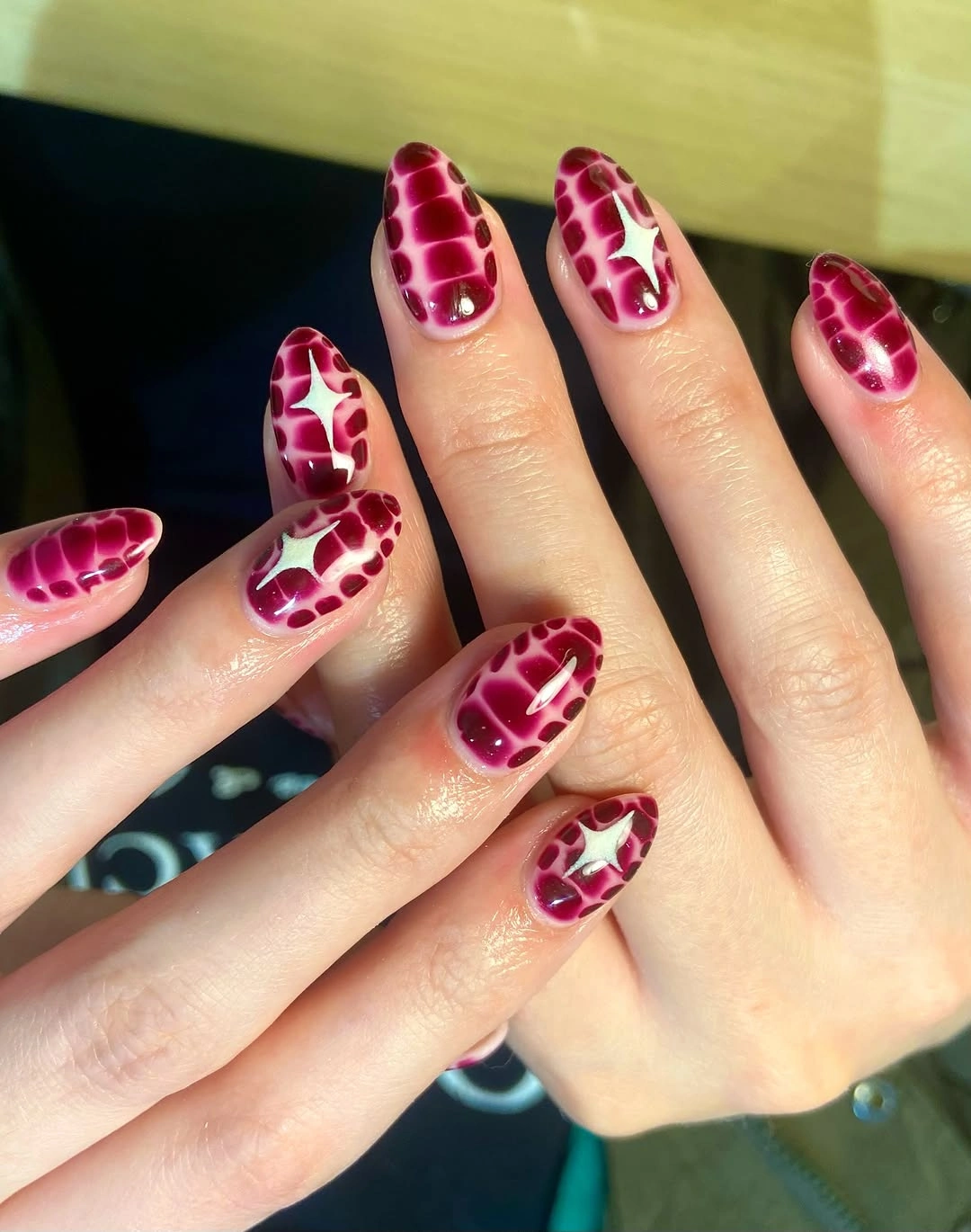
Negative space gives the berry colour a place to breathe, while the small pale stars repeat the light note across several nails. Keep one panel large and let the other details stay small if you want a cleaner interpretation; changing fuchsia to raspberry or plum will preserve the contrast without copying the exact temperature.
The set has a high detail density, so length helps the blocks and stars remain distinct. A shorter adaptation should remove one layer – for example, keep the pale panel and one star but drop the dark inner block – because simplifying the hierarchy works better than shrinking every element until none has room.
Blue and Burgundy with Repeating Dots
Bright blue and deep red alternate across long almond nails, then meet through small contrasting dots. The two colours are strong enough to compete, but the repeated point motif gives them a shared visual language and prevents the manicure from feeling like two unrelated halves. A dot can sit on the blue or red without changing the overall balance.
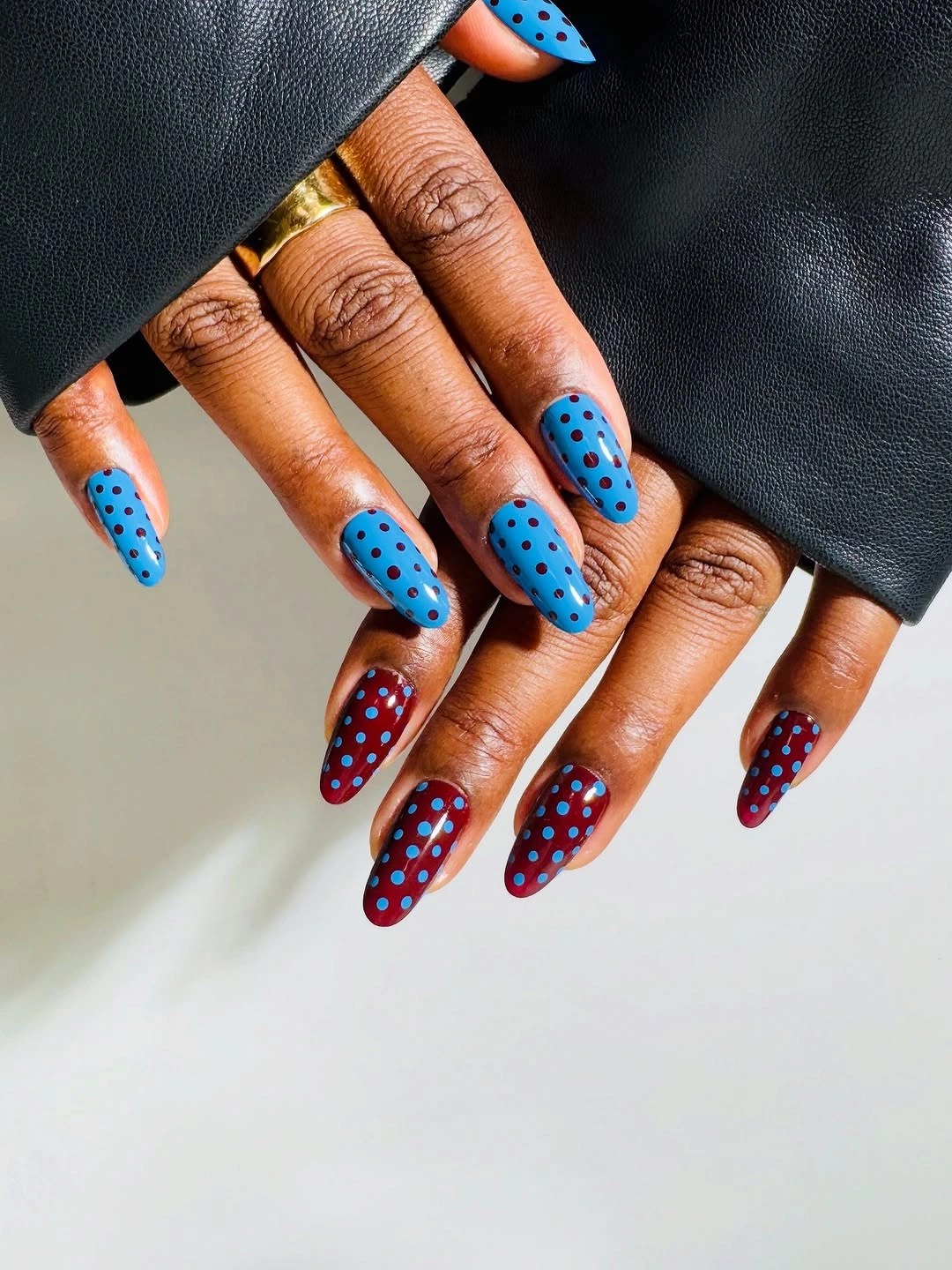
Contrast is the main attraction, so the dots should remain small and regular rather than becoming a second pattern. You can soften the look by replacing the bright blue with slate or dusty denim, or keep the high contrast and use only one dotted accent nail beside solid blue and burgundy fingers. Leave a little bare space around each point so the pattern retains its pulse.
Long tapered nails make the colour blocks easy to read, but the length also magnifies any uneven edge or wandering dot. A shorter almond shape will feel more practical and less graphic; the honest tradeoff is that the red-blue relationship becomes quieter when there is less surface for the alternating rhythm.
Solid Deep Burgundy for a Clean October Mood
Solid deep burgundy proves that an October manicure can feel seasonal through colour alone. The medium-long almond shape gives the wine shade a refined outline, and the uninterrupted glossy finish lets the depth of the polish remain the only decision the eye needs to follow. Its impact comes from saturation and silhouette rather than embellishment.
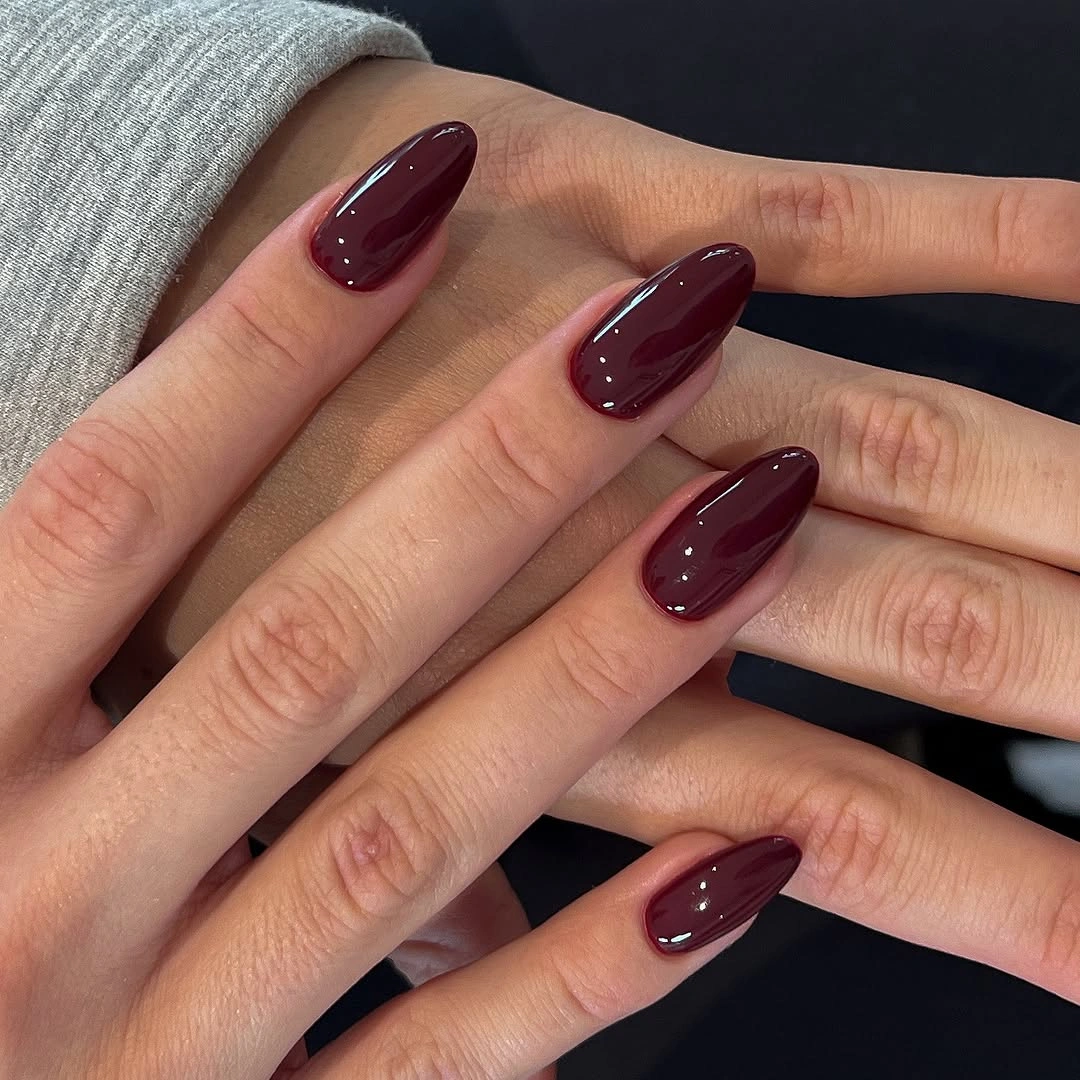
Removing nail art creates breathing room around a rich shade, which is why this set feels calmer than a decorated berry manicure. For nail colours October styling, pair the same idea with a shorter oval or squoval shape when you want the colour to sit closer to the hands, or choose a slightly browner wine for a softer edge.
A solid dark surface makes chips and regrowth easy to notice, so the simplicity raises the value of a tidy outline. The benefit is that the look remains coherent without additional details; the limitation is that the shade and finish must carry the entire result from the first day to the later stages of wear.
Olive and Burgundy with Playful Mini Patterns
Lime-olive, burgundy, cream, and brown share short-to-medium rounded nails covered with small checks, stripes, dots, and curved smile-like marks. The palette repeats more consistently than the motifs do, which gives the playful mix a visual anchor even when every nail makes a slightly different move.
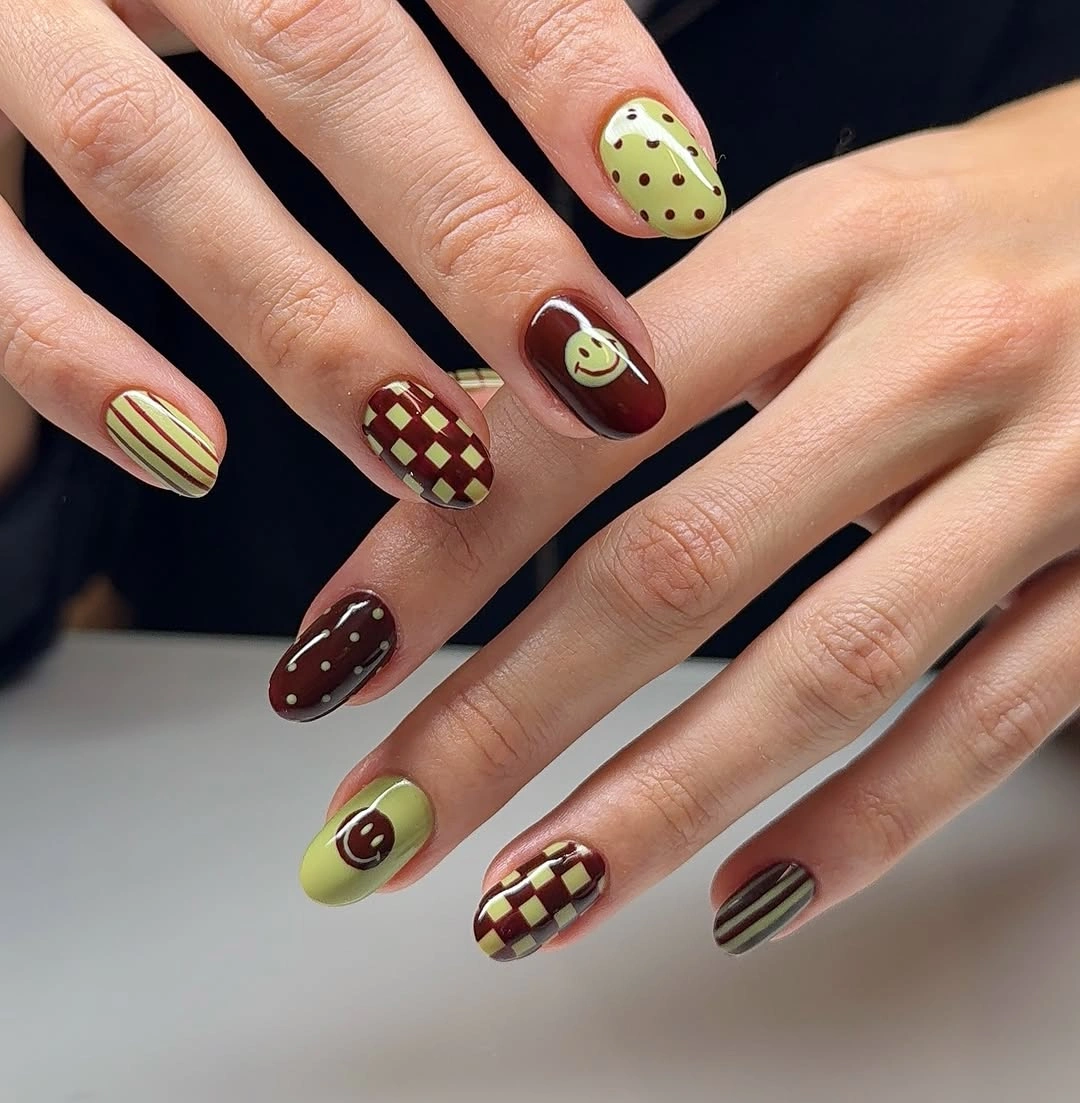
Repetition of colour keeps the variety from becoming noise, while the shorter shape makes the details feel friendly rather than ornate. To adapt the set, keep olive and burgundy as the two anchors, then choose only one supporting language – checks or stripes, for example – so the manicure has a clearer hierarchy.
Small patterns need enough spacing to survive normal viewing distance, and crowded details can blur as the nails grow. A practical edit would place the smile-like mark on one accent nail, use a simple stripe on two others, and leave the remaining fingers in solid olive or burgundy for a more breathable finish.
Wine Curves over a Pale Pink Base
Deep wine curves trace the tips of long almond nails over a pale pink base, with a few fuller burgundy nails adding weight to the set. The result sits between a classic French shape and a richer autumn palette, using the bare-looking center as a deliberate pause. The wine edge reads strongest when the pale base stays visibly open.
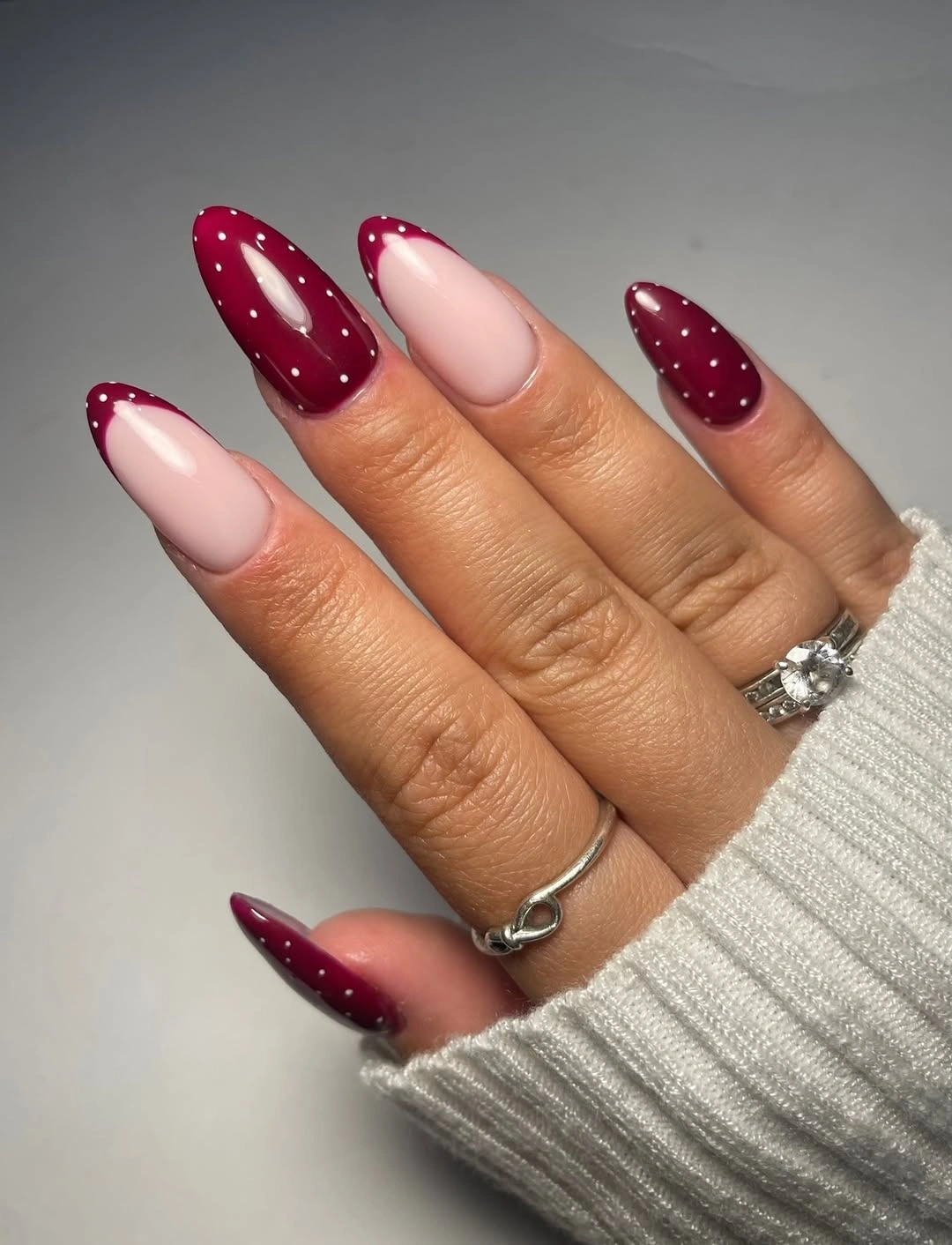
The curved edge follows the silhouette, so the colour feels tied to the shape rather than placed as a flat band. Keep the fuller wine nails as one or two accents, or replace them with a thinner crescent when you want a lighter version of these nail colours for October without losing the berry focus.
Long almond length makes the wine arc elegant but also leaves less room for an uneven boundary to hide. A medium almond or oval shape will reduce that demand and make the pale-to-dark contrast more approachable, although the tips will read as less elongated and less dramatic. That change keeps the colour relationship while making daily movement feel less restricted.
Deep Red, Brown, and Bright Yellow Blocks
Deep burgundy, warm brown, and bright yellow alternate as mostly solid rounded nails, creating a compact palette with one clear jolt of light. The short-to-medium length keeps the yellow from taking over, while the glossy finish ties the three shades together across the set. The bright accent acts as a small flash rather than a second dominant field.
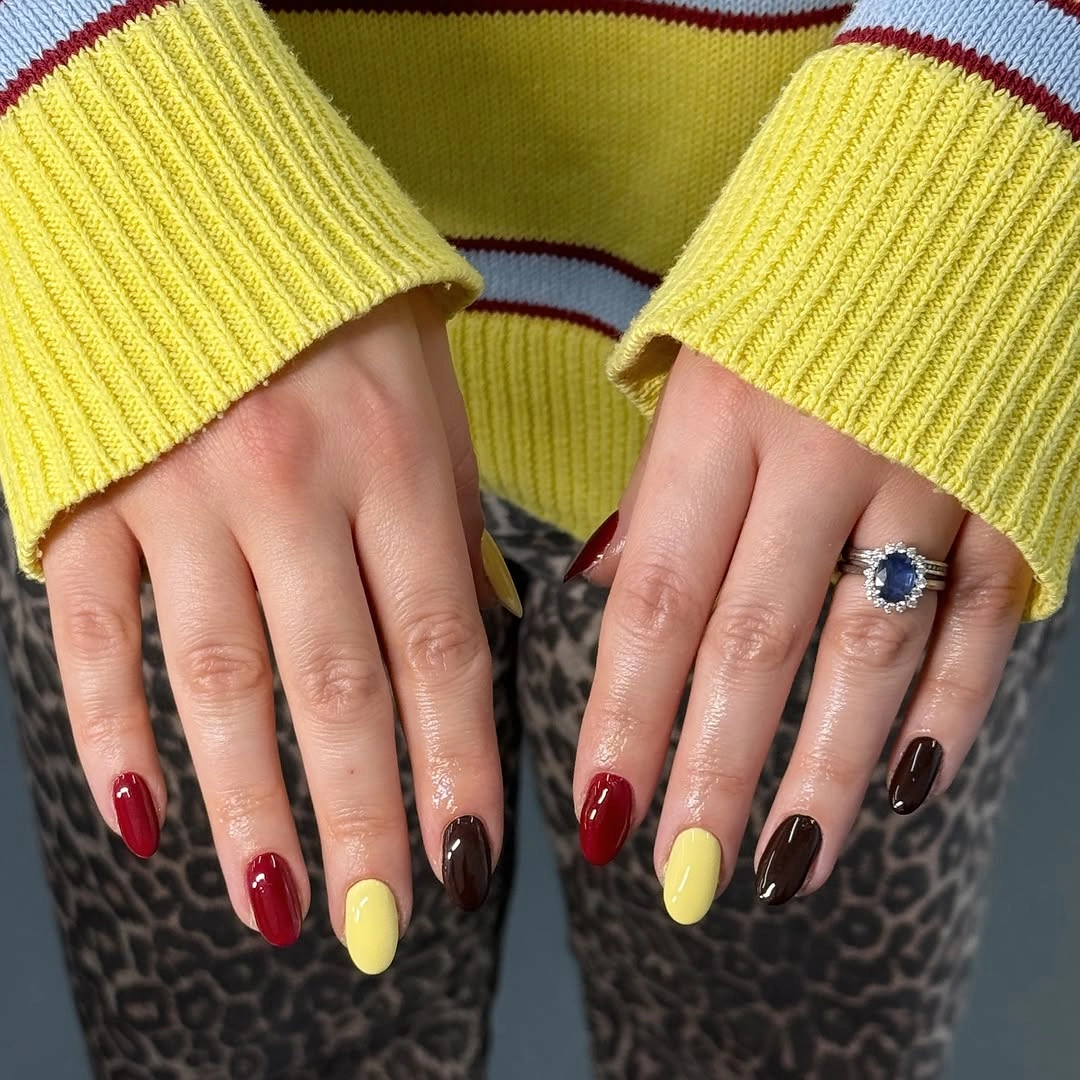
Yellow works here because it appears as an accent inside a field of grounded red and brown, not as a competing all-over theme. For a quieter fall manicure, trade it for muted mustard or use yellow on two fingers only; for more energy, let the bright shade lead one hand while keeping the other mostly wine and brown.
Solid colour blocks are easy to understand but unforgiving when the edge becomes uneven, especially with the lightest shade. The rounded shape offers a practical balance, and keeping the length moderate makes the contrast suitable for daily outfits instead of reserving it for a single seasonal occasion.
Teal, Blush, and Tortoiseshell-Like Panels
Deep teal, pale blush, dark brown borders, and spotted tortoiseshell-like panels create a cooler October palette on short almond nails. The set feels composed because the blue-green shade returns several times, while the outlined blush nails and brown accents connect the warmer and cooler sides. The palette stays grounded even when a single teal nail becomes the cool focal point.
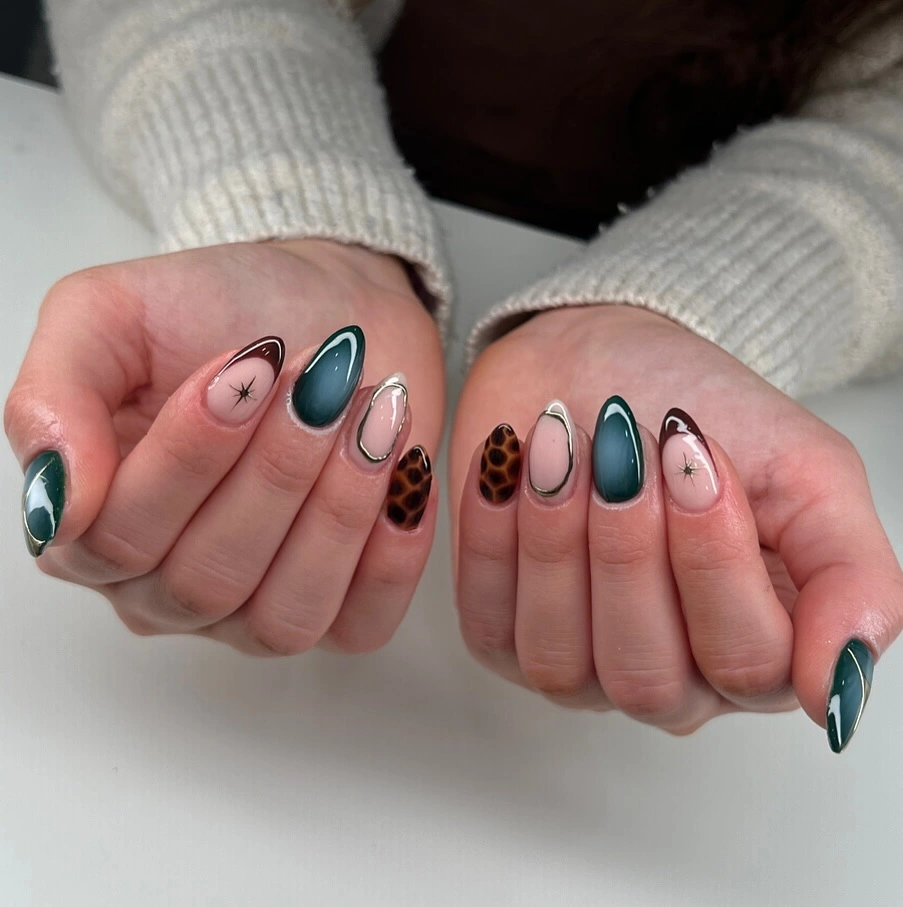
Colour blocking gives each finger a distinct role, and the repeated outlines stop the mix from looking accidental. Keep teal as the lead and use the spotted brown only on one or two nails if you want less decoration, or switch the blush to a pale mushroom shade for a more muted transition. That repeated border also gives the eye a path through the alternating surfaces.
The almond length is short enough for the panels to stay readable without needing a large canvas. Detail-heavy borders may need more attention as the nail grows, so a useful simplified version keeps one clean teal nail, one blush outline, and one brown-spotted accent rather than repeating every element across the hand.
Chocolate, Turquoise, and Fine Feather-Like Lines
Chocolate brown and pale pink form the base of this long almond mix, while turquoise panels, rounded tip bands, dotted edges, and fine white feather-like lines add cooler movement. The palette is decorative, yet the repeated brown and pale anchors keep the turquoise from becoming disconnected. The result has detail, but its hierarchy remains visible from the first glance.
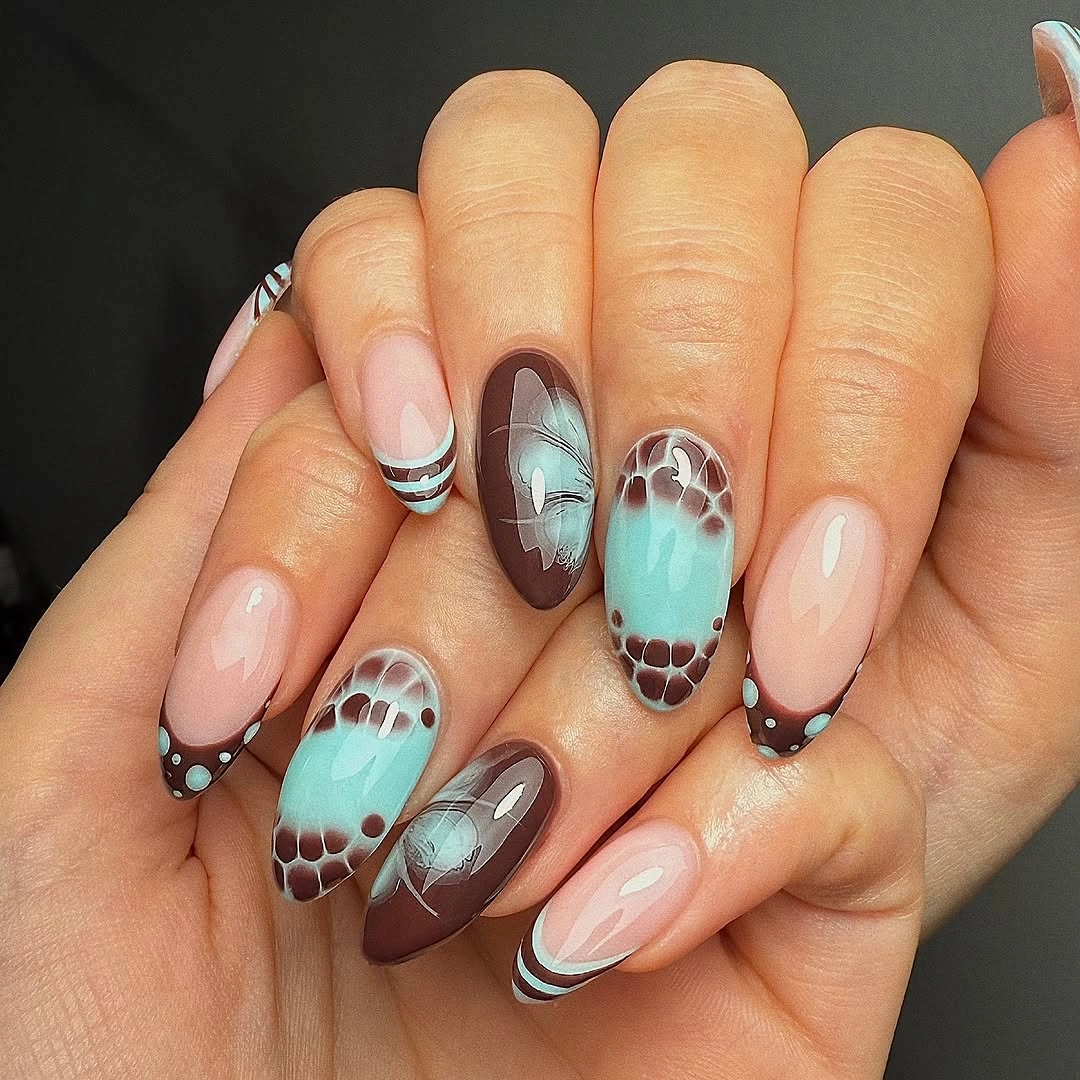
Layering works because the strongest marks have different scales: broad colour fields sit behind small dots and delicate lines. To make the set easier to wear, keep the turquoise on one or two accent nails and carry the brown tip band onto the rest, or replace it with a muted blue-gray for less intensity.
Long length gives the fine details space, but it also makes the set more dependent on clean spacing and a stable silhouette. A shorter adaptation should keep the broad turquoise panel and one pale line while dropping the tiny border marks, accepting a simpler composition that remains recognizable. Open areas matter as much as the fine marks in keeping the design readable.
Dark Chocolate with a Pale Metallic-Like Accent
Glossy deep chocolate-burgundy covers most of the long almond nails, while one pale pearly accent carries a small gold-like fleck. The quiet contrast between the dark field and the light accent gives the manicure a finished focal point without distributing decoration across every finger. The light accent therefore feels intentional instead of merely decorative.
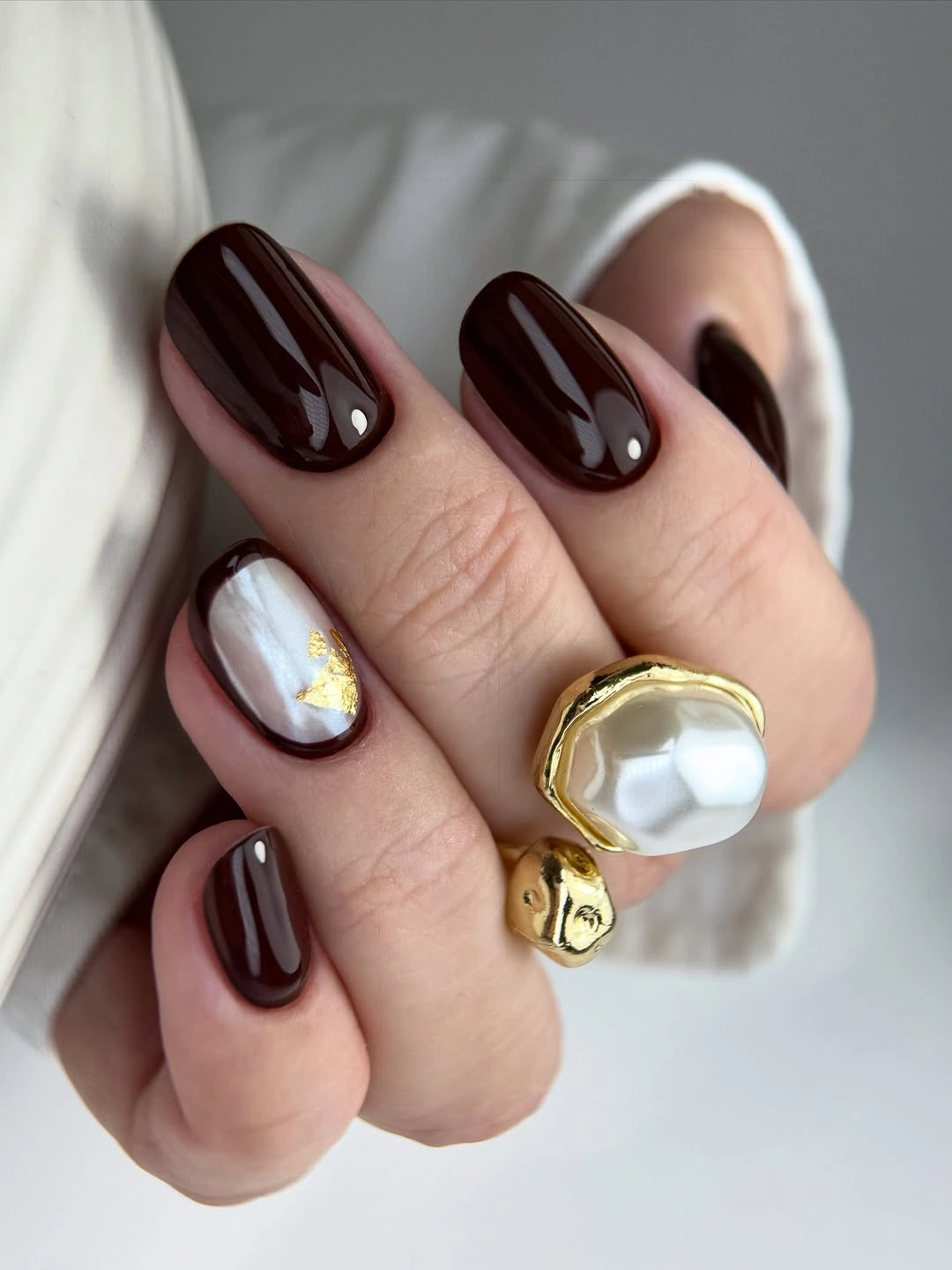
The accent works through scale: a small warm mark is enough because the surrounding colour is so deep and reflective. Keep the pale nail isolated for a clean reset, or use a soft silver-like detail instead of gold-like warmth if you want the set to lean cooler while preserving the same dark-to-light structure.
Very dark polish can make a single irregular edge stand out, so the plain nails benefit from a carefully kept outline. A shorter almond shape will make the colour more approachable and reduce the visual weight, though it will also soften the elongated contrast that gives the original set its presence.
Quiet Neutrals with Blue-Gray Reflective Notes
Ivory, blush, champagne-brown, and muted blue-gray alternate across short-to-medium rounded-square nails. Some surfaces catch light with a metallic-like sheen, yet the palette stays pale and controlled, offering an October direction for anyone who wants seasonal depth without a dark base. Small differences in sheen keep the neutrals from appearing identical.
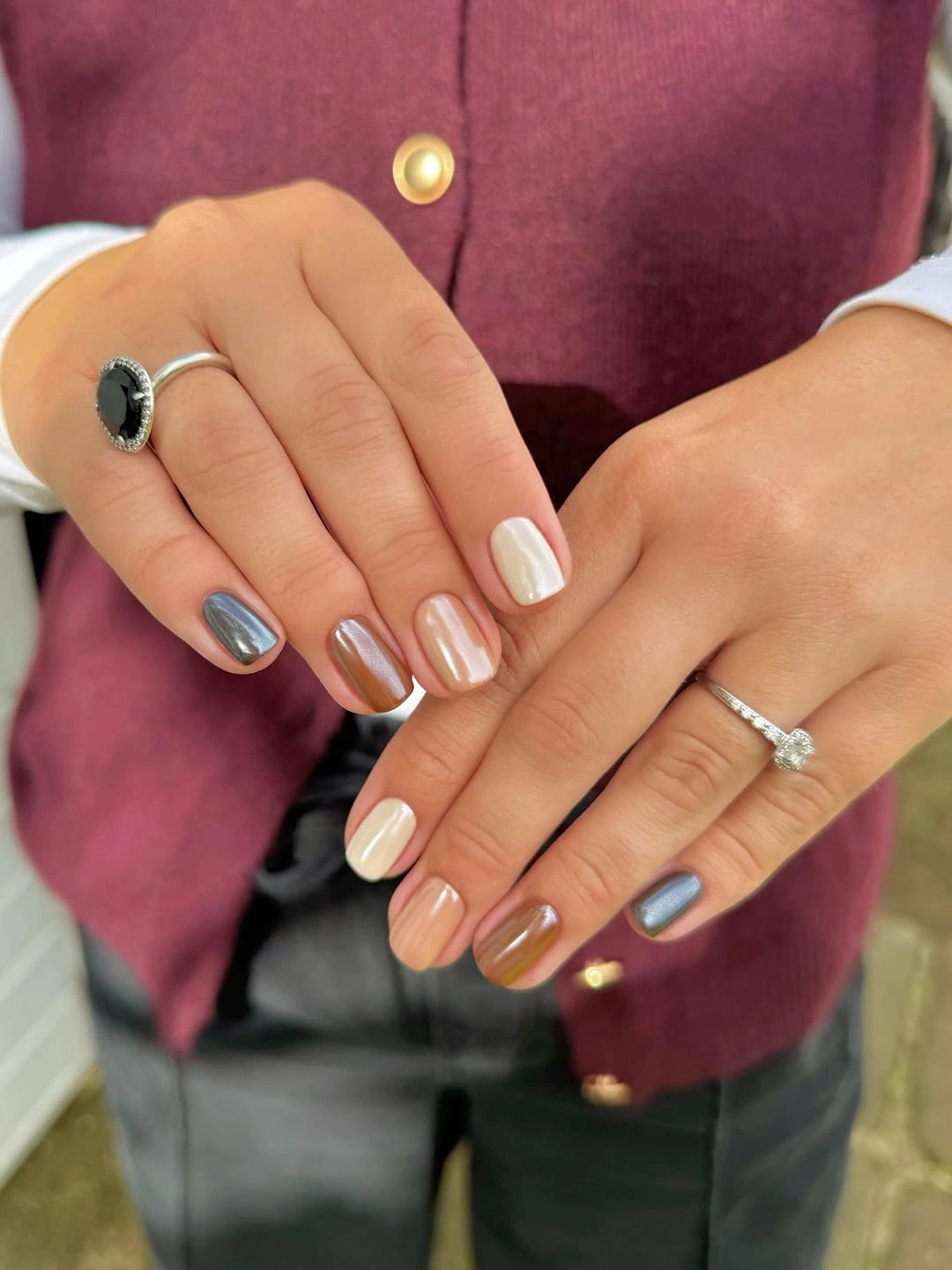
The set works through small shifts in temperature and reflection rather than strong pattern, so the eye can move across the hand without a single colour dominating. Use cream, dusty rose, and soft pewter as close substitutes, and keep the blue-gray on one or two nails if you prefer a more open neutral arrangement.
Short rounded-square nails make this palette easy to live with because the colour blocks remain tidy as the length changes. The tradeoff is lower drama than a wine or fuchsia set, but that quieter register can be useful when you want nail colours for October to support clothing, jewelry, or a busy daily schedule.
Short Wine and Mauve in One Colour Family
Several short oval nails move between glossy burgundy, wine, mauve, and muted taupe without relying on visible art. The colours stay close enough to read as one family, but the different values create depth across the hand and keep the manicure from becoming a single flat block. Close shades make the transition gentle, but they still create enough separation to notice.
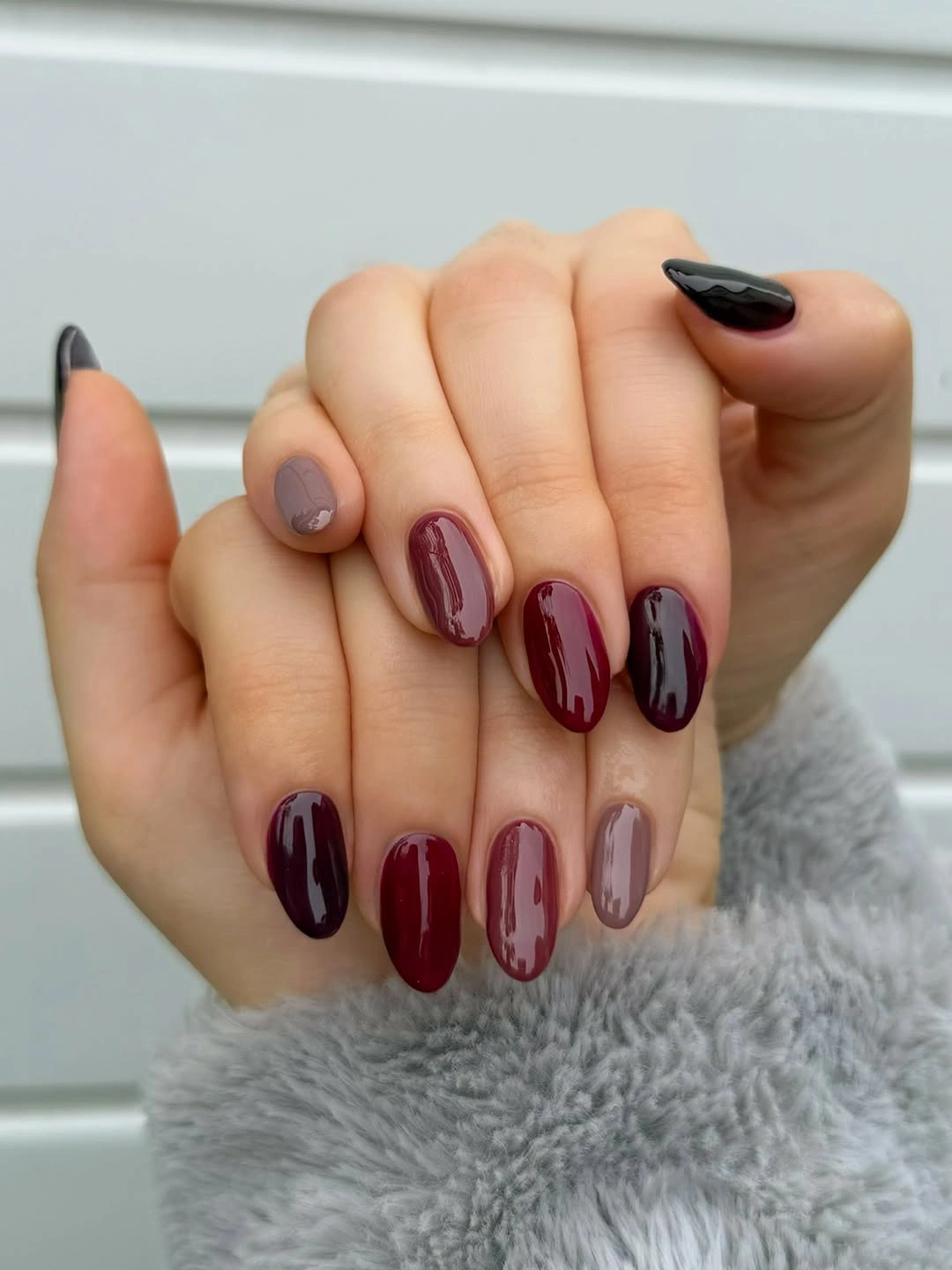
Subtle variation is the defining choice, making the set a useful alternative to high-contrast fall nail ideas. Arrange the darkest burgundy beside the palest mauve for a stronger rhythm, or keep the tones closer together if you want a soft gradient effect without introducing another motif or finish.
Short length supports the restrained palette and keeps the look practical as the nails grow. Because there is no decoration to distract from the colour differences, uneven shine or mismatched coverage may show more clearly, so the design rewards consistency and does not need extra details to feel complete.
Black Nails with Small Blush Floral Accents
Glossy black nails alternate with pale blush accents carrying tiny white and pink flower-like marks. The dark solids provide the strongest visual frame, while the decorated blush nails add a softer note without changing the overall medium almond silhouette or turning the set into a full floral pattern.
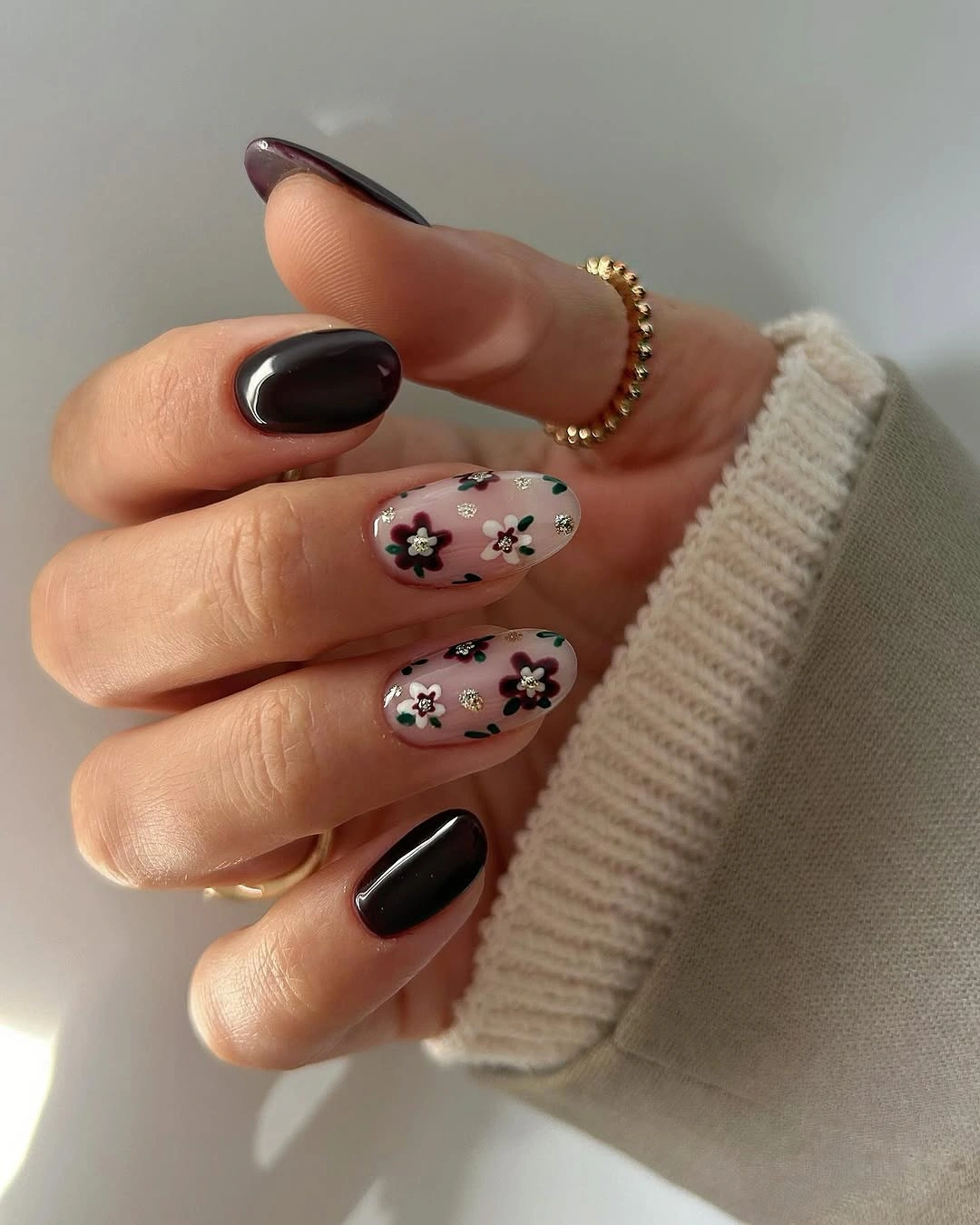
Opposition makes the small flowers readable: they have open pale space around them instead of competing with a patterned base. Keep the black on most fingers and use the floral detail on two accents, or replace black with espresso brown for an occasion-neutral interpretation that still preserves the light-versus-dark relationship.
Fine petals and tiny centers can lose definition when placed too close together, especially as the blush base grows out. A shorter almond version can use one larger flower on a single nail, giving the manicure a clearer focal point while avoiding the need to repeat minute details across the whole hand.
Gingham, Spirals, and Warm Autumn Motifs
Pink gingham with tiny orange motifs sits beside burgundy spirals, yellow-orange accents, cream-and-orange stripes, and green-brown details in this maximal medium almond set. The manicure is intentionally busy, but the repeated warm colours and returning checked panels create enough structure to hold the many small ideas together.
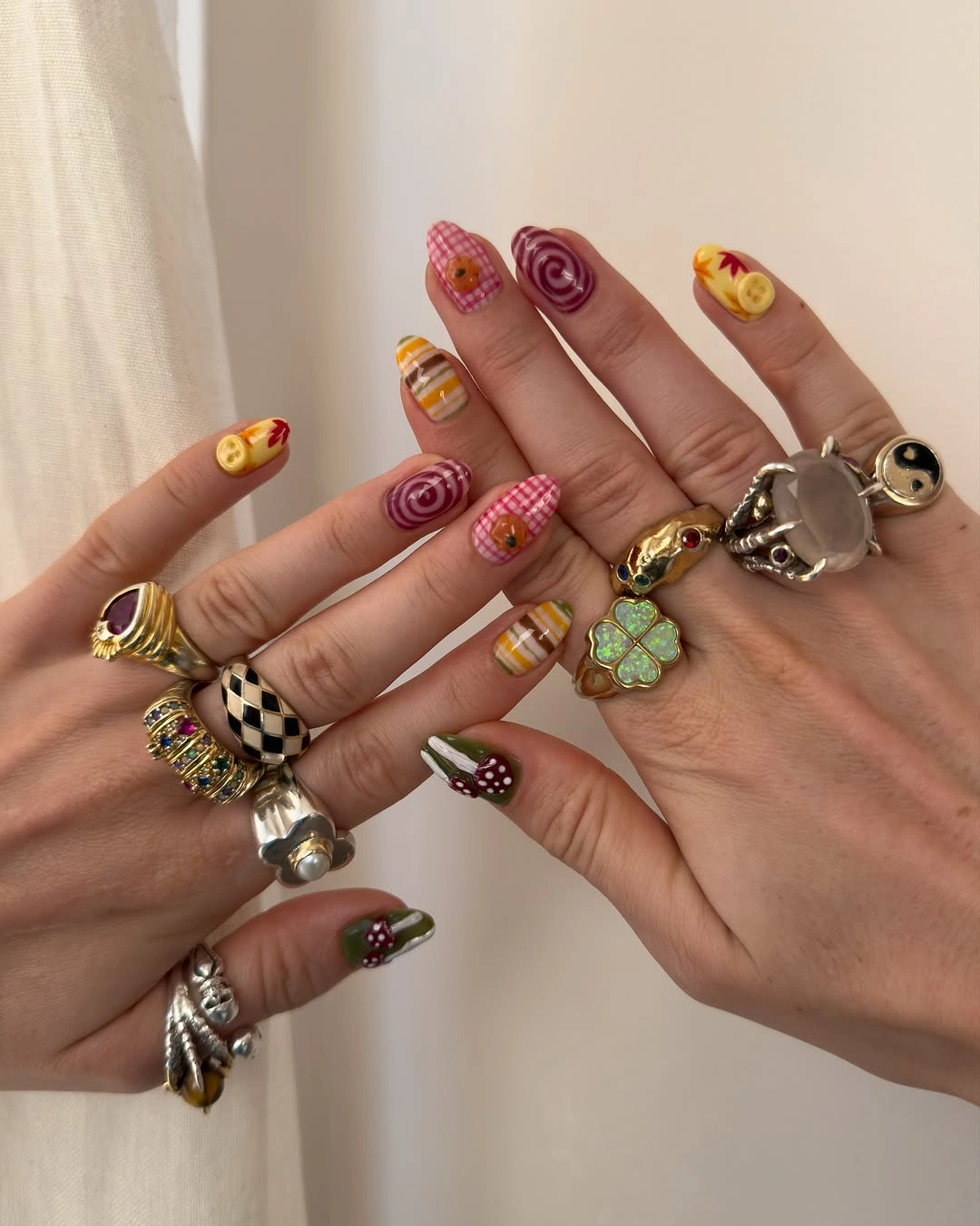
Each nail offers a different focal point, so the design works best when the palette is allowed to repeat more often than the motifs. For a wearable edit, keep the gingham and one spiral as the signature pair, then turn the remaining nails into simple yellow-orange or cream blocks; the story remains clear with far less detail density.
Medium almond length gives the checks, fruit-like marks, stripes, and dots enough room to register, but the full arrangement will require more visual upkeep than a solid or two-tone set. Choose it when you enjoy maximal detail, or borrow only its pink, burgundy, and orange colour relationship for a cleaner October manicure.