The smallest decision in a matte manicure can carry the whole mood. Here, deep brown almond nails leave one pale nail open for a loose black botanical sketch, so the eye moves toward the accent without losing the quiet weight of the solid color. That restrained contrast is what makes this matte fall nails design feel considered instead of merely dark.
This collection moves through brown, wine, olive, berry, and cool green while paying close attention to shape, spacing, and surface. Some sets use one tiny mark, others borrow texture or a second finish, but each idea shows a practical way to make seasonal color readable on real nails. The strongest choices are the ones that know when to stop adding detail.
One Pale Accent Lightens Deep Brown Almonds
Long almond tips give the deep matte brown a smooth, uninterrupted silhouette, while one pale accent nail changes the entire balance. Its black botanical line runs diagonally and leaves plenty of nude-looking space, so the decoration reads as a sketch rather than a dense panel. That single light interruption keeps the dark manicure from becoming visually flat.
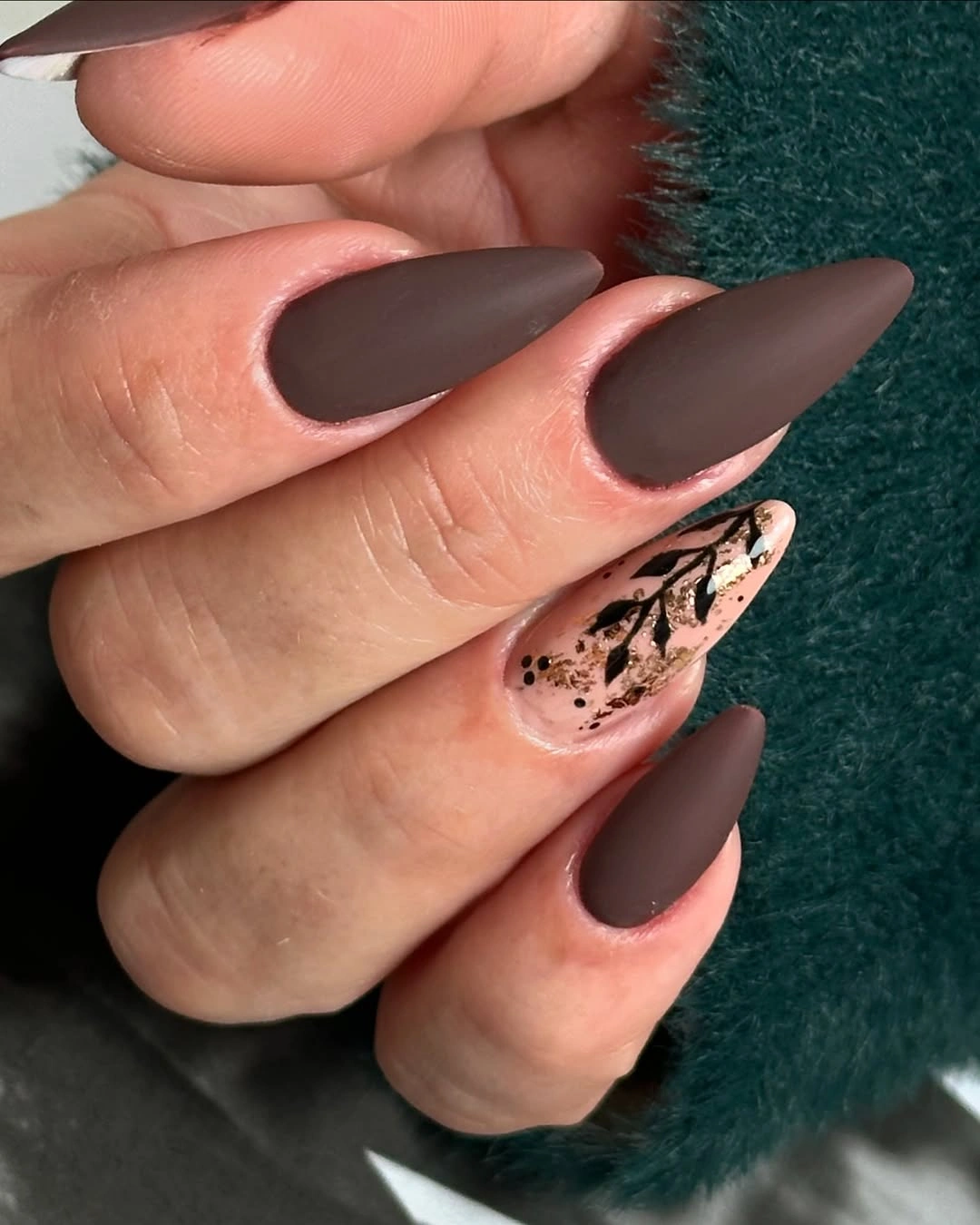
The accent works because its line color is repeated by the dark base, even though the base itself is not black. A warm brown field remains dominant, while the pale nail acts as a small pause between several pointed shapes. If the same drawing covered every nail, the almond tips would feel much busier and the clean contrast would disappear.
For a wearable version, keep the brown on most nails and move the sketch to one ring finger or thumb. A shorter almond or rounded oval can carry two or three simple leaves without losing the idea, while burgundy or muted olive can replace the brown. The long points are the honest tradeoff here: they give the accent room, but they also make the set more statement-led.
Warm Leaves Meet Muted Red Rounded Tips
Dusty pink nails provide a pale ground for rust and ochre leaf shapes, while two muted red nails hold the warmer side of the palette in place. The rounded-square tips give the pattern a stable border, so the leaves feel graphic instead of delicate and floating. Repeating the botanical detail on two pale nails makes the set read as one composition.
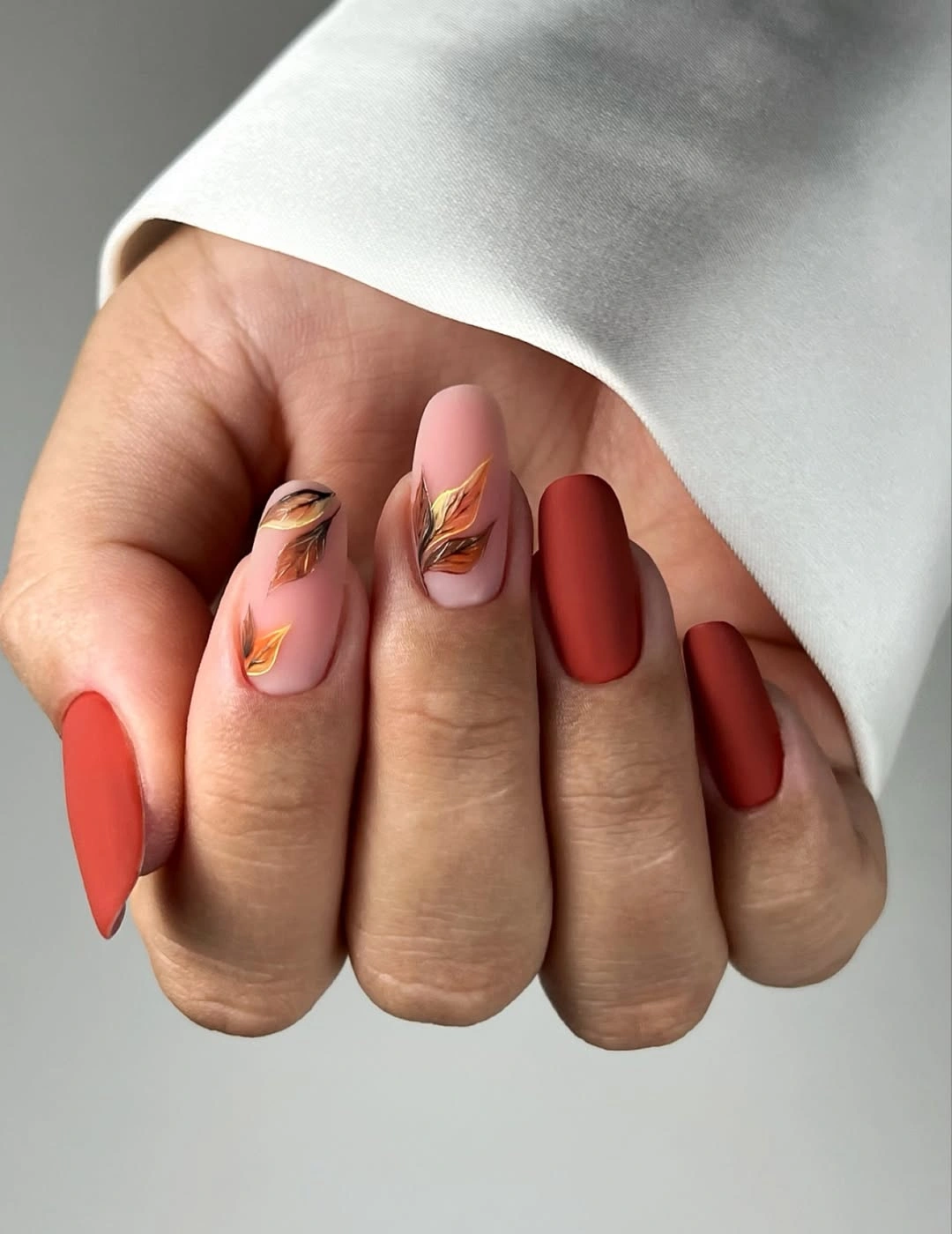
The solid red nails matter because they prevent the leaf accents from carrying every bit of visual information. Their flat color supplies a pause, and the warm red returns inside the art so the pale nails never look disconnected. That is a useful approach for matte fall nails with design: let one anchor shade do more than one job.
Copy the structure rather than the exact drawing by choosing a pale base, two small leaf accents, and one deeper solid color. Brown, cocoa, or muted burgundy can stand in for the red, while shorter rounded tips can keep the leaves larger and simpler. If the nail surface is narrow, reduce the number of leaves before reducing the open space around them.
Wine Matte Color Frames Nude Botanical Details
Deep wine almond nails alternate with pale nude accents carrying matching wine leaves and tiny warm gold-like fragments. The solid nails establish a strong dark rhythm, then the illustrated nails soften it by exposing more of the base. Because the botanical lines stay in the same wine family, the metallic-looking flecks add a small glint without pulling the set into a separate color story.
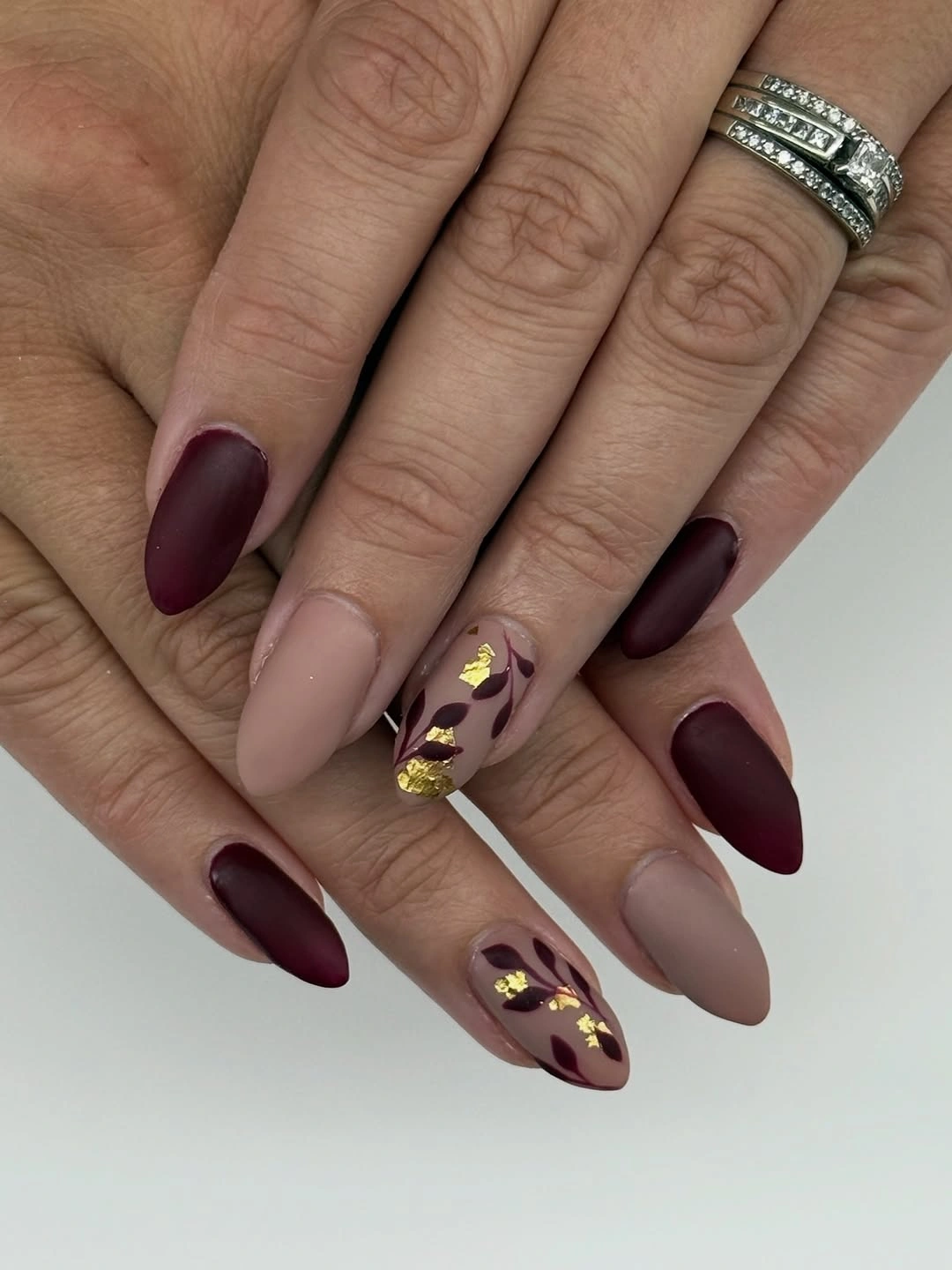
The balance comes from repetition with different surfaces: the eye sees the wine shade as both a quiet block and a fine line. Gold is used as punctuation inside the accents rather than as a full glitter nail, which leaves the matte majority in charge. Long almond length makes that relationship easy to see, but the same logic can work on a medium tapered shape.
Start with the solid shade and treat the pale botanical nails as a controlled variation, not as the foundation of the set. A few warm flecks are enough, and they can be replaced by a plain nude detail when a lower-key result is wanted. Keep in mind that long almond tips make every accent more visible, so this arrangement suits someone comfortable with a noticeable silhouette.
Solid Matte Burgundy Lets Shape Lead
Nothing decorative competes with the compact rounded outline of this matte burgundy set. Every visible nail uses one deep shade, and the side angle shows how the color follows a shorter, softer silhouette instead of stretching into a pointed statement. That simplicity is the design decision: the surface and the curve are asked to carry all of the seasonal character.
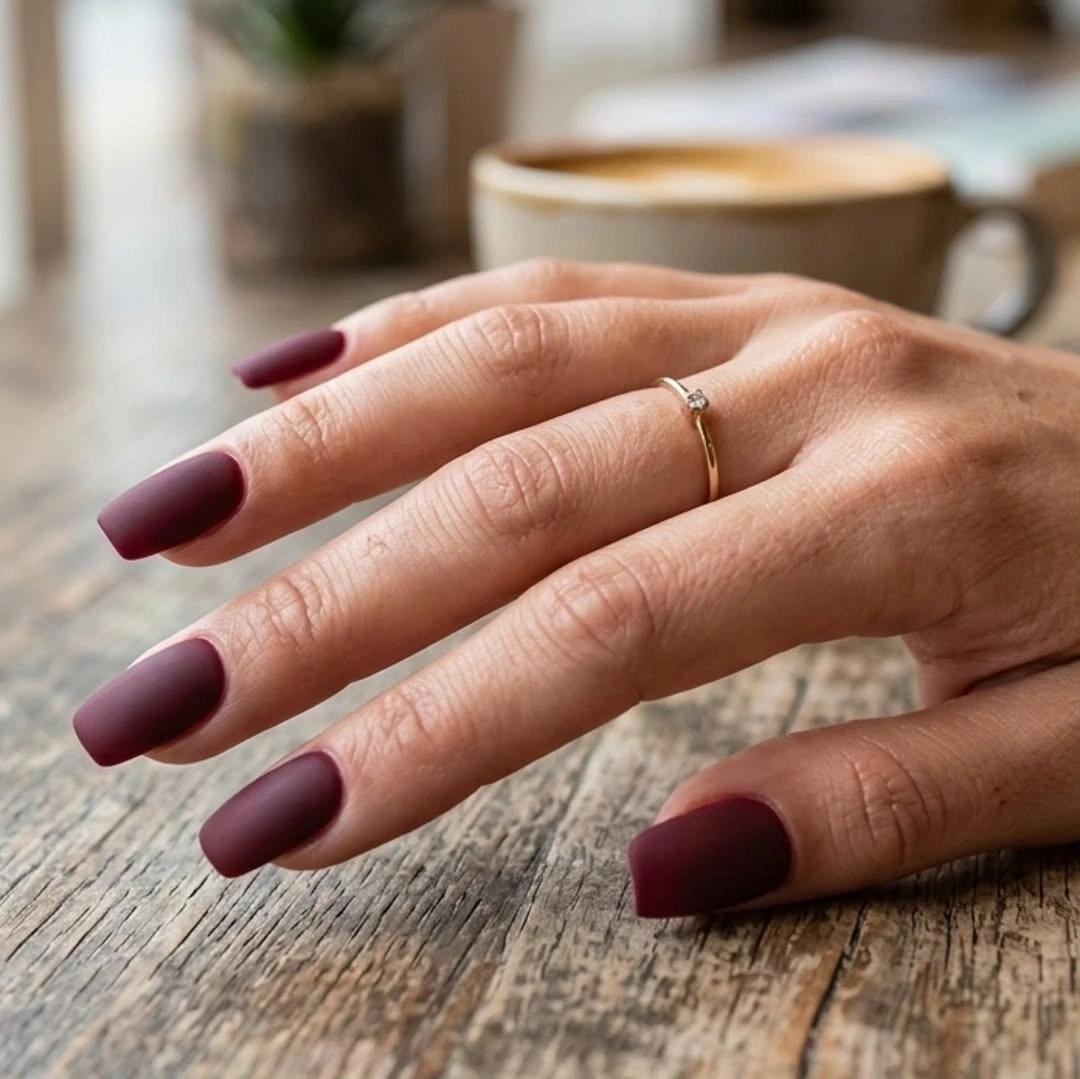
A dark color can feel surprisingly calm when it is not paired with sharp length or extra contrast. The matte surface removes the bright reflection that would make burgundy appear more dramatic, while the rounded tips keep the hand visually compact. This is a good reminder that a matte nails fall design does not need art to look intentional.
Choose a rounded, oval, or soft-squoval outline when you want a similar result for daily wear. The payoff is a clean color block that works with many clothes, but the limitation is equally clear: uneven shaping or patchy coverage has nowhere to hide. If you want more movement later, add one accent rather than changing every nail.
Sparse Black Sprigs on Cocoa Almonds
Muted cocoa brown covers most of these long almond nails, leaving one pale nude nail for separate black leaf sprigs. The marks do not fill the accent; they sit apart from one another and allow the base to show through between each stem and leaf. That sparse placement gives the manicure a botanical direction without turning the only decorated nail into a dense illustration.
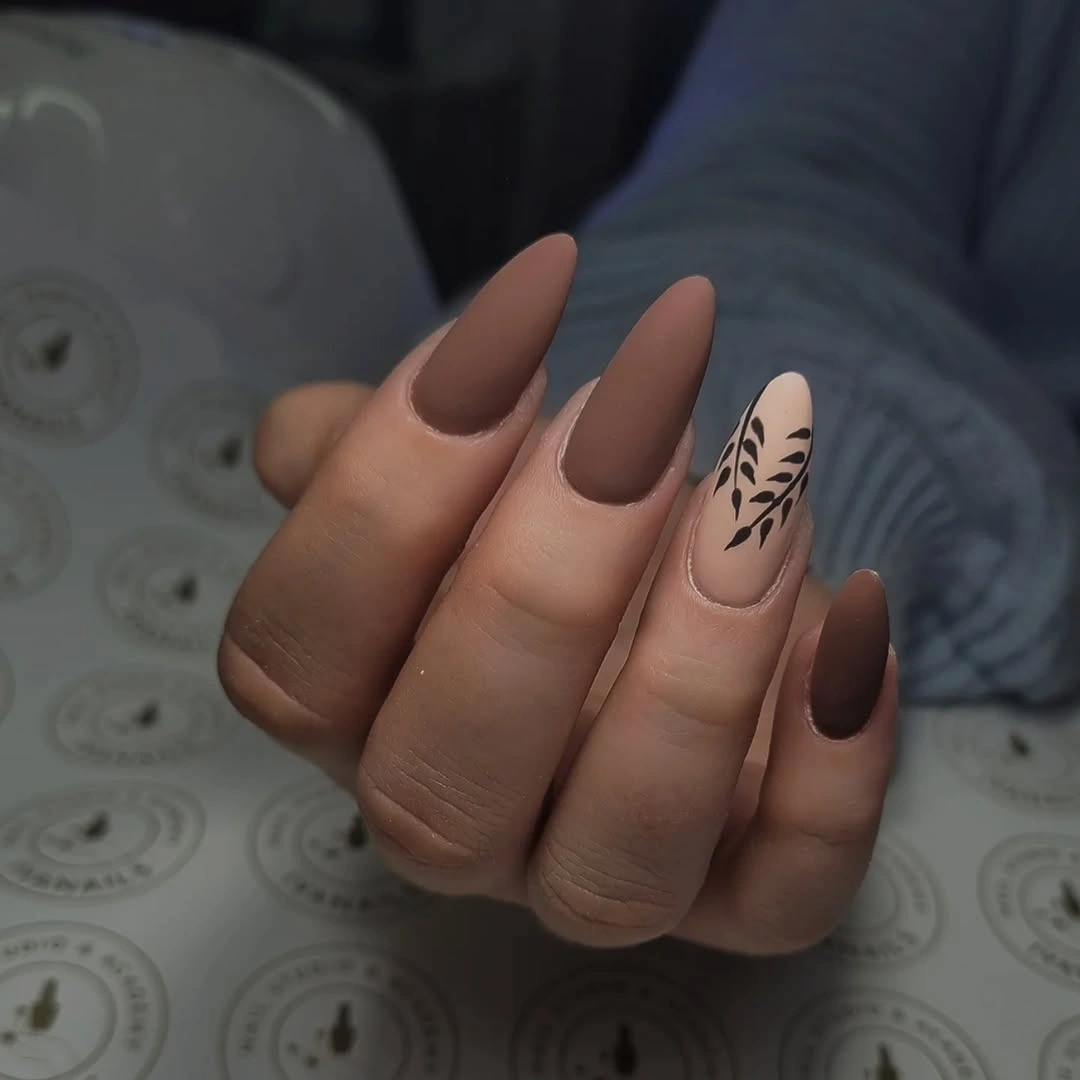
The open background is doing as much work as the black lines. It creates a light focal point against the cocoa solids, while the shared dark family keeps the accent connected to the rest of the hand. A fuller leaf panel would be easier to notice, but it would also compete with the long taper and remove the quiet pause that makes this version distinctive.
Use one accent nail and draw a few separated sprigs when adapting the idea. On a shorter oval, keep the stems close to one side and avoid adding tiny veins that may collapse into a dark patch. Burgundy, espresso, or muted green can replace the cocoa, but the open space should remain; it is the detail that keeps the design airy.
Cool Neutrals Turn Small Graphics Into A Set
Ivory, slate, navy, and black share a short rounded manicure in which every accent nail speaks a slightly different graphic language. One shows a leafy branch, another carries repeated pale strokes, and a dark nail uses curved bands near the tip, while a tiny seasonal-looking mark appears at the edge of a pale base. The variety feels controlled because the colors stay cool and limited.
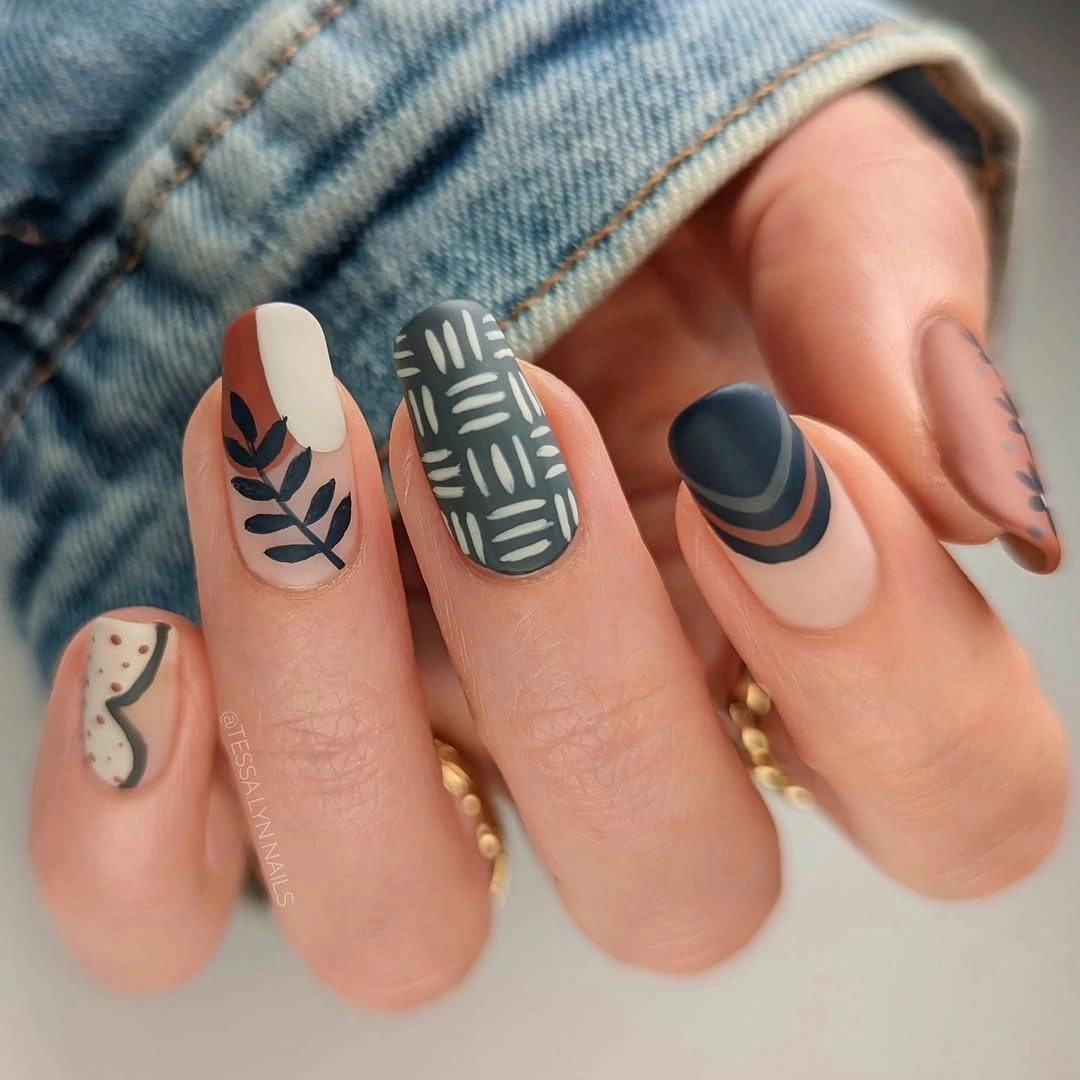
The charm is in the editing rather than in any single motif. Each nail receives one clear idea, so the eye can move from branch to strokes to bands without meeting a pile of competing marks. Denim at the edge reinforces the slate direction, but the manicure would still work with a plain wardrobe because the cool palette supplies its own structure.
For a simpler matte fall nails designs set, choose one branch or one curved-band idea and repeat it on two nails. Keep the base colors to ivory, slate, and one dark anchor so the small art stays legible. The realistic tradeoff is that mixed motifs can become busy quickly, so a narrow palette and generous open space matter more than adding another seasonal symbol.
Side-Swept Leaves Soften Matte Plum
Most nails are muted matte plum with a softly squared edge, while one pale pink nail carries a dark botanical motif along one side. The leaves follow the vertical direction of the nail instead of sitting in the center, leaving a calm strip of pink visible beside them. That placement gives the accent a sense of movement and keeps the dark color from taking over the pale base.
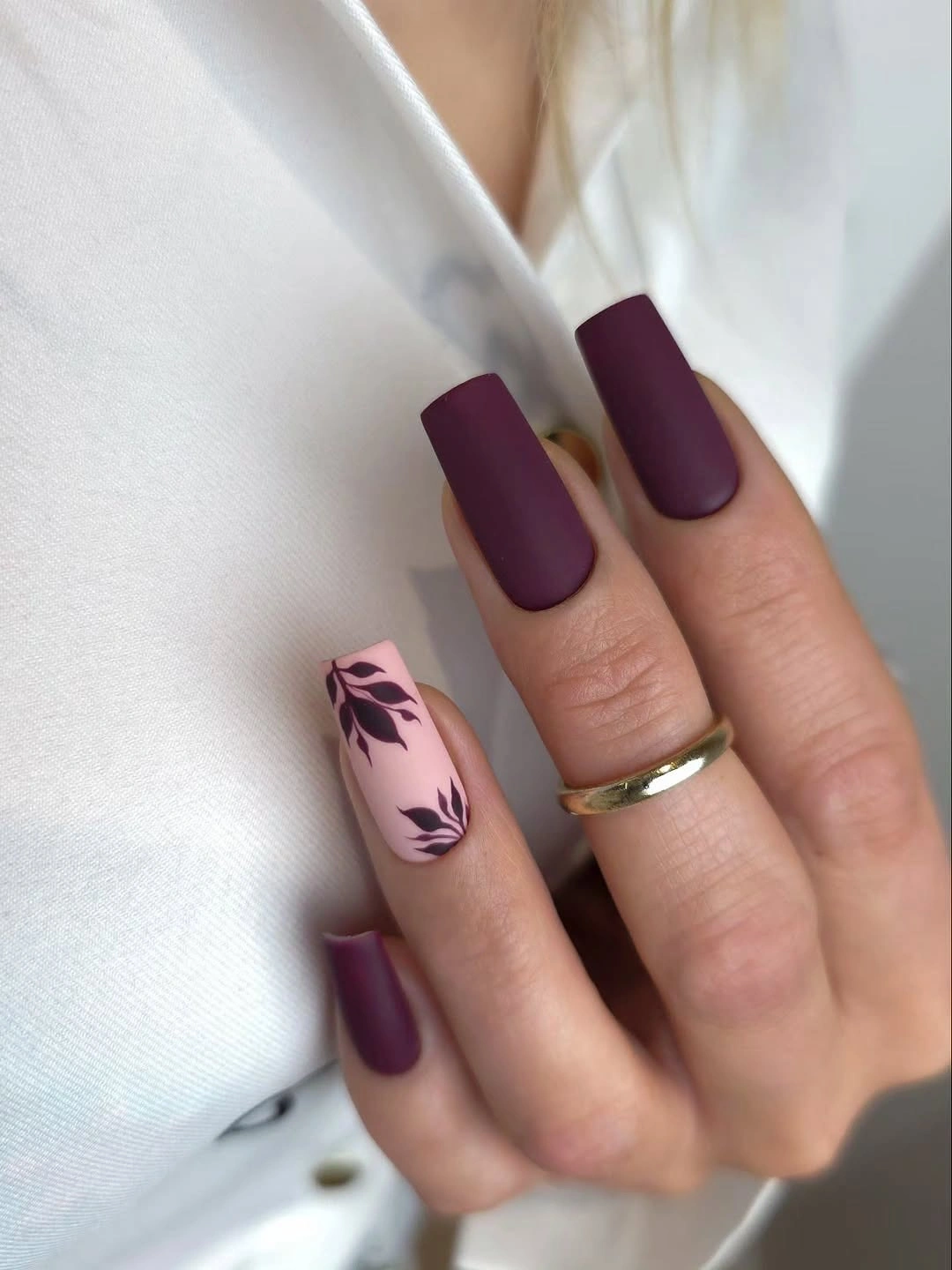
The side alignment is important because a soft square already supplies a straight visual frame. An edge-hugging branch introduces an organic counterpoint without fighting that border, and the surrounding plum nails make the pale accent feel purposeful. Centering a larger drawing would create a different result, but it would lose the light, slightly off-center rhythm seen here.
Try a shorter square with fewer leaves placed close to one edge, or swap the pale pink for cream, blush, or taupe. Keep the branch narrow enough to preserve open space and use the solid plum as the main color block. The practical limit is width: on a very narrow nail, side art needs to be reduced before it becomes cramped.
Tonal Purple Marks Add Depth Without New Color
Long almond nails stay within a deep purple family, but darker and lighter leaf-like marks move across the surface so the set has pattern without a contrasting accent color. The reflective highlights reveal the layered tonal details, and the almond taper gives those shapes room to travel along each nail. It is a full patterned set that still feels visually unified.
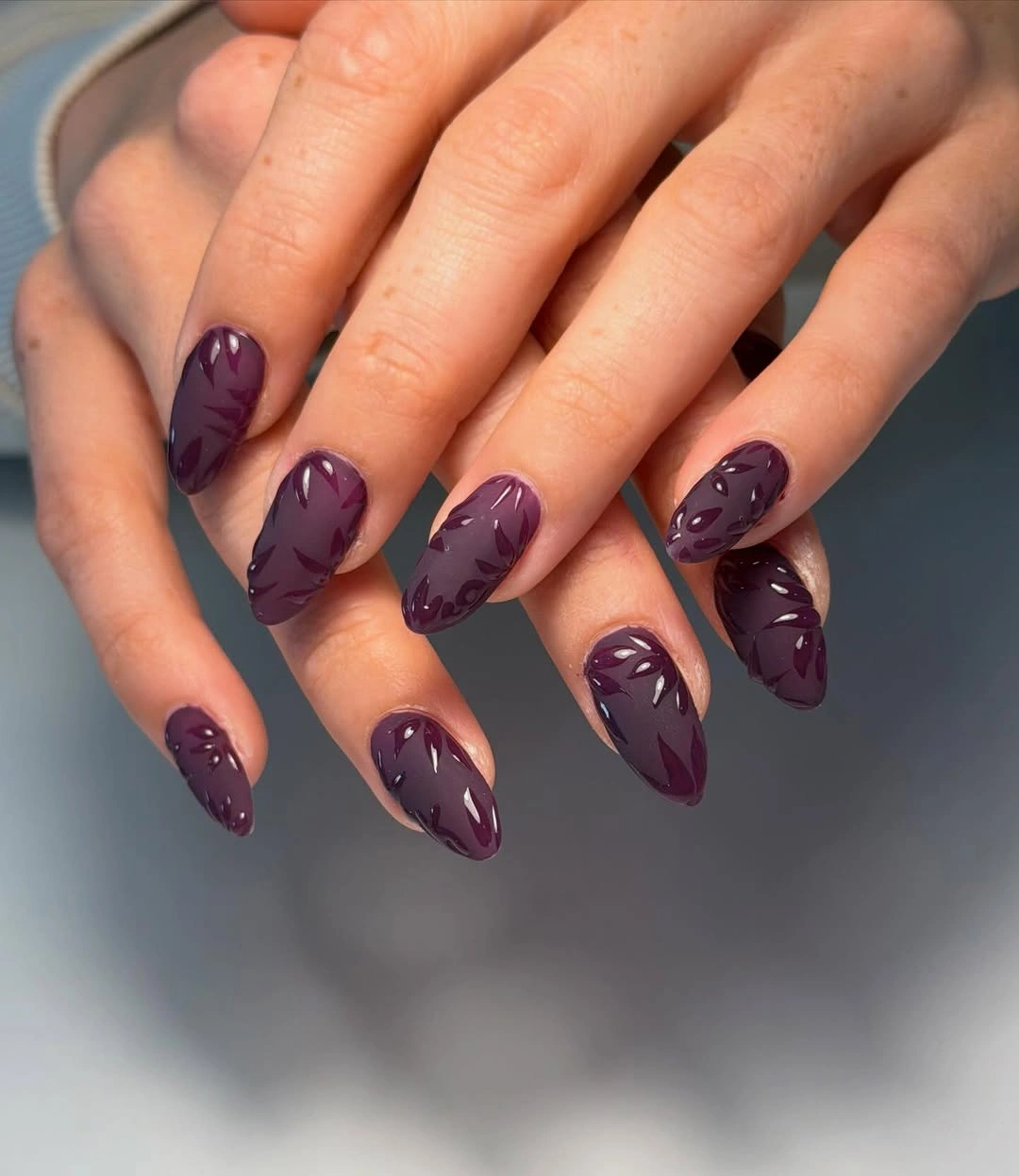
Low color contrast is what makes the repeated marks wearable. The eye notices the texture and movement after noticing the overall purple field, so no single line competes with the shape of the hand. A flatter satin or matte surface would make the design quieter, while a bright contrasting color would change it from tonal pattern to graphic statement.
To adapt the idea, use a base and a second shade only slightly lighter or darker, then keep the motif to one or two accent nails on a shorter shape. A single tonal leaf or curved mark can carry the same editorial point. Long almond length helps the pattern breathe, so reduce detail rather than squeezing the full arrangement onto compact tips.
Charcoal Anchors Pale Twig Accents
Several medium almond nails use a pale cream base with black twig-like marks placed near the side or tip, while one solid dark charcoal nail interrupts the light sequence. The pale nails stay open and low-shine, so the marks read as small branches rather than heavy illustrations. That single dark anchor gives the airy set a firm visual stop.
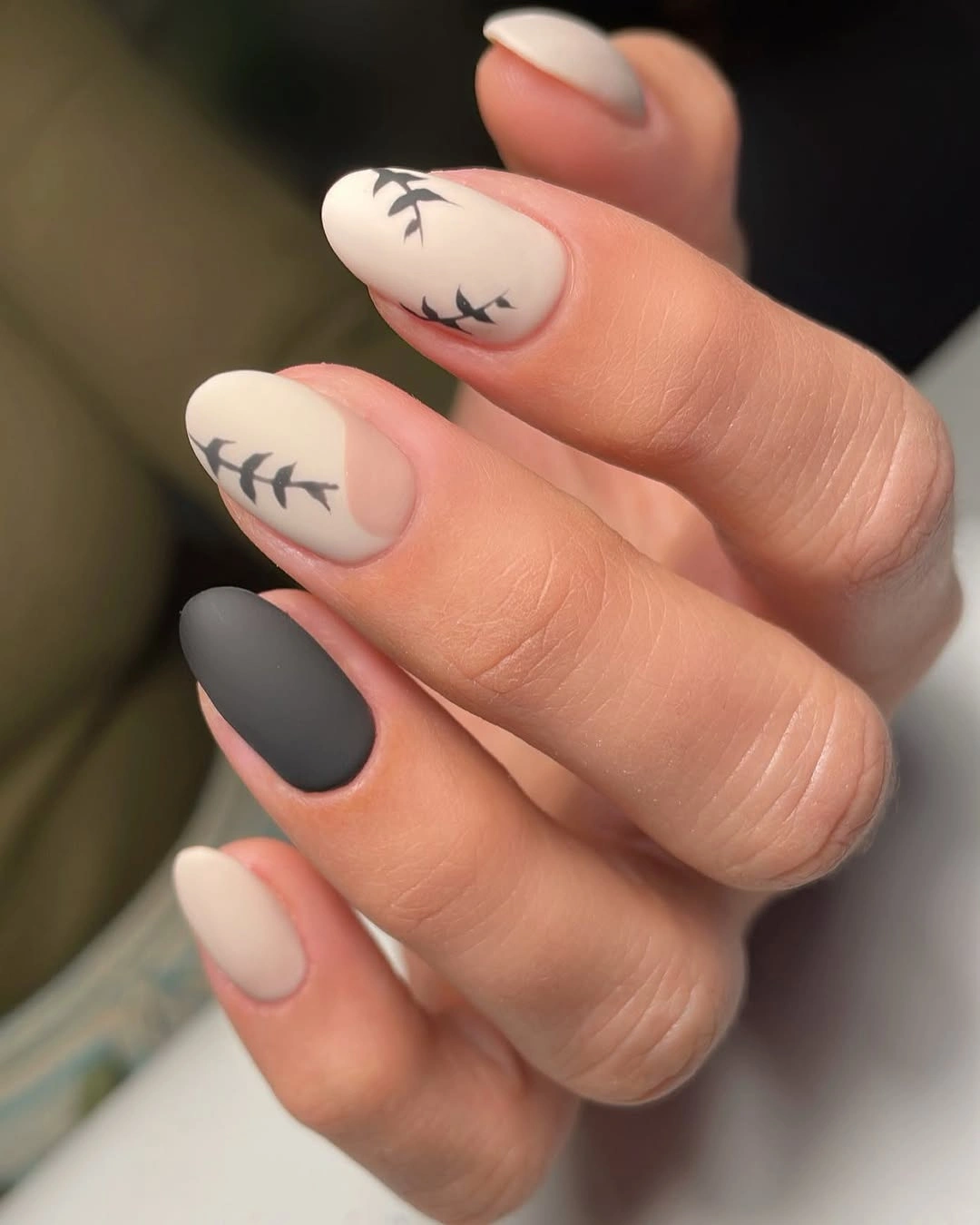
The contrast works through both color and placement. A twig near the edge follows the curve of the almond and can visually extend it, while the charcoal nail prevents the pale accents from blending into one soft row. The dark anchor also lets the manicure keep a restrained palette; no bright metallic or extra motif is needed to create emphasis.
Use one dark gray, chocolate, or forest anchor with two pale nails carrying short twig marks. On a shorter oval, move the motif closer to the free edge and use fewer branches so the base remains visible. Pale backgrounds need careful edges because small placement differences show easily, so the tradeoff for this light look is a little more precision.
Muted Mauve Makes Floral Panels Feel Intentional
Most nails are muted mauve with a matte surface, while two pale accents contain small flowers and leaves arranged like miniature panels. The flowers use quiet color patches and dark outlines rather than filling the entire manicure with decoration. Rounded short-to-medium tips keep the illustrated nails approachable and let the mauve majority act as a calm frame.
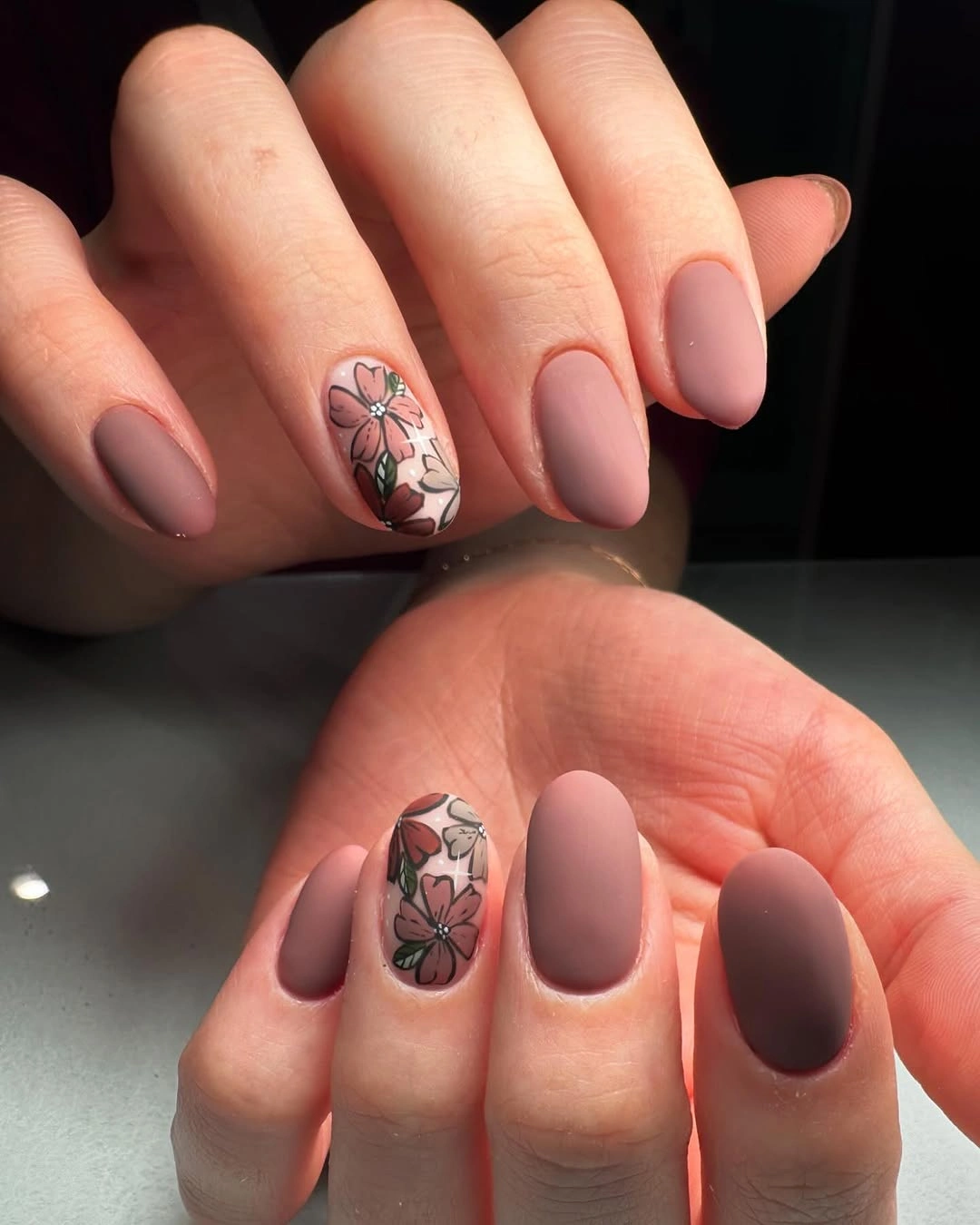
Two matching accents create a rhythm that one isolated nail would not provide, but the solid mauve nails keep that rhythm from becoming repetitive. The floral panels are easy to find because they repeat, yet they do not compete with one another for attention. This is a practical example of using placement as structure: the design feels complete because the accents have a clear relationship.
For shorter nails, reduce each panel to one flower, one stem, and plenty of pale base. Olive, cocoa, or dusty plum can replace the mauve if you want a different autumn direction, while one accent nail is enough for a very quiet version. The limitation is scale; tiny petals need breathing room, so extra flowers will usually weaken the idea rather than improve it.
Muted Olive Works As A Quiet Fall Neutral
Every visible nail is a compact rounded shape covered in the same subdued olive green matte color. There are no accents, metallic pieces, or contrasting tips to distract from the relationship between shade and silhouette. Because the green is muted toward gray, it behaves more like a neutral block than a bright statement color.
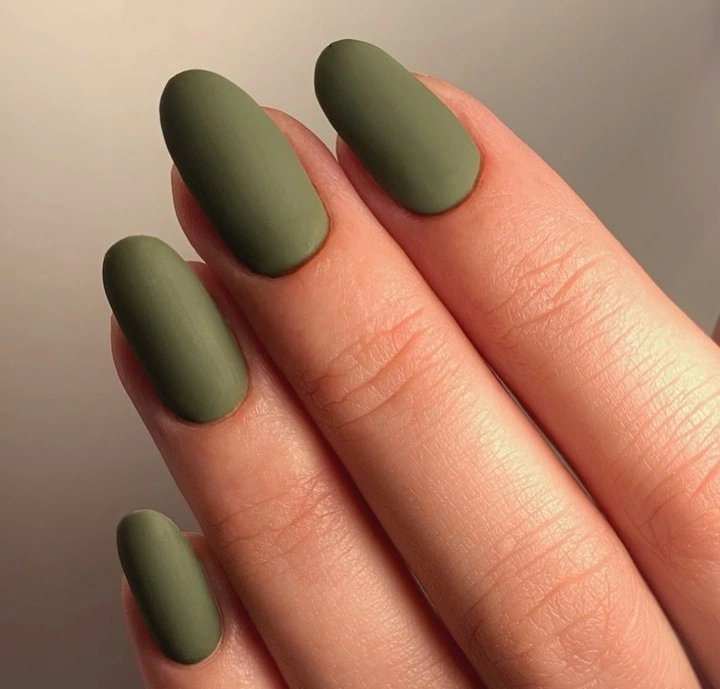
The quiet effect comes from low saturation and consistent shaping. A brighter green would make the manicure more playful, while a glossy surface would add reflections and make the color appear sharper; here the matte finish lets olive settle into the hand. That makes the set useful for someone who wants color but does not want a motif or a multi-step pattern.
Keep the shade on every nail, or introduce only one darker forest accent if a little contrast is needed. Rounded or soft-squoval tips preserve the calm proportion, and a shorter length makes the green feel especially grounded. Since a solid set exposes every edge, even shaping and clean color coverage become the main maintenance considerations.
Olive Solids Carry Black Leaves And Gold
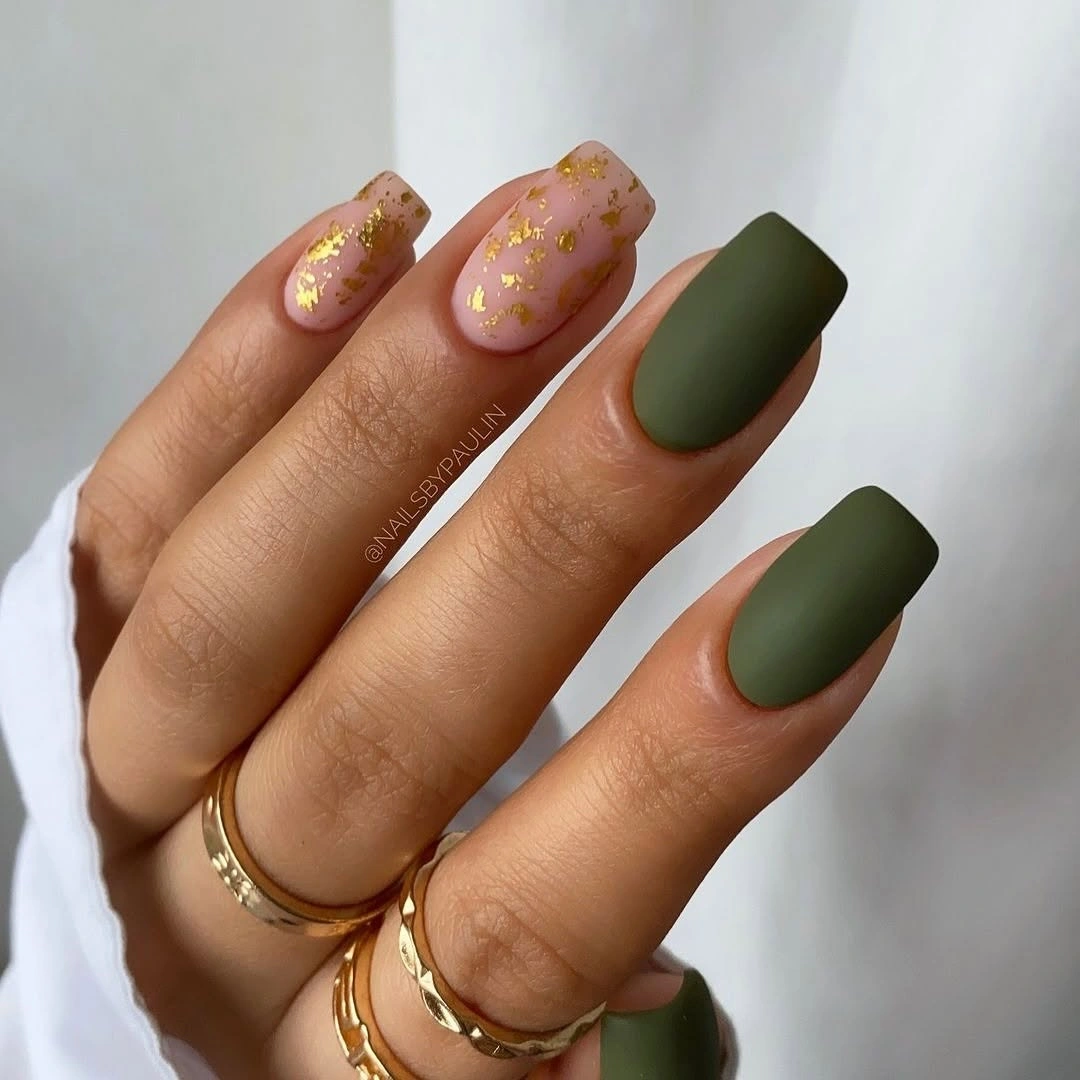
Matte olive nails alternate with pale nude accents carrying larger black leaf shapes and small warm gold-like flecks. The leaves are bolder than fine sprigs, so they remain visible against the pale base, while the olive solids repeat the same grounded direction across the hand. Gold appears as a few bright fragments and never displaces the green as the main color.
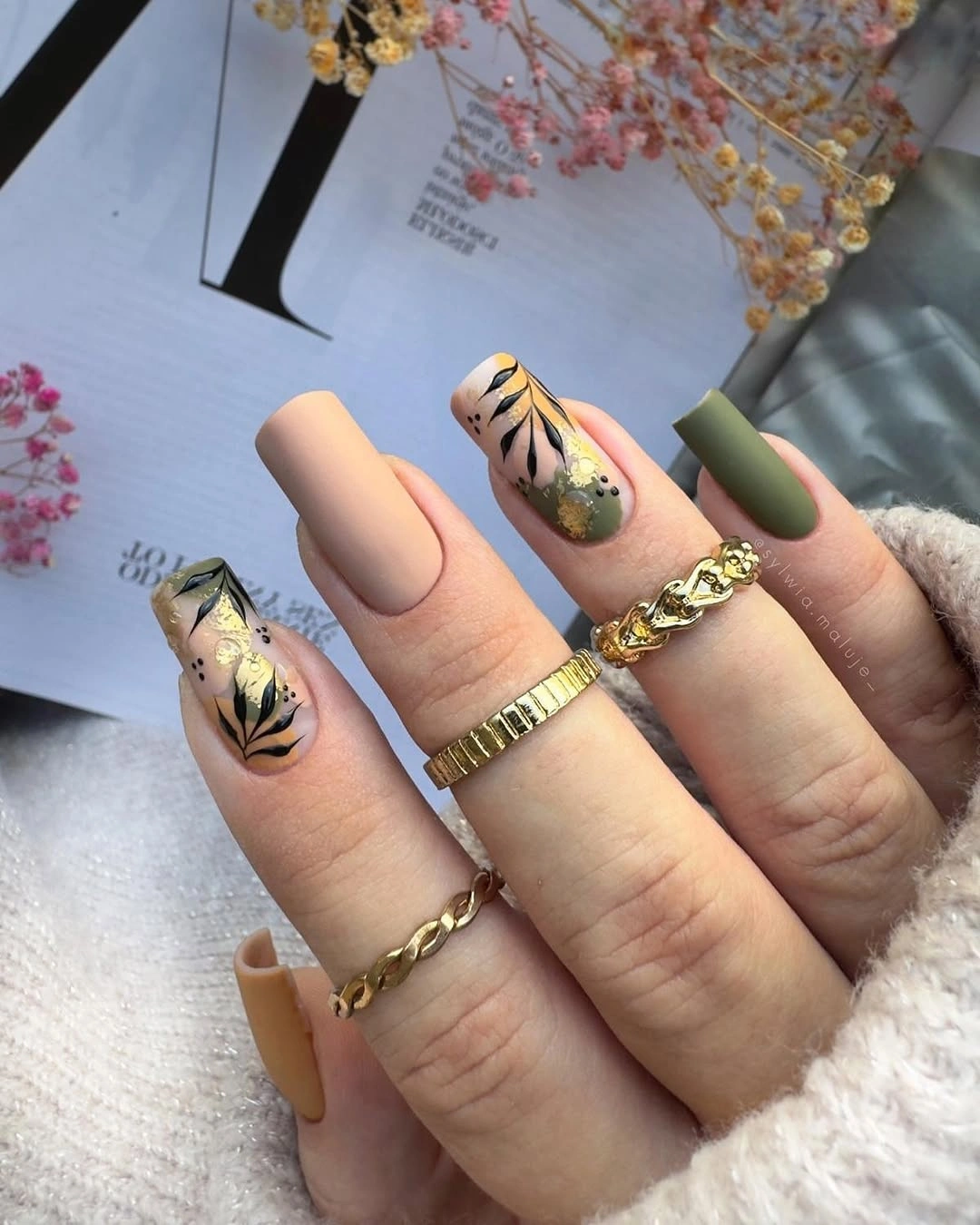
The composition works because each material-looking detail has a limited role. Olive provides continuity, black gives the leaves definition, and the warm flecks add a pinpoint of light that echoes the jewelry without needing to match it exactly. If the gold were spread across every nail, the muted contrast would become a glitter story instead of a leaf story.
Keep olive on most nails and reserve one or two pale bases for large leafy shapes. A beige accent can replace gold, or the leaves can be reduced to two bold forms on a shorter oval. Wider nails support the larger silhouettes better, so the honest adaptation is to simplify the motif before trying to preserve every small fragment.
Forest Green Meets A Pale Luminous Edge
Deep green matte nails sit beside pale nails that catch a narrow vertical sheen and finish with a dark green edge near the tip. The set gains variety from the difference between powdery green and light-reflective pale surfaces, not from a busy motif. That dark edge quietly repeats the main color and gives the pale nails a defined ending.
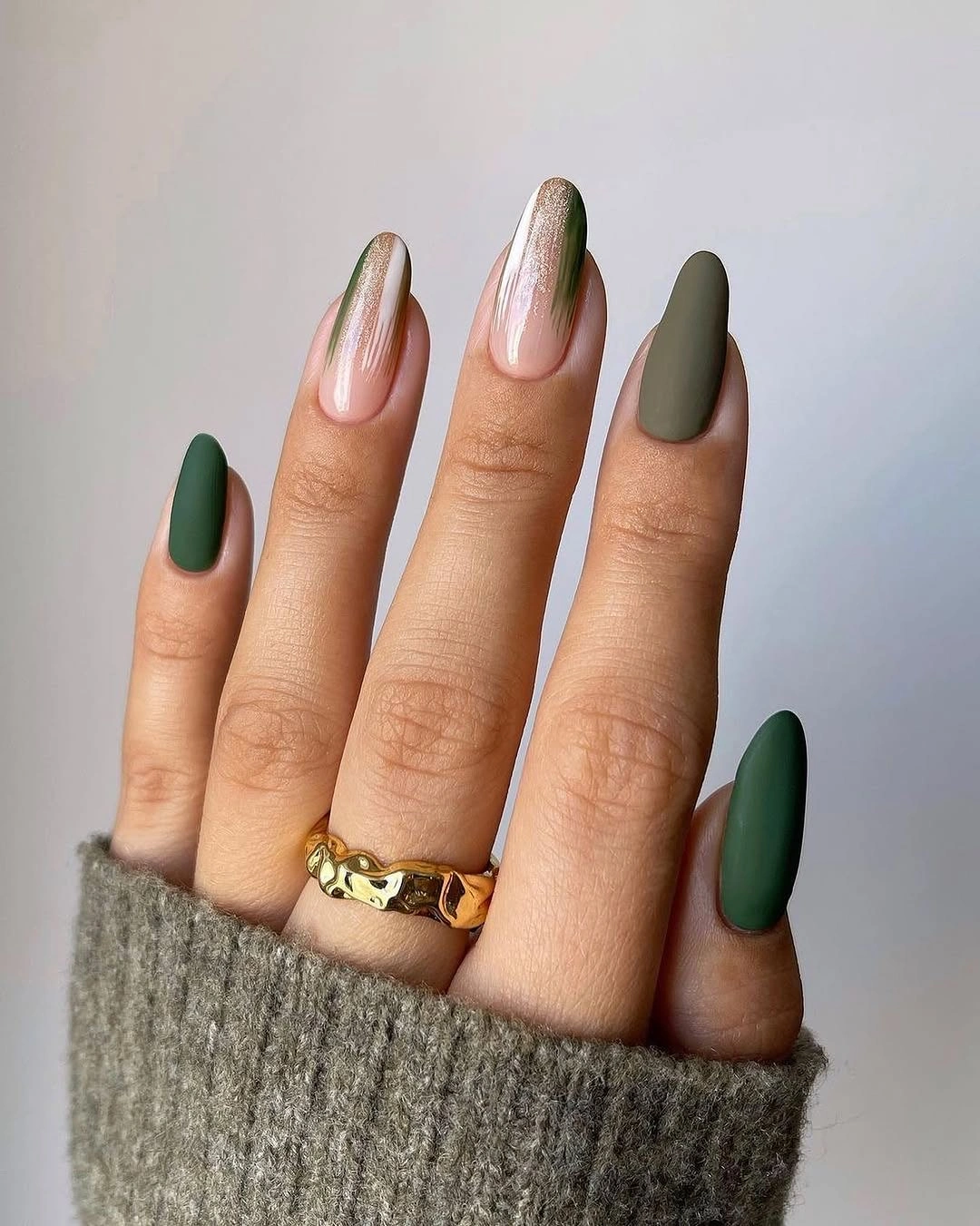
Finish contrast keeps the palette coherent because the color family does not have to do all the work. The green solids feel dense and grounded, while the pale nails open the hand and bring light toward the center; the narrow edge reconnects both sides. It is a useful option when you want matte green fall nails design ideas but prefer line and surface over painted leaves.
Choose one matte green and one pale low-contrast base, then place the darker edge on only one or two nails. If the shimmer is not your preference, use a soft satin or plain cream and keep the same dark border. Boundaries need to stay clear for this idea to look deliberate, so the tradeoff is that finish changes are less forgiving when the line becomes uneven.
Knit-Like Texture And White Sprigs Share Green
Deep green matte nails alternate between flat color, visible cable-like texture, and small white sprigs with tiny dots. The textured nails look more tactile than the painted ones, yet everything remains within one dark green palette with white used only as a light note. Short-to-medium oval proportions keep the mixture grounded and stop the cozy surface from becoming too sharp.
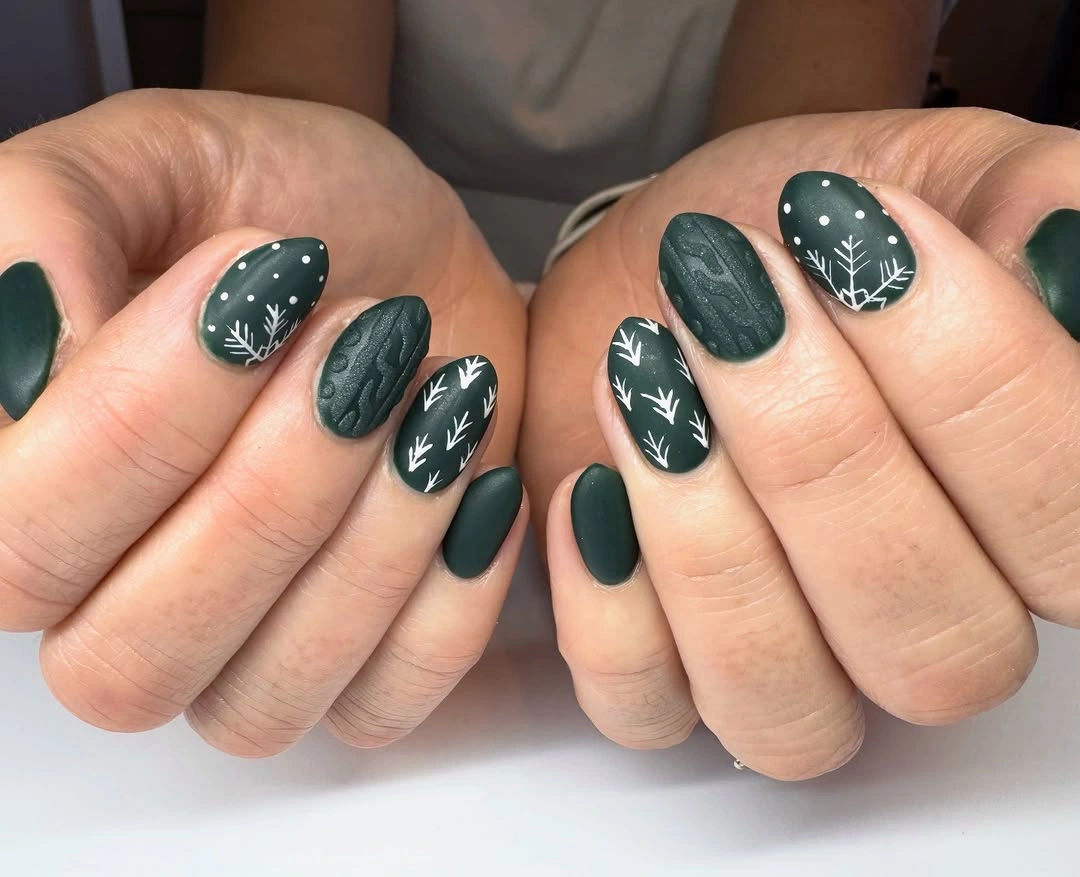
Texture changes the experience of the set without introducing another strong hue. Selected relief-like nails create depth, while the white sprigs bring a finer rhythm that can be read at a glance; the flat green nails provide the necessary rest points. That alternation is why the manicure feels layered rather than overloaded, even with more than one kind of detail.
Use textured detail on two nails and keep the rest flat, or choose only the white sprig idea for a lower-maintenance version. A flat painted cable pattern can suggest the same direction on a shorter oval, though it will look less dimensional. Raised-looking detail becomes the focal surface, so limit it when a smooth, understated finish is the priority.
One Glitter Nail Energizes Matte Coral
Medium-long rounded nails use matte coral or salmon as the main color, then switch one nail to dense orange-red glitter. The accent stays in the same warm family, so it reads as a change of surface and intensity rather than a random sparkle. Surrounded by flat coral, the glitter nail becomes an obvious focal point without asking every finger to compete.
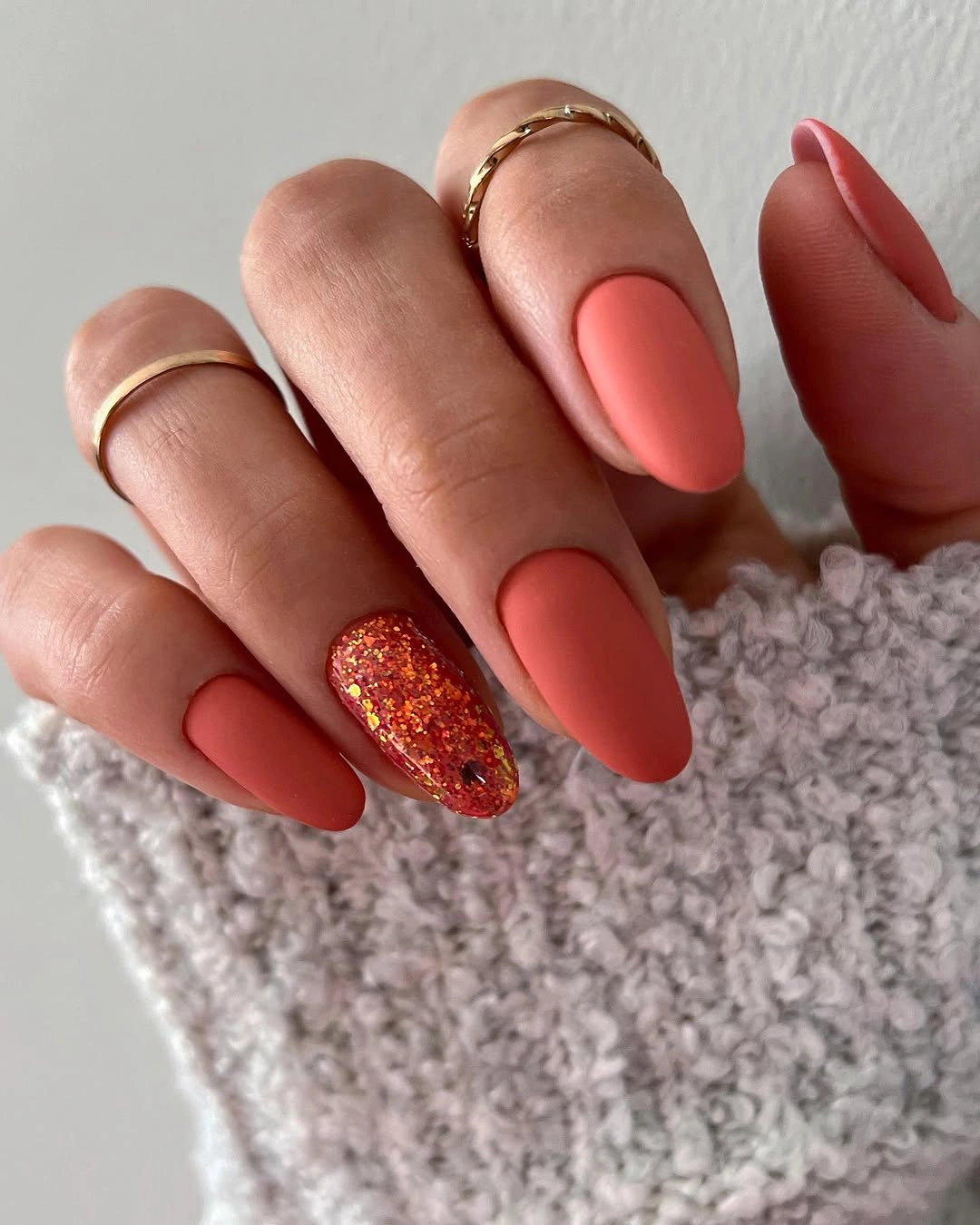
The color relationship matters more than the amount of glitter. Coral keeps the majority soft and approachable, while the brighter accent supplies movement and catches light against the plush neutral background. A different glitter color would make the manicure more fragmented, whereas tone-on-tone sparkle lets the matte base remain the main visual idea.
Keep the dense sparkle to one nail, or replace it with a fine shimmer if you want a subtler finish. Terracotta, warm peach, or muted red can replace the coral while preserving the relationship. The honest tradeoff is attention: one bright nail will be noticed first, so place it where that focal shift feels comfortable rather than adding glitter automatically.
Muted Color Blocks Build A Soft-Square Palette
Pale blush, taupe, mauve, and one deep chocolate nail share a medium soft-square manicure with no painted motif. Each shade occupies a clear block, so the hand gains variation without losing the calm quality of low-saturation color. Bright light makes the subtle differences visible, and the dark accent gives the lighter group a stable edge.
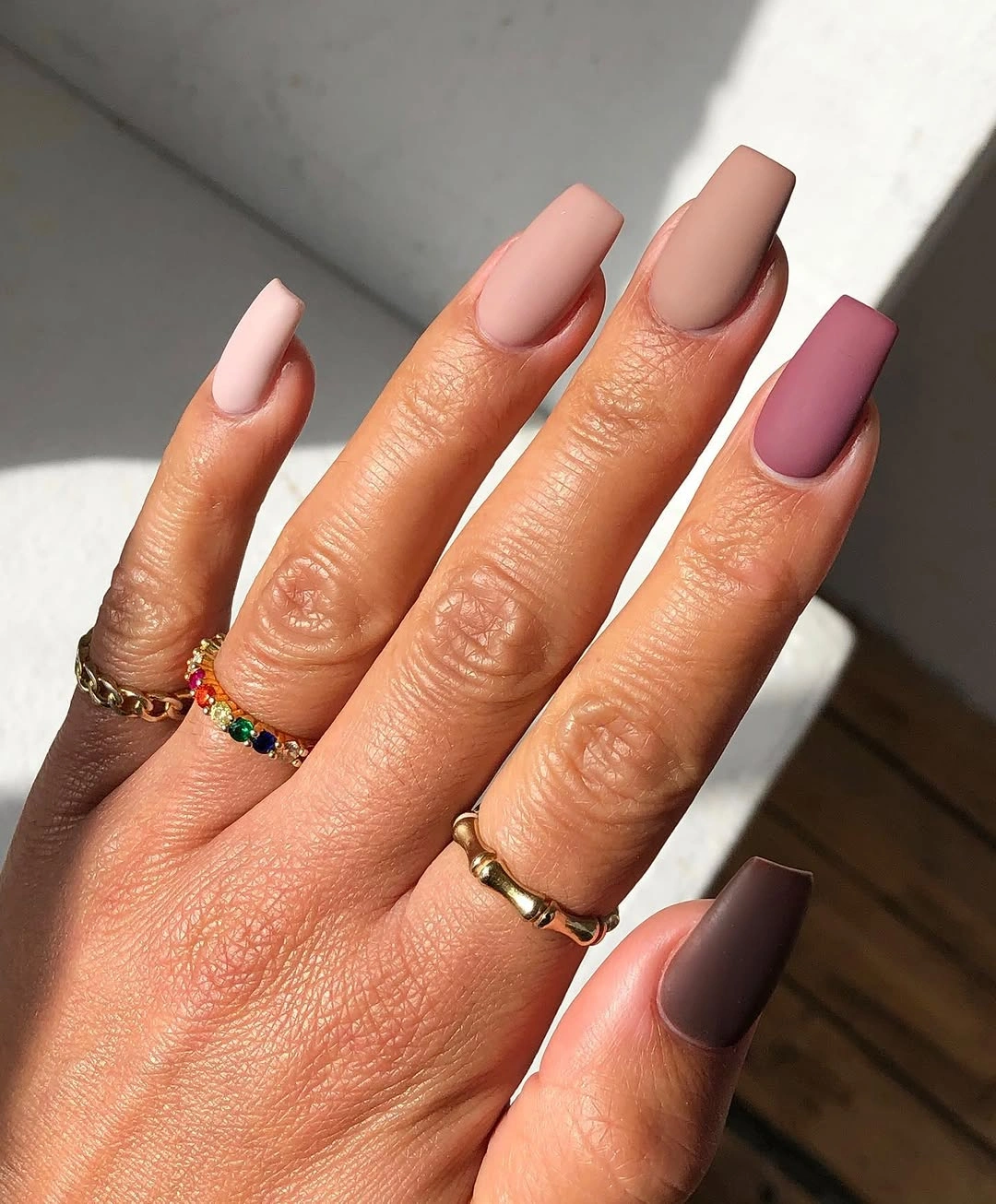
This palette works because none of the light shades tries to become the star. Blush warms the hand, taupe steadies it, mauve adds a berry note, and chocolate supplies depth; the colors are different but close enough to sit together. A high-contrast black accent would change the mood, while the softer chocolate keeps the transition measured.
Choose two light neutrals and one deeper anchor if four colors feel excessive. A rounded shape will make the blocks gentler, while a soft square keeps their edges more graphic; either way, place the darkest shade on one nail so it does not overwhelm the pale set. Subtle palettes can disappear under dim lighting, which is their quiet benefit and their visual limitation.
Earthy Pointed Nails Make Texture The Statement
Long pointed nails move through olive, mustard, rust, and deep plum, with several surfaces showing raised-looking dots, ridges, or knit-like patterns. Each nail has a different earthy color, yet the muted undertones keep the set related and the matte finish stops the palette from turning glossy or bright. The tactile details are the main event, not a small afterthought.
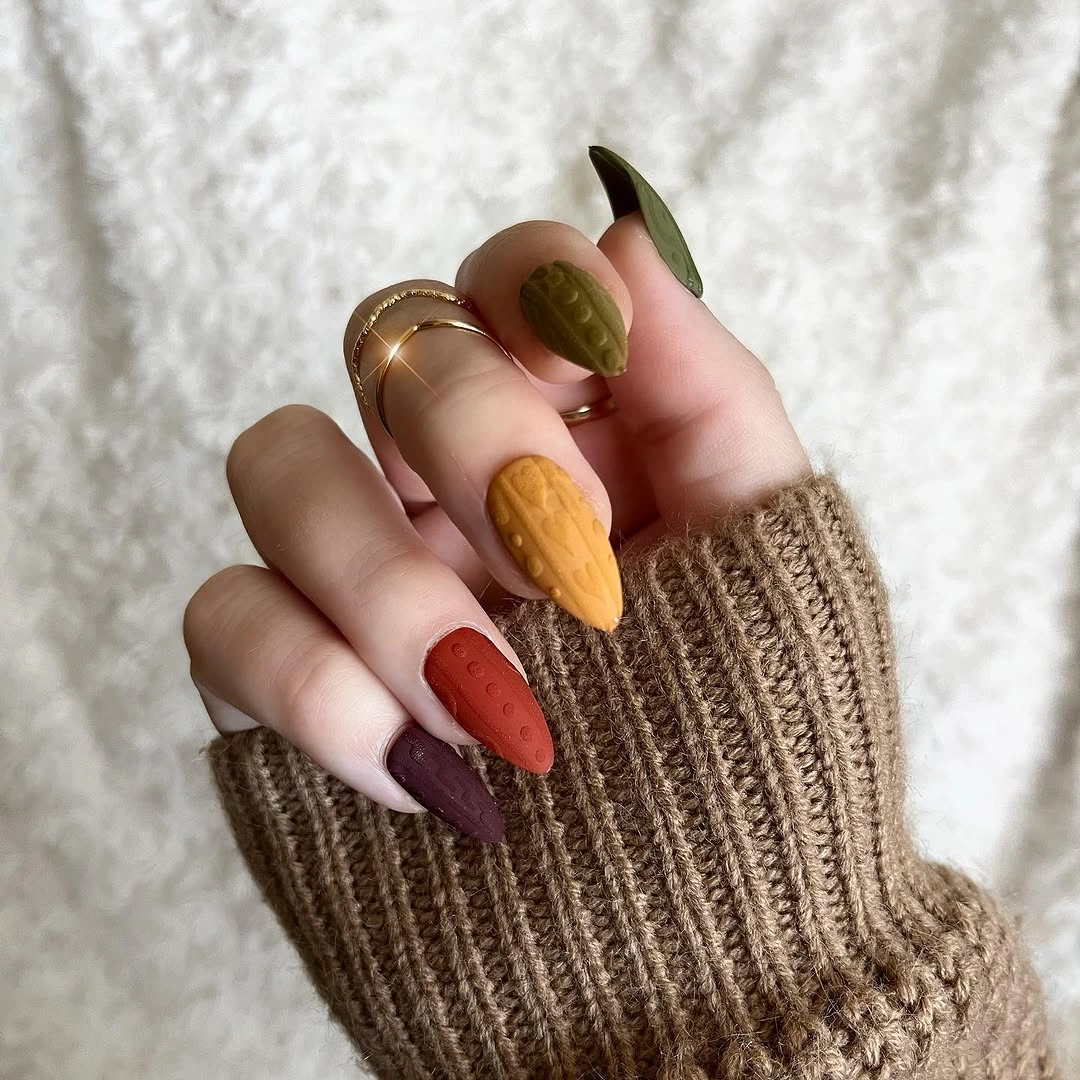
The texture gives every shade a separate identity while the shared softness prevents the colors from competing. Olive feels grounded, mustard brings a dry golden note, rust adds warmth, and plum deepens the edge; the tactile surfaces make those shifts easier to notice. Long points amplify the result, so the hand reads as expressive even though the colors themselves are restrained.
For a more practical version, keep two solid earthy shades and place texture on only two nails. A short oval will soften the statement, and reducing the palette to olive plus rust will make the design easier to coordinate. Pointed length and relief are the real tradeoffs here: they create a strong silhouette and require more comfort with visible detail.
Berry Matte Color Gets One Tactile Accent
Short rounded nails use a deep raspberry or berry matte shade from finger to finger, with one visible nail changing to a same-color cable-like texture. The accent is not brighter or darker; it is different because the surface catches the light and interrupts the smooth field. That keeps the manicure compact while giving the eye one place to pause.
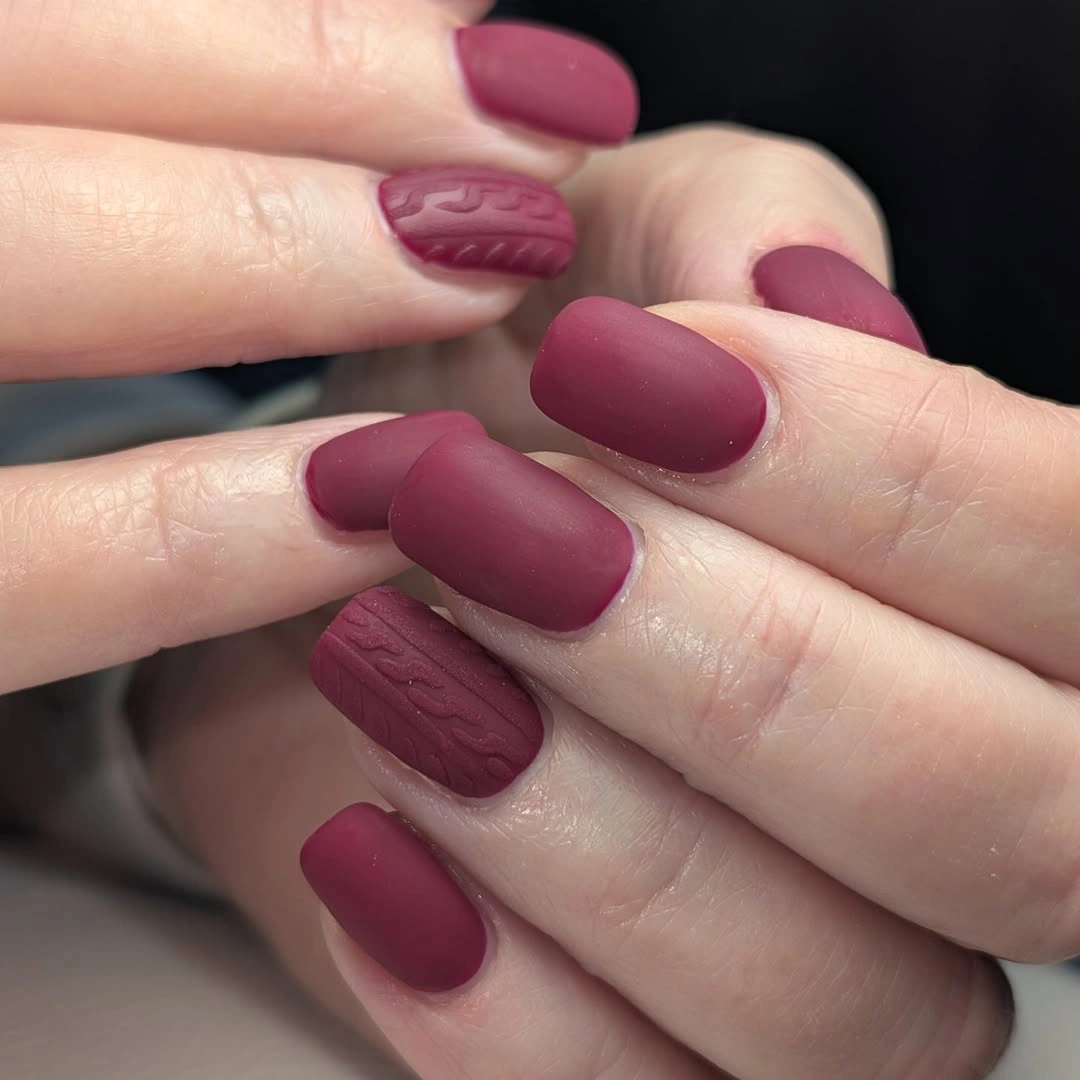
Monochrome texture is especially effective on a short shape because the color does not widen the design with extra contrast. The berry remains the first impression, and the relief appears only after the hand is viewed more closely. Adding a second color would make the accent louder, while keeping it tone-on-tone preserves the neat, everyday direction.
Use one textured nail on a short rounded set, or replace the relief with a flat cable-inspired line pattern. Deep burgundy, plum, or cocoa can follow the same structure, but keep the accent within the base family. The tactile nail naturally receives more attention and may need more visual upkeep, so it is best treated as a deliberate focal point.
Olive Solids Meet Pale Flecks And A Green Edge
Matte deep olive nails alternate with pale accents scattered with small warm gold-like flecks, while a narrow green edge repeats the solid color on one light nail. The almond shape is moderate rather than extreme, giving the hand a tapered line without making the decoration feel oversized. Irregular flecks bring light, but they remain much quieter than full glitter.
The pale accents work because olive appears in more than one form. It anchors the solid nails and returns as a thin border, so the eye can travel through the set even when the light bases are open. Small flecks add warmth to that route, but their scattered placement prevents the manicure from becoming a metallic block that would compete with the green.
Try scattered flecks on one or two nails and repeat the main green as a slim tip or side edge. A shorter rounded shape will make the palette feel more casual, while cream can replace the pale base if you want stronger separation. Open accents show placement clearly, so the practical limitation is that uneven spacing becomes part of the visible design.
Bold Leaf Silhouettes Suit Short Oval Nails
Pale pink bases carry dark green leaf silhouettes that overlap near the tips, while several short oval nails are solid matte forest green. The leaves are broad and graphic rather than built from fine veins, which keeps their shape readable on a compact canvas. Matching the art to the solid nails gives the collection a clear visual anchor.
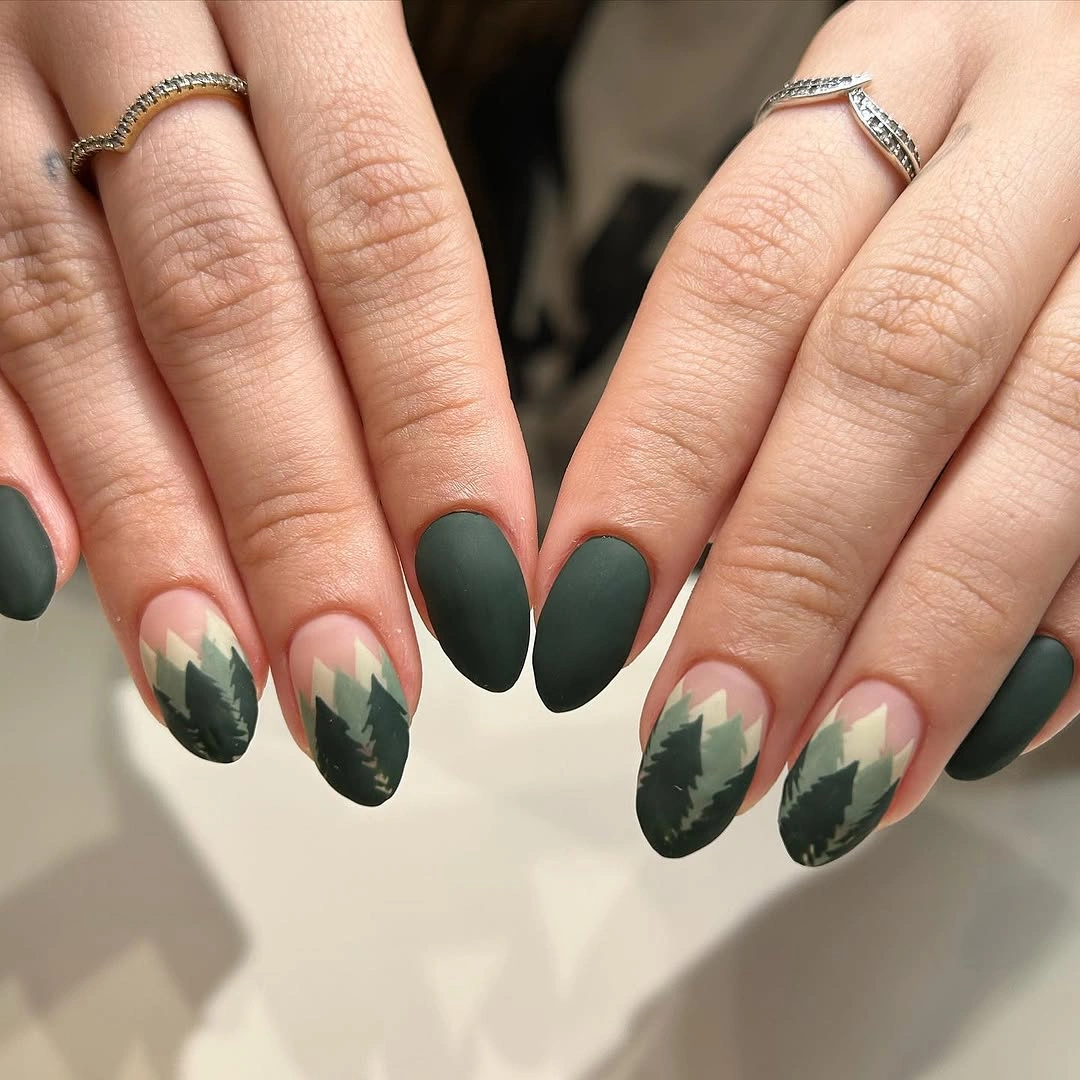
Larger silhouettes are a smart choice when the nail is short because they survive scale better than delicate line work. The dark shapes create a band of emphasis near the tip, and the pale base leaves enough room around them to keep the manicure from feeling closed in. Solid green nails repeat the silhouette color and give the hand a stronger rhythm than pale accents alone would provide.
Use two large leaves instead of a full branch, then place them toward one side or the tip. A rounded oval or short squoval can keep the same idea, while a brown, slate, or muted burgundy anchor can replace forest green. The tradeoff is visual boldness: silhouettes read quickly, so choose them when you want the botanical detail to be noticed.
Cable Accents Give Deep Green A Cozy Rhythm
Most nails are solid matte deep green, but selected nails carry a same-color cable-knit texture that changes the surface without changing the palette. The short-to-medium rounded shape makes the design feel compact, and the repetition on more than one textured nail creates a gentle rhythm rather than a single isolated bump. Flat and tactile greens alternate across the hands.
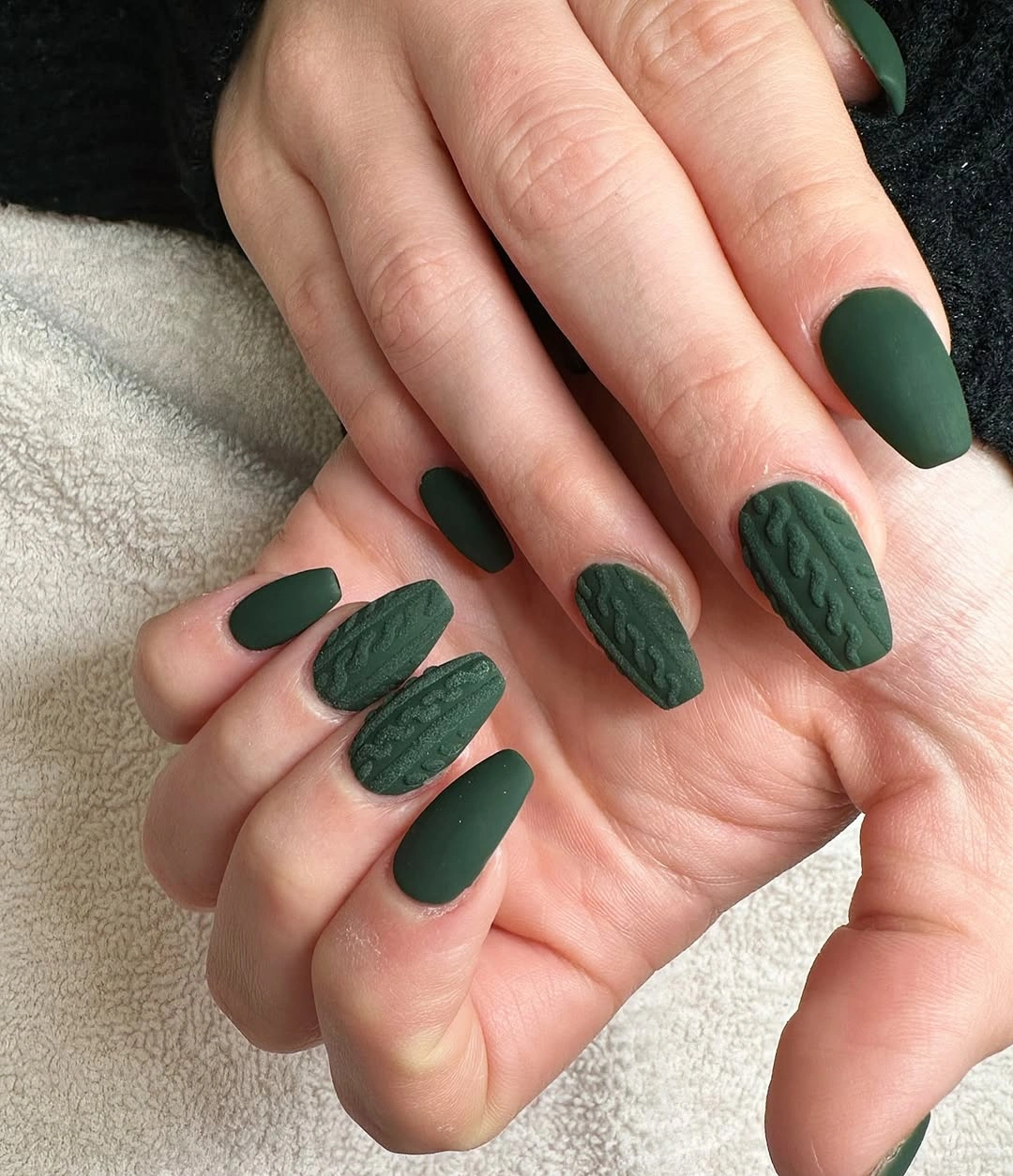
The repeated texture works as a supporting detail instead of making every nail a focal point. A single accent would feel more graphic, while two or three matching textured nails let the eye move through the set and return to the solid color. The pale background reinforces the cozy direction, but the manicure would still read clearly without the surrounding fabric.
Keep the texture on two nails and let the remaining green stay smooth for a balanced version. Berry or cocoa can replace deep green, and an oval outline will preserve the soft proportion if the square feels too firm. Because the relief draws attention to a chosen area, use it selectively when you want an understated manicure with one tactile consequence.
Teal Solids Freshen Pale Botanical Accents
Medium almond nails pair matte teal or blue-green solids with pale nails carrying small flowers and fine stems. The cool anchor makes the floral details feel less predictable than a brown or burgundy base, while the spaced artwork leaves the pale surface open around each stem. That contrast gives a seasonal manicure a transitional direction without relying on warm earth tones.
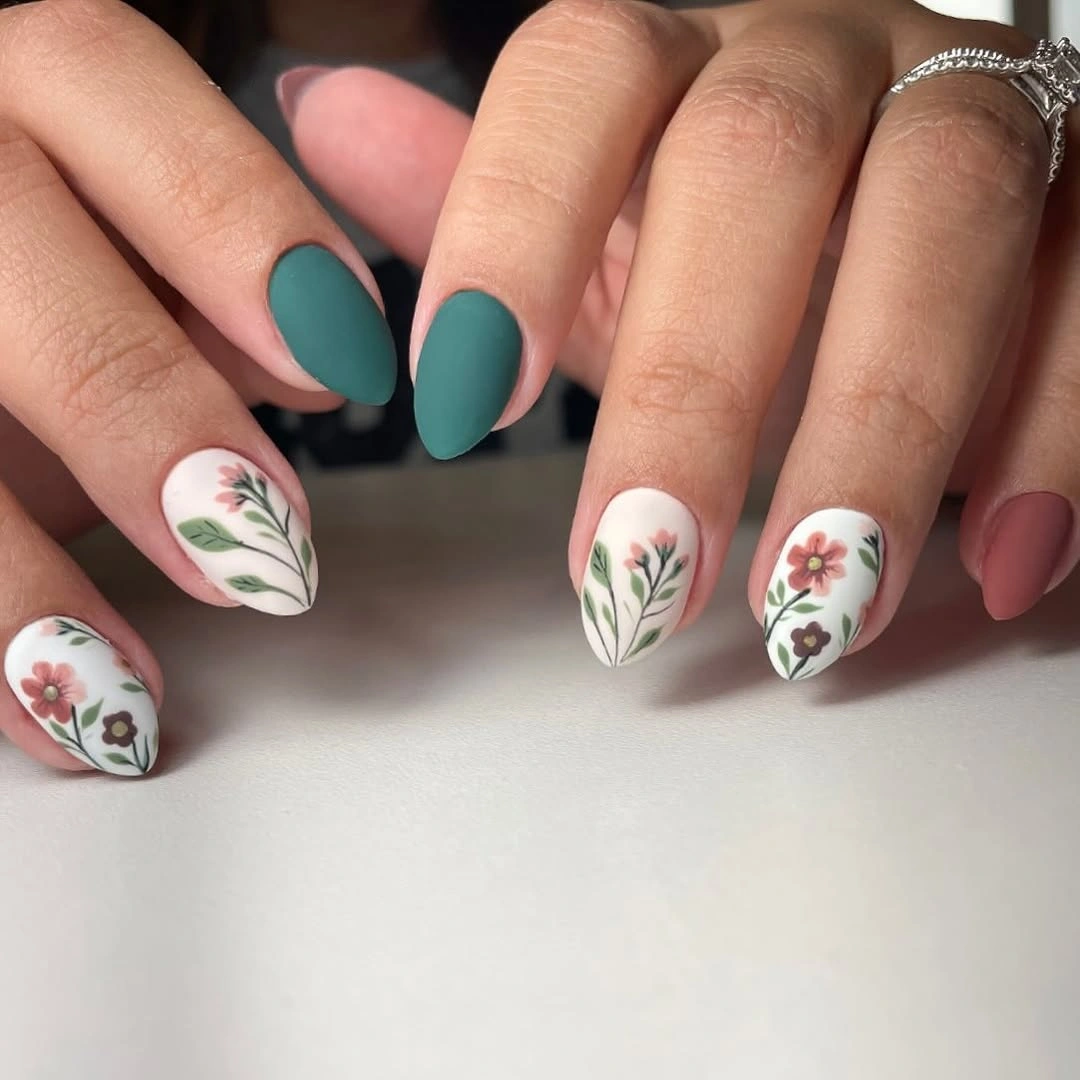
Teal supplies enough depth to frame the flowers, but its coolness keeps the set visually light. The pale nails are not covered by dense petals, so their almond taper remains clear and the flowers read as small marks rather than a full garden scene. Replacing teal with olive or slate would warm the design slightly while preserving the same relationship between anchor and accent.
Use one cool solid shade and keep the florals small, with only a few colors inside the pale base. A shorter almond can hold the idea if the stems are simplified and the spacing is protected. The honest limitation is seasonal expectation: teal feels less traditionally autumnal, which makes it useful for anyone who wants a fall palette with a cooler point of view.
Rounded Matte Burgundy Ends On A Quiet Note
Deep matte burgundy covers every visible short-to-medium oval nail, and the soft light makes the surface look velvety rather than reflective. There are no accents, leaves, or metallic pieces to interrupt the color, so the manicure closes by returning to the simplest relationship in the collection: one rich shade and one compact silhouette. Its restraint is visible precisely because the shape is even.
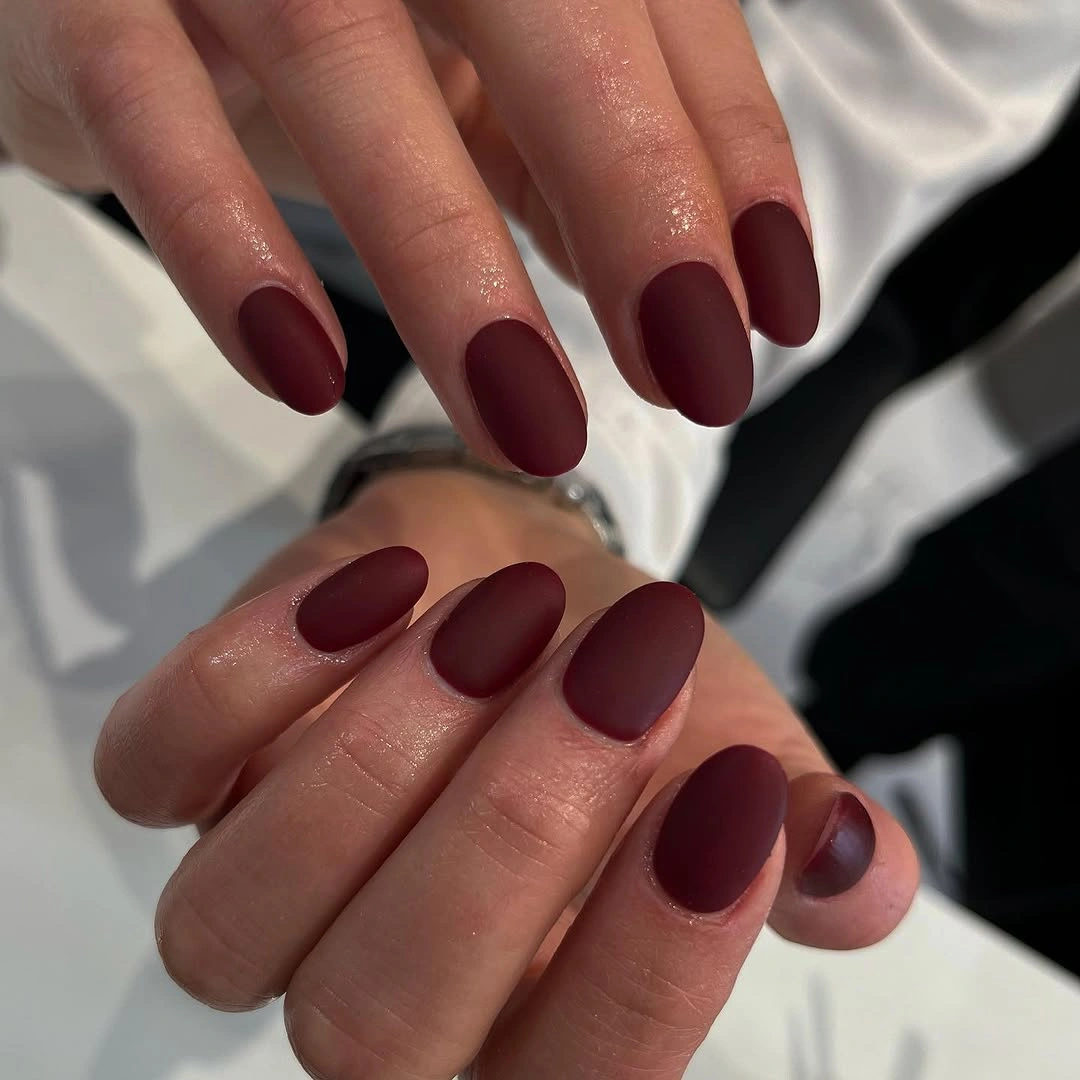
Rounded proportions soften the depth of burgundy and keep the color from reading severe. Without decoration, the eye notices the curve of each tip and the consistency between fingers, while the matte finish gives the shade a quieter edge than gloss would. A single accent could be added later, but the solid version has enough presence to stand alone.
Choose oval or soft-squoval tips if you want a compact interpretation, and keep the shade consistent across both hands. This is a useful option for anyone who wants dark fall nails designs matte without painted detail, although the minimalism leaves little room to hide uneven shaping. When the edges are clean, the decision to simplify becomes the feature that finishes the set.