Maroon does not have to stay in a single dark lane. In this collection, it meets pale pink, white, orange, taupe, gold-like sparkle, and even a cool lavender setting, so each maroon fall nails idea gets its own color moment. The common thread is not simply the berry shade; it is the way each accent gives that shade room to lead.
Some designs lean glossy and dramatic, while others use rounded short tips, open space, or one tiny symbol to keep the color easy to wear. Florals, plaid, curves, bands, and glitter all appear, but they work because their placement is edited. Think of the set as a series of ways to shift undertone, contrast, or finish without losing the rich maroon center.
Pale Florals Soften Glossy Maroon Points
Long pointed nails are coated in glossy deep maroon, then interrupted by pale accent nails carrying burgundy and dark floral shapes. The flowers repeat the main berry family instead of introducing a bright unrelated color, while small warm centers add a restrained glint. Pale bases on both hands make the sharp tips feel lighter and give the eye a place to rest.
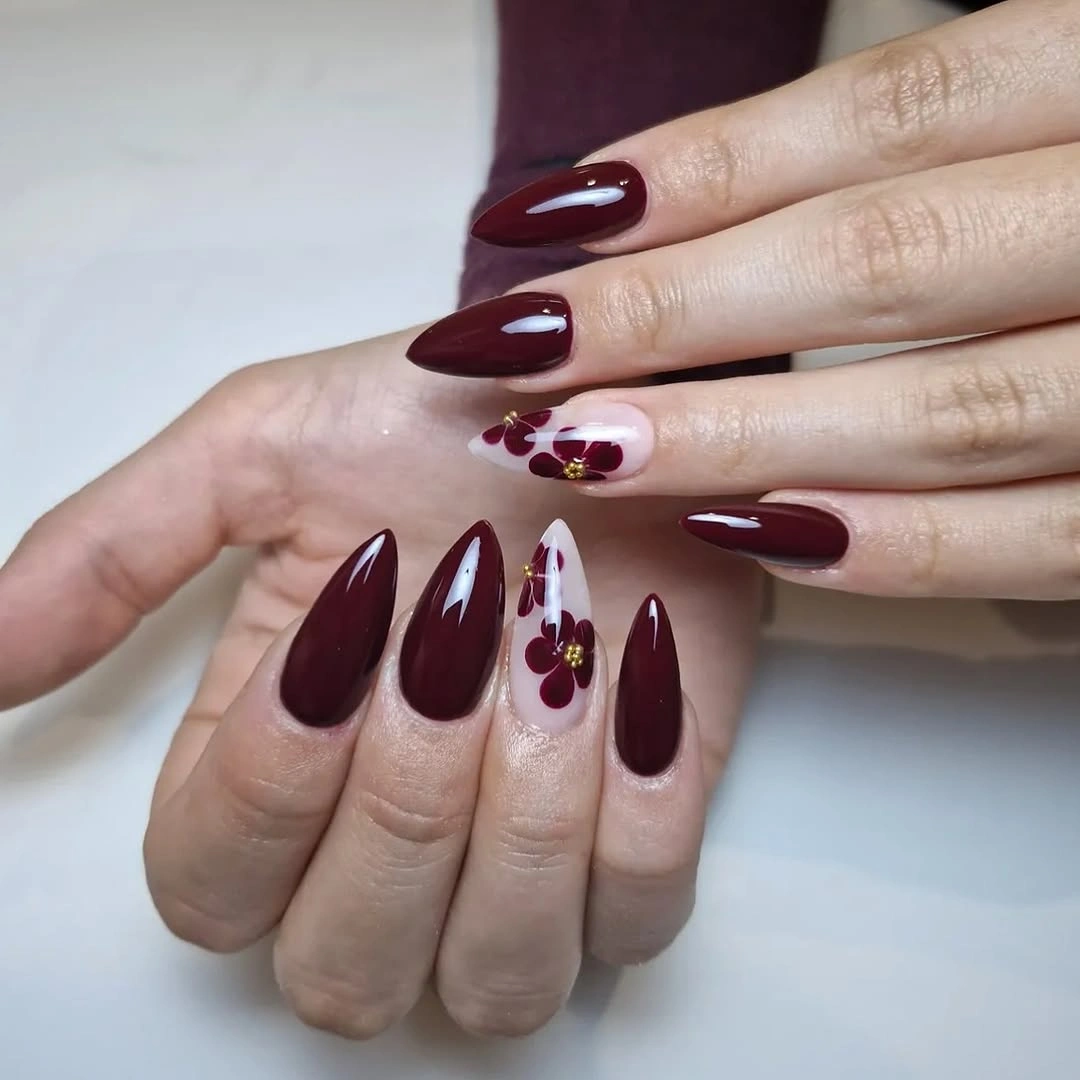
The color relationship is doing the organizing. Maroon remains the dominant block, the pale nails open the composition, and the flower details return the eye to the dark solids, so the set feels coordinated from a distance. Long points make the art expressive, but the repeated berry lines stop the pale accents from looking like separate designs pasted into the manicure.
For an everyday interpretation, keep the maroon on most nails and use one pale floral accent on each hand. Medium almond tips will preserve the direction with less visual drama, and a cream or blush base can replace the pale pink. The length is the obvious tradeoff: it gives the flowers room to breathe, but it also makes the whole color story more noticeable.
Repeated Flower Clusters Balance Berry Gloss
Glossy burgundy nails alternate with pale rounded tips covered in small flower clusters, creating several light accents instead of one isolated panel. The blooms use berry and dark pink marks, so the pale base changes the contrast without pulling the manicure away from its maroon center. Medium length keeps the decoration soft and approachable rather than pointed and theatrical.
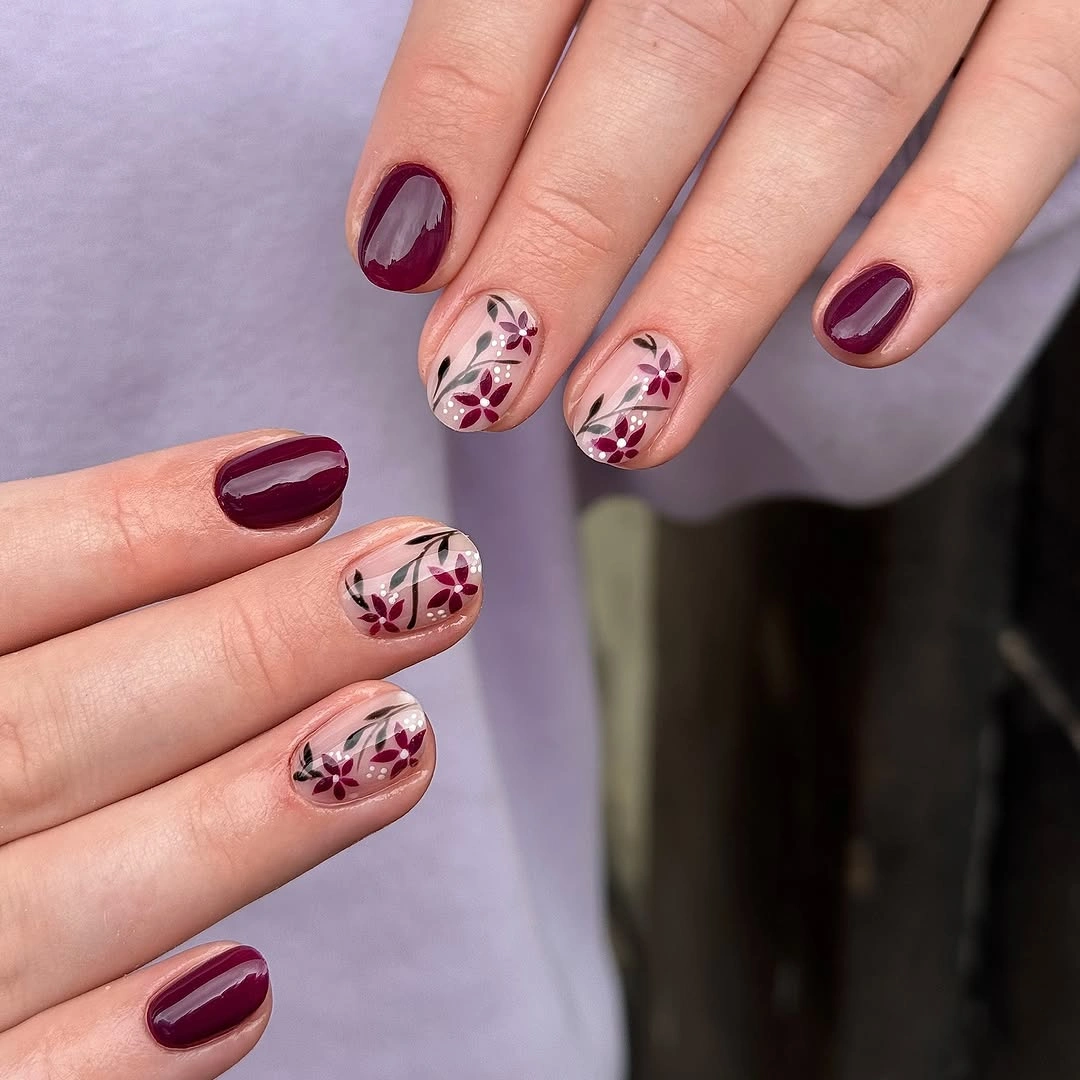
Repeating the same cluster is the key to making multiple accents feel intentional. Each pale nail has a related amount of detail, while the solid burgundy nails act as pauses between the lighter panels. That rhythm lets the design be lively without becoming a collection of unrelated flowers, and it shows why placement matters as much as color.
Choose two or three accent nails and reuse one small cluster instead of inventing a different flower for every finger. A blush, cream, or soft taupe base will lower the contrast, while rounded oval tips will keep the composition gentle. The fun option is a full repeat across both hands, but the quieter version is just as coherent with two pale accents.
Open Pale Centers Let Gold And Maroon Meet
Glossy maroon solids frame long almond nails with pale open centers, dark berry edges, and scattered warm gold-like pieces. The light areas are not fully covered, so the eye can see a clear transition from the pale middle to the dark tip. That empty space keeps the design from becoming too dense even though the length and shine make it a strong statement.
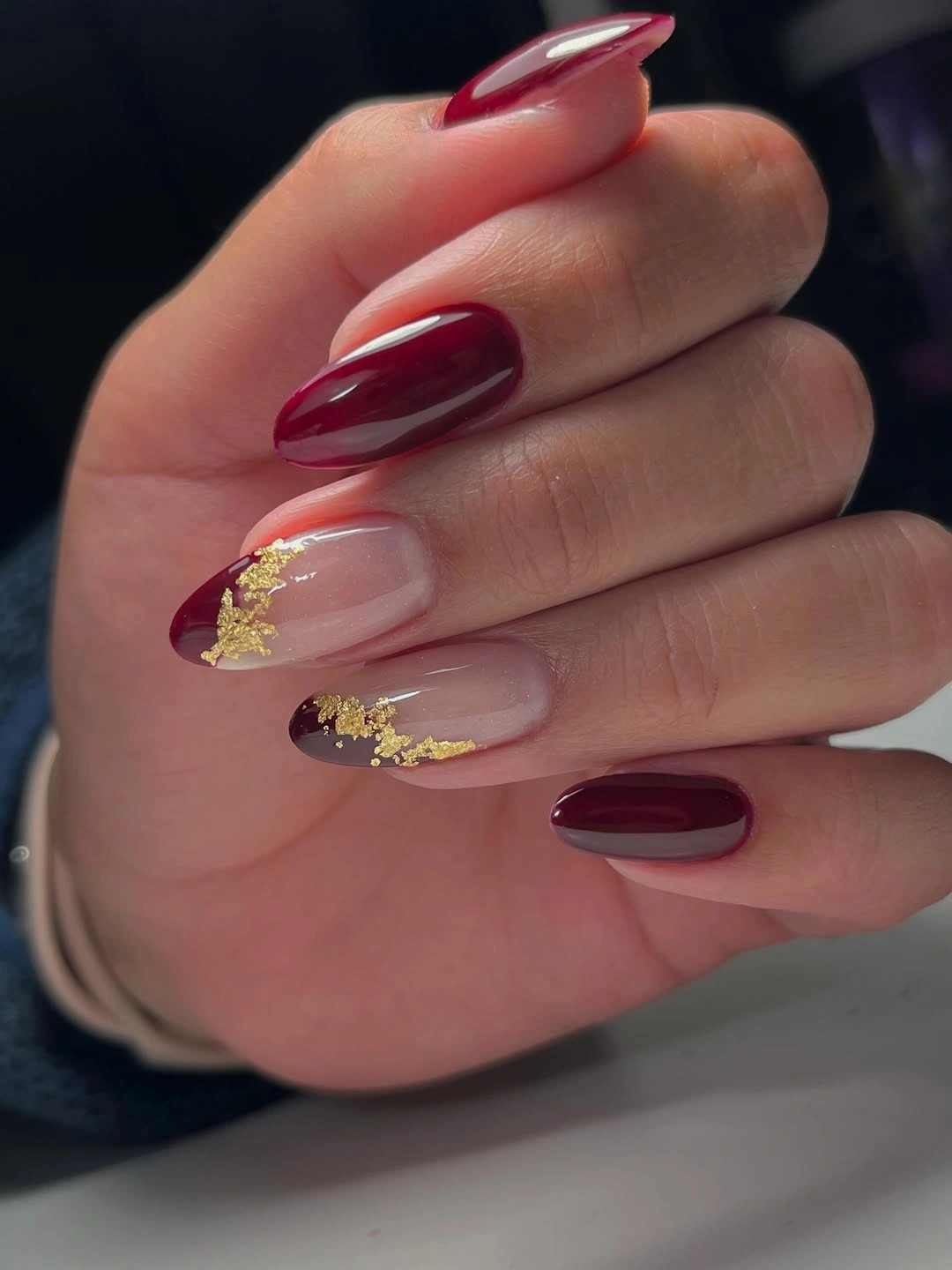
Gold is placed along the boundary rather than spread across the whole accent, which gives the metallic-looking detail a specific job. It marks the shift between colors, while the maroon edge repeats the solid nails and keeps the palette close. A fully glittered accent would be louder, but these small fragments preserve the open center that makes the design feel balanced.
Use one pale accent with a maroon edge if you are adapting this for a shorter almond or oval. Replace the warm pieces with a thin nude line when a simpler finish is preferred, and reduce the number of crossings so the center stays visible. Long almond length supports the full arrangement, so the best short version edits the detail instead of shrinking everything into a crowded tip.
White Plaid Accents Bring A Textile Rhythm
Glossy burgundy solids surround two pale nails crossed with white, black, and maroon lines that form a plaid-like grid. The medium rounded tips keep the straight lines from feeling severe, while the knit background echoes the textile direction without taking attention from the manicure. Because the grid accents are limited to two nails, the berry color remains the main event.
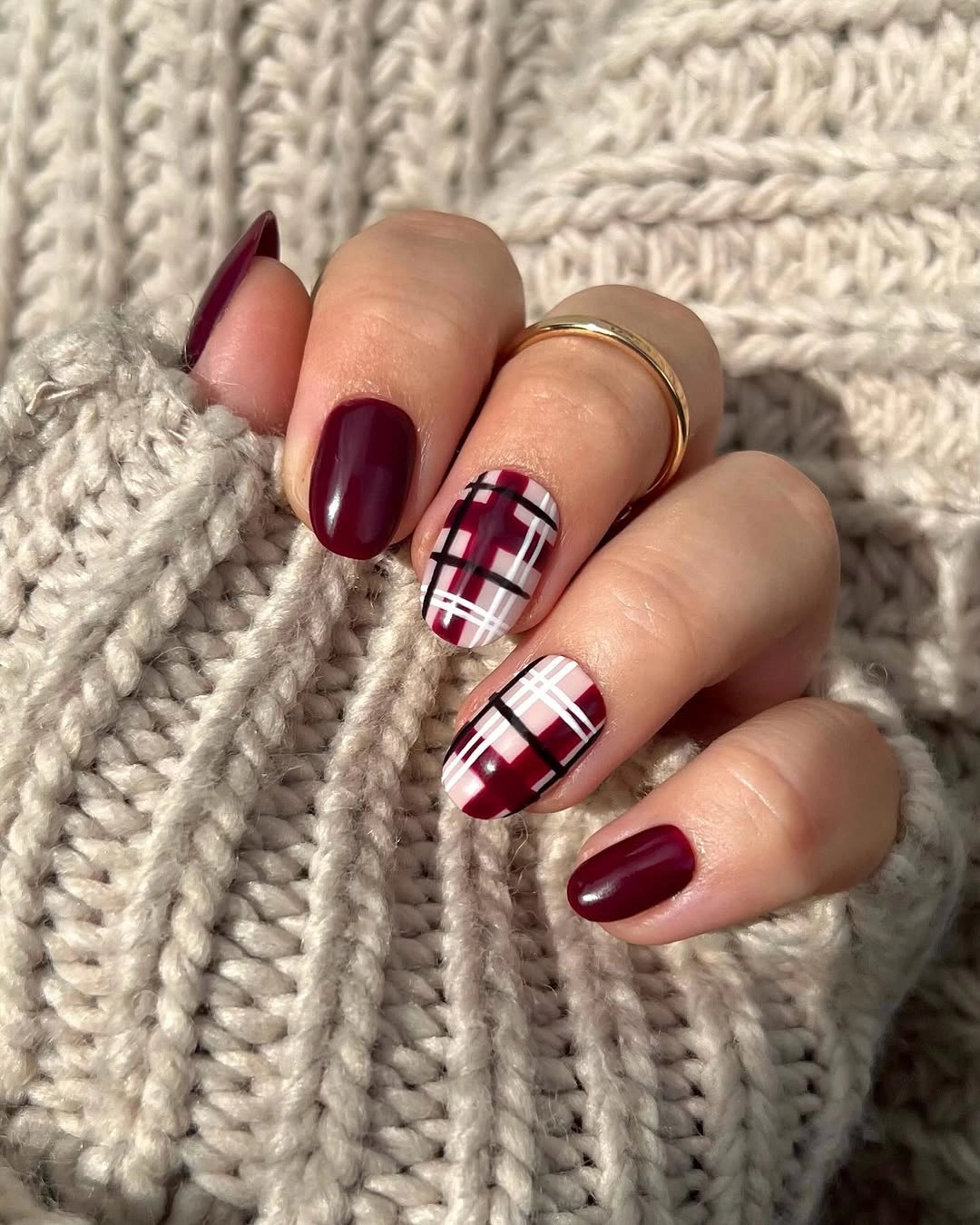
Shared maroon lines connect the pale panels to the surrounding solids, and the white ground creates enough contrast for the pattern to read clearly. The different line directions add a woven impression, but the composition is still simple enough to understand at a glance. A third patterned nail would be possible, yet the current spacing gives the design more breathing room.
On a shorter square or oval, use two crossed lines and one thinner stripe instead of building a full grid. Beige can soften the white base, while keeping burgundy in the pattern preserves the color link. Plaid shows uneven spacing more quickly than loose floral marks, so the honest practical cost is that clean, consistent edges matter.
Marbled Accents Add Movement To Wine Color
Glossy dark wine nails sit beside pale translucent-looking accents that blend maroon and brown swirls with small warm gold-like pieces. The marbling creates movement without relying on a repeated flower or symbol, while the dark solid nails give the lighter accents a clear frame. Medium almond tips allow the irregular lines to spread without losing their shape.
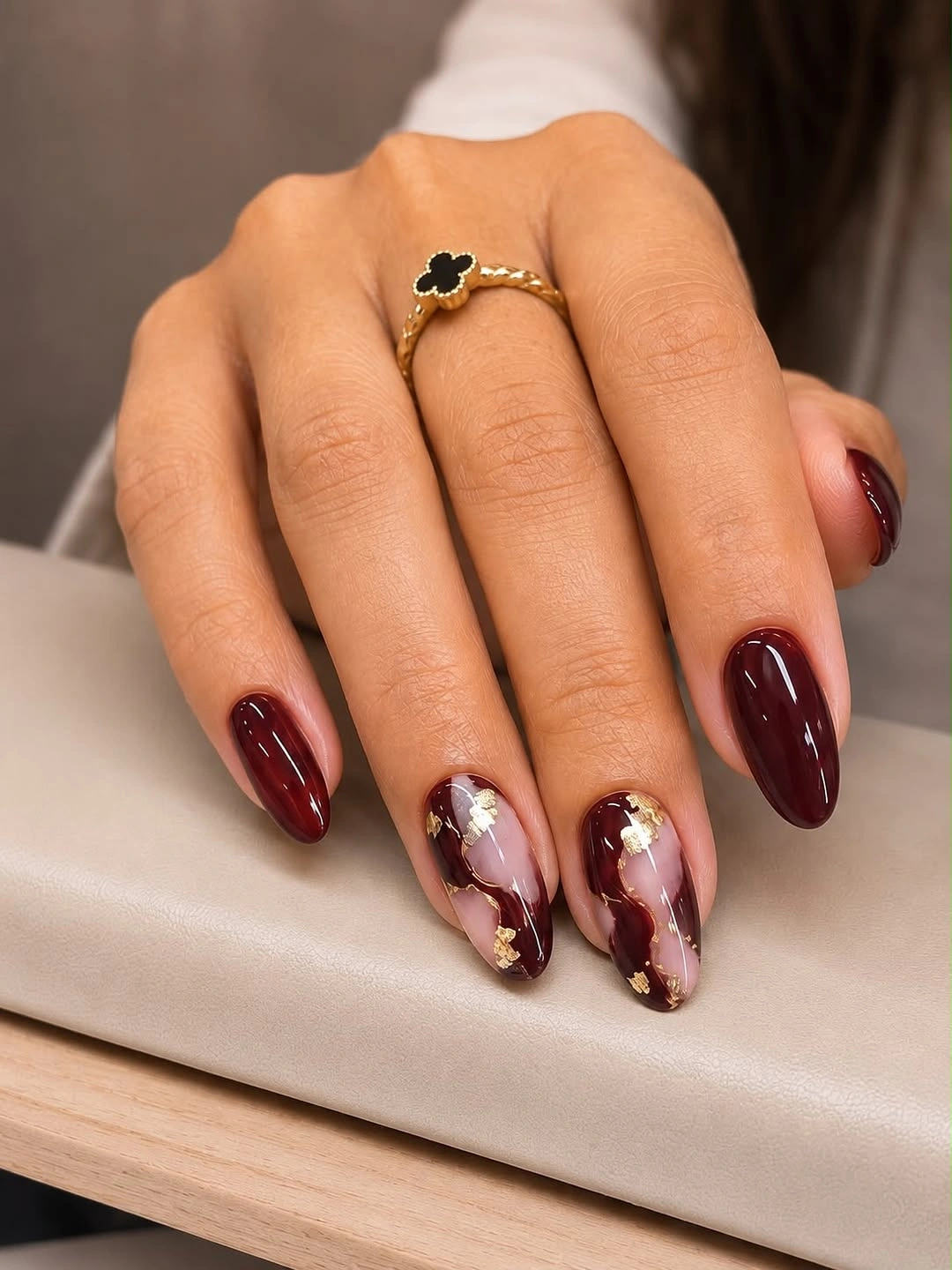
The set feels rich because the accents are varied but remain tied to the same deep wine family. Maroon provides the strongest blocks, brown softens the swirling areas, and warm fragments catch light inside the pale space; none of those details has to dominate alone. That is a useful way to create a maroon fall nails design when a literal seasonal motif feels too expected.
Keep the marbling to one or two nails and let the surrounding color stay solid. A matte or satin finish will make the swirls quieter, while a short oval should use fewer turns and fewer warm pieces. Irregularity is part of the appeal, but it also means the set will not look perfectly mirrored, so choose this direction when organic variation is welcome.
Diagonal Bands Give Maroon Almonds A Crisp Break
Long glossy maroon almond nails receive two pale diagonal bands edged with a fine warm line. The bands cross each nail at a slant while leaving the berry base visible at both ends, so the accent reads as a clean interruption rather than full coverage. Repeating the same geometry twice gives the pointed set a lively but organized color rhythm.
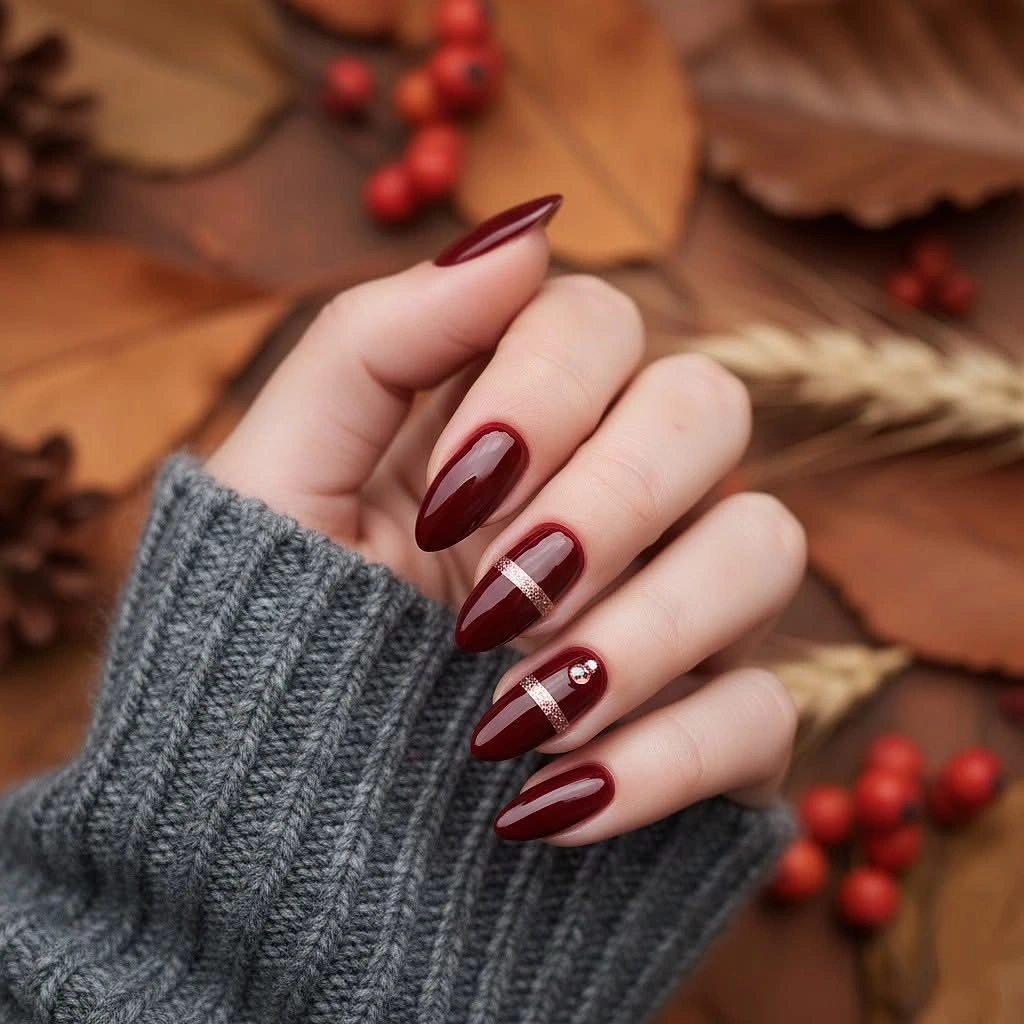
The diagonal direction follows the taper of the almond shape, which is why the bands feel integrated rather than pasted across the surface. The pale section lightens the deep color, and the thin warm edge adds definition without introducing a separate motif. A straight horizontal stripe would make the nails feel wider; the slant keeps the eye moving along the length.
Use one diagonal band on two nails, or keep the design to a single accent when adapting it for a maroon fall nails almond look. Cream, blush, or taupe can replace the pale section, and a short oval can use a narrower stripe. Clean spacing matters more than extra decoration here, especially when the tip is long and the geometry is easy to inspect.
Sweeping Pink Curves Keep Berry Color Fluid
Medium almond nails mix glossy burgundy solids with pale pink bases carrying curved burgundy edges that sweep rather than stop in a straight line. The curves vary slightly in width and direction, so the design feels fluid while the shared berry color keeps it together. Pale space remains visible on each accent, making the deep color look lighter than an all-over coat.
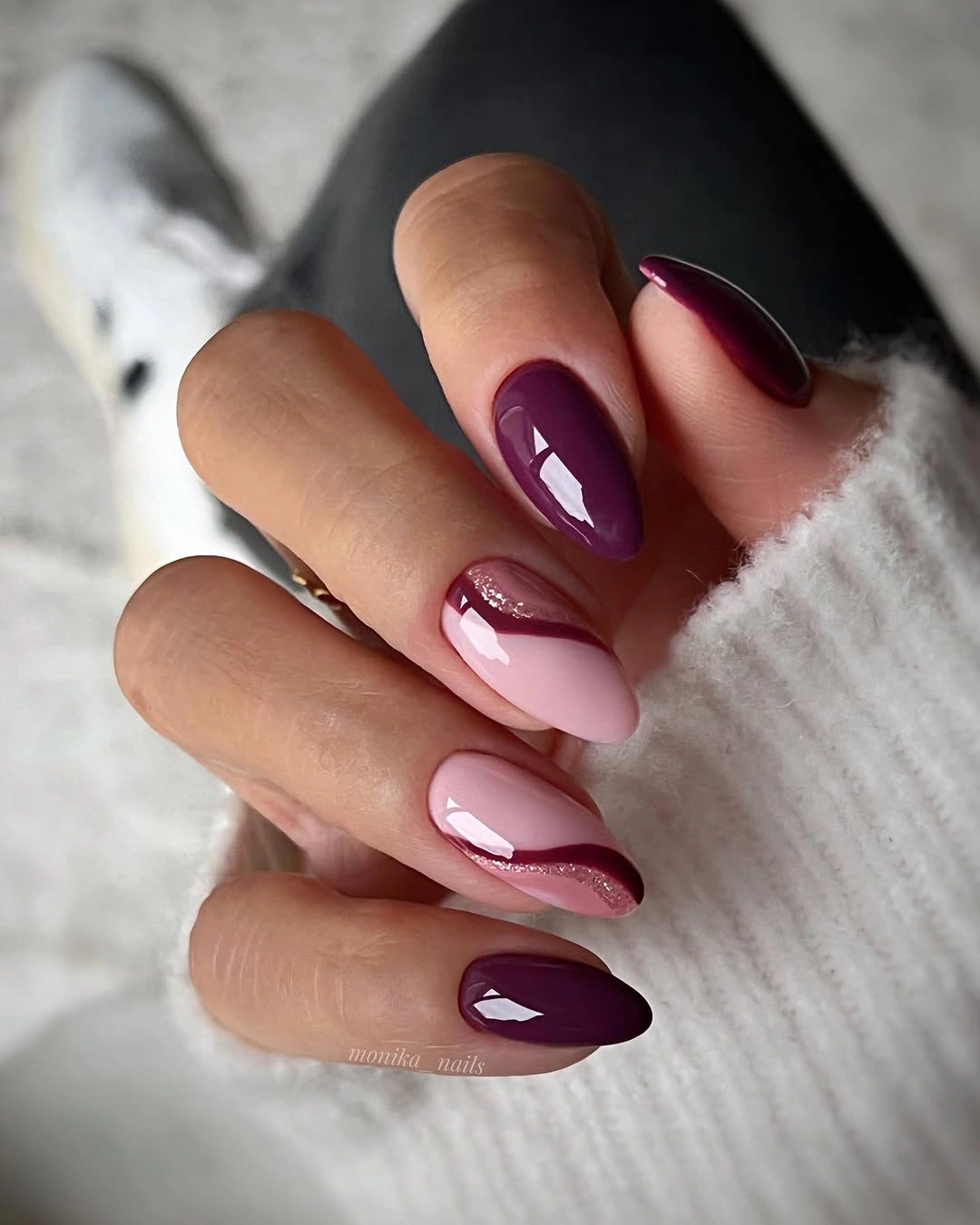
The curve echoes the almond outline and gives the hand a sense of movement from cuticle toward tip. Solid burgundy nails stabilize the composition, while pale pink creates a soft pause between the dark shapes. Because the accent line is the only decoration, its shape has a bigger effect than a tiny flower would, which makes the placement especially important.
Try a narrower sweep on two nails, or place one curved side accent on a shorter rounded shape. Cream can replace pink for a clearer graphic contrast, while mauve will keep the palette gentle. Curved boundaries are a precision detail, so a simpler single arc is often the better choice when the nail surface is compact or the design needs to feel relaxed.
Open Ribbon Lines Wake Up Deep Burgundy
Deep glossy burgundy covers long almond nails while pale lines cross and curve into open ribbon-like loops. The lines do not fill the spaces between them, so the dark base remains visible and the pattern has a sense of movement rather than becoming a solid panel. Low light makes the reflective highlights stand out, but the key decision is the open line work.
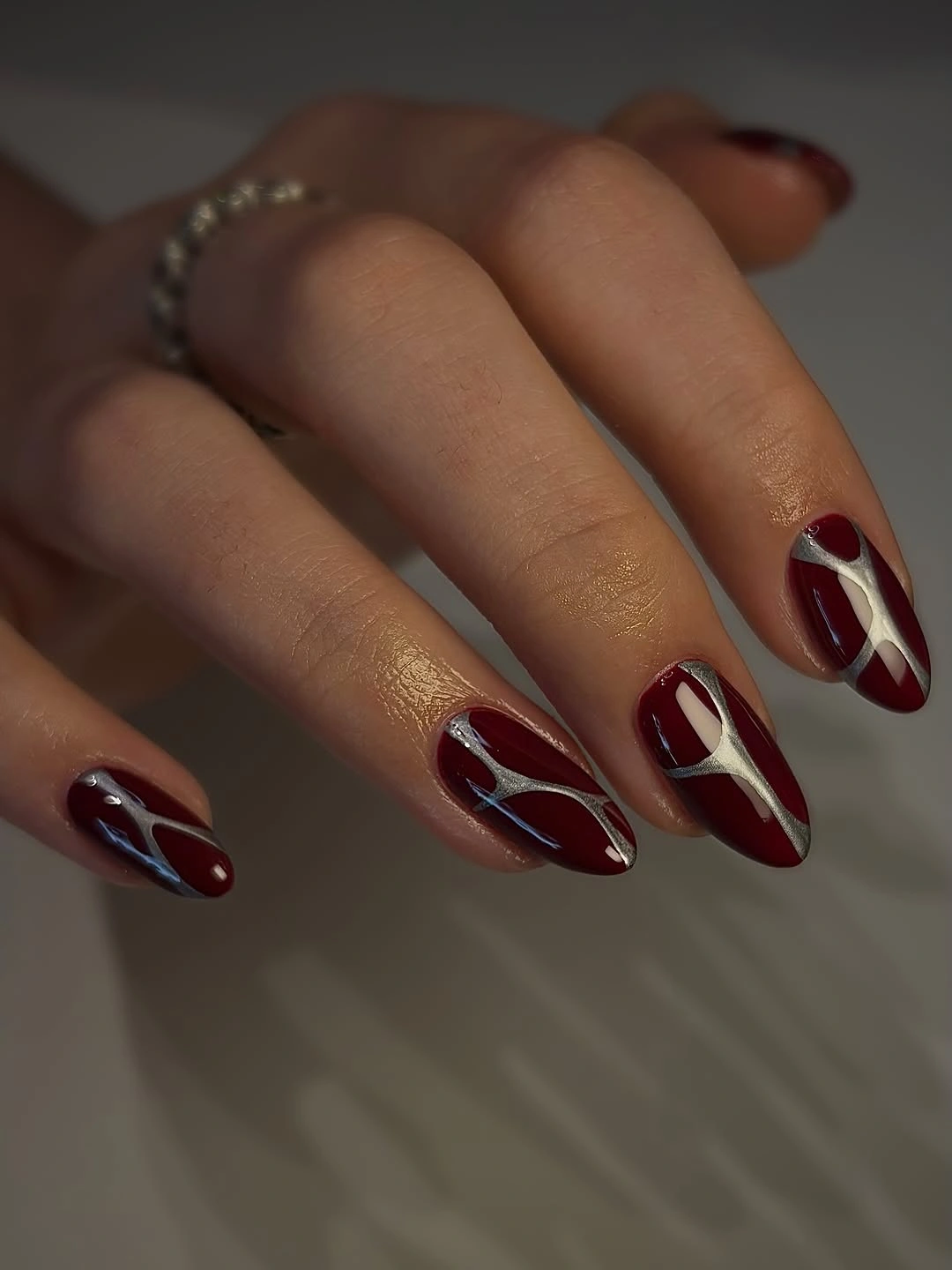
Curved crossings use the length of the almond nail and create a more animated color relationship than a simple stripe. The pale lines bring contrast, yet their thinness keeps the berry shade in charge, and the open spaces stop the design from becoming heavy. A bright second color would make the loops louder, while pale cream or soft pink keeps them controlled.
For a shorter maroon fall nails design, use one loop on an accent nail and remove extra crossings. Let the base show through, because filling the open sections would change the character completely. Long length helps separate the curves, so on a compact oval the realistic tradeoff is that fewer, clearer lines will look better than a scaled-down copy of every turn.
Matte Mauve And Glossy Burgundy Share The Set
Short-to-medium rounded nails alternate matte mauve solids, glossy burgundy nails, and pale accents with small burgundy leaves and warm gold-like flecks. The berry shades are close, but the change in finish lets each one occupy a different visual role. Pale accents repeat the botanical idea without covering the whole hand, so the set stays compact despite its variety.
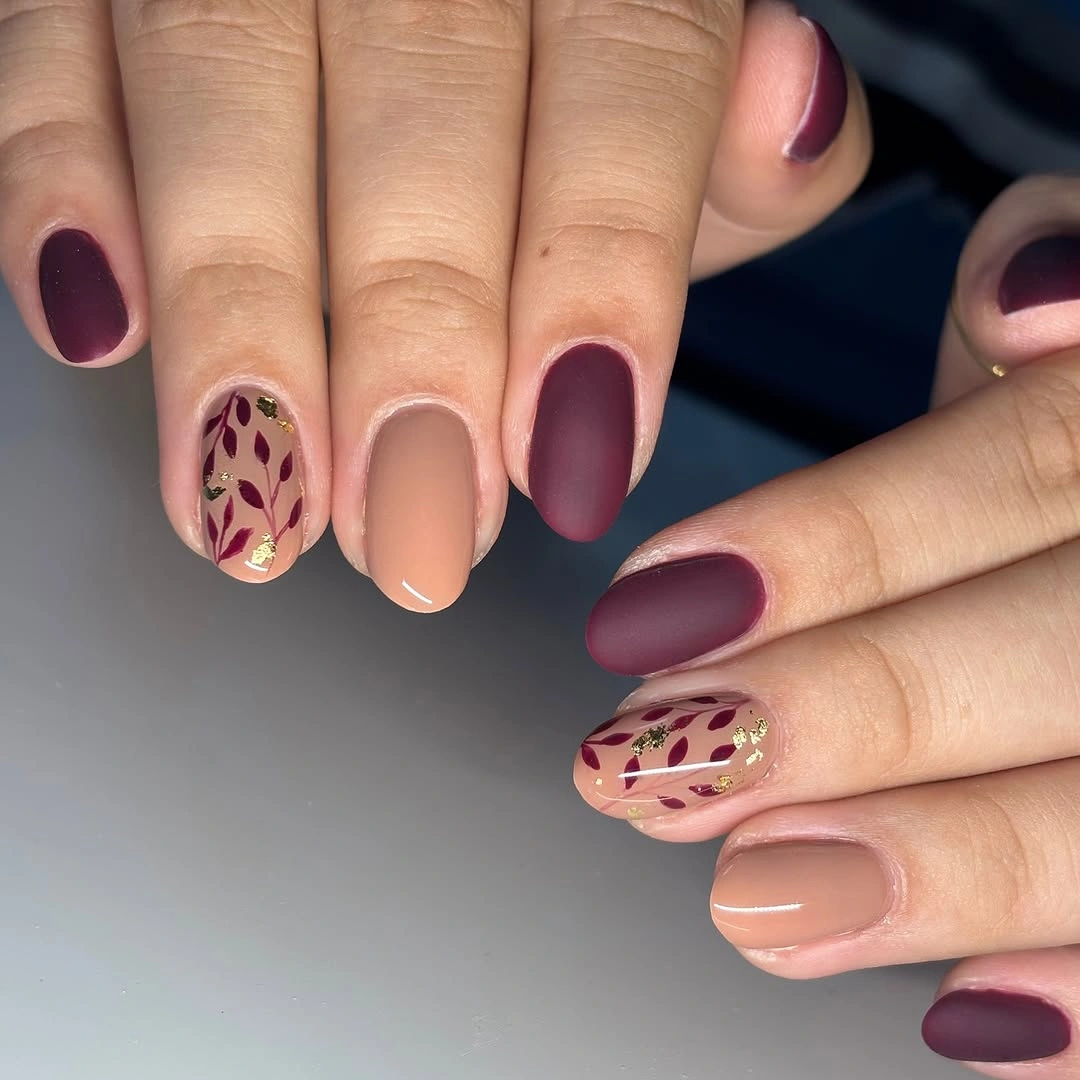
Finish contrast is what separates the neighboring colors. Matte mauve quiets the hand, glossy burgundy supplies depth, and the pale accents create a light focal break; no extra bright color is needed to make the arrangement readable. That makes the design useful for anyone who wants a maroon fall nails burgundy direction with more interest than one uniform finish.
You can keep the berry palette and choose just two surfaces, such as matte mauve with glossy burgundy, then reduce the leaves to one small accent. Rounded short tips support the mixed finish without making it feel formal. The practical caution is to keep the undertones close; if the mauve becomes too cool or the gloss too bright, the set may stop reading as one color family.
Small Flowers Give Short Burgundy Nails A Lift
Short rounded glossy burgundy nails are broken by two pale accents carrying small flowers in burgundy, pink, and white. The decorated nails repeat the same central idea, while solid berry nails sit between them and preserve a clear majority color. Compact length keeps the flowers close to the hand and makes the set feel easy to translate into everyday styling.
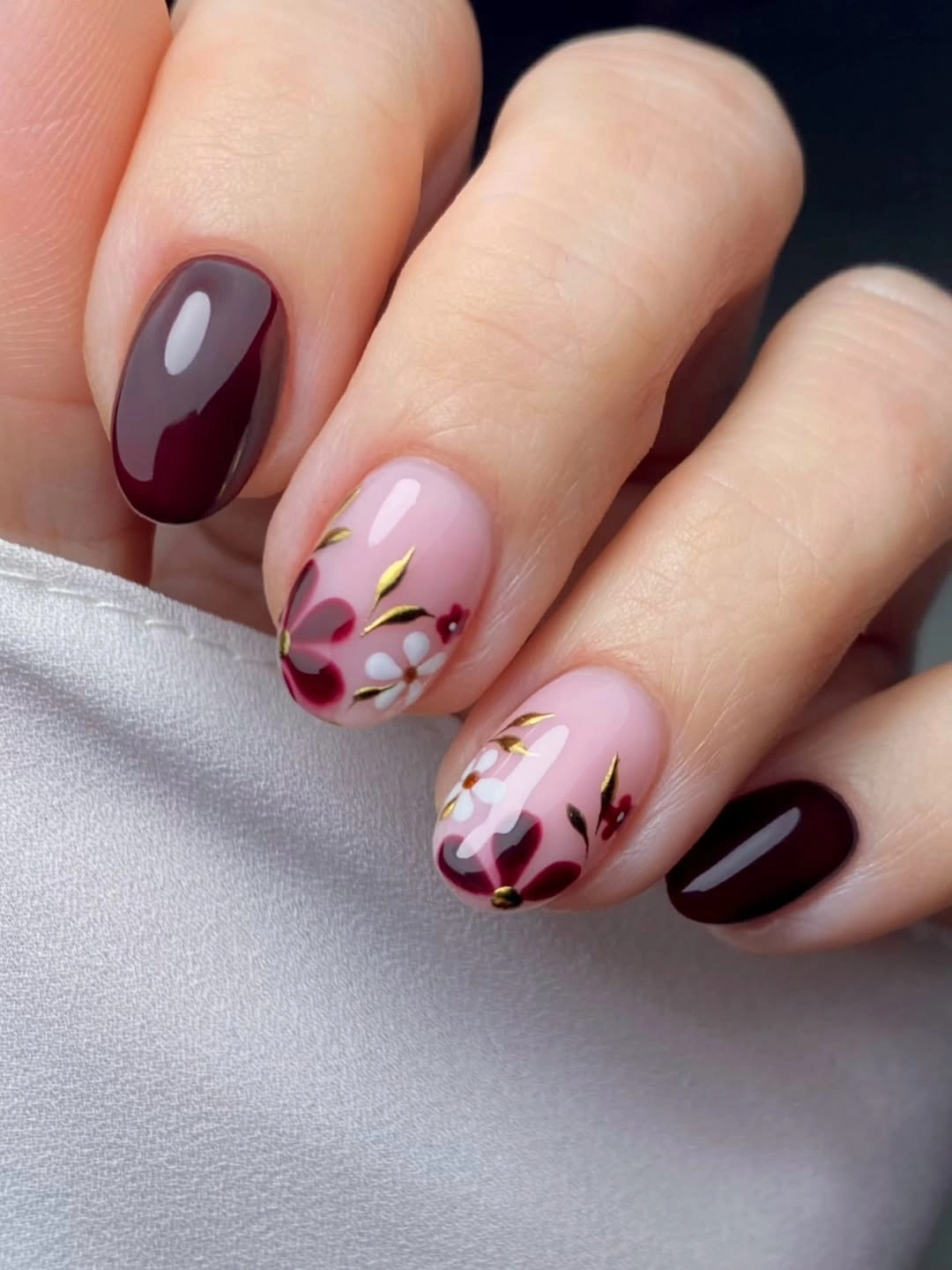
The light flower centers matter because they prevent the small blooms from disappearing into the berry palette. Pale bases create contrast, while the solid burgundy nails keep the art from spreading too far across the hand. Two matching accents provide a steady rhythm; one would be quieter, but several different floral panels would be less focused.
Use one flower and a short stem on each accent if the nail surface is small, or keep only one pale nail for a simpler maroon fall nails short version. Cream can make the flowers more graphic, while blush softens the contrast. Small details need clean scale, so resist adding extra petals when the first flower already gives the hand enough focus.
Organic Leaves Contrast With Square Edges
Medium square nails use glossy deep burgundy on most fingers, with two pale accents carrying sparse burgundy leaf shapes and tiny light dots. The straight tip creates a crisp frame for the curved organic marks, and the open pale ground prevents the accents from feeling crowded. Repeated placement on both hands keeps the asymmetry of the leaves from becoming visual confusion.
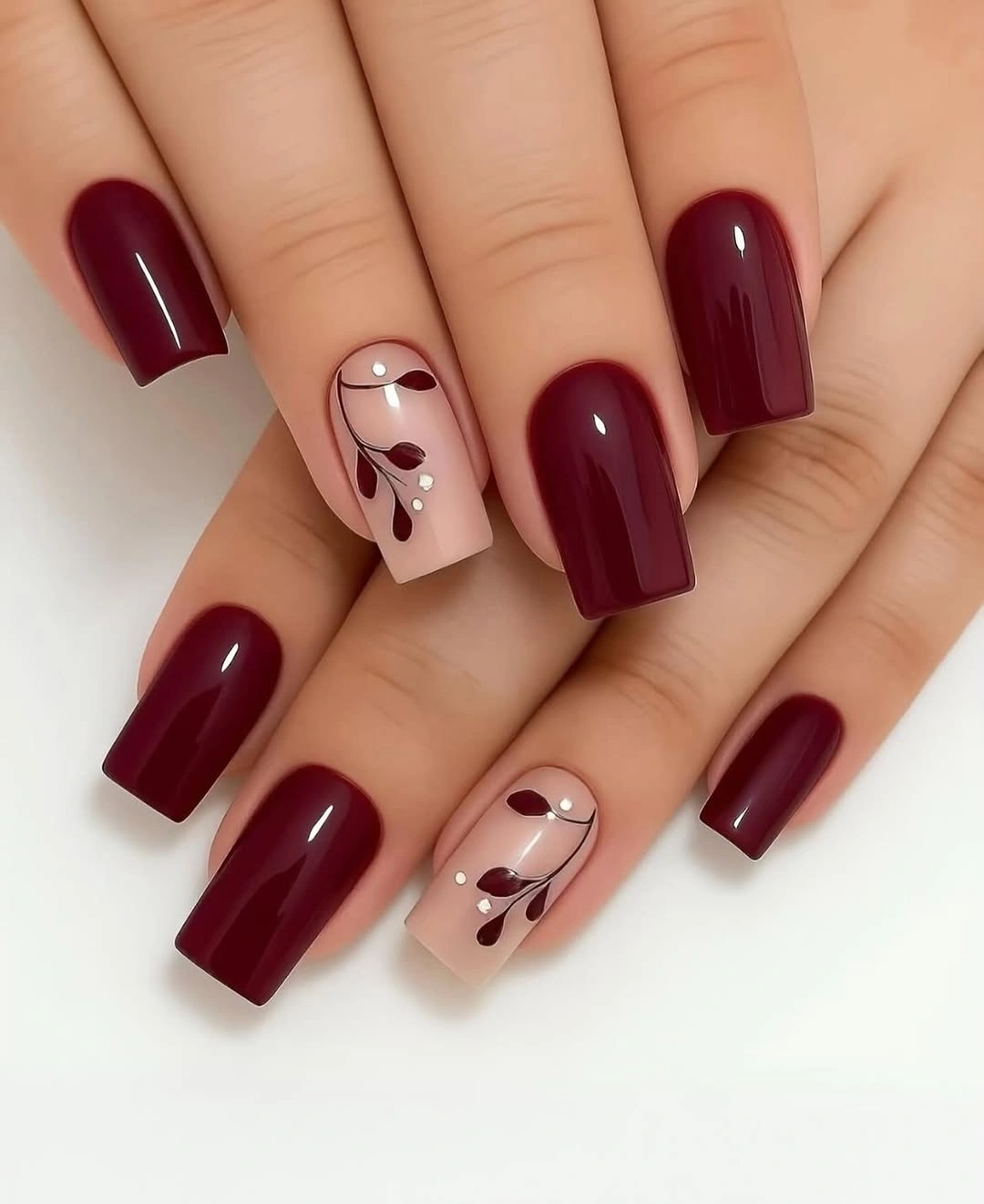
Square edges and rounded leaf forms provide a pleasing contrast in shape as well as color. The burgundy solids establish a polished block, while the pale panels let the small marks breathe; the dots add rhythm without demanding a new motif. This is a precise maroon fall nails square idea because the outline supplies structure before the art begins.
Keep the leaf shapes near one corner or side when adapting the set, and use two accents rather than decorating every nail. A short square can hold the same idea with two leaves and one dot, while taupe or blush can replace the pale base. Straight borders reveal uneven filing quickly, so the tradeoff is that the simple frame needs to be especially clean.
Berry Gloss Meets White Florals And Gold Sparkle
Medium almond nails combine glossy berry solids, white floral accents, and dense warm gold glitter on selected fingers. The berry shade returns inside the white art, so the bright panels remain connected to the dark nails, while glitter adds a completely different surface. Each finish has a separate job, which keeps the lively palette from becoming a random collection of highlights.
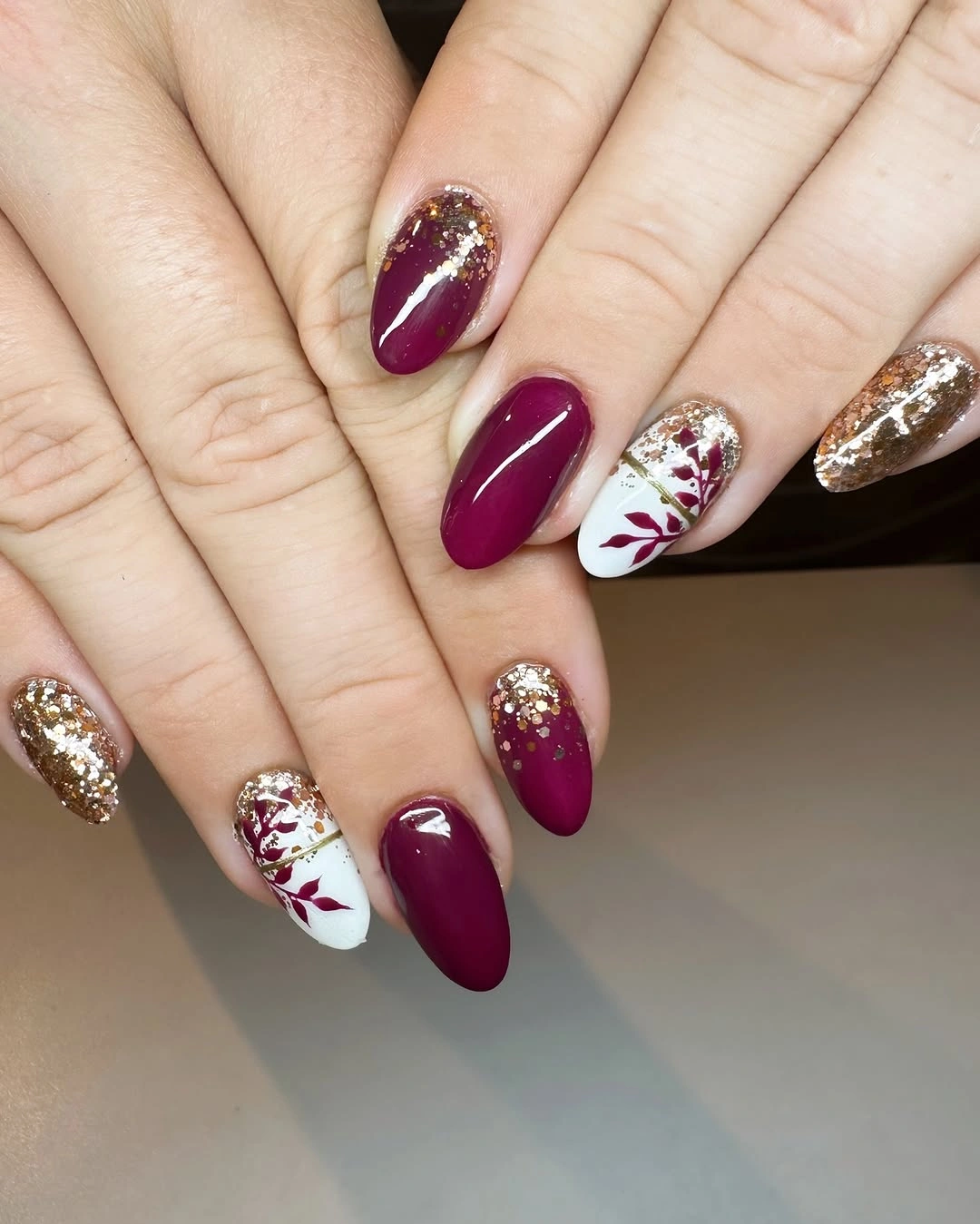
The composition works because sparkle is limited rather than sprinkled everywhere. Gold becomes the strongest light-catching element, white florals soften the transition, and berry solids keep the hand grounded between them. If every nail glittered, the flower accents would lose their role; if the glitter disappeared, the set would become calmer but less playful.
Choose the berry-and-white pairing for a more restrained version, or replace dense glitter with a fine warm shimmer. Two glitter nails are enough to create the color moment, and a medium almond shape gives the accents room without requiring very long tips. The tradeoff is clear: glitter changes the focal point quickly, so keep its placement deliberate.
Translucent Florals Lighten Long Maroon Almonds
Long glossy dark maroon nails alternate with translucent-looking floral accents that reveal pale space and muted pink and green details. The flowers sit within the lighter areas rather than replacing them, so the hand receives color without a second solid block. Maroon remains dominant, but the open accents keep the pointed silhouette from feeling uniformly heavy.
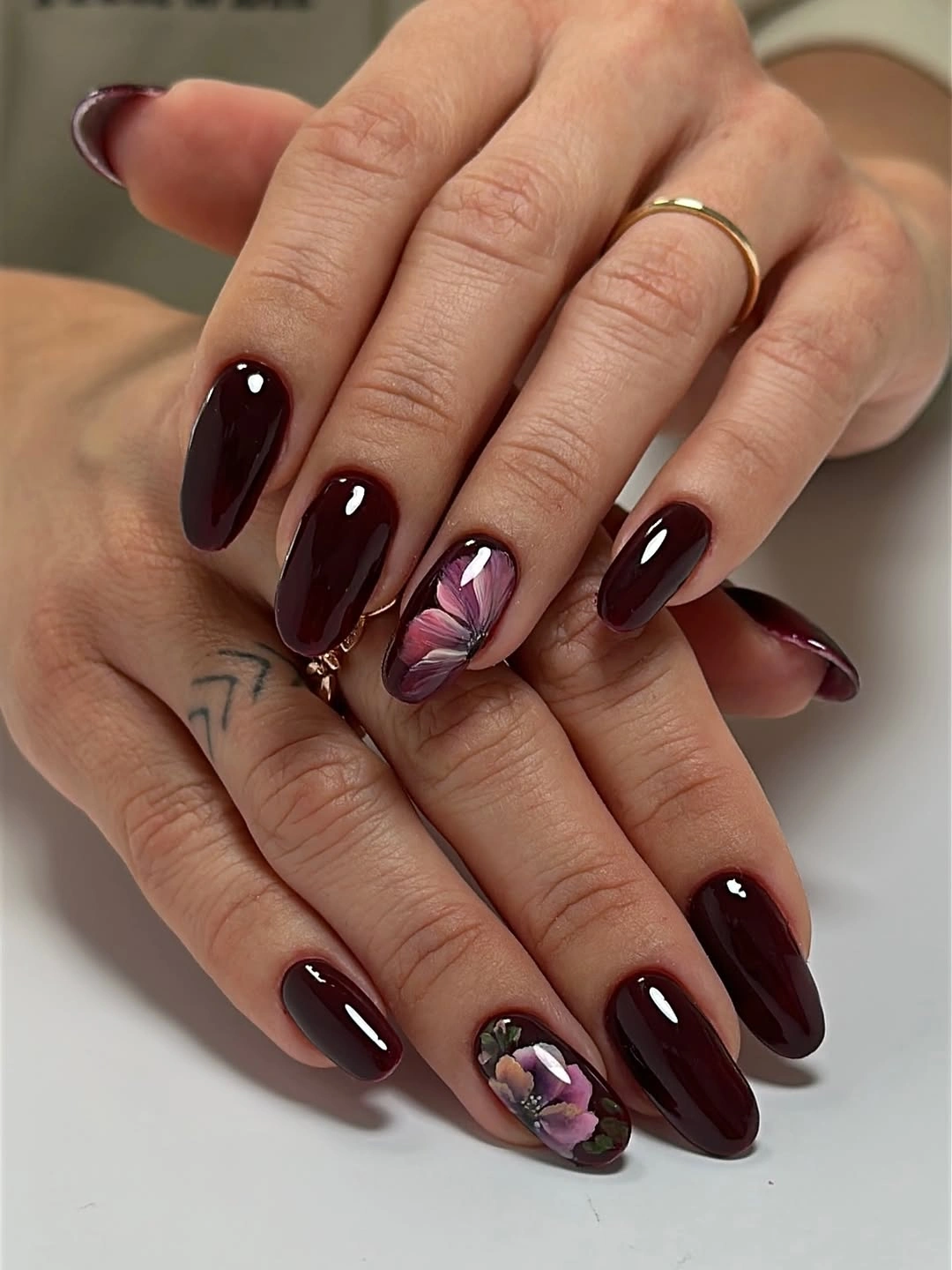
The muted green inside the flowers creates contrast without challenging the berry shade, and the pale areas soften the transition from solid to decorated nails. Because the accents look more open than opaque, they add depth through space rather than through a bright new finish. That balance makes this a useful maroon fall nails burgundy with design direction for someone who likes detail but not full coverage.
Use one open floral accent on a shorter almond and keep the secondary color quiet. A pale blush or cream base can preserve the effect, while fewer petals will keep the composition readable on compact tips. Long length supports the full floral arrangement, so the practical move is to remove detail first rather than force every leaf into a smaller canvas.
Small Warm Leaves Suit Compact Burgundy Tips
Short rounded burgundy nails pair glossy dark solids with pale accents holding small maroon and warm yellow leaf-like marks. The art is concentrated near one lower or diagonal area, leaving much of the pale base open and making the compact shape feel uncluttered. Compared with the long almond examples, this arrangement is a clear lesson in scaling the motif down.
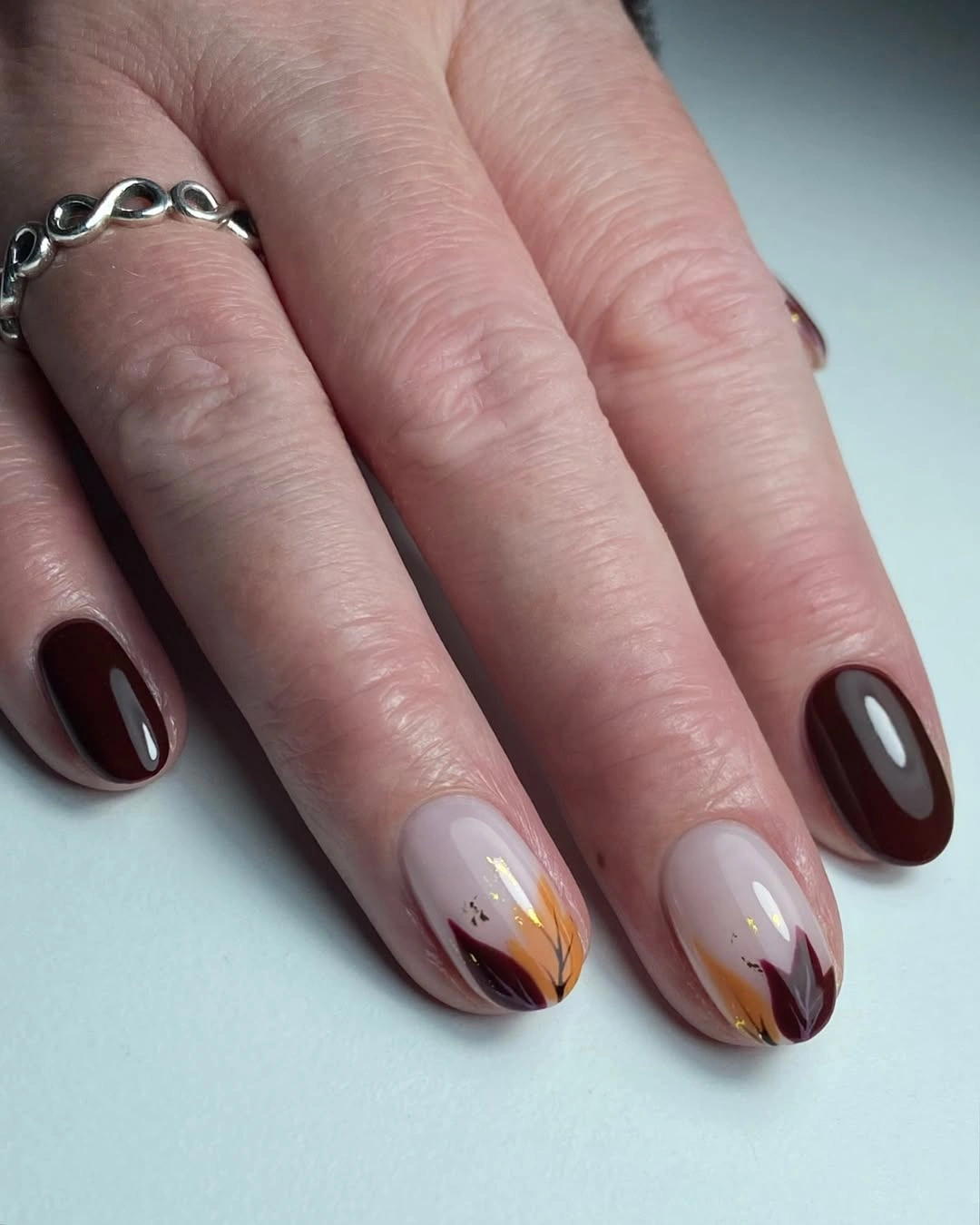
Concentrated placement gives the small marks a defined home. The dark solid nails supply enough contrast that the pale accents do not need a large illustration, and the warm details add a slight shift without changing the berry center. A full branch would shorten the visual surface, while the small cluster lets the rounded tip remain visible.
Use two or three leaves in one corner for a maroon fall nails short interpretation, and keep the other nails solid. Cream, blush, or taupe can replace the pale base, while a darker maroon can carry the marks if you prefer less contrast. The limitation is motif density: too many tiny leaves will merge, so fewer shapes create the cleaner result.
One Pale Leaf Accent Keeps Burgundy Clean
Short rounded glossy burgundy nails stay almost entirely solid, with one pale nail carrying sparse burgundy and mauve leaf-like forms near its upper edge. Strong sunlight makes the dark surfaces reflective, while the pale accent introduces a small change in temperature and texture. Because the art is abstract and open, the set feels more like a considered detail than a full floral theme.
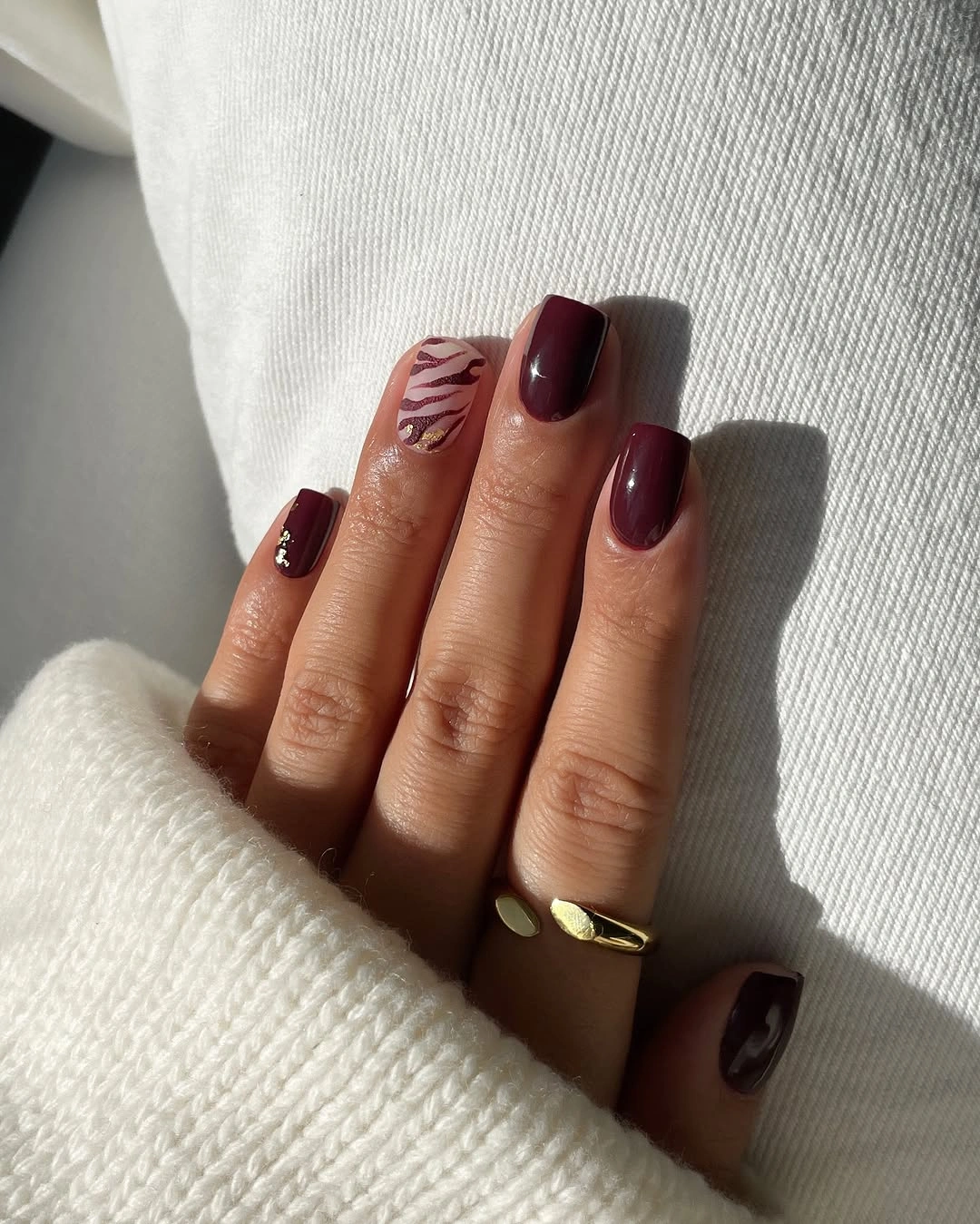
One accent preserves the authority of the berry color. The pale nail is easy to find, but it does not ask the eye to memorize a repeated pattern, and the off-center placement keeps the base visible around the marks. That is why a single accent can feel complete here: the surrounding solids already provide enough visual weight.
Try the same edge placement with a cream or warm taupe base, or move the design to the ring finger if you prefer a predictable focal point. A short oval can hold only a few leaves, so keep their size clear and avoid extra outlines. The quiet tradeoff is that one accent becomes very noticeable, making its spacing and position more important than in a busier set.
Tiny Burgundy Hearts Make A Quiet Motif
Glossy dark burgundy covers most of these short rounded nails, while two pale nails carry one small burgundy heart each. The symbols are centered within open space and scaled to the compact tips, so they read as a tiny graphic note rather than a theme covering the whole hand. A simple motif lets the rich color remain the first impression.
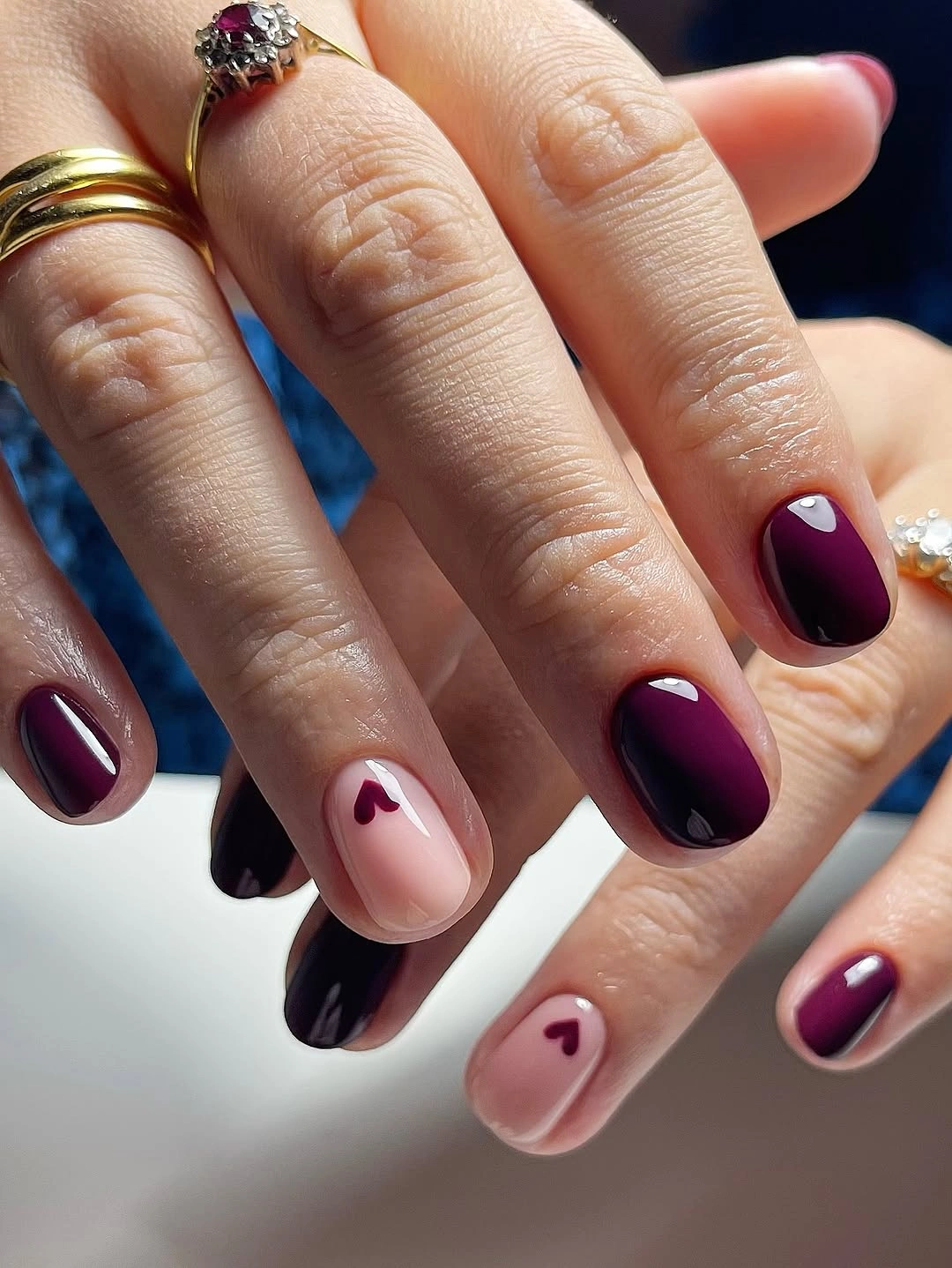
The pale accents create enough contrast for the small shapes to stay recognizable, and the solid berry nails keep the composition grounded. Repeating the heart twice provides a gentle rhythm without requiring a detailed drawing, while a single heart would create a more minimal result. The design shows how a small symbol can add personality without taking over the color story.
Swap the heart for a dot, leaf, or small star if you want a different graphic language, but keep one symbol per accent. A nude, blush, or cream base will support the same contrast, and a short oval will preserve the neat proportion. Tiny marks need clean edges, so the practical limit is precision rather than the amount of color.
A Fine Warm Curve Edges Pale Pink
Glossy burgundy nails dominate a compact rounded set, with one pale pink accent carrying a curved burgundy tip traced by a thin warm gold-like line. The curve follows the tip instead of crossing the whole nail, and the pale center stays visible around it. That narrow border adds a little sparkle without changing the clean, berry-led composition.
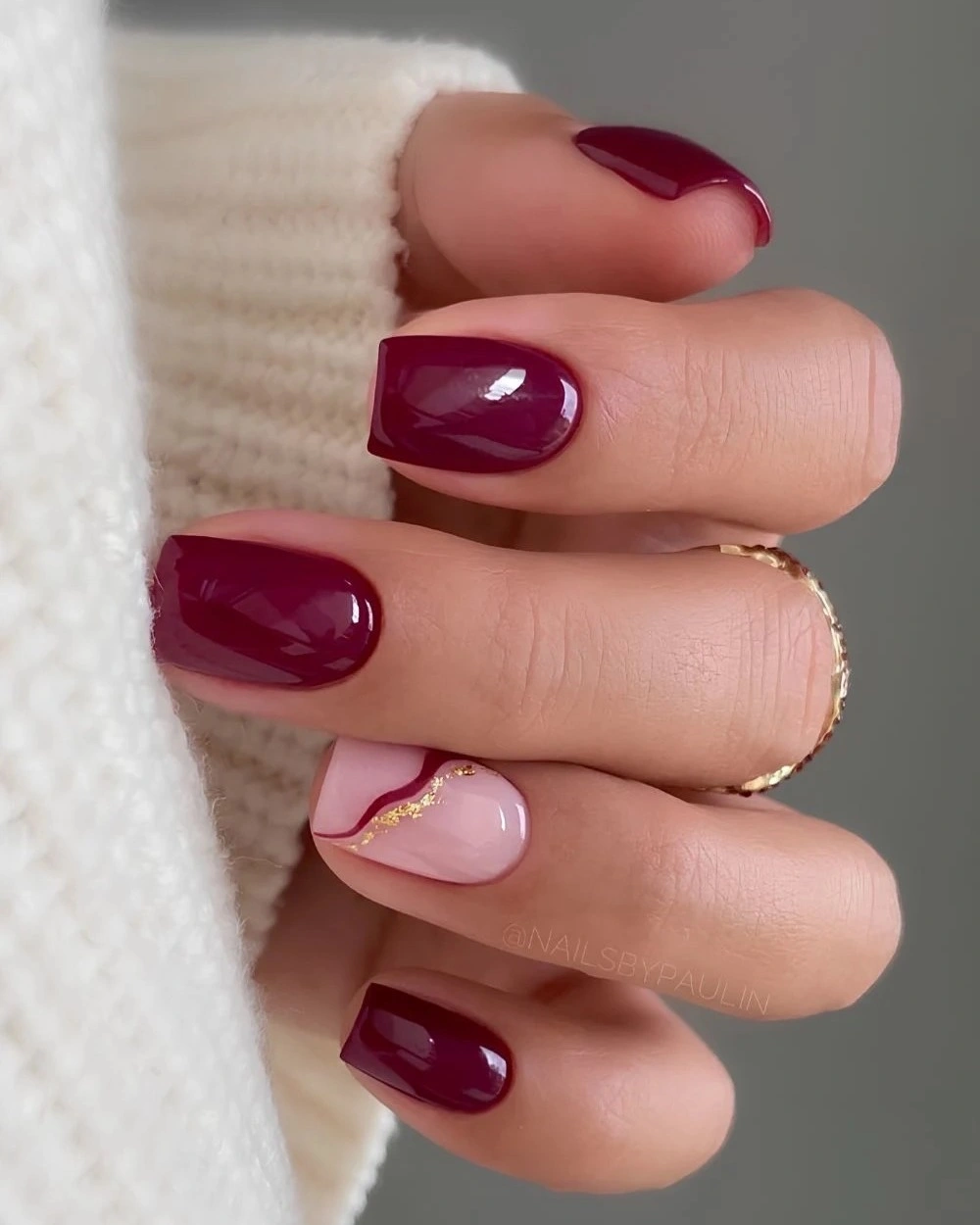
The warm line succeeds because it reinforces an existing boundary. It does not introduce another picture or pattern; it simply makes the curved transition easier to notice while glossy burgundy provides the surrounding depth. A wider metallic band would make the accent much louder, so the fine line keeps the color relationship in control.
Use one outlined curve on a pale pink, cream, or nude base, and leave the rest of the nails solid. On short tips, a single arc is easier to balance than a full sweep, while a taupe base can make the contrast less sweet. Fine edging is a precision choice, so simplify the line rather than widening it when the border starts to look uneven.
Bright Orange Gives Burgundy A New Temperature
Medium almond nails place a bright orange solid beside glossy burgundy and pale accents decorated with orange and berry leaf-like shapes. The orange is not an isolated surprise; it returns inside the pale art, so the warm color has a visual route through the set. That repetition lets the burgundy remain present while the brighter shade supplies the most unexpected shift.
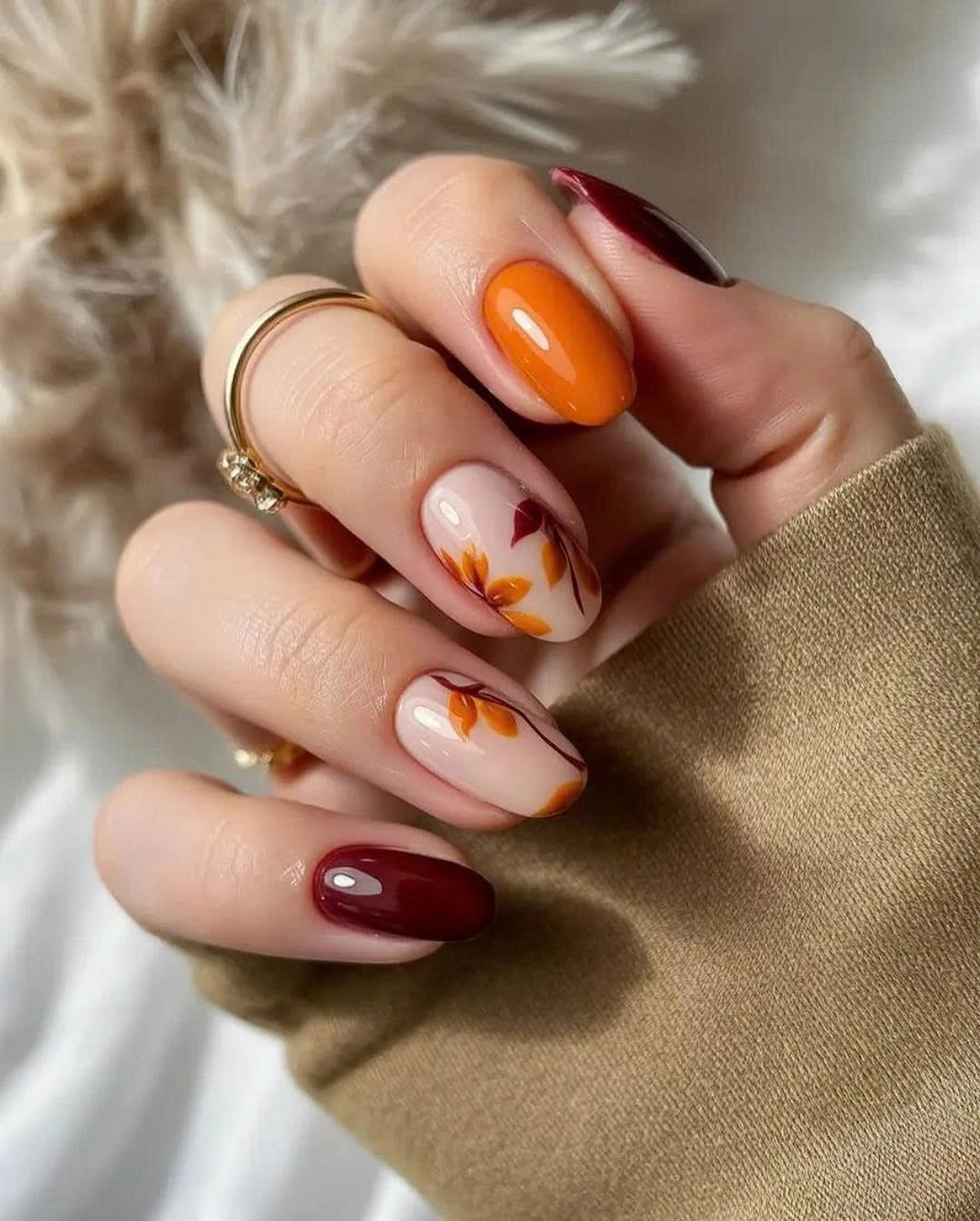
Color placement keeps the vivid orange from becoming disconnected. One solid nail announces it clearly, the pale accents echo it in smaller marks, and the burgundy solids give the eye a darker place to settle. A maroon fall nails burgundy gold direction would feel more traditional, but this orange pairing brings a brighter, curious edge without needing additional motifs.
Use orange on one nail and one pale accent, or replace it with ochre, rust, or muted copper for a less intense version. Medium almond length gives the leaves enough room, while a shorter oval should use larger, simpler marks. The realistic tradeoff is focal strength: orange becomes the first color noticed, so reduce its placement when burgundy should lead more quietly.
Near-Black Maroon Frames Tiny Dot Flowers
Very dark glossy maroon or near-black solids frame pale pink nails marked with tiny clustered dots that suggest flowers without drawing full petals. Short rounded tips keep the dark color compact, and the small clusters stay deliberately understated against the berry-black field. The result feels floral through rhythm and grouping rather than through a literal illustration.
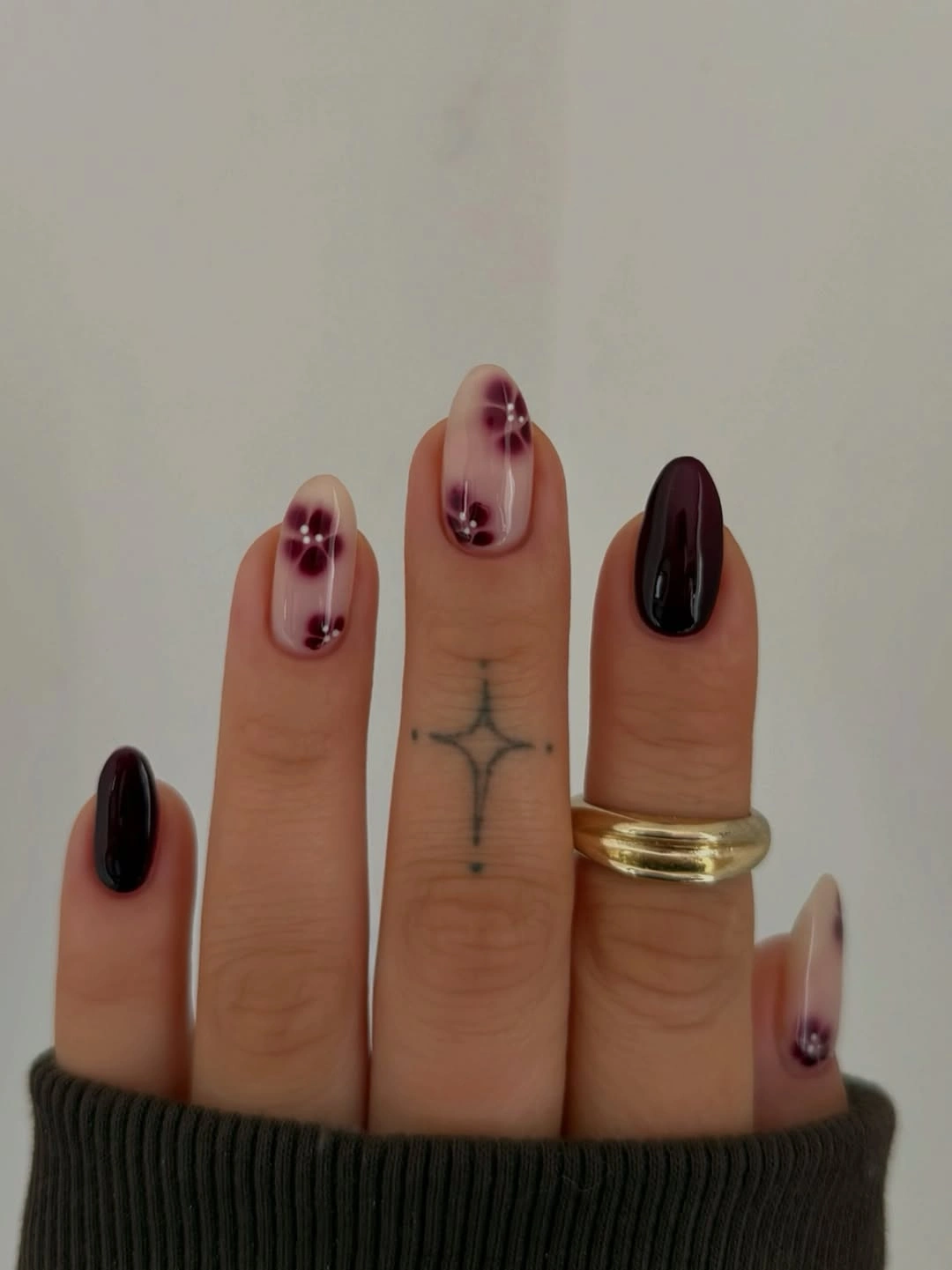
Dot clusters are a smart scale choice for short nails because they preserve the idea of a flower with fewer lines. Pale bases separate the small marks from the dark solids, while the near-black maroon gives the set a strong anchor that feels deeper than a standard red. If the dots were packed tightly, they would become a spot rather than a delicate cluster.
Use three or four small dots per accent and keep the remaining nails solid in dark burgundy, cocoa, or softened black. A warmer maroon can make the contrast easier, and an oval tip will keep the motif gentle. The tradeoff is spacing: with so few marks, an uneven cluster becomes very visible, so restraint has to be matched by careful placement.
Taupe Softens Fine Berry Line Work
Short rounded nails combine glossy deep burgundy solids with taupe or nude accents carrying fine dark line work and tiny warm gold-like points. The taupe ground lowers the contrast compared with white, so the berry marks feel softer while still remaining clear. Small warm details add light to the accents without turning the compact set into a glitter design.
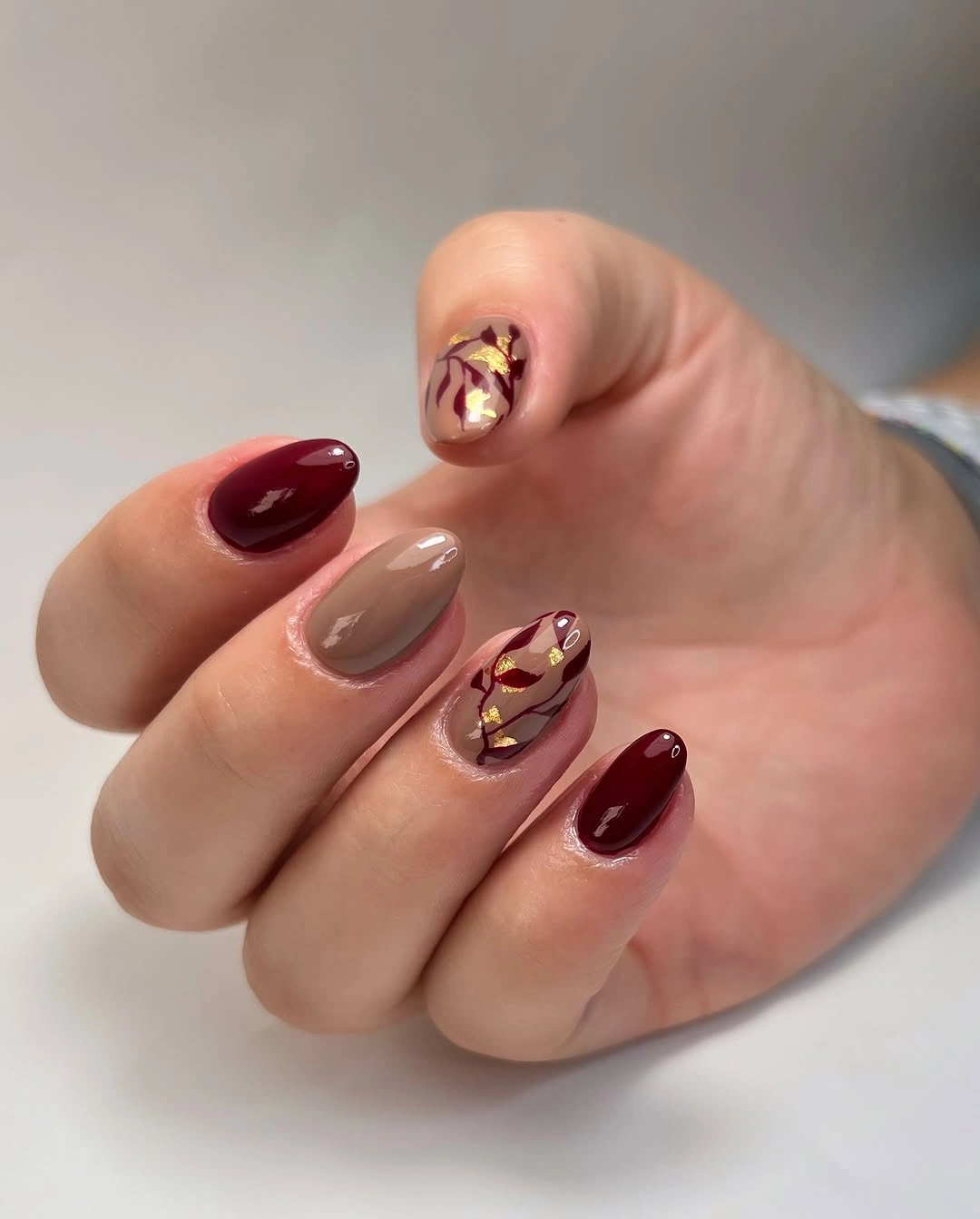
Taupe gives the dark line art a gentle middle ground. It keeps the berry color connected to the neutral background, while the glossy solids restore depth and prevent the manicure from looking washed out. Warm points are used sparingly, which lets the thin lines remain the primary detail instead of competing with a second bright surface.
Choose taupe instead of white when you want a quieter maroon fall nails design, then limit the line work to one or two accents. Replace the warm points with pale dots if you prefer no metallic-looking detail, and keep the tips rounded for a softer proportion. Fine lines need room to breathe, so the short version should remove crossings before adding another color.