Fall short nails 2026 lean on proportion more than excess: most of these manicures keep the edge close to the fingertip, then let one controlled color field or compact motif do the work. Deep chocolate, burgundy, muted plum, olive, caramel, and burnt orange appear beside blush or white areas that give small details room to stay legible. Rounded squares dominate the shortest lengths, while oval edges soften solid dark shades and keep leaf, heart, and dot patterns from feeling boxed in.
The strongest artwork is deliberately scaled, whether that means one heart at the center, a shallow French band, two broad gingham crossings, or a single branch instead of a crowded botanical scene. Gloss is common across the solid browns and patterned sets, while the matte olive manicure proves that a quiet surface can make tiny white dots clearer. A few longer almond and medium square examples widen the comparison, showing how tapered edges and extra length change the amount of pattern a nail can carry.
Deep Chocolate on Soft Square Edges
Very short rounded-square nails give this deep chocolate color a clean, weighty outline. The shade covers every visible nail without an accent, and the nearly black center warms to brown along the side reflections. Because the tips stop close to the fingertips, the solid color reads as a deliberate shape decision rather than a background waiting for artwork.
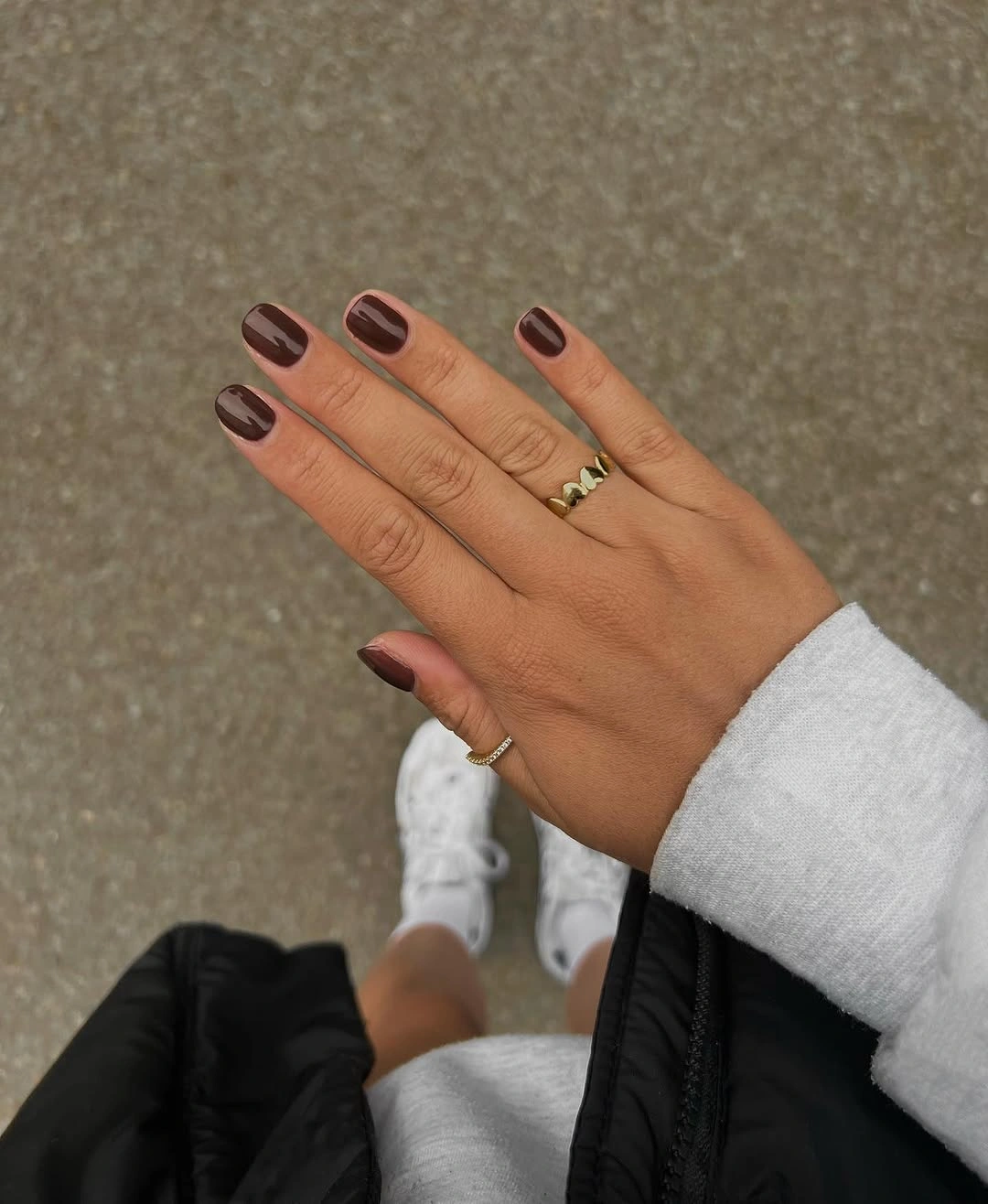
Long white highlights run through the glossy surface and emphasize how gently the corners have been rounded. The thumb is broader than the other nails, yet the same dark coverage keeps the hand visually consistent. I find that uninterrupted color is especially effective here because each compact perimeter remains easy to see.
Daily wear would show first at the dark free edges, where even a small pale chip could break the smooth outline. The close-cropped length removes projecting corners that might catch, which supports the practical mood of the manicure. Keeping the cuticle curve neat matters more than adding detail when the entire design depends on one even field of brown.
Burgundy Squares With Leopard Accent Pair
Three glossy burgundy nails set a dark baseline, then the ring and little nails switch to warm tan leopard markings. The short square tips give the irregular black and brown spots a firm boundary. Instead of shrinking the pattern into many tiny marks, the accents mix a few larger shapes with smaller dots that remain distinct on narrow surfaces.
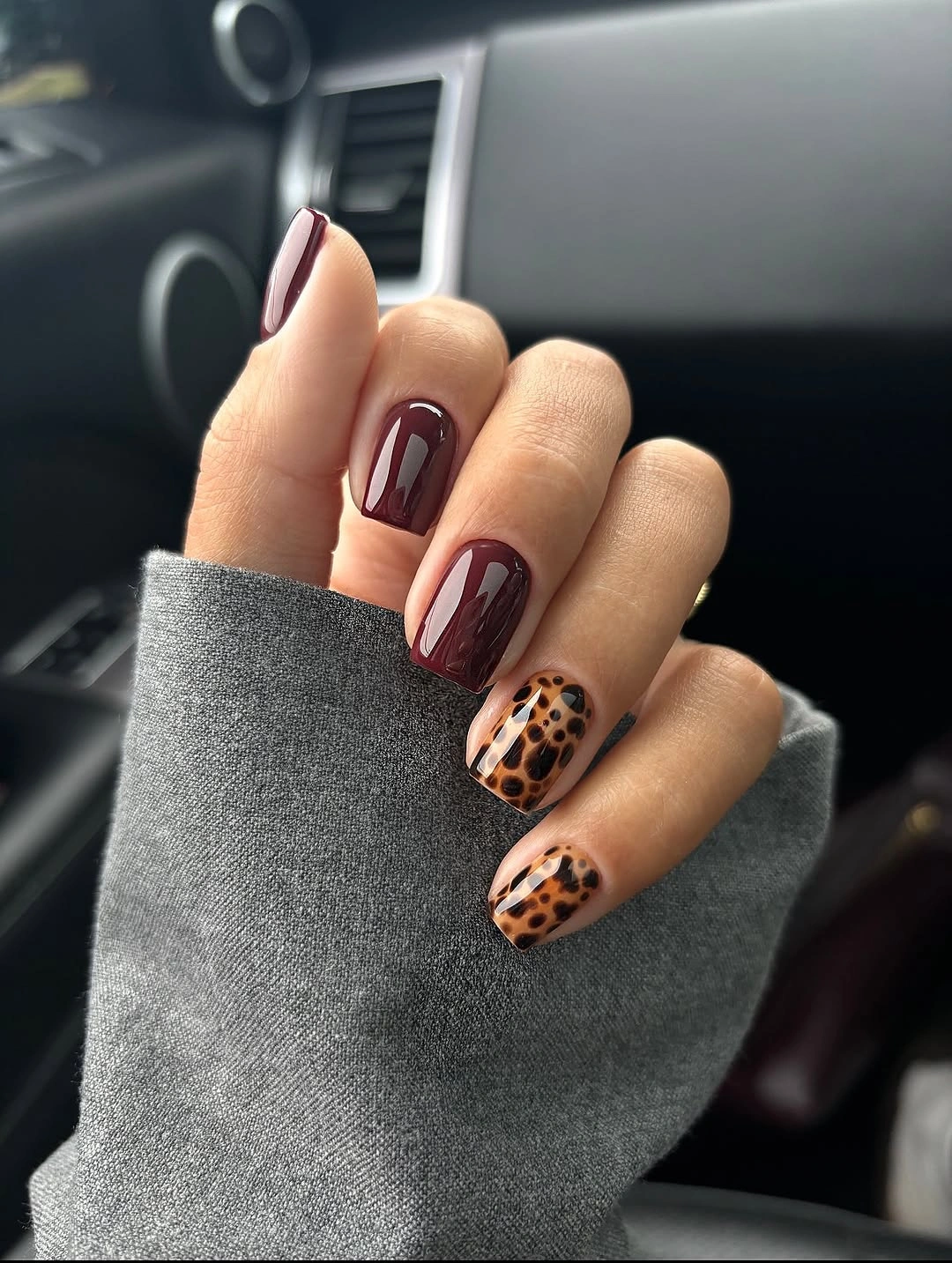
The burgundy repeats the deepest value inside the spotted nails, so the color break does not divide the hand into unrelated halves. Placing both patterned nails beside each other creates one concentrated area of movement rather than scattering it across all five fingers. Bright vertical reflections also keep the tan accents as glossy as the solid nails.
Two detailed nails are a sensible scale for this fall short nails set because most of the edges remain plain and easy to monitor. If the pattern reached every tip, small chips could interrupt far more spots and make the layout look uneven sooner. Here, the burgundy majority can tolerate ordinary edge wear with less visual disruption, while the accents still carry the personality.
Caramel Leaves on Compact White Accents
Warm caramel and pale beige solids establish the palette before two white nails introduce fine black branches and autumn-colored leaves. Each leaf is separated by visible white space, even where the stems cross diagonally. That spacing lets brown, tan, and muted olive shapes stay recognizable on short oval surfaces.
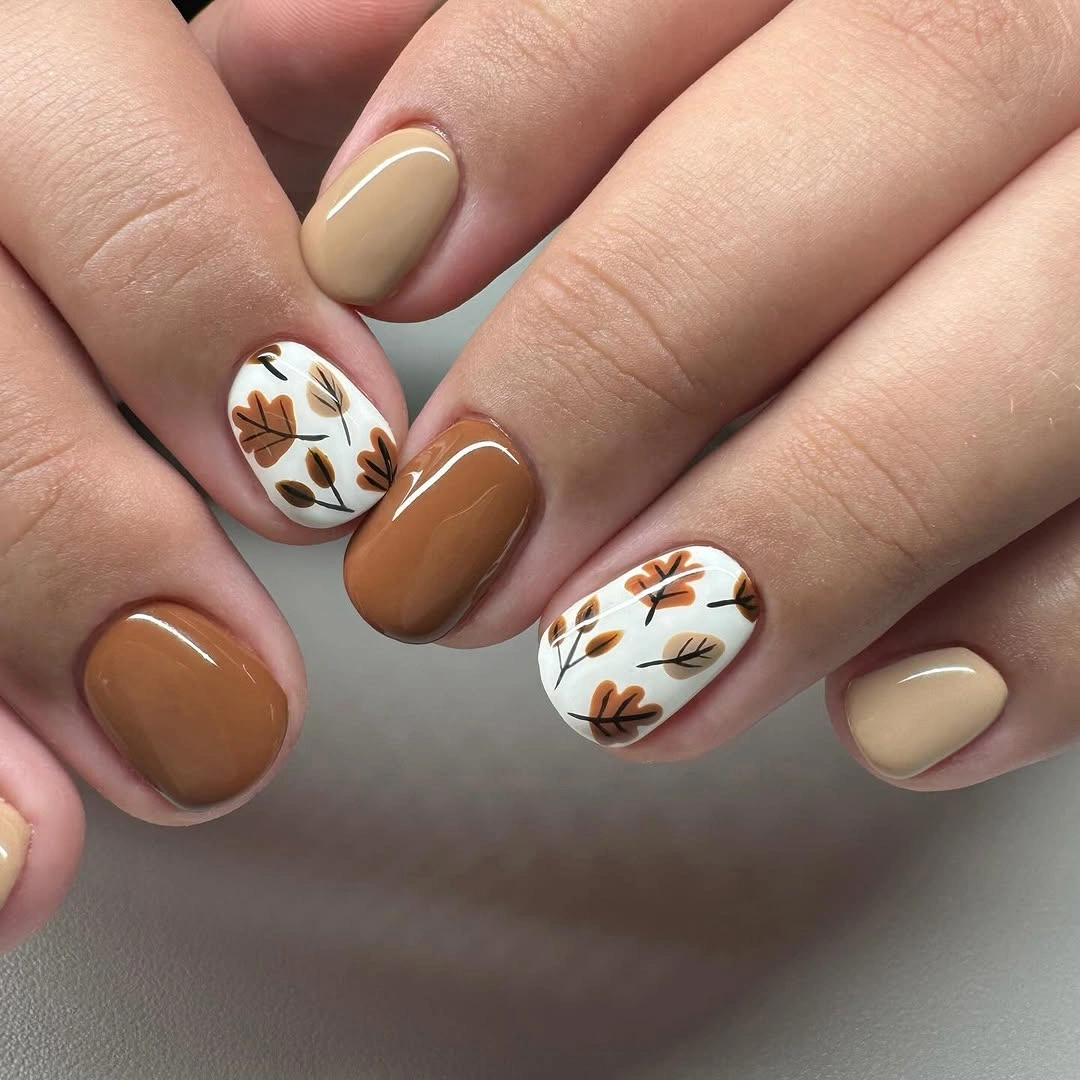
Rather than adding unrelated accent colors, the solid nails borrow their beige and caramel directly from the foliage. The black stems provide enough contrast to organize the softer browns without turning the accents into dense line work. Rounded tips are useful in this composition because they echo the curved leaves while the diagonal branches supply direction.
I would preserve the generous white gaps if adapting this idea to even smaller nails. Removing a leaf or shortening a branch would work better than compressing every element toward the sidewalls. The solid caramel nails can take more visible tip wear, while a chip through one of the white accents could remove part of a branch and deserves earlier attention.
Multicolor Gingham Across Rounded Short Tips
Pink, orange, olive, and brown each receive a separate nail, yet a shared milky white base holds the manicure together. Translucent horizontal and vertical bands cross only a few times, producing darker squares where matching colors overlap. The grids are broad enough to read as gingham without packing miniature checks into the very short nail plates.
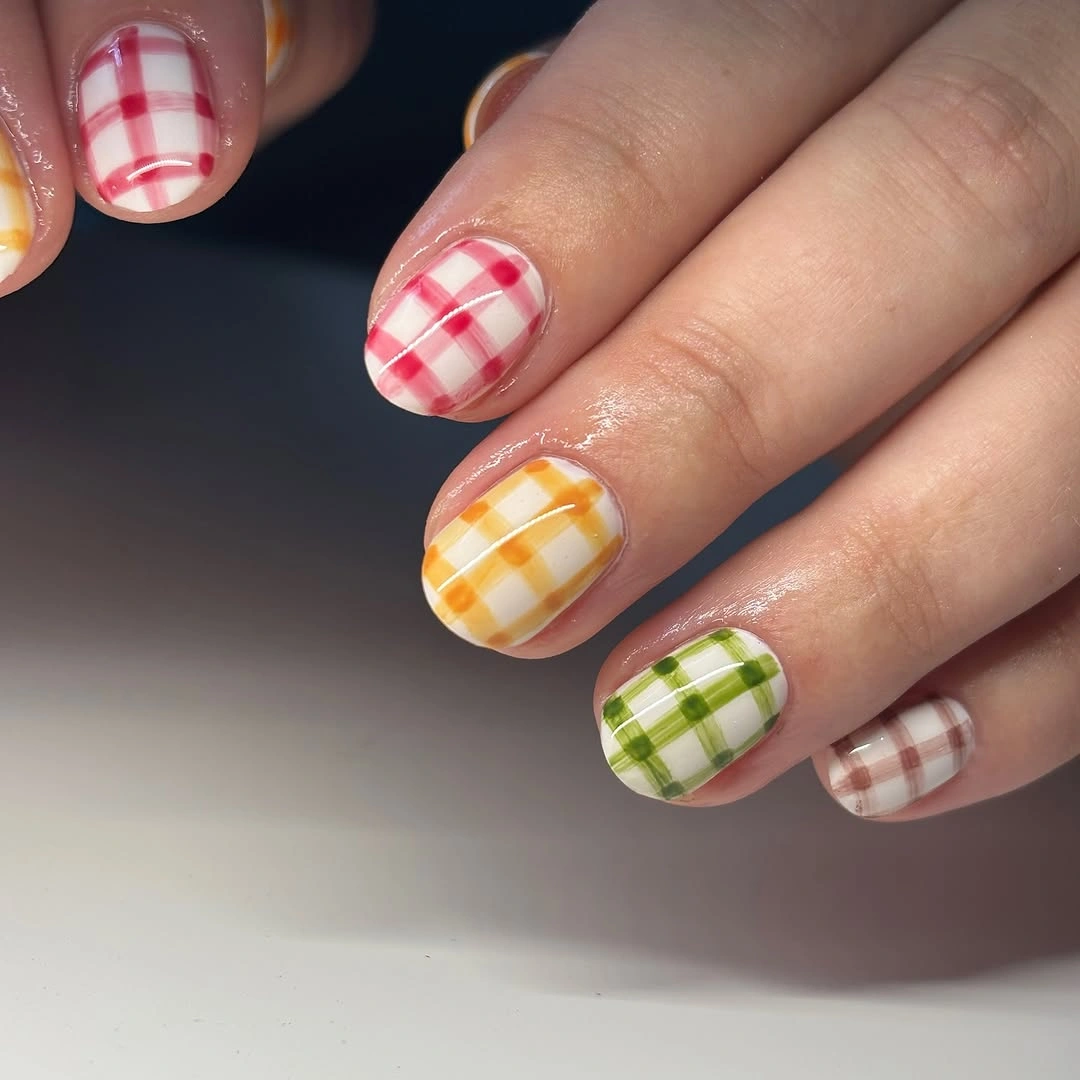
Small shifts in stripe width suit the different nail widths and keep the pattern from looking mechanically repeated. White gaps remain visible around every colored crossing, which gives four hues a common rhythm. The glossy top reflection softens the loose stripe edges and makes the hand-drawn-looking grids feel cohesive.
Because every nail carries pattern, the outermost horizontal bands are likely to reveal tip wear before the interior checks change. A rounded free edge helps by eliminating sharp plaid-covered corners that could chip first. Any practical variation should keep the same number of bands rather than add more, since the open white squares are what preserve clarity.
Tiny Hearts Over a Muted Fall Palette
Burgundy, olive green, blush pink, and pale blue divide the two hands into solid blocks of color. One tiny contrasting heart sits near the center of each short oval-to-rounded-square nail. The motif is intentionally small, leaving most of every glossy base exposed and making color the primary design.
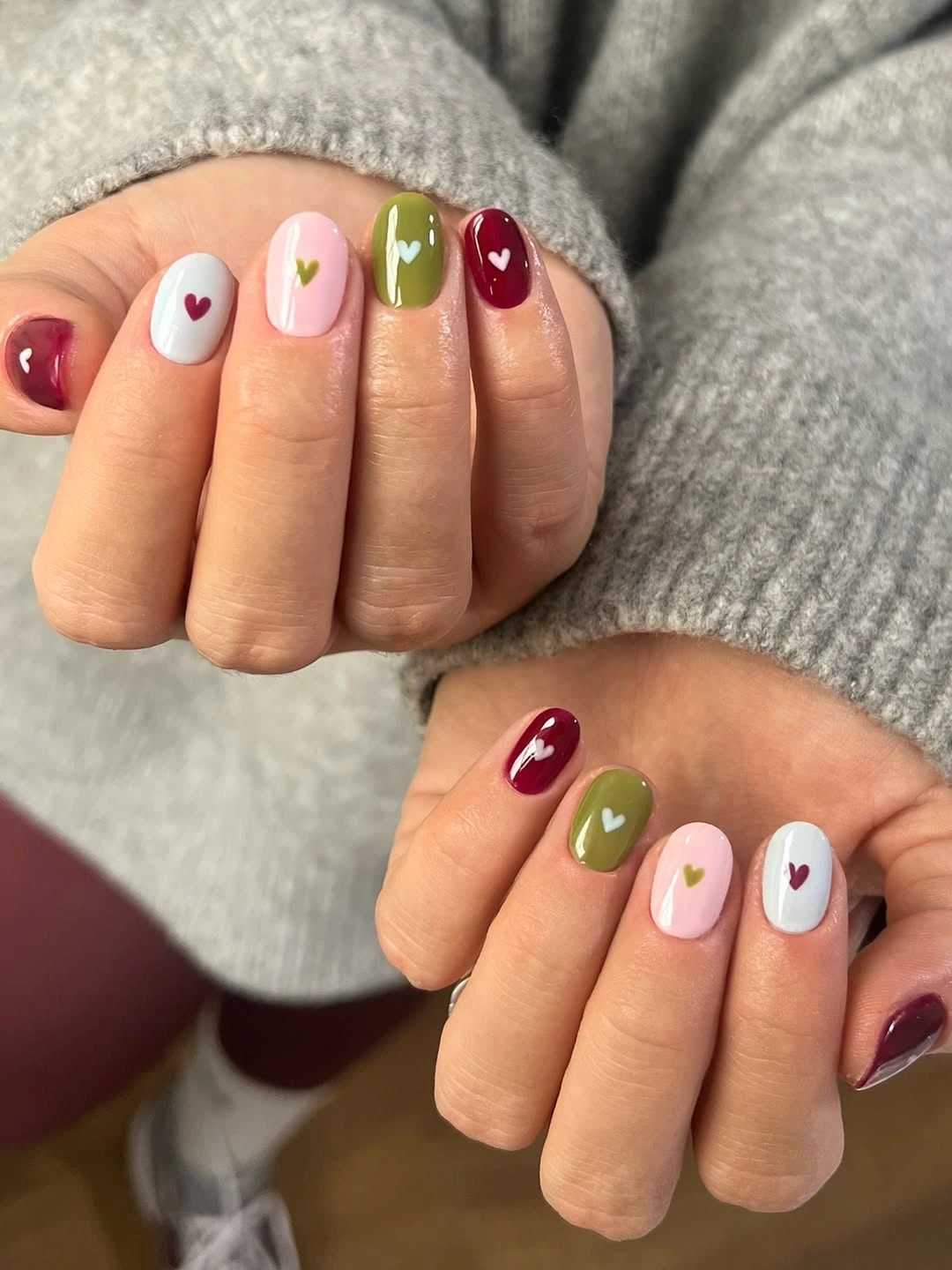
Heart colors circulate through the set: burgundy appears on the pale blue nail, olive lands on pink, and pale tones brighten the darker bases. Both hands repeat the sequence with matching logic, so the mixed palette feels ordered rather than random. Center placement also keeps each symbol away from the curved sidewalls, where a small shape could look pinched.
Compact artwork gains realistic breathing room through that wide border of plain color. Minor free-edge wear would leave the central hearts intact, although a dark burgundy chip would still be easier to notice than wear on pale blue. The most useful lesson is the ratio of motif to base, since the little hearts act like punctuation instead of becoming the entire sentence.
Espresso Brown Along Tapered Almond Edges
These nails extend beyond the fingertips and taper into medium almond points, so their edge behavior differs from the close-cropped squares nearby. A single espresso brown covers the full hand and turns the elongated outline into the design itself. The color is almost black in shadow but reveals a warm reddish cast wherever light meets the sides.
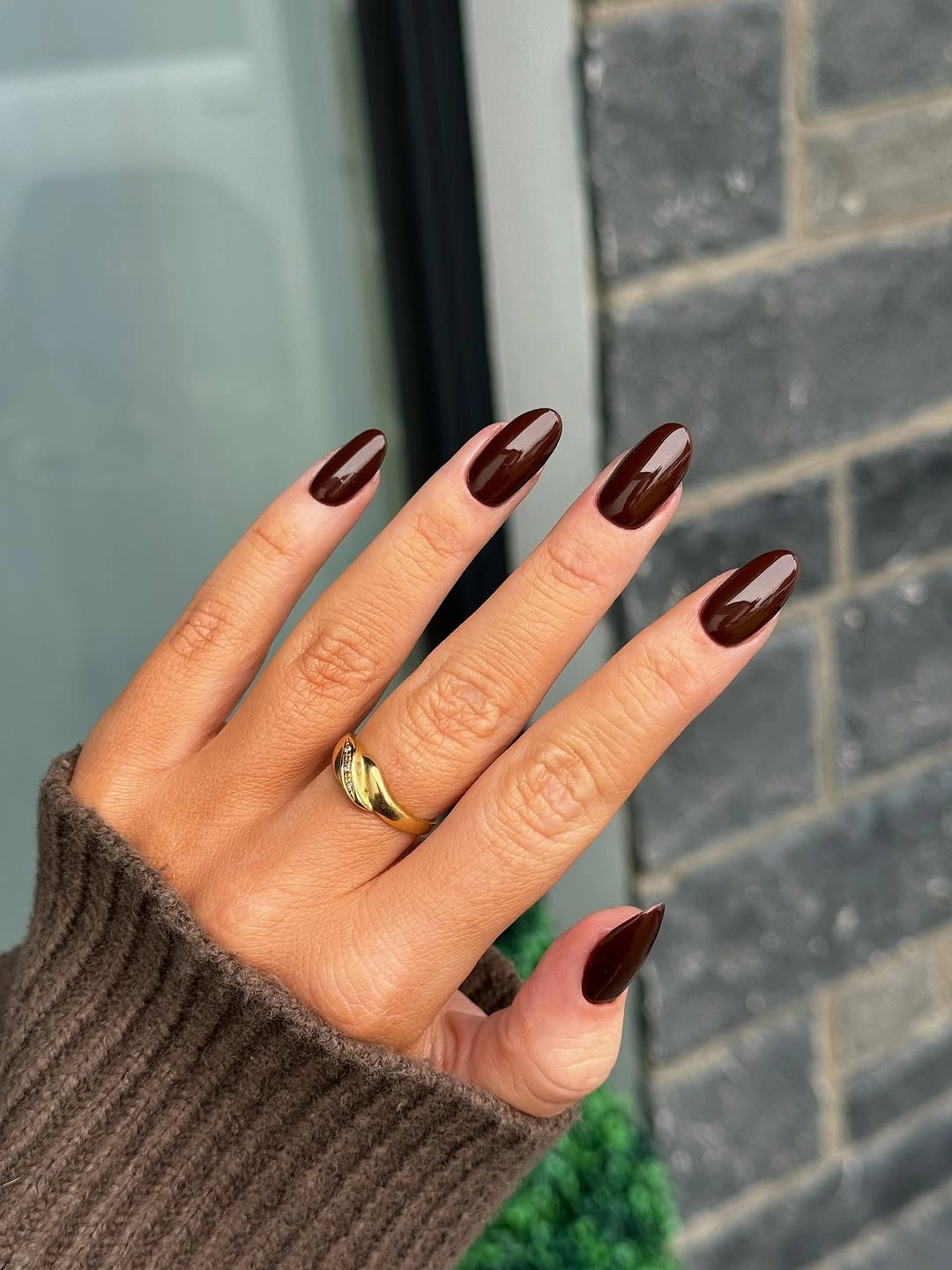
No artwork competes with the narrowing tips, and the bright lengthwise reflections make that restraint noticeable. The broader base of each nail flows gradually toward a rounded point instead of ending in a sudden sharp corner. Against the brown sleeve, the glossy manicure remains darker and more defined rather than disappearing into a tonal match.
Extra length creates more leverage at the tip than a short manicure, even though the almond edge has no square corners to catch. A chip in this near-solid darkness would break the smooth taper immediately, so the perimeter deserves close attention. For someone comparing lengths, this example shows that uninterrupted color can control a longer silhouette without relying on additional art.
Chocolate Plaid With Pale Blue Curves
Chocolate brown and pale blue move through several treatments on these long almond nails. The thumb and ring nail carry translucent brown plaid crossed by fine blue lines, while one nail stays fully blue and another fully brown. A blush nail completes the set with a curved chocolate tip traced by a pale blue arc.
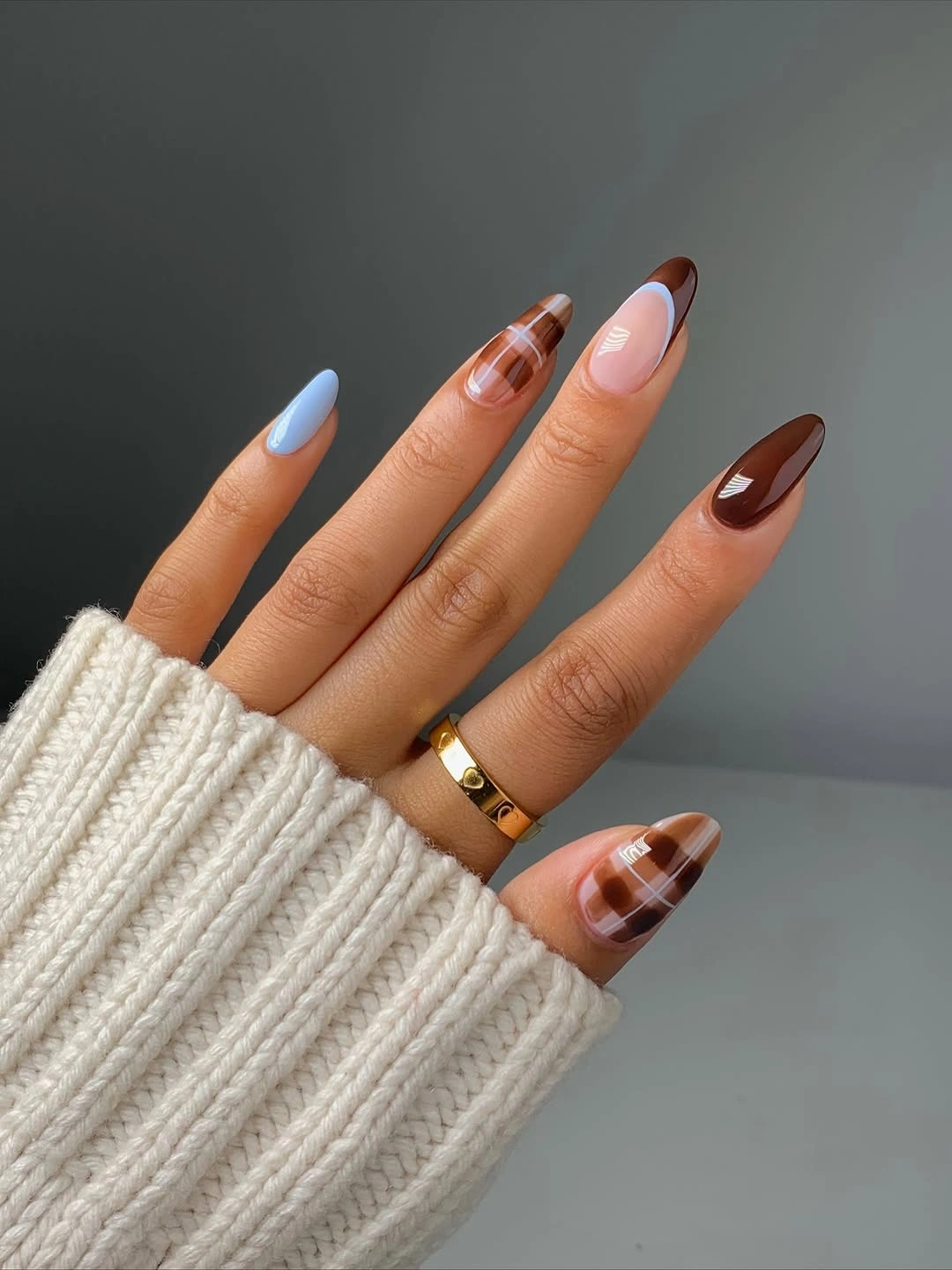
Repeating the same two colors lets plaid, solids, and curved edge work sit together without requiring identical layouts. The rounded brown tip follows the almond perimeter instead of cutting straight across it, and the blue border makes that curve easier to read. On the plaid nails, only a few broad blocks occupy the extra length, preserving translucency between intersections.
This is not a very short set, and its available surface is part of why several motifs can coexist. The tapered ends still impose discipline, because dense checks near the points would narrow into clutter. Wear at the brown tips or fine blue outlines would alter the geometry first, while the solid blue and brown nails provide quieter companions that are easier to maintain visually.
Smoky Burgundy With Sparse Gold Flecks
Deep wine color darkens around the sidewalls and opens into a slightly lighter center on these short oval nails. Small gold-colored flecks sit irregularly across every nail, with broad burgundy areas left untouched. The resulting depth is more important than the amount of sparkle, which remains deliberately restrained.
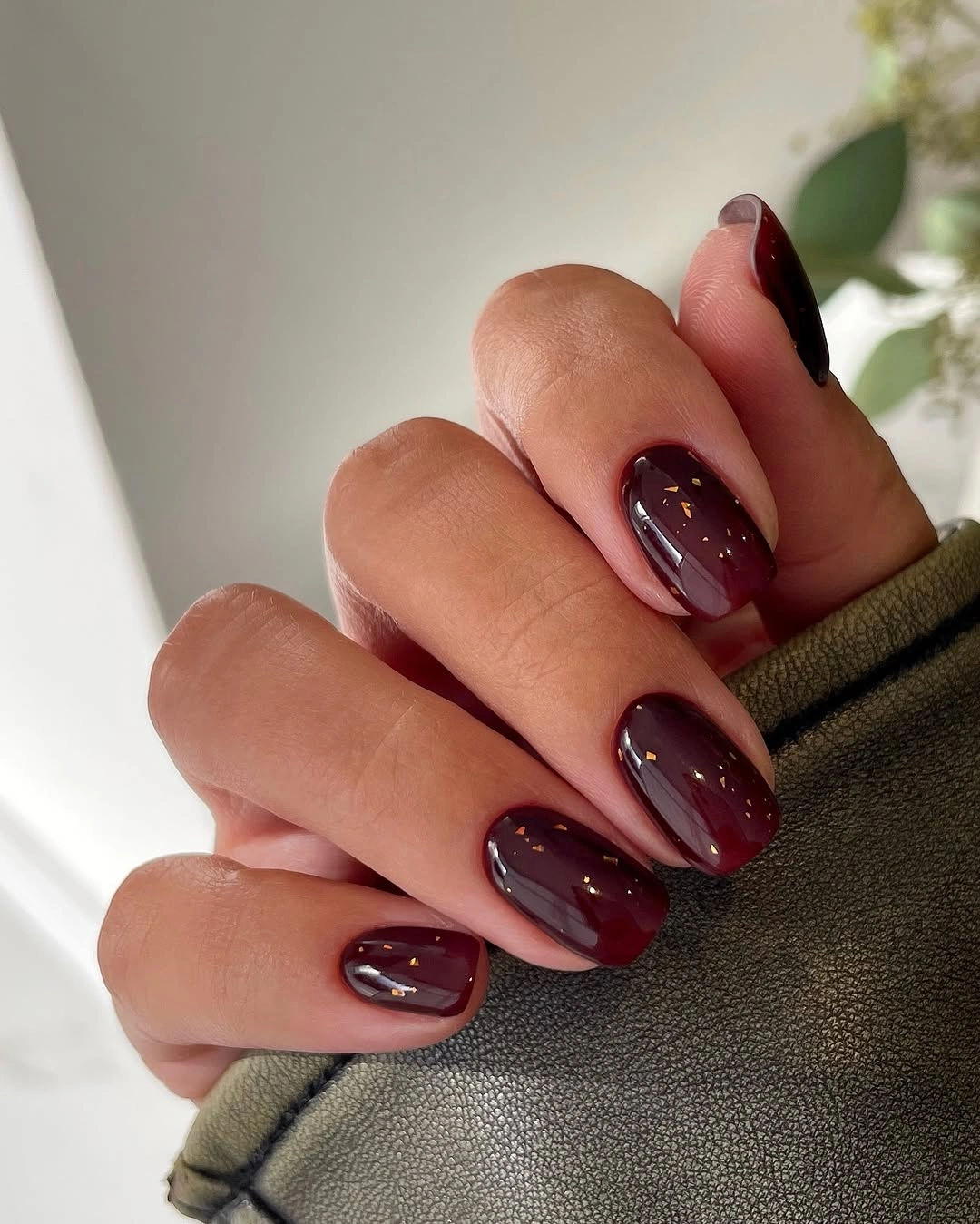
Some flecks are tiny points and others are angular fragments, so their scale changes without forming a repeated pattern. The glossy surface carries long reflections over the smoky color, reinforcing the sense of a translucent center without obscuring the rounded outline. Since no nail is singled out, the scattered detail feels continuous across the hand.
Irregular flecks are forgiving on a small surface because none needs to align with a sidewall or match its neighbor. Darker edges define the compact oval shape, although they will also expose pale tip wear more quickly. I prefer the sparse distribution here, since additional metallic points would flatten the wine depth that makes the manicure distinctive.
Dusty Berry on Close-Cropped Squares
A muted berry-mauve shade covers these very short square nails from cuticle to straight free edge. The color sits between rose, plum, and brown, giving the solid manicure autumn depth without approaching black. Softened corners keep the clipped shape from looking rigid on the narrow outer nails.
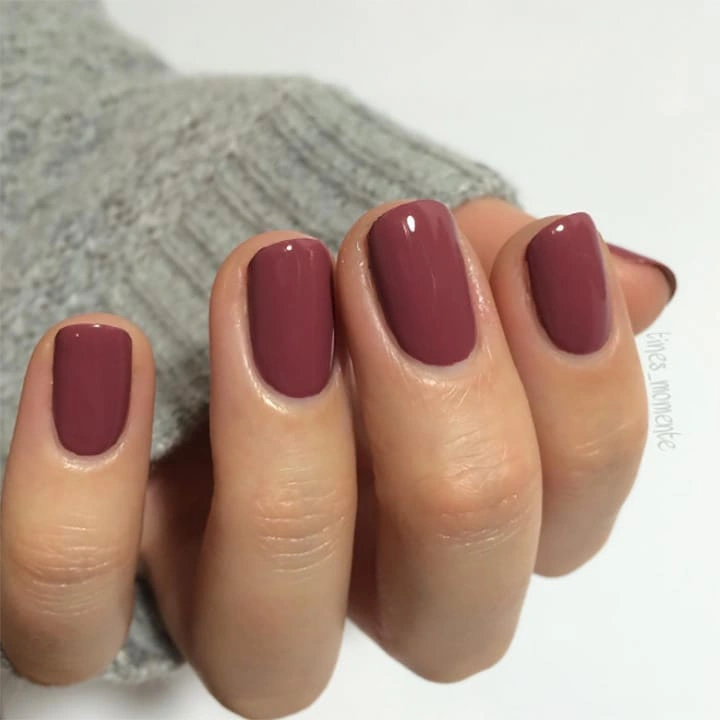
Small points of reflected light show a gentle gloss, but the mid-depth color remains the first thing the eye registers. Uniform coverage makes subtle width differences visible, and the square outline still looks consistent because every corner receives the same rounding. There is no shimmer or accent nail to interrupt that calm repetition.
Compared with a near-black brown, this softened berry should make tiny edge changes less stark while still showing the shape clearly. The practical demand is even coverage, particularly near the short tips where a pale gap would look accidental. Its restraint also makes it a useful reference for how much character undertone alone can bring to fall short nails.
Burgundy Curves Across Blush Square Nails
Two nails are fully wine-colored, while three blush accents carry one broad burgundy curve beside a much finer silver sparkling line. The arcs bend in different directions and occupy only part of each compact rounded-square surface. Open blush space keeps the crossing strokes legible and prevents the set from becoming a tangle of lines.
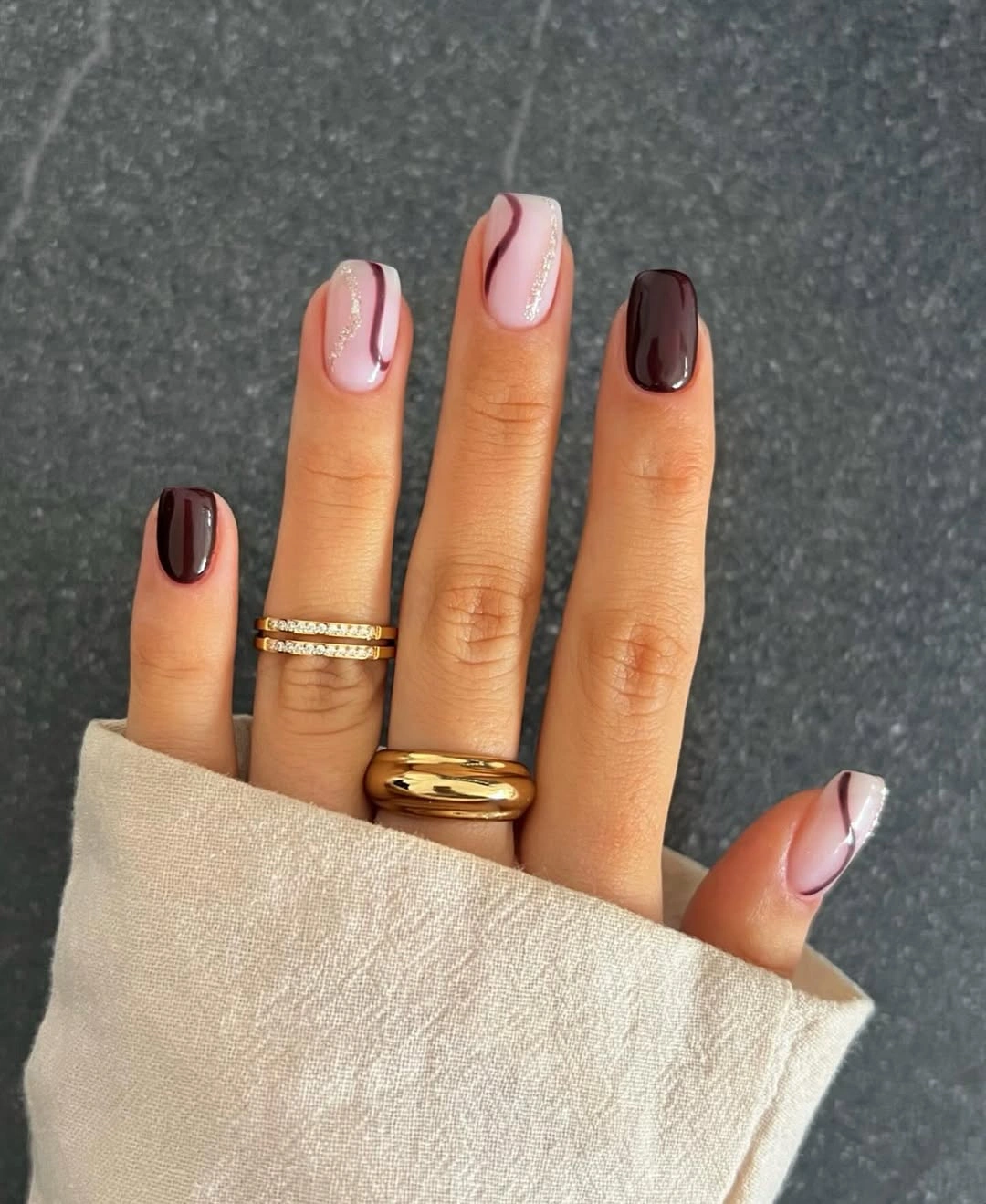
Unequal line weight is the key proportion choice: burgundy carries the movement, and the narrow sparkle acts as a light echo. The solid nails repeat that dark tone at full strength, anchoring the pale accents without demanding another motif. Several curves stop before reaching the corners, so the softly squared perimeter remains visible around them.
Fine sparkling paths will reveal scratches or missing segments sooner than the broad burgundy areas. Even so, limiting each accent to two main lines makes small repairs less complicated than an all-over illustration. A practical variation could shift the curves slightly while preserving their spacing, since balance depends on open blush area rather than exact symmetry.
Mushroom Taupe Over Smooth Oval Lengths
One gray-brown taupe stretches across every medium oval nail with no secondary color. The shade is lighter and cooler than the chocolate sets, and broad gloss reflections travel down the centers. Modest length beyond the fingertips lets the oval ends look smooth rather than compressed.
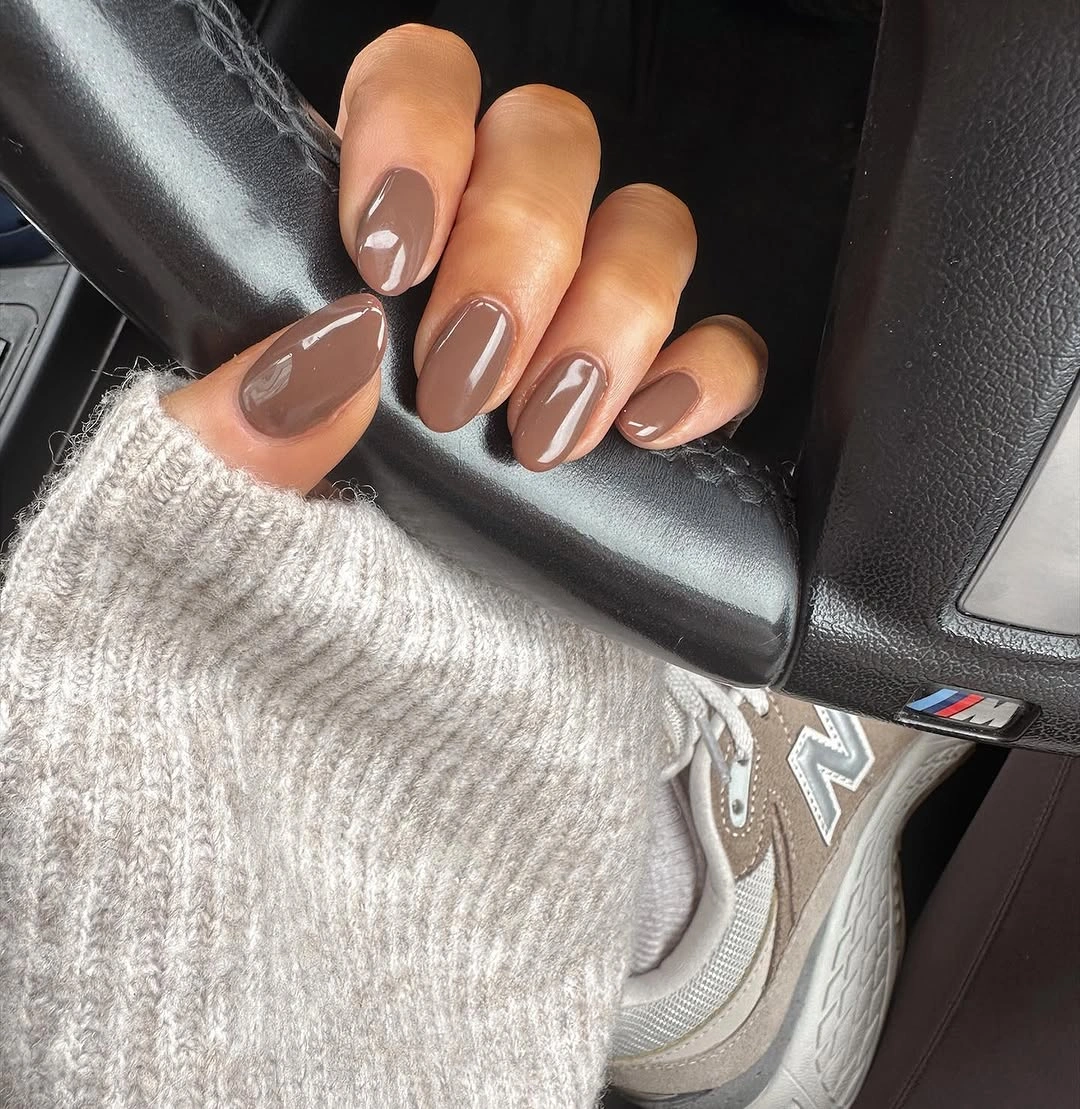
The thumb carries a wider field of taupe, yet its rounded edge follows the same contour as the narrower fingers. A light gray knit sleeve brings out the cool cast in the color, while the opaque coverage keeps it from reading sheer. What gives this manicure presence is not contrast but the steady relationship between a muted tone and repeated oval edges.
Medium length offers more tip exposure than the shortest squares, though the absence of corners reduces obvious catching points. Chips would still interrupt the even taupe field, particularly under the long white reflections. I would pair this quiet color with regular edge checks rather than add an accent, because the unbroken surface is the entire visual argument.
Dark Cocoa on Clipped Square Nails
Both hands are cut close to the fingertips and covered in the same opaque cocoa brown. Straight tips and softly rounded corners create broad little rectangles, including on the thumbs. The shade stays clearly brown under direct light instead of collapsing into pure black.
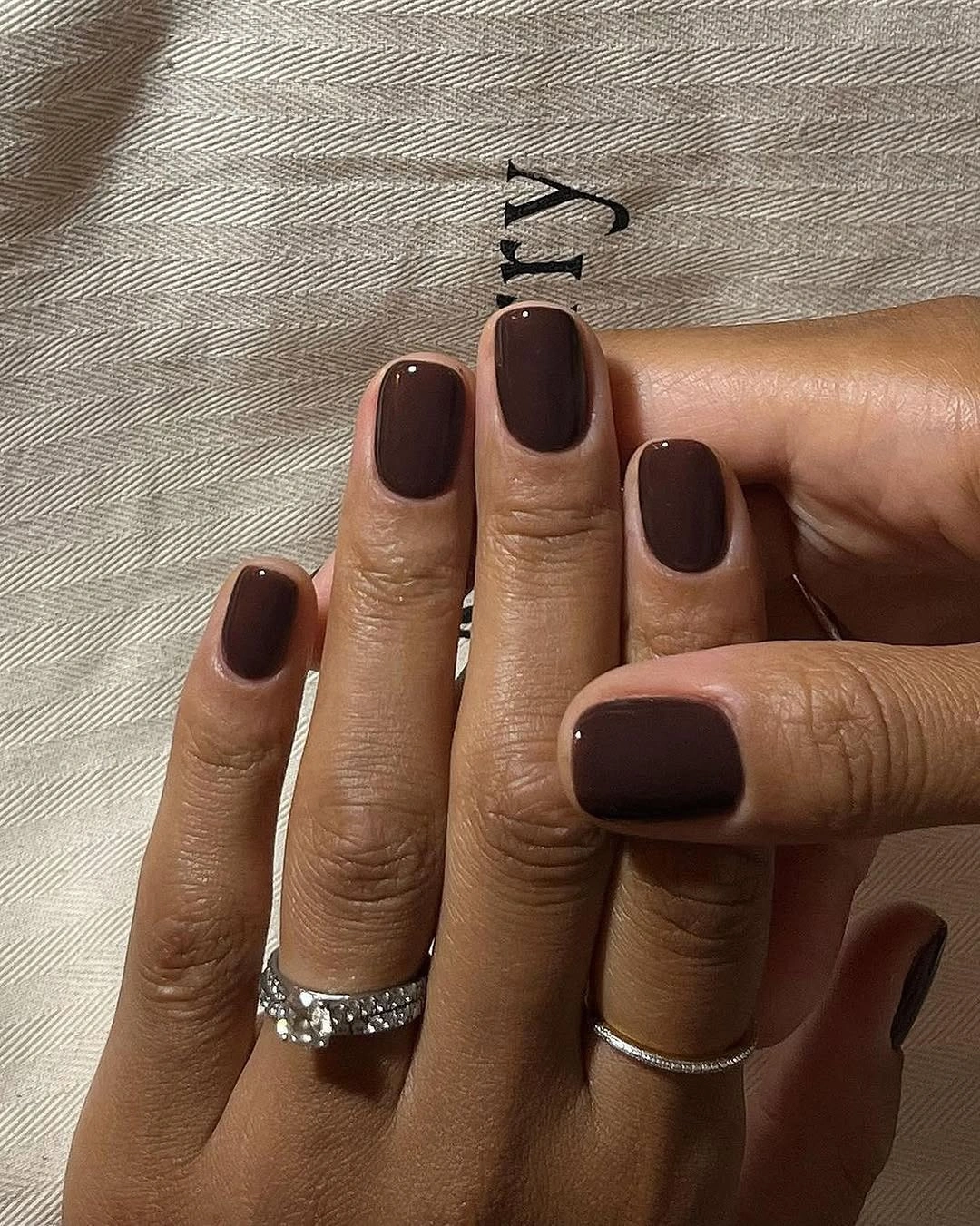
Tiny highlights near the cuticles suggest a softer gloss than the mirror-like chocolate manicure at the beginning. That quieter reflection lets the short architecture take priority, especially where the sidewalls meet the free edge. Consistent color across ten nails makes the close-cropped length look purposeful rather than unfinished.
Little projecting edge makes the low-overhang shape well suited to repeated daily contact. Dark cocoa still exposes chips quickly, so the practical advantage comes from the length and softened corners, not from the color hiding damage. Precise side coverage carries more weight here than decorative complexity ever could.
Burgundy Micro Tips With Solid Alternates
Solid burgundy nails alternate with translucent blush nails edged by shallow burgundy tips. The French bands are narrow enough that most of each short square remains pale and visually open. Across both hands, the sequence changes position slightly while preserving the same split between full coverage and slim edging.
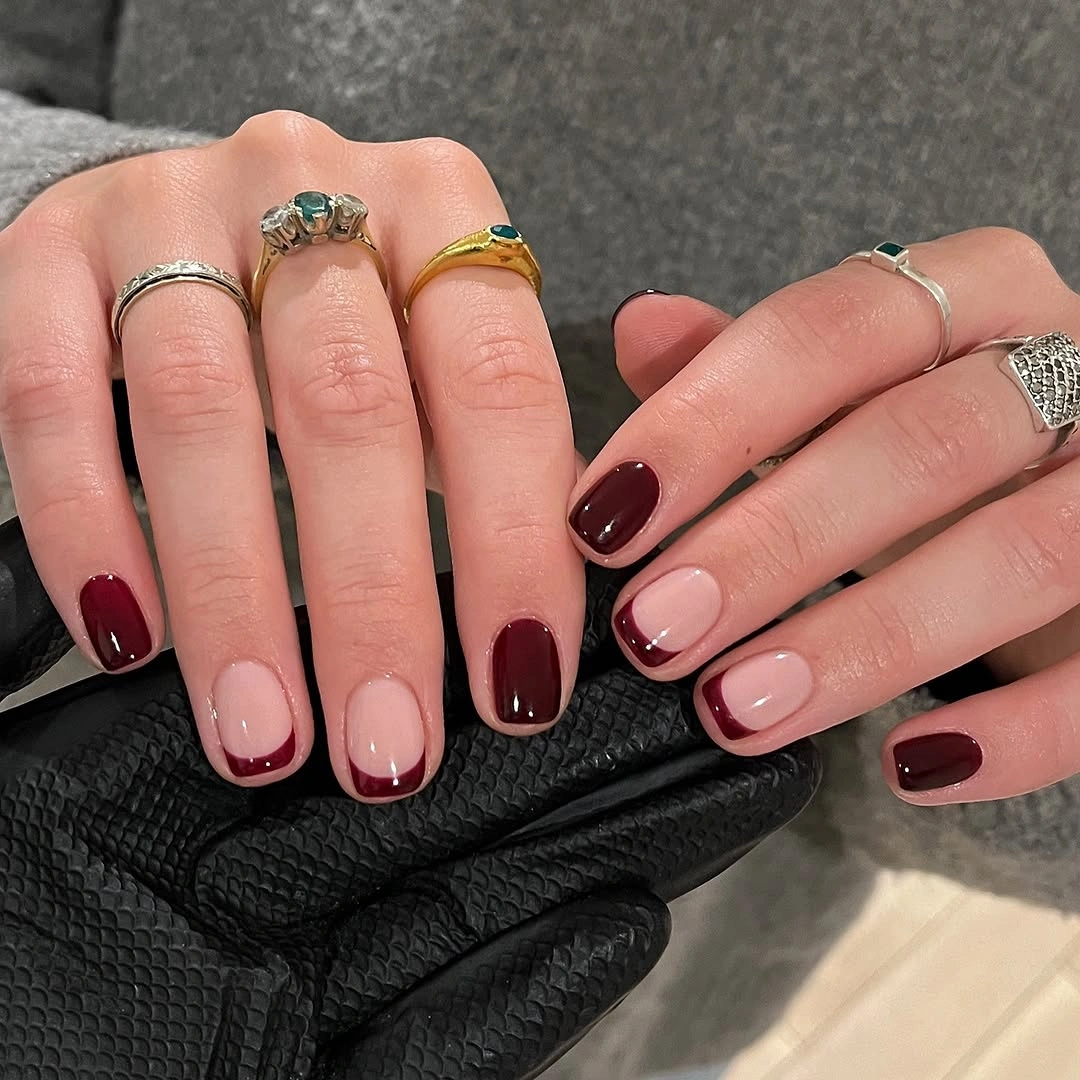
Using one shade for two different coverage levels creates contrast without expanding the palette. The dark solids give the manicure weight, then the blush centers lengthen the look of neighboring short nail beds. Softened square corners keep the burgundy bands from ending in severe right angles.
The defining detail sits directly at the free edge, which means ordinary tip wear has more consequence than it would on a centered motif. Keeping the band shallow leaves room for a clean refresh without allowing it to grow visually heavy. This alternation also avoids asking every short nail to support a precise line, a useful compromise between detail and upkeep.
Warm Cocoa Across Natural Rounded Edges
A medium warm cocoa color follows the natural differences between these short rounded nails. Some sidewalls look nearly oval, while others stay a little squarer before curving at the tip. The same glossy brown unifies those variations instead of forcing every nail into an identical silhouette.
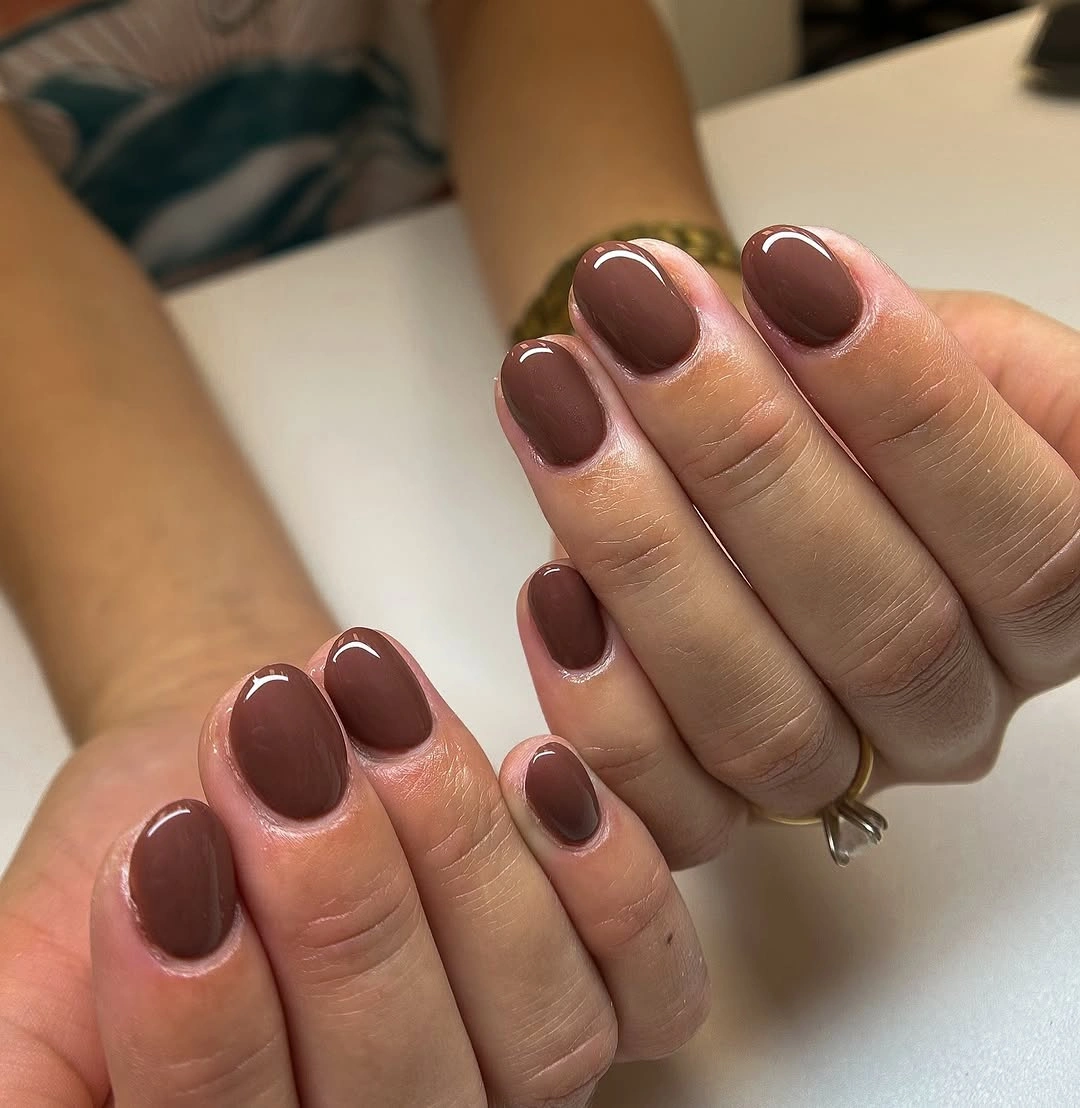
Curved white highlights reveal a redder, lighter brown than the dark cocoa and espresso examples. That warmth softens the edge contrast against the fingers, even though the opaque color still outlines each compact shape. With no accent work present, subtle changes in width and roundness become part of the manicure rather than flaws to disguise.
Close length and rounded corners reduce the number of exposed points that could snag. Midtone brown should make very small chips less abrupt than near-black polish, but an uneven tip would still disturb the tidy series of curves. The understated result needs no accent because warmth, gloss, and natural proportion already supply its interest.
Burnt Orange With Tiny Golden Mushrooms
Glossy burnt-orange solids alternate with blush square accents covered in miniature gold-colored stars, dots, and mushroom illustrations. The detailed nails do not repeat one identical arrangement; one favors scattered starbursts, while others place larger mushroom forms near a corner. Rust-colored areas around the illustrated details connect them back to the orange solids.
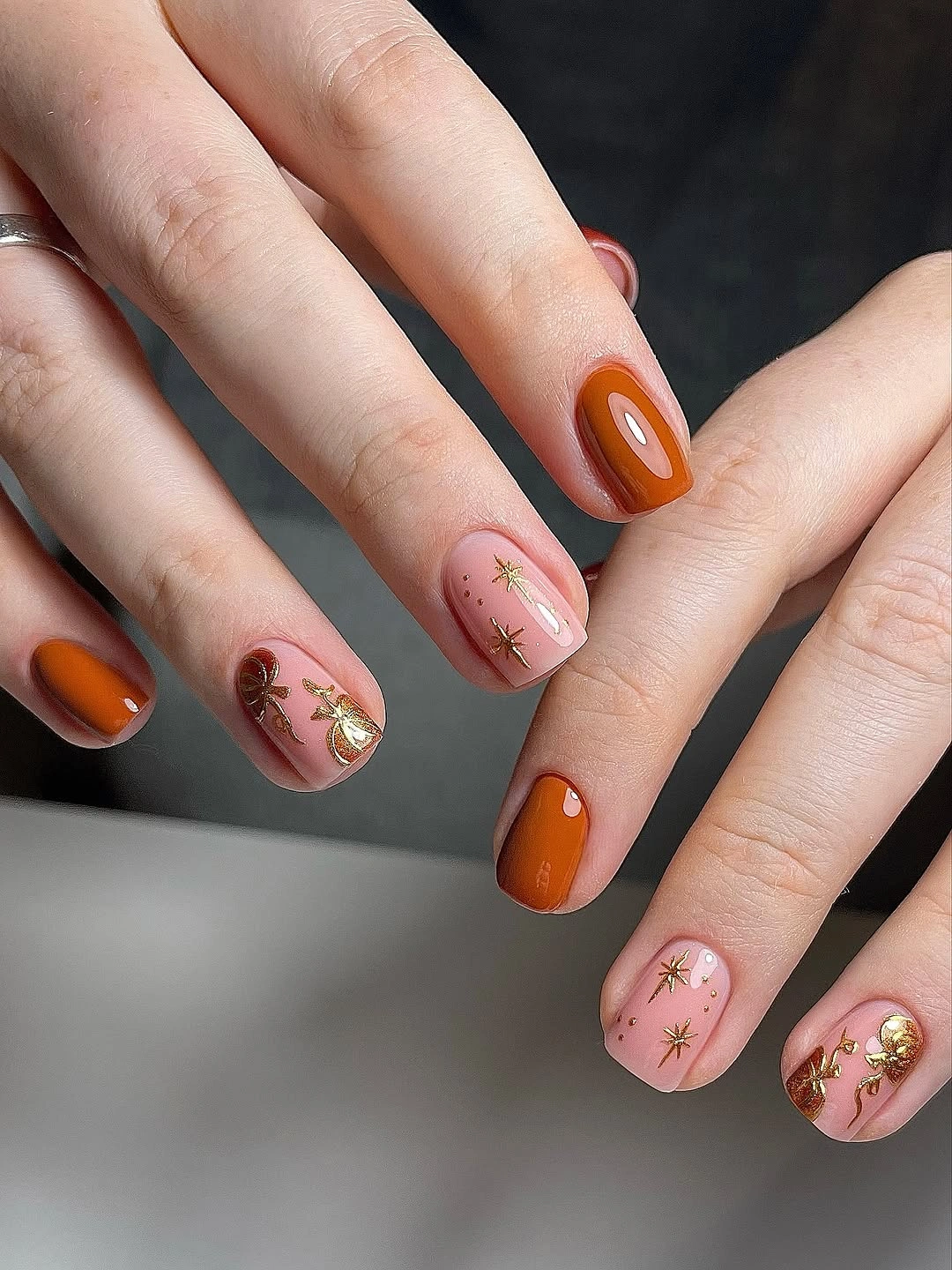
Open blush areas are essential because the metallic-looking motifs vary in size and direction. Small stars can sit away from the larger mushrooms without filling every gap, and the straight short tips form a stable lower boundary. The solids also give the eye somewhere to rest between illustrated nails.
Artwork that reaches a corner or free edge can lose recognizable parts when wear begins, especially on the mushroom accents. Centered starbursts and dots are less vulnerable because they remain separated from the perimeter. A harder-wearing edit could preserve one illustrated nail per hand and let the burnt orange carry more of the design.
Reversed Cocoa Daisies on Cream and Brown
One hand uses chocolate brown bases with cream five-petal flowers, while the other reverses the formula to cream bases with brown flowers. A single bloom occupies the center of each short square nail. Even the flower centers participate in the color swap, making the two hands clearly related without making them identical.
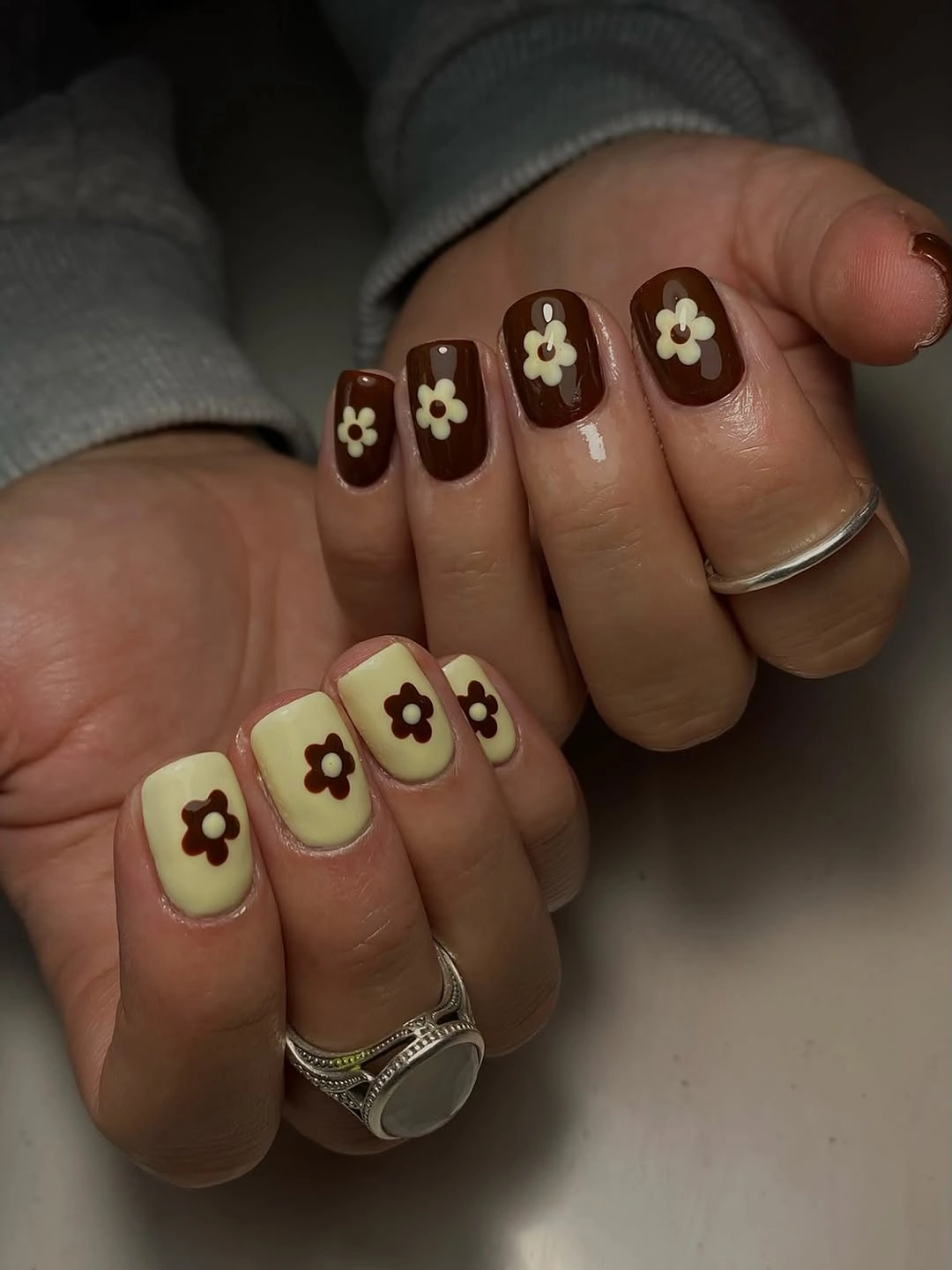
The flowers are broad rather than intricate, so five rounded petals remain distinct on the compact surfaces. Their central placement leaves a border of base color around most edges and protects the motif from feeling cropped. Gloss reflections fall beside the blooms, allowing the high-contrast shapes to stay readable.
Palette reversal creates variety without requiring a second style of artwork, which is a smart use of limited space. Because each bloom sits away from the tip, modest edge wear would not immediately remove a petal. The cream hand may show dark marks more readily, while the brown hand will make pale chips at the perimeter easier to spot.
Mixed Brown Motifs Across Almond Lengths
Four distinct treatments share a narrow brown palette across these visibly long almond nails. Deep chocolate covers the thumb and one finger, tortoiseshell mottling fills another, a blush nail receives a dark micro tip, and a smoky brown center is outlined on the remaining accent. The extra length gives each idea room, yet no treatment introduces a color outside brown, blush, cream, and a fine sparkling edge.
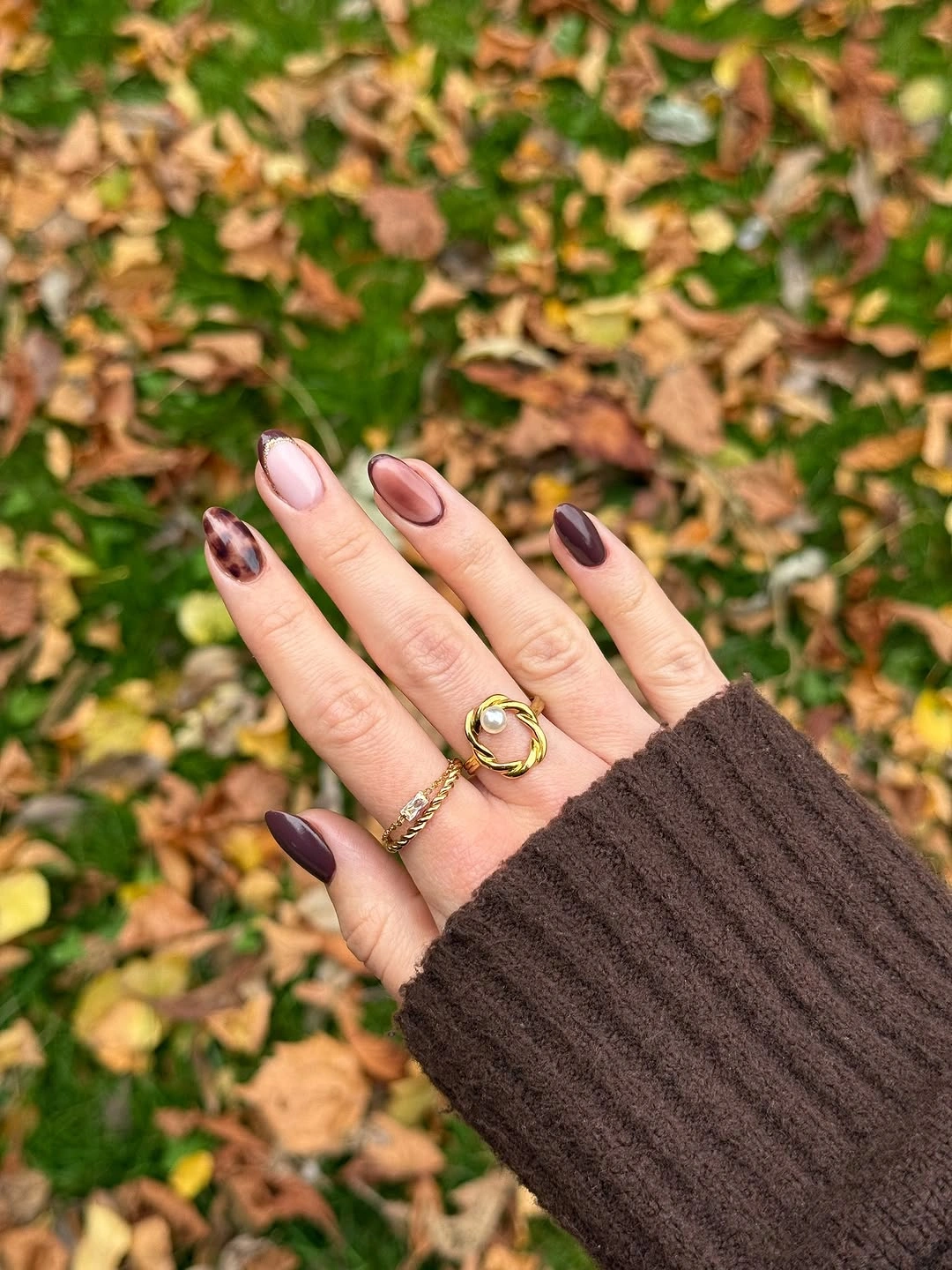
The outlined accent is especially sensitive to shape because its lighter margin follows the almond perimeter. On the micro-tipped nail, the dark arc occupies only the point, preserving a long blush center. Tortoiseshell breaks the geometry with irregular cream and dark patches, but shared undertones keep it inside the same story.
This longer set should not be treated as a direct short-nail template without editing the scale. A shorter version would need either the outline, the tip, or the tortoiseshell accent simplified so each element retained breathing room. At this length, edge wear on the fine tip and perimeter outline would change the design sooner than wear on the solid chocolate nails.
Amber Tortoiseshell on Very Short Squares
Amber, caramel, and near-black patches cover every very short square nail in this tortoiseshell set. The warm areas appear translucent, while the deepest shapes gather unpredictably near sidewalls, tips, and centers. No two nails share the same map, yet the compact straight edges contain the organic movement.
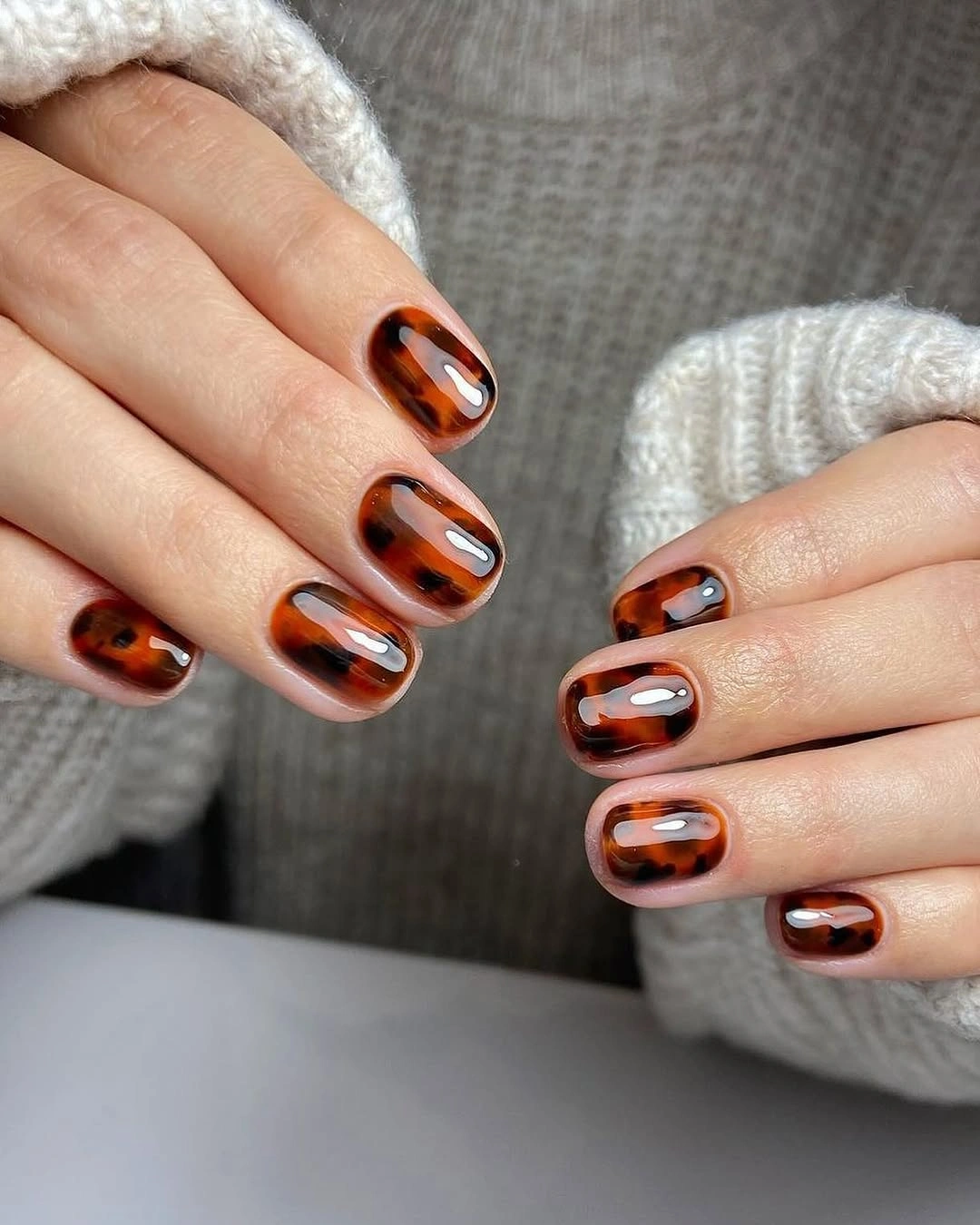
Broad patches are what make the pattern successful at this length. Tiny speckles would lose the translucent amber intervals, but these larger dark fields leave enough warm color to create depth. High gloss lays clear reflections over the irregular pattern without erasing its boundaries.
The broken surface has a practical advantage because a small chip may blend more easily into the uneven color than it would on a solid dark nail. Straight free edges still need attention, especially where a black patch meets the tip and makes the silhouette look heavier. For a short adaptation, the scale is already right: a handful of large shapes works better than an attempt to reproduce every possible tortoiseshell mark.
One Berry Branch Against Muted Plum
Four very short nails use a muted plum solid, then the ring finger opens into a pale blush base with one dark berry branch. The stem crosses the lower half diagonally and carries small paired leaves in a brighter magenta. Most of the accent remains bare-looking, allowing the compact botanical detail to stand alone.
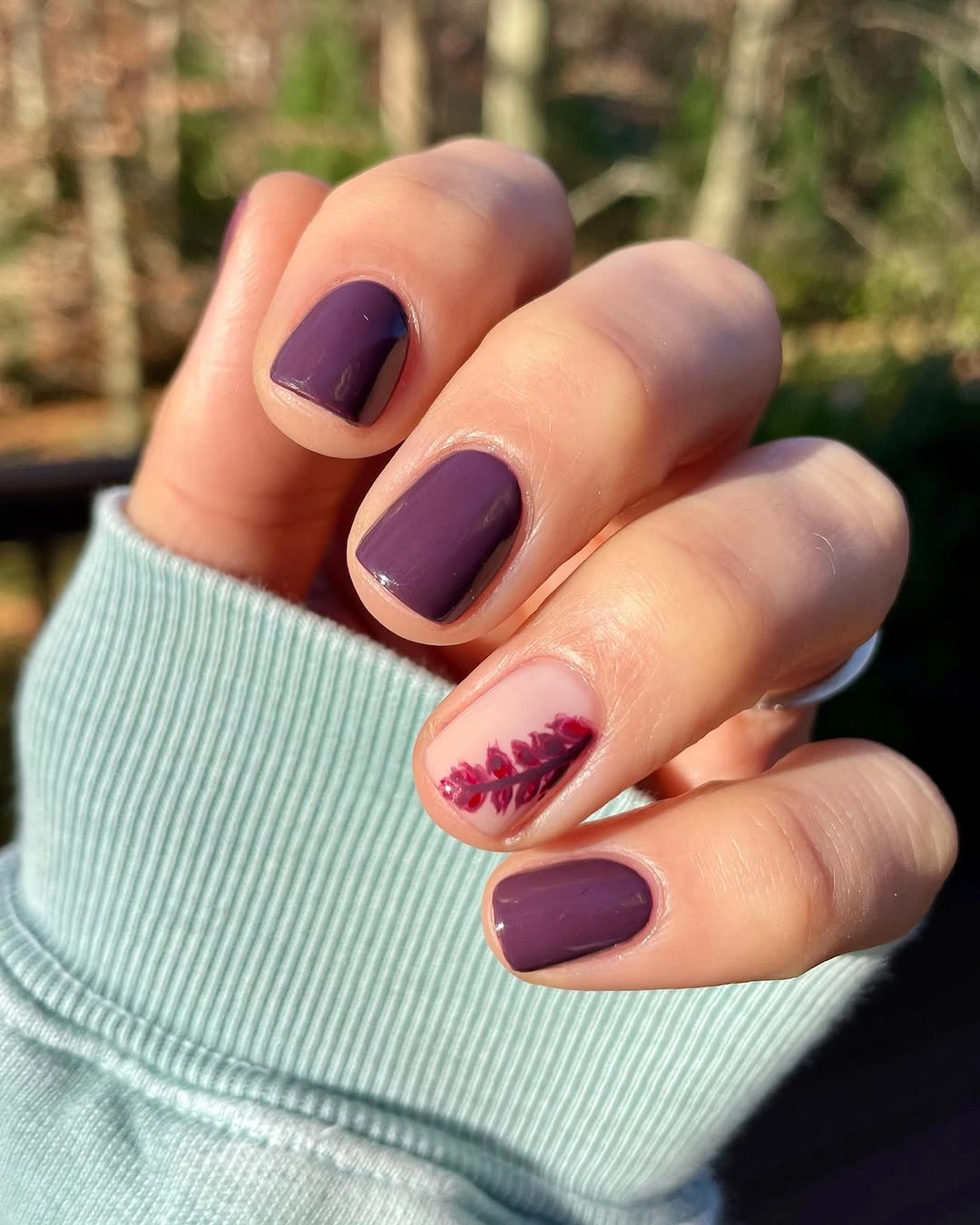
Direct sunlight exposes the purple undertone in the solid nails and the redder character of the leaves. That small color difference keeps the branch visible without introducing a disconnected hue. Its diagonal route avoids both a rigid central stripe and a crowded cuticle cluster.
One branch is enough for a nail this short, and adding a second would consume the blush breathing room that gives the motif definition. The art begins near a lower corner but does not run along the entire free edge, so slight tip wear may leave most leaves intact. Solid plum on the remaining fingers keeps maintenance straightforward and gives the single accent greater authority.
Oversized Brown Checks With Scattered Flowers
Large chocolate-and-beige checkerboards alternate with sheer blush nails carrying four-petal flowers in brown, rust, and tan. Only a few checker rows fit across each medium oval nail, which keeps every square broad and unmistakable. The floral nails use the same palette but release it from the grid, placing petals near different sides and tips.
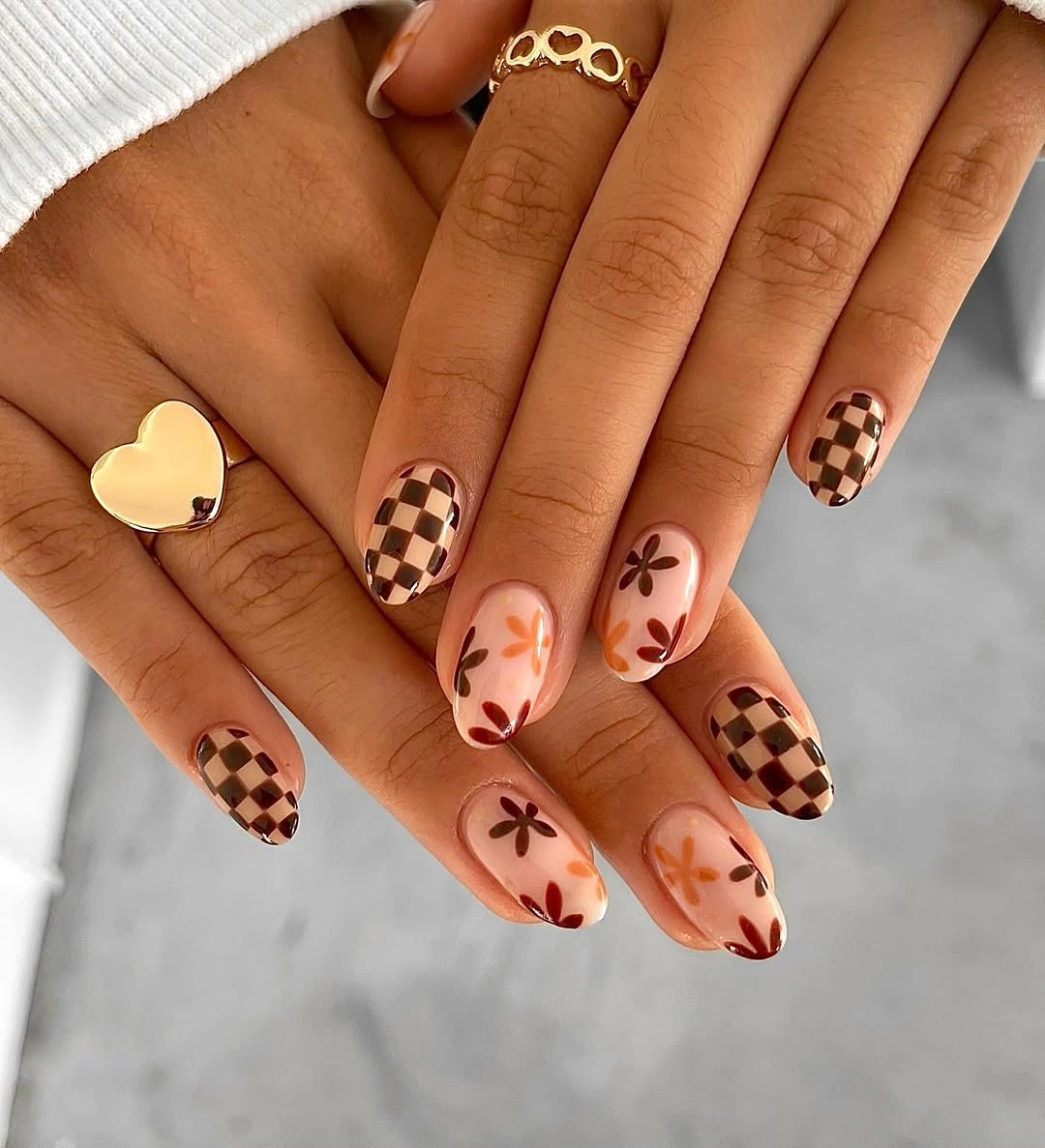
Geometry and looseness trade places from finger to finger. The checks meet cleanly at their corners, while the flowers turn in several directions and sometimes enter from the edge. Repeated colors prevent that contrast from splitting the manicure into two unrelated themes.
These nails have medium oval length, so a very short version would benefit from even fewer checker squares and perhaps one flower per nail. Petals that touch the free edge will be the first part of the artwork affected by wear, whereas a central check can survive a small tip change. The alternating rhythm deserves to remain because it distributes demanding detail rather than stacking checks and flowers on the same surface.
Dark Olive With Cloudy Gold-Lined Accents
Very dark olive solids alternate with pale cloudy accents on short square nails. The light nails contain translucent ivory and soft green patches, then a thin gold-colored line crosses each one near the middle. A precise horizontal divider gives structure to the irregular color underneath.
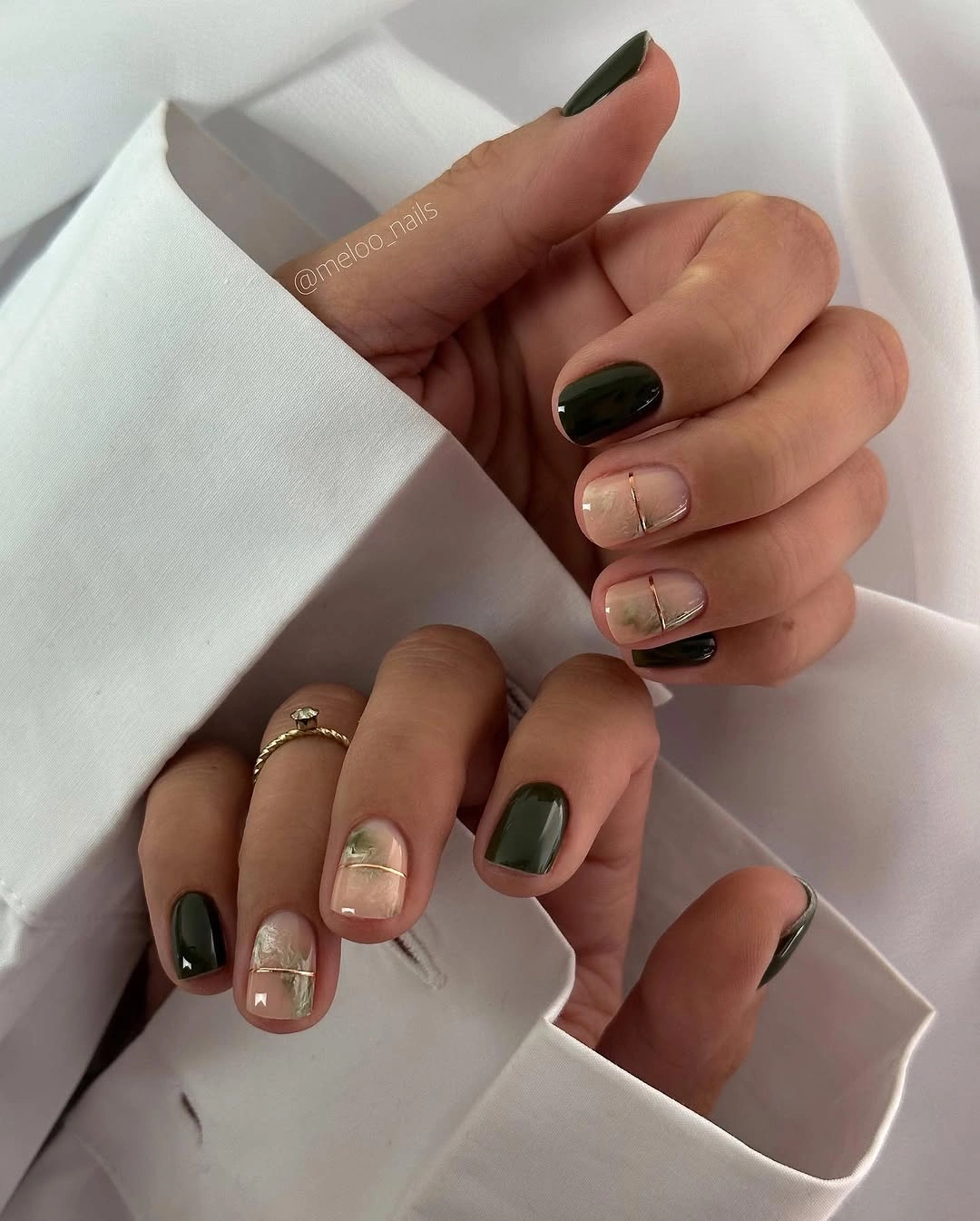
The accents have a pearly-looking sheen, but their visible interest comes from shifting pale patches rather than any identifiable material. Olive solids provide dark pauses and repeat the green haze buried inside the lighter nails. Across both hands, alternating placement prevents the fine line work from becoming a continuous stripe.
A single straight line is enough to organize each compact accent without covering the cloudy surface. Scratches or gaps would be noticeable along such a narrow feature, so that seam is the maintenance point to watch. The short square perimeter is otherwise practical, and its straight tips quietly echo the gold-colored crossbars.
Chocolate Waves Inside Straight Square Tips
Solid chocolate nails sit beside translucent blush nails divided by broad curved brown fields. One accent concentrates color at the tip, another carries a sweeping band through the middle, and the thumb places brown along an opposing edge. Medium square tips frame those soft boundaries with a clearly straight outer line.
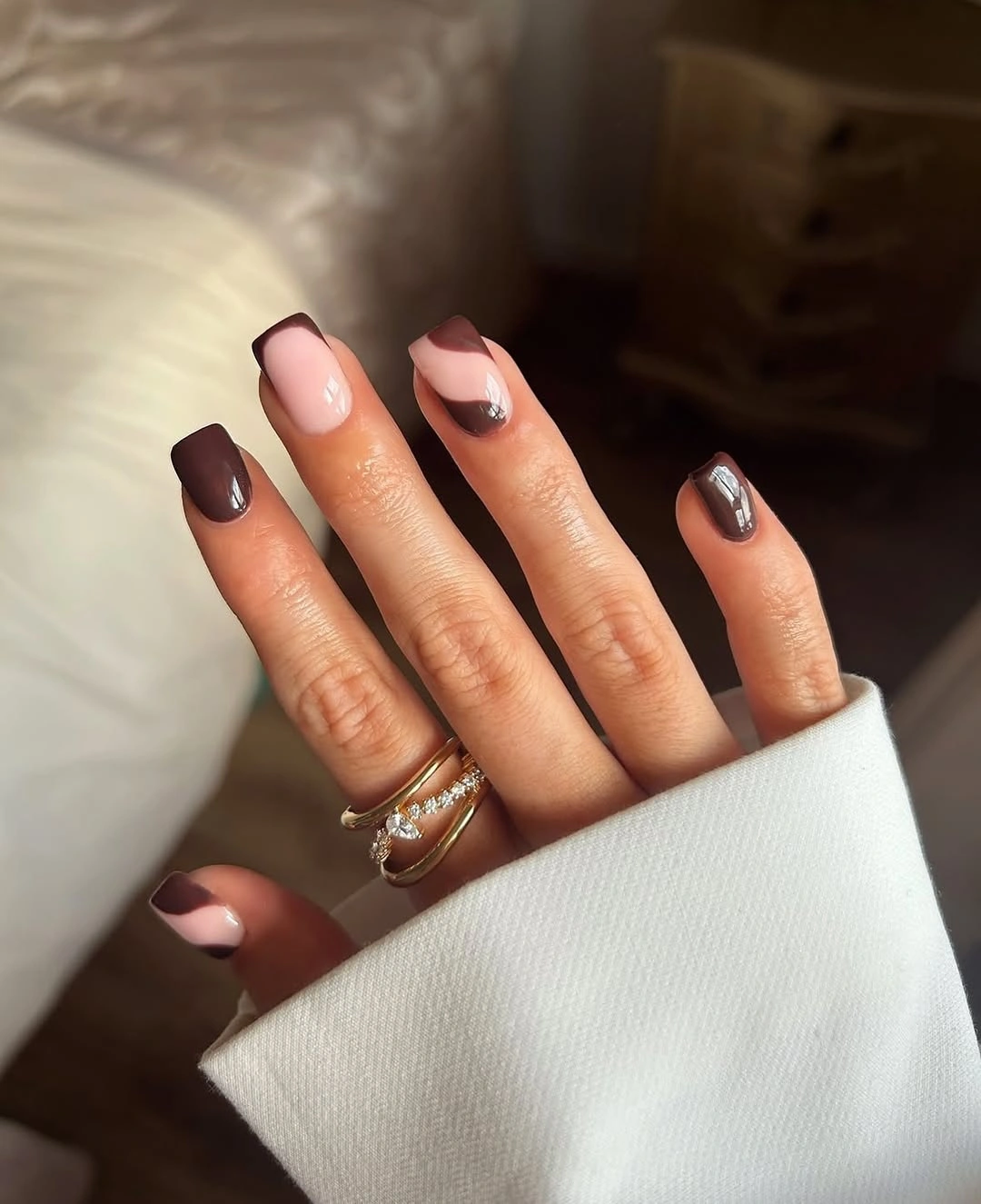
The contrast between curved interior blocks and angular edges creates the design without any fine illustration. Repeating one chocolate shade at full coverage and partial coverage makes the asymmetry feel planned. Gloss further clarifies the blush openings, which vary in size but never disappear completely.
Brown placed directly across some free edges will expose chips faster than the blush portions. The broad curves themselves are more forgiving than thin lines because a tiny surface mark is less likely to break the entire path. A shorter-square translation should preserve one large wave per accent and remove any extra bend that narrows the remaining blush space.
Near-Black Squares With Botanical Corner Accents
Most nails are glossy near-black brown, while one accent on each hand opens to a translucent blush base. A dark lower corner curves upward across the accent and meets a narrow copper-gold sparkling seam. From that corner, a fine black leafy sprig reaches into the pale area.
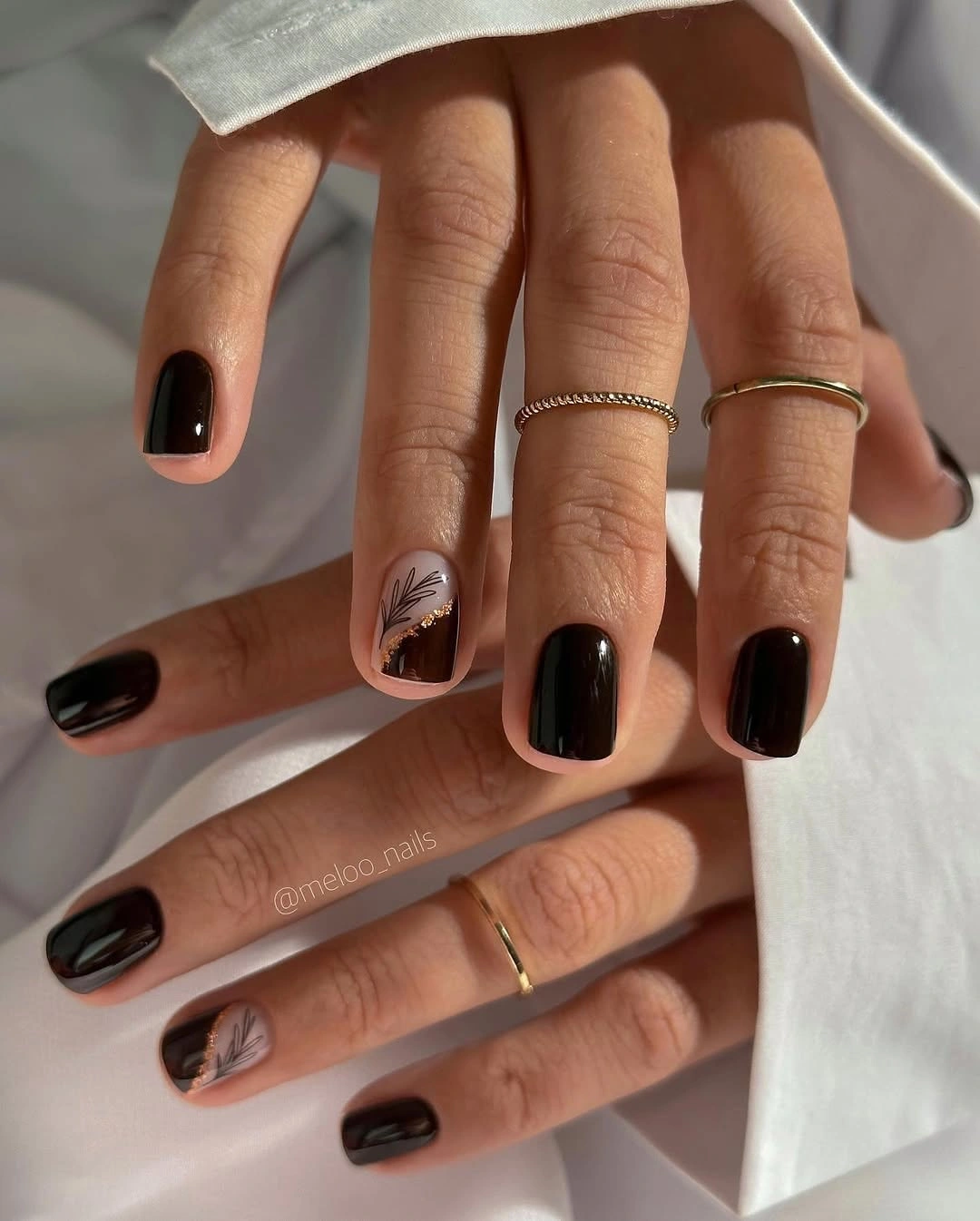
Three visual weights are carefully separated: the broad dark block anchors the tip, the bright curved seam marks its border, and the branch occupies open space with hairline strokes. Repeating the near-black color on the other short rounded squares prevents the accent corner from looking isolated. The branch remains slender enough that individual leaves do not merge.
Fine line work on only two nails keeps detailed maintenance contained. A chip at the dark accent corner could disturb both the color block and its sparkling boundary, while the branch higher on the nail would likely remain readable. I would protect the open blush region from extra decoration, since its emptiness is what lets the tiny botanical structure breathe.
Matte Olive Dots on Very Short Nails
Muted olive-gray covers every very short softly squared nail, and small white dots scatter across the full set. The dots are spaced loosely enough that the dark base remains dominant. Slight changes in dot size and distance keep the all-over pattern relaxed instead of turning it into a rigid grid.
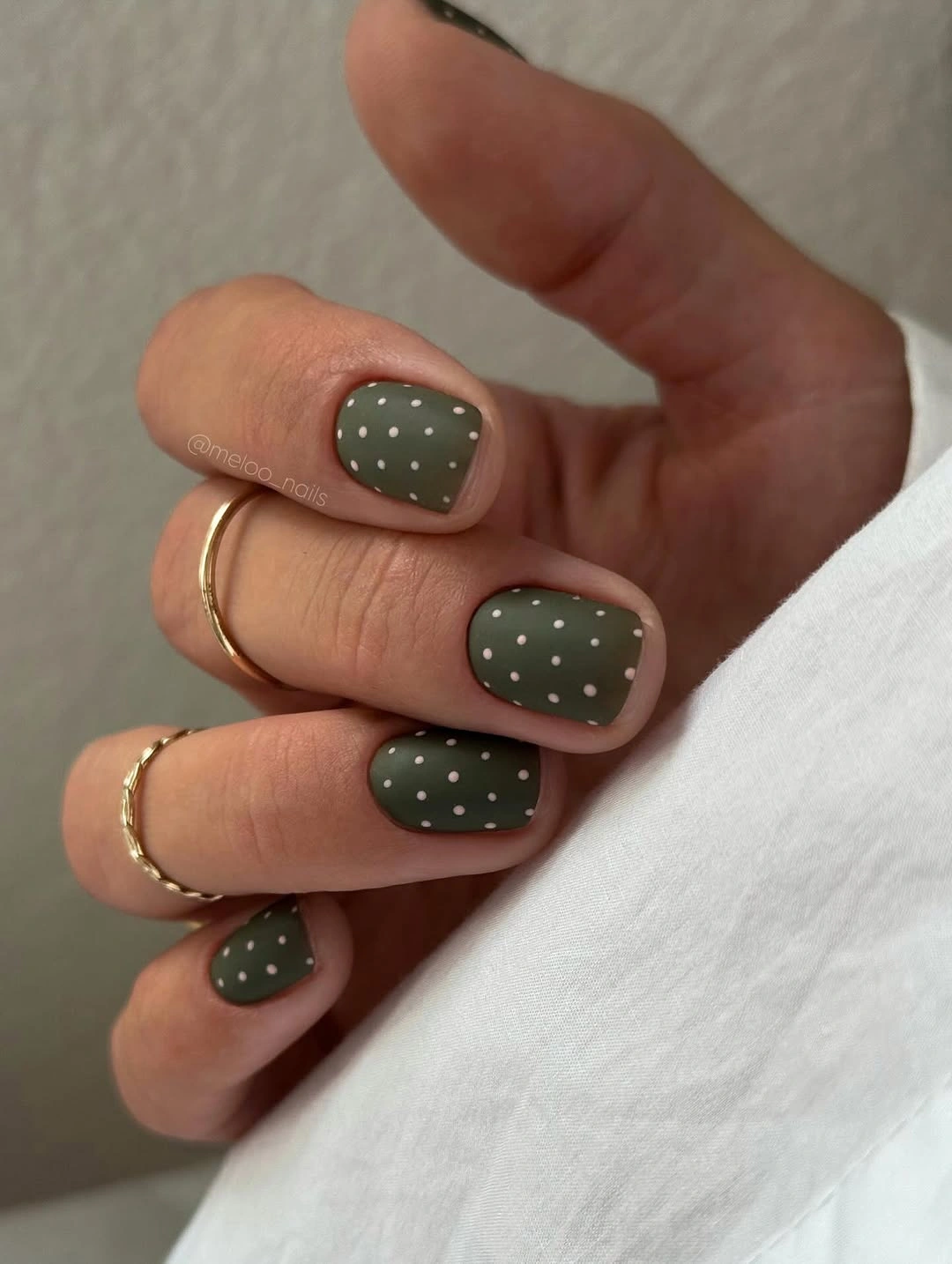
A matte surface removes strong reflections that might compete with such tiny pale marks. Each dot therefore reads as a distinct point, even on the little nail where the available area is especially limited. Several dots approach the perimeter, but none creates a continuous border around the short shape.
Scattered points can disguise minor surface scuffs better than an empty matte field, although missing color at the tip would interrupt any edge-adjacent dots. The clipped length and softened corners remain practical for daily wear. Restraint comes from spacing rather than motif count, and that distinction is why the pattern looks clear instead of busy.
Pastel and Burgundy Squares With Tiny Hearts
Pale blue, blush pink, olive, and burgundy occupy separate medium square nails, each marked by one contrasting heart. The hearts sit near the centers with plenty of solid color around them. Straight free edges extend modestly beyond the fingertips, giving the motifs more breathing room than the shorter rounded heart set.
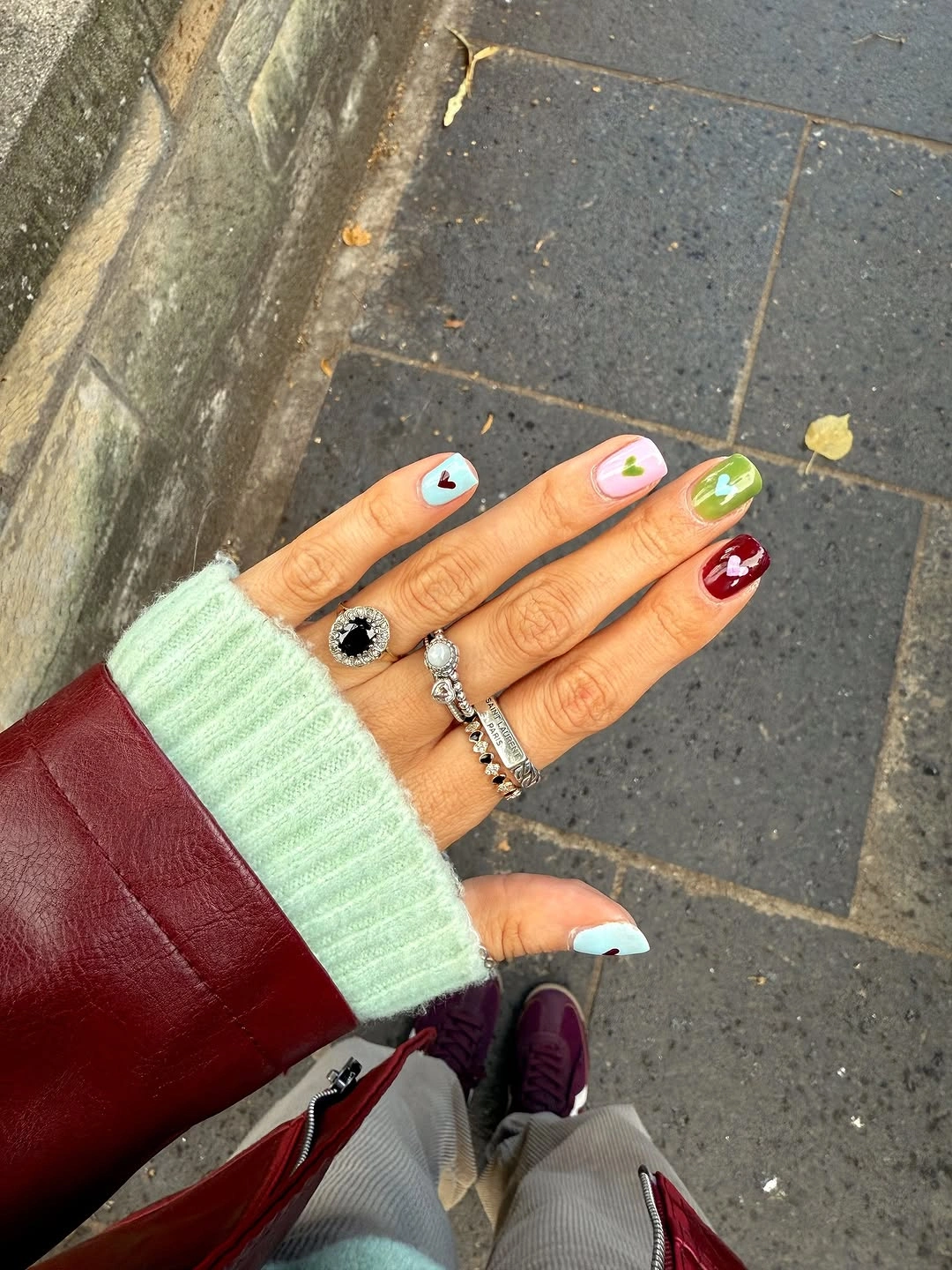
Color repetition provides the connection: burgundy appears as both a base and a small heart, while pale blue and olive exchange roles elsewhere. The blue heart on the olive nail tilts slightly, adding movement without changing the single-symbol rule. Outdoor light makes the pastel fields brighter and the burgundy edge more emphatic.
Medium square length gives edge wear more room to develop than a close-cropped version, and the burgundy tip will show it most clearly. Since every heart is centered, ordinary wear should leave the artwork intact until damage moves well beyond the free edge. The placement demonstrates a useful scale choice: keep the emblem small even when more surface is available, then let the contrasting base carry the rest.