Fall nails with pumpkins can be playful without turning every surface into a crowded seasonal scene. The most wearable sets use a clear order: a solid warm color does the daily work, a pale nail gives the small illustration room, and one or two icons supply the autumn signal. Looking at the length and placement first makes it easier to decide which details are worth keeping for your own routine.
These designs move from quiet pumpkin accents to more expressive collections with plaid, glitter, leaves, and small Halloween-adjacent marks. Treat each one as a styling idea rather than a rule. Keep the visual feature that makes you smile, simplify the supporting details when needed, and pair the stronger colors with clothing that lets the manicure stay intentional instead of competing with it.
Tiny Pumpkins on a Warm Shimmer Base
Short rounded nails use a warm gold shimmer with brown and pale nude areas, then place tiny orange pumpkins and leaf marks on selected nails. The seasonal icons stay small, so the repeated glow remains the main surface and the pumpkins act as little interruptions. The compact shape helps the design feel friendly rather than overly illustrated.
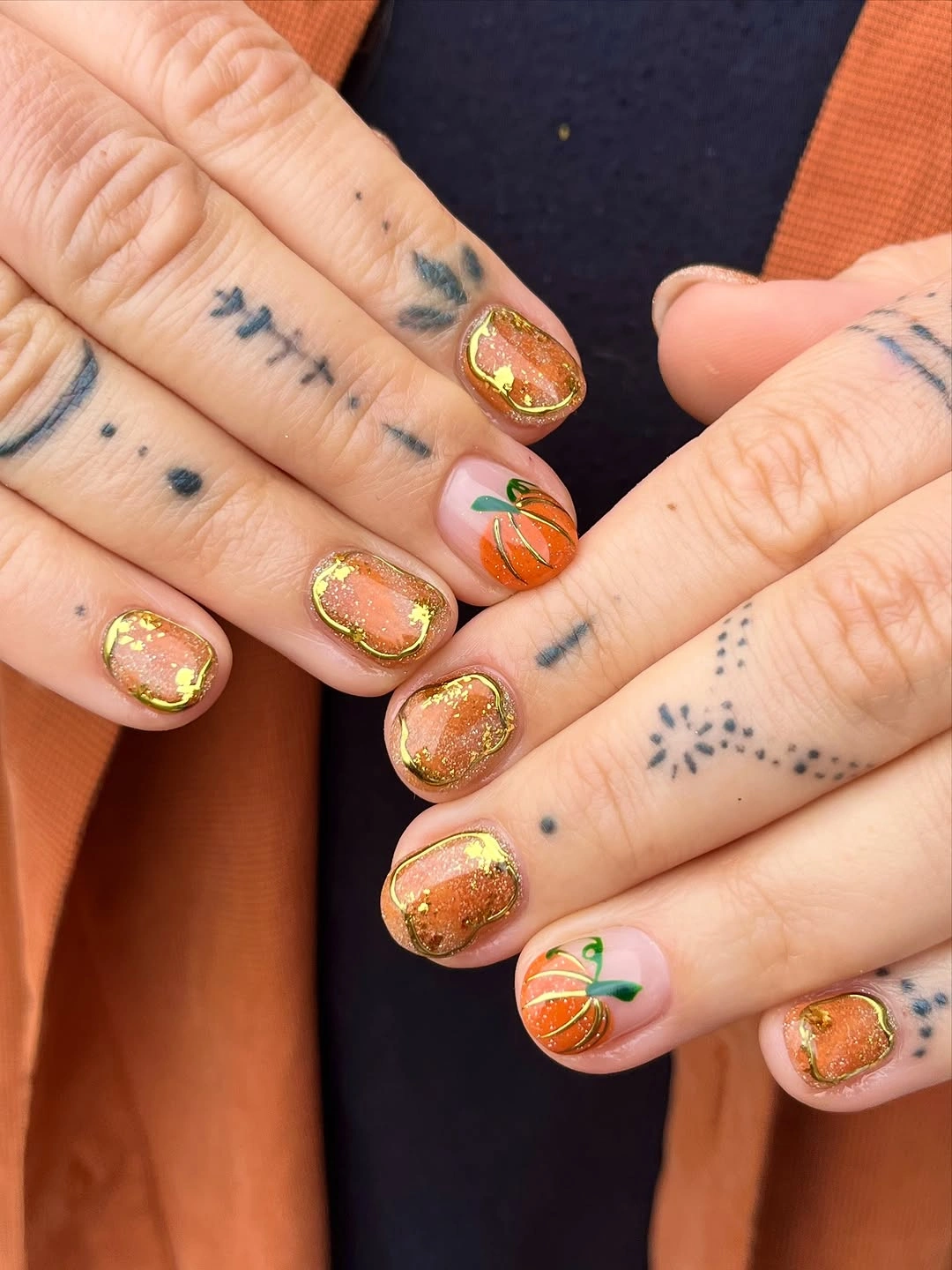
For an everyday version, keep the shimmer on most nails and use one pumpkin accent instead of repeating the icons across the hand. A brown or nude solid can replace another patterned surface without losing the fall connection, while the tiny leaf mark can be reduced to a dot or short curve. This edit lowers maintenance and keeps the motif readable.
The palette is easy to pair with cream sweaters, denim, warm brown, or a small orange accessory. Gold adds light without demanding a fully dressed-up outfit, and the orange pumpkin gives the neutral base a clear seasonal reason. The look works best when the pumpkin remains a detail inside the color story, not the only thing the eye sees.
Blush Pumpkins with Plaid and Glitter
Medium almond nails combine blush pink bases with orange pumpkins, warm plaid-like panels, and gold glitter. The pale surface gives the icons and lines room to breathe, while the plaid repeats the same orange-brown family so the set feels collected rather than random. Glitter adds a bright pause between the illustrated roles.
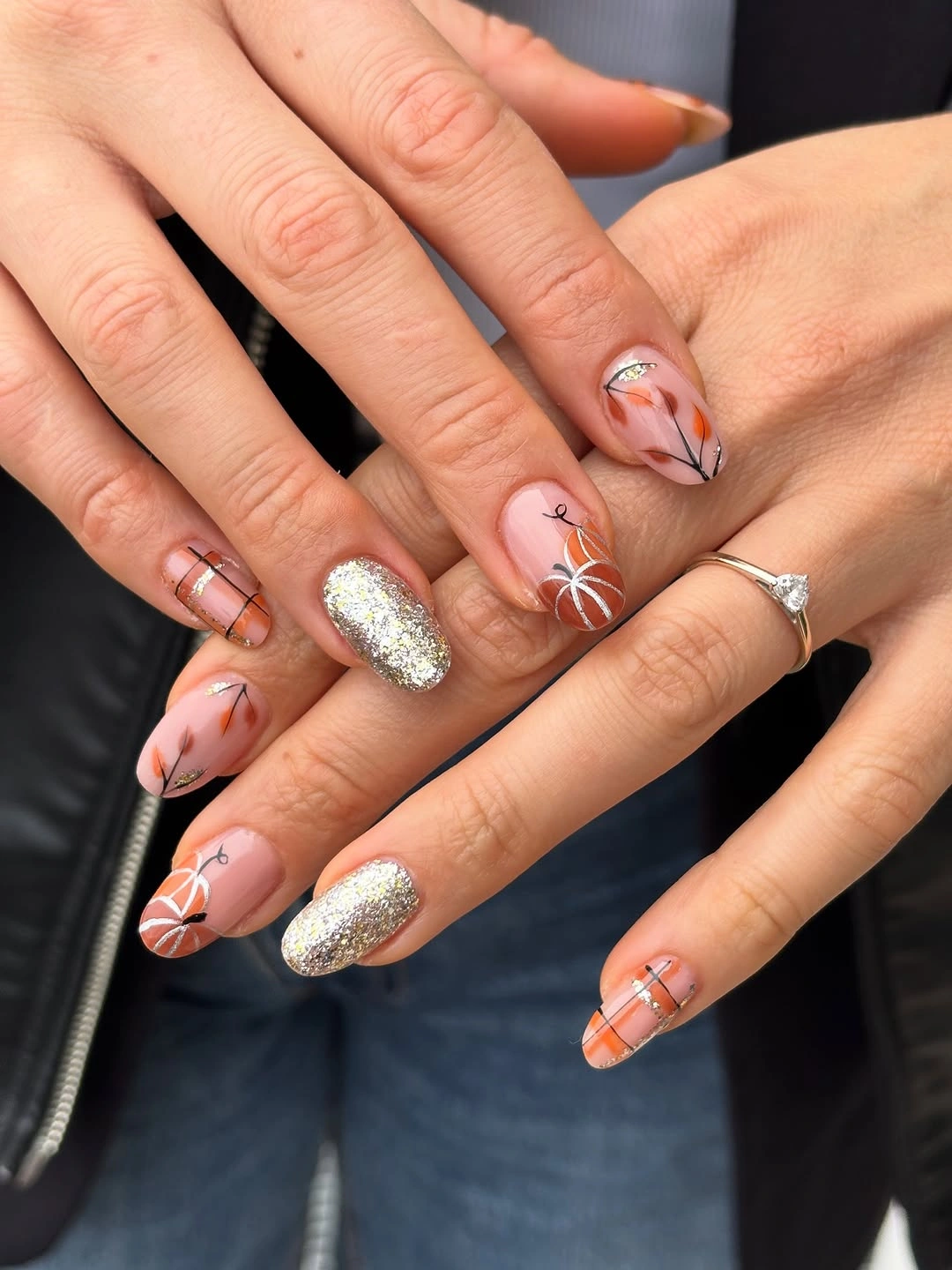
If you want a calmer version, keep the blush base, one pumpkin nail, and either the plaid or glitter. Choosing one supporting accent makes the idea easier to repeat and gives the pumpkin a clearer place in the arrangement; using both patterns everywhere would make the almond length feel busier than it needs to be. A warm brown line can stand in for a full plaid panel.
This direction suits a reader who wants a recognizable fall manicure with a soft background. Blush works with cream, tan, and denim, while orange and gold can be echoed in a scarf or small accessory without requiring a matching outfit. The design stays approachable because the seasonal detail is surrounded by pale space.
Pale Squares with Pumpkins and Curved Stripes
Medium square nails alternate pale bases with orange pumpkins, curved stripes, and copper-like glitter. The orange and copper surfaces supply the strongest blocks, while the illustrated nails carry smaller seasonal signals across a lighter field. The broad square shape makes the stripe direction easy to see and keeps the pumpkin from disappearing at the edge.
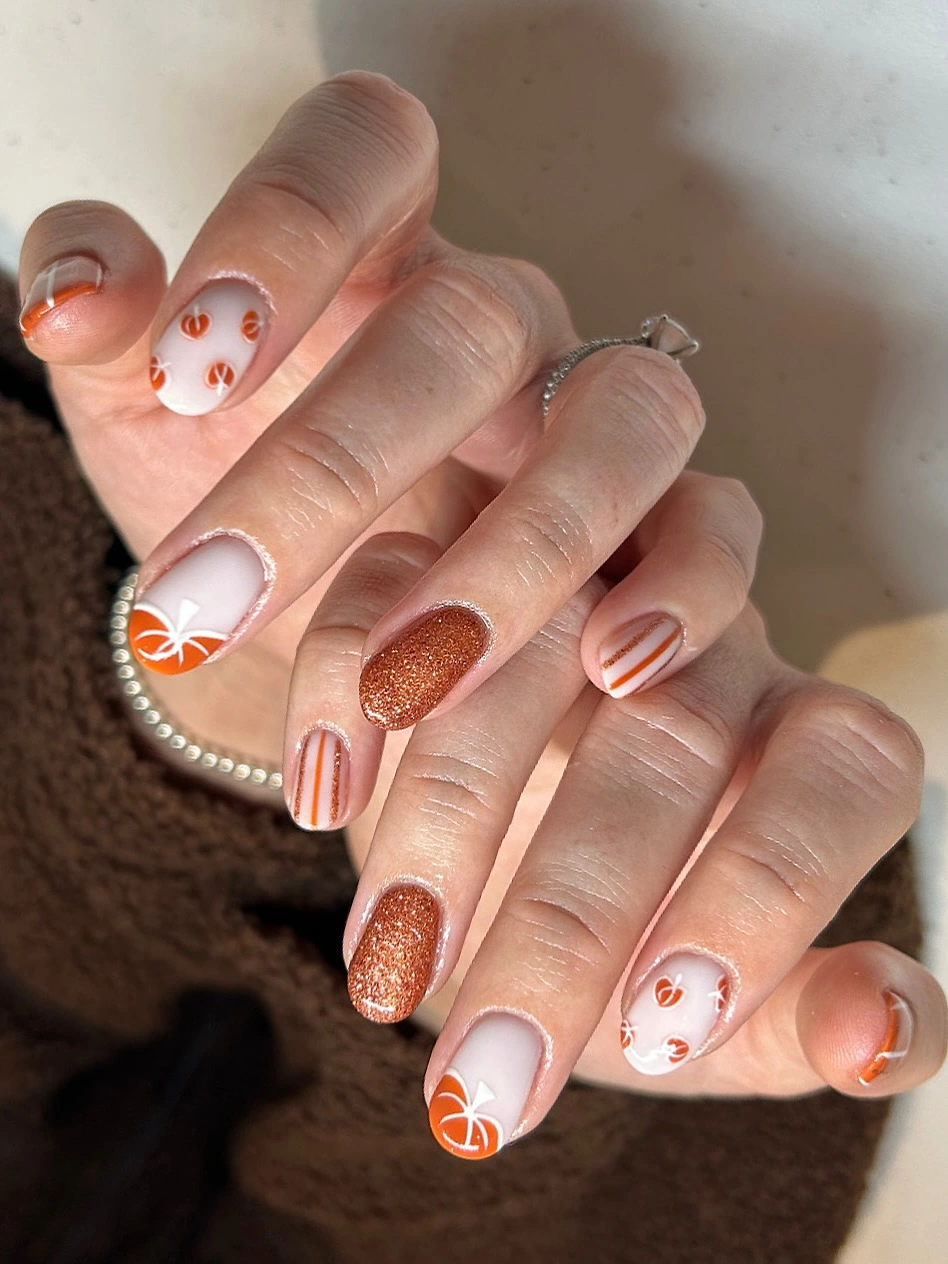
For a shorter square, use one curved stripe or one pumpkin rather than stacking both details on the same small surface. The glitter can stay on a single accent because its job is to repeat warmth, not to become a second pattern. Keeping the pale base visible is the simplest way to preserve the open composition.
This set works with warm neutrals, rust, brown, and a muted cream wardrobe. Copper brings a softer glow than bright yellow gold, so the result can feel seasonal without looking like a party-only choice. The design is most useful when the stripes guide the eye and the pumpkin provides the recognizable point of focus.
Bright Yellow with Pumpkin Line Art
Long almond nails use bright yellow, orange, white, and glitter, with a pale illustrated nail carrying pumpkin and seasonal line art. Yellow is the dominant color, so the design reads as cheerful before the smaller marks become visible. The white panel gives the illustration a clear field while the glitter adds another warm reflection.
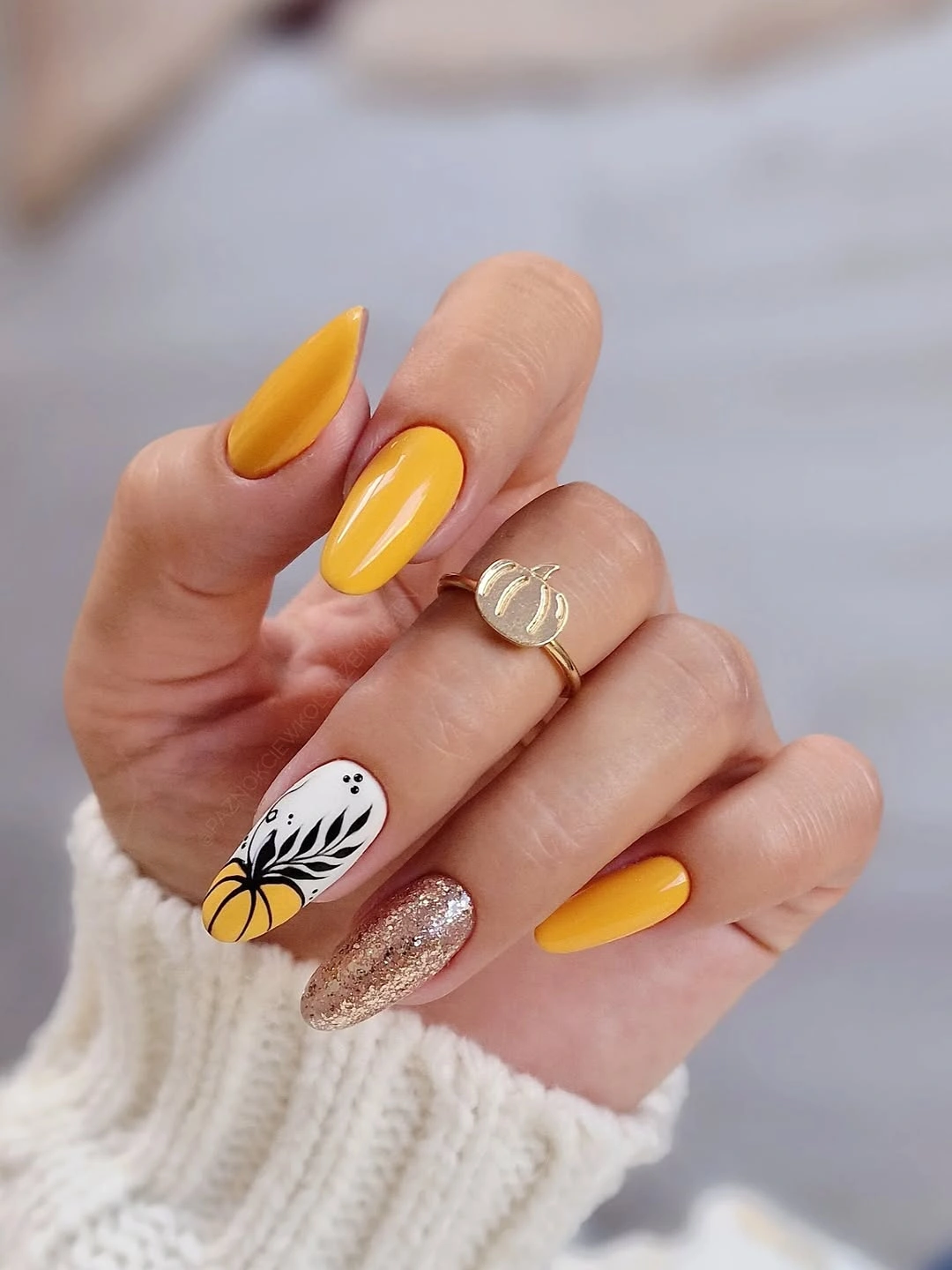
To make the idea easier to wear, keep the yellow on two or three nails and move the pumpkin drawing to one pale accent. A medium almond shape can hold the same line art with less length, but adding more symbols would compete with the strong yellow block. Let the bright color remain the personality of the set.
This is for someone who wants fall nails with pumpkins to feel sunny rather than muted. It pairs well with denim, cream, camel, and small black details, while the orange keeps the yellow from looking disconnected from the season. The design has energy because the illustrated nail supports the color instead of trying to replace it.
Mustard, Brown, and Cream Pumpkin Details
Medium almond nails mix mustard, brown, glitter, and cream accents carrying pumpkin and leaf lines. The warm solids create the main color map, and the cream nails hold the small illustrations without making them compete with the darker surfaces. The repeated earth tones make the set feel cohesive even though the motifs vary slightly.
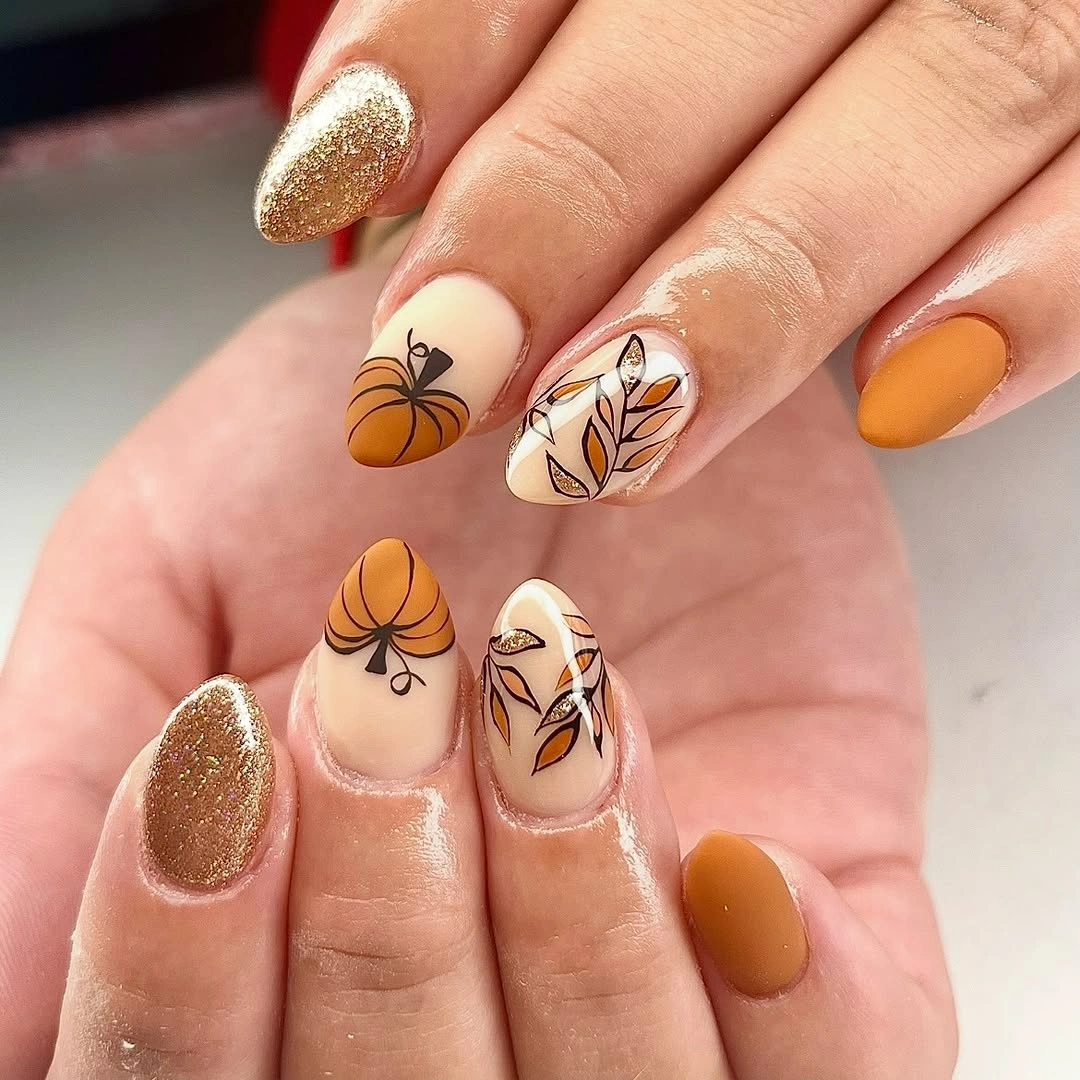
For a simpler adaptation, keep mustard and brown as the two solid anchors, then use one cream nail with a pumpkin or leaf mark. If glitter already supplies enough light, it can replace another illustrated nail; removing one detail creates a clearer hierarchy without changing the palette. This is a practical way to reduce visual effort while keeping the seasonal idea obvious.
The color combination works beside oatmeal, chocolate, olive, and denim. Mustard gives the hand warmth, brown adds depth, and cream prevents the set from becoming too dark. The pumpkin detail feels natural because it grows out of colors already present in the solids, so no extra seasonal color is required.
Orange and Copper with Tiny Gold Accents
Long almond nails alternate orange, copper, and nude surfaces with tiny gold details placed near the center or tip. The dominant orange does most of the seasonal work, while the small marks add a little structure without covering the nail. The long silhouette makes the warm color feel expressive, but the design remains focused because the accents are limited.
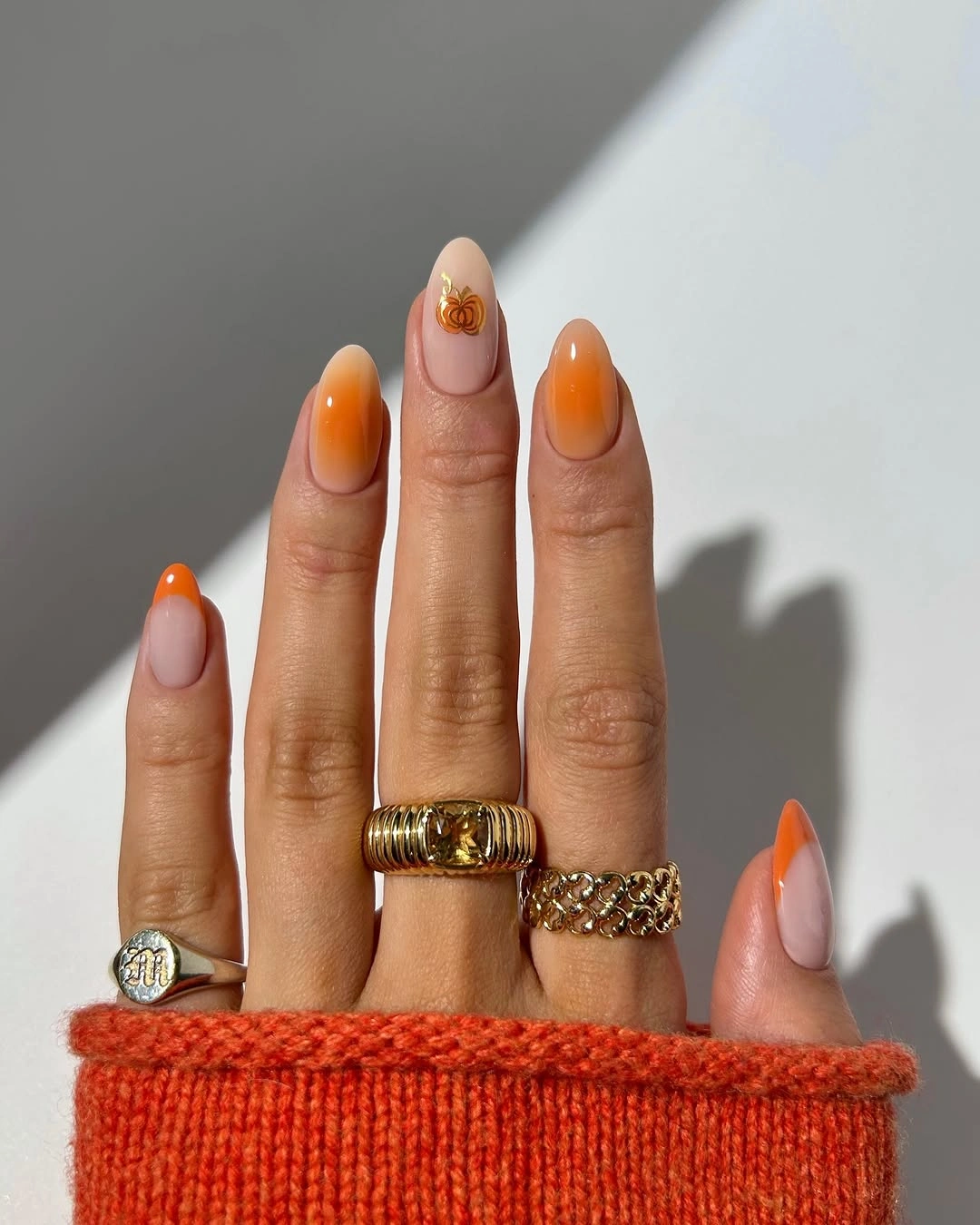
A shorter version can keep orange on two nails, nude on the rest, and one small gold mark as the bridge. The copper does not need to become a full patterned panel; its value is in creating a neighboring warm tone that keeps the orange from looking flat. Use the smallest accent that still remains visible.
This is an uncomplicated palette for sweaters in cream, brown, black, or dark green. Orange brings brightness, copper adds depth, and nude gives the hand a pause that makes the stronger color easier to wear. The set reads as autumnal through temperature and placement before the tiny pumpkin reference is even noticed.
Orange Shimmer with Small Pumpkin Accents
Short square nails use orange shimmer as the repeated surface and place small pumpkin accents on pale pink or warm brown areas. The shimmer is the first visual feature, while the pumpkins give the compact manicure a clear theme without filling every nail with art. The square shape makes the repeated color feel neat and stable.
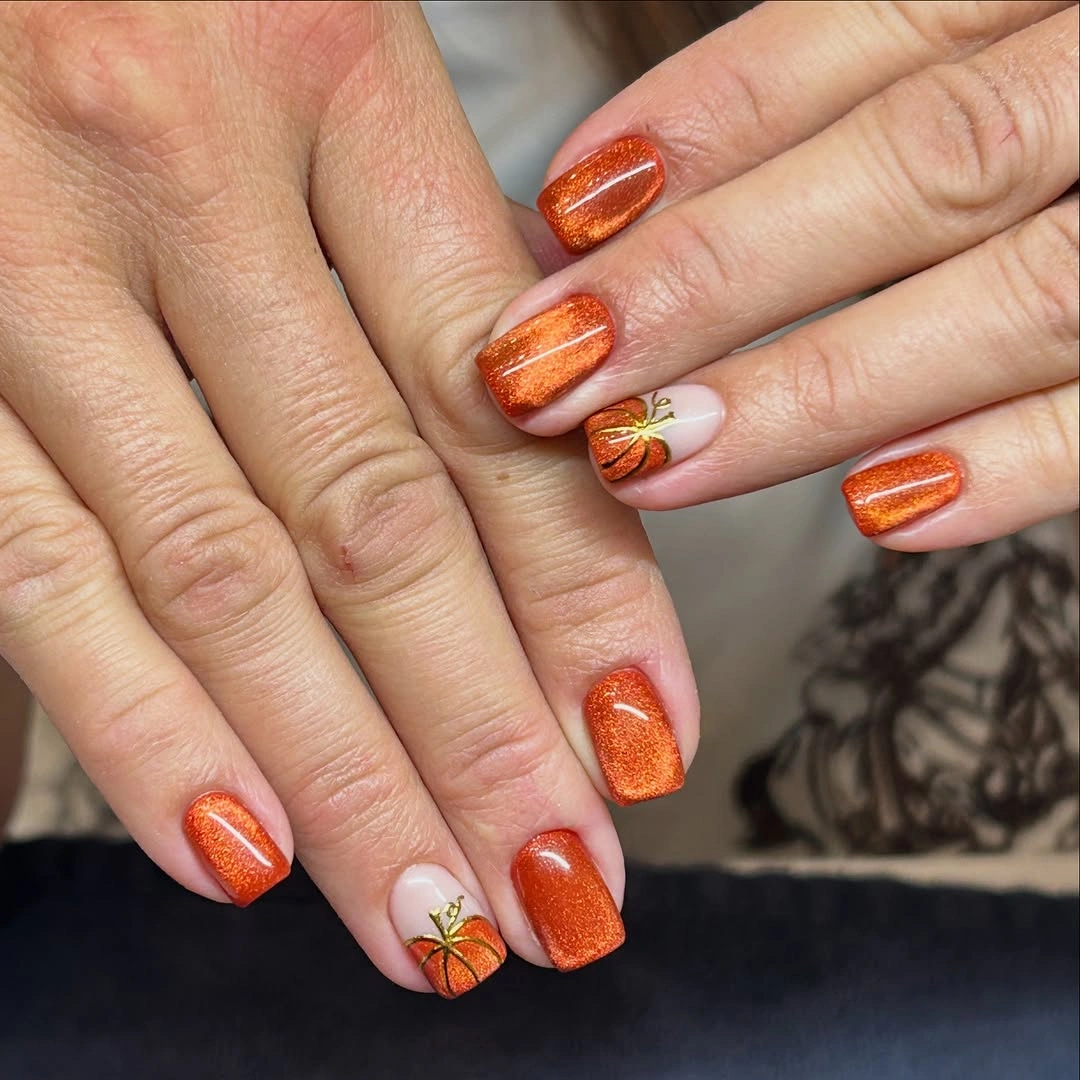
For a low-detail version, keep the orange shimmer on most nails and use one pale accent with a single pumpkin. A warm brown solid can replace a second icon panel, and the shimmer can remain light enough to show the outline of the nail. The goal is a small seasonal signal that survives daily styling.
This set pairs easily with denim, black, cream, and tan because the orange does not depend on a complicated palette. The reflective surface gives the hand interest even when the icon is tiny, so the manicure does not feel unfinished after simplifying it. The pumpkin is most successful when it is allowed to be small.
Pink Pumpkins, Ghosts, and Tiny Stars
Short squoval nails use pink bases with orange pumpkins, white ghost-like icons, and small stars. The open base gives each mark a little room, while the mixed symbols create a playful edge beyond a single pumpkin theme. The compact shape keeps the collection approachable and prevents the icons from becoming a long illustrated story.
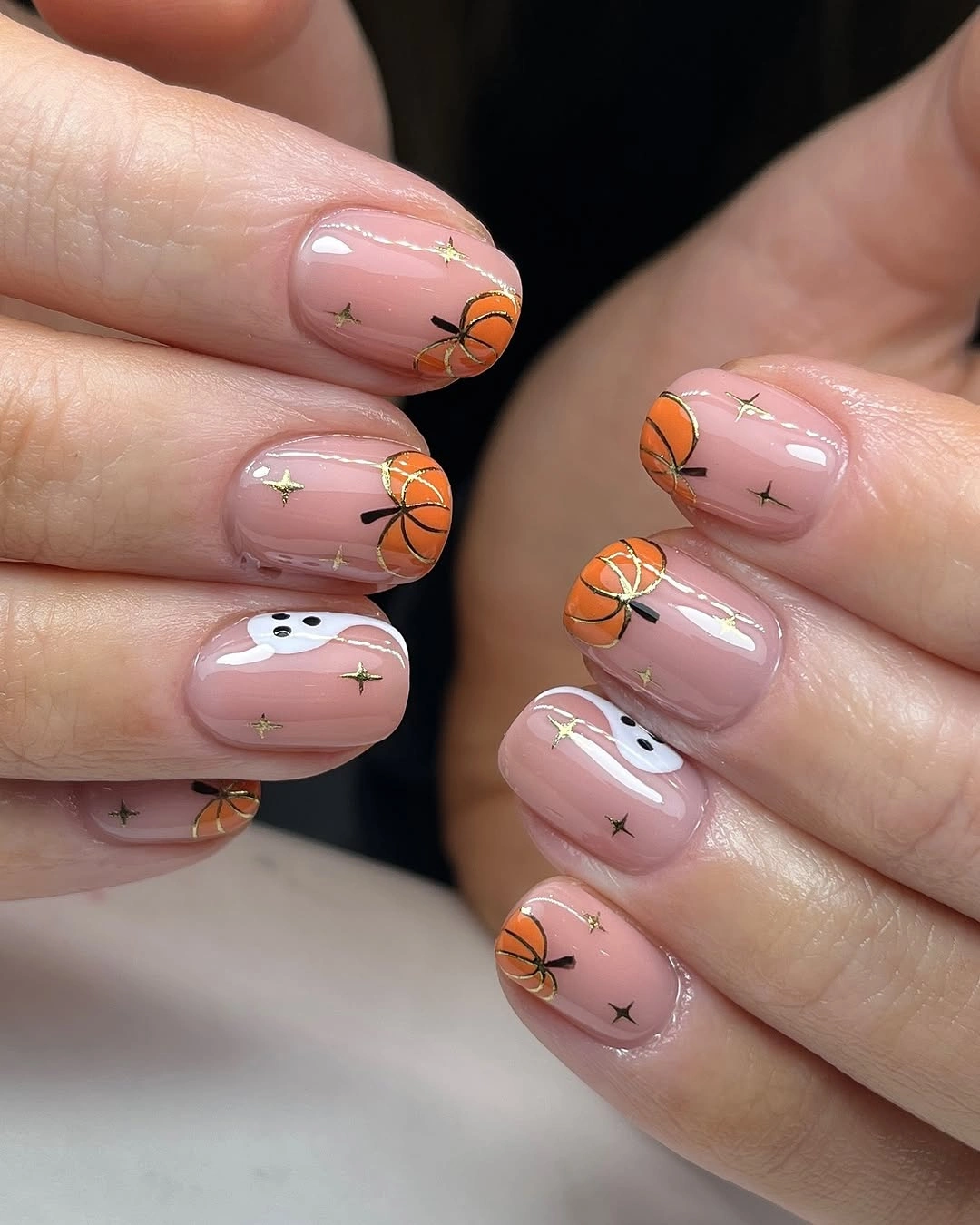
If you want the set to feel less busy, choose pumpkins and stars or pumpkins and ghost-like faces, rather than keeping every symbol. Pink can remain the main surface, and one gold or white mark can repeat across the accents to make the reduced palette feel intentional. Removing an icon is more useful than shrinking all of them.
This direction works with casual layers, pale sweaters, denim, and small orange accessories. The pink base softens the Halloween-adjacent marks, so the result feels playful instead of dark. It is a good example of how a clear background can hold several ideas when each one stays small and separately readable.
Colorful Pumpkin Borders at the Tips
Long almond nails use sheer pink bases and concentrate orange, yellow, green, and red floral-pumpkin-like clusters near the tips. The color is treated as a border rather than full coverage, leaving the center open and making the long silhouette part of the composition. The clusters feel seasonal because several warm details gather in one controlled area.
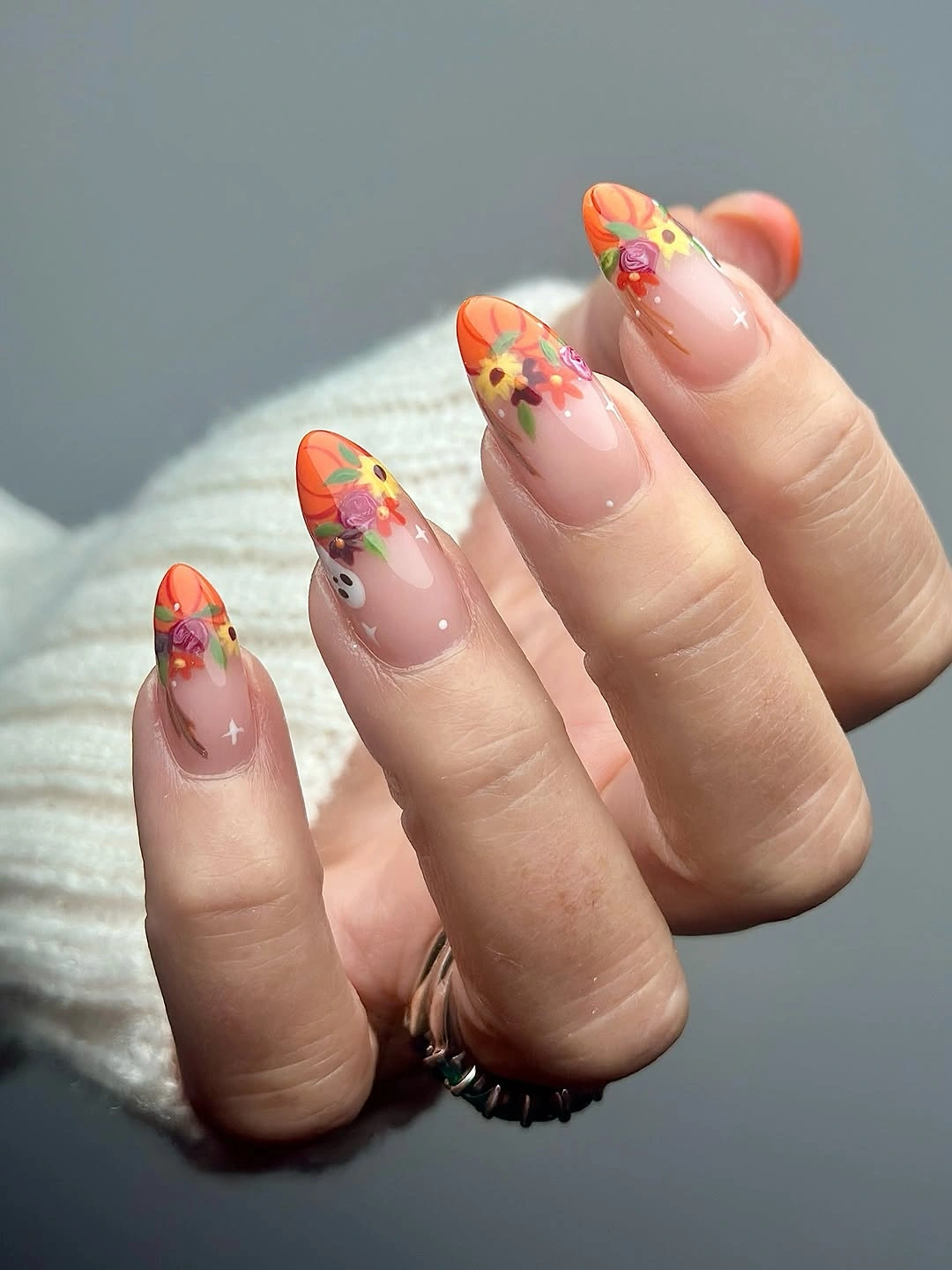
For a shorter adaptation, limit the tip border to orange and one supporting color, such as green or yellow. The open pink base should remain visible, because adding marks down the entire nail would remove the lightness that makes the design work. A two-color border is easier to pair and easier to keep legible.
This is a more expressive choice for readers who want color at the edge without covering the whole hand. Sheer pink pairs with cream, gray, denim, and warm brown, while the tip cluster can pick up a single accessory color. The idea feels festive through concentration, not through the number of different marks.
Pale Pink Pumpkins with Gold Leaves
Long almond nails place orange pumpkins and fine gold leaf accents over pale pink bases, with the warm details kept separate enough to read clearly. The gold marks add a delicate layer around the pumpkin shapes without turning the entire nail into a metallic field. Pale pink remains the main surface and keeps the seasonal story light.
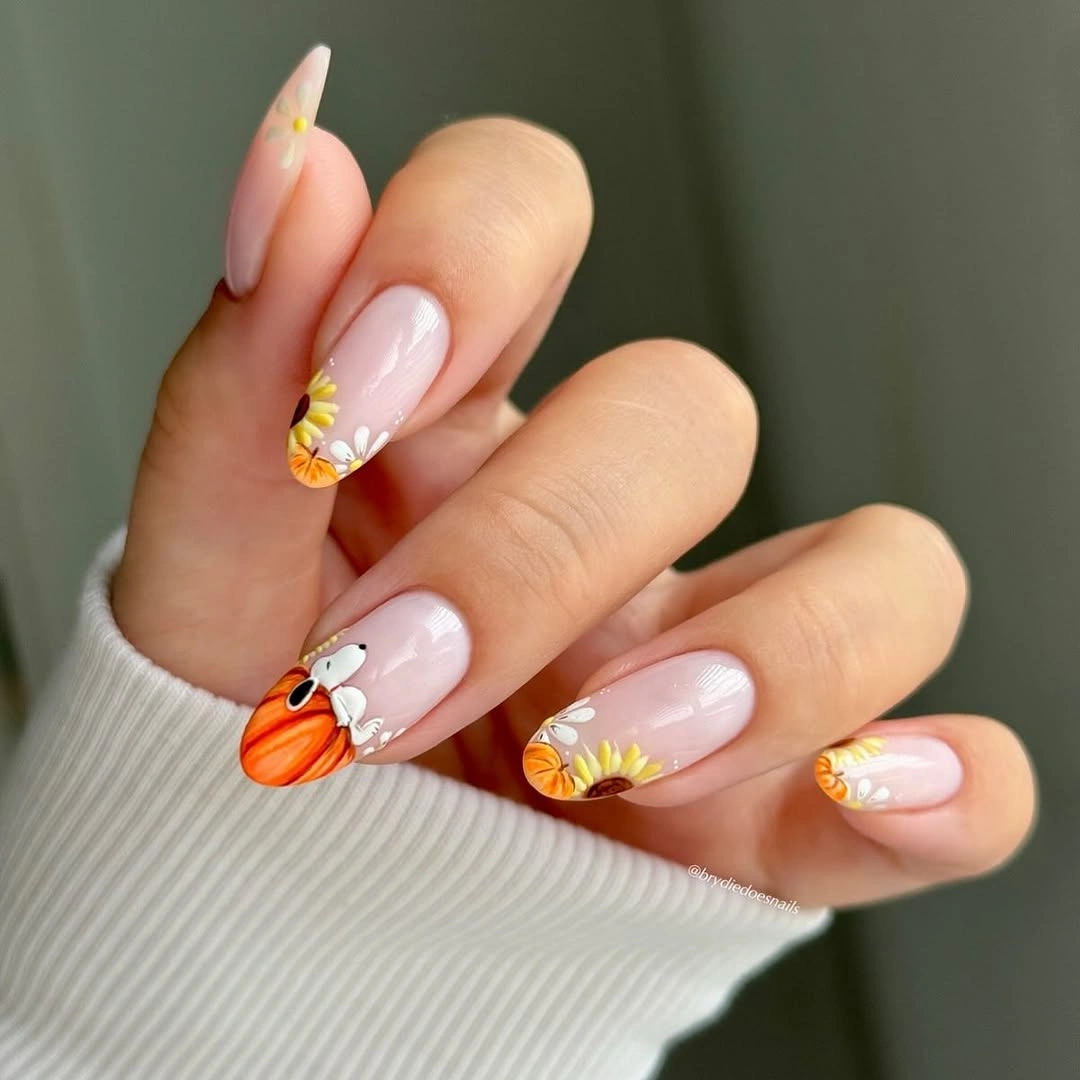
For a shorter shape, keep one pumpkin accent and reduce the gold leaves to a few dots or a short branch. The pumpkin should remain the recognizable feature, while the gold only supports its placement; adding more fine marks would make the pale nail look busy and harder to pair with clothing. The simpler version retains the same warmth.
This design works with blush, cream, soft brown, and gold jewelry because the colors already share a gentle warmth. Orange gives the manicure a fall center, while pale pink prevents it from becoming visually heavy. The result is useful when you want pumpkin art that feels decorative but still leaves plenty of open space.
Miniature Fall Scenes on Nude Squoval Nails
Short squoval nails combine nude bases with pumpkins, plaid, leaves, and other tiny autumn marks. Each motif is kept at a similar scale, so the hand feels like a series of small coordinated panels rather than one oversized illustration. The nude base gives the brown and orange details a quiet background.
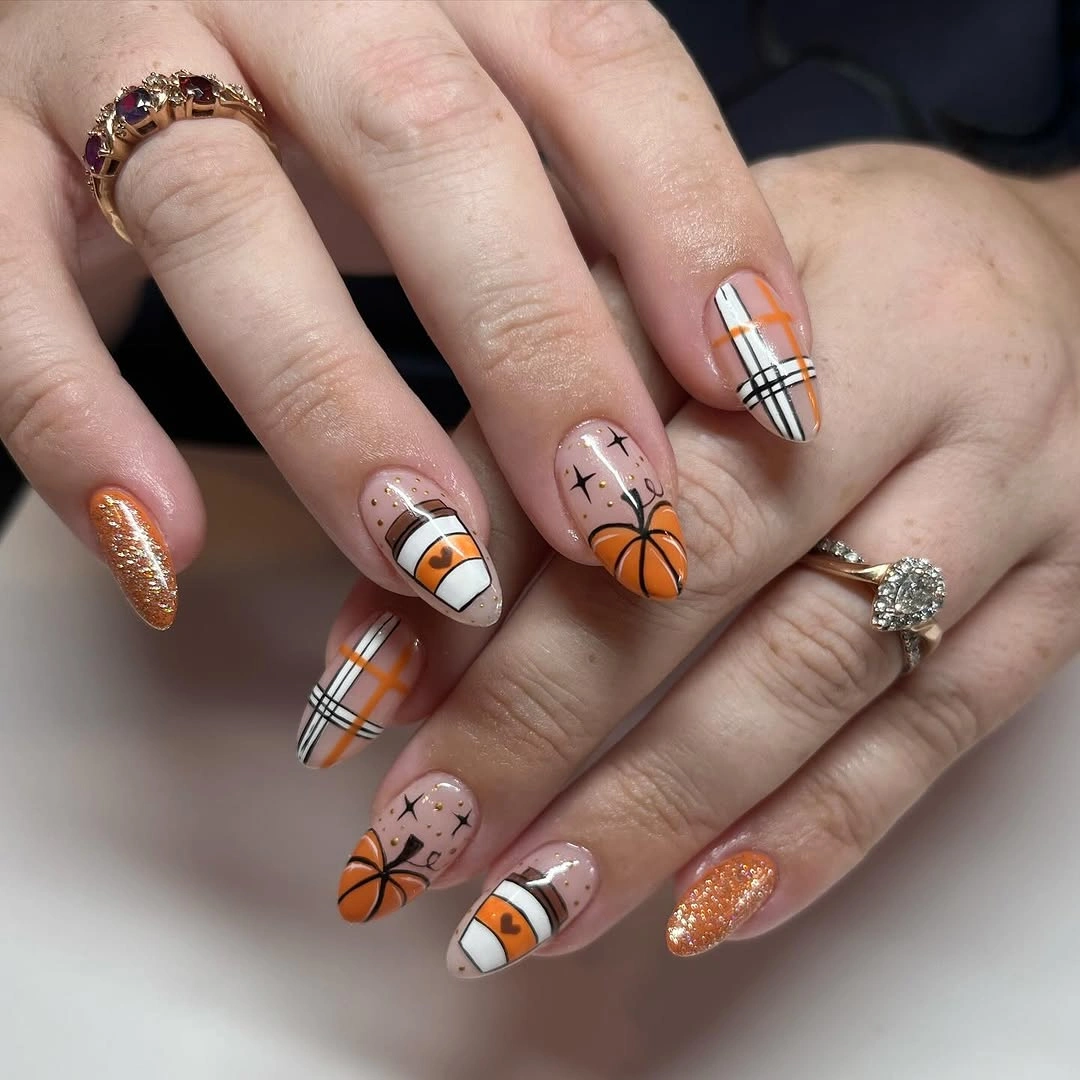
If you need a simpler version, choose pumpkins and one plaid accent, then let the nude nails remain plain. The small symbols can be difficult to read when too many are compressed together, while a reduced set makes the color repetition more useful. Keep the orange and brown close enough that the hand still tells one seasonal story.
This is a friendly direction for casual fall outfits because nude, orange, and brown sit comfortably beside denim, cream, and olive. The squoval shape keeps the motifs compact and practical, and the open base stops the collection from becoming visually loud. The idea survives best when the motifs share scale rather than when every nail gets a new subject.
Orange Shimmer with Plaid and Pumpkin Linework
Medium almond nails use orange shimmer as a repeating block, with pale surfaces carrying plaid, pumpkin, leaf, and black line accents. The shimmer gives the set its visual anchor, while the pale decorated nails provide places for the smaller details to remain visible. The warm base and dark lines create enough contrast without needing a very broad palette.
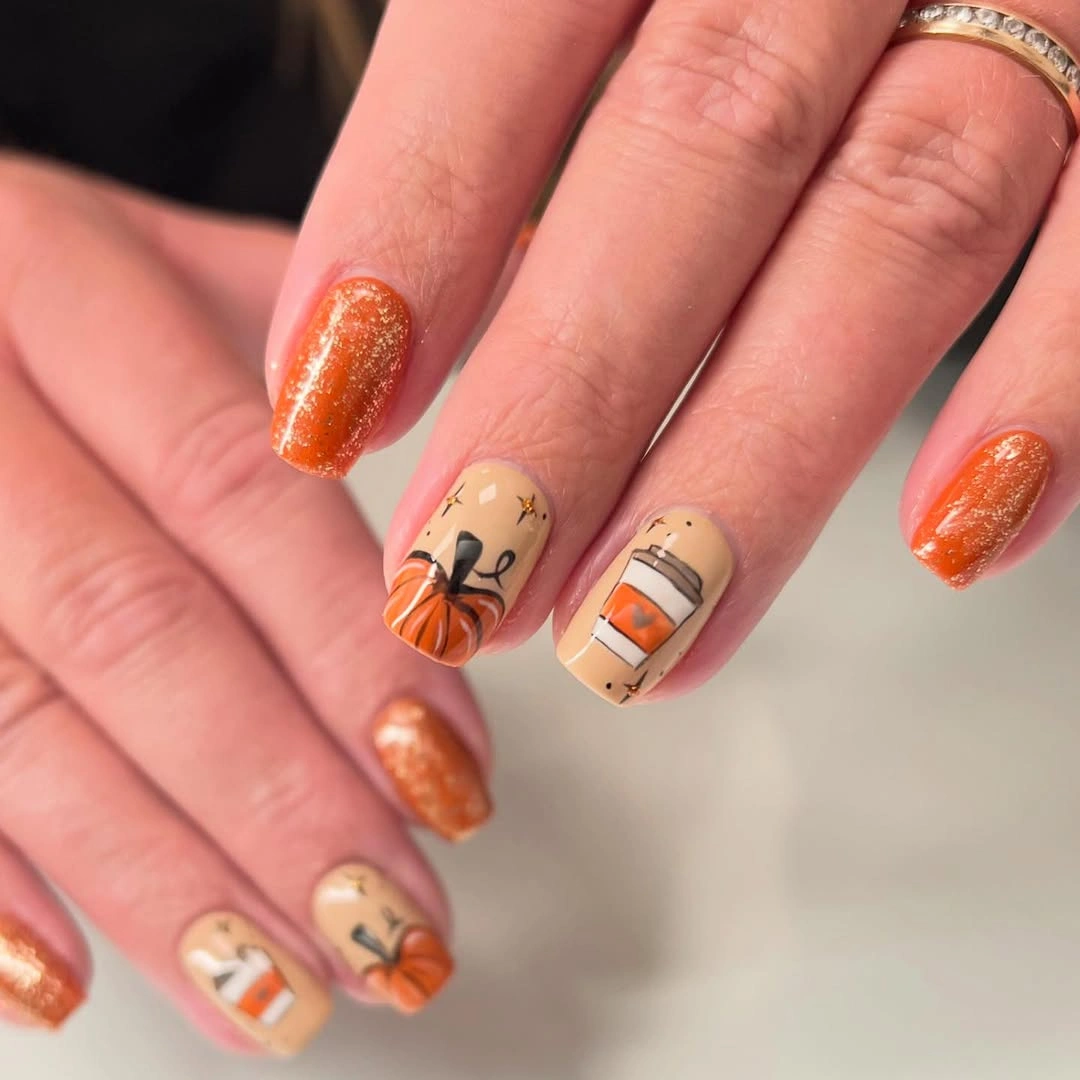
For a more manageable arrangement, keep the orange shimmer on several nails and choose either plaid or pumpkin linework for the pale accents. The black marks can be reduced to one outline or short stem, and the glitter-like surface can remain the main source of light. This keeps the idea recognizable while lowering the number of details to maintain.
The set pairs with brown, black, cream, and denim, making it easier to style than a collection built from several unrelated bright colors. Orange brings the season, pale nails give the eye rest, and the dark line accents make the small motifs readable. The structure feels deliberate because the color block repeats more consistently than the illustrations.
Hand-Painted Pumpkins with Warm Plaid
Medium almond nails combine brown, orange, burgundy, cream, and yellow with plaid panels, pumpkins, and leaf marks. The warm palette repeats across different motif types, so the hand reads as one fall collection even though some nails are solids and others are illustrated. Medium length gives the details room without requiring the longest silhouette.
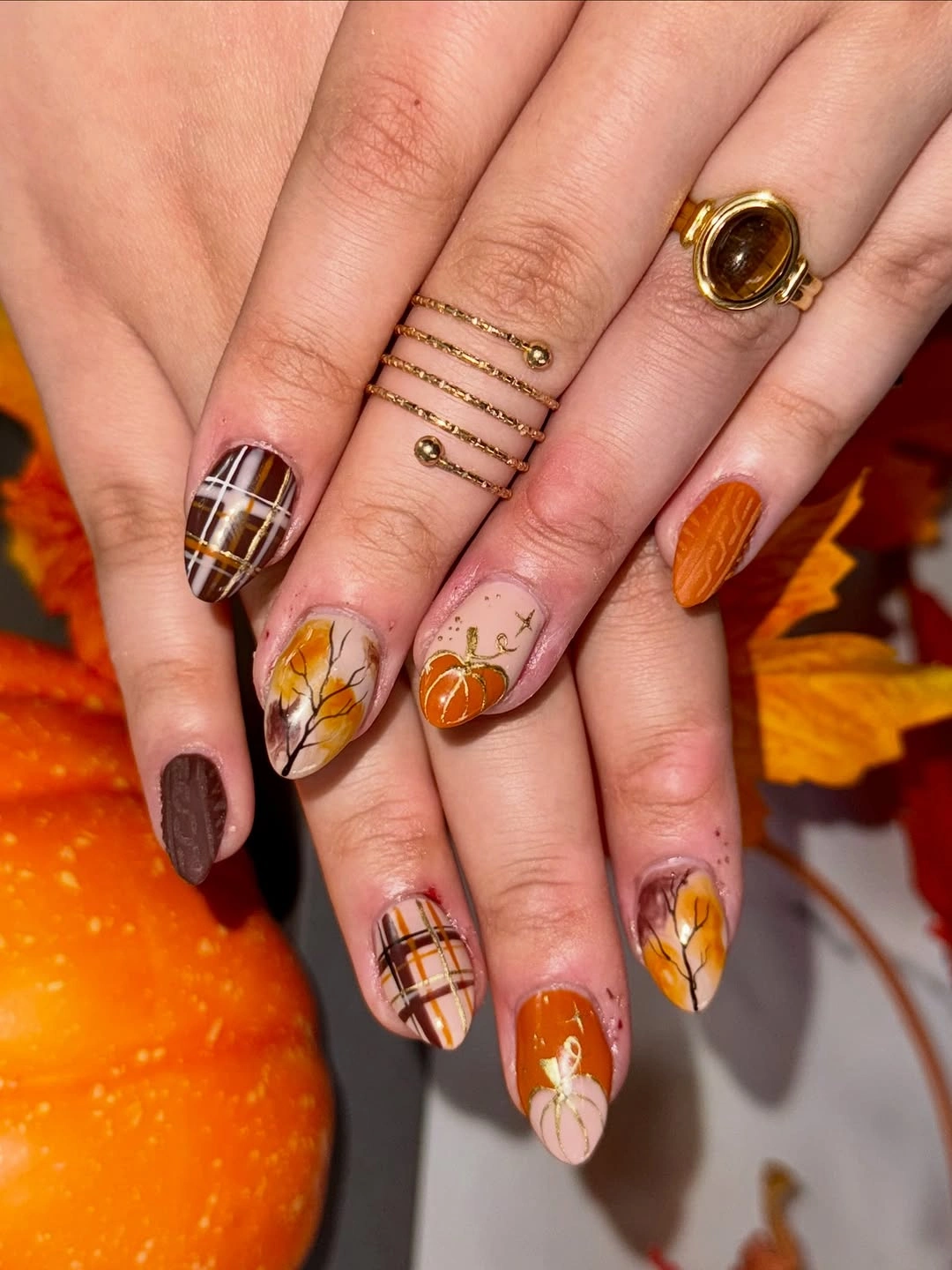
A useful reduction is to keep brown and orange as the main solids, then choose one plaid nail and one pumpkin nail. If the hand-painted details are already the focus, burgundy or yellow can appear as a small color note rather than another full accent; clear role separation makes the set easier to repeat. The palette stays rich after the edit.
This design works with rust, chocolate, cream, olive, and burgundy clothing because those colors are already present in the manicure. The pumpkin feels integrated rather than pasted on, since the plaid and solids share its warm surroundings. It is expressive, but the repeated palette keeps it from feeling scattered.
Orange, Burgundy, and Gold Pumpkin Accents
Medium almond nails bring together orange solids, burgundy accents, pumpkin and leaf art, and gold shimmer. The saturated surfaces echo the warm colors inside the small illustrations, while the pale decorated nails keep the art from disappearing into the darker blocks. Gold adds a light-catching pause between the stronger autumn shades.
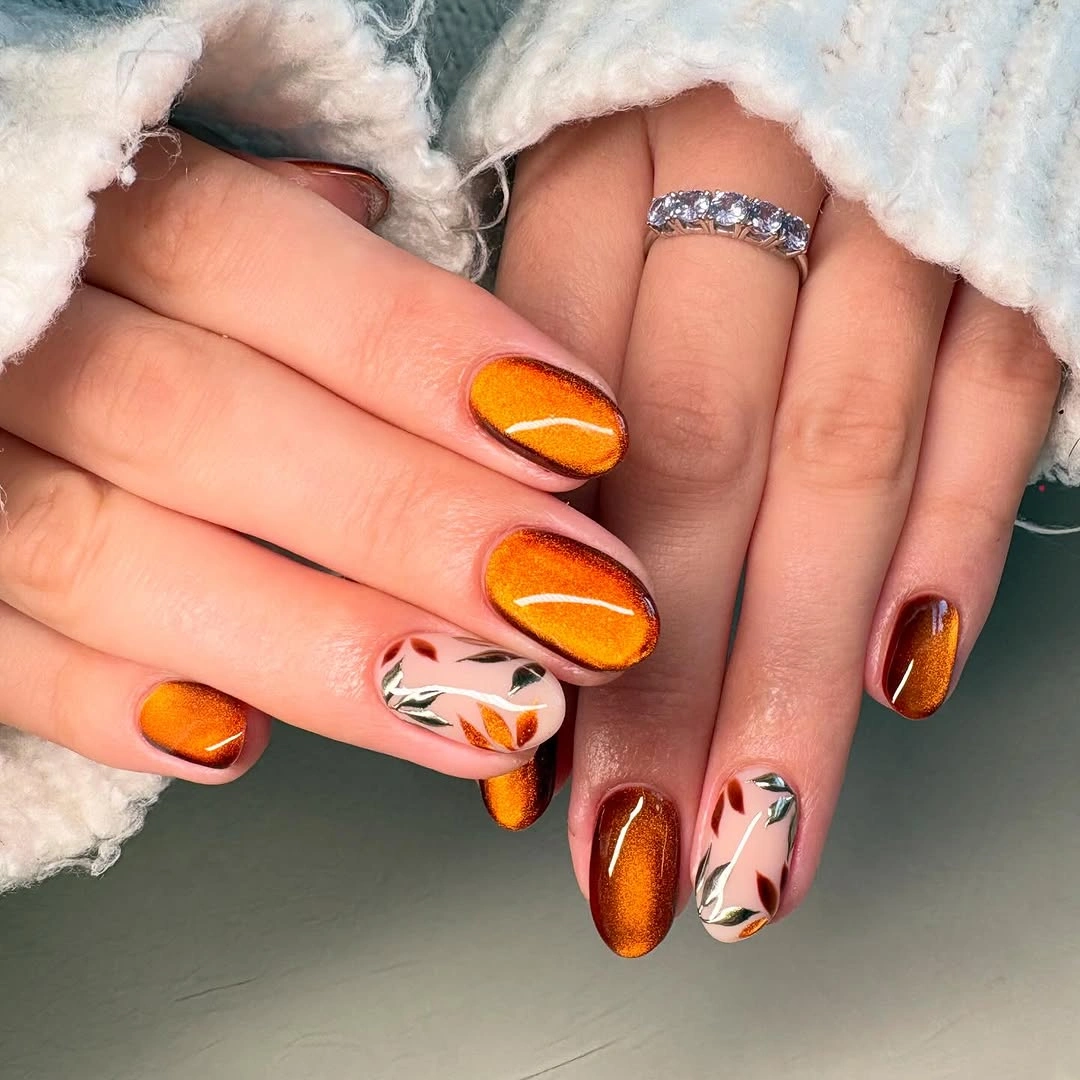
For a simpler version, keep orange and burgundy as the solid pair, then use one pale pumpkin nail and one gold accent at most. The glitter should support the color rhythm instead of becoming another focal point, and the leaf marks can be shortened to one warm line. This gives the hand a clear center without removing its seasonal character.
The palette is easy to connect with brown boots, cream knits, denim, or a burgundy layer. Orange supplies brightness, burgundy keeps the set grounded, and gold bridges the two with a small reflective note. The design feels intentional when the pumpkin details repeat colors already doing visible work elsewhere.
Short Almonds with Pale Pumpkin Panels
Short-to-medium almond nails use orange, burgundy, pale pink, and gold glitter, placing white pumpkin art and warm leaf marks on the lighter surfaces. The saturated solids make the hand feel lively, while the pale panels protect the illustrations from becoming lost inside the stronger colors. The almond shape gives the accents a little vertical space without making them dominant.
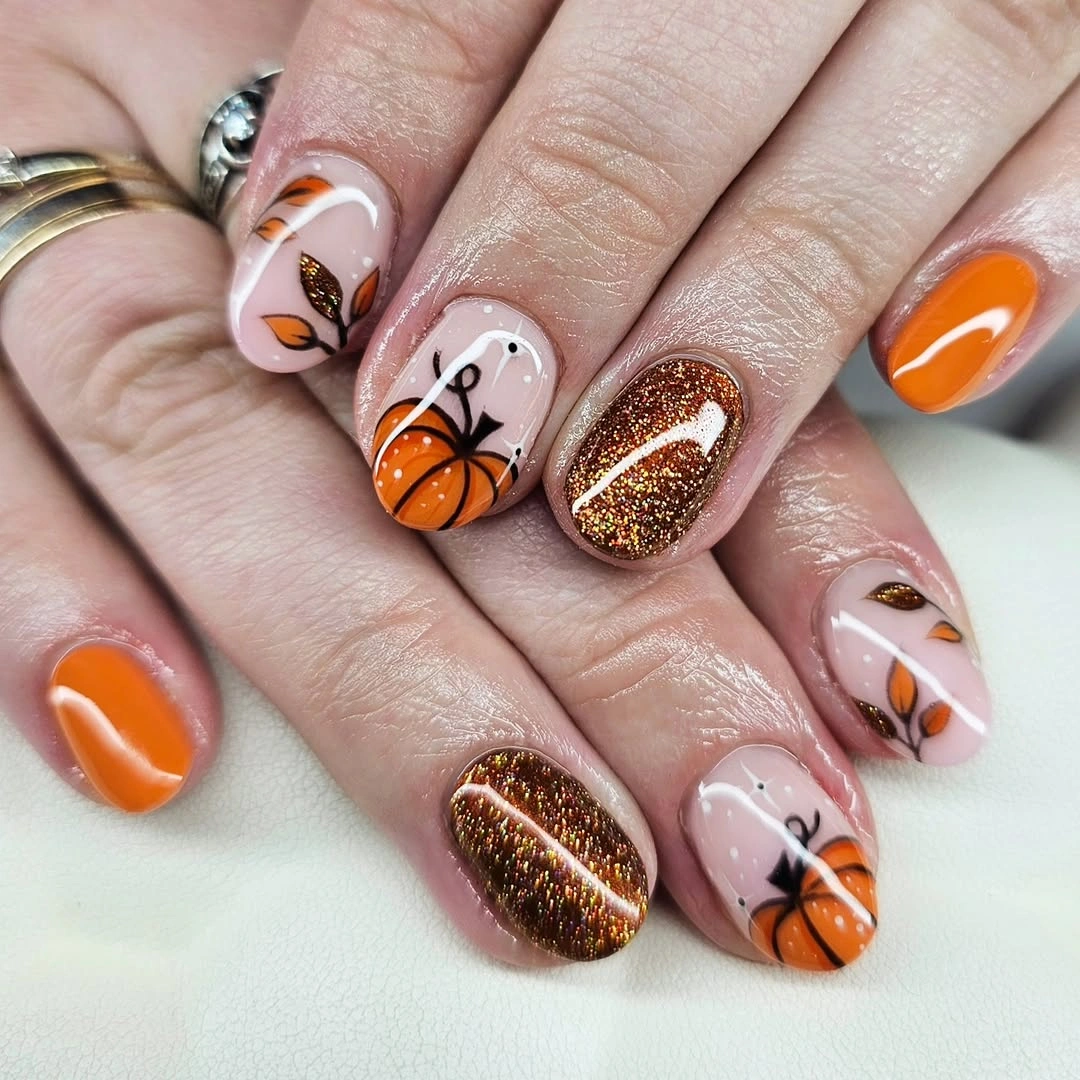
For a shorter or quieter set, keep one pale pumpkin panel, one orange solid, and one burgundy solid. Gold glitter can stay on a single nail or be removed entirely if the color contrast already feels sufficient; the main idea is the relationship between a light illustrated surface and warm solids. Fewer roles make the design easier to style.
This is a good middle ground between tiny accent art and a fully illustrated hand. The colors work with cream, denim, brown, and warm pink, while the pale pumpkin provides a clear seasonal focal point. The result stays friendly because the illustration is supported by simple blocks rather than surrounded by more symbols.
Repeating Tiny Pumpkins on Pale Pink
Short square nails use pale pink bases with repeated tiny orange pumpkins placed in a regular, confetti-like rhythm. The icons are similar in scale, so no single pumpkin needs to carry the whole composition; the repeated pattern supplies the movement. Orange, brown, and a little green keep the otherwise light surface tied to fall.
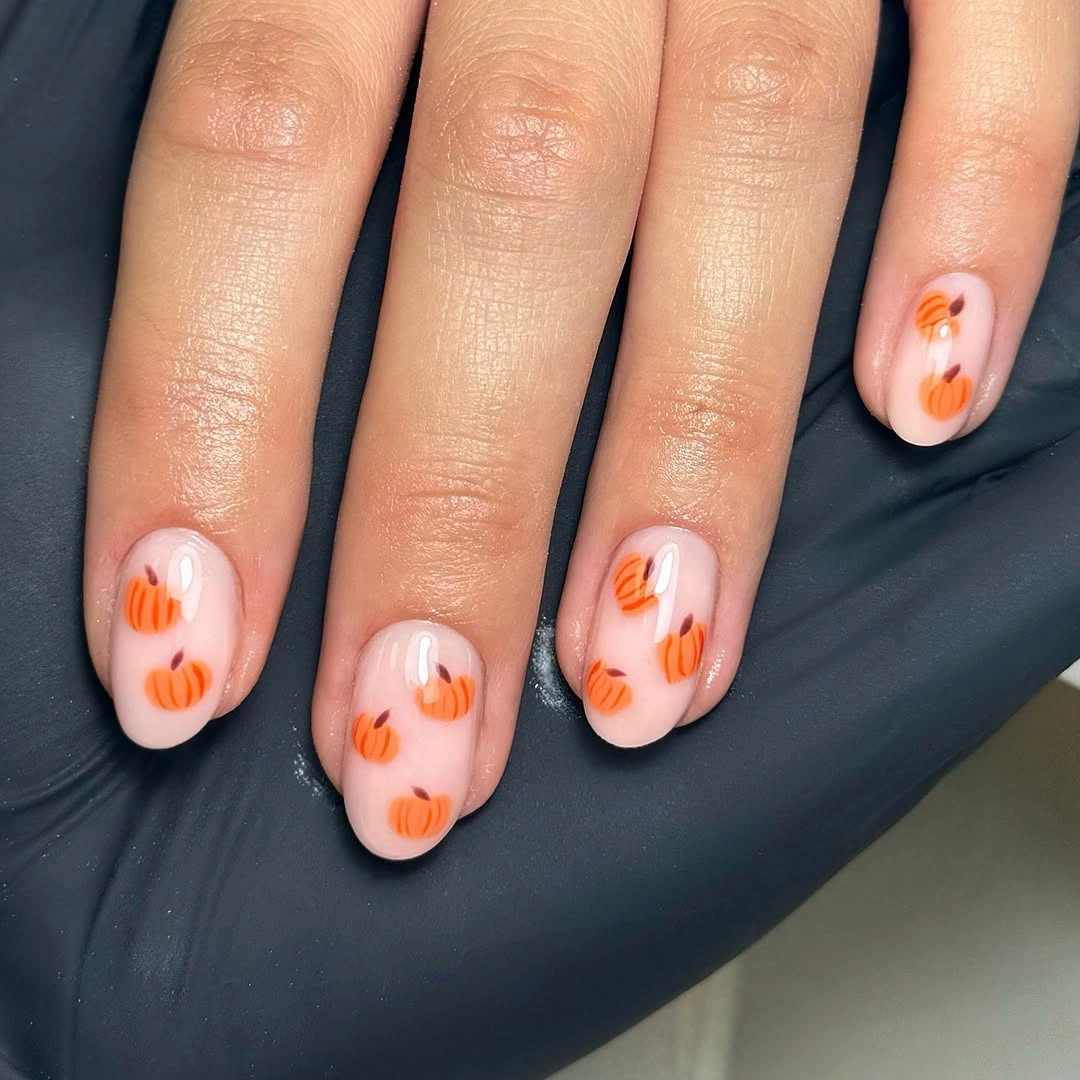
If repeating icons feels too busy, keep the pattern on one or two nails and use pale pink solids on the rest. One small pumpkin can also be enlarged slightly on a single accent so the theme remains visible after reducing the number of marks. The square shape benefits from a regular arrangement, but it does not require every nail to match.
This look is easy to pair with pale sweaters, denim, brown, or orange accessories because the base remains soft. The repeated pumpkins bring personality without asking for a dark Halloween palette, and the short square keeps the design compact. It works when the spacing feels intentional and the icons are not crowded against the edge.
Earthy Pumpkins with Olive and Cream
Short-to-medium oval nails combine brown, olive, cream, orange, and red with small pumpkin icons and other autumn marks. The earthy solids make the illustrations feel like part of a cozy storybook palette, while cream gives the hand enough light to keep the small shapes visible. The oval silhouette softens the contrast between the warm colors.
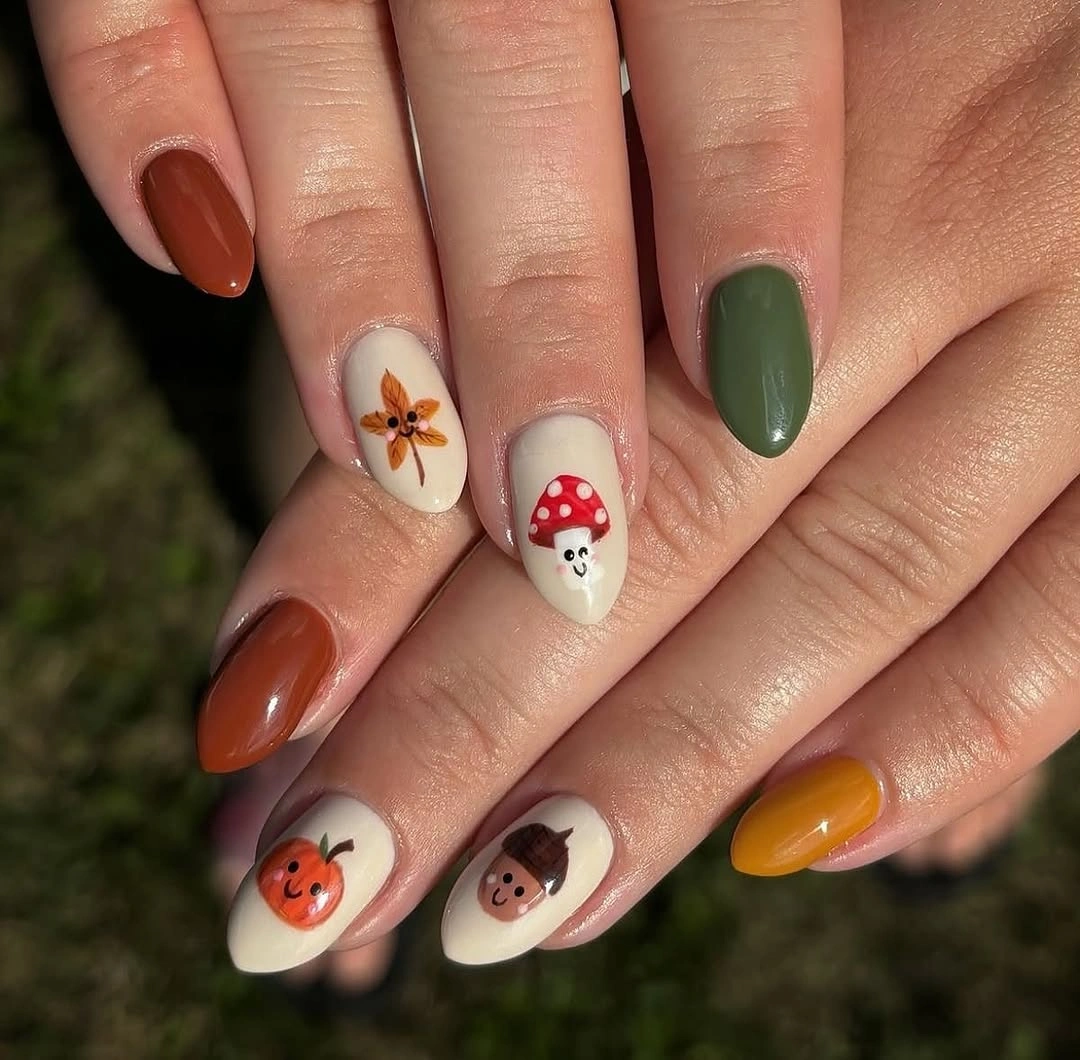
For a quieter version, keep brown and olive as the anchors, use cream on one accent nail, and place one or two pumpkin marks there. Red can remain a tiny supporting note rather than a full surface, especially if the hand already feels warm enough. This adjustment preserves the earthy mood while making daily outfit pairing simpler.
The palette works beside olive jackets, camel knits, cream tops, and dark denim. Brown supplies depth, olive brings a muted seasonal note, and orange makes the pumpkins readable without overwhelming the base. The design feels grounded because the icons are surrounded by colors that belong to the same visual world.
Orange Solids with White Illustration Panels
Short square nails alternate saturated orange solids with white panels carrying pumpkin and leaf illustrations in brown and muted green. The white nails act as clear drawing surfaces, creating a strong pause between the orange blocks. The square shape gives the illustrated panels a broad, stable area, so the small marks can remain simple.
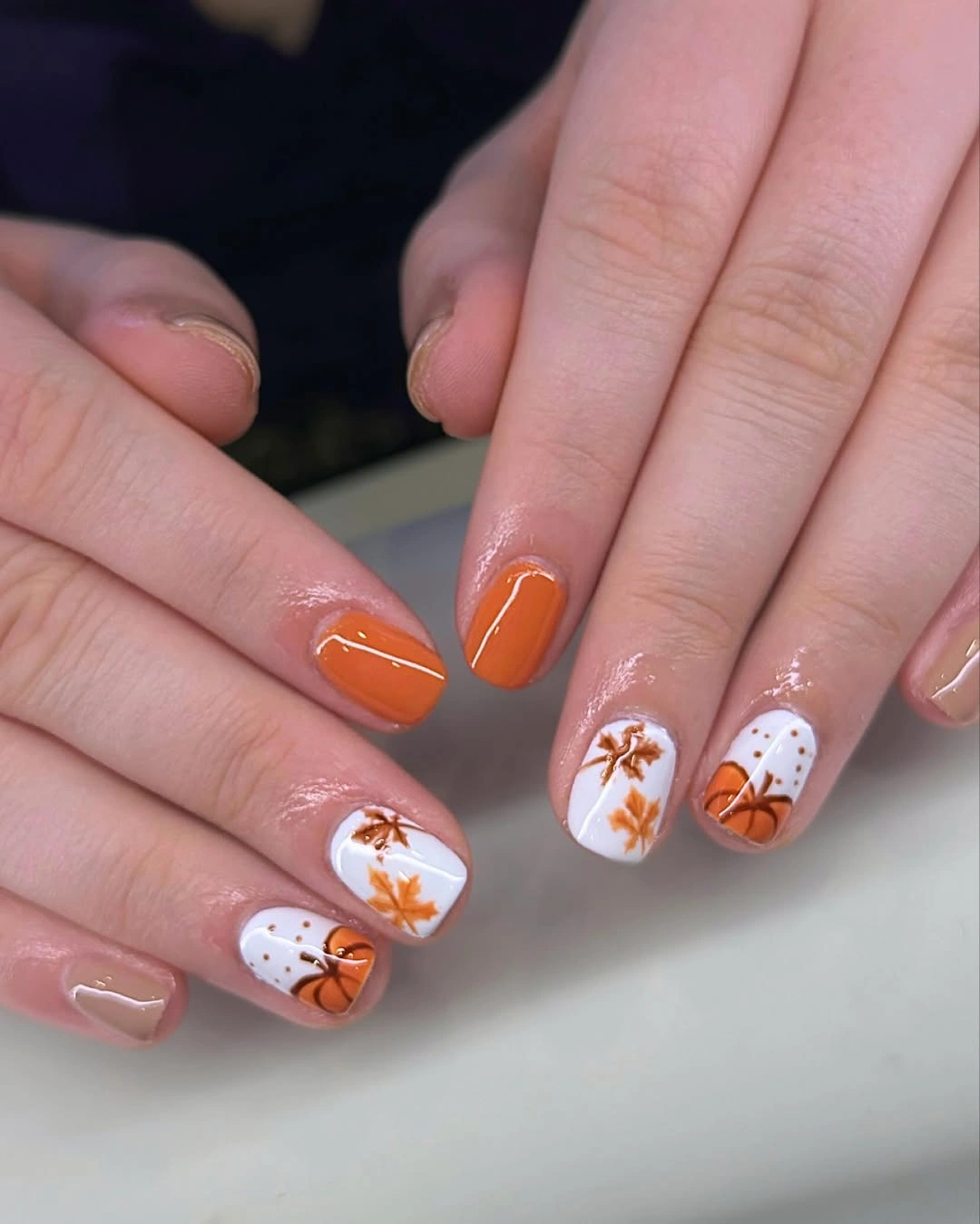
If you want less contrast, replace one white panel with a pale nude and keep only one illustrated nail. Orange can stay on several nails because it is the main seasonal color, while the white or nude surface gives the eye a place to stop. The best reduction keeps the illustration separate from the strongest solid rather than layering more marks over it.
This is a direct option for someone who wants fall nails with pumpkins to be unmistakable. Orange and white pair with denim, black, brown, and cream, and the small green note keeps the illustration from becoming a single warm block. The set remains clear because each nail has one easy-to-understand role.
Orange Solids with Pale Pumpkin Art
Medium almond nails combine orange solids, gold glitter, pale pumpkin illustrations, and autumn leaves. The glitter repeats the warmth of the orange, while the pale nails hold thin dark linework that would be harder to see on a saturated base. The arrangement creates a conversation between simple color blocks and more detailed accents.
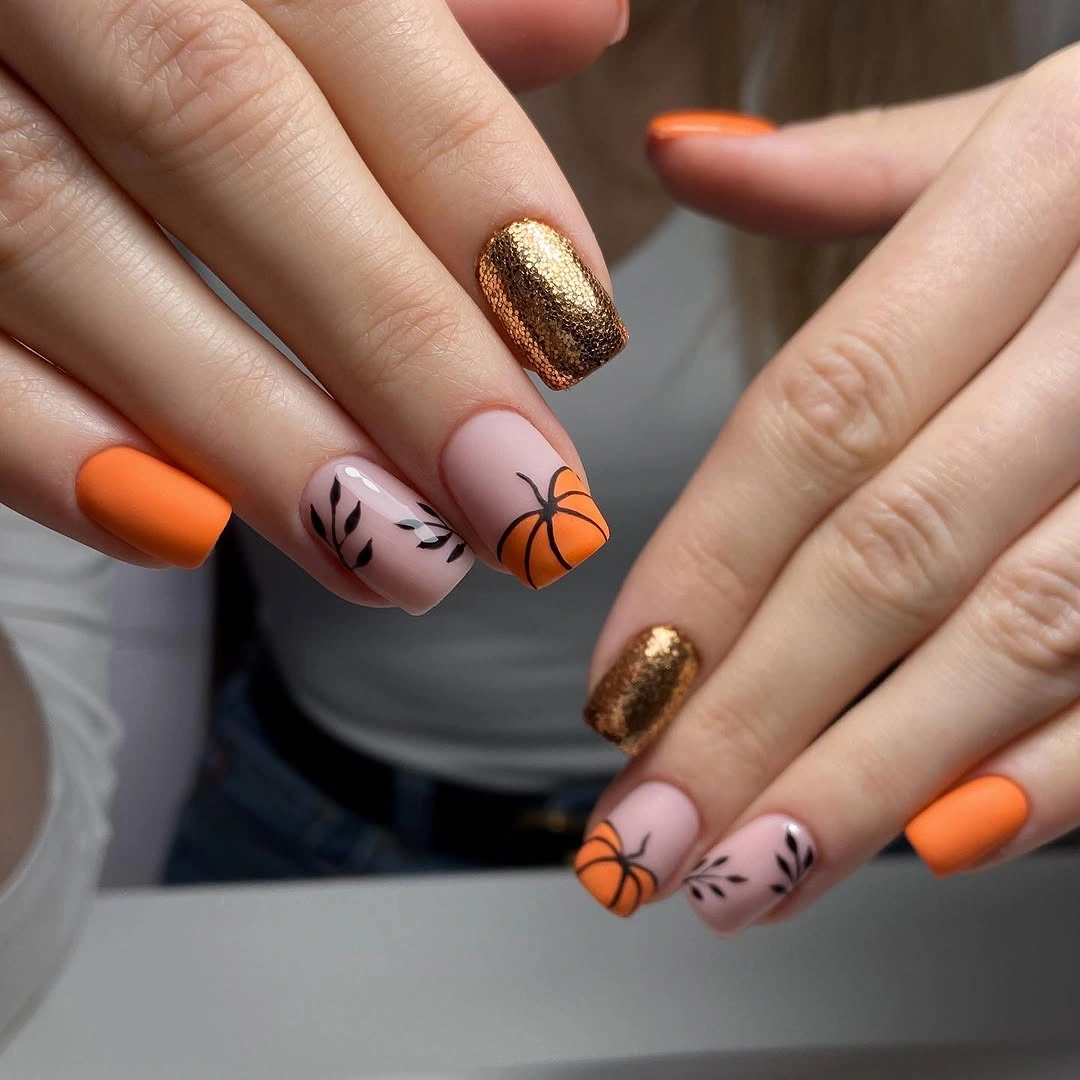
For a lower-effort adaptation, keep orange on the majority of nails, choose one pale pumpkin accent, and use gold only where it helps separate the colors. The leaf marks can be reduced to one or two strokes, since the pumpkin already provides the theme. This edit keeps the hand expressive without requiring every detail to be equally precise.
The look pairs with rust, cream, brown, olive, and black, and it can be softened by choosing a less saturated orange. Gold makes the set feel brighter, while the pale panel keeps the small illustration from getting lost. The composition is easy to understand because the warm block and the illustrated pause repeat in clear positions.
Orange-Brown Solids with Tortoiseshell and Gold
Medium almond nails mix orange-brown solids, amber tortoiseshell-like panels, pale pink, and tiny gold pumpkins or leaf marks. The patterned panel provides a neutral transition between the simpler colors, while the small seasonal accents add a recognizable finish without covering the hand. The almond shape allows the warm surfaces to look elongated and deliberate.
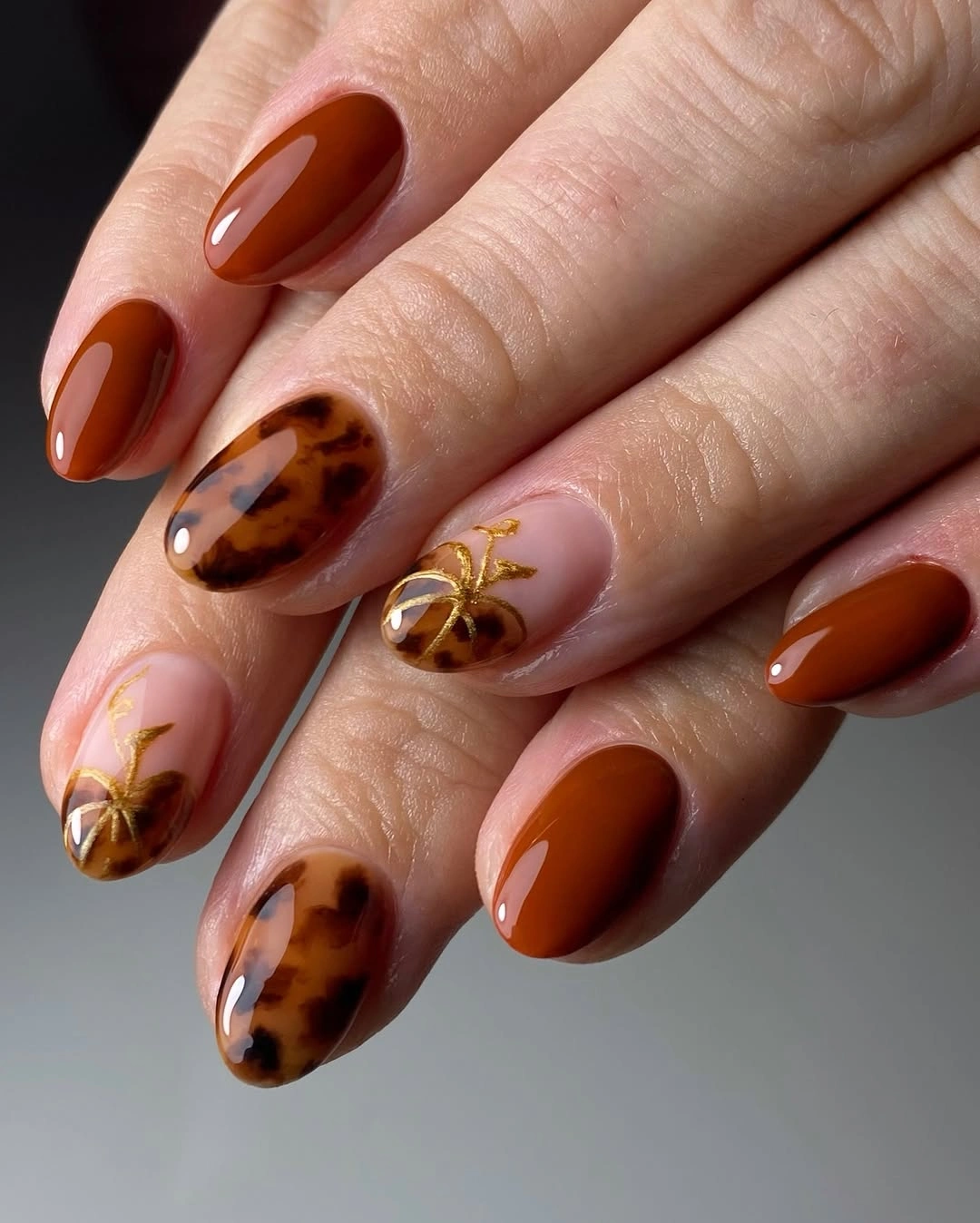
For a simpler version, keep the orange-brown solids and one tortoiseshell-like accent, then place a single gold pumpkin on a pale nail. The pattern already supplies texture, so adding several more icons would make the arrangement harder to read; choose either more texture or more illustration as the focal point. A small gold note is enough to connect the two.
This palette works with camel, chocolate, cream, black, and denim, making it practical for the whole fall wardrobe. Amber and orange-brown provide warmth, pale pink opens the composition, and gold keeps the pumpkin reference visible without turning it into a cartoon scene. The design feels styled because the seasonal detail is balanced by a pattern that can stand on its own.