Autumn does not have to mean one predictable brown manicure. These fall nails with autumn designs move between orange, burgundy, olive, forest green, cream, berry, and muted taupe, using botanicals, plaid, knit-like lines, tiny illustrations, and reflective finishes in different amounts. The collection keeps changing its balance of warmth and depth, so a seasonal manicure can feel soft, graphic, playful, or nearly plain.
Start by noticing the foundation under the detail. A bright solid can frame a tiny botanical mark, a pale nail can make a brown line visible, and a short rounded shape can keep several motifs from becoming too loud. Each idea below has a clear visual decision to borrow, plus a practical adjustment for changing the length, accent intensity, or amount of pattern without losing the autumn character.
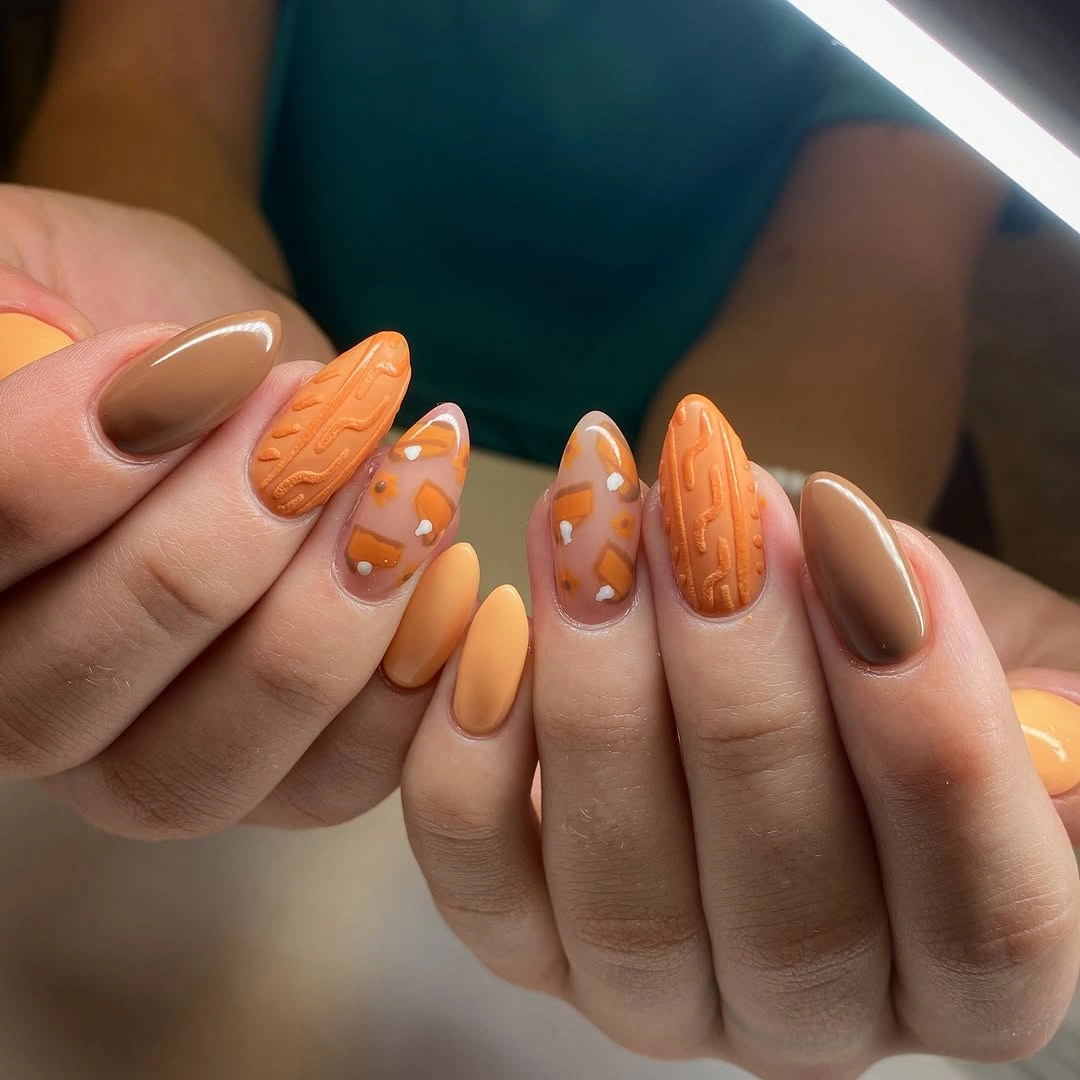
Orange and Pink With Botanical Pinpoints
Medium almond nails alternate glossy orange with pale pink accents carrying fine brown-gold botanical marks and small bright dots. The saturated orange supplies warmth, while the pink nails create a lighter surface where the delicate details can be read. The almond outline keeps the mix elongated and polished, but the decoration remains concentrated instead of covering every nail with the same drawing.
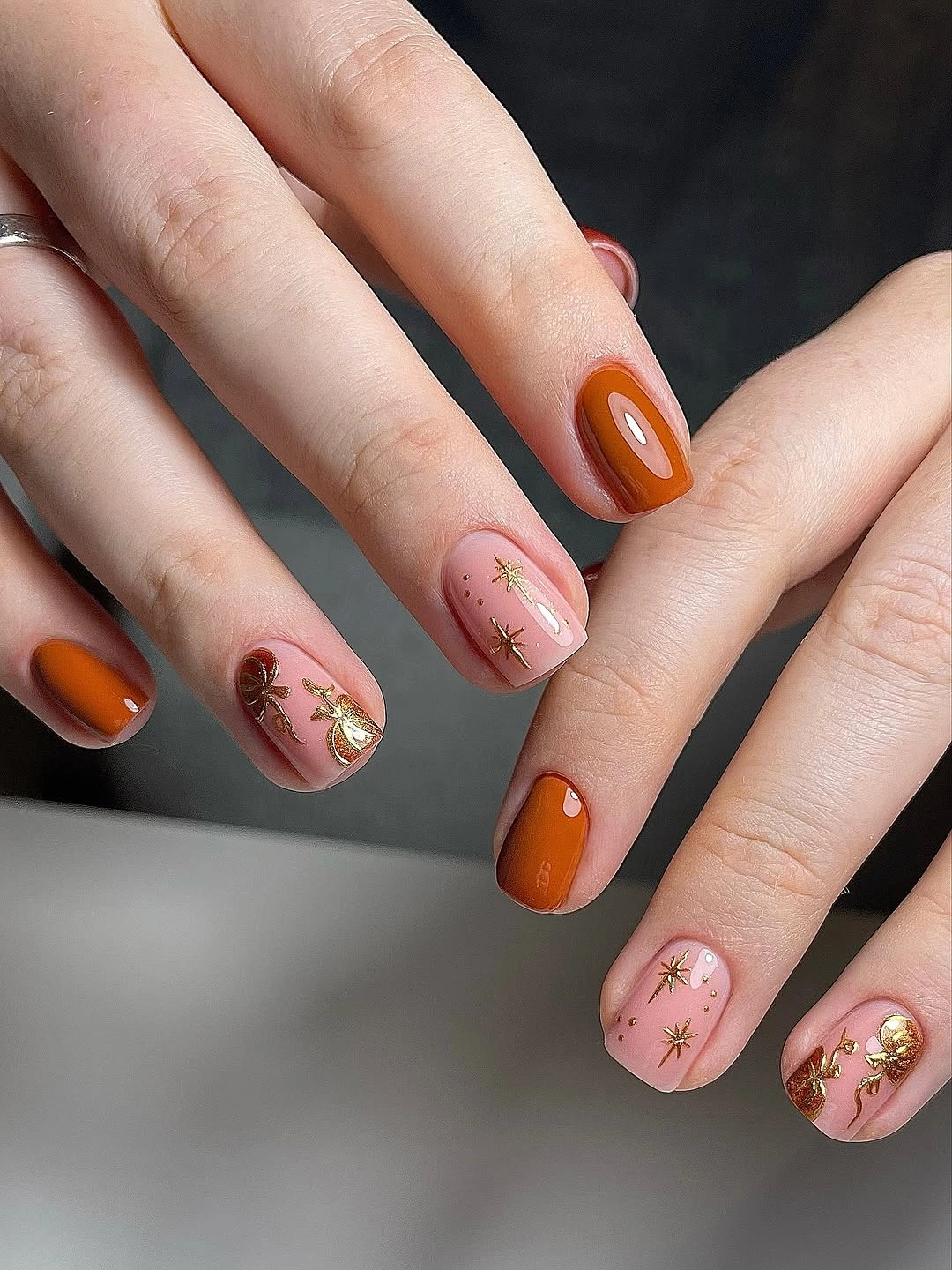
The small metallic-looking points matter because they repeat the warmth of the orange without becoming a second large motif. They act as quiet highlights around the botanical marks, giving the pink nails a little structure and keeping the set from splitting into a solid-color half and an unrelated art half. This is seasonal color used with restraint: warmth is present, but the pale accents keep the hand open.
For a simpler adaptation, keep the orange on three nails and place the botanical detail on one pink nail per hand. A shorter almond will still carry the palette, although the lines and dots should be spaced farther apart so they do not close together. The limitation is that bright orange attracts attention quickly, so reducing the number of decorated fingers may be necessary when you want the manicure to feel softer.
Charcoal Nails With a Tonal Floral Veil
Medium almond nails use a glossy charcoal-black base with a delicate darker floral or leafy pattern layered across the surface. The design stays close to monochrome, so the pattern appears through changes in tone rather than through a bright accent color. That gives the manicure a quiet depth and lets the almond shape remain visible beneath the decorative layer.
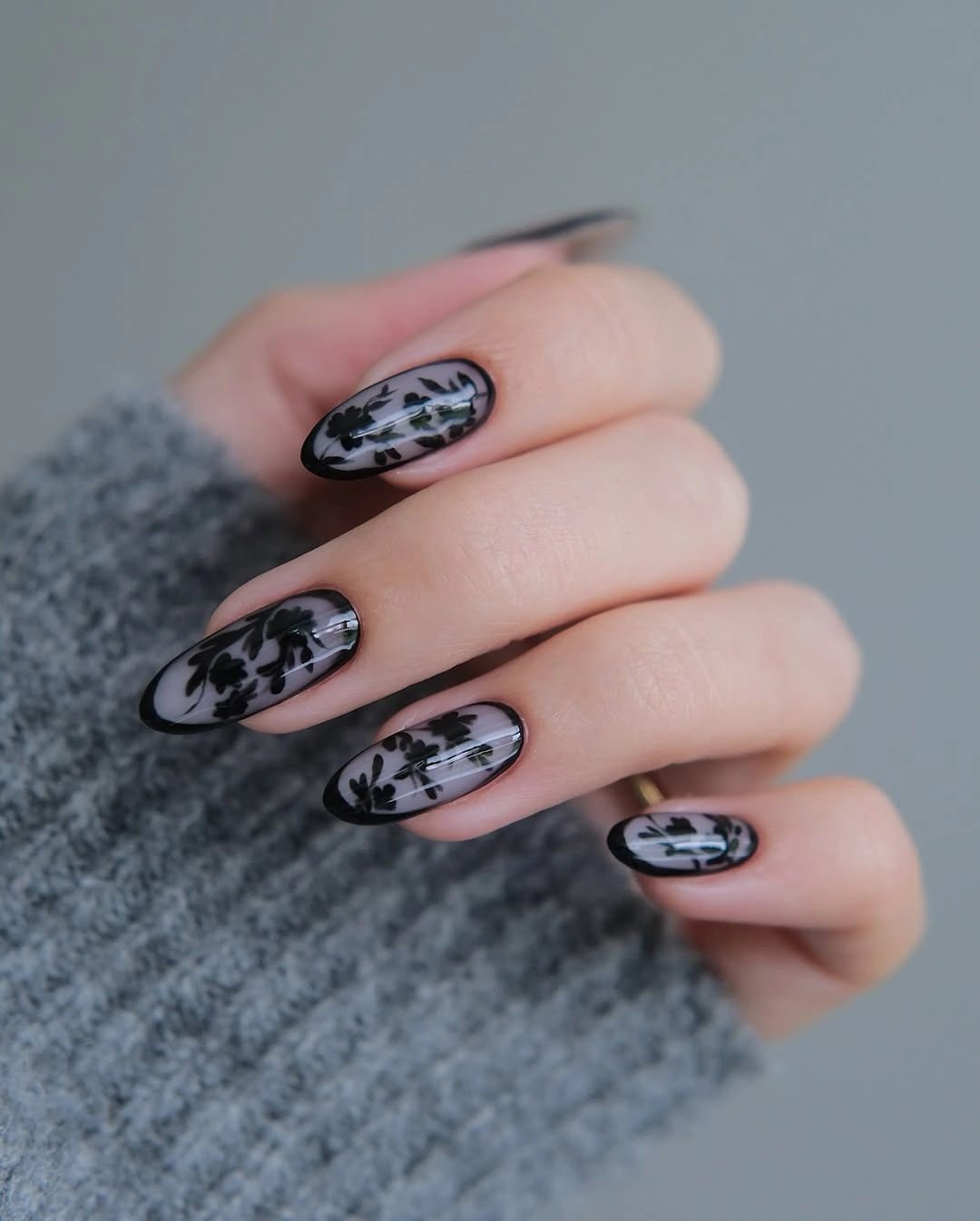
The tonal contrast is the detail to keep. A pattern that is only slightly lighter or darker than the base adds texture without breaking the dark mood, while the repeated placement makes the set feel connected from finger to finger. Compared with bright botanical nails, this option feels more like a surface study, proving that autumn detail can come from depth and repetition rather than color alone.
On a shorter oval, use a lighter pattern so the leafy shapes remain visible, and keep the design to two or three accent nails if the surface is small. A plain charcoal nail beside the pattern will create useful relief. The limitation is resolution: if the tonal difference is too slight, the artwork may disappear outside direct light, so a readable contrast matters more than adding extra lines.
Orange Tips With One Tiny Leaf
Medium almond nails place vivid orange at the tips of a pale base, then add one small orange botanical mark on an accent nail. The design has a clean division between the open center and the warm edge, so it feels seasonal without using a full illustrated scene. The almond silhouette gives the tips room to follow the curve while the pale center keeps the color from becoming heavy.
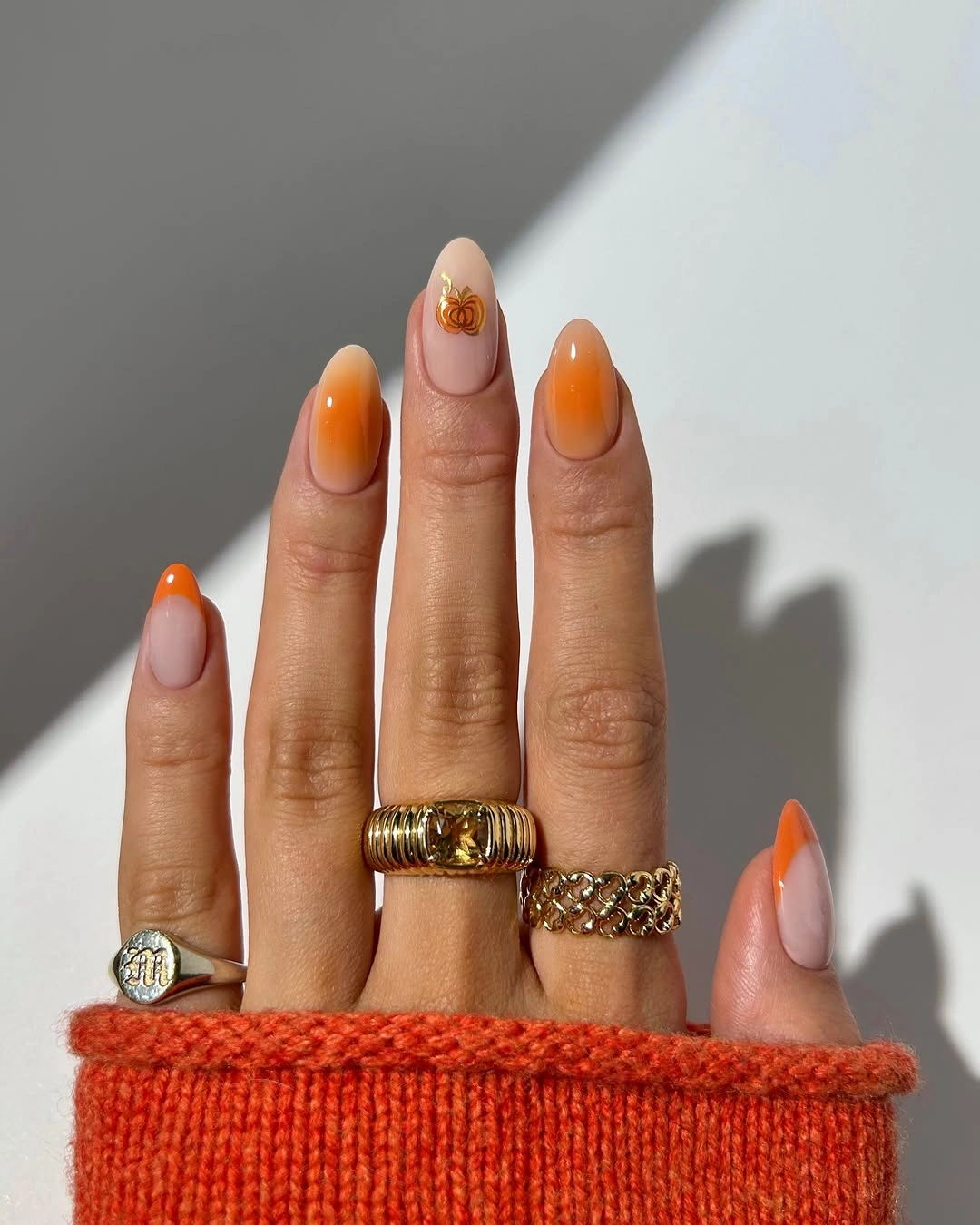
The tiny leaf works because the tips have already established the visual language. It repeats the orange in a smaller scale, linking the accent nail to the rest without asking every finger to carry a separate motif. This makes the manicure a useful middle ground between a simple colored tip and a more detailed autumn set: the seasonal cue is present, but it is not the only thing the eye sees.
Use a muted rust or brown at the tips for a quieter variation, and keep the small mark on one nail per hand. A shorter oval can handle a wider tip, provided the pale base remains visible around it. The limitation is that a curved tip needs to follow the nail evenly, so the clean look depends more on consistent spacing than on adding another accent color.
Burgundy With Warm Spotted Accents
Short rounded nails pair deep burgundy and nude solids with patterned accents carrying brown, amber, and dark spotted details. The burgundy supplies the richest note, while the nude sections create enough open space for the warm pattern to remain distinct. The compact outline makes the design feel grounded and keeps the mixture from expanding into a long, high-contrast statement.
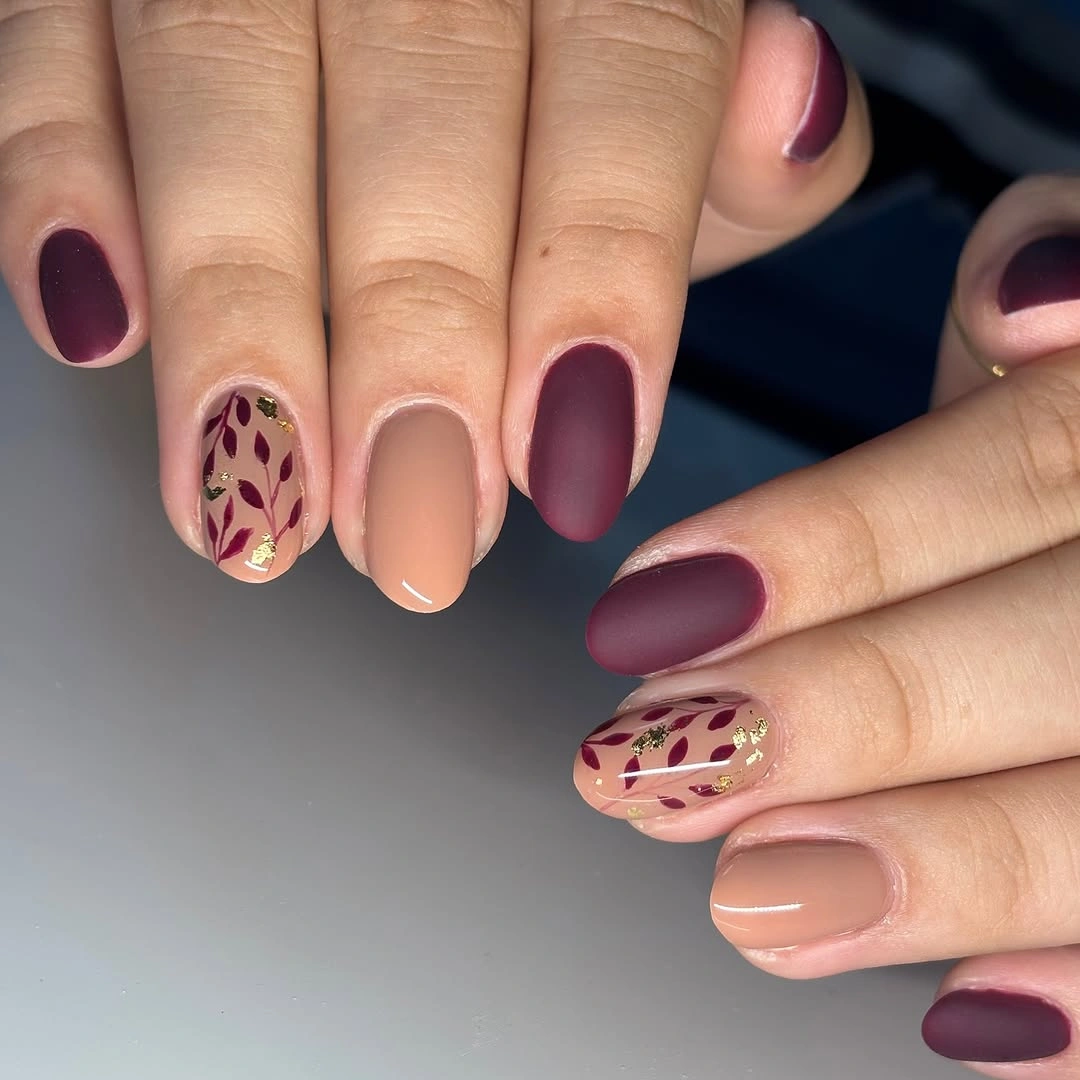
The accents work because their colors sit close to the burgundy rather than pulling the set in a completely different direction. Amber brings a small lift, brown echoes the dark base, and nude separates the marks so the pattern does not become a solid block. This is a good way to add a spotted detail while keeping the manicure tied to a warm, wearable palette.
For a cleaner short set, use one patterned nail per hand and leave the remaining fingers burgundy or nude. A rounded square can be replaced by a short oval if you want the transition between solid and patterned nails to feel softer. The limitation is that small spots can become muddy on a tiny surface, so larger patches and more visible nude space will usually read better.
Muted Taupe and Berry for a Quiet Season
Medium almond nails combine muted taupe, dusty mauve, and deep berry-brown tones in a subdued color story. There is no dominant illustration to explain the season; the mood comes from the relationship between soft neutrals and one richer berry note. The almond shape keeps the palette graceful, while the low-contrast progression allows the hand to remain calm even when the colors change from finger to finger.
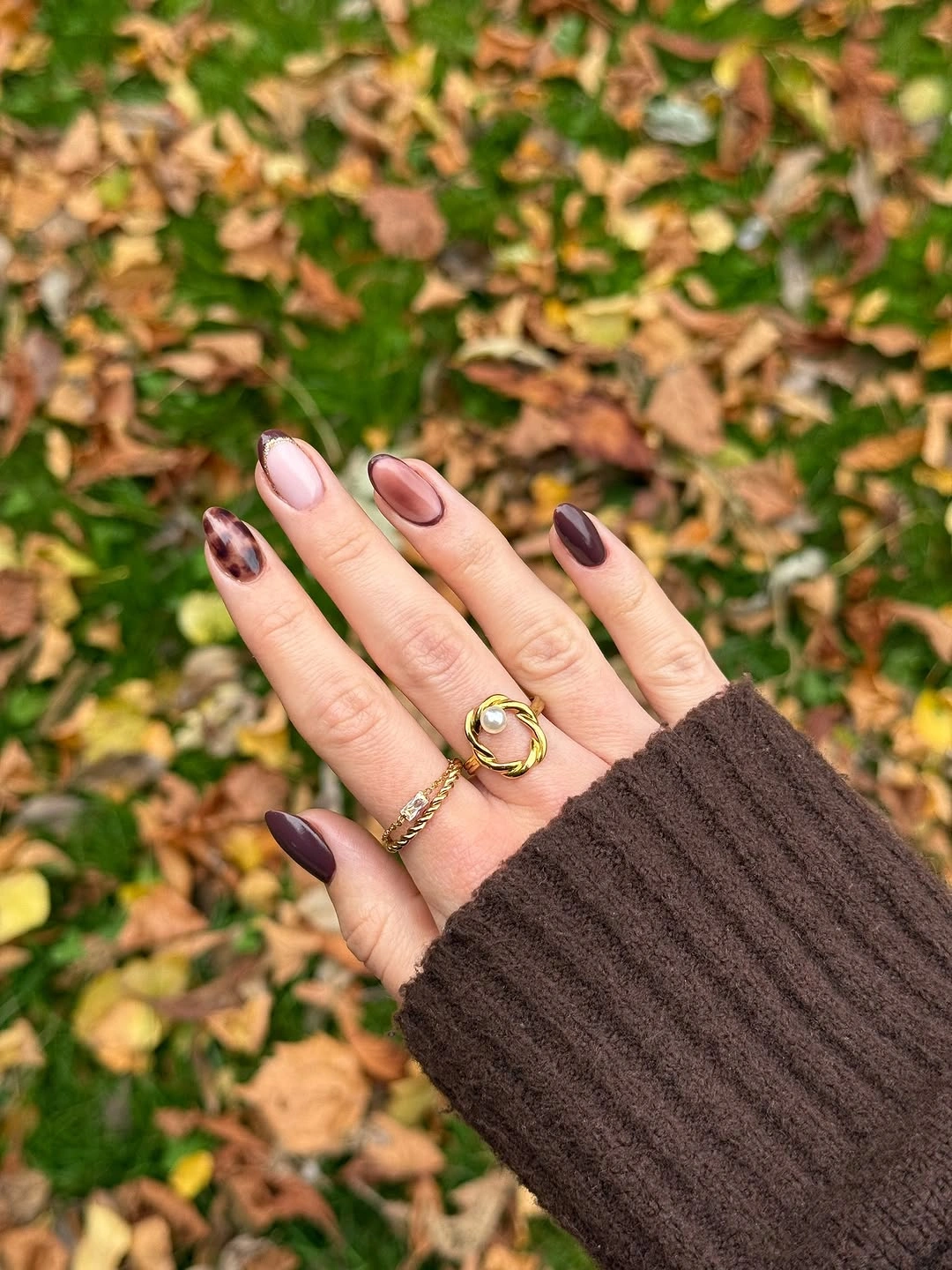
The useful detail is the shift in depth rather than the background of fallen leaves around the hand. Taupe gives the set a pale resting point, mauve warms the middle, and berry anchors the darker end, creating a gentle movement from light to rich. This makes the design a good choice when you want seasonal color but prefer the manicure itself to stay more muted than illustrated.
Use berry on one or two nails if the full palette feels too close in value, and keep the other fingers in taupe or mauve. A shorter oval will preserve the soft progression while reducing the visual length. The limitation is contrast: if every shade is equally muted, the manicure may look indistinct, so one deeper color is useful for giving the collection a clear endpoint.
Burgundy With Pale Sweeping Arcs
Medium almond nails use glossy deep burgundy as a base, then add broad pale curved accents that follow the surface of several fingers. The light arcs interrupt the solid color without turning it into a full pattern, creating a graphic moment inside an otherwise rich manicure. The warm burgundy remains dominant, while the pale contrast gives the almond outline a little extra movement.
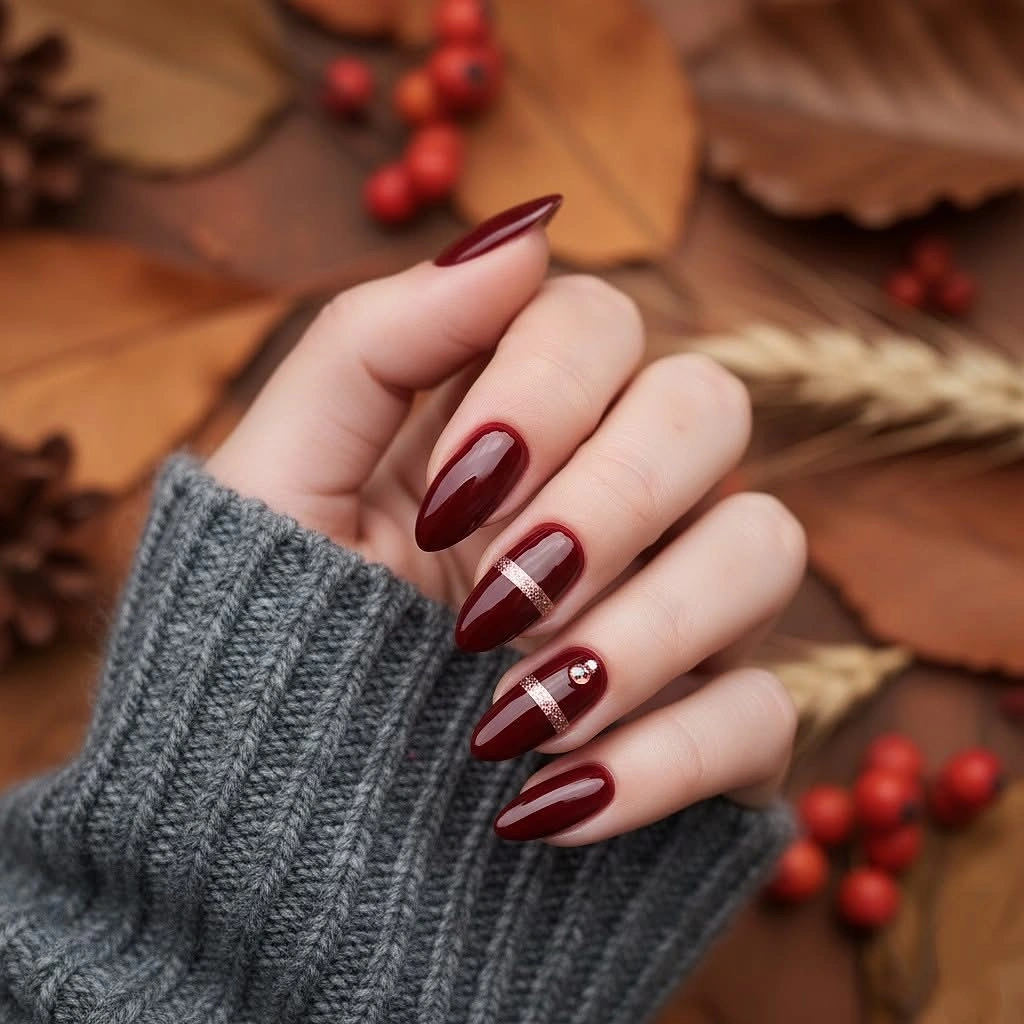
The arcs are effective because they are larger than a tiny dot but softer than a hard checkerboard. They break up the dark surface and make the eye travel along the curve, while the repeated burgundy keeps the set grounded. This is a useful autumn design for someone who wants art that feels visible from a distance but still leaves most of the color uninterrupted.
On short nails, narrow the arcs and place them on one or two accent fingers so the pale area does not overwhelm the base. A warm cream can soften the contrast, while a brighter white will make the shape more graphic. The limitation is that a curved accent must follow the nail rather than fight it, so a simpler single arc will look stronger than several uneven ones.
Brown, Cream, and a Little Checkerboard
Short-to-medium almond nails mix cream, brown, dark chocolate, checkerboard squares, dots, and curved stripe details. The palette repeats enough to hold the mismatched motifs together, while the cream nails give the darker marks a clear surface. The shape stays compact enough for the set to feel playful rather than elongated and formal, making the pattern mix easier to wear in everyday routines.
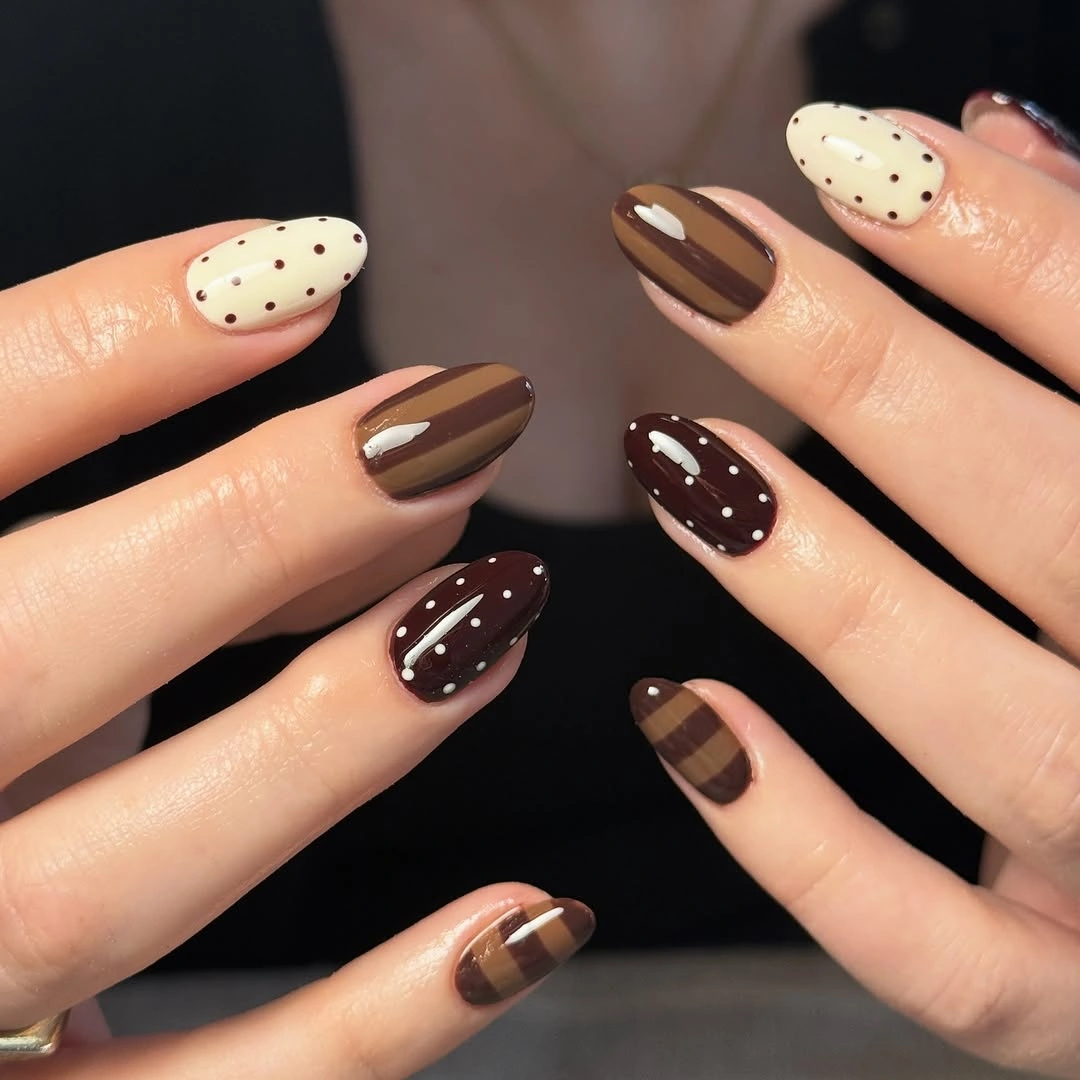
The checkerboard is only one part of the balance. Dots and curved stripes soften its strict geometry, and the dark chocolate solids give the eye a pause between patterned fingers. That mixture of structure and relief is what makes the manicure feel autumnal without relying on a single leaf motif; the season comes through the warm palette, repeated brown, and tactile-looking variation.
For a shorter version, keep the checkerboard on two nails and choose either dots or stripes as the second motif. Larger squares will stay legible as the length changes, and a solid cream finger can replace a crowded accent. The limitation is that too many small patterns can merge into one texture, so simplifying the motif count is more useful than shrinking every element.
Orange, Burgundy, Olive, and a Leaf Accent
Medium oval nails alternate glossy orange, deep burgundy, and muted olive, with a pale accent carrying abstract brown-orange leaf-like lines. The bright orange brings immediate warmth, while the olive cools the palette and the burgundy gives it weight. The oval shape softens the contrast and makes the three solid colors feel more relaxed than they would on a sharply pointed tip.
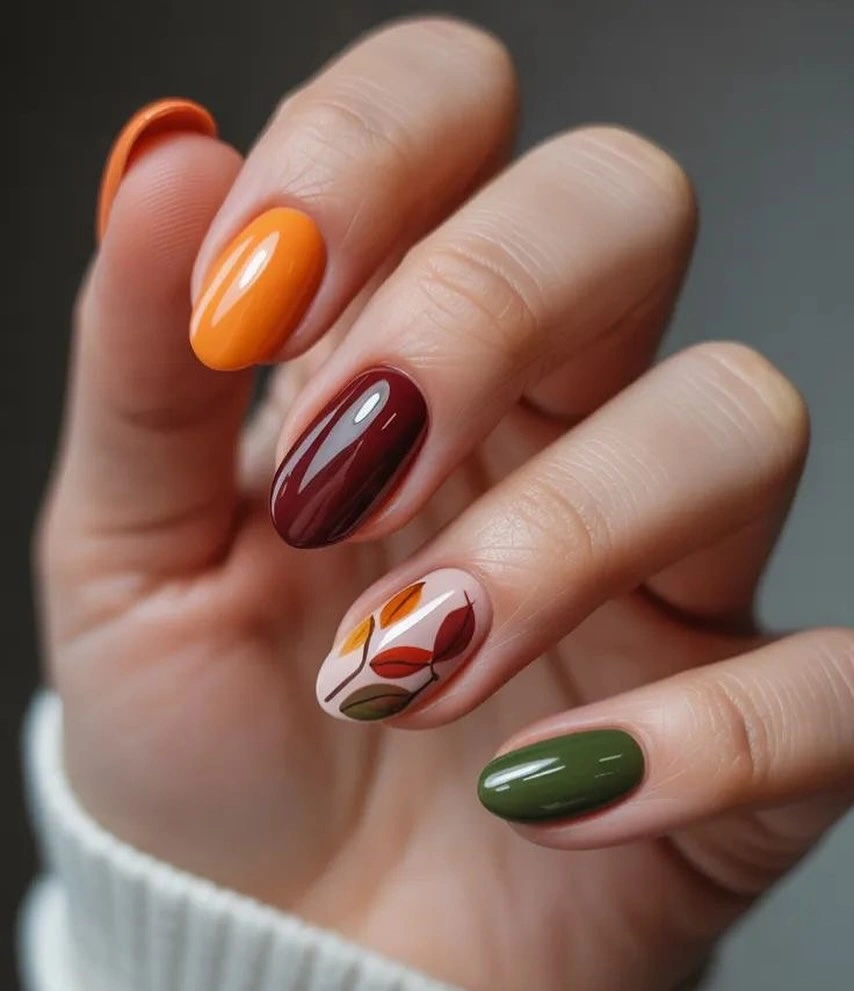
The botanical accent works as a meeting point for the solids. Its brown and orange lines echo the warm colors, while the pale base gives the olive and burgundy a lighter place to appear. This keeps the manicure from becoming a row of separate color blocks and shows how one carefully placed accent can make several solid shades feel like one seasonal edit.
Use the leaf detail on the ring finger and keep olive to one or two nails if you want orange to remain the focal color. A shorter oval will carry the same combination, although the leaf lines should be more open and less numerous. The limitation is that the bright orange can dominate quickly, so the darker shades need enough space to keep the palette layered.
Playful Seasonal Marks on Short Ovals
Short oval nails combine rust-orange, sage green, beige, and pale accent nails with tiny seasonal marks, including a red-and-white mushroom-like shape and warm leaf or pumpkin-like details. The solid colors are simple, which allows the small illustrated accents to be read as individual moments instead of merging into one busy collage. The rounded outline keeps the playful mix close to the hand.
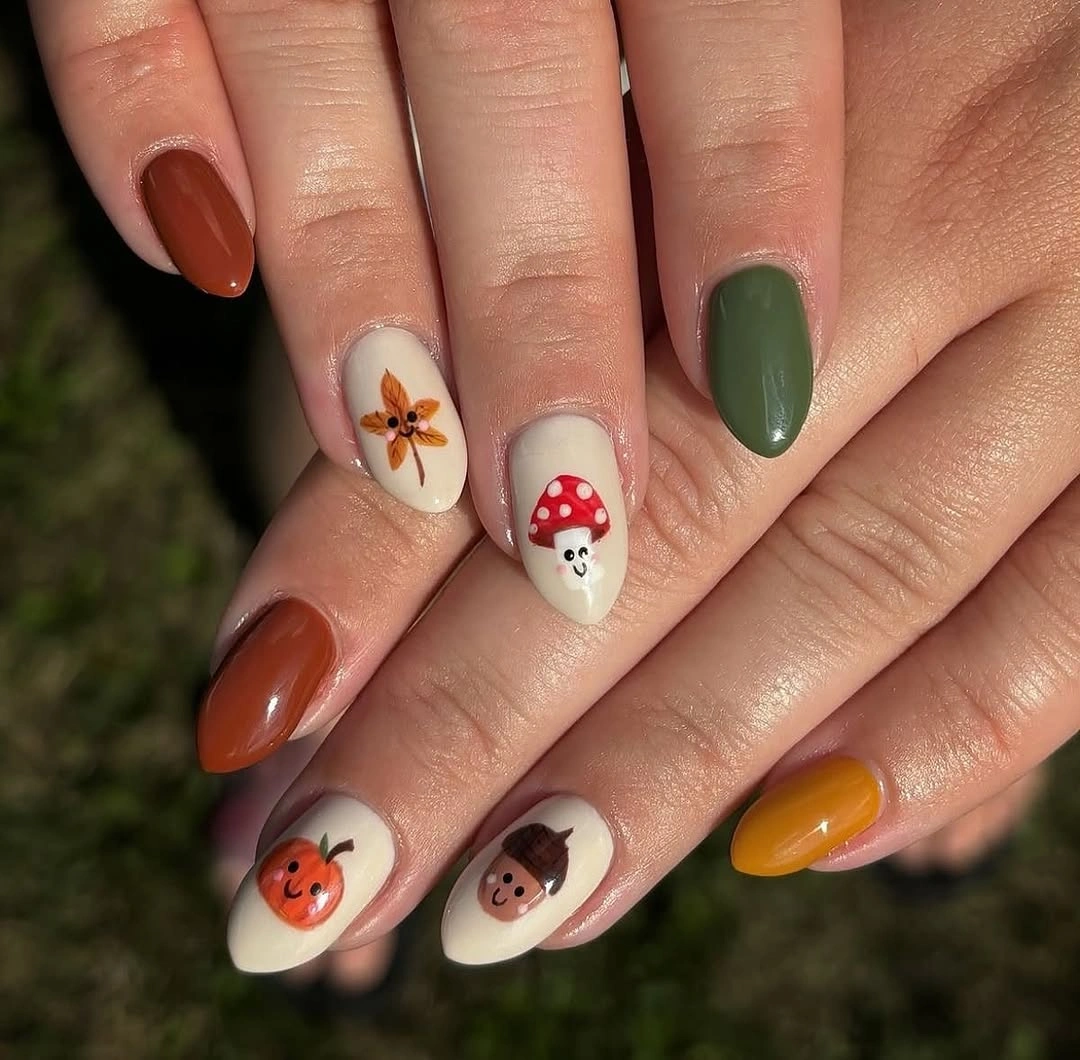
The strongest design choice is the contrast between ordinary solid nails and tiny illustrated ones. Sage and rust create a grounded background, beige gives the small marks a light field, and the dark accents help the drawings retain their edges. This makes the set feel seasonal through several small references while still keeping the overall color story clear and warm.
For an easier adaptation, keep the red-and-white accent on one nail and replace the other small illustrations with dots or simple leaves. A short oval will support that reduction well, especially if the solid sage and rust shades are repeated. The limitation is detail size: tiny figures can become ambiguous after shaping, so the simplified version should preserve color contrast rather than trying to copy every line.
Forest Green on a Long Almond
Long almond nails use a consistent deep forest-green shade with a glossy surface and no dominant artwork. The color carries the seasonal reference on its own, while the length creates a narrow, elegant outline that makes the single shade feel intentional. Because nothing competes with the green, the finish and the consistency of the silhouette become the details that determine how the set reads.
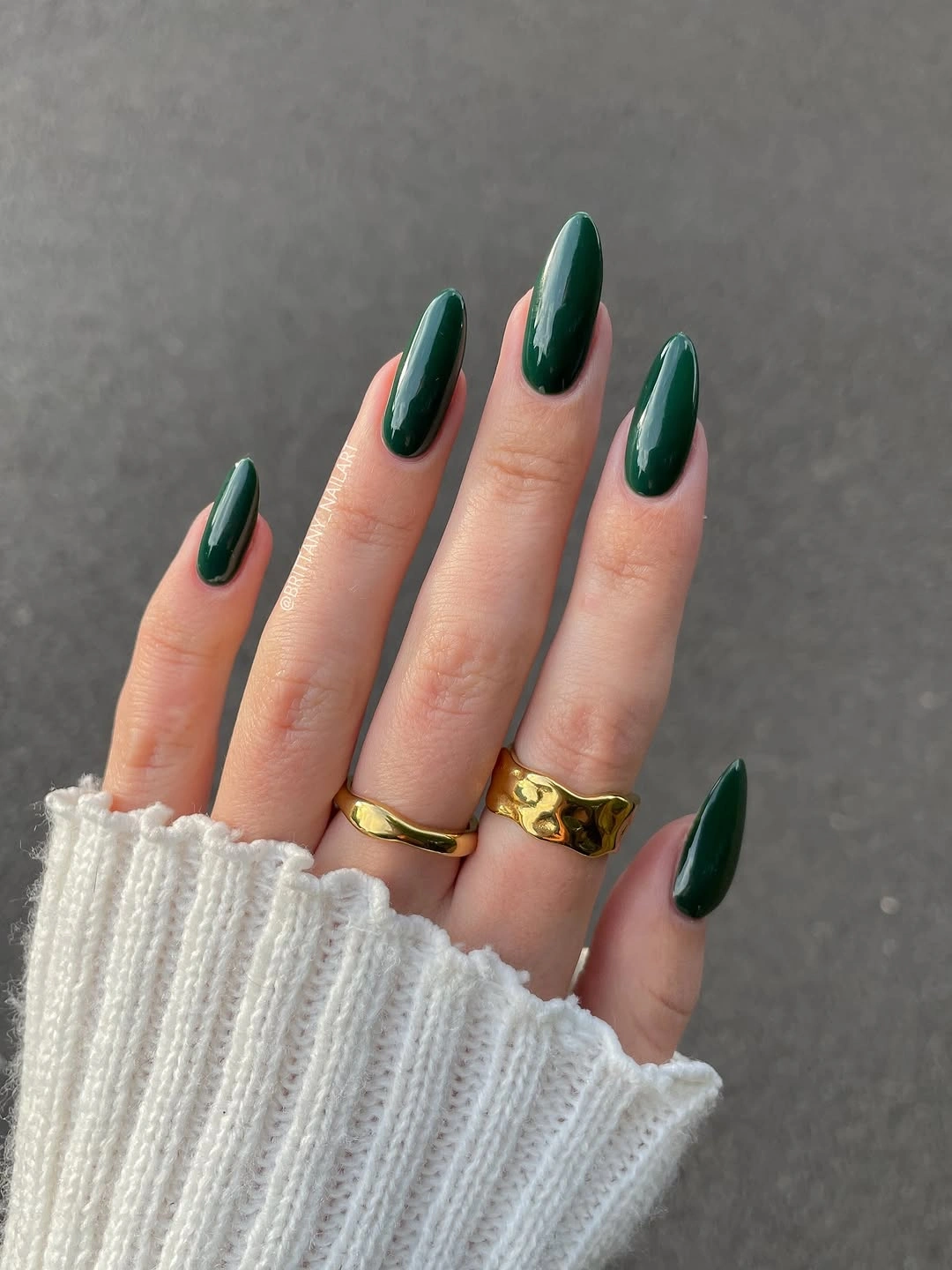
The depth of the green gives the manicure more range than a brighter leaf color would. It can look nearly black at the edge, then return to a clearer green where the light reaches the center, which creates subtle movement without a gradient or motif. This is a quiet autumn choice for readers who want a strong seasonal shade but do not need a literal illustration.
Choose a shorter almond or oval if the long silhouette is not practical, and keep the color uniform so the clean idea remains intact. One pale accent could be added, but it would shift the focus away from the depth of the green. The limitation is that a single dark shade reveals uneven edges quickly, so the manicure benefits from a consistent outline and a smooth-looking surface.
Burgundy and Nude With Tiny Botanicals
Long almond nails combine deep burgundy with warm nude accents carrying small orange-brown floral or leaf marks. The burgundy fingers create depth, while the light nails provide a generous field for the seasonal details to remain visible. The almond length gives the motifs room to sit near the center without crowding the tip, and the two sides of the palette feel connected through warm undertones.
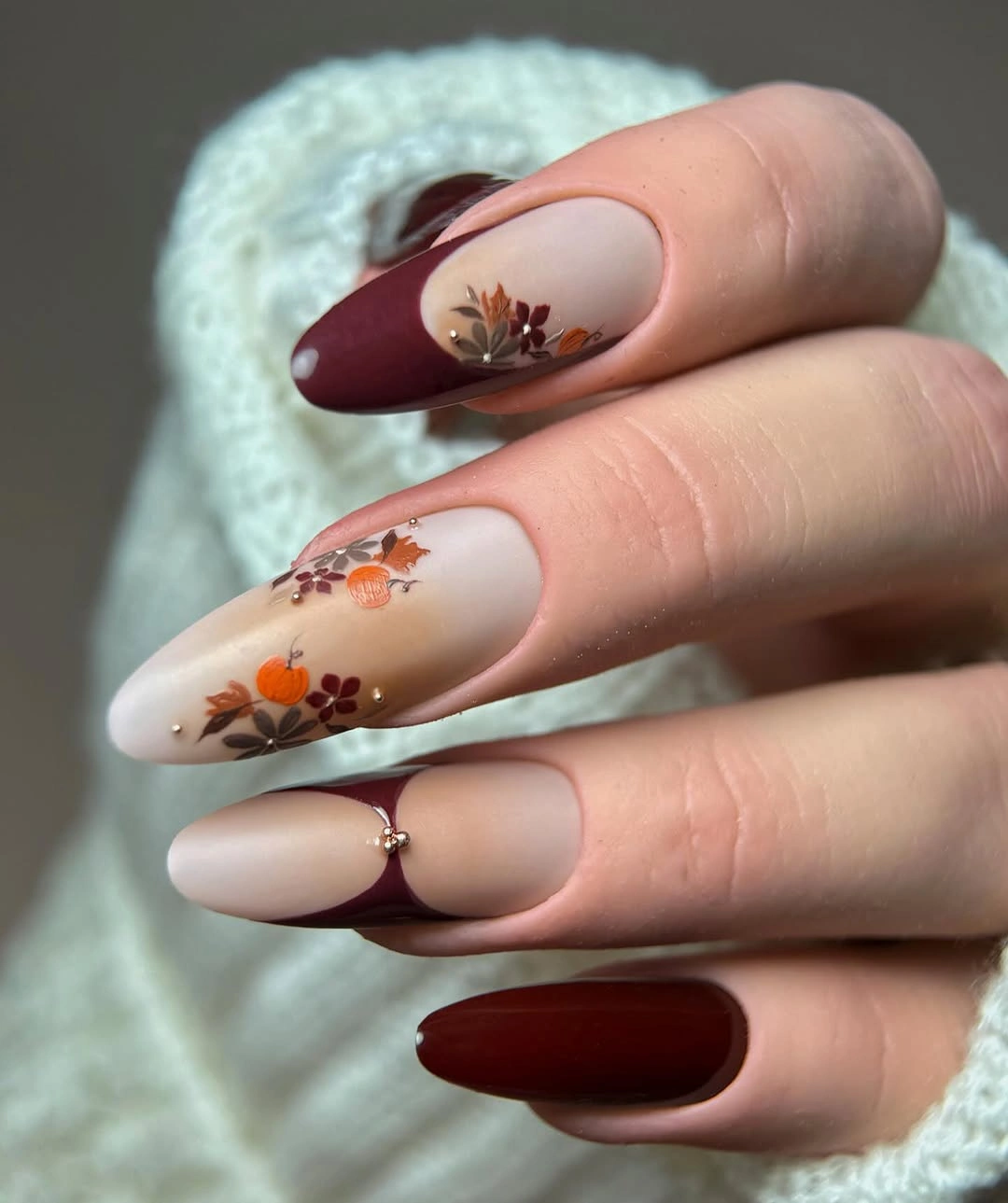
The small botanical marks work because they are not competing with another bright color. Their warm lines repeat the richness of the burgundy, while the nude background keeps each accent light enough to inspect. This arrangement gives the manicure a comfortable visual rhythm: dark, light, detail, then dark again, rather than a continuous field of seasonal symbols.
For a more restrained set, decorate one nude nail per hand and leave the rest burgundy. A medium almond can carry the same composition, although the flowers or leaves should be larger and fewer. The limitation is that a very delicate mark may disappear against a warm nude base, so the accent color should remain visibly deeper than the background without becoming harsh.
Chocolate Brown With Small Floral Breaks
Medium almond nails are mainly glossy chocolate brown, with pale accent nails showing small warm floral marks. The dark solids provide a steady foundation and make the lighter details easy to identify, while the almond shape keeps the transition between colors smooth. This design feels seasonal through a modest botanical interruption rather than through several different motifs competing across the hand.
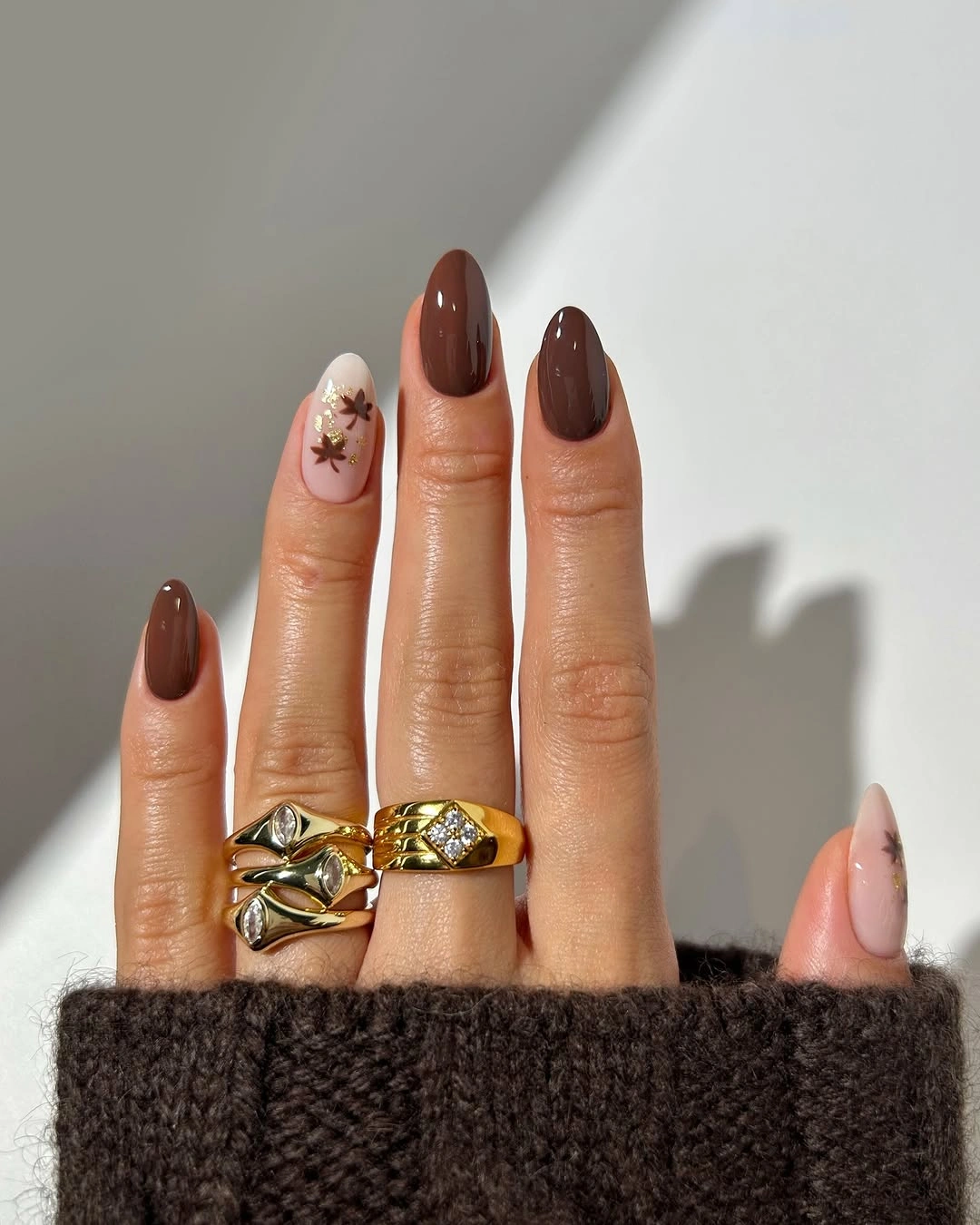
The pale accent is doing more than adding decoration. It lightens the visual weight of the brown and creates a place where the small warm marks can be seen without increasing their size. Compared with an all-brown manicure, the result has more rhythm; compared with a full floral set, it feels quieter because the dark solids remain the majority.
Keep the accents on two fingers and use the same chocolate shade everywhere else when adapting the idea. A shorter rounded shape will make the palette feel even more compact, while larger flower centers can protect the detail from blurring. The limitation is that pale polish beside dark brown shows stray edges clearly, so the accent nails need the same tidy outline as the solids.
Plaid and Knit-Like Texture Together
Medium-to-long almond nails mix muted mauve, cream, brown, and pink glitter with plaid panels and cable-like knit motifs. The surface feels inspired by textile pattern and texture, but the color remains controlled enough for the details to stay legible. The almond shape gives the plaid a vertical frame, while the glitter accent adds a small flash inside the otherwise muted, warm collection.
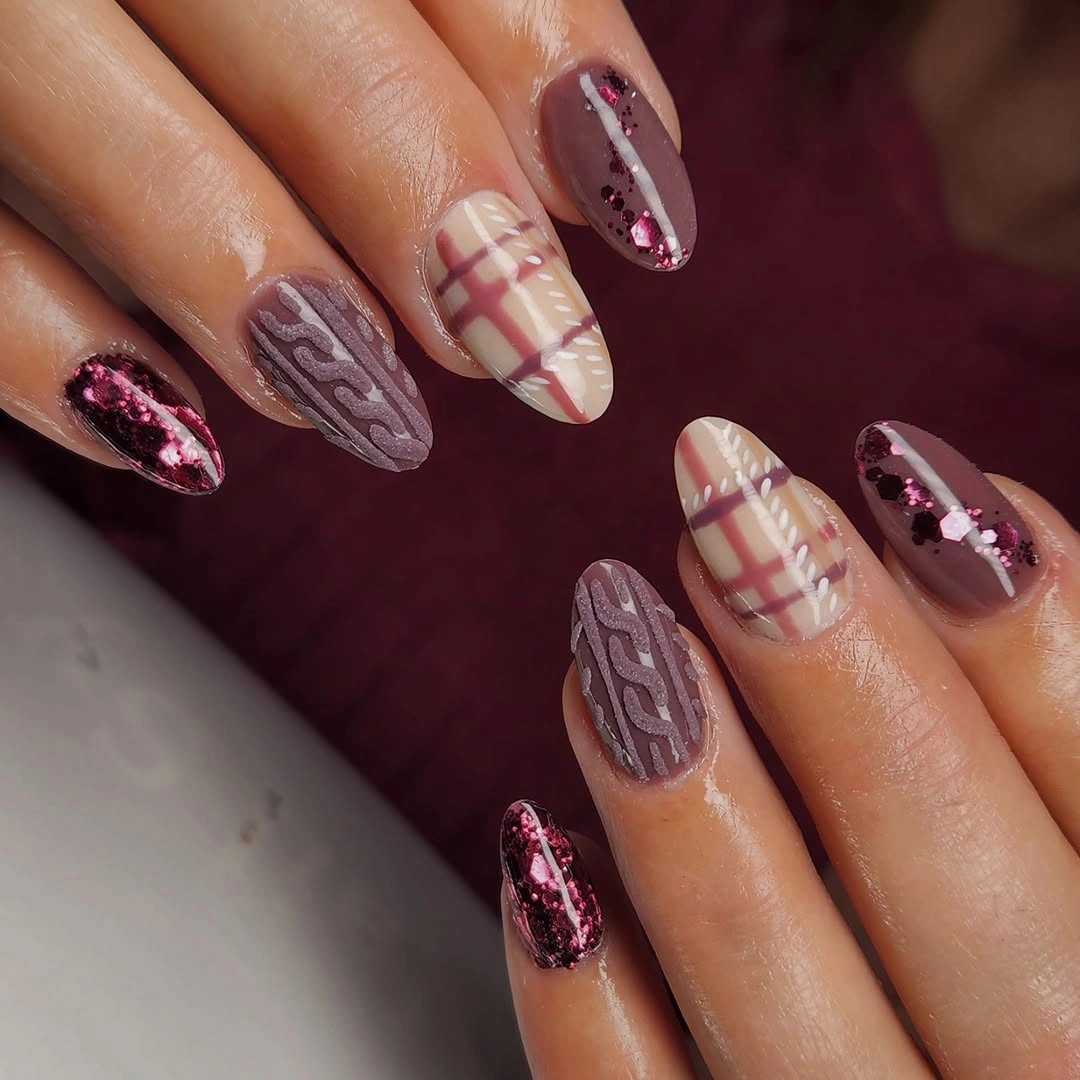
The design is strongest when the plaid and cable-like lines are allowed to play different roles. Plaid brings repeated geometry, the soft swirls provide a warmer break, and glitter marks one finger as a bright point rather than covering the whole set. That contrast creates seasonal comfort through visible pattern and surface suggestion, not through repeated autumn symbols.
On shorter nails, select either the plaid or the knit-like lines and keep the other fingers in cream, brown, or mauve. A single glitter accent can remain if the rest of the palette is quiet. The limitation is scale and texture: details that look spacious on a long almond can crowd a short surface, so reducing the motif count will preserve the impression better than squeezing everything in.
Navy With Small Light Motifs
Long almond nails use a deep navy base with tiny pale and warm marks that resemble flowers or leaves. The motifs repeat across the dark surface, but they remain small enough for the navy to dominate and the long shape to stay visible. A warm orange-white note inside the pale details prevents the blue from feeling too cool for the autumn palette.
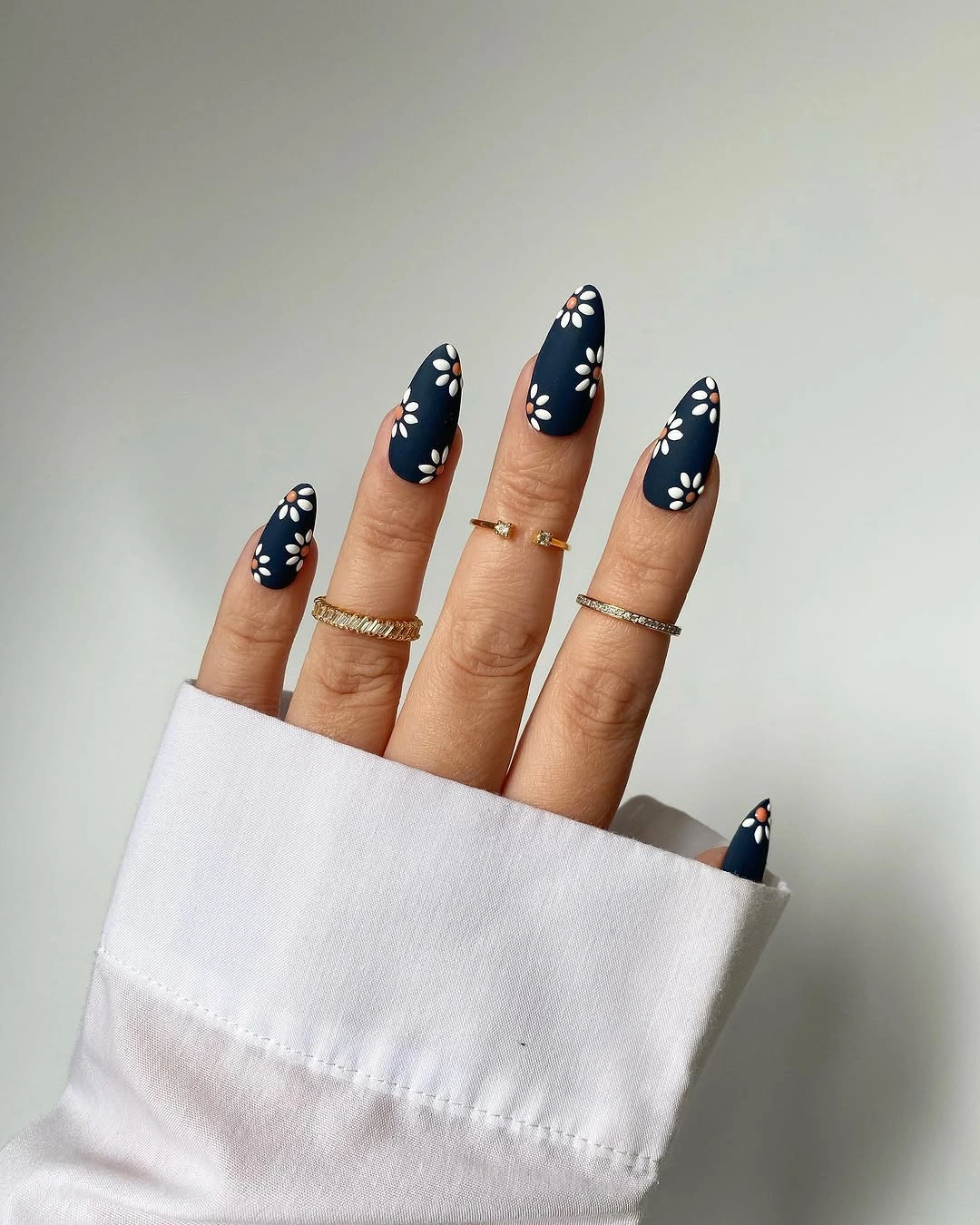
The repeated small mark is the important part of the composition. It creates continuity from finger to finger, while the dark base gives each accent a clear boundary and keeps the design from becoming a pale pattern. This is a useful seasonal direction for readers who are tired of brown but still want the manicure to feel grounded and rich.
For a shorter almond, use fewer marks and place them toward the center of two accent nails so they do not crowd the edges. A deep blue-green can warm the base slightly, while a plain navy finger can provide relief. The limitation is that tiny pale details need enough contrast to show against a dark surface, so very muted marks may disappear outside direct light.
Cream and Brown With Soft Miniature Lines
Short rounded nails mix creamy solids with translucent-looking brown accents and pale swirls, hearts, leaf-like lines, and one small framed detail. The motifs are varied but stay within a soft neutral palette, so the manicure feels warm rather than loud. The rounded shape supports the miniature artwork by keeping the visual movement close and preventing the set from becoming too elongated.
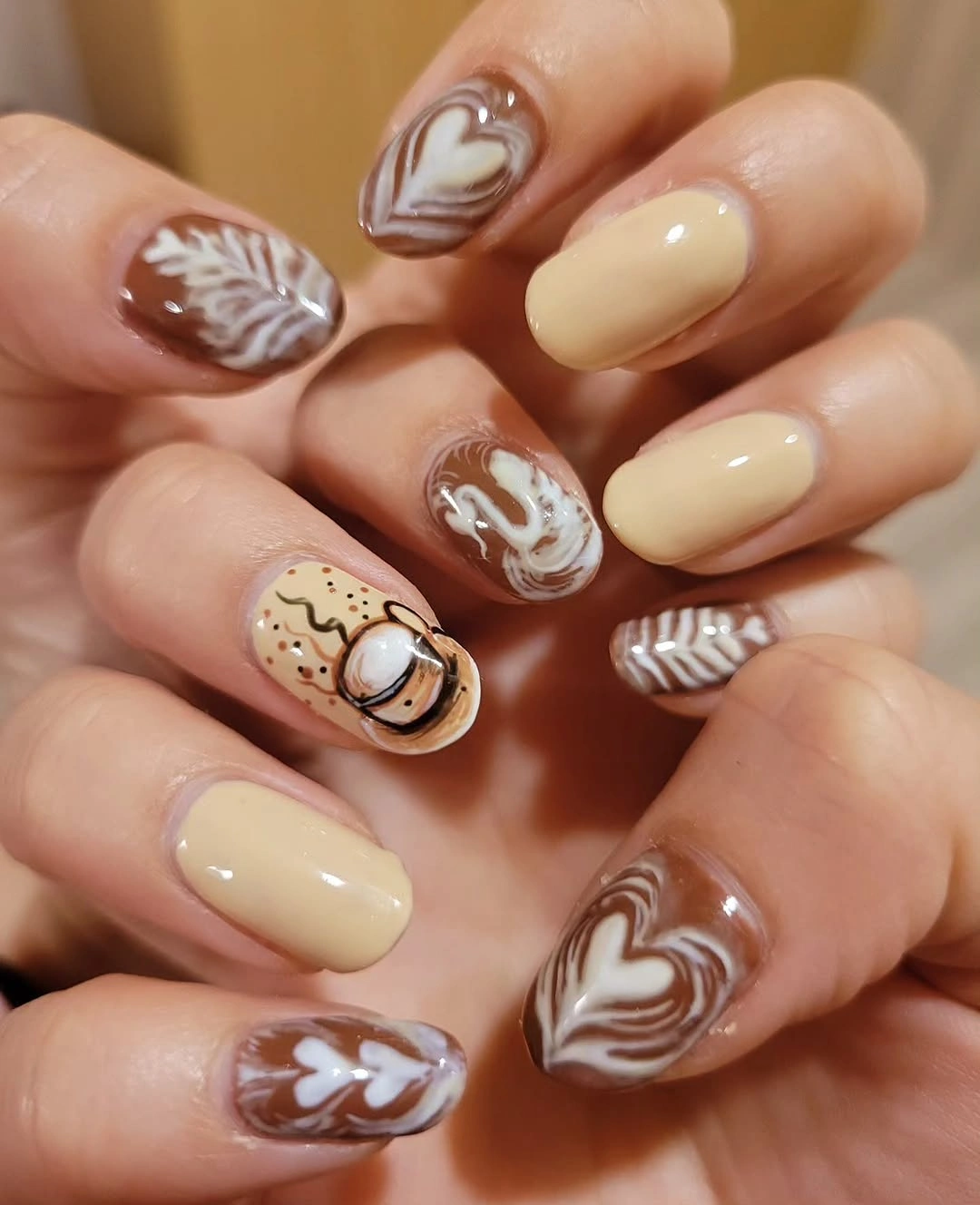
The open cream nails create the relief that the small details need. Pale lines can curve and overlap without fighting a bright base, while the brown accents echo the warmer autumn side of the palette. The result is a gentle pattern mix, and its character comes from the way the motifs share a quiet tone rather than from one large emblem that dominates the hand.
To simplify it, repeat only the swirl or leaf-like line on two nails and keep the remaining fingers cream or brown. A short oval will soften the look further, although the smallest framed detail may need to be removed. The limitation is interpretation: when several miniature marks are close together, reducing them to one clear gesture will look more intentional than preserving every uncertain shape.
Blush, Orange Lines, and One Glitter Nail
Soft blush nails carry fine orange geometric or botanical lines, small warm seasonal details, and one silver-glitter accent on a medium almond shape. The pale base allows the line work to remain delicate, while the glitter provides a bright change in texture that gives the collection a focal point. The manicure feels autumnal through its orange notes, but the blush keeps the overall surface light.
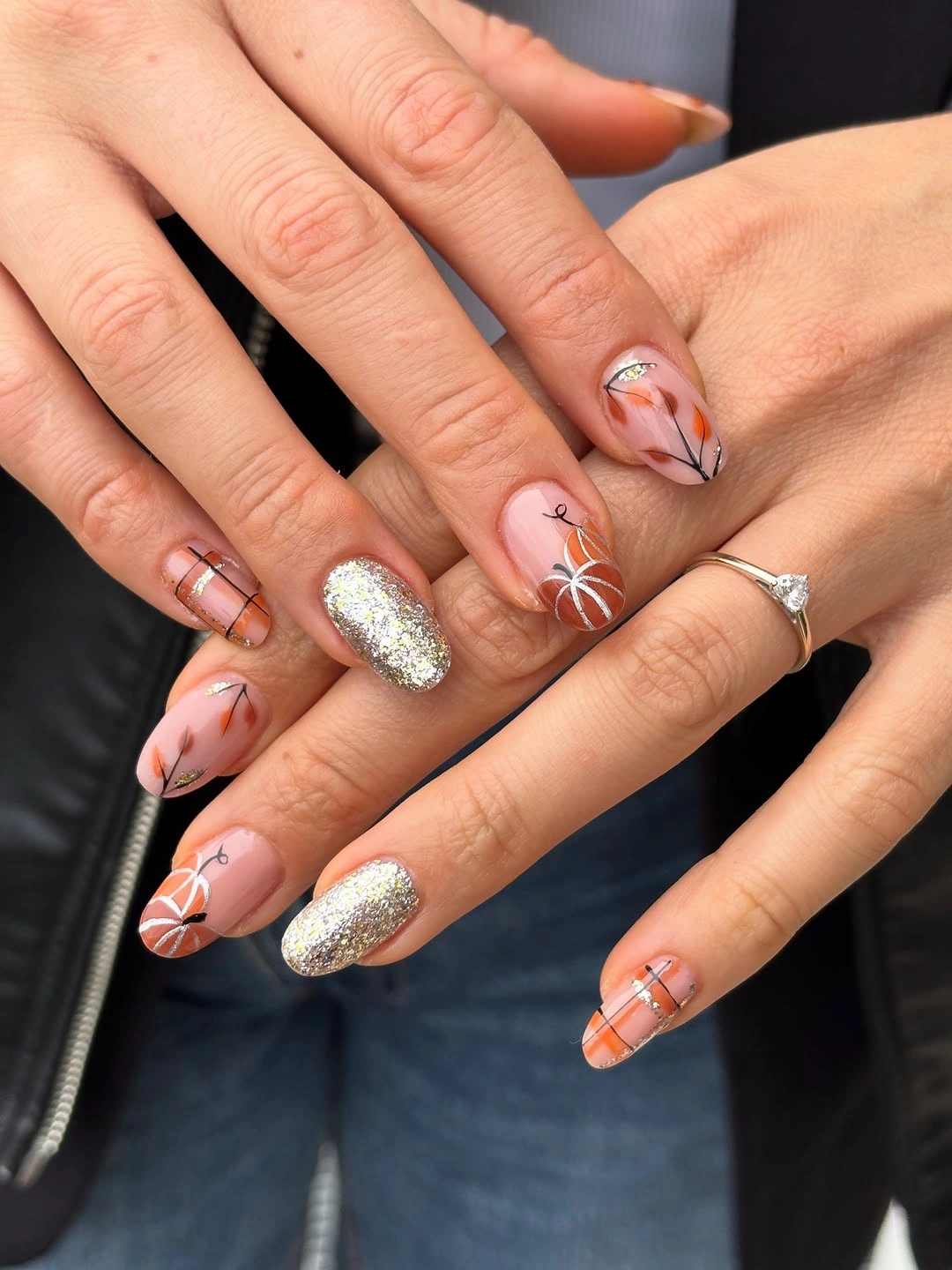
The isolated glitter nail prevents the thin marks from competing across the hand. It creates a pause in the rhythm, then the eye returns to the orange lines with more attention because the surrounding nails are not equally bright. This is an effective way to combine detail and relief: one finger catches light, while the rest explain the palette through smaller, quieter decisions.
Keep the glitter to one nail per hand and repeat one line motif if you want a cleaner version. A shorter almond can use broader curves and fewer warm marks, ensuring the blush base remains visible. The limitation is that fine orange details depend on neat spacing, so simplifying the drawing will usually produce a stronger result than adding more tiny seasonal elements.
Nude, Brown, and Orange in Fine Lines
Medium almond nails combine pale nude, chocolate brown, orange, and a taupe accent with plaid-like and curved line details. The palette feels warm but not overly saturated, and the small linear marks give the manicure a crafted quality without turning every finger into a full picture. The almond shape provides enough length for the lines to travel, while the solids keep the set visually grounded.
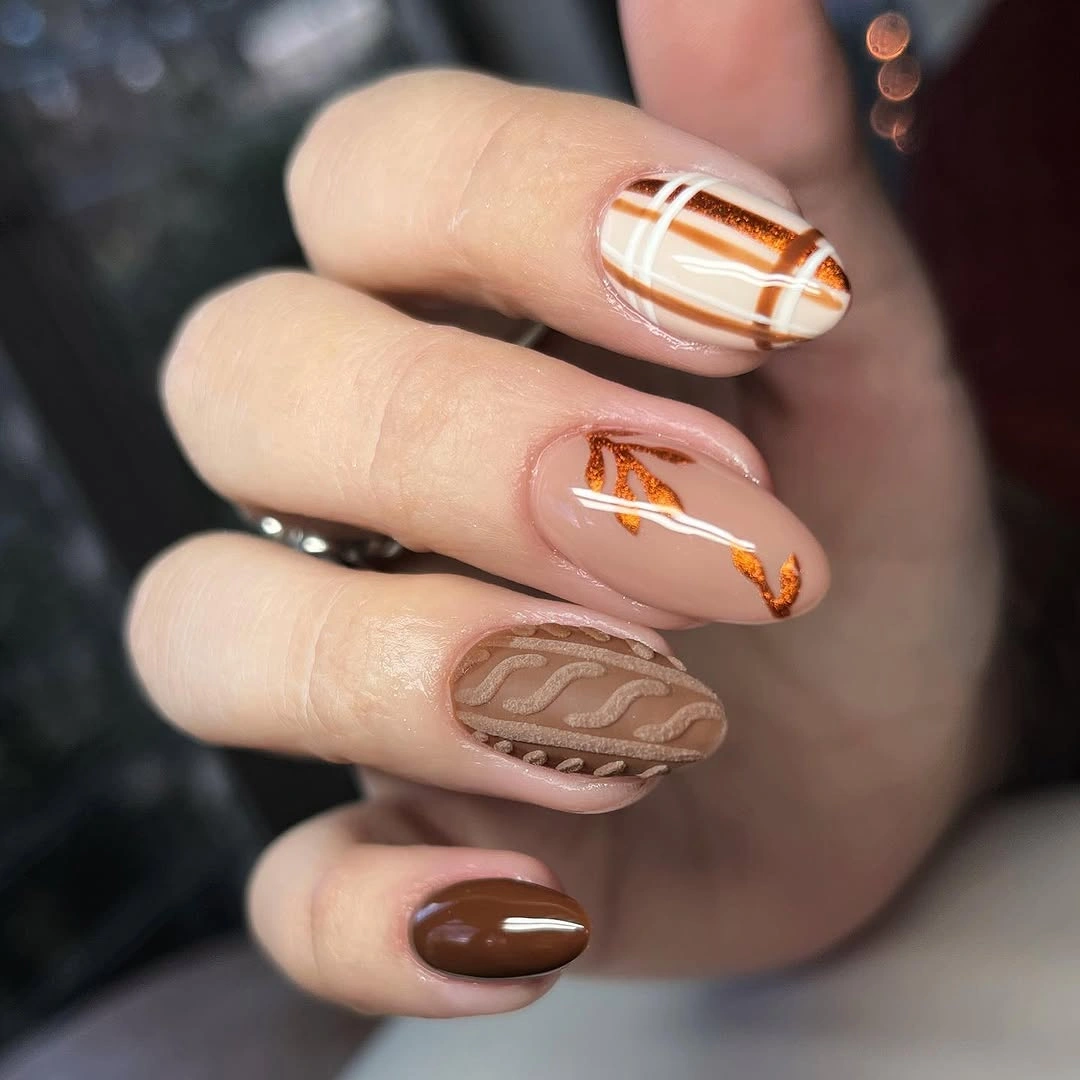
The repeated warm neutrals are what connect the different accents. Brown frames the lighter surfaces, orange supplies a seasonal flash, and taupe softens the transition so the plaid-like details do not look too sharp. This lets the manicure combine geometry and organic-looking marks while keeping the eye within one family of colors rather than moving through unrelated contrasts.
For shorter nails, use the nude and brown as the base and reserve orange for one accent line or a single solid finger. A simple curved mark will remain clearer than a dense plaid, especially when the nail has less length. The limitation is that linear designs expose spacing differences, so a reduced pattern with generous gaps will look more balanced than several tight lines.
Deep Teal and Cream in Geometric Balance
Long almond nails alternate deep teal and warm cream, with pale fingers carrying thin brown-orange curved accents. The cool teal gives the autumn palette an unexpected direction, while the cream and warm lines bring it back toward a softer seasonal range. The long silhouette makes the two solid colors look graphic, but the small curves keep the contrast from becoming rigid.
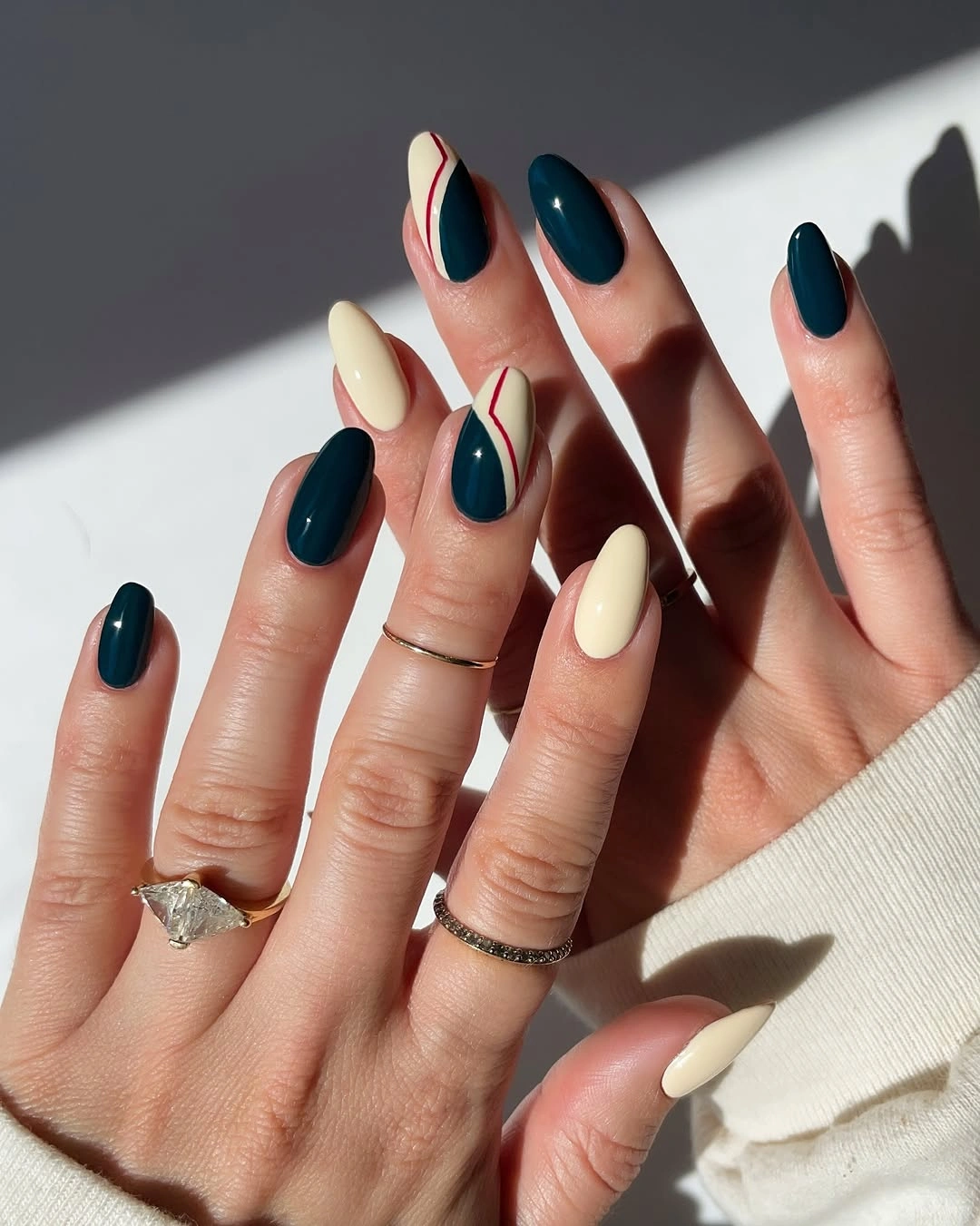
The useful detail is the color balance between cool and warm. Teal supplies depth without repeating the usual burgundy or brown, and cream prevents it from reading as a heavy block. The fine lines act as a bridge because their warm notes echo the season and connect the pale nails to the richer solid ones without adding another large color field.
On a shorter almond, use teal on two nails and cream on the rest, then place one curved accent on a pale finger. A muted blue-green can soften the contrast if the deep teal feels too strong. The limitation is that the design relies on clean color separation, so uneven edges or overly narrow cream areas can make the set look busier than the original idea.
Small Seasonal Characters on Short Nails
Short rounded nails combine dark brown, sage green, pale pink, white, and a striped accent, with tiny colorful seasonal figures or marks on the lighter fingers. The solid nails give those playful accents enough space to stand out, while the short shape keeps the mismatch from becoming visually long. It is an illustrative direction, but the palette remains grounded in autumn neutrals.
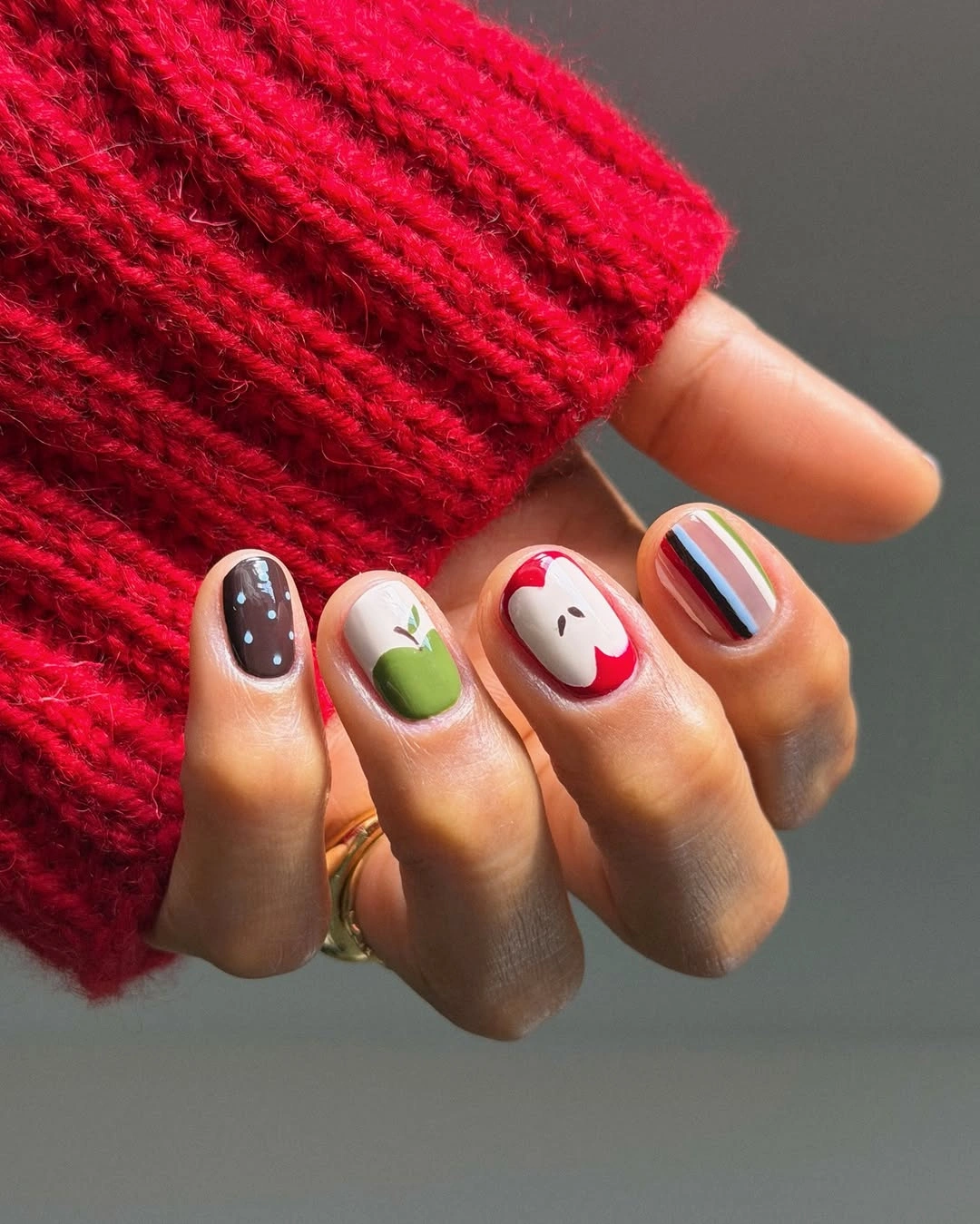
The contrast between plain and illustrated nails creates the collection’s rhythm. A small figure or dot is easier to notice when it sits beside a quiet sage or brown surface, and the striped nail adds another kind of pattern without repeating the same drawing. This makes the manicure feel planned even though each accent carries a slightly different visual idea.
For a simpler recreation, keep the sage and brown solids, then use dots or tiny leaves instead of trying to copy every small figure. A short oval can make the mismatch feel softer, while one white accent can provide enough contrast for a small mark. The limitation is scale, because miniature characters may lose their identity as the nail changes, so color and simple silhouettes are safer than fine outlines.
Charcoal With Patterned Tonal Depth
Medium almond nails return to a glossy charcoal base with a darker floral or leafy pattern visible through tonal variation. The manicure is restrained in color but not completely plain, because the pattern adds a soft layer of texture across the surface. The almond silhouette remains important, and the low-contrast detail follows it without creating a separate bright focal point.
This design feels seasonal through depth rather than through orange or brown. The charcoal base is rich, the repeated pattern adds quiet surface interest, and the absence of bright contrast keeps the hand looking composed. It is a useful alternative for someone who wants autumn detail but prefers a cooler palette and a motif that reveals itself gradually.
Use a slightly lighter pattern on shorter nails so the floral shapes remain visible, and leave a few fingers plain to create relief. A soft oval can reduce the graphic quality if you want the set to feel gentler. The limitation is visibility in flat light, so a tonal design should have enough difference between base and pattern to avoid becoming indistinguishable.
Shifting Mauve, Gold, and Green Reflection
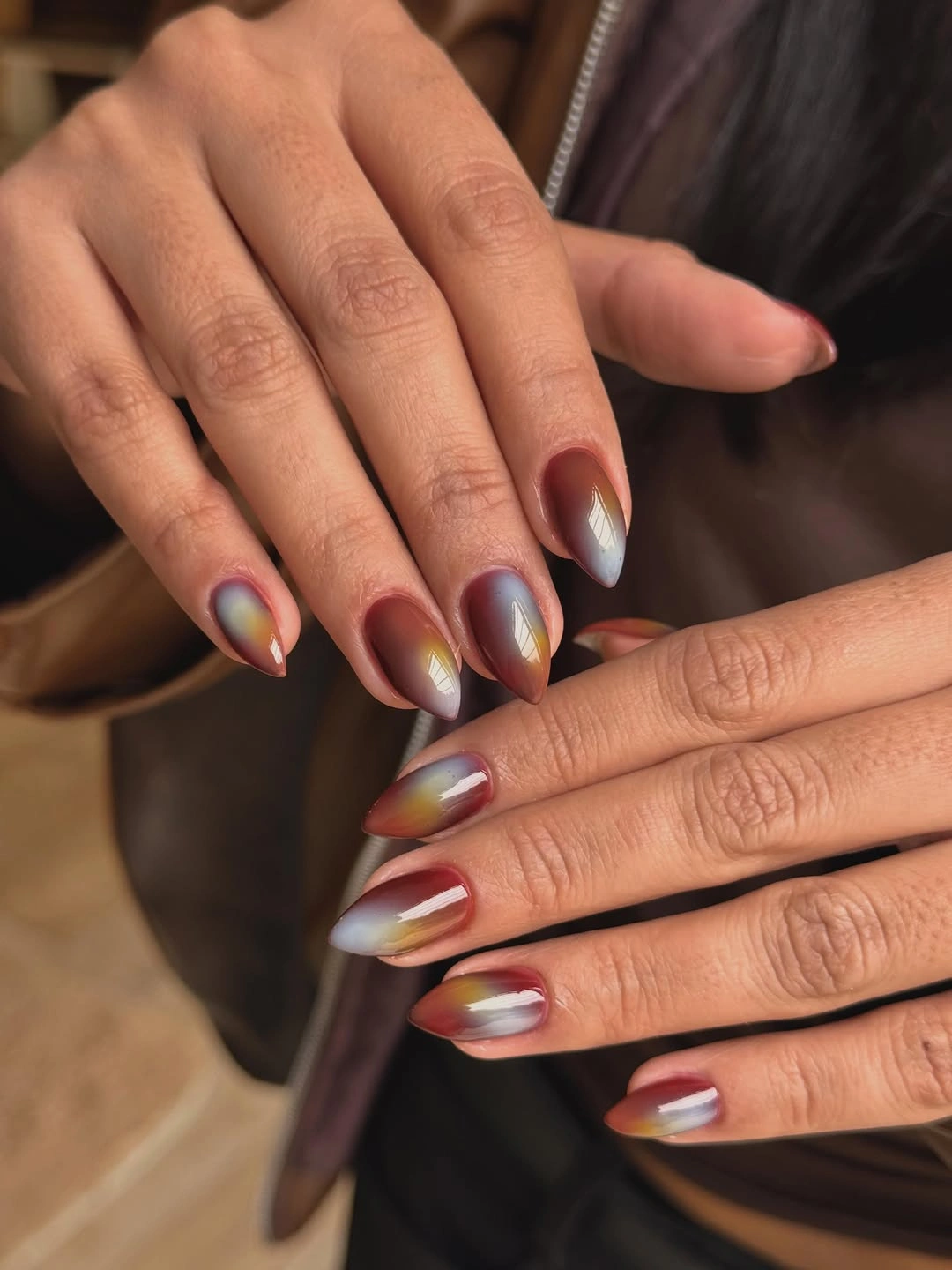
Medium-to-long almond nails carry a smooth reflective surface that shifts between mauve, gold, green, and pearl-like tones. There is no separate painted motif to direct the eye, so the visual interest comes from the changing color across the curved nail. The length gives the reflection space to move, while the mixed undertones keep the manicure connected to both warm and cool parts of the season.
The color change is most effective when the base remains cohesive. Mauve supplies a soft berry note, gold adds warmth, green keeps the effect from looking flat, and the pale reflection gives the surface a clean lift. Together they create a layered finish that can sit beside autumn clothing without needing leaves, plaid, or other literal seasonal marks.
Choose a shorter oval or almond if you want the shifting effect with less visual length, and keep the shape smooth so the reflection remains continuous. Avoid adding a separate accent unless it is very small, since another motif would compete with the surface movement. The limitation is lighting: the manicure can look more like one muted shade indoors and reveal its range only when the hand moves.
Burgundy, Plaid, and Knit-Like Lines
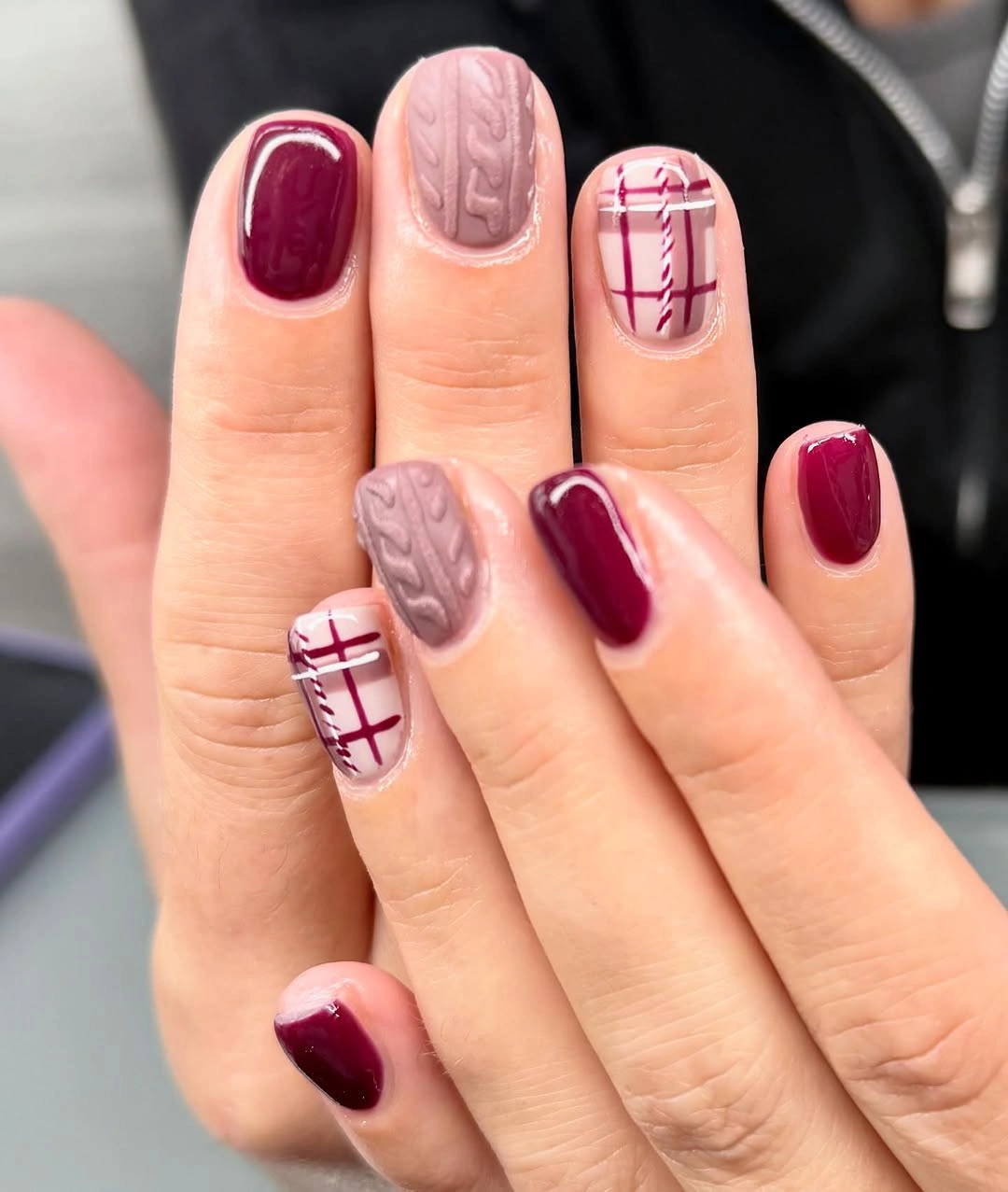
Short rounded nails alternate deep burgundy solids with pale pink accents carrying plaid lines and cable-like knit motifs. The burgundy anchors the set and makes the pale patterned fingers feel like deliberate breaks rather than a second manicure. The compact shape keeps the cozy reference close to the hand, while the repeated lines provide enough texture to make the seasonal idea visible.
The most useful detail is the difference between the two pale accents. Plaid introduces a regular grid, while the cable-like lines feel softer and more curved, creating visual comfort through contrast in pattern. Because both remain on a light base, the motifs share a common setting, and the burgundy solids keep the varied details from spreading across every finger.
For a lower-detail version, choose plaid or cable lines and repeat that one motif on two nails. A short square can carry larger shapes more easily than many thin intersections, and the burgundy can stay uniform elsewhere. The limitation is that knit-like detail can become dense quickly, so leaving some pale space around each line is more important than adding another texture.
Magenta, Orange, and Textured Plaid
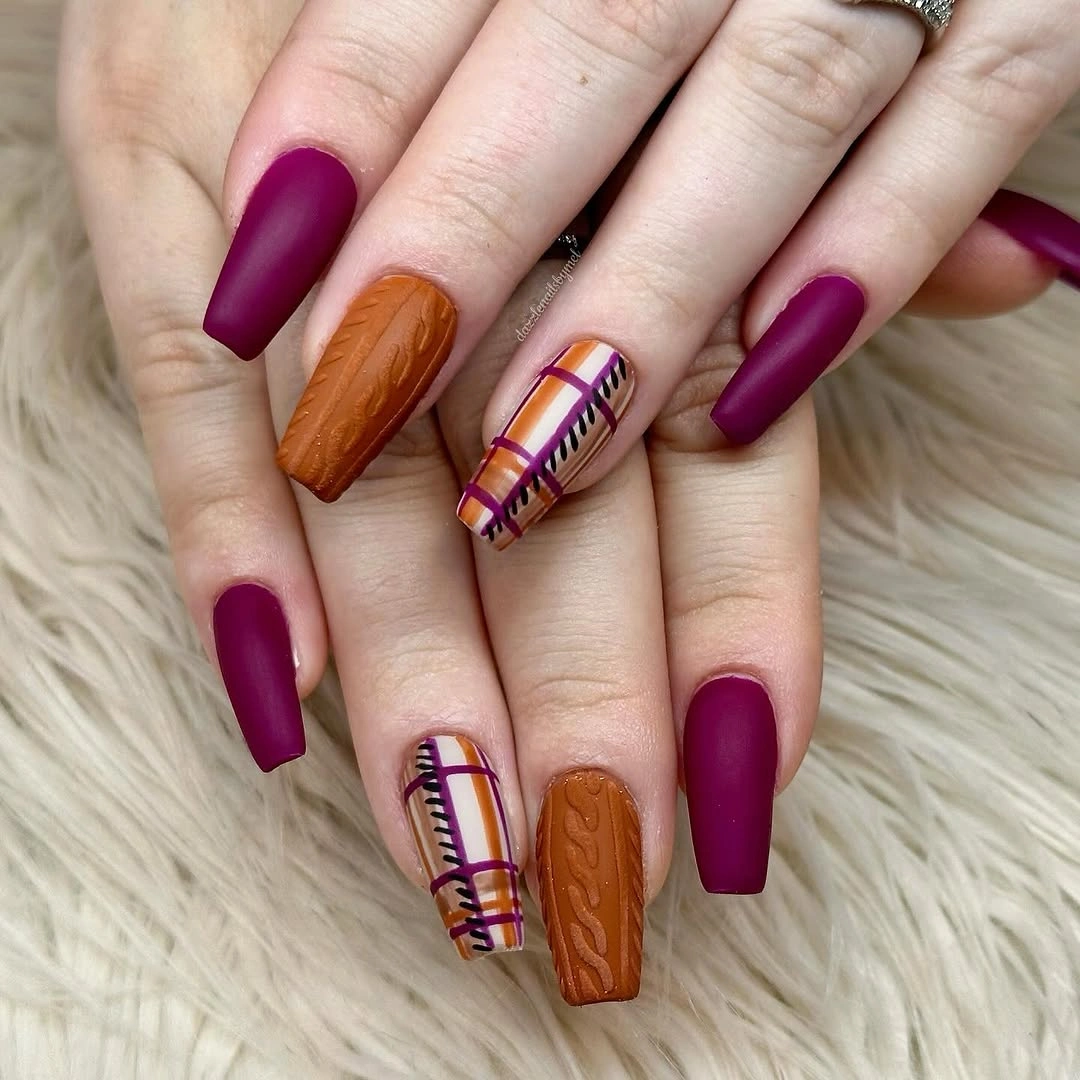
Long square nails combine deep magenta, orange, mauve, cable-like textured accents, and purple-orange plaid lines. The saturated colors make the set more assertive than the muted designs earlier in the collection, while the square outline gives the mixture a firm structure. The textured-looking nails add a tactile suggestion, but the color contrast remains the first thing to register.
The design works because the plaid and warm solids repeat the same energetic palette. Magenta supplies depth, orange adds a clear autumn flash, and mauve softens the transition so the combination does not become only red versus orange. The cable-like details then add another layer, but they are supported by the colors rather than asked to carry the entire visual identity.
Shorten the square shape and keep one textured accent if you want the design to feel more practical. A simpler plaid with fewer crossing lines will preserve the pattern while avoiding a crowded surface, and the magenta can remain the main solid color. The limitation is maintenance around dense details, since small changes in edge or texture can be more visible than they would be on a plain nail.
Nude Nails With Warm Pointed Tips
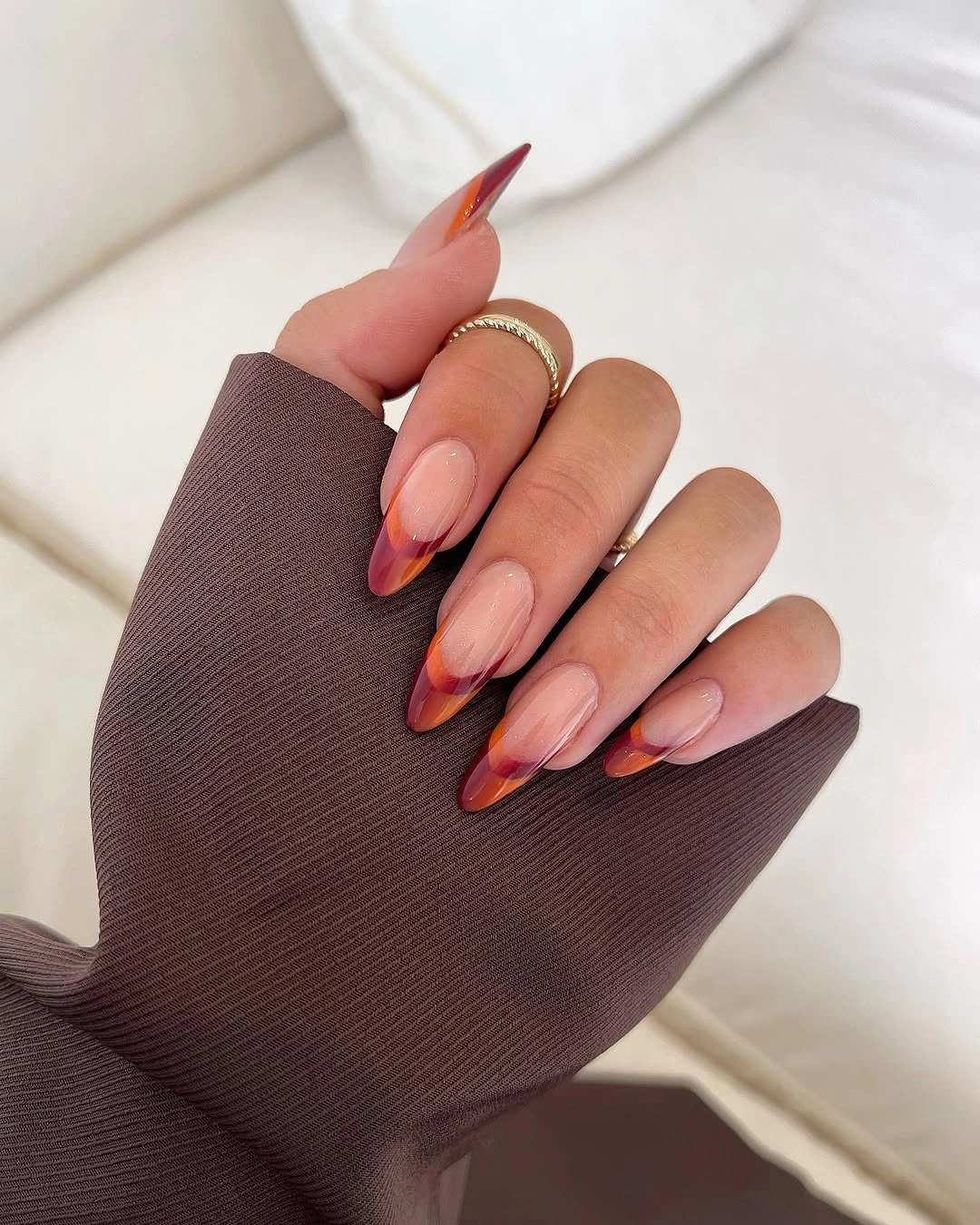
Long pointed nails use a sheer nude-pink center with sharp orange, rust, and deep brown tip accents. The open center keeps the long silhouette light, while the warm tips create a clear autumn contrast without covering the whole nail in dark color. The design is simple in its ingredients, but the pointed outline makes the change from pale to warm feel precise.
The pale center is the detail that gives the tips room to speak. It separates the warm colors from the skin and lets the pointed edge become the main graphic line, while the combination of orange and brown keeps the manicure seasonal rather than neon. Compared with a full orange manicure, this version feels lighter; compared with a plain nude, it has a much clearer endpoint.
For a softer adaptation, use a medium almond with wider rust-brown tips and fewer color changes. Keeping one pale area open will preserve the visual logic, even when the shape is shortened. The limitation is that a pointed tip can make the design feel more dramatic than the palette alone suggests, so rounding the edge or reducing the number of warm accents may be the better adjustment.