Fall nail colors for dark skin can move from deep plum and espresso to copper, teal, nude, caramel, bright yellow, and dusty pink. The useful question is not which shade is universally flattering, but how value, saturation, finish, and placement create visible contrast in each design; these twenty-one looks show solid color, French edges, ombre, glitter, line work, and compact accents.
Use the examples as color relationships rather than fixed rules. A dark base may need gloss or a lighter accent to show its surface, a pale nude can act as open space for a line or tip, and a bright color becomes easier to organize when a neutral or repeated shade gives it a place to settle on your own nails.
Deep Plum with Glossy Almond Contrast
Medium-long almond nails are painted a deep plum-purple with a smooth glossy finish. The saturated cool color remains distinct against the visible dark skin and dark fabric because the highlights separate the surface from the background. Rings add a small metallic interruption, but the solid palette and tapered outline keep the manicure focused.
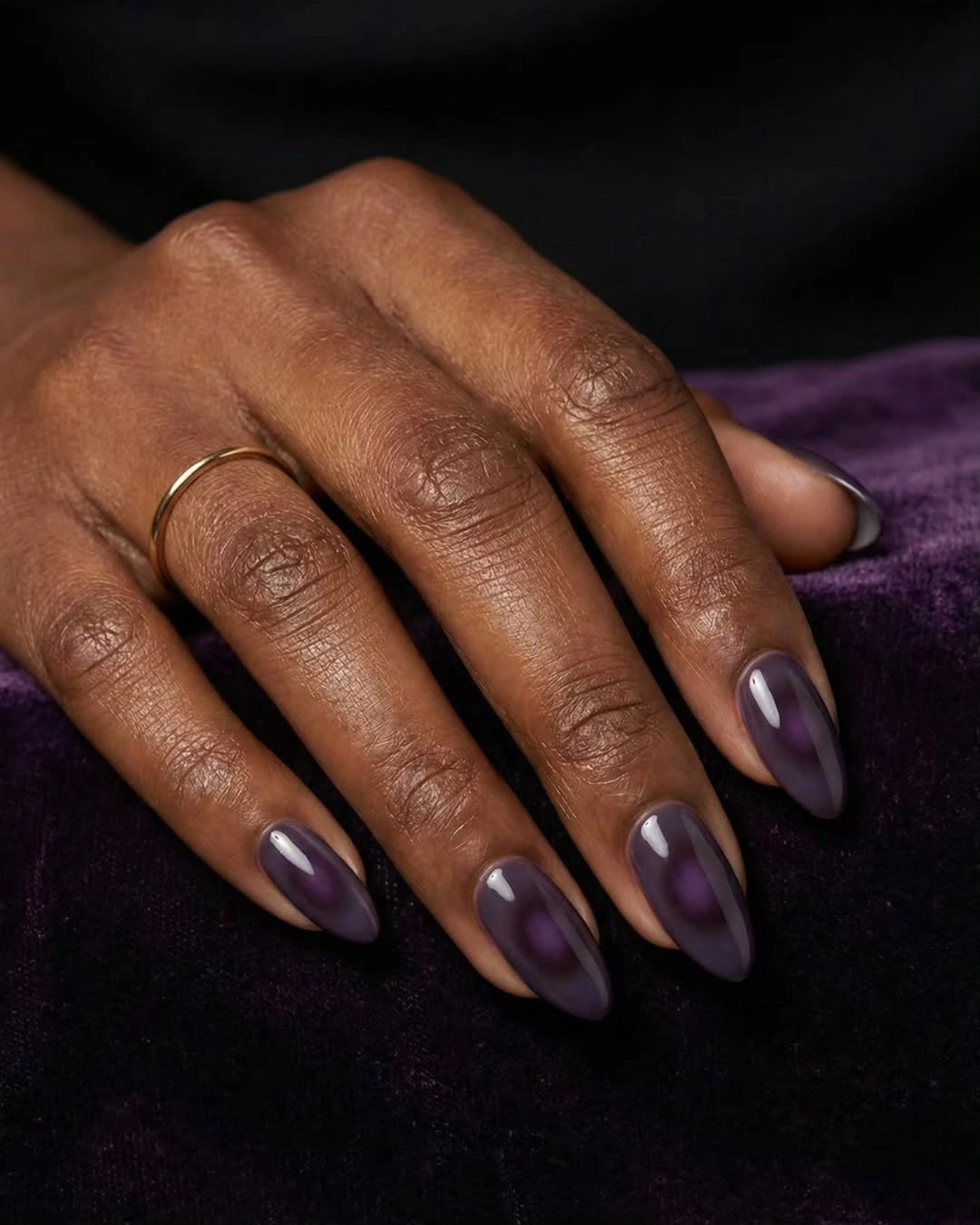
Keep the plum solid if you want the shade to remain the main decision, or use a pale accent on one finger to make the contrast more obvious. An oval shape will soften the same color, while a longer almond will make the dark tone look more elongated. Gloss is doing real visual work here, so a matte finish would change the value relationship and make the color read more quietly.
This design illustrates why a deep shade can still be visible on a deep background when finish and shape create separation. The purple undertone adds difference from the fabric, and the almond tip provides a clear edge around the finger. The limitation is not the color itself but surface clarity: a solid dark polish exposes chips, uneven coverage, and edge wear quickly.
Turquoise and Orange Lines over Nude
Long almond nails use a pale nude base with thin turquoise and orange accents tracing the tips. The bright colors sit at the edge rather than filling the nail, so the contrast remains crisp and the nude center stays open. Denim and dark skin in the surrounding composition make the cool blue-green and warm orange relationship easy to notice without requiring a heavy base.
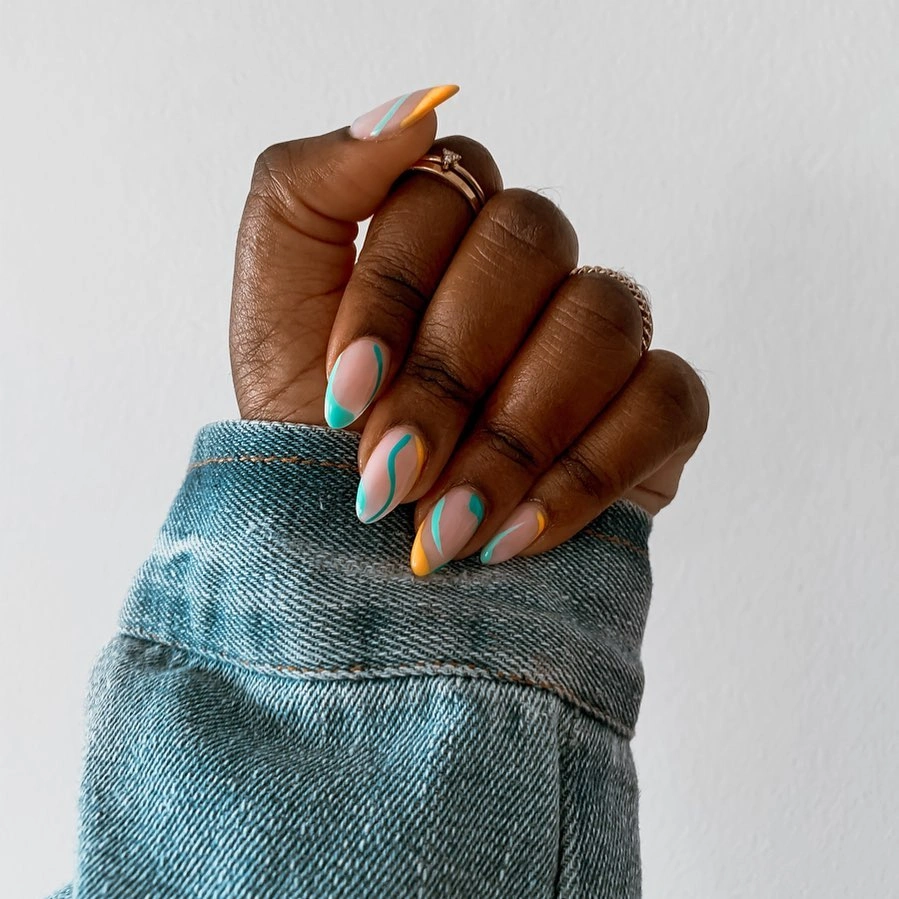
Keep one tip color if two feel too lively, using turquoise for a cooler result or orange for a warmer one. The almond shape gives the lines a long curve, while a shorter oval can use a thicker, simpler edge so the detail does not disappear. Repeat the same placement on several fingers because consistency is what turns bright accents into a palette rather than scattered marks.
The design works through temperature contrast and negative space. Nude keeps the surface light, turquoise supplies a cool note, and orange brings warmth, so the eye moves along the tips instead of stopping at one full-color block. The practical tradeoff is precision: thin tip lines are visible because they contrast strongly, which also means uneven borders will be easy to spot.
Burnt Orange across a Long Almond Set
Long almond nails are coated in a warm burnt-orange shade with a glossy, even surface. The color reads as terracotta rather than bright neon, and it stands apart from the visible dark skin through warmth and reflected light. No pattern interrupts the set, so the nail length, color value, and surface finish remain the entire visual argument.
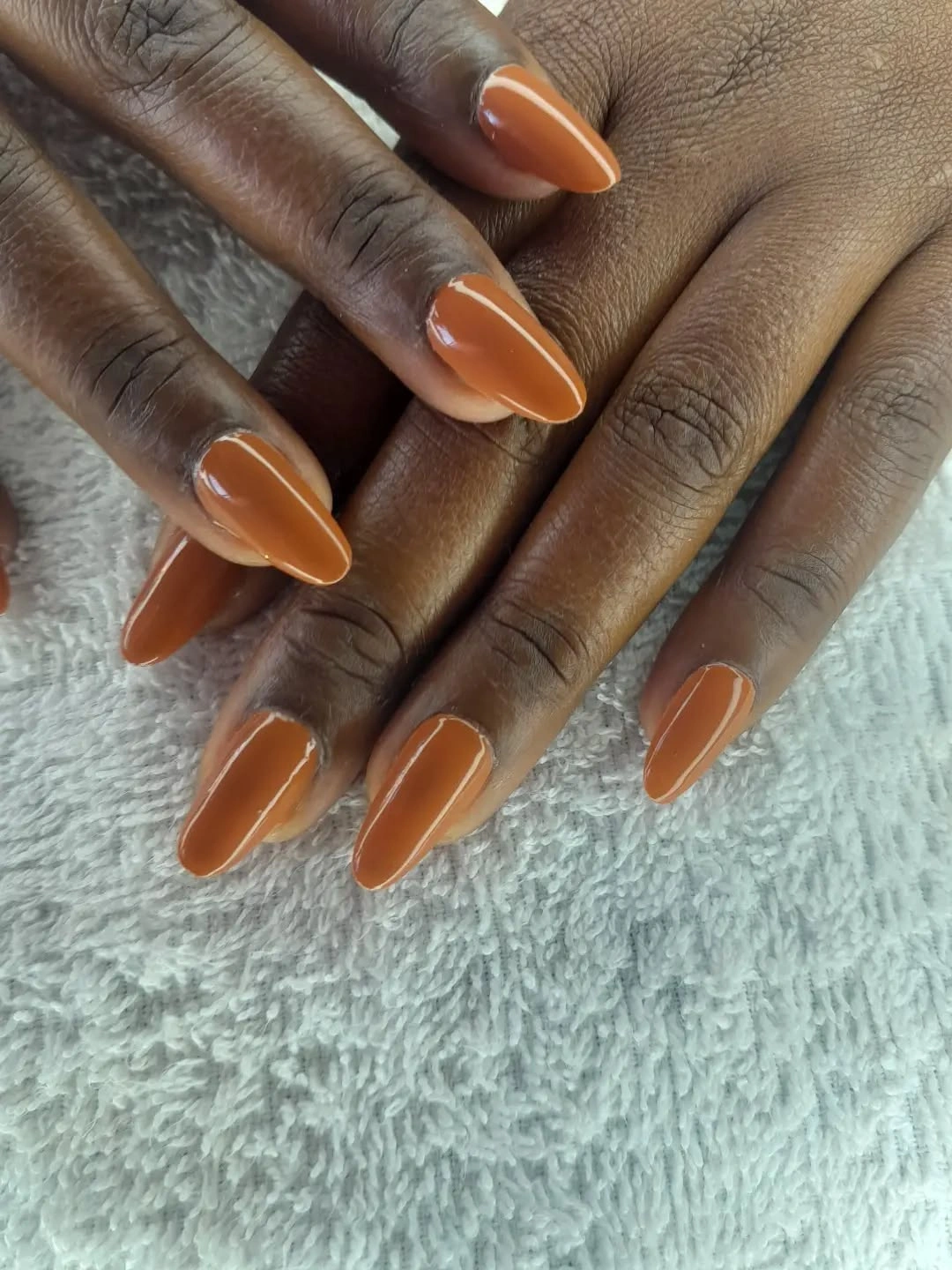
Use a shorter almond or rounded shape if you want to make the orange feel less elongated. The solid shade will remain visible as long as its undertone stays warmer and lighter than the surrounding skin, but the exact effect will change with lighting. If you add an accent, choose a nude or deeper brown so the orange remains the anchor rather than competing with another bright color.
This is a clear example of saturation doing the work. Burnt orange has enough warmth to separate from the background, while gloss creates highlights that make the long almond surface easier to read. The limitation is visual intensity: because the color covers every nail, a brighter orange may feel more commanding than the same shade used on two accent fingers.
Deep Brown French Edges on Nude
Medium-long almond nails use a pale nude-pink base with dark brown curved tips. The brown edge creates a strong outline while leaving most of each nail light, and the repeated curve follows the almond shape on both hands. A plain wall keeps the contrast clear, making the design useful for studying how a dark accent can be concentrated instead of spread across the full nail.
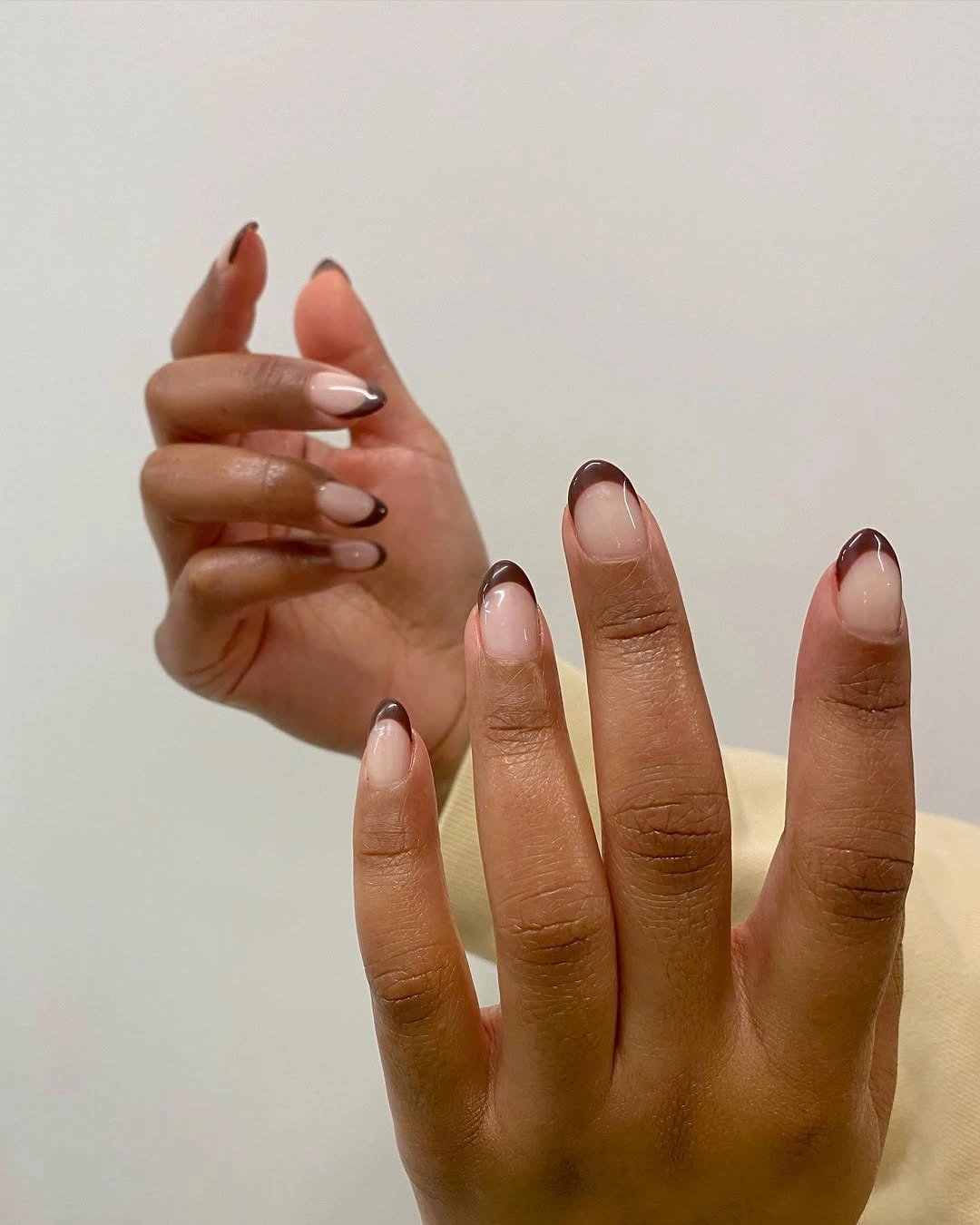
Keep the tip narrow if you want more nude space, or make it slightly wider on a longer almond for a stronger fall statement. A shorter oval can use a smaller dark crescent so the free edge does not dominate the hand. Repeating the curve consistently matters more than choosing a very dark brown, because the shape is what makes the contrast look deliberate.
The color relationship is simple but effective: pale value opens the surface, brown adds depth, and the curved border creates repetition. It is a gentler alternative to a fully dark manicure while still making the tip visible against the surrounding skin. The tradeoff is edge maintenance, since a French boundary near the free edge reveals chips and growth more clearly than a blended color.
Glossy Teal on a Compact Oval Shape
Short-to-medium oval nails are painted a saturated teal-green with a glossy finish and no visible art. The jewel-like color creates a cool contrast against the visible dark skin, while the rounded shape prevents the solid shade from feeling too sharp. Gold rings and a light sleeve frame the hand, but the color remains the strongest element.
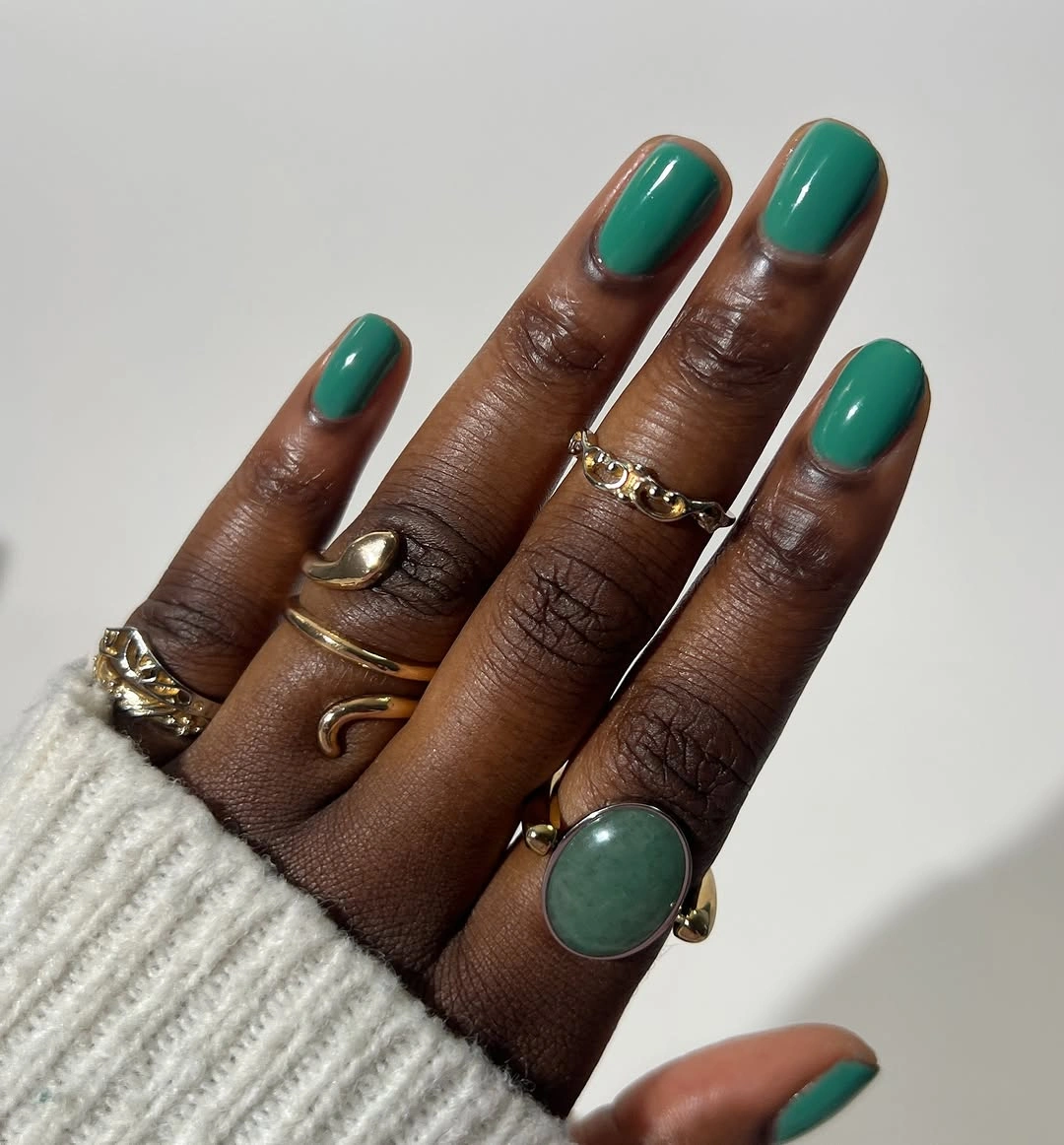
Use a shorter oval for a quieter version, or move to a medium almond if you want the teal to look more elongated. Because the set is solid, the contrast comes from saturation and finish rather than a second color, so adding several accents would change the clear simplicity. A muted teal can soften the effect, while a brighter one will make the color relationship more immediate.
This shade shows that a cool color can feel seasonal when its value is rich and its surface catches light. Teal does not need a warm brown beside it to work, but the rounded outline helps contain the saturation and keep the hand balanced. The practical note is surface consistency: gloss makes the color lively, but it also highlights small marks and uneven edges.
Nude Nails with Copper-Brown French Tips
Long almond nails have a glossy pale nude base with warm copper-brown tips and a fine lighter outline near some edges. The darker tip supplies fall depth, while the open nude field keeps the design visibly lighter than a full brown manicure. Against dark skin and a pink background, the warm border reads as a clear color change without needing additional art.
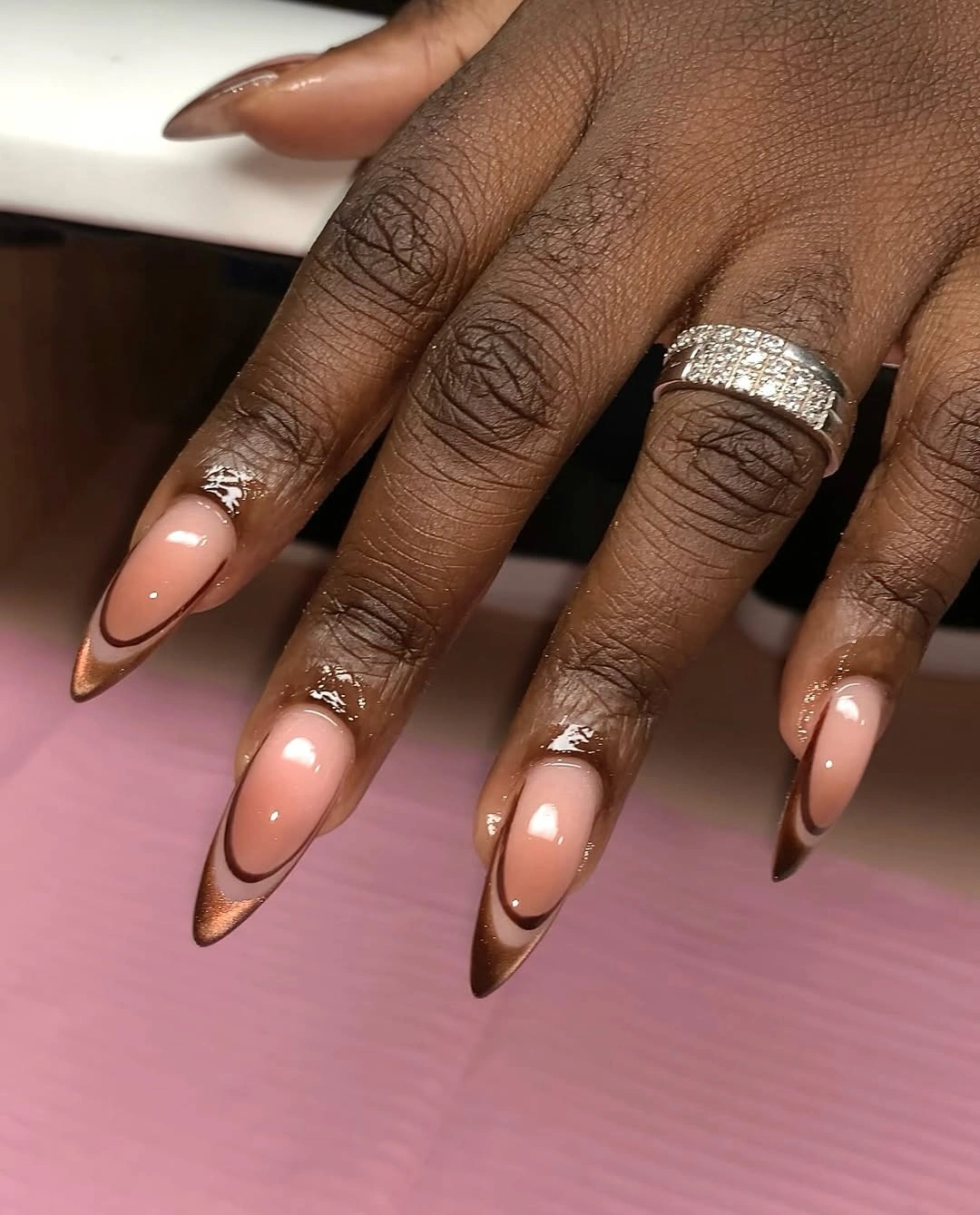
Use a medium almond or tapered oval if you want the tip to feel more contained. Keep the lighter border narrow, because it works as a small separator between the nude base and warm brown edge rather than as another large color block. If the design needs more contrast, deepen the brown tip before adding new decoration so the color relationship stays easy to follow.
The visual logic comes from value and temperature together. Nude leaves the center open, copper-brown introduces warmth, and the almond curve repeats the boundary across the hand. The limitation is precision at the edge: a warm French tip can look uneven when the curve changes from finger to finger, especially on a long pointed outline.
Nude-to-Brown Ombre on Long Points
Long pointed nails fade from pale nude near the base into deep brown at the tips. The glossy transition creates a smooth value shift, and the dark ends visually extend the sharp points without covering the entire nail in opaque color. A white background makes the gradient easy to inspect and keeps the two-tone relationship distinct.
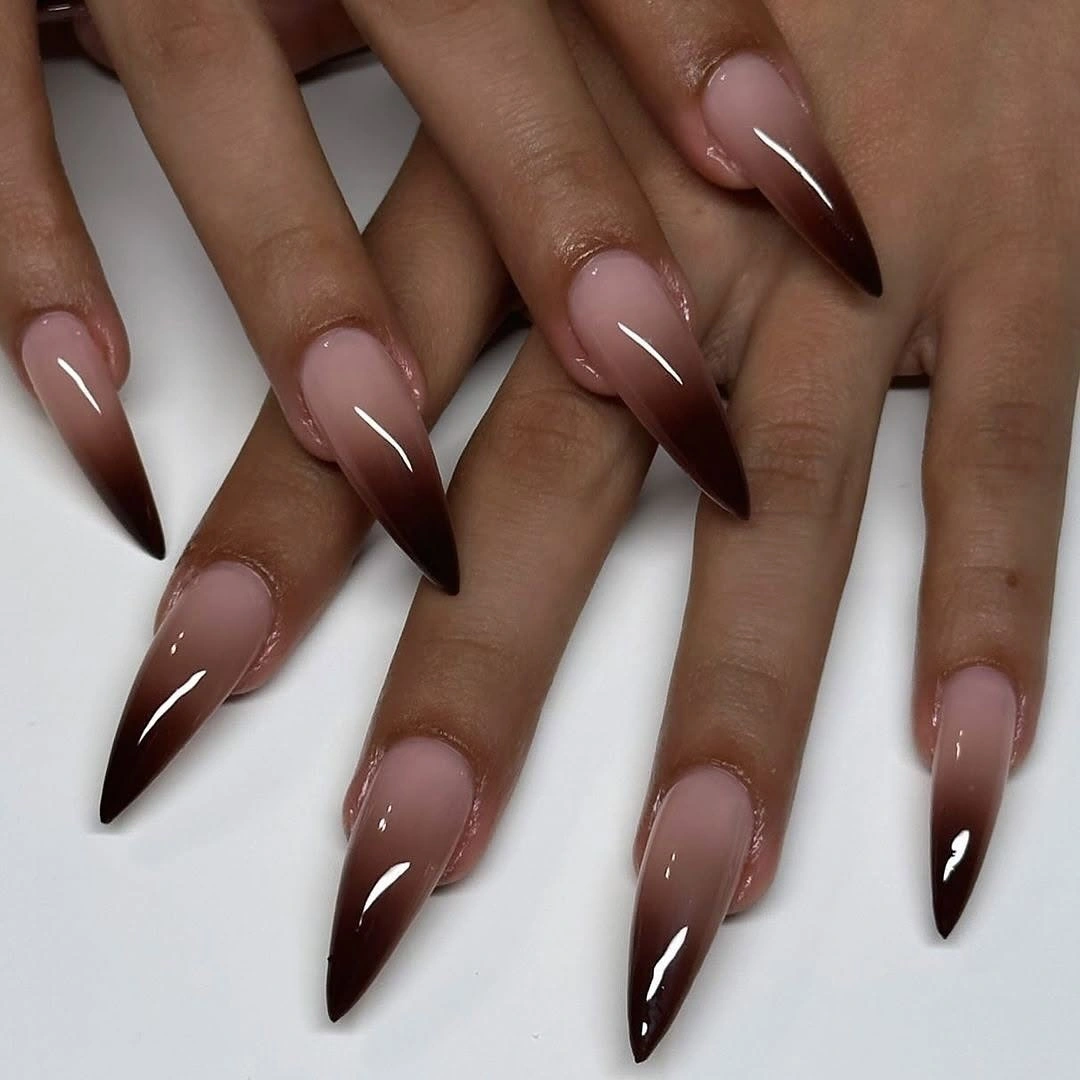
Keep the dark area closer to the tip if you want the base to stay light, or move the transition slightly higher for a stronger brown presence. A medium almond can carry the same fade with less dramatic length, while a shorter shape may need a broader, simpler blend. Avoid adding glitter unless the gradient itself becomes hard to read, because the value change is already the main feature.
This design uses contrast as a line of movement rather than a boundary. Nude creates a light starting point, brown deepens the end, and the pointed shape makes the eye travel outward. The functional tradeoff is the length itself: long points change how the hand works, and any interruption in the blend will be more visible along the extended tip.
Mixed Brown and Blush with Small Accents
Medium almond nails alternate pale pink-nude, brown, and soft neutral shades, with a few small dark botanical-like marks on lighter fingers. The deeper brown acts as an anchor among the open tones, while the tiny accents add direction without turning the set into a full pattern. A gold watch and bracelet supply surrounding warmth, but the manicure stays organized through related values.
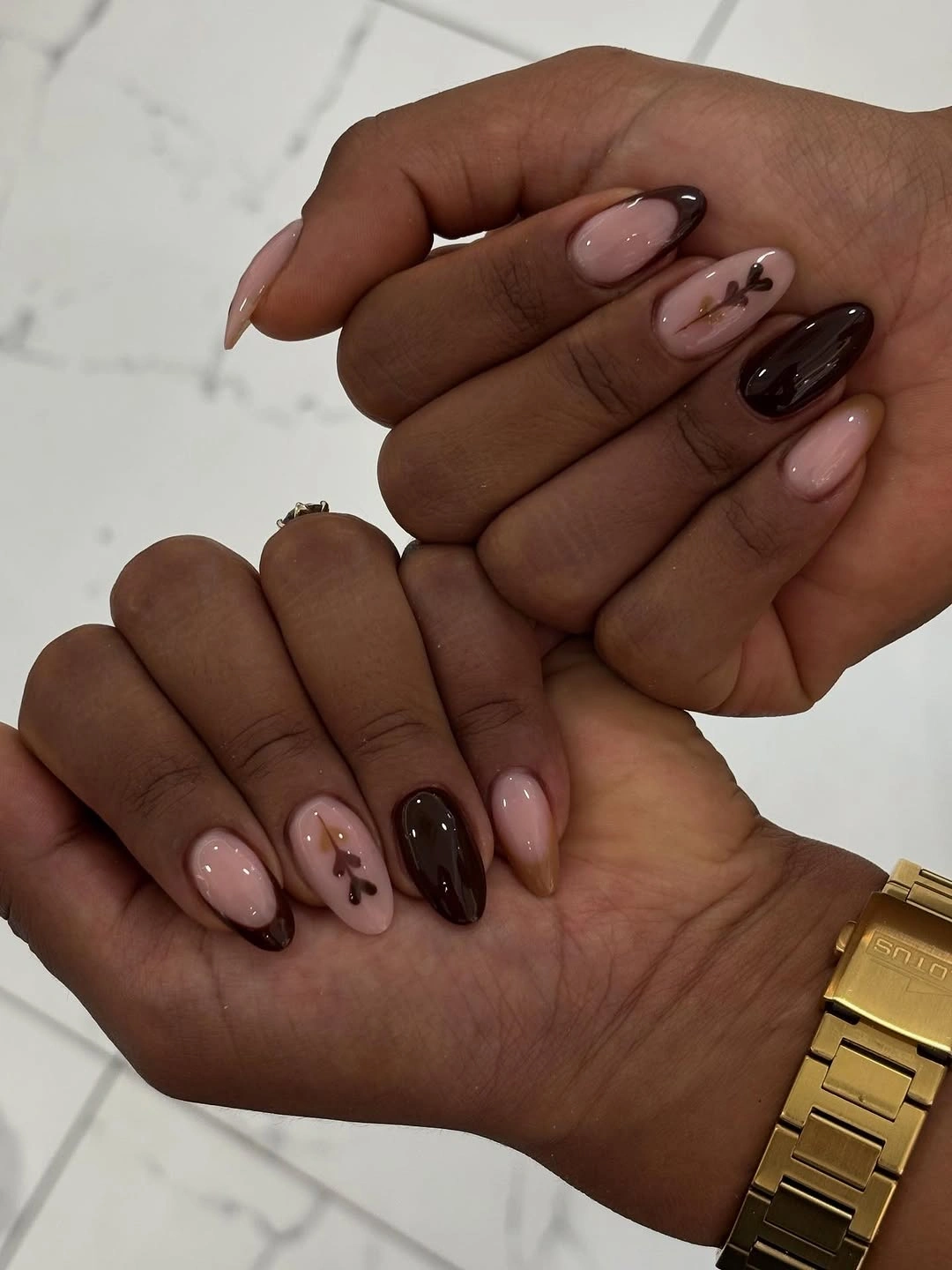
Choose one brown and one blush if you want a cleaner palette, then use a single small mark on the lighter finger. The almond shape gives the contrast room to stretch, while a short rounded nail can keep the accent near the center and preserve more open space. Repeating the deeper shade on at least two fingers will give a mixed neutral set a stable anchor.
The important relationship is value rather than a strict warm-cool split. Brown provides depth, blush brings lightness, and the small dark marks repeat the anchor color so the accents do not float apart. The limitation is that mixed neutrals can become vague if every shade is too close, so one visibly deeper tone is useful for keeping the design legible.
Caramel Brown French Tips with White Hearts
Medium square nails use a warm caramel-brown base with bright white French tips and small outlined white hearts on selected fingers. The white edge creates a crisp horizontal contrast against the brown, while the heart remains secondary to the graphic tip structure. The visible dark skin gives the warm base and white accents a clear frame without requiring a heavy dark color.
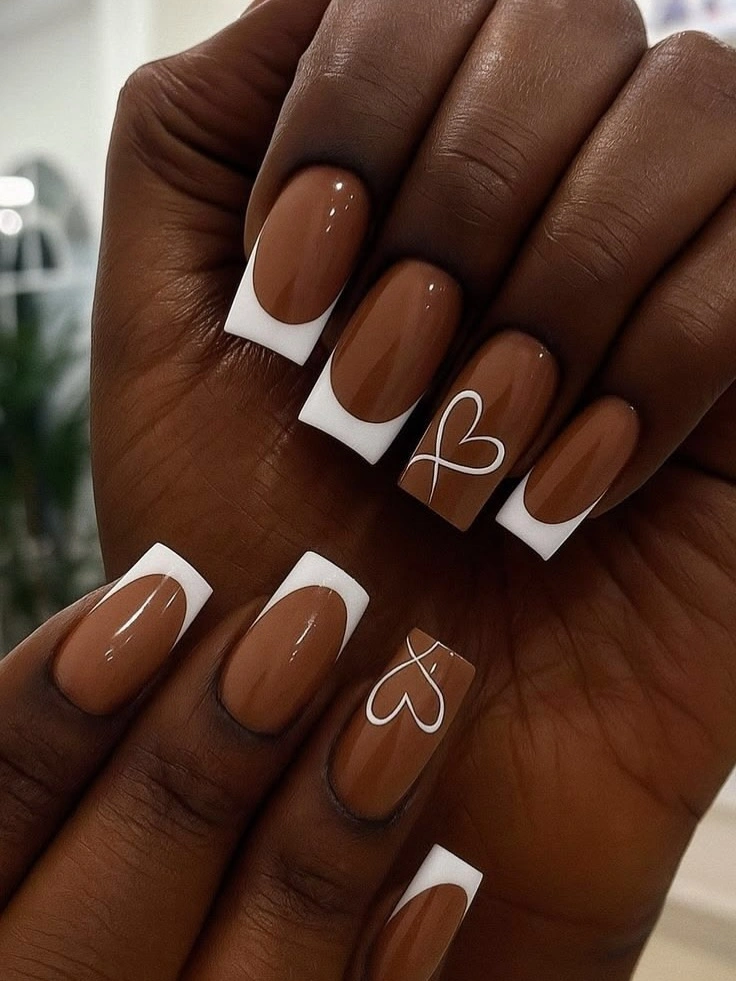
Keep the hearts on one or two nails and let the French edge repeat across the set for a simpler brief. A shorter square can use a thinner white tip, while a medium length allows the heart outline to sit comfortably inside the brown field. If you want a quieter result, replace the bright white with a softer cream while preserving the same value contrast.
This manicure works because the base, edge, and motif have different jobs. Caramel supplies warmth, white establishes the structure, and the small heart adds a personal note without competing with the shape. A crisp square edge also creates a practical limitation: growth and minor chips can interrupt the clean horizontal line sooner than they would in a blended design.
Espresso Stiletto Tips as the Main Shape
Very long pointed nails are painted a solid espresso-brown that reads close to black in the deepest areas. The glossy surface creates long highlights, while the stiletto outline supplies the sharp vertical direction and makes the dark color visible against the lighter sleeve. Gold rings add small points of contrast, but there is no separate motif to dilute the silhouette.
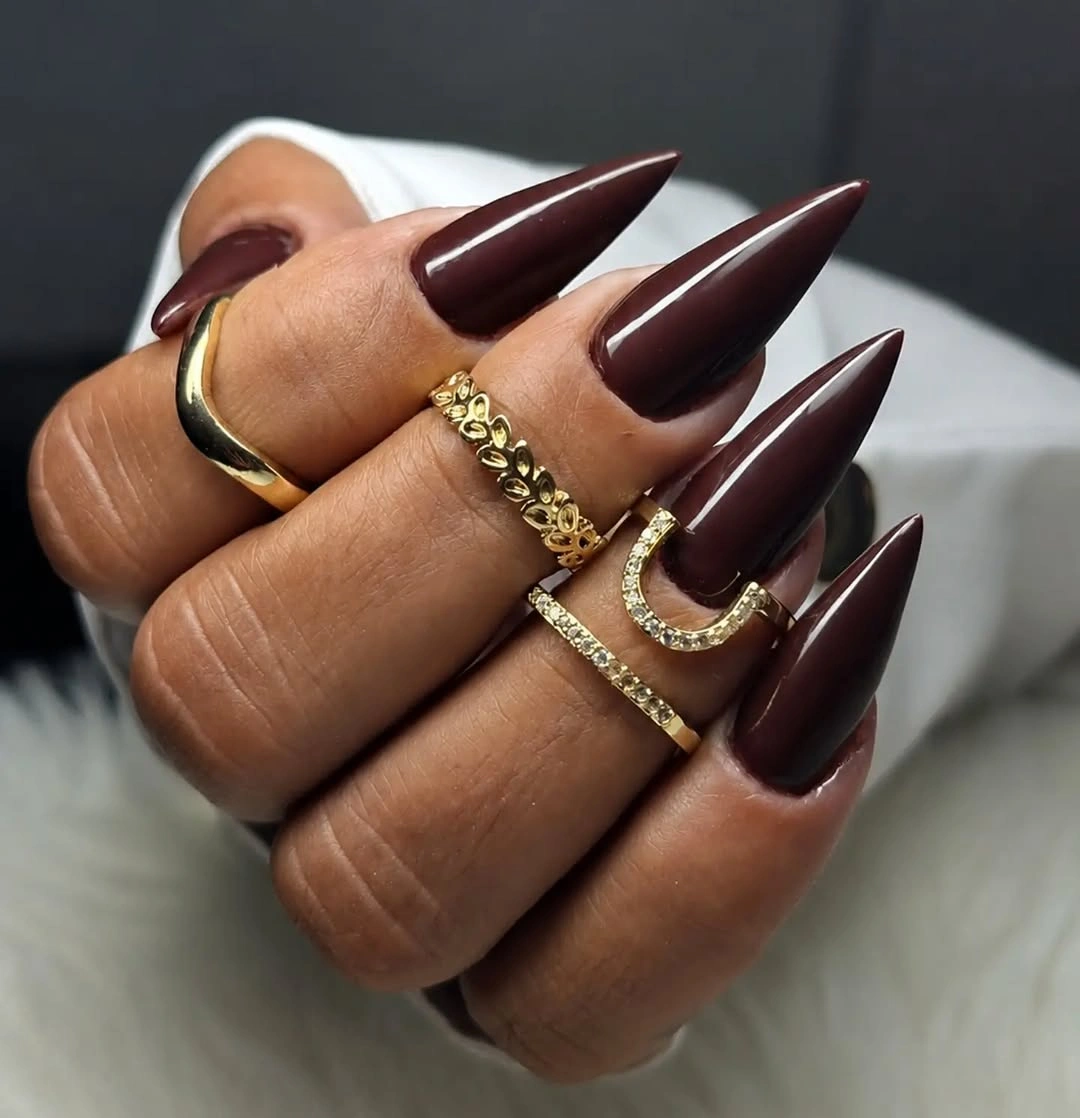
Move to a medium almond or tapered square if you want the same dark color with a less dramatic functional profile. A glossy finish helps preserve visible separation on a deep skin background, while a matte version will make the shade quieter and more graphic. Keep the set solid if you want the point and color to remain the complete design rather than adding a competing accent.
The manicure is an exercise in value, edge, and proportion. Espresso brings the deepest tone, gloss draws a line across the surface, and the pointed tip makes the hand look visually extended. The honest tradeoff is practical: very long points carry a strong aesthetic but require more adjustment in everyday movement than a short solid shape.
Sheer Nude with Warm Gold-Looking Flecks
Medium-long almond nails use a translucent nude-beige base with small gold-colored flecks or fine accents on selected fingers. The light field leaves the shape and surrounding skin visible, while the warm metallic-looking details add depth without covering the nail. Beige fabric repeats the muted palette, so the design reads softly even though the accents catch the light.
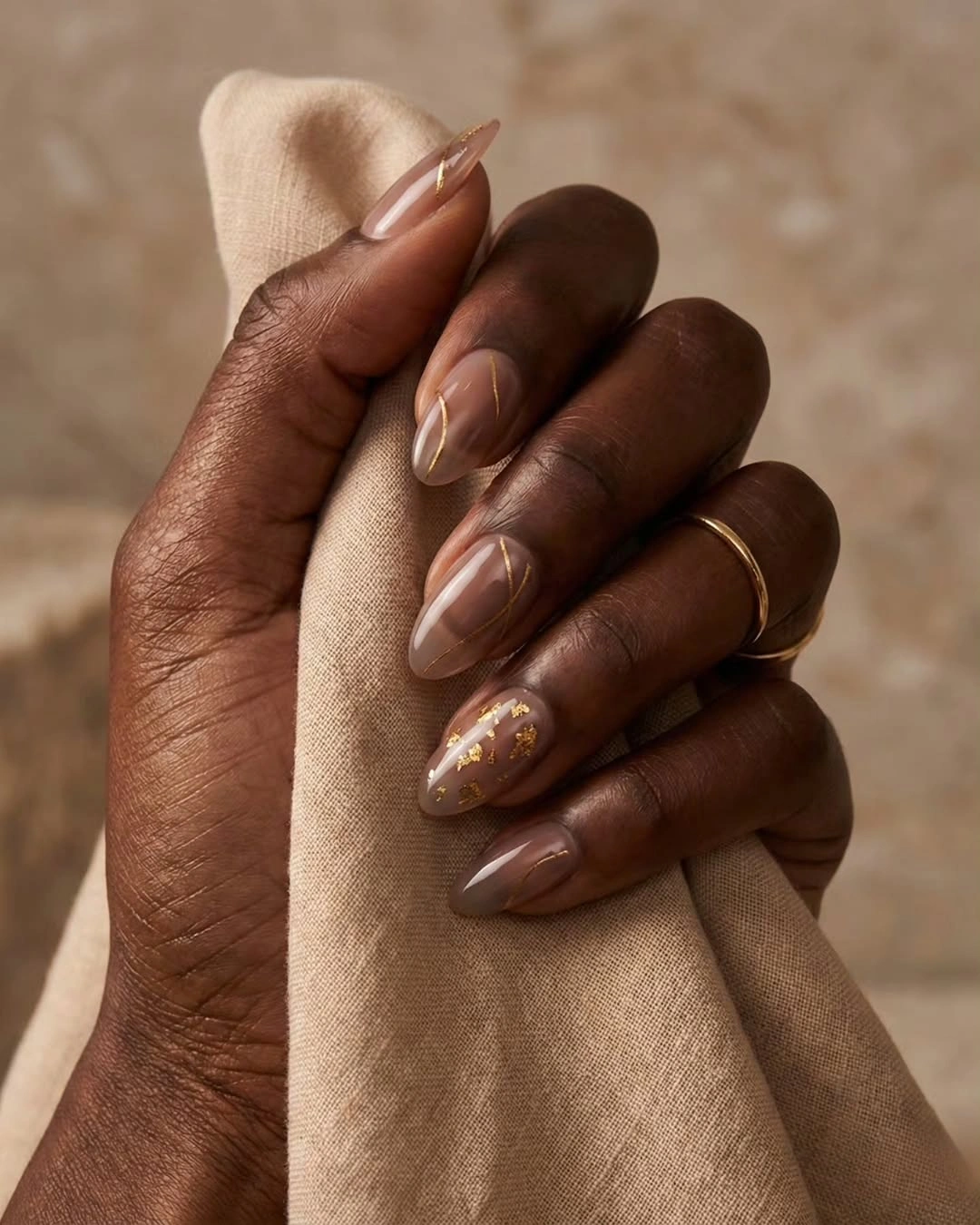
Use one or two flecks near the center or tip if you want a lower-detail version. A shorter almond can preserve the same open base, while a rounded shape will make the gold accents feel more delicate. If the nude becomes too close in value to the surrounding skin, a slightly deeper beige or a glossy highlight can create more visible separation without changing the concept.
The color theory here is understated. A light neutral supplies openness, warm gold adds a small value and temperature shift, and the almond outline keeps the pale set from looking shapeless. The limitation is delicacy: sparse accents can disappear at a distance, while adding too many would remove the quiet balance that makes the neutral palette appealing.
Fine Gold Curves over Pale Nude
Long almond nails are built on a pale nude-pink base with thin gold-colored curves and small flecks repeated across several fingers. The dark background makes the pale surface easy to see, while the fine accents create a light vertical rhythm along the pointed tips. The design is more detailed than a sheer neutral, but it still leaves broad areas of open space.
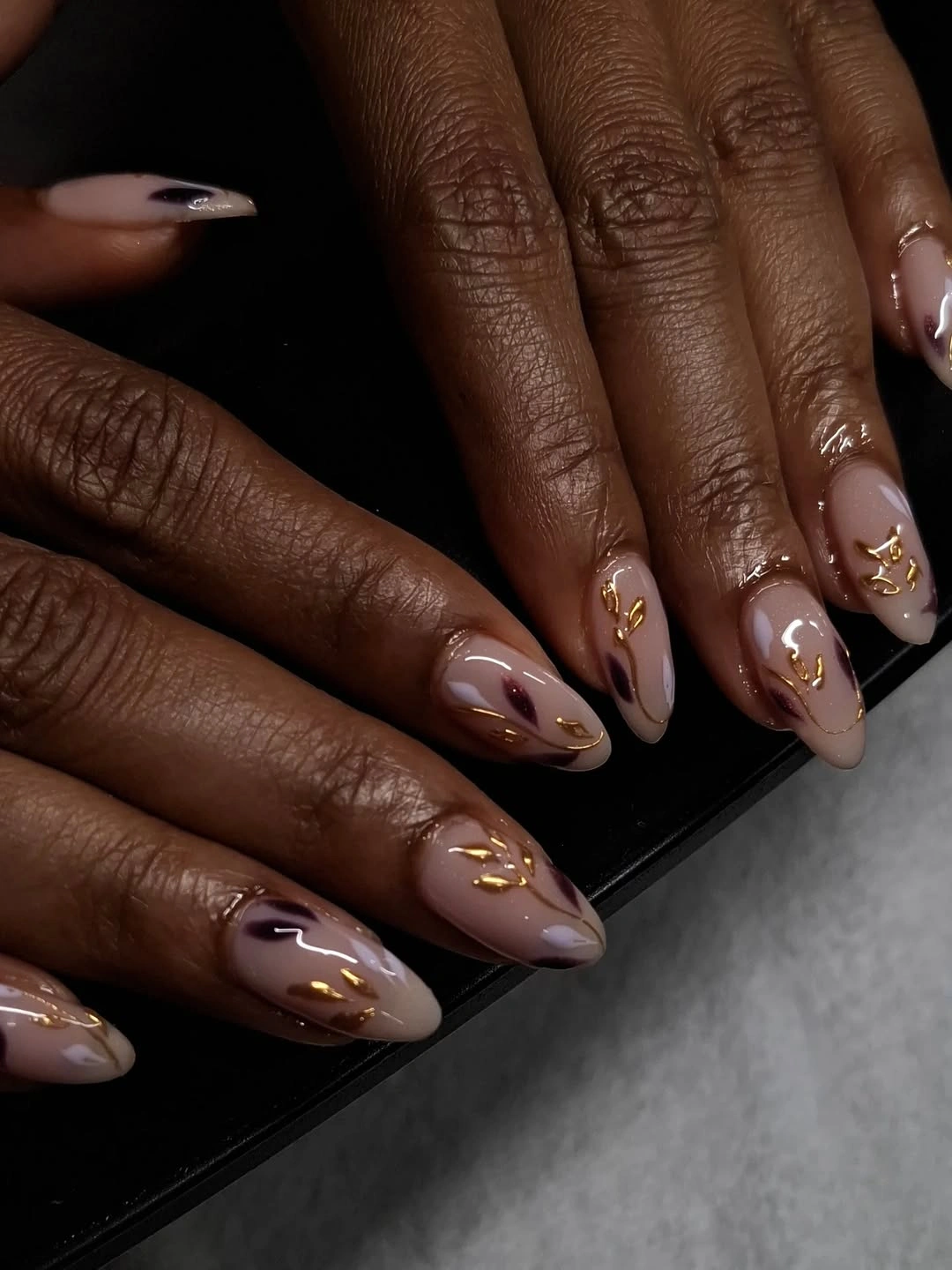
Keep the curves on two or three accent nails and let the others remain pale and glossy for a calmer version. A shorter almond can use one broad curve instead of several fine marks, while a square shape will make the lines feel more architectural. The main adaptation is spacing: the gold should guide the eye across the nail, not fill every available area.
This design uses low saturation and high contrast in small places. Nude keeps the overall field light, gold creates a warm reflective note, and the long almond outline makes the curves look intentional rather than random. The practical weakness is fine detail, since tiny lines need precise edges and may lose clarity sooner than a solid nude finish.
Outlined Brown Tips with Open Nude Space
Medium-long almond nails use a pale nude base with dark brown curved outlines tracing the tips and side edges. Some fingers show an additional pale line inside the border, creating a layered outline rather than a filled French tip. Gold rings add warmth, but the large area of nude space keeps the design crisp and visually open.
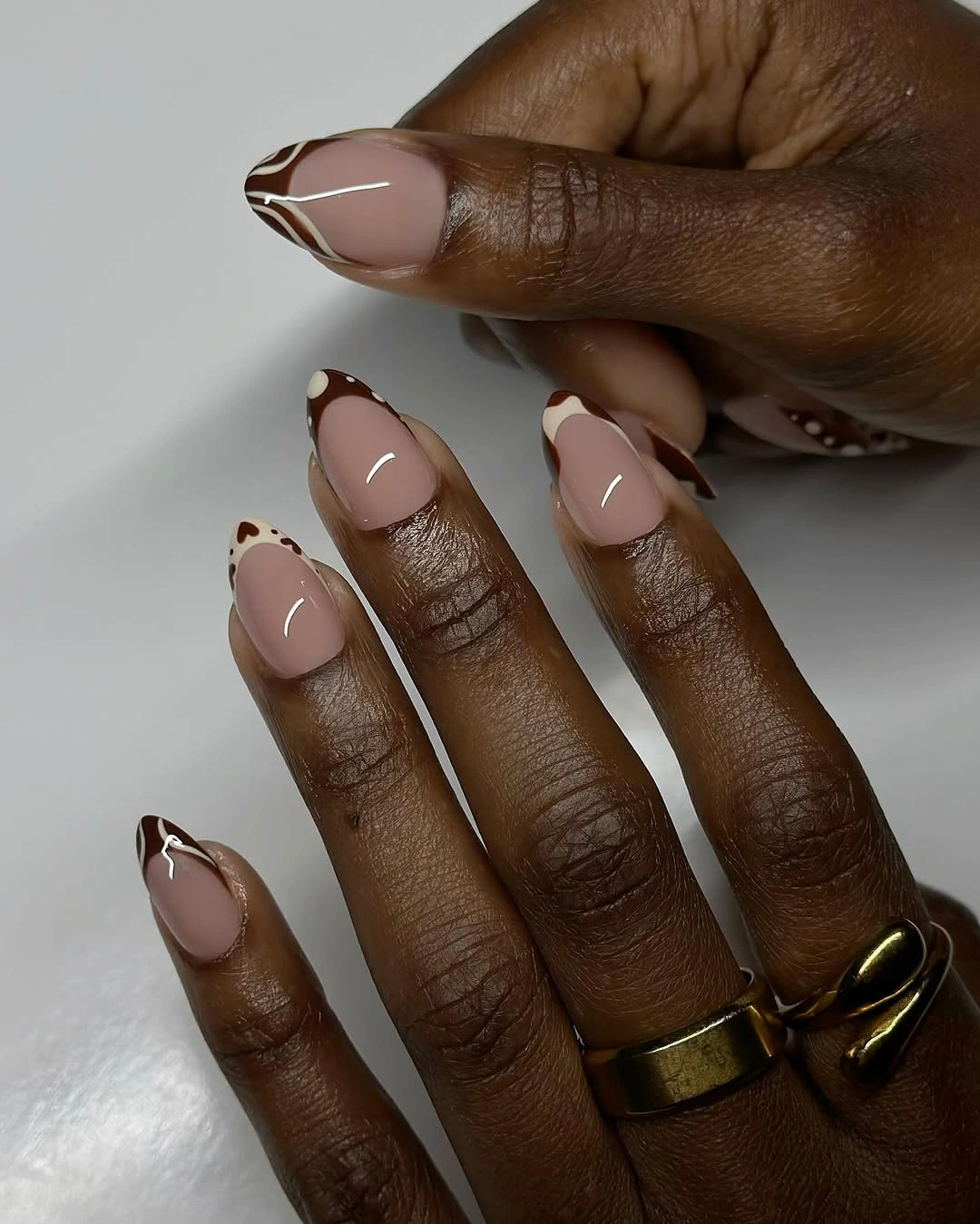
Use one clean dark curve on a shorter almond if the double outline feels too detailed. The open center is the important part, so avoid filling the tip unless you want a stronger, heavier contrast. A rounded shape will soften the border, while a square outline will make the line feel more graphic and precise.
The relationship between outline and empty space is what makes this manicure readable. Brown frames the pale center, the almond shape echoes the curve, and the skin remains part of the overall contrast rather than disappearing under full coverage. The limitation is precision again: a thin border shows small changes in thickness, so consistency matters more than adding another line.
Copper Orange Shimmer on Long Stilettos
Long pointed nails are painted a copper-orange metallic with fine shimmer that catches the light along the center of each tip. The warm color is solid, but the reflective finish creates movement as the fingers change direction. Rings and a light background frame the visible dark skin, making the bronze-orange contrast especially direct.
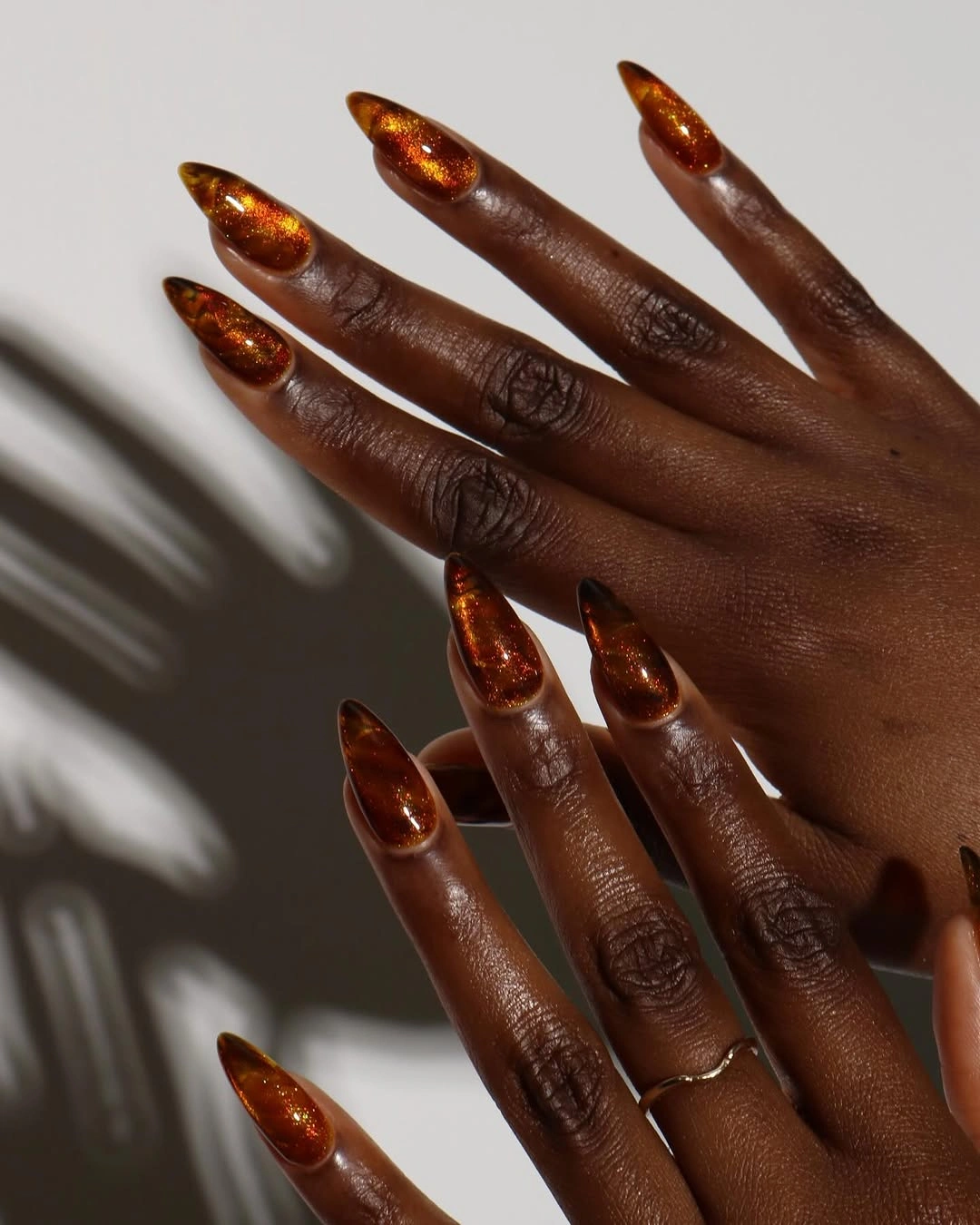
Shorten the point to an almond if you want the copper to feel more wearable while keeping the same warm finish. A quieter bronze can reduce saturation, but the reflective surface should remain even so the color does not break into patchy highlights. Because the shade already carries shine, a separate accent nail is optional rather than necessary.
Metallic copper is effective here because it combines warmth, saturation, and reflection in one decision. The pointed silhouette makes the highlight travel outward, so the shape and finish reinforce each other rather than competing. The practical tradeoff is intensity and length: a high-shine solid on very long tips becomes a strong statement, and chips will be easy to notice.
Neutral Points with Jewelry-Like Gold Lines
Very long pointed nails use a pale nude-beige base and narrow gold-colored lines that follow portions of the length. The open color keeps the design light against the visible dark skin, while the extreme points create a strong vertical rhythm and a jewelry-like impression. Pearl jewelry and dark fabric sit around the hands, but the line placement remains the central choice.
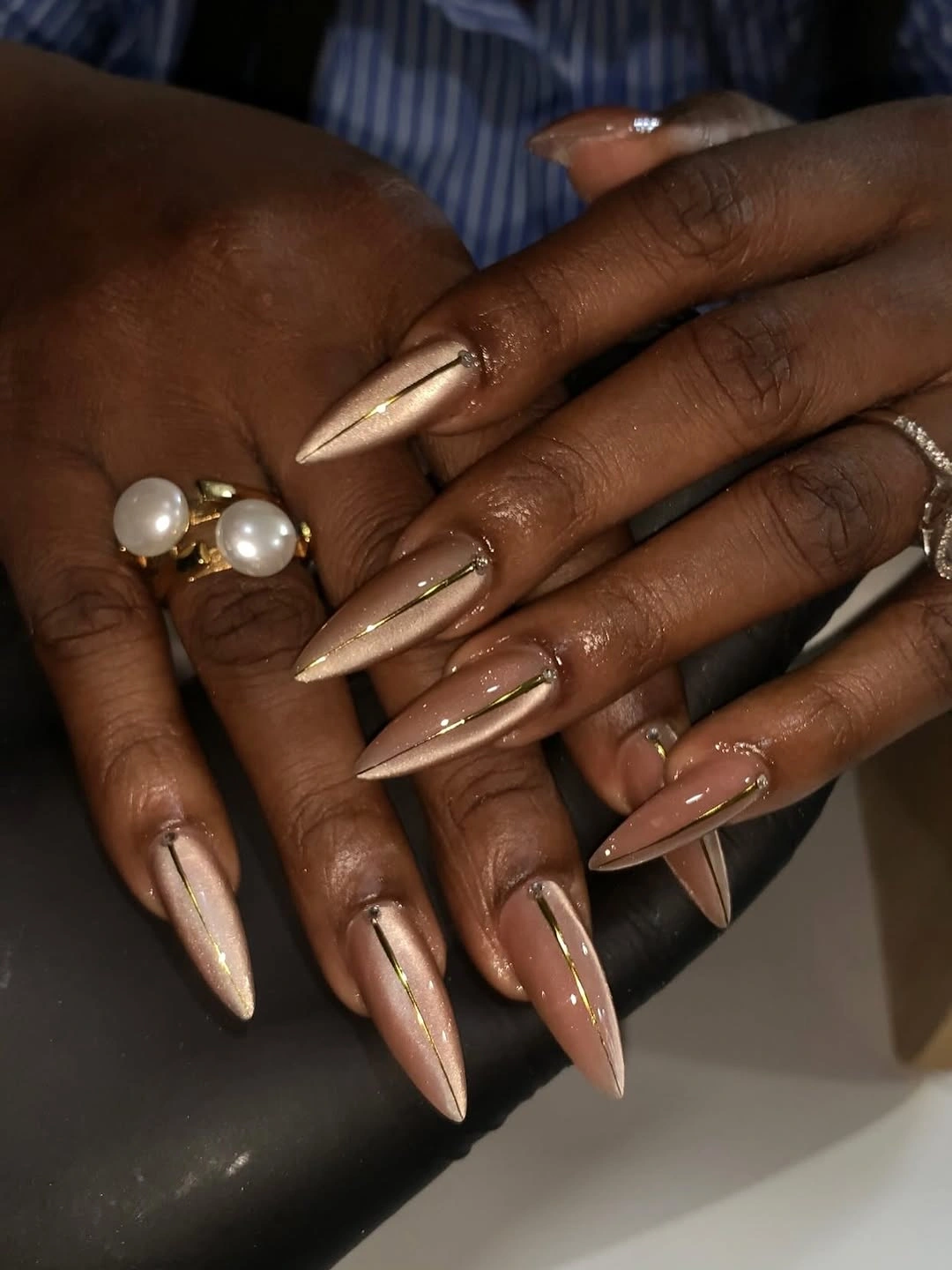
Choose a medium almond if you want to keep the neutral-and-gold relationship but reduce the functional impact of the point. One line on each accent nail will be enough on a shorter shape, while longer tips can hold a slightly more extended curve. Keep the base pale and uncluttered, because the design depends on the gold lines being small against a broad field.
This manicure shows how a neutral can still be visually strong when shape and line direction are doing the work. Nude leaves the surface open, gold adds a narrow warm contrast, and the point pulls the eye outward. The limitation is the same source of drama: very long tips affect everyday handling, and a thin line can emphasize any unevenness in the underlying outline.
Brown and Nude with Spotted Tip Details
Medium almond nails alternate glossy brown and pale nude, with small irregular spotted patterns concentrated at the tips of several light fingers. The brown solid nails anchor the set, while the pale tips keep the print playful and visible. The dark skin and neutral setting provide contrast, but the manicure remains organized by repeated color and controlled placement.
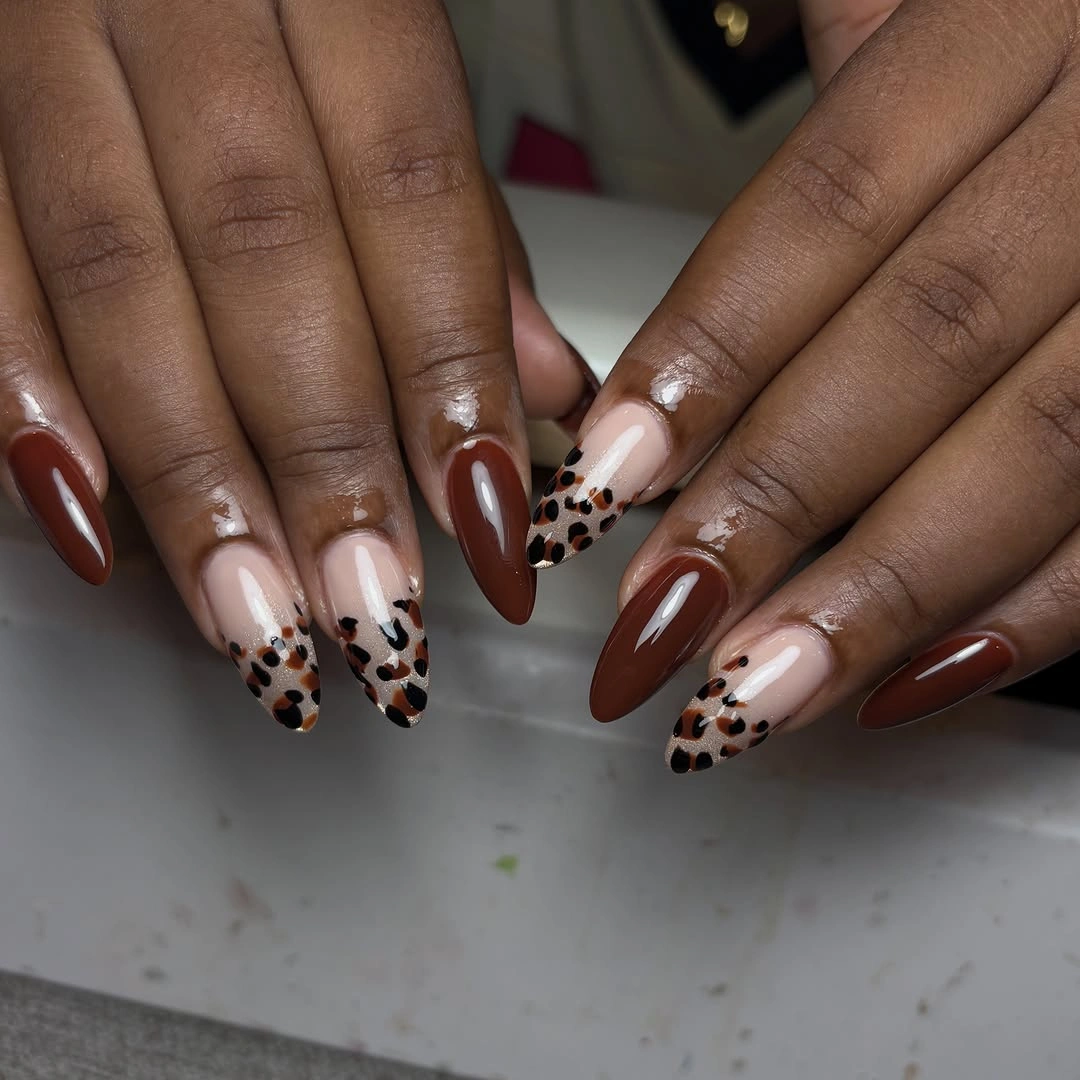
Keep the spots near the free edge and use fewer, larger marks if you move to a shorter nail. The almond shape gives the tips a long frame, while an oval will make the same print softer and less graphic. Repeat brown on the solid fingers so the patterned accents remain connected to the main palette rather than reading as a separate theme.
The design is a lesson in concentrating saturation. Brown supplies depth across the hand, nude opens the accent surface, and the spots add a small shift in pattern without introducing a bright new color. The tradeoff is density: irregular marks can become muddy when they are too close together, so negative space is as important as the spots themselves.
Yellow and Lime Organized by Taupe Space
Medium square nails alternate taupe nude, bright yellow, and lime green, with black abstract strokes crossing several fingers. The vivid shades are high in saturation, but the taupe nails create neutral pauses and the repeated dark lines give the set a shared graphic language. On visible dark skin, the bright colors are immediate, while the square outline keeps the blocks contained.
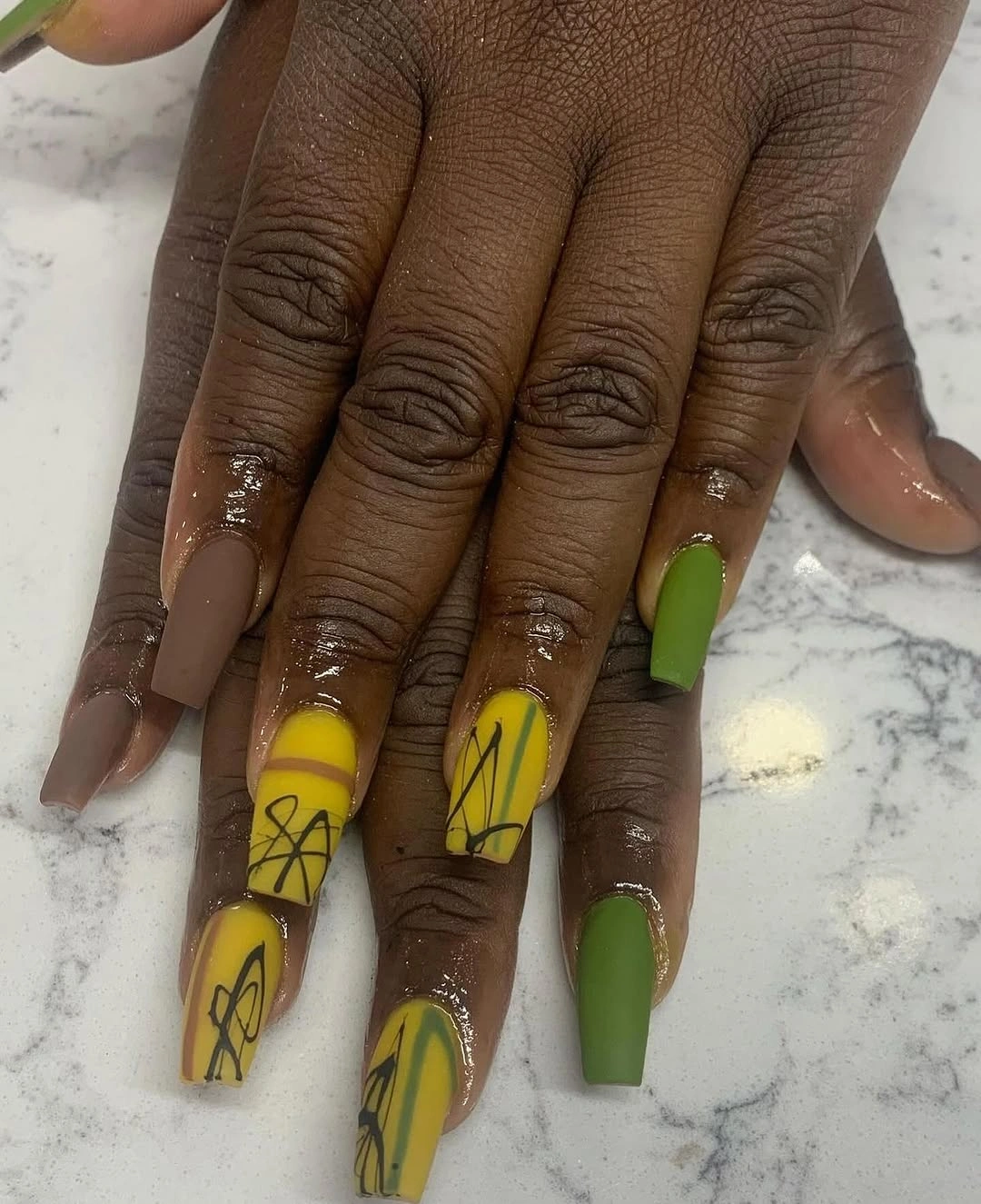
Use one bright shade beside taupe if you want to soften the contrast, then repeat the black stroke on two accents. A short square shape benefits from broad color fields, while a longer tip can hold more line detail without crowding the surface. Change one variable at a time, because adjusting both saturation and pattern scale can make the result lose its structure.
The color theory is broader than warm versus cool. Yellow brings high-value warmth, lime adds a sharper green note, taupe supplies neutral support, and black repeats the lines across the changes. The limitation is visual energy: several bright colors can compete, so the set needs spacing and repetition to keep the eye from jumping without a clear anchor.
Deep Brown with Multicolor Glitter Accents
Short square nails are mostly deep brown or burgundy, while one or two accent fingers carry dense multicolor glitter. The dark base gives the hand depth, and the glitter introduces pink, gold, and blue reflections in a concentrated area rather than across every nail. Against dark skin and pale fabric, the accent particles remain visible without requiring a bright base color.
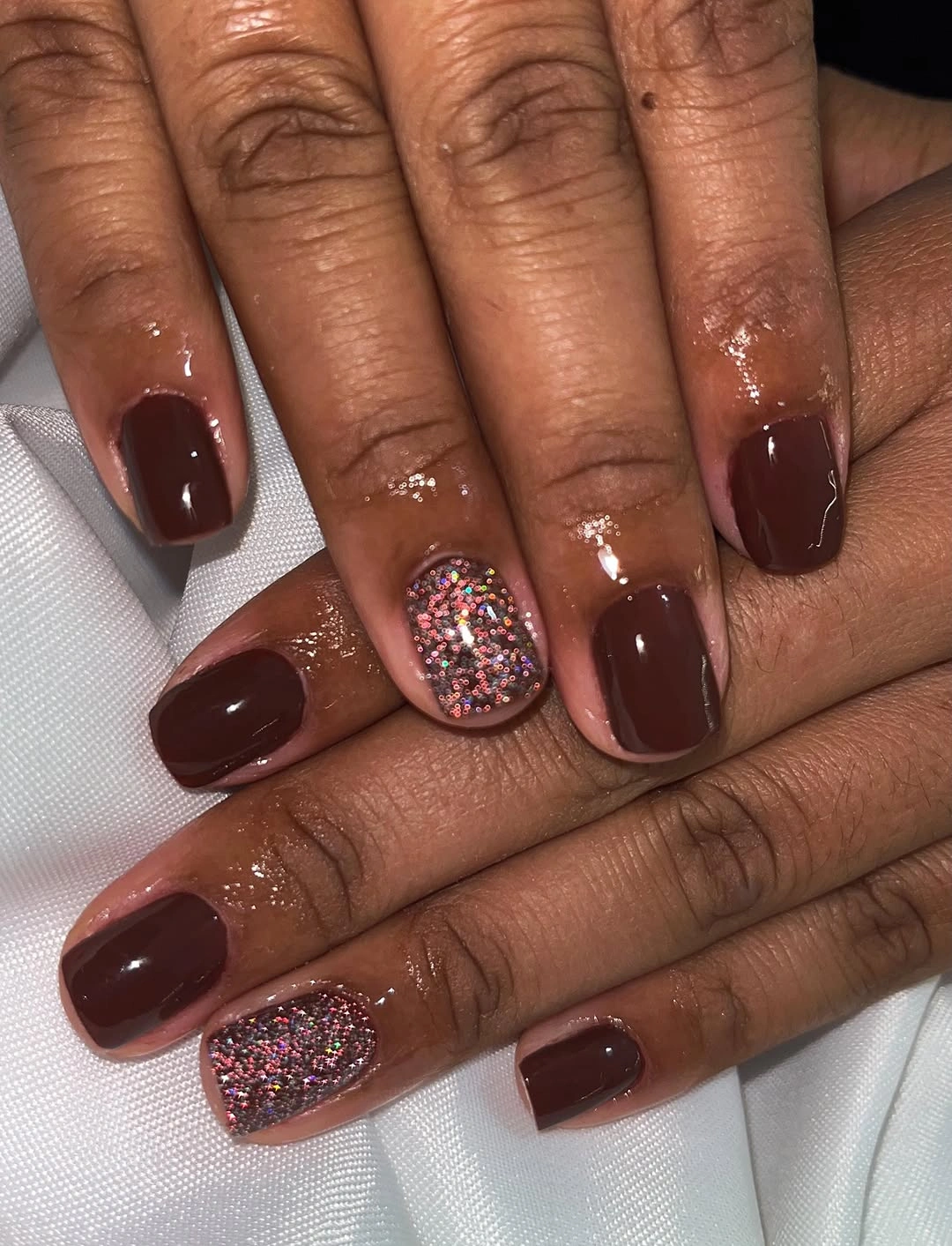
Keep the glitter on one finger for a quieter set, or use two accents if you want a matched rhythm. A short square shape supports a broad glitter field, while a rounded outline will make the contrast softer. Leave the dark fingers solid, because their repeated value is what allows the reflective accent to feel intentional rather than scattered.
This design shows how a small area of high visual activity can change a low-saturation palette. Brown supplies the neutral depth, glitter raises the light level, and the short shape keeps the sparkle close to the hand. The practical limitation is surface contrast: glitter can reveal texture and edge wear, especially when the base color remains very dark.
Metallic Copper on Short Rounded Nails
Short-to-medium rounded nails use a solid copper-orange metallic finish with warm highlights across the visible fingers. The compact shape keeps the color contained, while the shimmer creates enough movement for the manicure to stand alone without an accent or motif. White knitwear and gold rings reinforce the warm contrast with the visible dark skin.
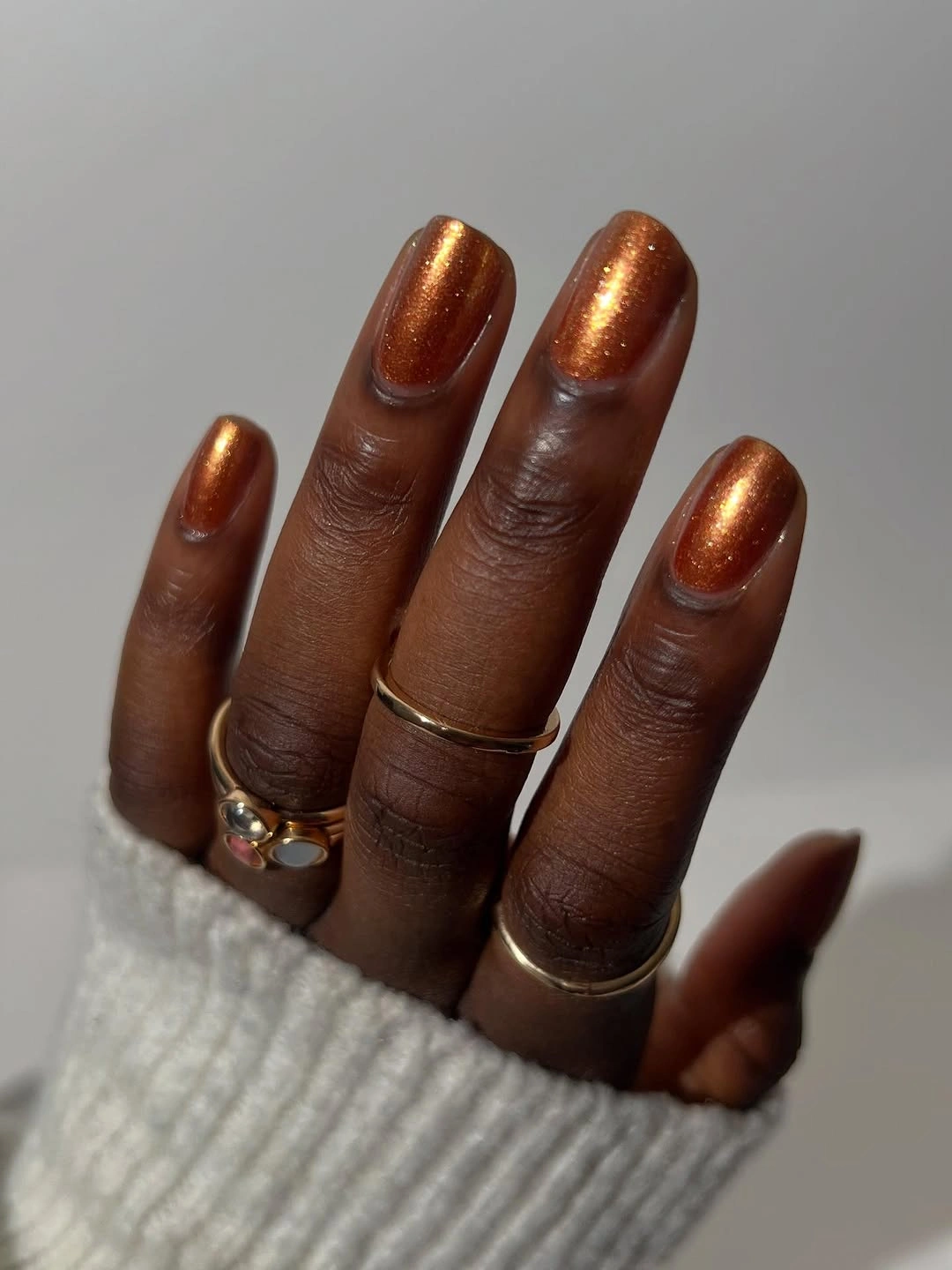
Keep the rounded outline if you want the copper to feel approachable, or use a short square for a crisper, more graphic result. A darker bronze will lower the saturation while preserving the reflection, and a paler copper will increase the light contrast. Because the finish already supplies the focal point, adding a second bright shade is not necessary.
Copper works here through finish as much as hue. The warm metallic surface catches light against the skin, and the short length keeps the reflection from becoming too dramatic. The tradeoff is surface honesty: a solid metallic finish can make small chips, streaks, or uneven edges visible, so the simplest color still needs a clean application.
Mint with Pink Floral Grid Accents
Short square nails are mostly muted mint green, while accent fingers combine pink flower-like shapes, black lines, colored dots, and pale grid-like blocks. The cool base is softened by warmer pink detail, and the short shape contains the decoration so it does not spread into a large collage. A fine green shimmer on selected solid nails adds a quiet change in finish.
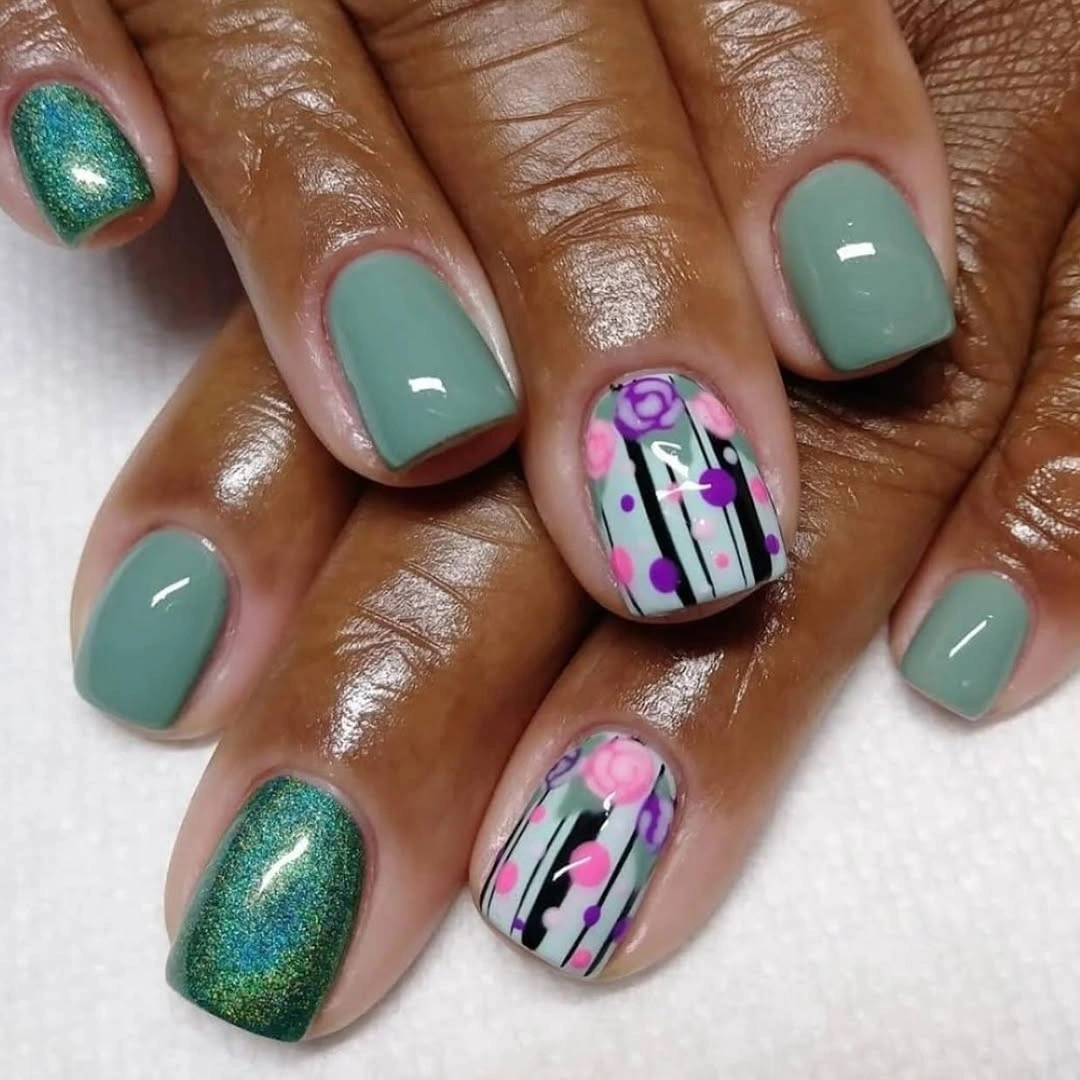
Keep one decorated accent finger and let the others remain mint if you want to simplify the set. The square outline gives the grid structure a clear frame, while a shorter nail may need fewer flowers and larger dots. Repeat one warm accent color across the art so the pink details feel connected instead of becoming unrelated marks.
This manicure uses contrast in layers. Mint provides a cool field, pink adds warmth, black lines supply structure, and tiny dots create scale inside the accents. The limitation is detail density: the design can lose its calm quality if every small space is filled, so preserving open mint or pale areas will help the color relationships remain legible.
Dusty Pink as a Quiet Closing Color
Short rounded nails are painted a glossy dusty pink with no visible art or color change across the hand. The muted shade sits lighter than plum, less saturated than copper, and softer than bright yellow, creating a calm close to the color range. A cream ribbed sleeve and gold rings frame the visible dark skin, while the finish keeps the solid set from looking flat.
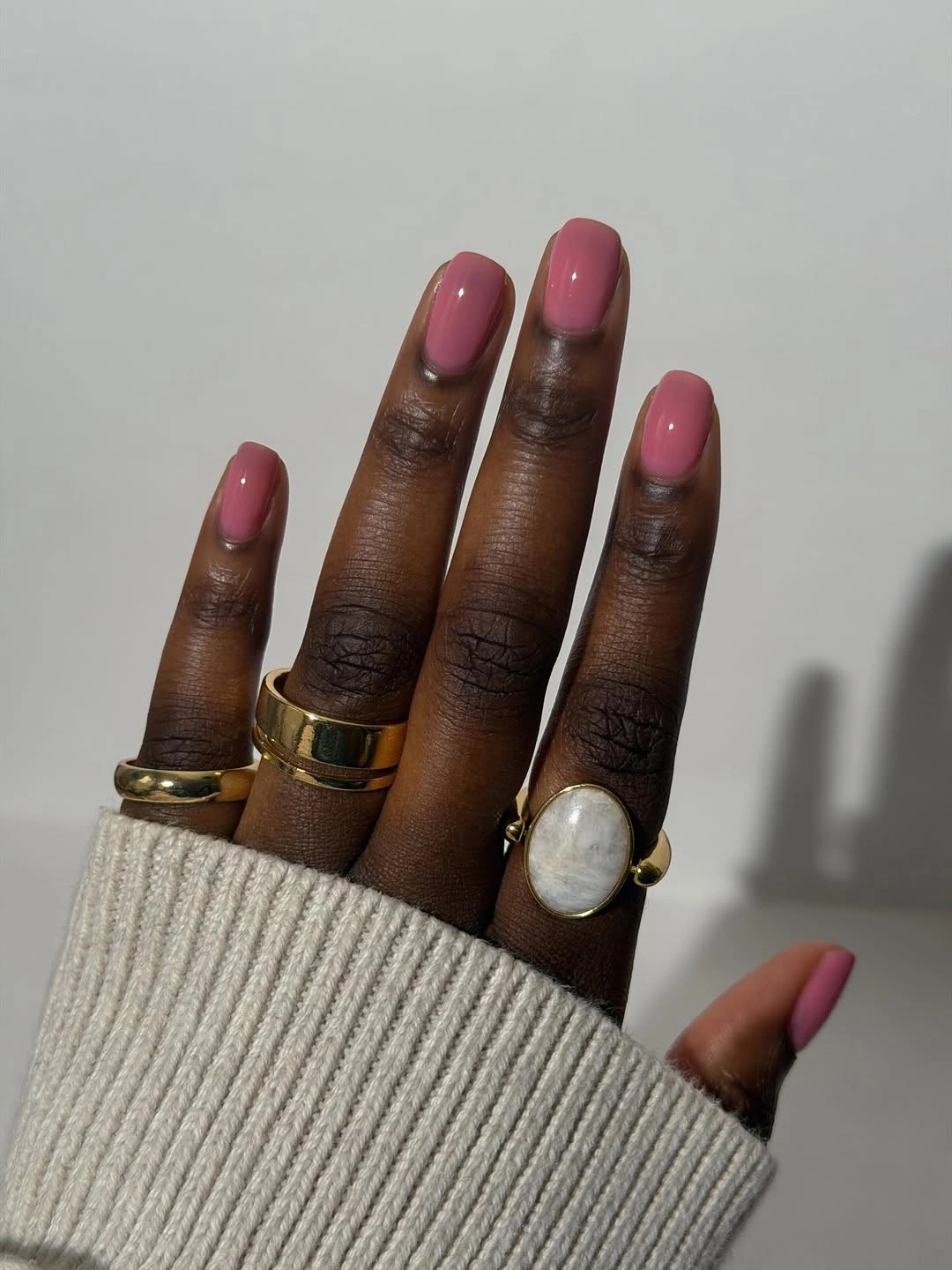
Keep the manicure solid if you want the shade to remain the entire point, or add one deeper burgundy accent for a controlled value change. A shorter round shape will make the color even quieter, while a medium almond will create more length without changing the palette. The key is not to add detail merely because the color is soft; a clean surface can be enough.
This closing example shows how a light, muted color can be seasonal through temperature and finish rather than depth alone. Dusty pink creates a gentle contrast with the surrounding skin, gloss adds a small highlight, and the rounded outline keeps the effect approachable. The limitation is visibility of coverage: an all-solid pale shade shows uneven edges and small marks clearly, so simplicity depends on surface consistency.