Fall nail trends 2026 are moving between quiet neutrals and details that reward a closer look. The collection brings together milky pink, cocoa, burgundy, olive, rust, blue, glitter, florals, curved French edges, and sheer negative space, so the season does not have to mean one predictable brown manicure. Shape changes the mood just as much as color, especially when a glossy surface keeps the design crisp.
Use these ideas as a visual menu rather than a fixed checklist. A short oval can carry glitter and small motifs without feeling busy, while a long almond shape gives ribbons, marbling, and layered tips room to travel. The most adaptable choices keep one clear focal detail and leave enough open base for the manicure to grow out gracefully.
Milky Pink Almonds with Flowing Accent Lines
The first set uses a translucent milky pink base on long almond nails, with narrow white and deep brown curves placed along selected sides. Those lines follow the taper instead of cutting across it, which gives the manicure movement without adding a heavy block of color. The pale center also lets rings and a soft knit sleeve remain secondary to the actual nail design.
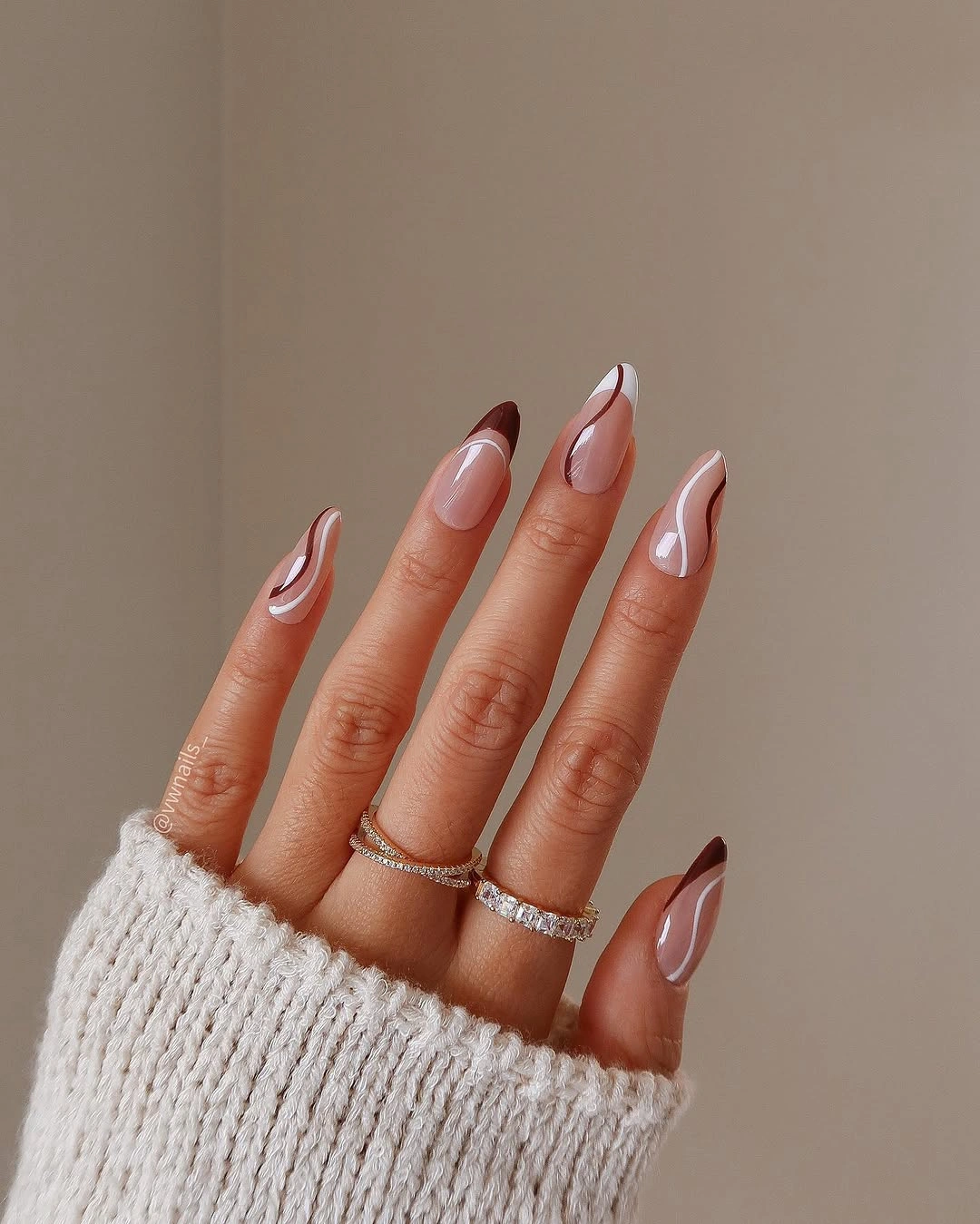
For a more restrained version, keep the white line on every nail and add the brown only to two accent fingers. On a shorter almond shape, the same idea can become a small side sweep near the tip rather than a full-length ribbon. That adjustment preserves the visual direction while reducing the amount of fine detail that has to stay sharp.
The open base is doing practical work here. It makes the dark accents easier to place, leaves room for the shape to remain visible, and gives the design a softer transition as the nail grows. If a completely pale set feels too delicate, a single cocoa line on the ring finger is enough to bring the palette toward autumn.
Neutral Nails Lifted by Mixed Metallic Accents
Short rounded nails make the second idea feel compact and easy to wear, even though the palette shifts across cream, taupe, rosy beige, and cool silver. A few nails are reflective while others stay glossy and quiet, creating variety through finish rather than through a large pattern. The result is a neutral manicure with enough contrast to avoid looking like one flat shade.
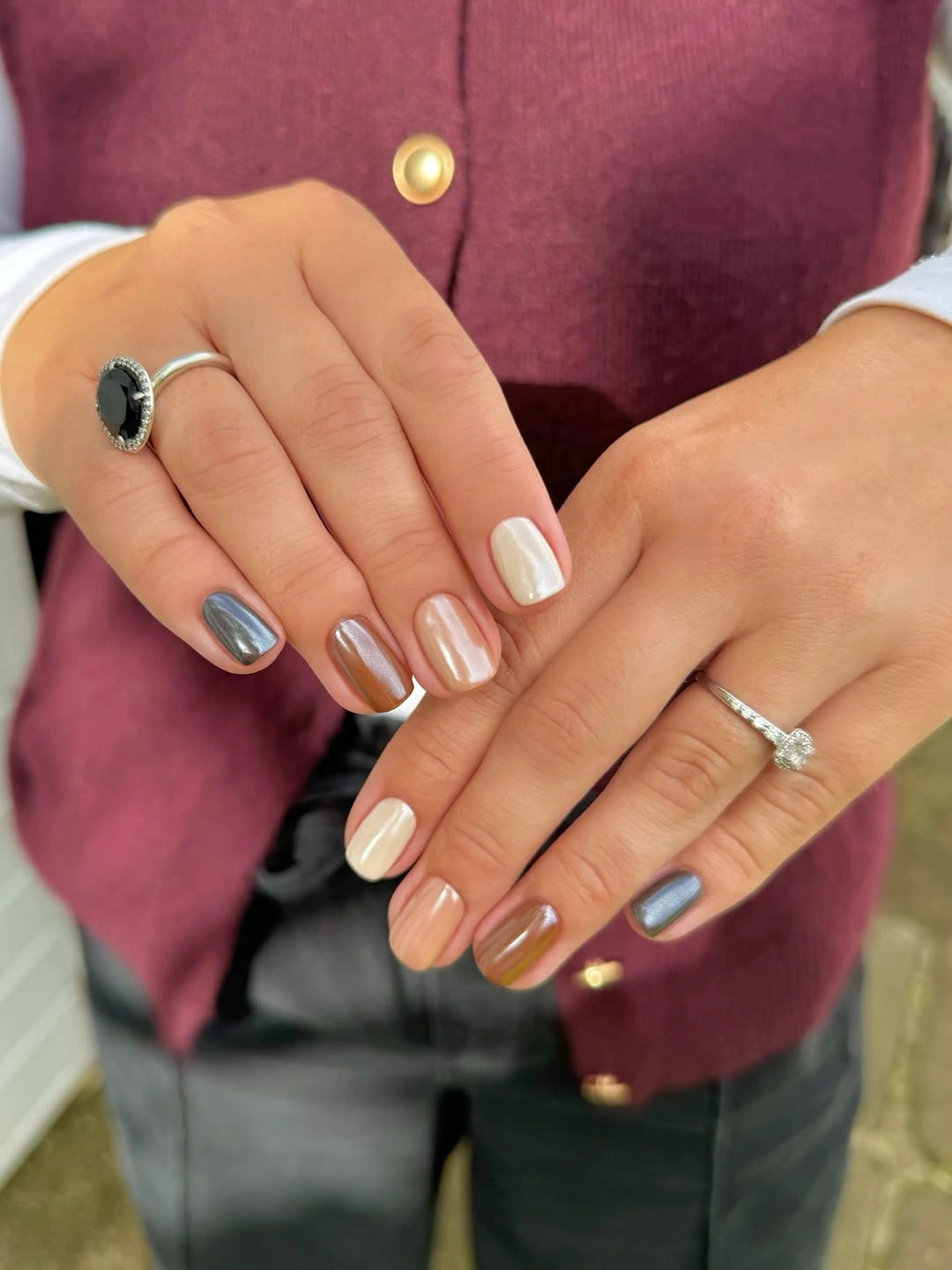
Color balance matters more than matching every finger exactly. Keep the pale cream on the thumb and one central nail, then use silver on one side of the hand and a warmer metallic on the other so the accents feel scattered but intentional. If you prefer less shine, replace one metallic nail with a sheer pink version and let the remaining reflective detail hold the focus.
The short rounded shape is a useful compromise for anyone who likes a layered palette but does not want long tips. There is enough surface for two or three finishes, yet the proportions keep the manicure from reading as formal jewelry. It would also translate well to a very short oval, where the metallic accents can be narrowed to partial panels.
Sheer Pink Almonds Framed by Cocoa Ribbons
Here the defining choice is not a dark base but the contrast between a sheer pink center and slim cocoa ribbons. The long almond silhouette gives each curved mark space to bend, and the glossy surface makes the lines appear almost drawn over glass. Because most of the nail remains open, the brown reads as a graphic border rather than a dense seasonal coating.
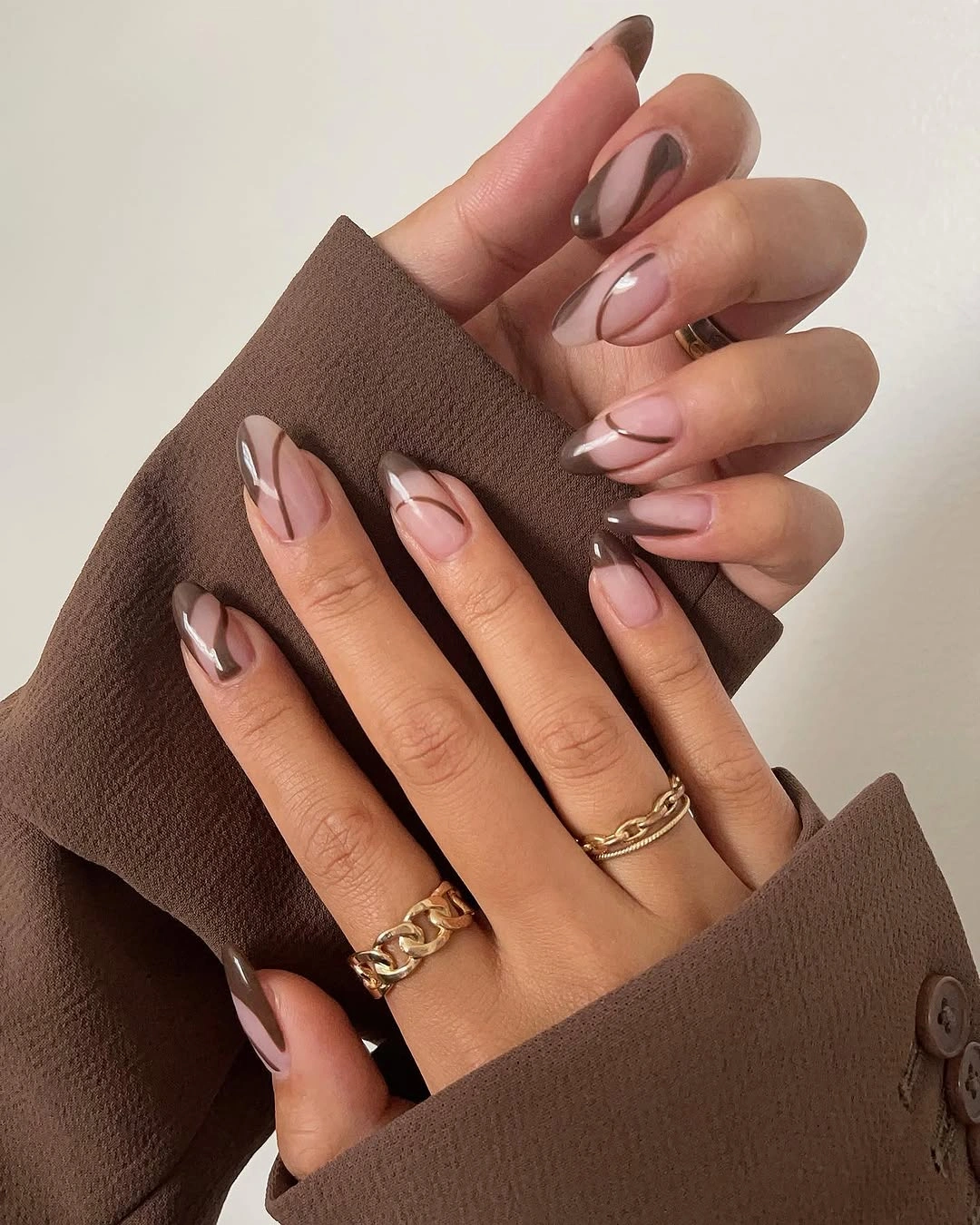
To adapt the design for everyday wear, place the brown curve only along one side of each nail and leave the opposite edge bare. A shorter almond can use one rounded hook near the tip, which keeps the same sense of motion without asking a small surface to carry several turns. Pairing the set with warm brown clothing would echo the palette without needing a literal match.
Negative space is the practical advantage of this design. It lowers the visual weight of the long shape and gives small changes in line thickness less impact than they would have on an opaque base. The tradeoff is that uneven borders become noticeable, so the concept works best when the curves are kept simple and generously spaced.
Glossy Taupe with Charcoal and Glitter Focal Nails
Short oval nails create a calm foundation for taupe, charcoal, and glitter gold. Most fingers stay in the brown-gray family, while the glitter accents add a bright interruption that catches the light near the center of the hand. The rounded outline keeps the contrast friendly, so the set feels seasonal without turning into a dramatic evening-only manicure.
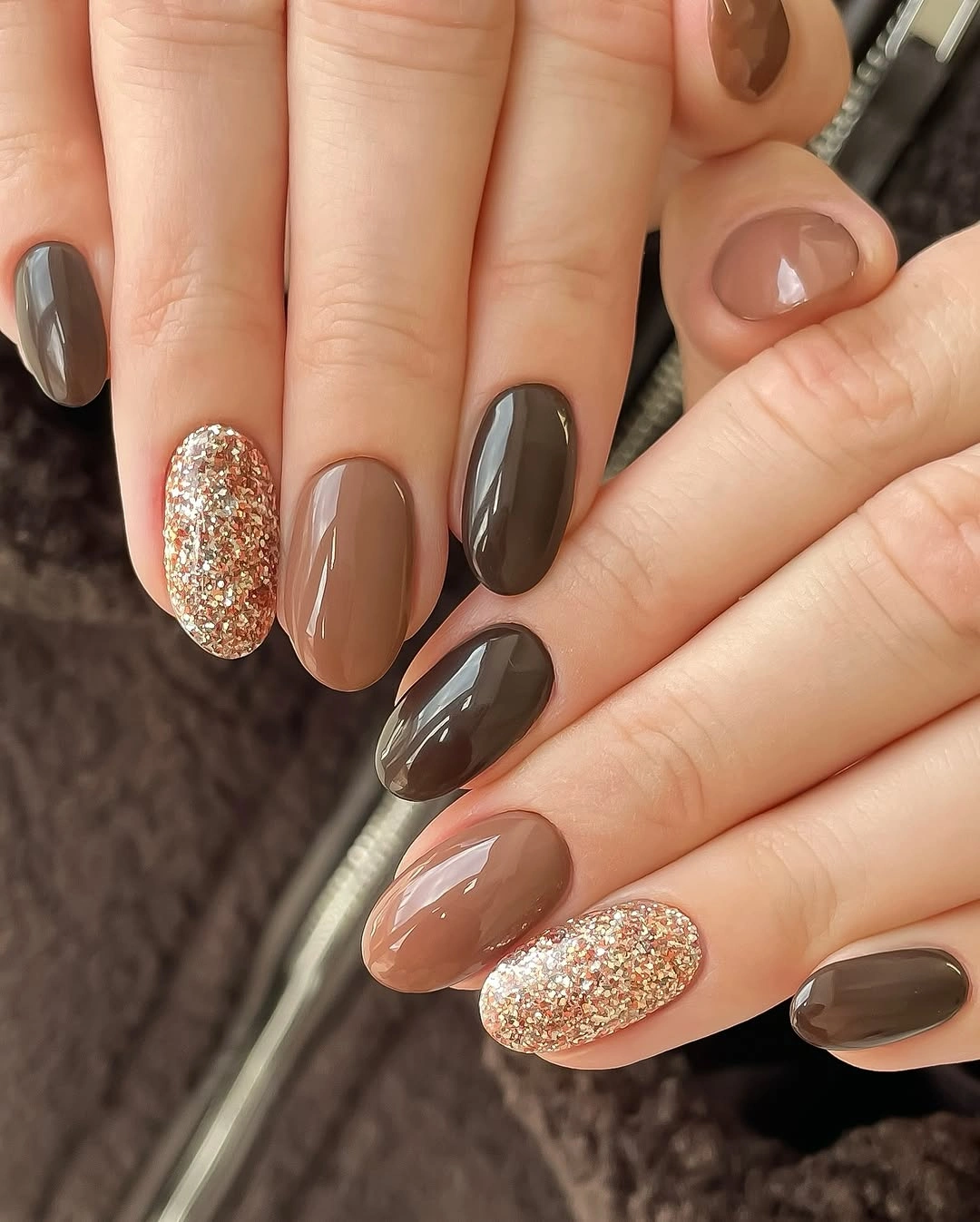
One way to personalize it is to choose whether the sparkle should sit on the thumb and ring finger or on two neighboring nails. The first arrangement spreads the focus across the hand, while the second makes a stronger pair. If glitter feels too decorative, a metallic taupe accent can supply a similar shift in finish with less texture in the visual field.
Short oval proportions are especially helpful when a dark shade and glitter appear together. They keep the palette from feeling top-heavy and make the solid taupe nails important rather than merely supportive. The main limitation is that a glitter accent can dominate quickly, so surrounding nails should stay plain and the color transition should remain close to the base.
Small Rust Motifs on a Soft Seasonal Base
A short rounded manicure becomes seasonal through tiny rust, terracotta, and red-brown marks placed over a pale creamy base. The motifs resemble small leaves and heart-like petals, but their value comes from placement: each nail keeps enough blank space around the drawing for the shape and glossy surface to remain visible. The knit sleeve reinforces the cozy mood without taking attention from the fingers.
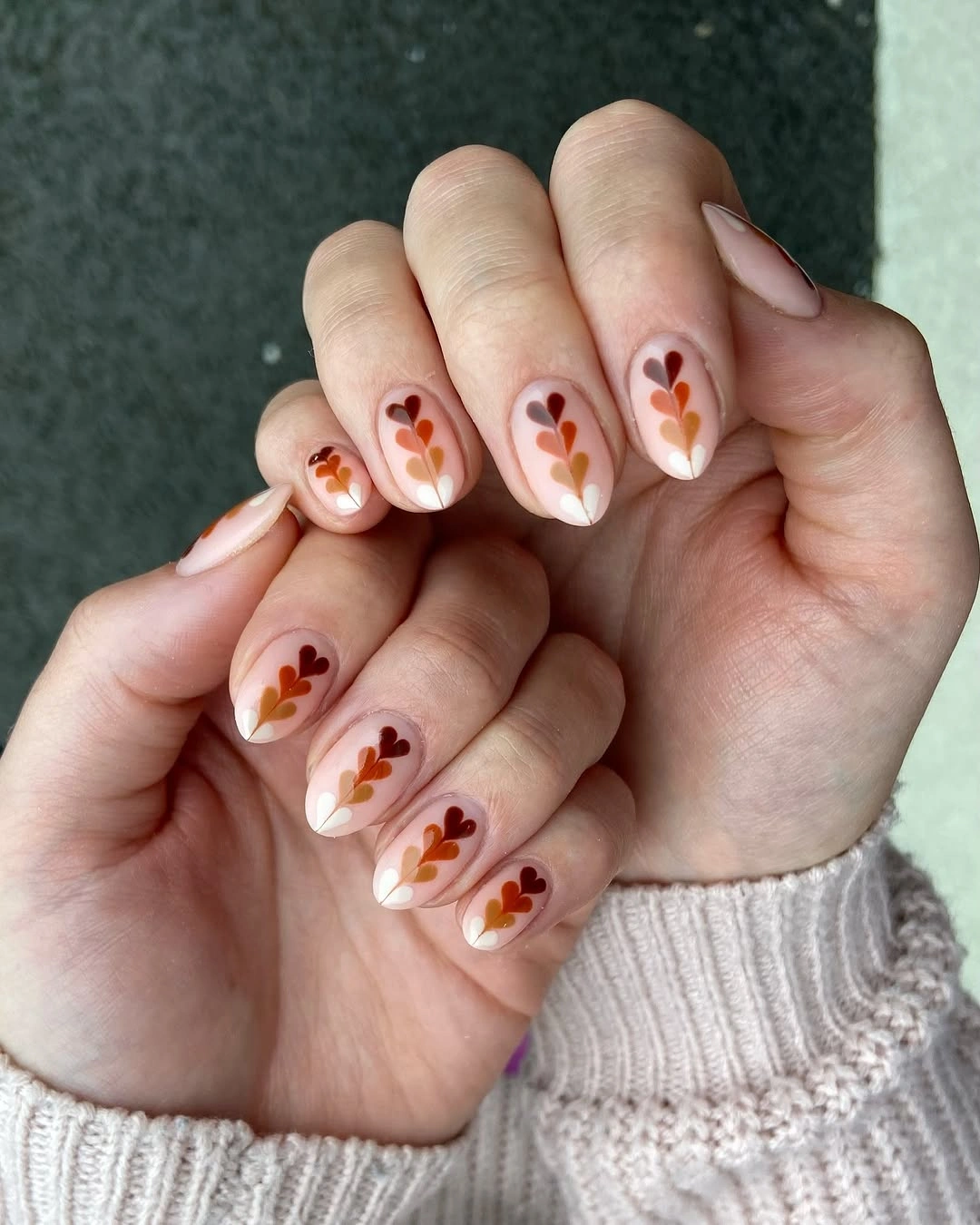
For a cleaner appointment brief, ask for the small motifs on only two or three nails and keep the rest milky or softly beige. A shorter round shape can use one mark close to the tip, while a slightly longer oval can carry a small vertical arrangement. This gives the design a seasonal cue without turning every finger into a separate illustration.
The strongest practical feature is the scale. Tiny art lets a pale set feel personal while keeping the color story gentle enough for daily clothes and jewelry. The honest tradeoff is that very fine shapes need more visual discipline than a solid polish, so replacing a detailed leaf with a simple dot or curved petal can make the idea easier to maintain.
Dark Solids with One Abstract Sheer Accent
Short rounded square nails alternate glossy black, chocolate, and soft blush, then place an abstract translucent detail on one pale accent finger. The manicure gets its rhythm from the change between opaque and open surfaces rather than from a repeated motif. That contrast makes a compact shape look considered while keeping the overall palette grounded in deep fall color.
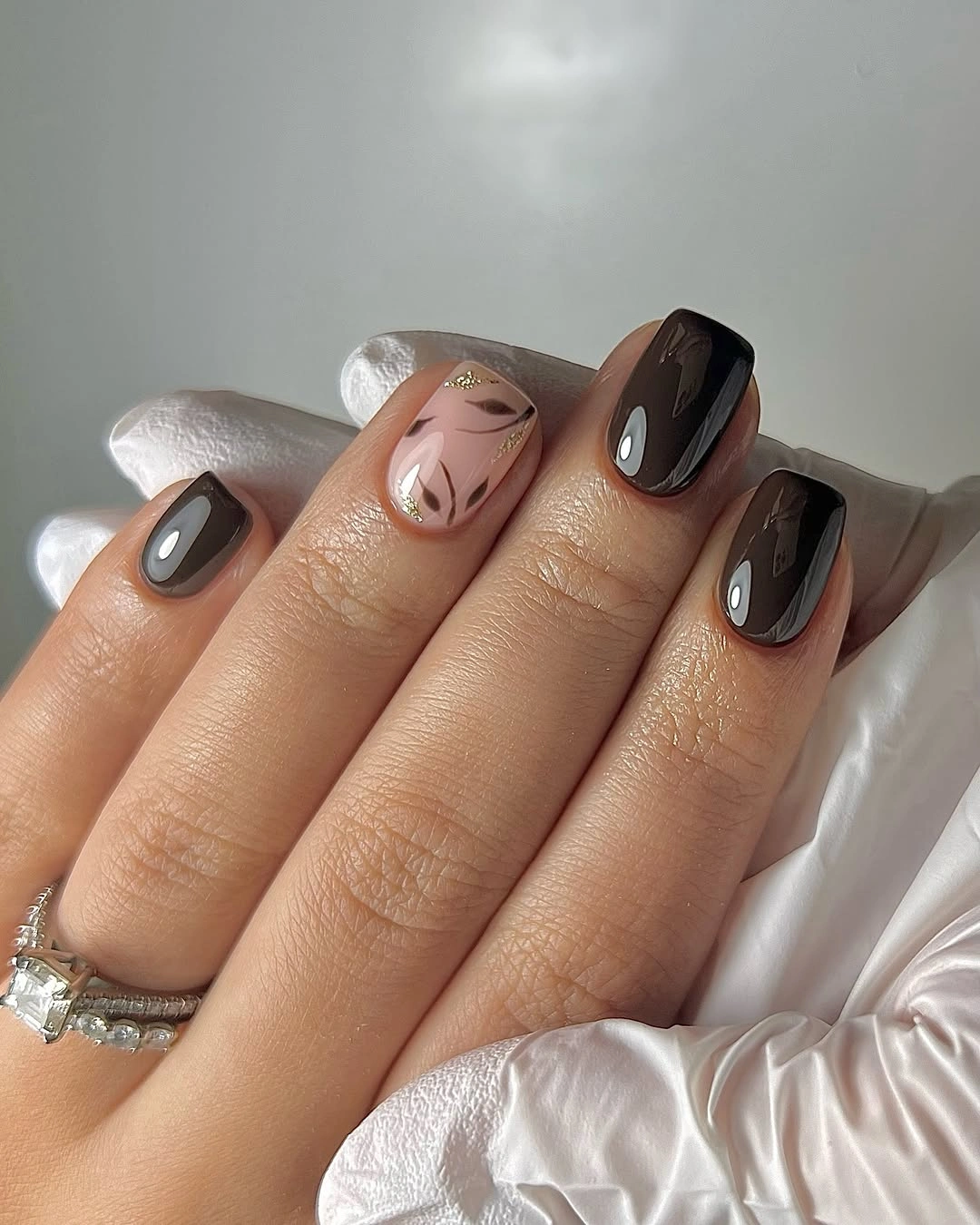
A practical variation would keep the black on two nails, the chocolate on two, and move the pale accent to the thumb so it appears only when the hand turns. If you want less contrast, swap black for deep taupe and allow the abstract mark to use the same brown family. The structure stays intact because the visual pause is still doing the work.
The design suits someone who wants dark color but does not want every nail to look identical. A short rounded square gives the blocks a stable edge, while the sheer accent prevents the hand from feeling visually closed. The limitation is that the open detail needs breathing room, so adding extra dots or lines would weaken the clean balance.
Checkerboard and Botanical Details in Warm Browns
This short oval set mixes chocolate, cream, and warm brown through small checkerboard nails, little flowers, and leaf-like marks. The motifs are varied, yet the palette stays close enough that the hand reads as one collection rather than several unrelated ideas. The contrast comes from pattern scale: checks feel graphic, while the botanical accents soften the surrounding solid color.
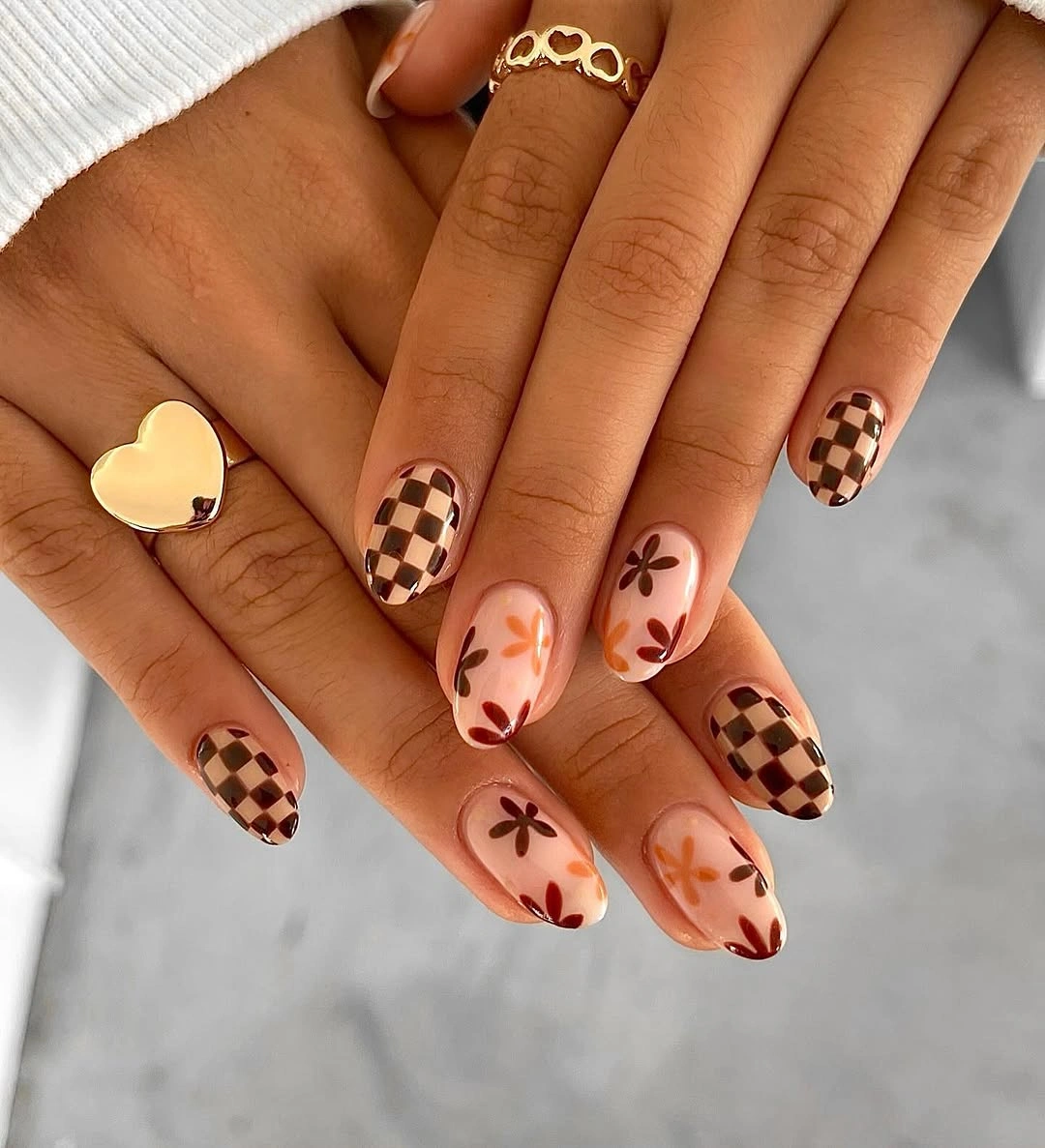
To make the design more wearable, choose one pattern family for the index and ring fingers, then reserve the flowers for the middle finger or thumb. A shorter oval can use two large checkerboard squares instead of a full grid, leaving the cream base visible. That edit lowers detail density while preserving the warm, playful relationship between pattern and motif.
The set works because every accent repeats at least one color from a neighboring nail. That is useful when combining checks with tiny drawings, since shared color keeps the hand from looking scattered. The tradeoff is that several small motifs can compete if their scale is identical, so alternating one larger pattern with smaller marks creates clearer visual order.
Bright Floral French Tips for a Gentle Transition
Long almond nails carry a sheer base with bright orange, pink, green, and coral floral tips. Instead of covering the entire nail, the color gathers at the end and leaves a transparent center, so the manicure feels like a bridge between late summer and fall. Tiny dots and petals add detail, but the clear base gives the composition plenty of calm space.
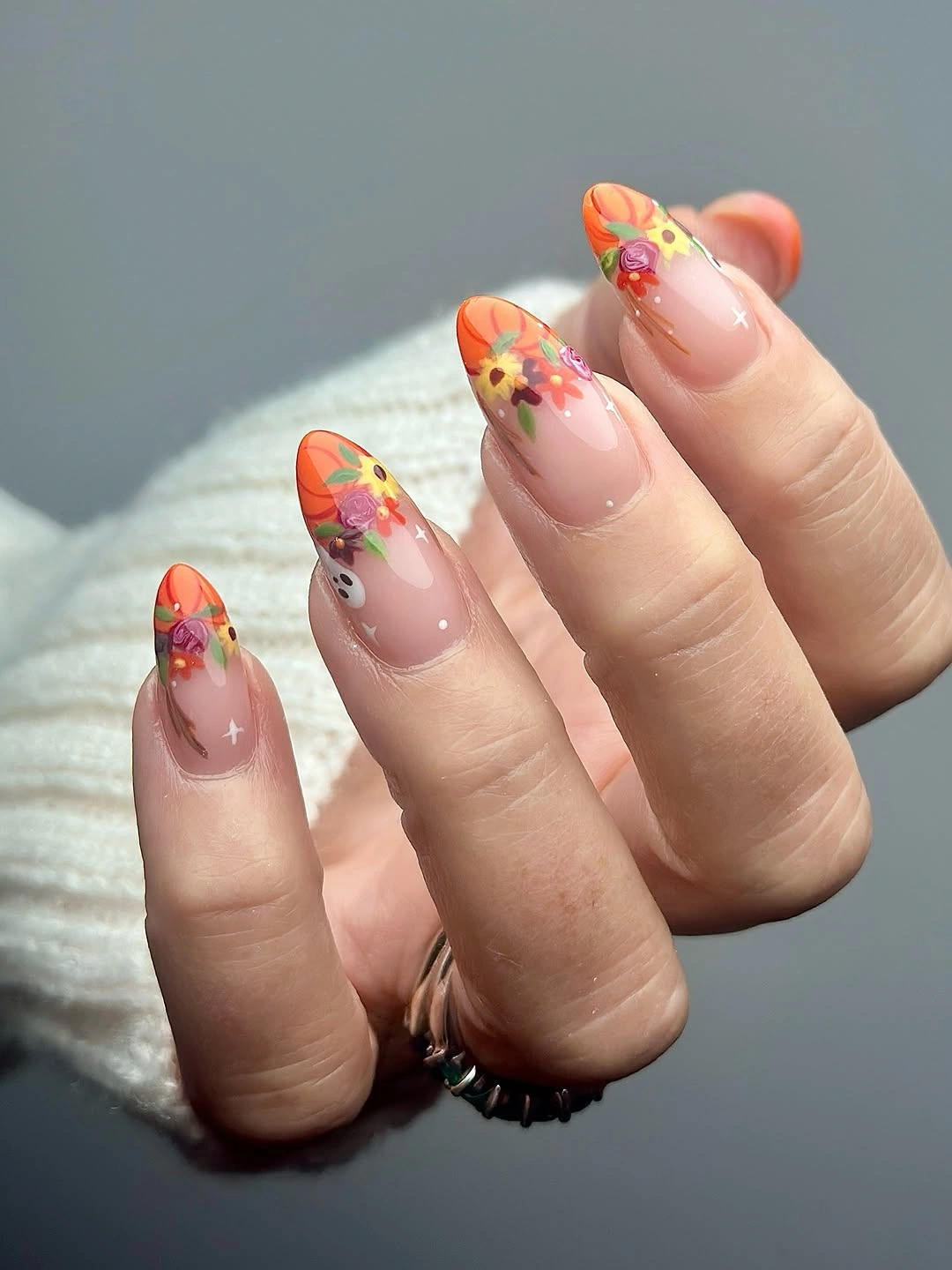
For a subtler version, repeat the orange on every tip and use the pink and green only inside two floral accents. On medium almond nails, the flowers can sit just above the edge so the tip remains visibly French rather than becoming a full illustration. The same idea can also work with rust, cream, and muted olive when a quieter seasonal palette is preferred.
The shape and placement are what keep the bright colors wearable. Long almond tips provide enough length for petals to remain legible, while the open center keeps the hand from looking saturated. The realistic limitation is that many colors require clean spacing, so reducing the number of flowers often improves the result more than adding another accent shade.
Deep Berry Almonds in a Clean Glossy Finish
A solid deep berry manicure proves that a fall trend can be driven by color alone. The long almond nails are glossy, even-toned, and free of extra art, which places all attention on the tapered silhouette and the richness of the polish. Against warm skin and gold rings, the shade looks expressive without relying on glitter, lines, or seasonal symbols.
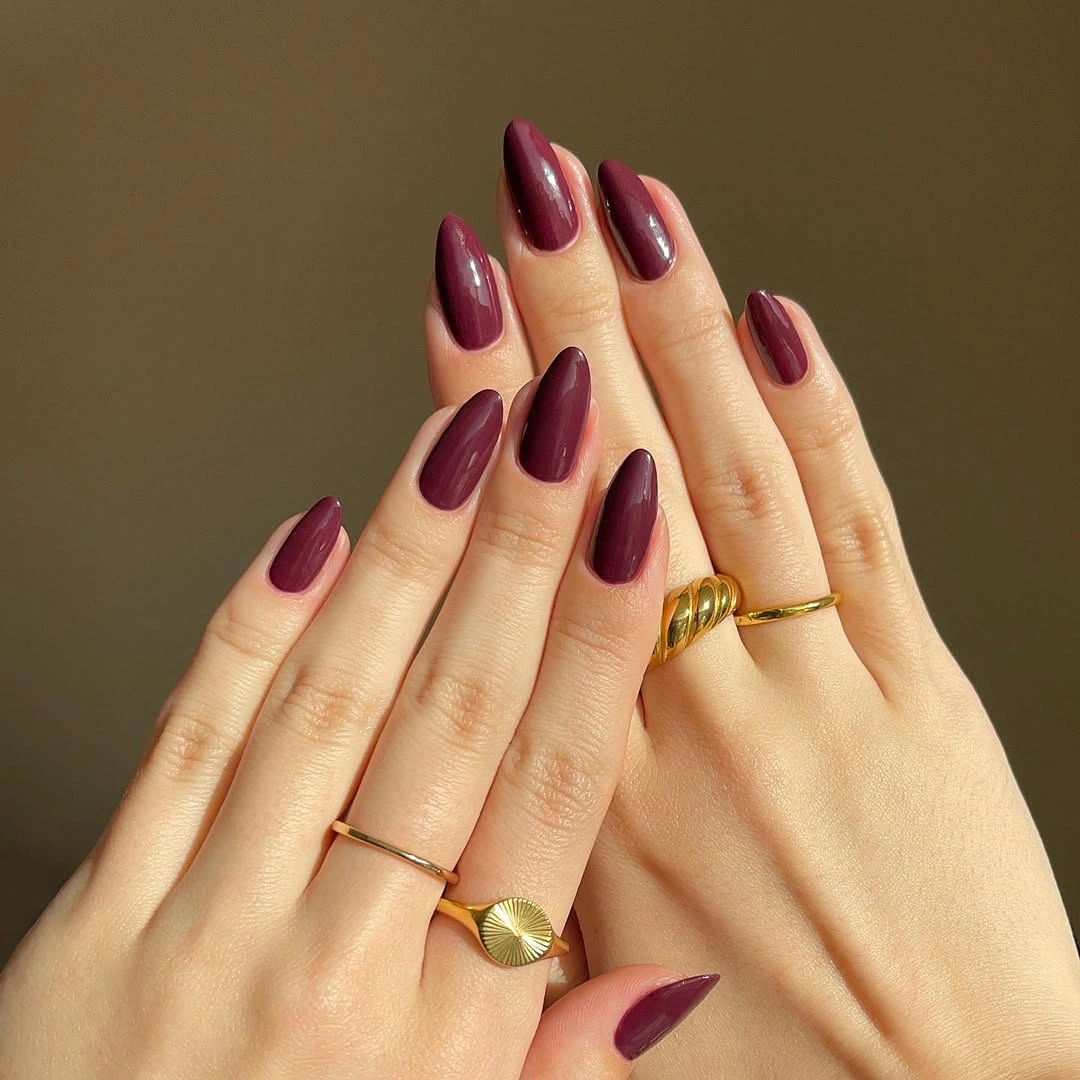
If you like the color but need a lower-maintenance proportion, shorten the almond to a medium length and keep the surface uninterrupted. Another option is to use the berry shade on four nails and a sheer pink on one, creating a quiet focal change without disturbing the solid-color idea. The simplicity also makes it easy to coordinate with patterned clothing.
Monochrome sets reveal every decision in the outline, so a neat edge matters more here than in a busy design. The reward is a manicure that feels finished with very little visual noise, and the dark tone can move from daytime to evening without a new motif. The tradeoff is that small chips or uneven shine will be more visible than they would be among patterns.
Chocolate, Cream, and White Blocks with Soft Curves
Short oval nails combine chocolate brown, cream, white, and muted taupe in geometric blocks and rounded half-moon shapes. Some nails are solid while others divide the surface into curved panels, giving the collection a graphic quality without relying on sharp lines everywhere. The neutral palette keeps the contrast approachable, and the varied placement stops the hand from looking uniform.
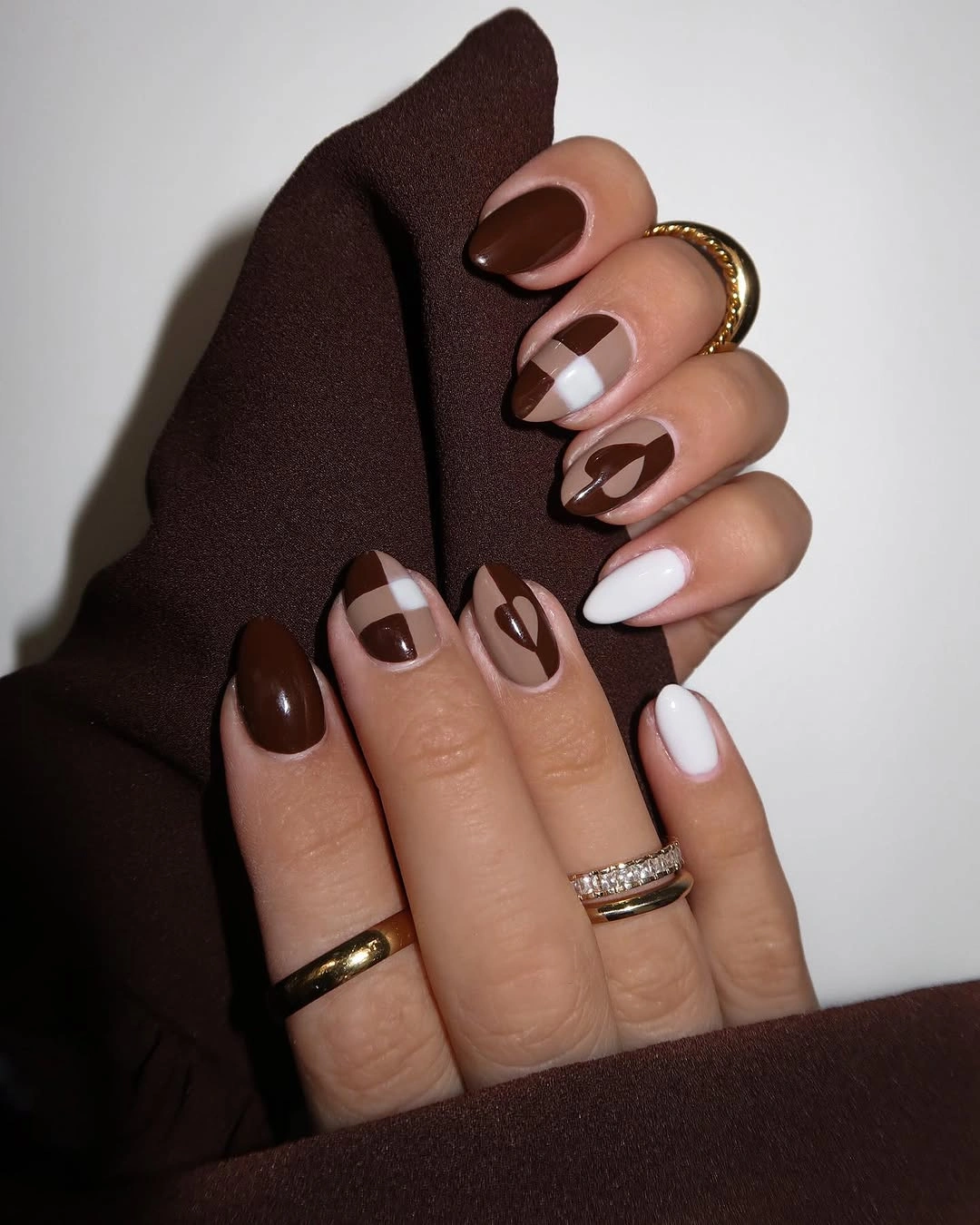
For a more edited version, choose one dark brown block and one white curve as the repeated language, then let the remaining nails stay solid. On very short nails, place the block near the tip so the base remains visually long. If the white feels stark, a warm cream or pale beige will soften the same composition without changing its structure.
The useful lesson is that a limited palette can still create movement when the shapes change from nail to nail. Rounded blocks suit the oval outline and make the design feel softer than a strict checkerboard. The limitation is that too many panels can shorten the visual field, so open base and larger shapes are more effective than several tiny sections.
Warm Shimmer Moving from Burgundy to Gold
Short square nails show a warm gradient that moves from burgundy and red-brown into orange-gold shimmer. The glitter is spread across each nail so the color feels illuminated rather than covered with separate sparkles, and the straight edge gives the fade a neat finish. This is a stronger seasonal look, but the shape keeps it graphic instead of ornate.
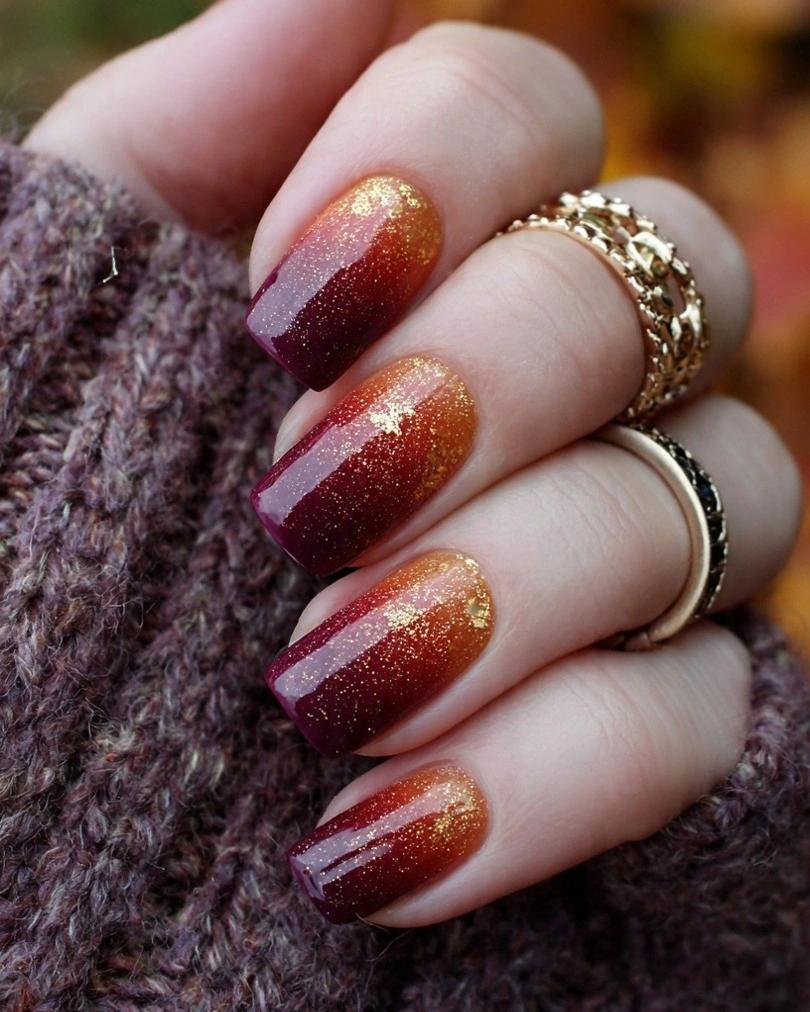
To make the gradient easier to wear, keep the darkest tone at the tip and let the warmer gold rise toward the center, or reverse the direction for a softer glow near the edge. A single accent nail can carry the full fade while the rest stay burgundy. That edit is useful when you want the color story but prefer less reflective surface overall.
The palette works because burgundy and orange share a warm undertone, so the gold reads as a transition rather than a separate color. The square shape gives the glow a clear boundary and makes the manicure feel intentional with simple clothing. The practical tradeoff is that shimmer shows texture, which means the gradient benefits from a smooth, even-looking surface.
Sheer Brown with One Fine Gold Accent
Long almond nails use mushroom brown and sheer pink as the quiet base, then add a narrow gold detail on one accent nail. The main colors are glossy and close in value, while the metallic mark supplies a small point of light without turning the set into glitter. This balance makes the manicure feel polished but still connected to natural neutral tones.
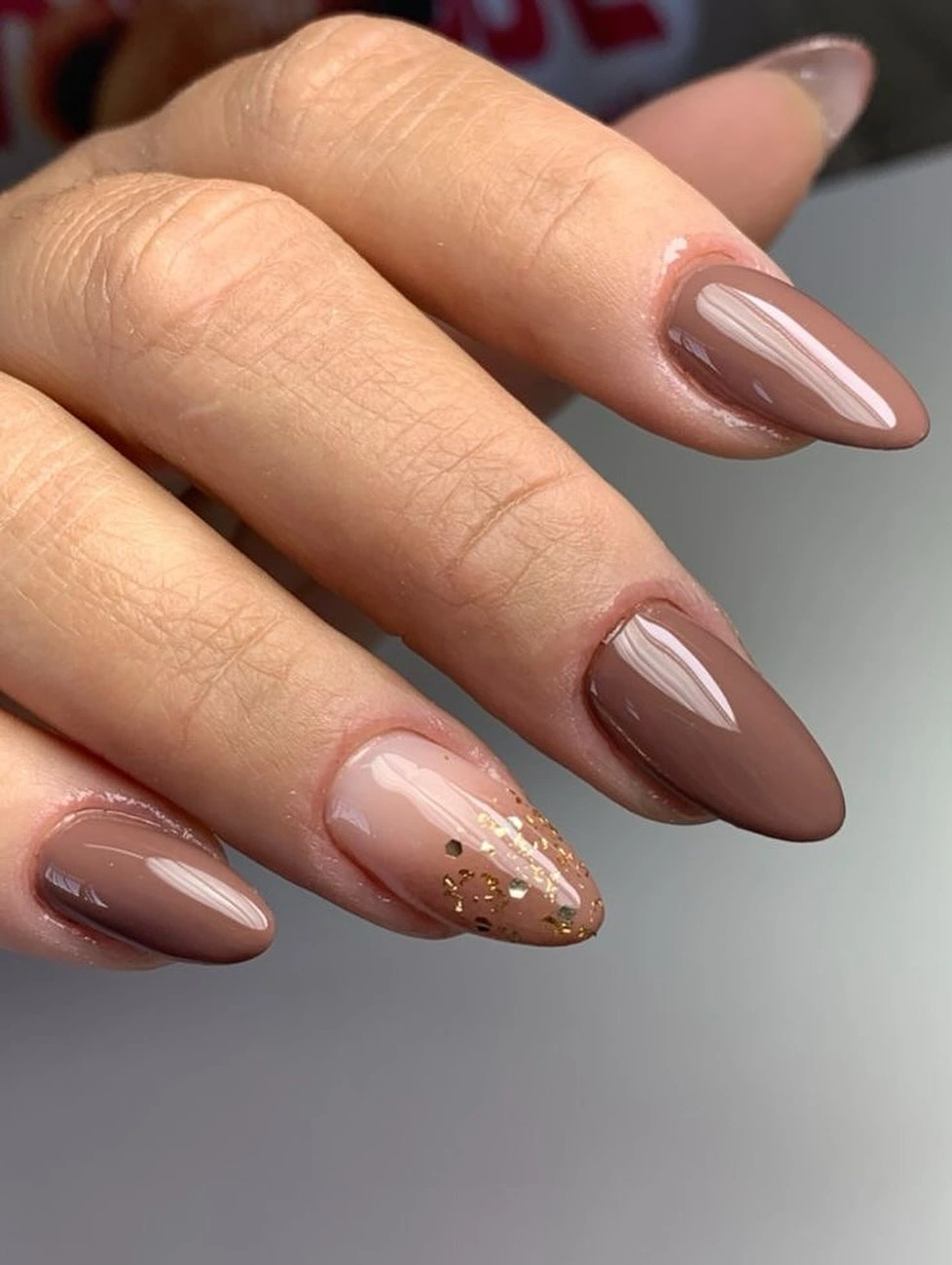
Place the gold near the tip if you want to emphasize the almond taper, or keep it closer to the center when the goal is a subtle jewelry-like glint. A medium almond can use a tiny foil fleck instead of a line, and a short oval can simply carry one warm metallic accent nail. The surrounding brown should remain uncomplicated so the detail keeps its role.
Sheer color gives the design flexibility because it allows the skin tone to become part of the palette. It also reduces the density of a long shape and lets the brown feel softer than a full opaque block. The limitation is that a delicate accent can disappear under heavy pattern or jewelry, so the styling around the hands should stay relatively clean.
Cool Blue and Bronze in a Sparkling Almond Mix
Long almond nails pair a cool slate-blue tone with warm bronze and copper shimmer, using the metallic color as a gradient across selected fingers. The combination is unexpected for fall, yet the knit texture in the background shows why it works: the blue supplies contrast while the bronze brings warmth back into the seasonal conversation. The almond shape gives both colors room to stretch.
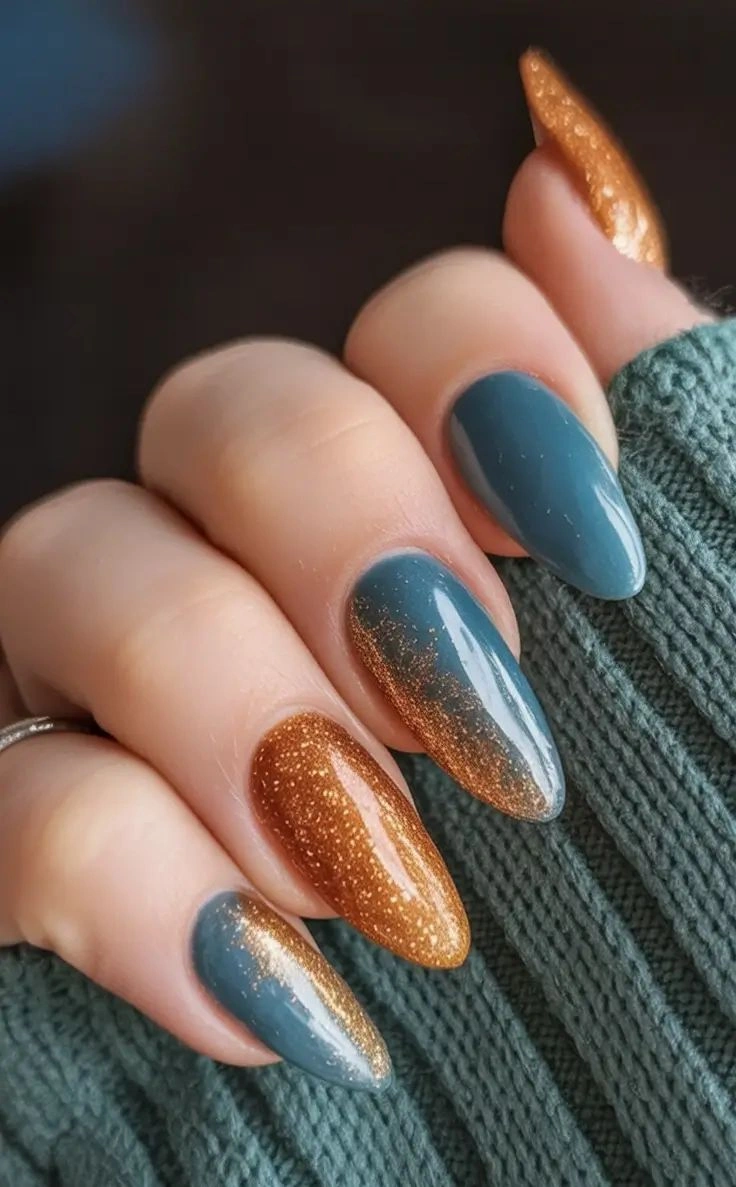
For a quieter interpretation, keep blue on three nails, use bronze on one, and reserve the fade for the thumb or ring finger. A shorter almond can place the bronze at the tip so the color contrast remains visible without covering the whole surface. This is also a useful palette when brown clothing is already doing the warm work and the nails need one cooler note.
The manicure is strongest when the two temperatures are allowed to meet without being blended everywhere. That preserves a clear visual relationship between cool and warm and prevents the shimmer from becoming a single muddy tone. The tradeoff is that reflective color can look different under indoor and outdoor light, so the base shades should stay distinct enough to survive that change.
Deep Wine Solids for a Simple Statement
Long almond nails return to a single deep wine shade, with the glossy surface and tapered outline carrying the entire idea. There is no pattern competing with the color, so the manicure feels direct and confident while still fitting the darker side of the season. Gold rings and a brown bag add context, but the wine tone remains the clear focal point.
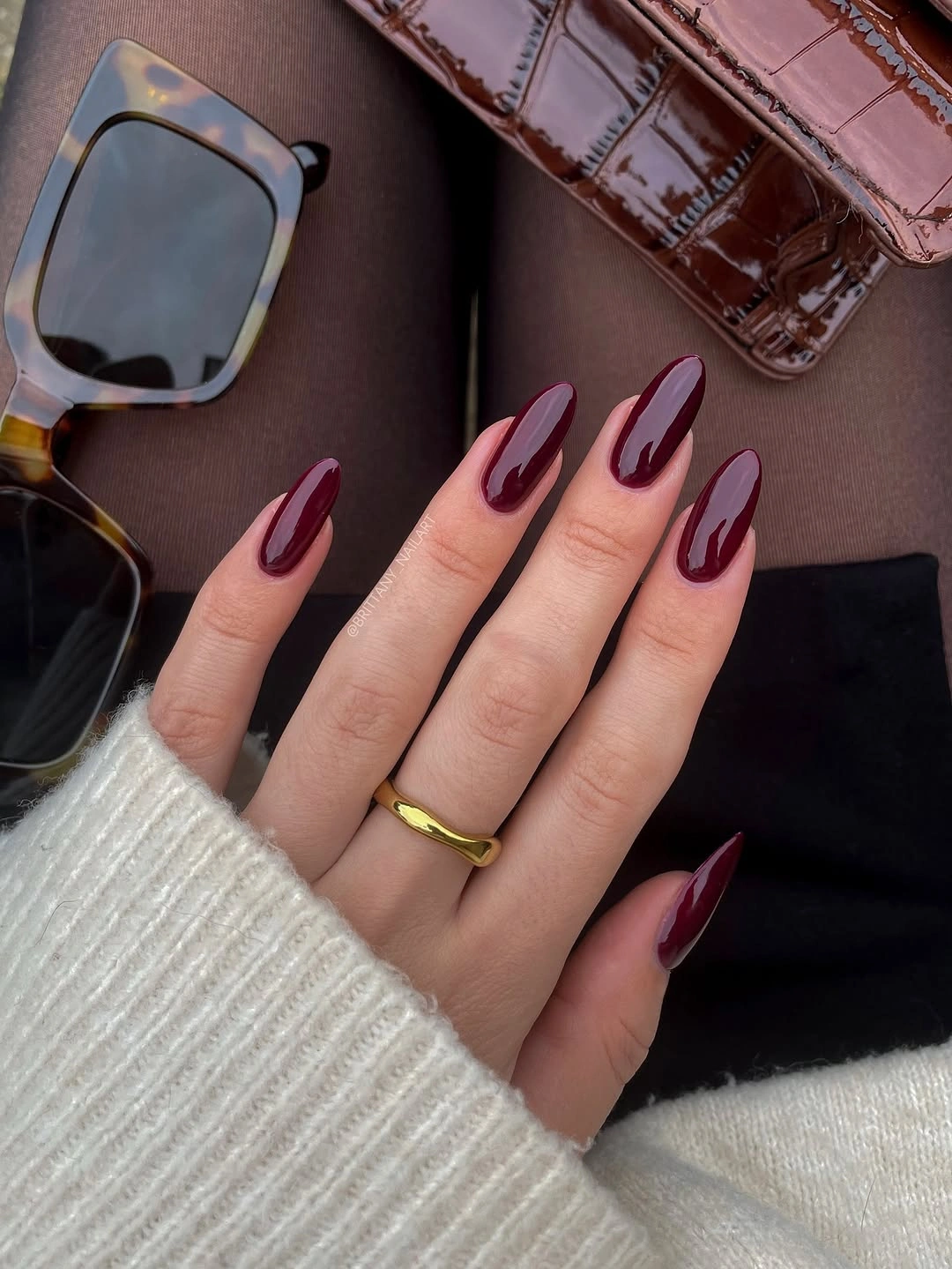
Shorten the shape to medium almond when you want the same depth with easier daily movement, or use the shade on four nails and a muted blush on one. A single accent can be left plain rather than decorated, which keeps the collection monochrome while adding a small break. These adjustments change the proportion without weakening the central color decision.
Solid dark color benefits from intentional contrast around it. Cream knitwear, denim, or a lighter neutral makes the wine look richer than another dark accessory would, and the glossy finish gives the hand a clean line. The limitation is visual exposure: uneven edges and small chips are harder to hide, so a simple manicure deserves careful proportion and placement.
Muted Olive Almonds Against Soft Knit Texture
Long almond nails use a muted olive shade that sits between green and brown, giving the set a quieter alternative to burgundy or chocolate. The glossy surface reflects a slim highlight on each nail, while the cream knit sleeve makes the color feel seasonal without forcing a literal leaf motif. Shape and tone do nearly all of the styling here.
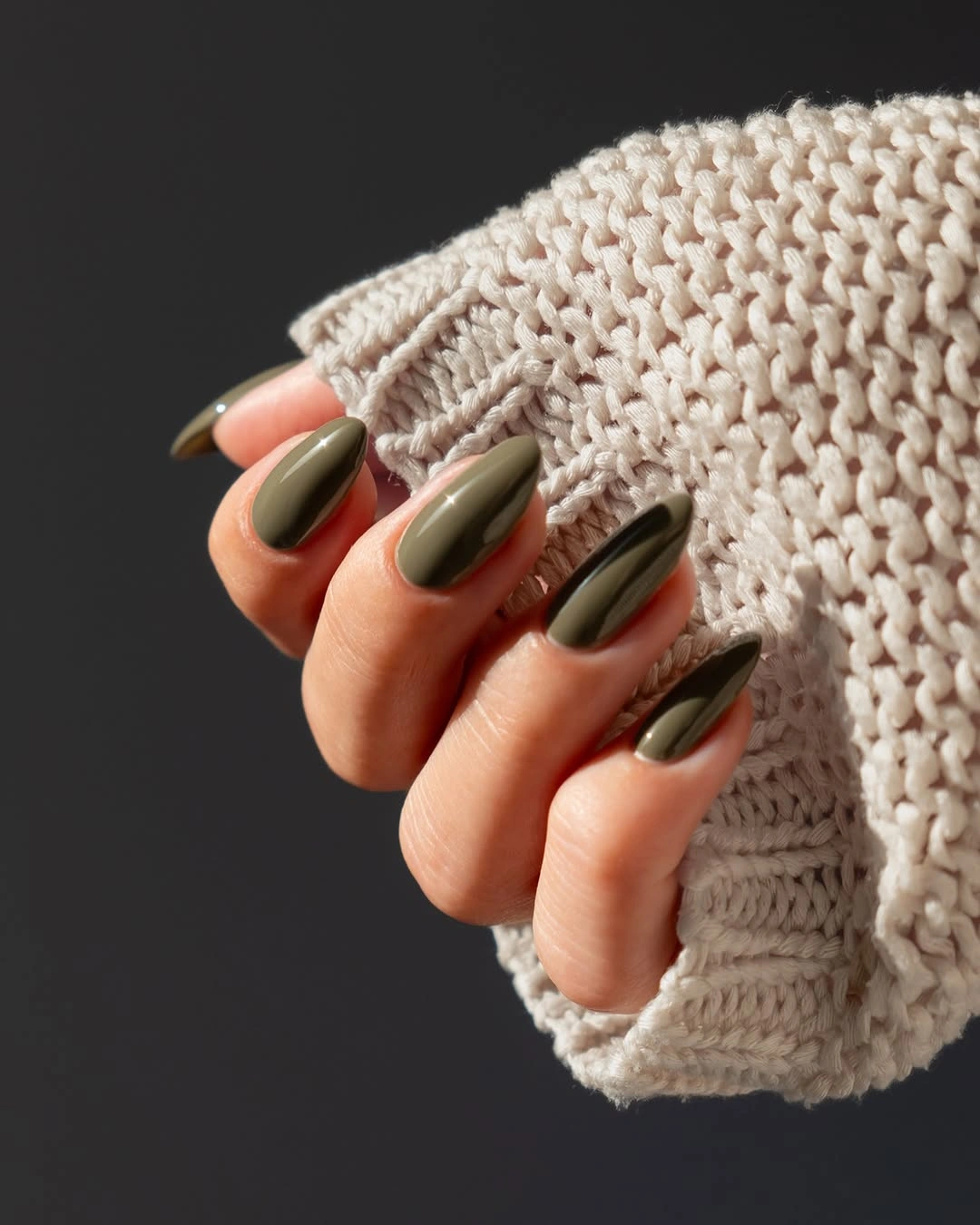
If olive feels too unusual as a full set, place it on three nails and use warm taupe or sheer beige on the rest. A shorter almond can keep the same color depth while reducing the visual length, and a single thin gold line would add light without turning the manicure into a pattern. The key is to let olive remain the recognizable color choice.
This idea is useful for readers who want fall color but prefer something less expected than red. The muted undertone pairs with cream, denim, and brown clothing while still giving the hand a point of difference. The tradeoff is that olive can shift under different lighting, so a restrained surrounding palette helps it read as intentional rather than accidental.
Chocolate Solids with Transparent Contour Nails
Long almond nails alternate deep chocolate solids with sheer nails outlined by dark brown contours. Some open sections include a few pale, almost translucent shapes, so the design feels dimensional even though the colors stay close together. The visual rhythm comes from switching between full coverage and clear space, which keeps a dark collection from becoming visually dense.
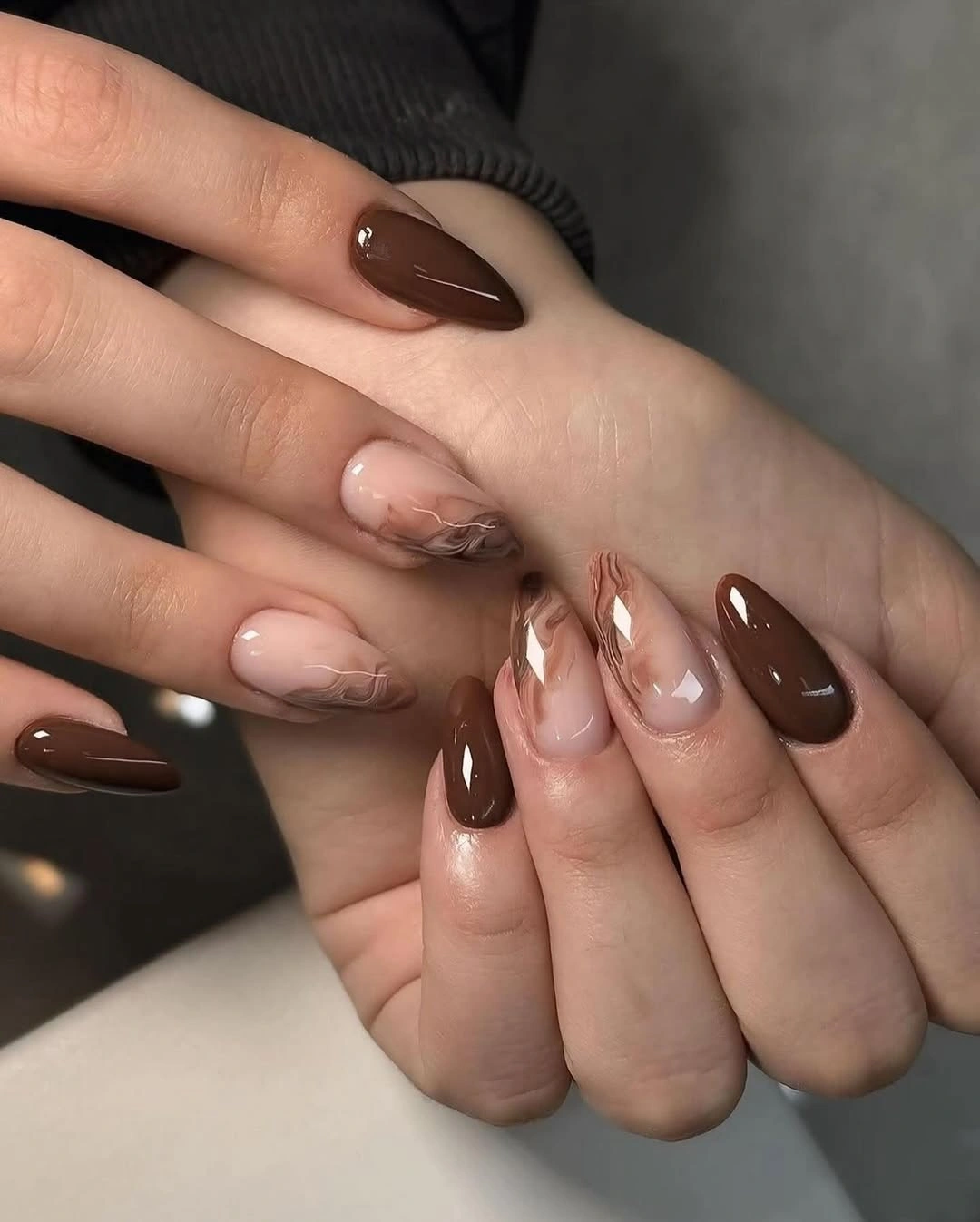
For a more practical set, keep the contour design on two nails and use the chocolate shade on the rest. On a medium almond, the outline can be placed only around the tip and one side, making the transparent base easier to read. If the dark brown feels too strong, a warm taupe contour will keep the contrast but soften the mood.
The clear nails provide a useful pause between deeper fingers and also make the long shape appear lighter. They are the part to protect if the design needs editing, because removing the open space would make the set feel much heavier. The limitation is that thin contours can look crowded when placed too close together, so generous gaps are more valuable than extra decoration.
Multicolor French Edges on a Nude Almond Base
Long almond nails keep a nude center and build the fall palette along the tips with narrow black, brown, rust, and cream edges. Each color follows the taper, so the result feels like a layered French treatment rather than a set of separate stripes. Because the base remains open, several shades can appear without overwhelming the length or competing with rings.
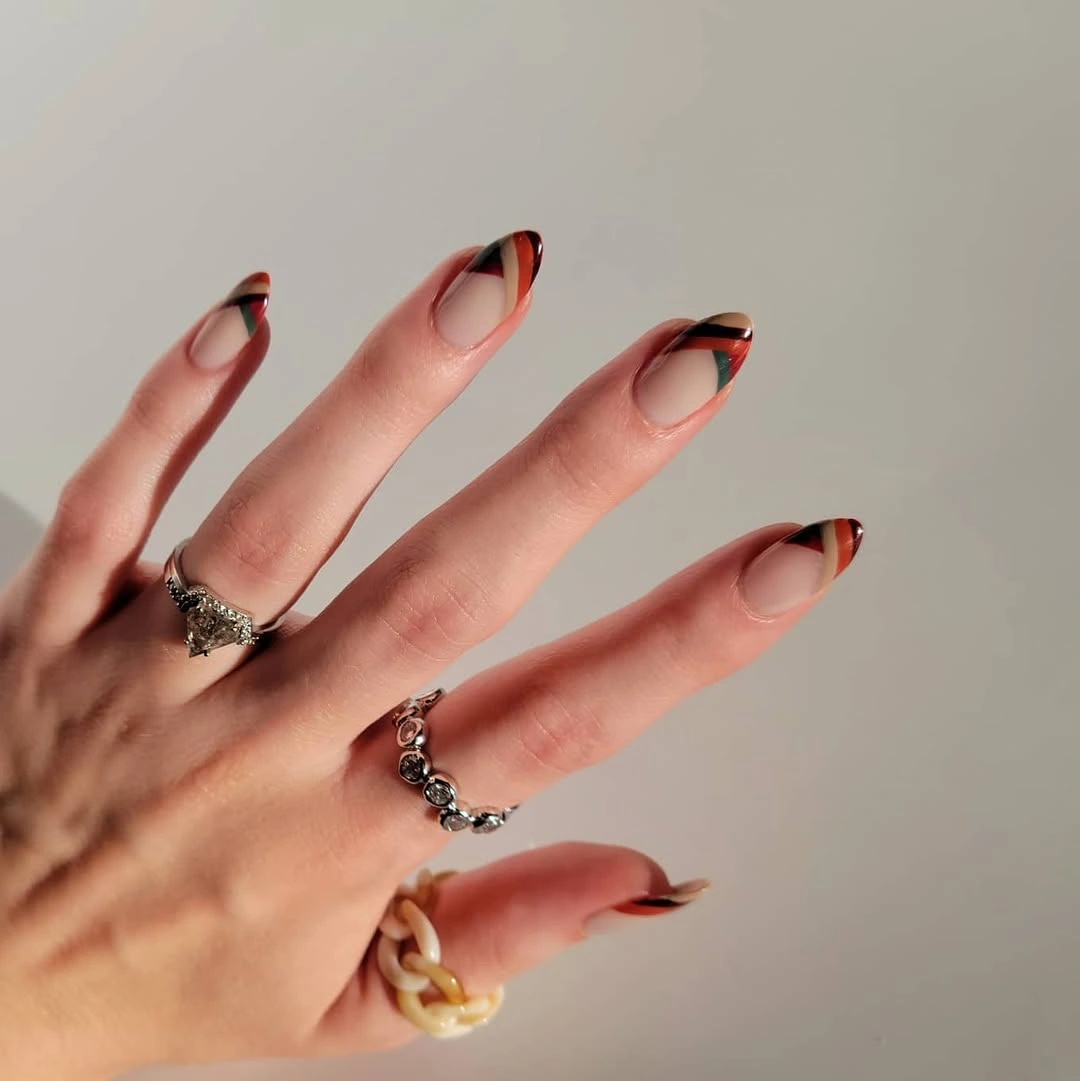
To simplify the idea, use one dark line and one warm line on every nail, then reserve the cream detail for the thumb or ring finger. A medium almond can carry wider tips while a shorter nail benefits from two narrow colors at most. The design also adapts well to a neutral wardrobe because the color is concentrated at the edge rather than across the full nail.
The main strength is proportion: the nude center creates a calm field, and the colored edge gives the season a clear voice. This is more flexible than a full set of dark solids when you want fall color but still like a natural-looking center. The tradeoff is precision, since uneven tip widths can change the visual balance from finger to finger.
Coral Matte with a Single Glitter Accent
Medium almond nails use a warm coral-red matte color on most fingers and place a glittering orange-red accent on one nail. The difference between soft and reflective finishes supplies more interest than an elaborate motif would, while the rounded taper keeps the strong color from feeling severe. A textured knit sleeve echoes the cozy warmth without turning the design into a costume.
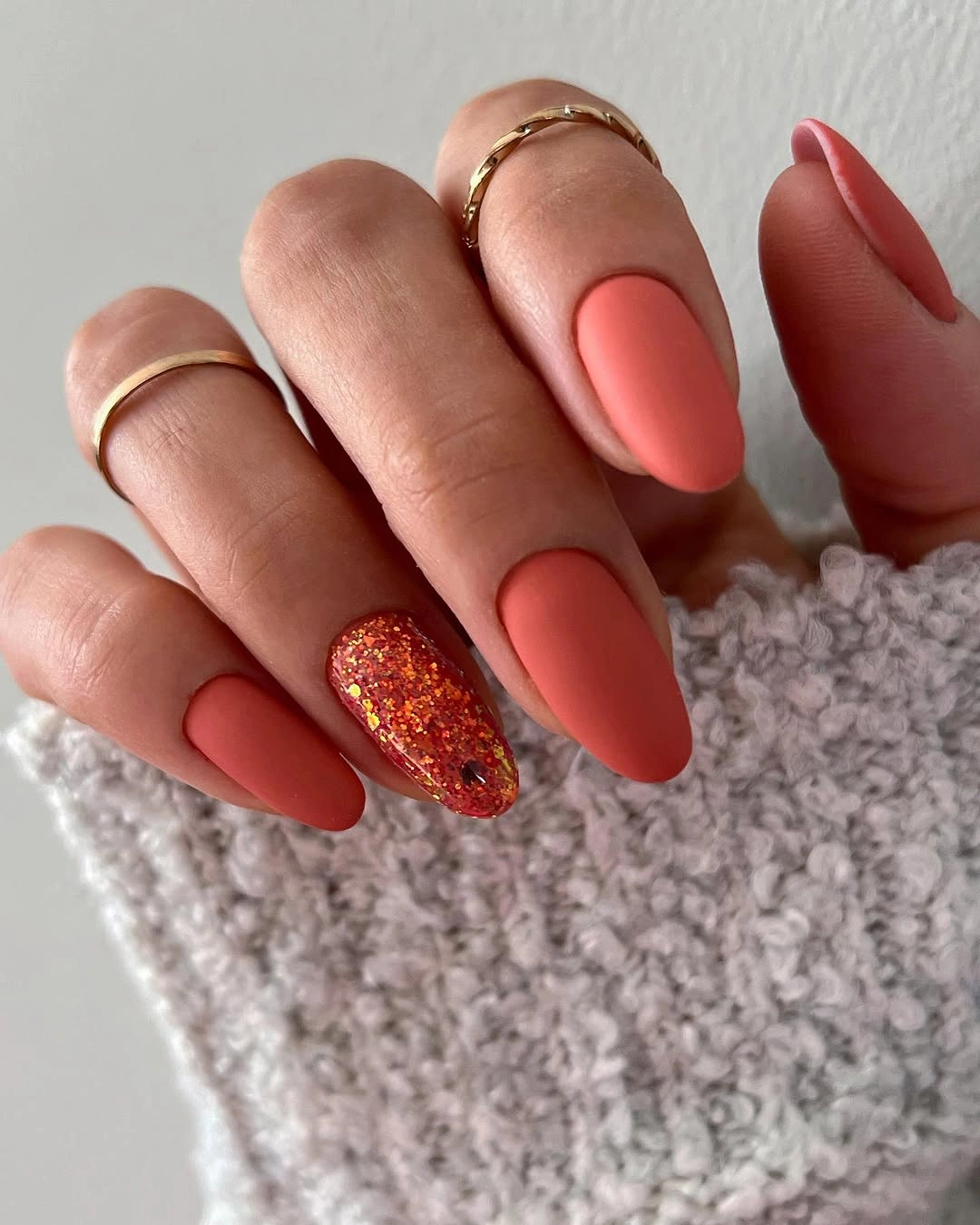
Keep the glitter on the ring finger when you want the hand to look balanced, or move it to the thumb so the accent appears only in certain gestures. A shorter almond can use a metallic coral instead of loose-looking sparkle, and a longer shape can carry one small foil edge. The surrounding nails should stay solid so the finish contrast remains clear.
Matte color is doing more than reducing shine; it gives the warm coral a softer visual weight and makes the glitter feel intentional. That pairing works for someone who likes a statement shade but does not want every nail to reflect light. The limitation is upkeep around the surface, because a matte appearance makes stray shine and uneven texture easier to notice.
Glossy Chocolate Almonds in a Deep Monochrome Set
Long almond nails return to a deep chocolate brown with a wet-looking glossy finish, letting the rich color and pointed taper create the statement. The hands overlap in the composition, which makes the repeated shape easy to compare and shows how a single tone can still have depth when light travels across each nail. No extra motif is needed for the palette to feel seasonal.
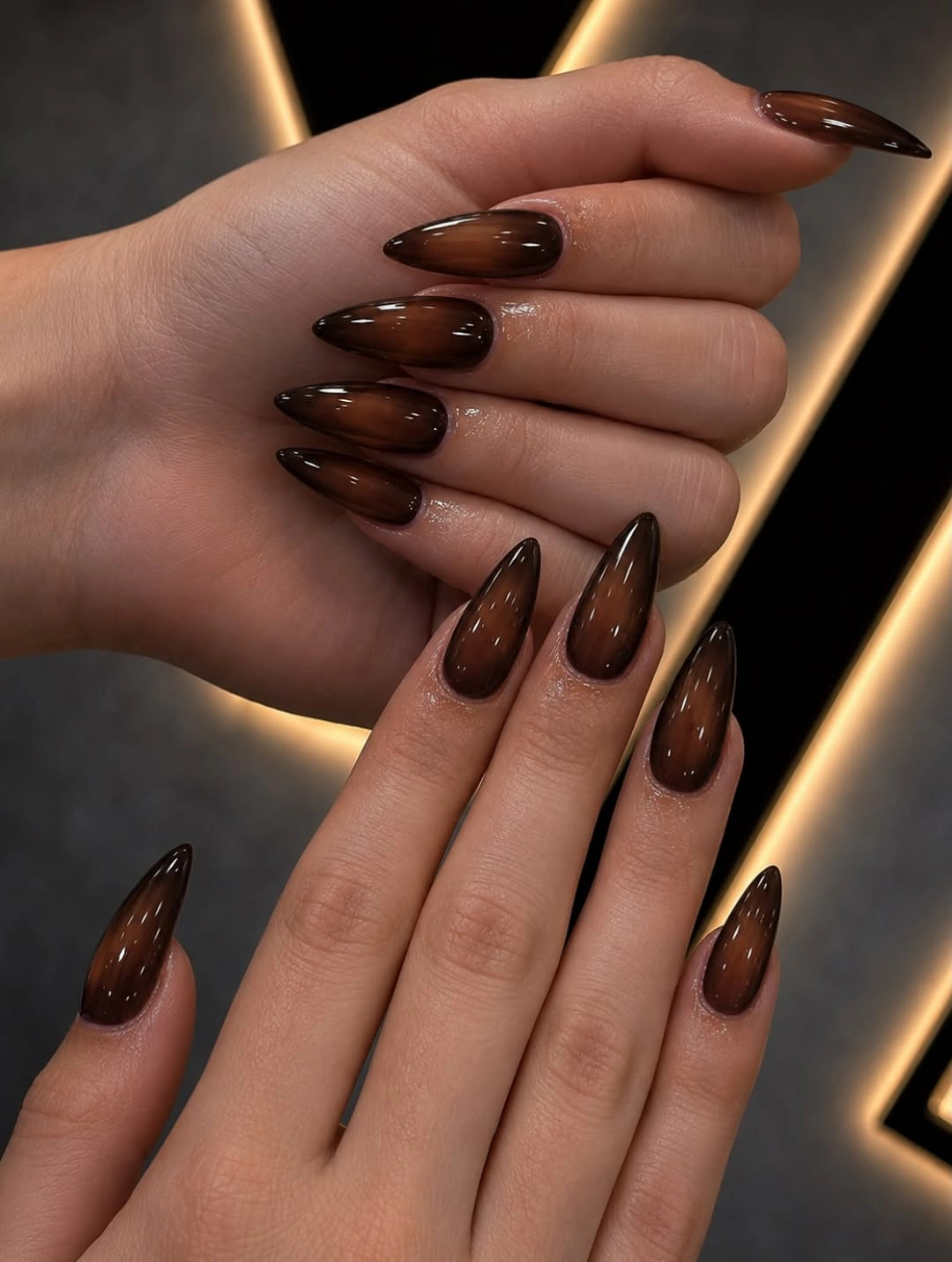
If the full length is not practical, shorten the tips evenly and keep the color uninterrupted. You can also use a slightly lighter cocoa on the thumb and ring finger to introduce tonal movement without breaking the monochrome idea. A cream sweater or soft gray background will give the dark brown enough contrast to stay readable.
Monochrome is a useful choice when the wardrobe already has prints or textured layers. The manicure supplies a strong line and a single deep note, so it can support rather than compete with the rest of the styling. The tradeoff is that a glossy dark surface shows every reflection and edge, making careful shaping more important than it would be in a busy design.
Sheer and Espresso Nails with Alternating Depth
Medium almond nails alternate sheer blush, espresso brown, and darker translucent tips, creating a rhythm that changes the visual depth from finger to finger. Some nails appear almost open at the center while others look fully saturated, and the repeated almond shape keeps those differences connected. The set feels expressive through transparency rather than through additional color.
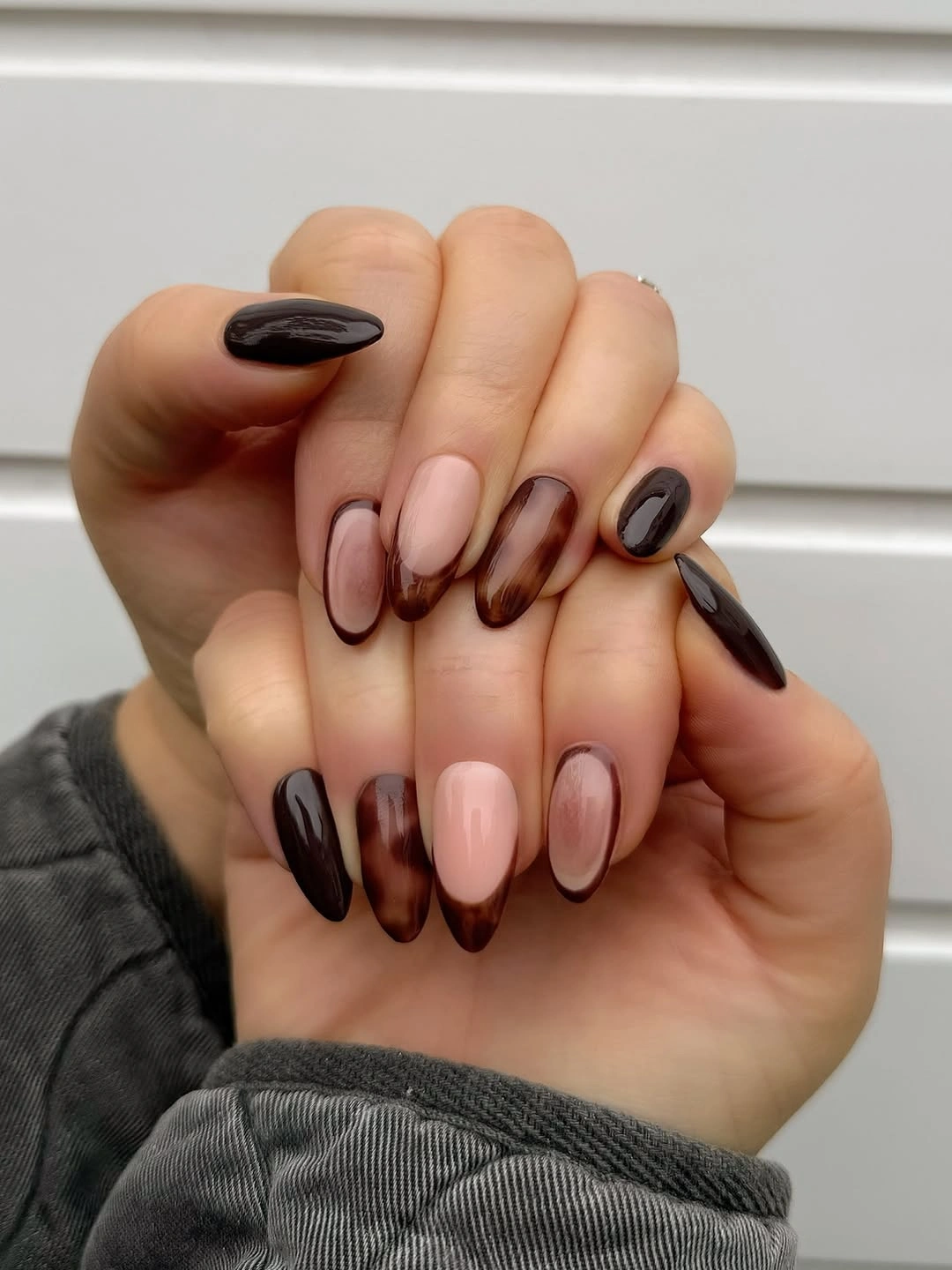
For a softer adaptation, keep the sheer blush on three nails and use espresso only at the tips of two accents. A shorter almond can turn the darker sections into small half-moons, while a longer one can carry the open contour farther toward the cuticle. This gives you control over how much of the hand feels dark without changing the central contrast.
The transparency creates room for the skin tone to participate in the palette, which is why the dark accents do not feel as heavy as a full opaque set. It also gives the design a natural variation from nail to nail. The limitation is that the effect depends on clean spacing, so adding extra lines or a strong third color would make the rhythm less legible.
Brown and Black French Curves with Negative Space
Long almond nails use a sheer pink center with sweeping brown and black curves that rise from the tip and bend along the sides. The lines are asymmetrical, so each nail has its own movement, but the repeated relationship between dark curve and open base keeps the hand coherent. It feels like a more graphic ending to the collection than a solid polish would.
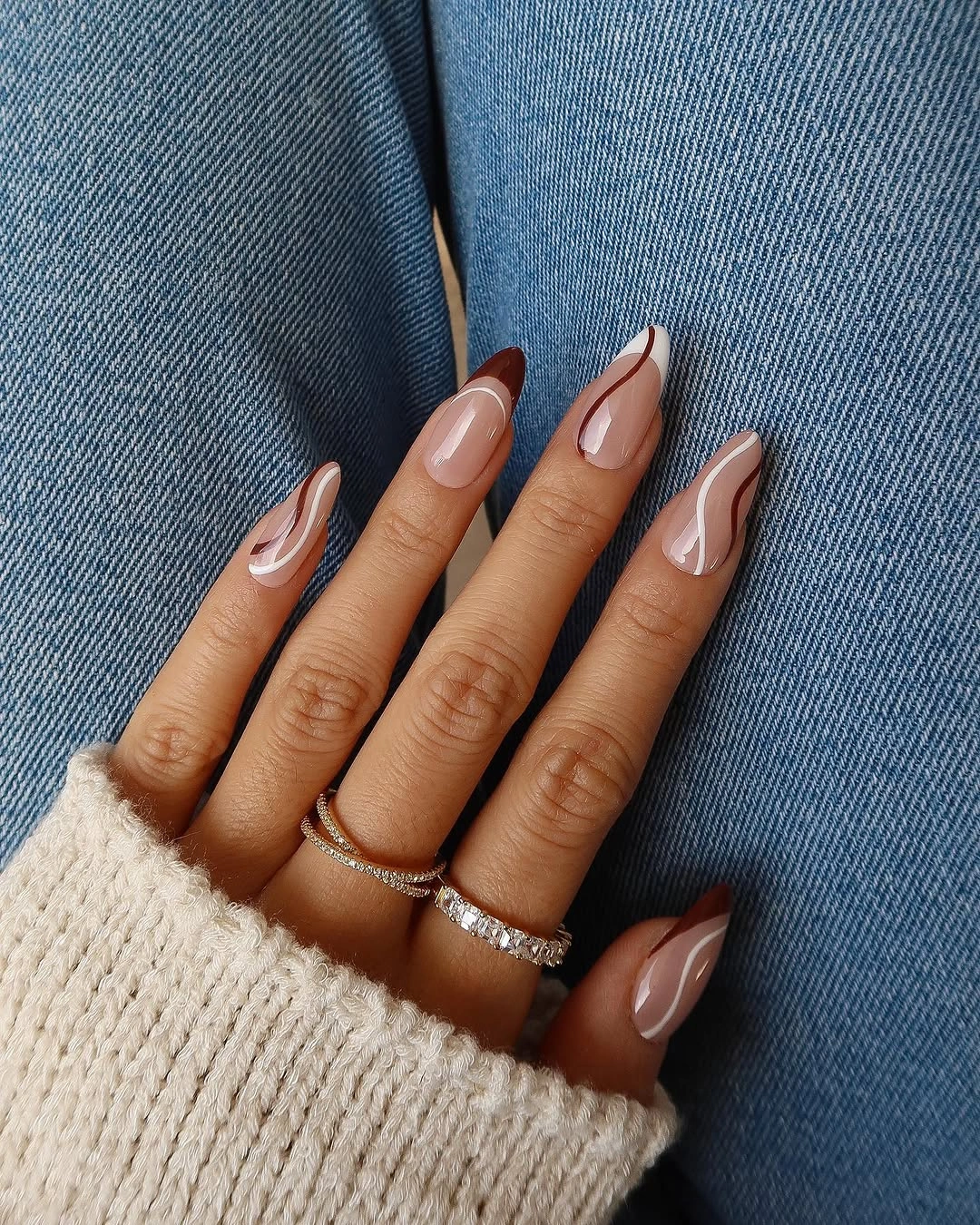
To make the idea easier to wear, choose brown as the main line and use black on only two accent nails. On a shorter almond, one curve near the tip will have more impact than several narrow loops, and a soft taupe can replace brown when the contrast feels too strong. The center should stay open so the design does not lose its lightness.
Negative space allows a bold pair of colors to remain visually controlled. The curves trace the almond shape, which lengthens the look without adding a solid dark block, and the glossy surface makes the movement easy to see. The tradeoff is that asymmetry needs intentional spacing, so a simpler curve is safer than trying to copy every small bend exactly.
Expressive Amber and Teal Marbled Swirls
Long almond nails close with a lively marbled mix of amber, orange, lime, pink, and teal. The colors appear to flow into one another in irregular swirls, producing a glossy surface where no single nail looks exactly the same. The saturated palette is the most expressive idea in the set, so the simple silhouette and minimal jewelry help the color remain the center of attention.
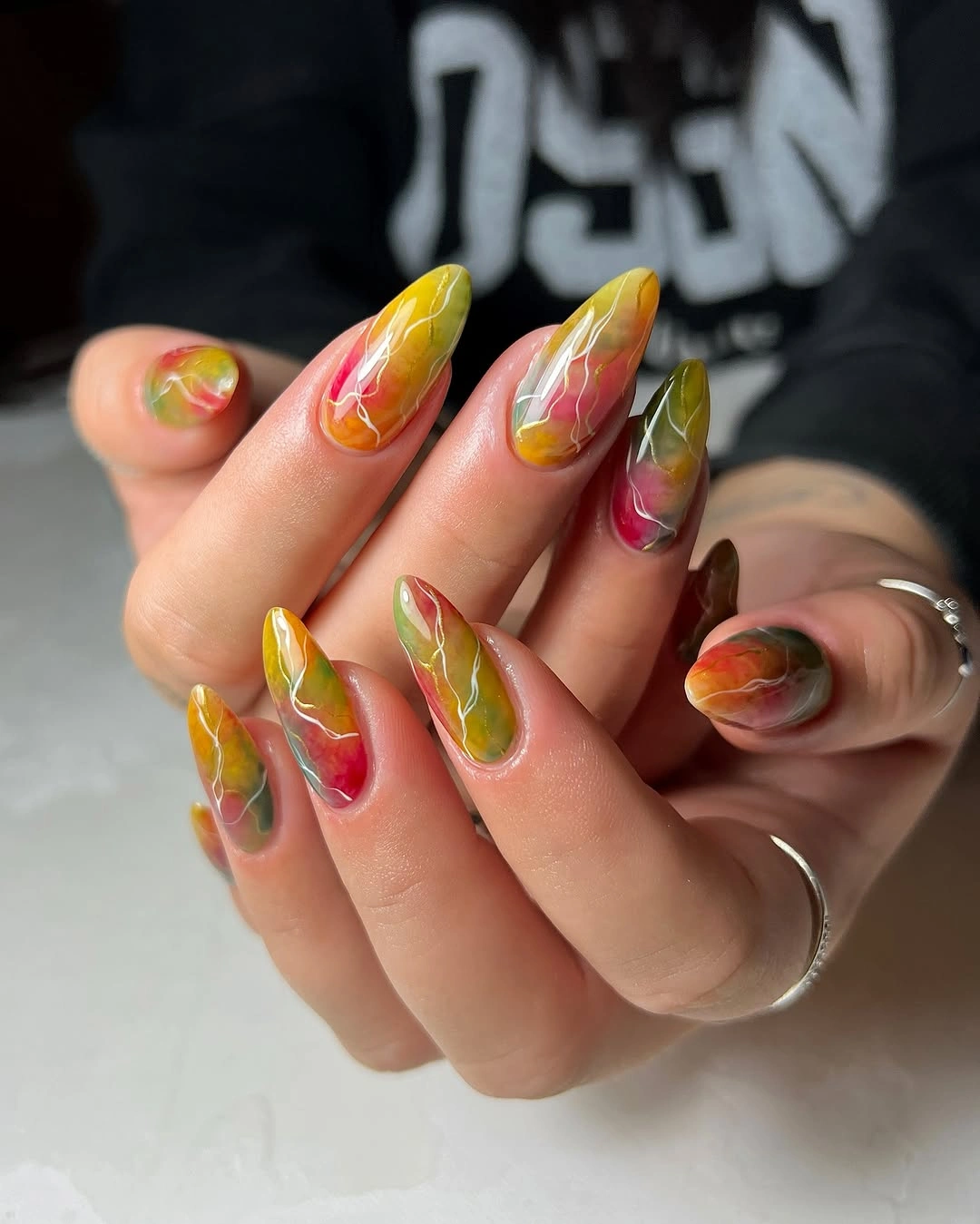
If the full mix feels too bold, choose two warm shades and one cool shade, then let the marbling appear on three nails rather than all five. A medium almond can use larger color patches so the pattern stays clear, while a short nail benefits from a single curved accent instead of several blended marks. The concept survives as long as the colors still visibly move together.
Marbling is useful when you want a trend-forward finish without a repeated drawing on every finger. Its variation hides small differences in placement and makes the set feel collected rather than mechanically matched. The honest limitation is that several bright colors will compete with strong clothing, so a quiet outfit or one repeated accessory gives the manicure enough visual space.