Fall nail art can tell a story with a single shifting color or with a cast of tiny chickens, pumpkins, branches, and stars. These manicures move between open blush grounds, saturated wine tones, smoky borders, and warm metallic-looking accents. Line work changes character repeatedly, appearing as loose waves, crisp frames, curling stems, scattered veins, and one carefully placed leafy sprig. The variety comes from how each set controls space, not simply from how many details it contains.
Several designs gather their motifs at the tips so the center of each nail remains quiet, while others stretch color or foliage from edge to edge. Short rounded shapes turn busy scenes into compact panels, and longer almond silhouettes give gradients and winding lines more distance to travel. Even the darkest palettes preserve contrast through translucent-looking centers, pale outlines, or reflected bands. That push between containment and movement is the thread running through this fall nail art collection.
Mocha Waves Across Sheer Taupe Panels
Medium almond nails alternate between solid mushroom brown and lighter taupe fields crossed by narrow dark stripes. The lines bend diagonally, change spacing, and taper as they approach the sidewalls. Their irregular rhythm gives each patterned nail a different current, even though the palette stays tightly controlled. A glossy surface sharpens the distinction between the two close neutral shades.
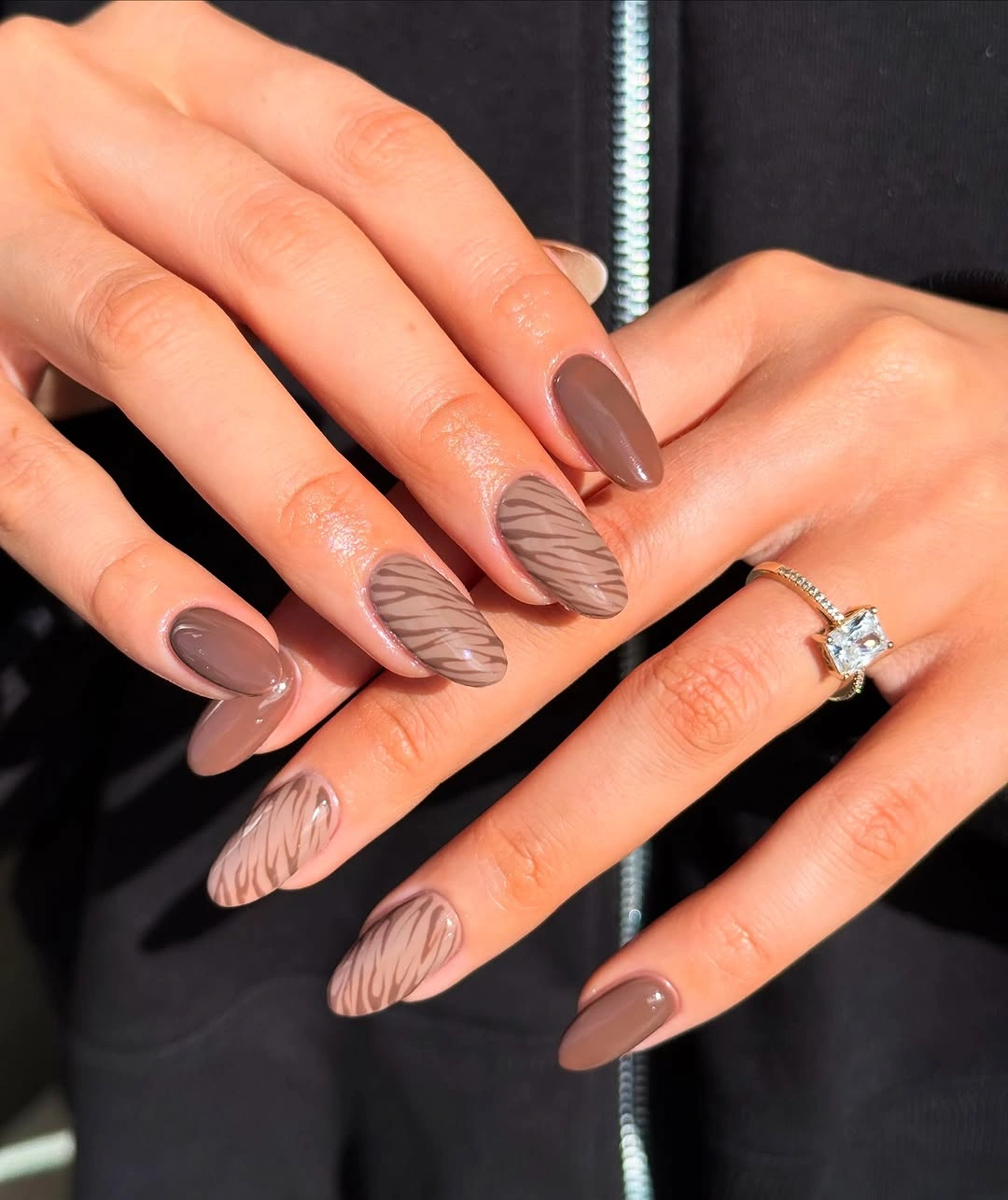
Solid nails act as visual rests between the busier striped ones. That alternation matters because ten fully patterned nails would blur the individual turns and forks in the line work. Here, the plain brown areas let the eye reset before following another group of curves.
The medium length is generous enough for several bends without making the design dependent on an extreme tip. I would pair this neutral movement with simple dark clothing so the subtle difference between taupe and mocha stays readable. The result feels more like contour drawing than a literal print, which gives the set an understated narrative.
Tiny Harvest Scenes on Blush Nails
Short rounded nails become miniature stages for white chickens, orange pumpkins, burgundy flowers, muted green leaves, and tiny dots. Most of those elements gather near the tips or along one side, leaving broad blush-pink centers exposed. The chickens have black dot eyes and small orange combs, while the pumpkins are divided by fine dark or metallic-looking lines. No two nails carry exactly the same arrangement.
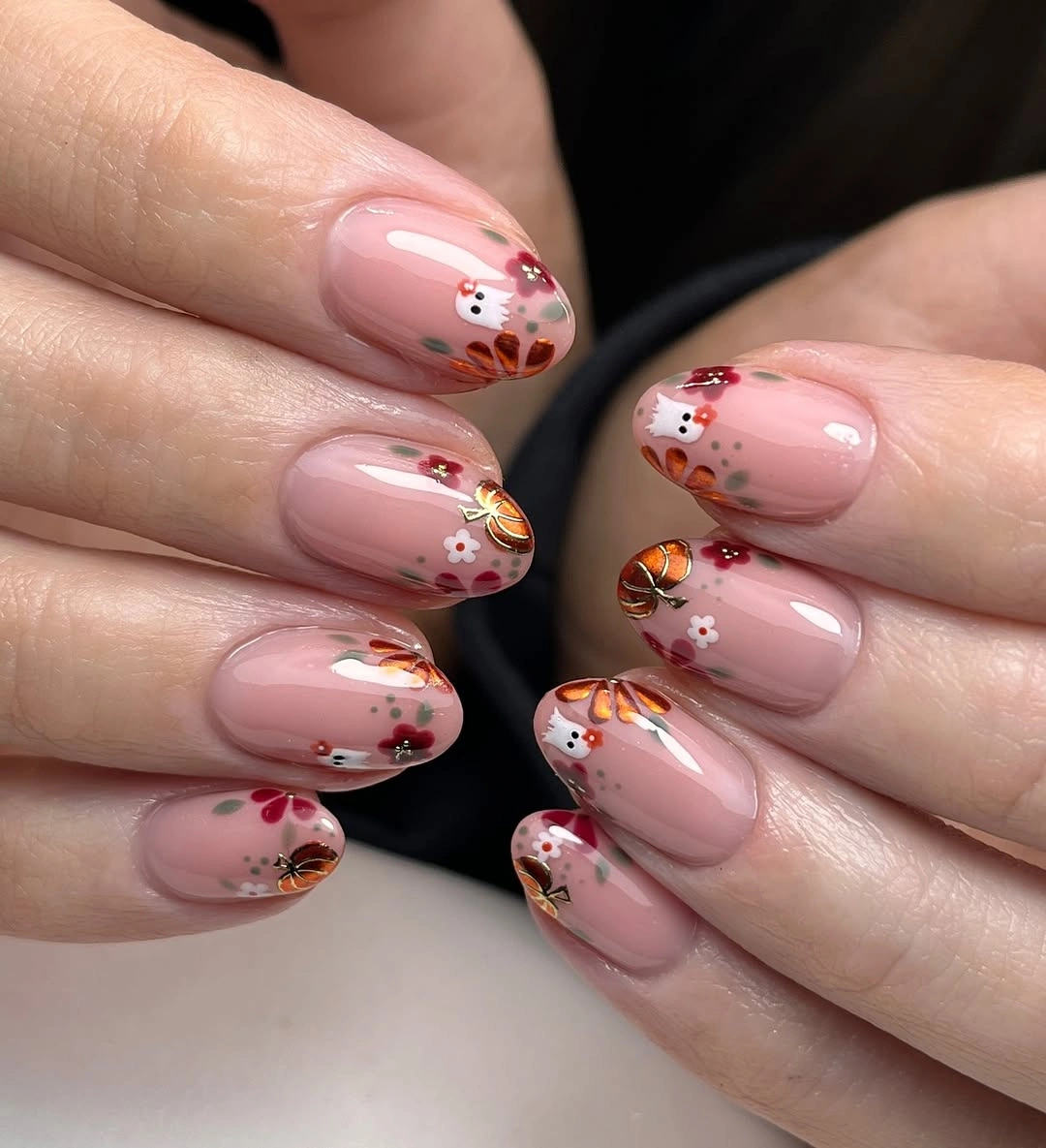
Open space is doing as much compositional work as the painted characters. A flower can sit beside a pumpkin without colliding with a chicken because each motif has a clear pocket of pink around it. Pinpoint flashes at several flower centers and pumpkin edges add another scale of detail without filling those gaps.
Playfulness does not come at the expense of disciplined placement, so the short shape never looks crowded. The varied scenes also remove any need for strict symmetry between hands. For a quieter version, keeping the chickens on two accents and distributing the leaves and dots elsewhere would preserve the little harvest narrative.
Red Embers Inside Plum Almond Nails
Warm red-orange color glows through the center of every medium almond nail. Plum-purple deepens around the cuticles, sidewalls, and pointed tips, forming a soft perimeter rather than a hard outline. The transition remains blurred from end to end, so the central color appears suspended inside the darker shade. Repeating that placement across all ten nails creates an unbroken pulse.
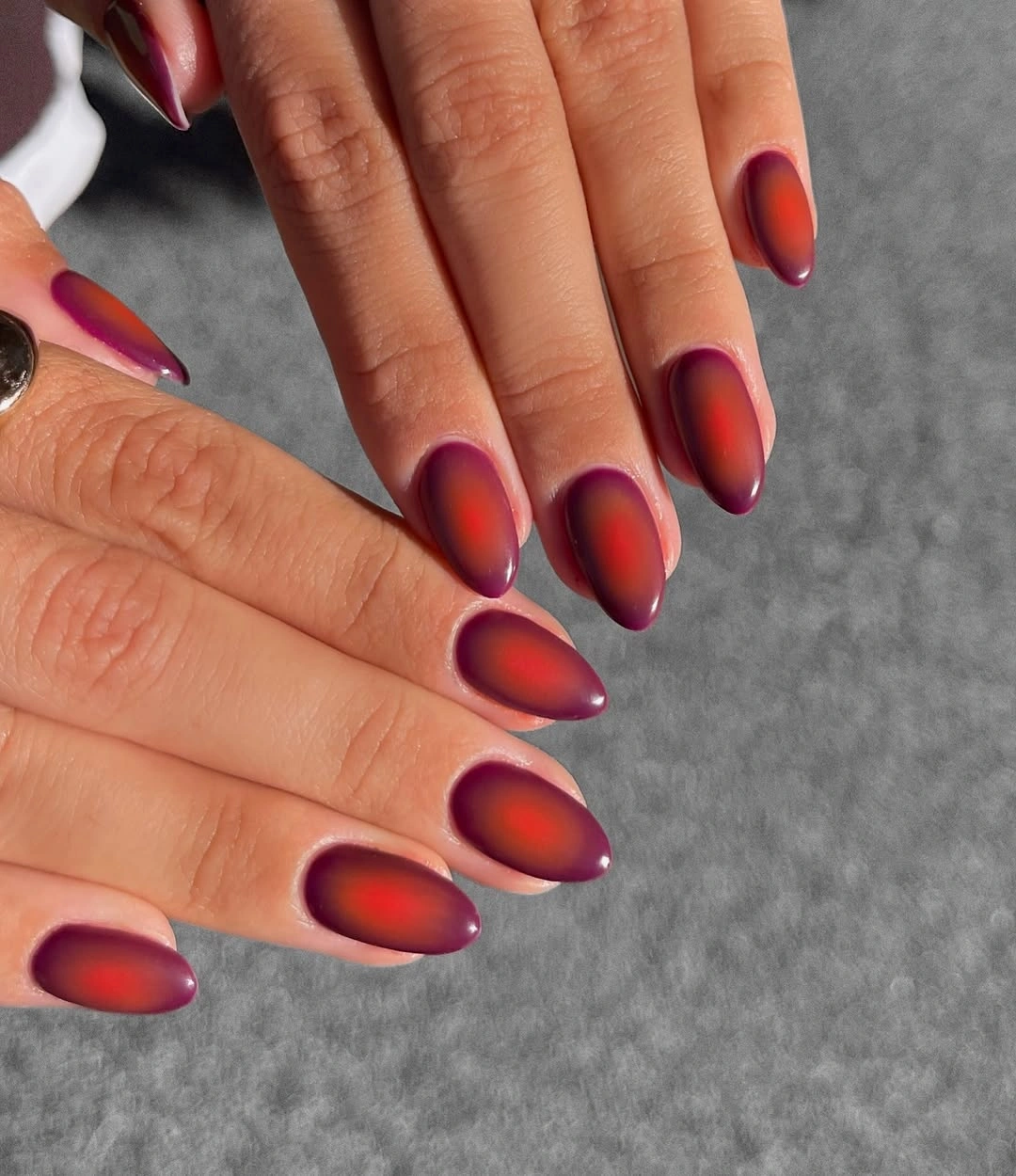
Color performs the full narrative here because there are no separate motifs competing for attention. The orange-red center pulls the eye lengthwise, while the purple edge defines and slightly sharpens the almond silhouette. A neutral gray setting makes that internal heat look even more concentrated.
Consistency is the demanding part of this design, since every glow sits in nearly the same vertical position. The softly diffused surface keeps the saturated pairing from becoming harsh, yet small highlights still reveal the curvature of each nail. I like this approach when the goal is dramatic color interaction with no decorative clutter.
Wine Borders Around Smoky Mauve Centers
Deep burgundy gathers around the perimeter of these glossy oval-almond nails, while each center fades toward smoky mauve-gray. The strongest wine color runs along the tips and sidewalls, creating depth without enclosing the middle in a rigid line. Long white reflections cut through the shading and reveal a smooth, curved surface. From a distance, the manicure can read as solid burgundy before the quieter centers come into focus.
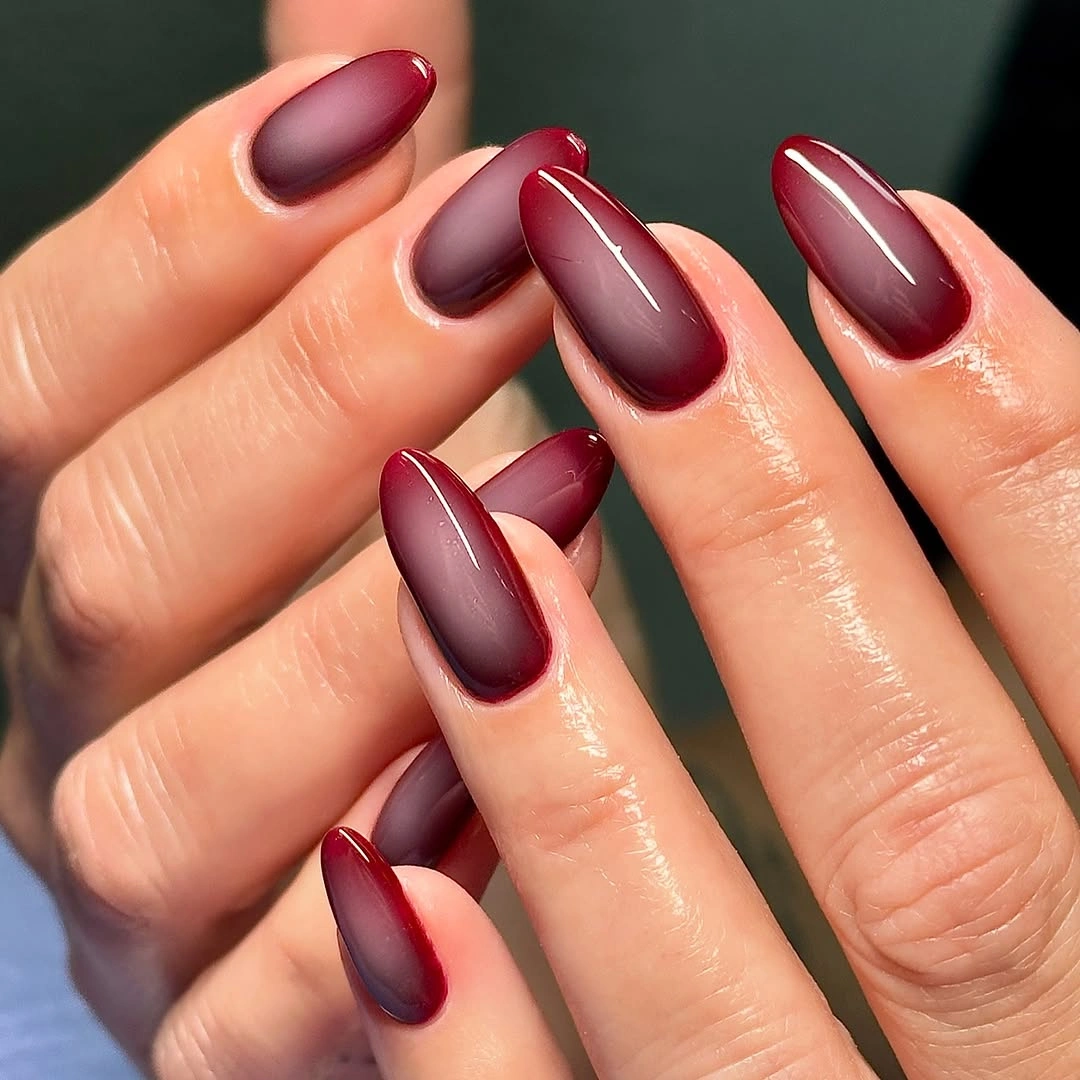
The composition reverses the usual idea of a bright central spotlight. Here, the inner area recedes and the saturated border supplies the visual weight. Slight shifts in rim intensity keep the repeated treatment atmospheric rather than mechanically uniform.
Because there is no figurative motif, the story rests on seeing burgundy move from opacity toward haze. The glossy finish rewards strong light, although it will also make dull spots and surface wear easier to notice. This is the kind of fall nail art that changes character with viewing distance rather than with added decoration.
Copper Light Through Deep Red Squares
Short rounded-square nails carry a dark red-brown base with a concentrated copper-red band running through each center. The outer edges sink toward black cherry, making the luminous strip look narrow and intense. Its placement shifts slightly as each nail turns, so the glow travels across the hands instead of sitting like a painted stripe. Straight sidewalls give that moving light a compact frame.
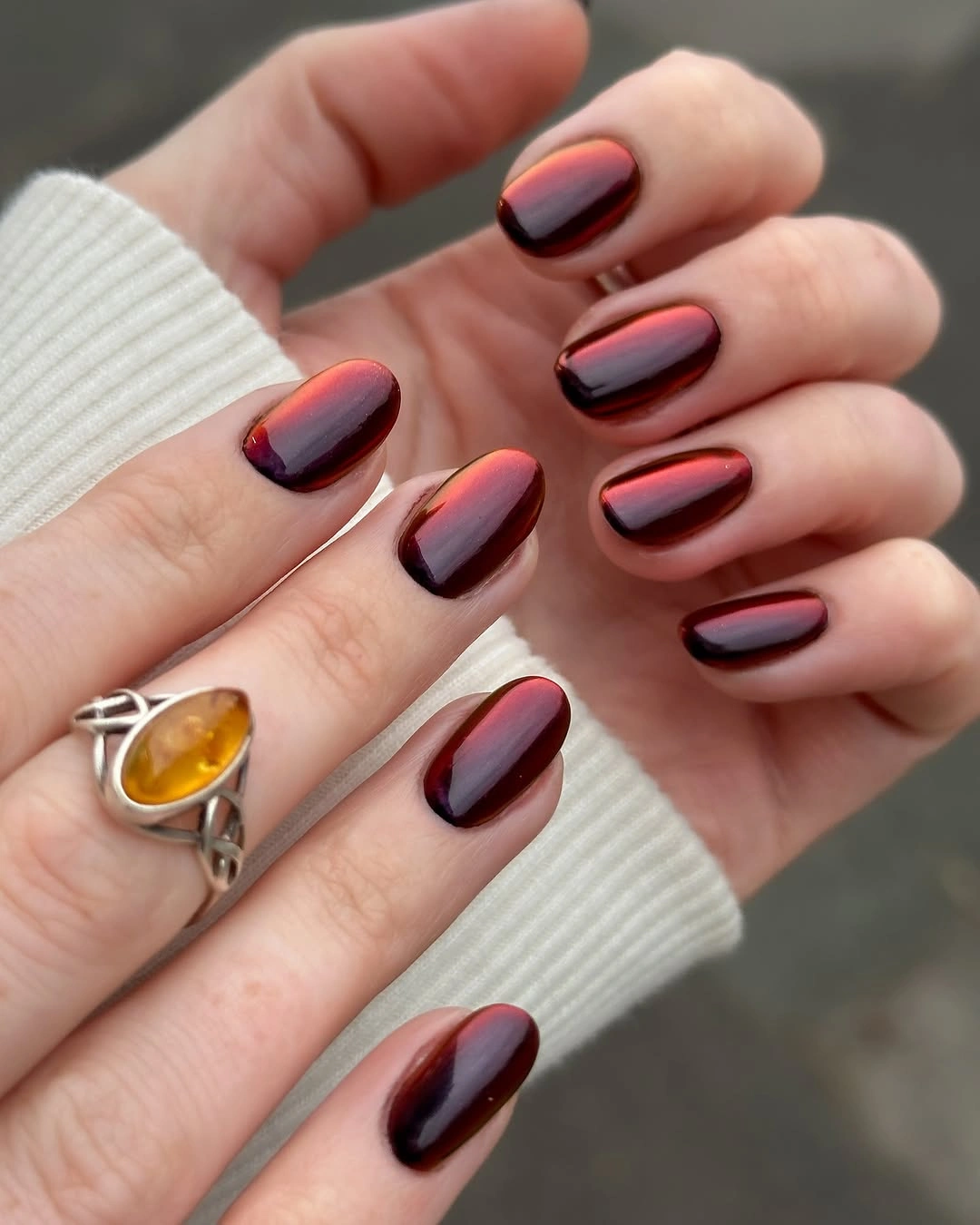
Nothing interrupts the reflective color treatment from thumb to little finger. That uniformity lets small changes in angle become the design, especially where one band widens and another nearly disappears into burgundy. A cream ribbed sleeve makes the dark perimeter appear even heavier.
The practical short length concentrates a high-impact finish into a restrained silhouette. Keeping the surface smooth matters because a dull patch would break the long line of light. An amber-colored ring beside the nails adds a warm echo, but the red-copper shift remains the central event.
Burgundy Framed by Spots and Mottling
Three long almond nails are solid dark berry, while two neighboring accents introduce completely different mark systems. The cream nail carries black dots that jump from pinpoints to larger circles, all separated by generous blank areas. Beside it, amber brown and near-black patches blend with soft irregular borders. The shared darkness ties crisp spotting to fluid mottling without pretending the patterns are the same.
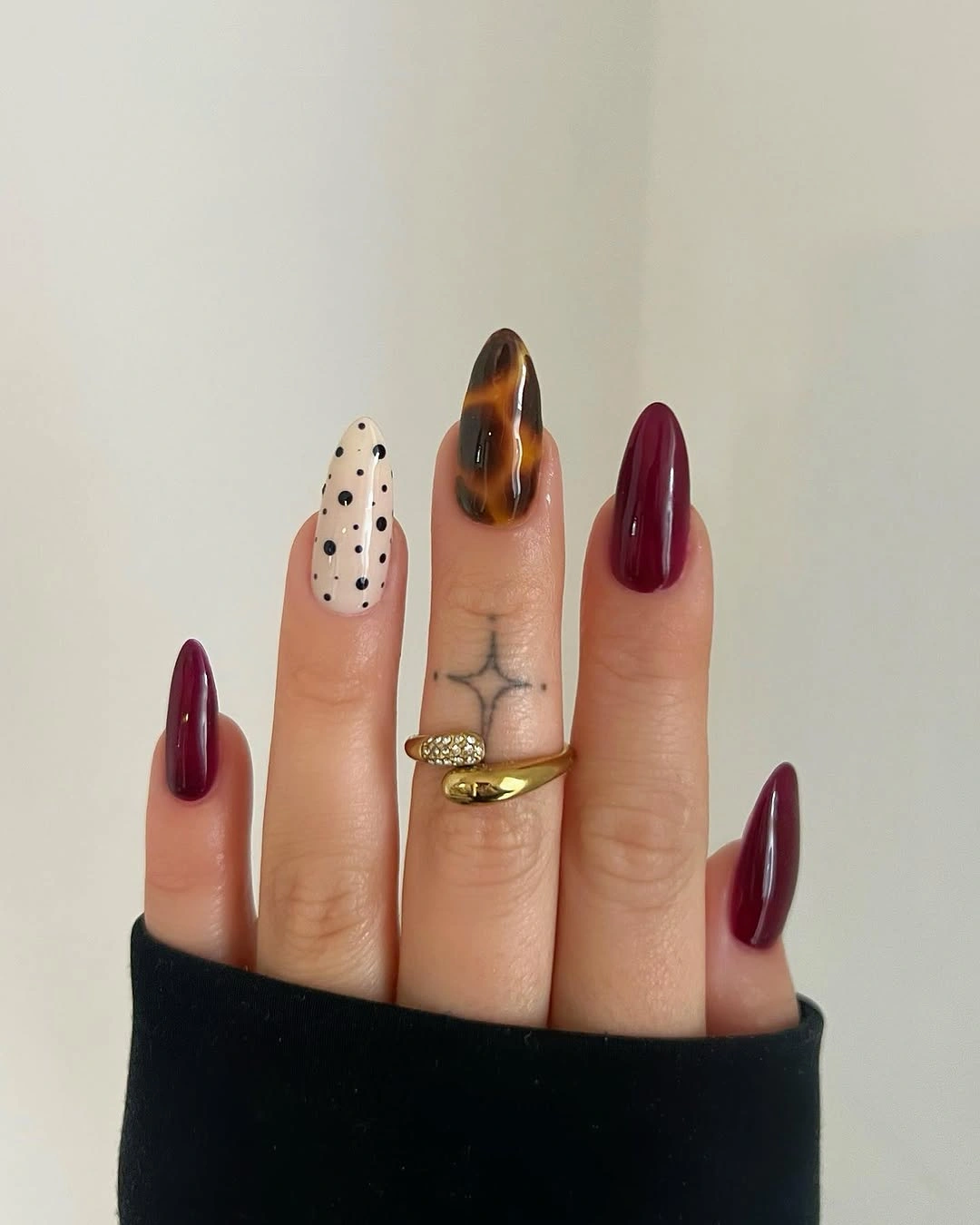
Placing both accents in the center of the hand creates a brief pattern collision framed by burgundy on either side. Hard black circles read quickly against cream, then the eye slows down to follow the blended amber shapes next door. Gloss is the common finish that prevents the trio of ideas from splitting apart.
Most of the set remains a single color, which is a useful way to carry two statement nails without covering every tip in detail. The elongated silhouette gives both accents enough height for their marks to breathe. For less daily maintenance, the same pattern sequence could work on a shorter oval while preserving the strong solid-pattern-pattern-solid rhythm.
White Blossoms Woven Through Burgundy Vines
Large white flowers spread across burgundy almond nails, each one surrounded by curling green leaves and stems. Pale sage and deeper green shapes loop around the petals instead of forming isolated sprigs. Small gold-colored centers punctuate the flowers, giving every blossom a bright fixed point. The background remains visible only in narrow channels between the layered botanical forms.
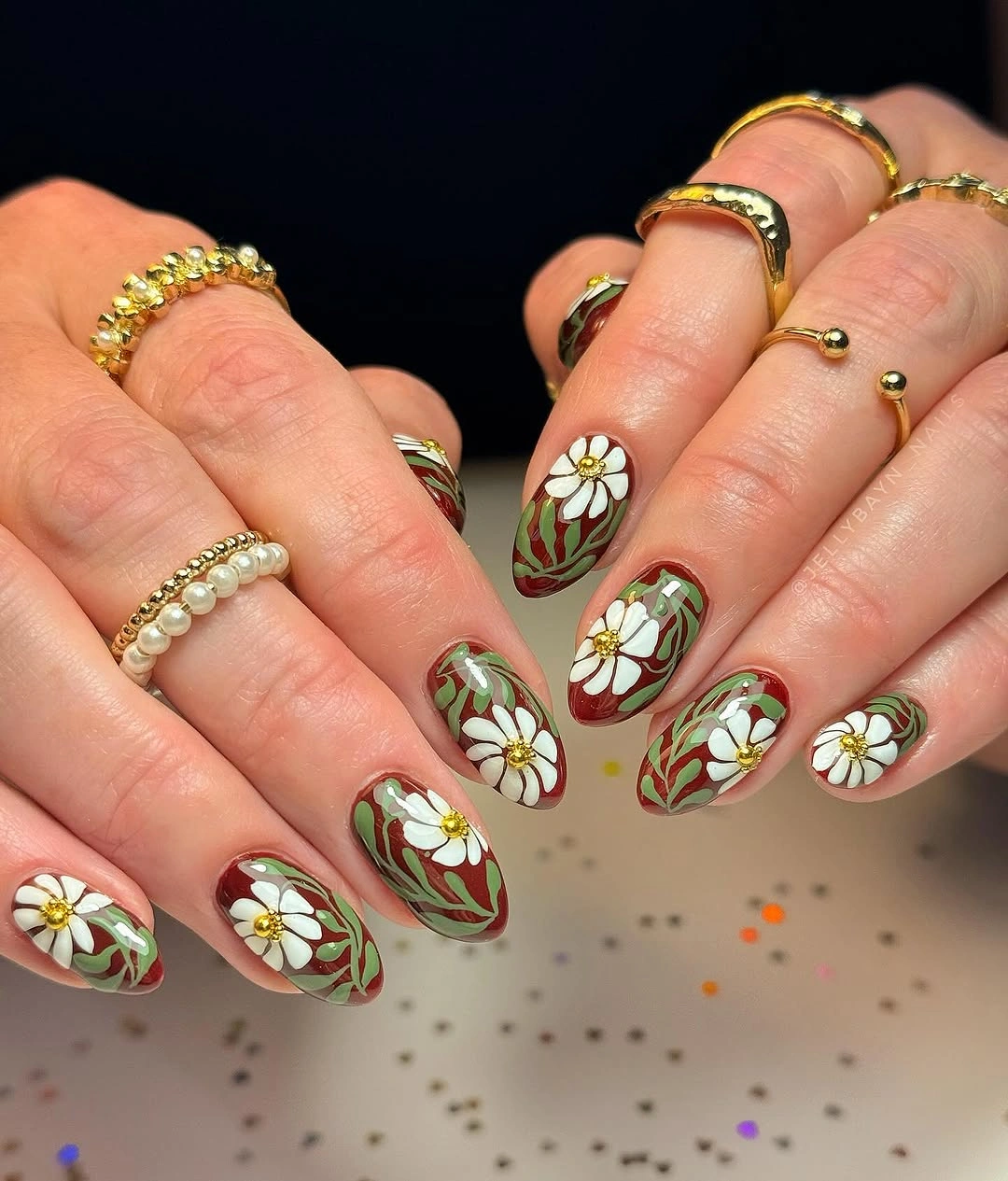
The foliage appears to continue from nail to nail, turning ten separate surfaces into one wandering garden. Some flowers enter from a side, others rise from a tip, and none sits in an identical crop. White petals are crucial because they stop the sage lines from dissolving into the deep red ground.
Abundance takes priority over negative space, so every curve and overlap contributes to the overall flow. Medium almond tips provide room for large petals without adding an aggressively sharp point. Other surrounding patterns would compete with the interlaced vines, which already deliver a complete visual story.
Plum Pauses Between Delicate Floral Branches
Short rounded nails alternate glossy plum solids with airy botanical panels on a nearly clear pink base. Slim black stems run diagonally through gray leaves, burgundy flowers, and small white dot clusters. The branches stay within narrow paths rather than spreading across the entire nail. As a result, the exposed blush ground remains an active part of the design.
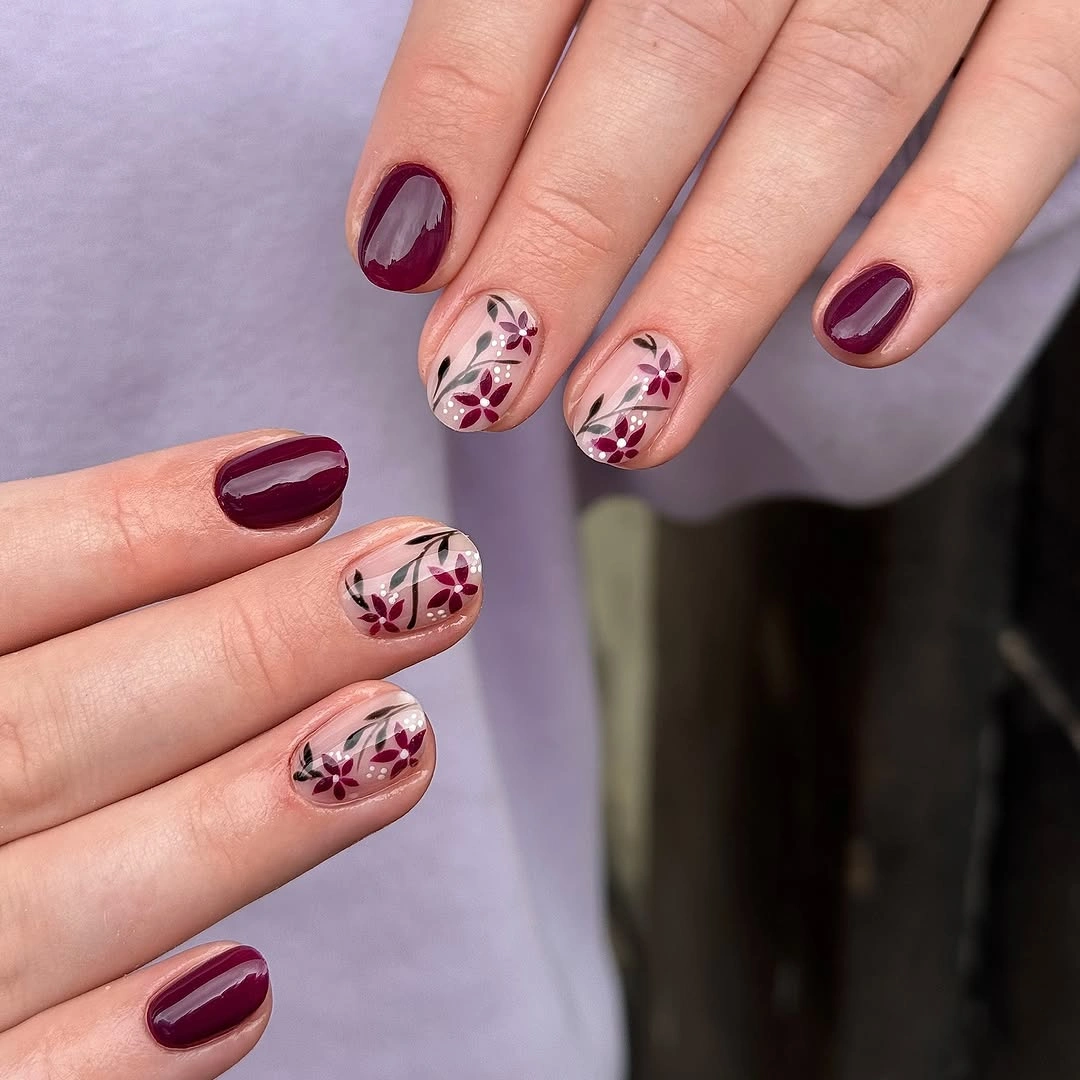
Opaque plum nails work like commas between the lighter scenes. They repeat the flower color at a much larger scale and keep the set from becoming uniformly delicate. White dots then brighten the spaces where a leaf and petal might otherwise merge.
The design uses a short surface intelligently by choosing diagonal movement over long vertical stems. Its open base can also make early growth appear less abrupt on the decorated nails. A single branch and one plum solid would be enough to carry the same color logic into an even more minimal variation.
Black Botanical Shadows Inside Glossy Frames
A narrow black border traces the perimeter of each long almond nail. Within it, layered leaf silhouettes cross a cool gray, translucent-looking center. Some stems angle upward while others spread horizontally, and their density changes from nail to nail. The strict outer frame keeps those loose interior branches from drifting visually beyond the shape.
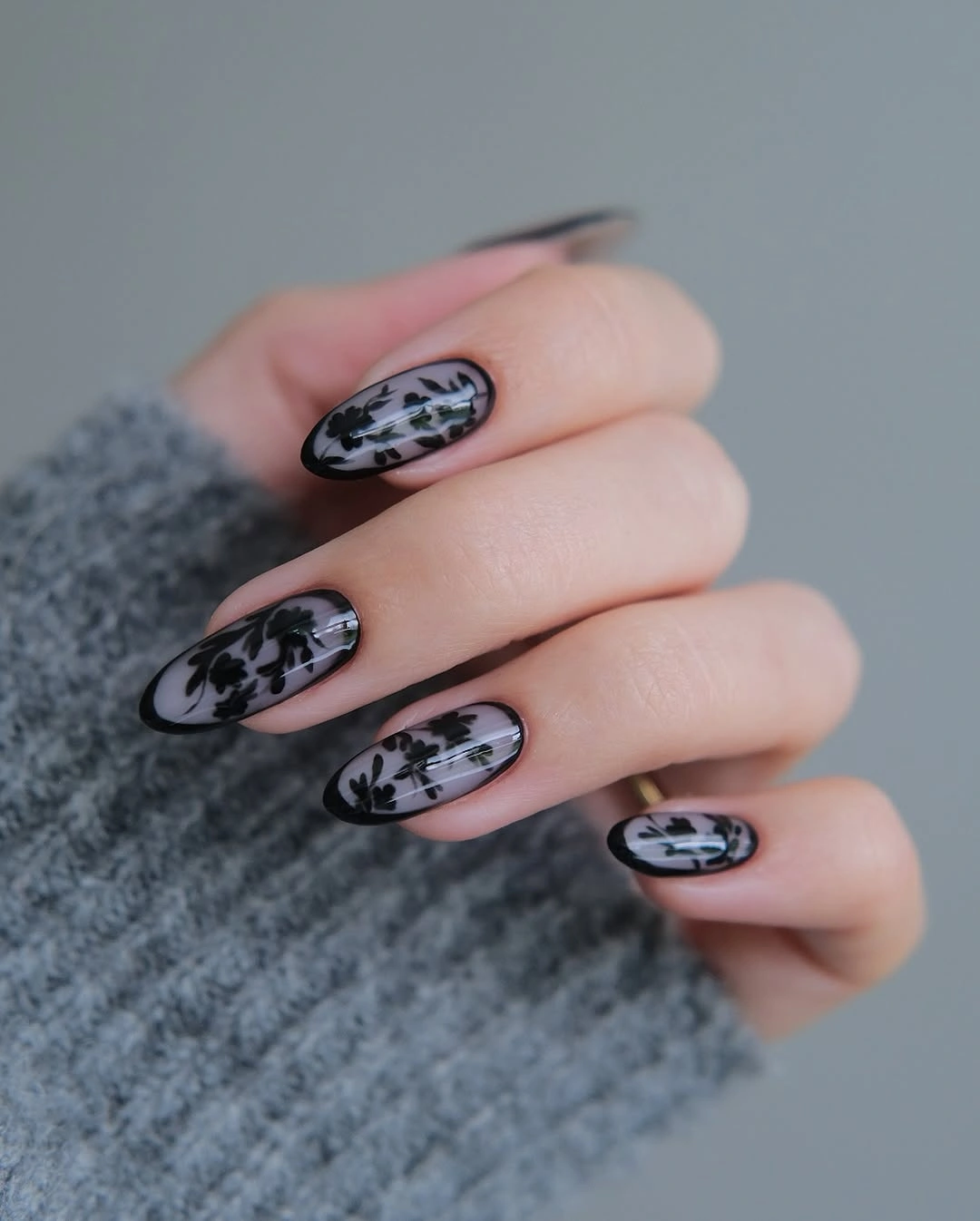
Several leaves touch the border, which makes the foliage seem to continue beyond the visible gray field. Others remain isolated near the center and expose more of the cool base. Glossy vertical highlights pass over both areas, adding depth to a palette built almost entirely from black and gray.
The fine dark edge is visually precise, but that precision means tip wear would be easy to spot. Long nails are useful here because overlapping stems can remain distinct before they reach the pointed ends. A gray knit sleeve repeats the muted ground and leaves the framed botanical shadows in command.
Cherries and Reflections in Red and Black
Paired red cherries hang from thin dark stems on two pale short nails. Around them, the manicure shifts through black brushy fields, deep red solids, and narrow pink reflections that flare down the center of selected nails. One red accent is ringed with small silver-colored dots, while another carries a round detail at each side. The mixed components read like separate scenes connected by a compact red-black palette.
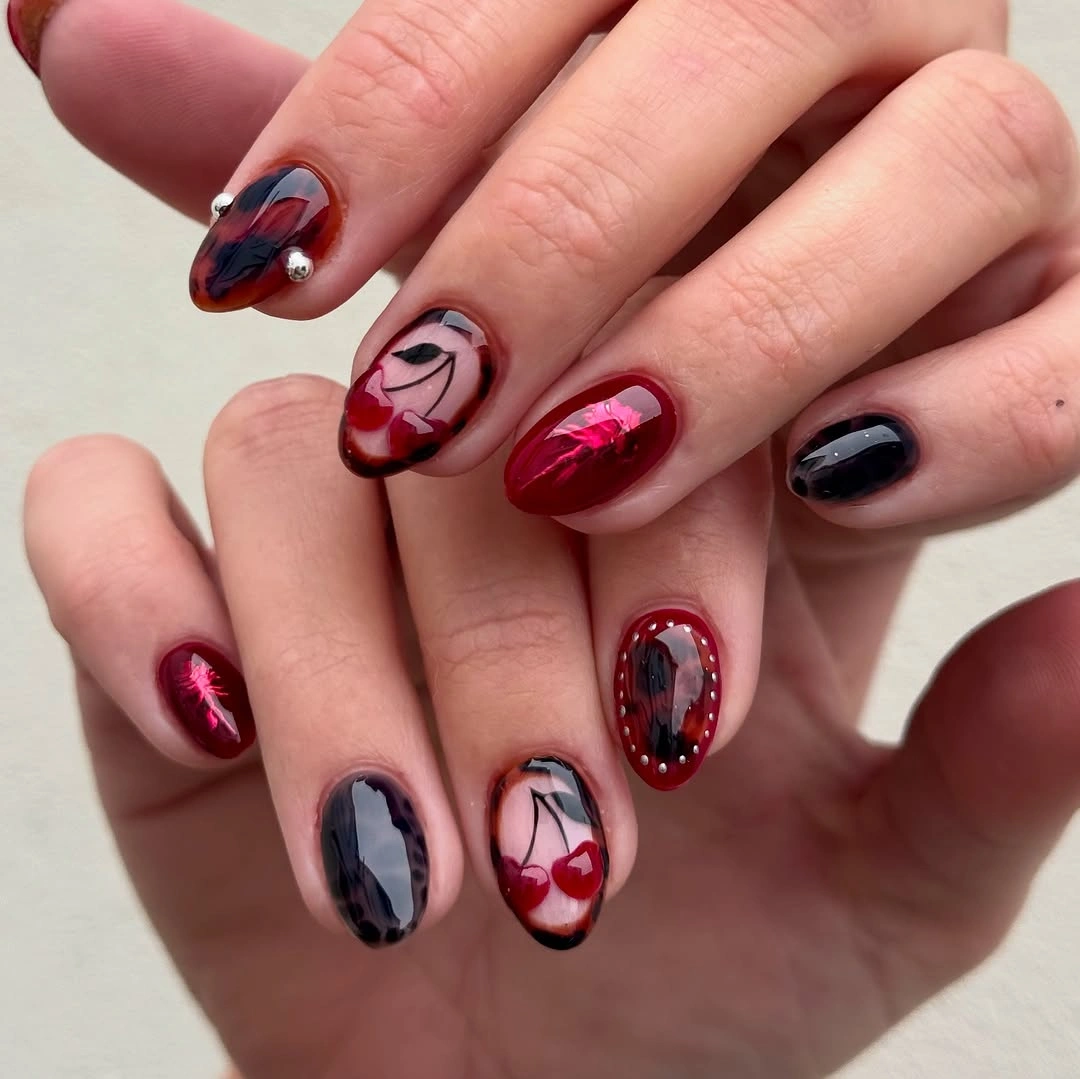
Line changes meaning on every accent. It becomes a cherry stem on the pale grounds, a dotted perimeter around the red oval, and a jagged dark boundary where black meets translucent color. Bright pink streaks introduce yet another direction by pulling the gaze lengthwise.
Short rounded nails contain the visual intensity and stop the varied details from becoming sprawling. The small side elements appear raised, so they may need more care around hair or textured clothing than the flatter painted motifs. I would preserve the asymmetry if adapting this set, because its appeal comes from discovering a different red-and-black episode on each finger.
Copper Leaves Rising Over Matte Terracotta
Muted terracotta covers three long tapered nails in a flat, velvety-looking field. Two blush accents hold pointed leaves built from orange, cream, dark brown, and gold-colored segments. Their clusters rise from opposite sidewalls rather than occupying the center. Sharp leaf tips repeat the direction of the elongated nail silhouette.
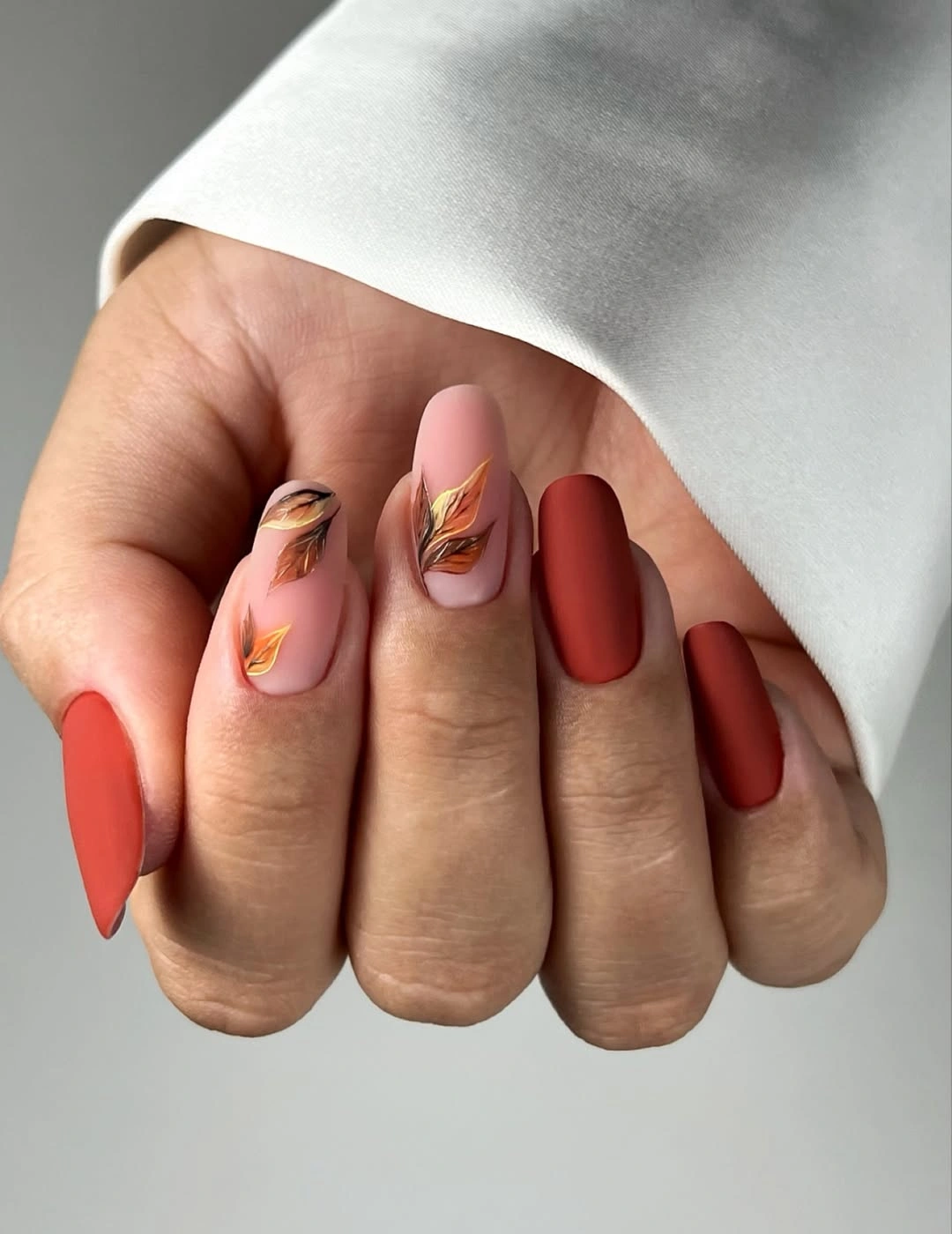
The contrast is not only between pink and rust, but also between quiet matte expanses and small reflective flashes. Dark vein lines separate the warm leaf sections and give each cluster a readable internal structure. Because the accents enter from the edges, the remaining blush space looks intentional rather than unfinished.
Restricting the botanical work to two fingers allows the long set to stay composed. Matte terracotta may reveal rubbing sooner than a glossy finish, while the detailed leaves could disguise minor changes near their edges. The white sleeve surrounding the nails adds a clean boundary that makes the warm palette appear especially concentrated.
Colorful Leaves Gathered Along Short Tips
Yellow, orange, magenta, burgundy, and brown leaves collect along the tips of short rounded nails. Fine dark veins divide many of the larger shapes, while tiny warm-colored dots occupy selected gaps. Each cluster is different, ranging from a pair of slim leaves to a fuller fan of overlapping forms. Broad translucent-looking pink centers remain uncovered above those miniature borders.
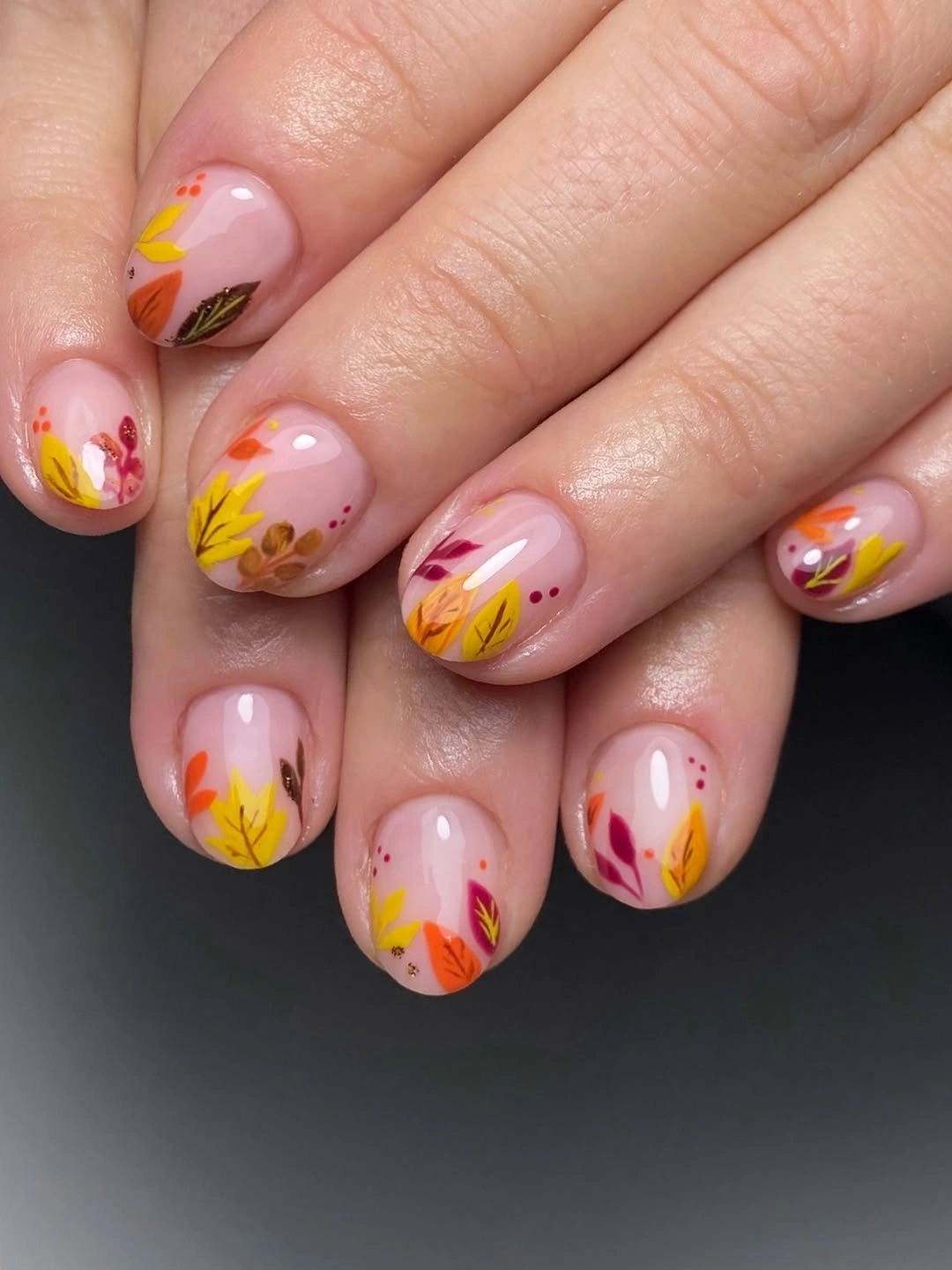
Bright yellow pushes forward first, then deeper magenta and brown settle behind it. That color hierarchy keeps the many small pieces readable rather than turning them into one multicolored band. Scattered dots soften the spaces between pointed leaves and stop the tip line from becoming too rigid.
Irregular placement is an advantage here because both hands can coordinate without becoming mirror copies. The open centers also keep a high-saturation palette light on a short surface. For an even quieter version, I would retain one yellow leaf per nail and let the burgundy dots carry the rhythm between them.
Burnished Orange Glow with Airy Branch Accents
Most of these short oval nails shine in saturated burnt orange, with dark brown edges concentrating the color toward each center. Two pale blush accents replace that glow with sparse diagonal branches. Orange, rust, deep green, and silver-colored leaves sit far apart along slim stems. The cool leaves are small, but they interrupt the warmth at exactly the point where the palette could become one-note.
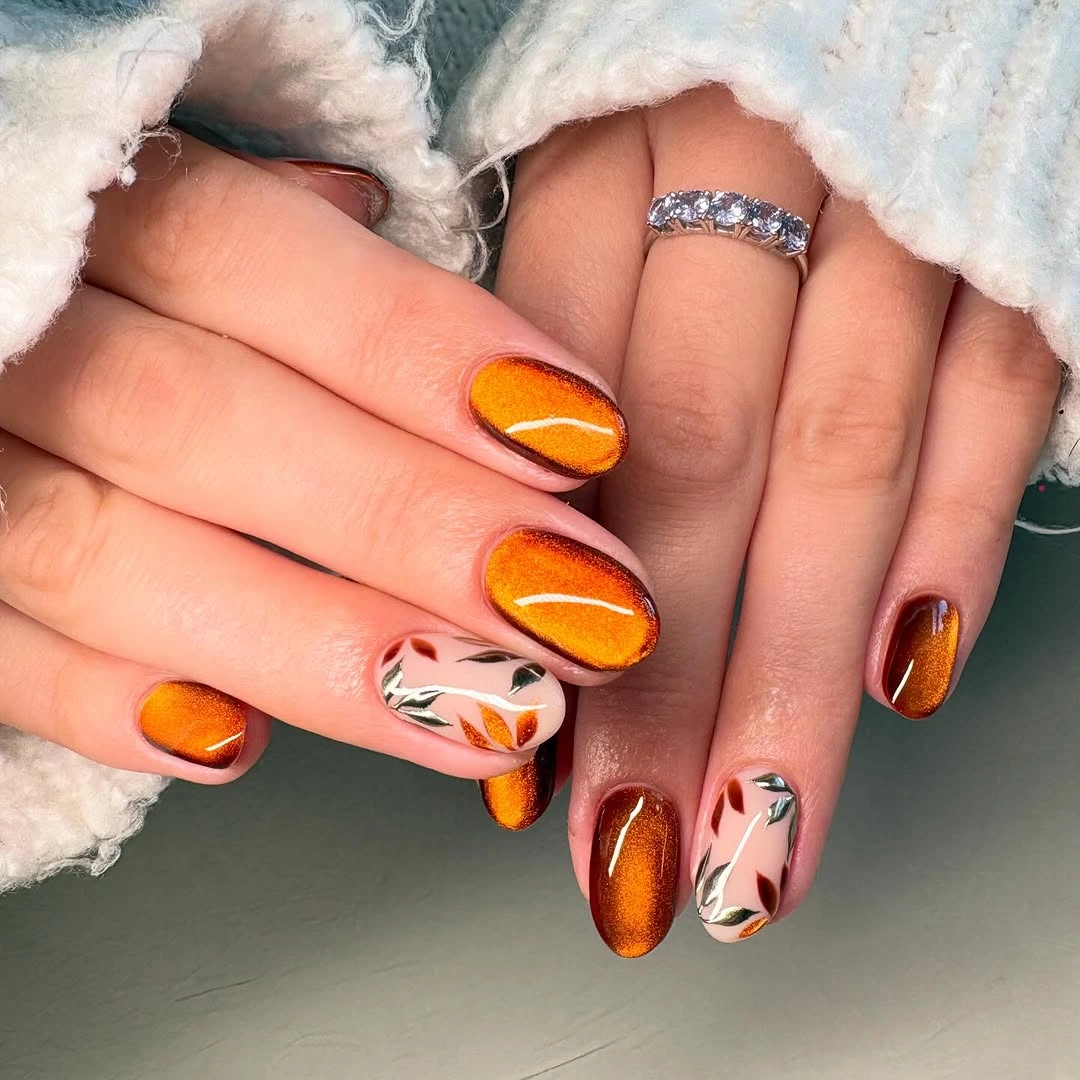
The orange nails carry most of the visual weight through color alone. Against them, each blush accent feels nearly weightless because its branch leaves wide zones untouched. Moving from dense glow to fine line work gives the set a clear rise and release.
Only two botanical nails need detailed upkeep, which keeps the concept practical on a short shape. A dark perimeter will make edge wear more visible on the orange nails, while the open accents should be more forgiving near the cuticles. Keeping the cool silver-green leaves in any variation preserves the contrast that gives this warm story depth.
Gold Contours Through Burgundy Glass Shapes
Burgundy, blush, and near-black nails become separate abstract objects through a shifting gold-colored line. On one blush nail, that line contracts into a starburst over a dark corner tip. Elsewhere it outlines a long irregular opening or narrows into a sharp interior slash. The oval-almond shape repeats those stretched windows without forcing them into perfect symmetry.
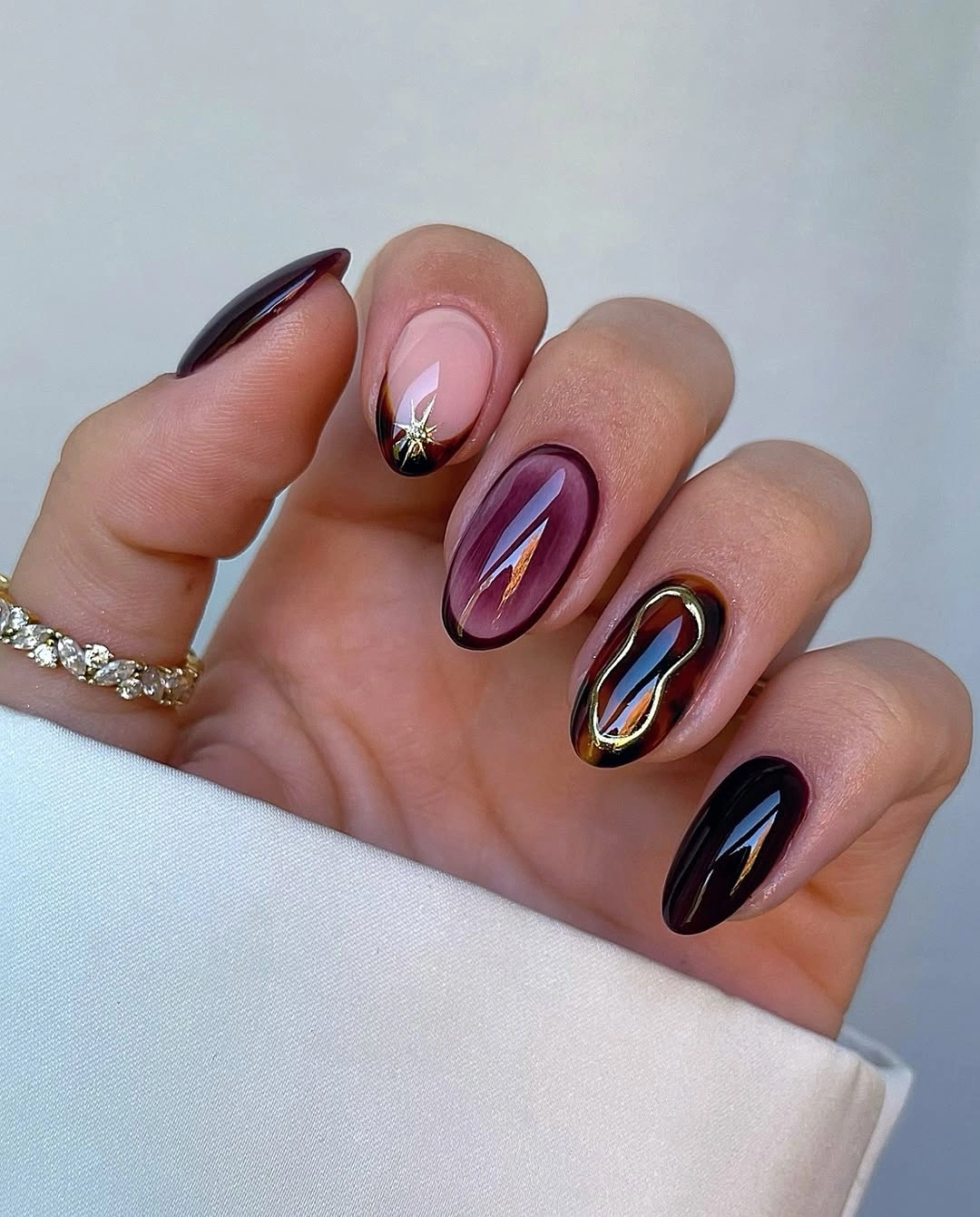
The ring nail has the most layered composition, moving from a deep brown outer field to a gold-colored border and then to a dark central opening. By contrast, the little finger stays almost entirely black-burgundy, interrupted only by a narrow warm reflection. Those differences let the same palette tell several connected stories rather than one repeated motif.
Irregular contour lines suit this set because tiny shifts in width or placement do not look accidental. Their raised appearance may call for more care at the edges, especially where a border approaches the tip. The glossy darkness and narrow warm flashes make this design feel architectural even though none of its shapes is perfectly geometric.
Black Flecks Scattered Over Burnt Orange
Long coffin nails provide a structured orange field for hundreds of uneven dark flecks. Pinpoint pieces sit beside larger jagged fragments, and their density changes across every nail. Gold-colored reflective bits introduce a second scatter that flashes more selectively. Straight sidewalls and flat tips contain all of that irregular movement.
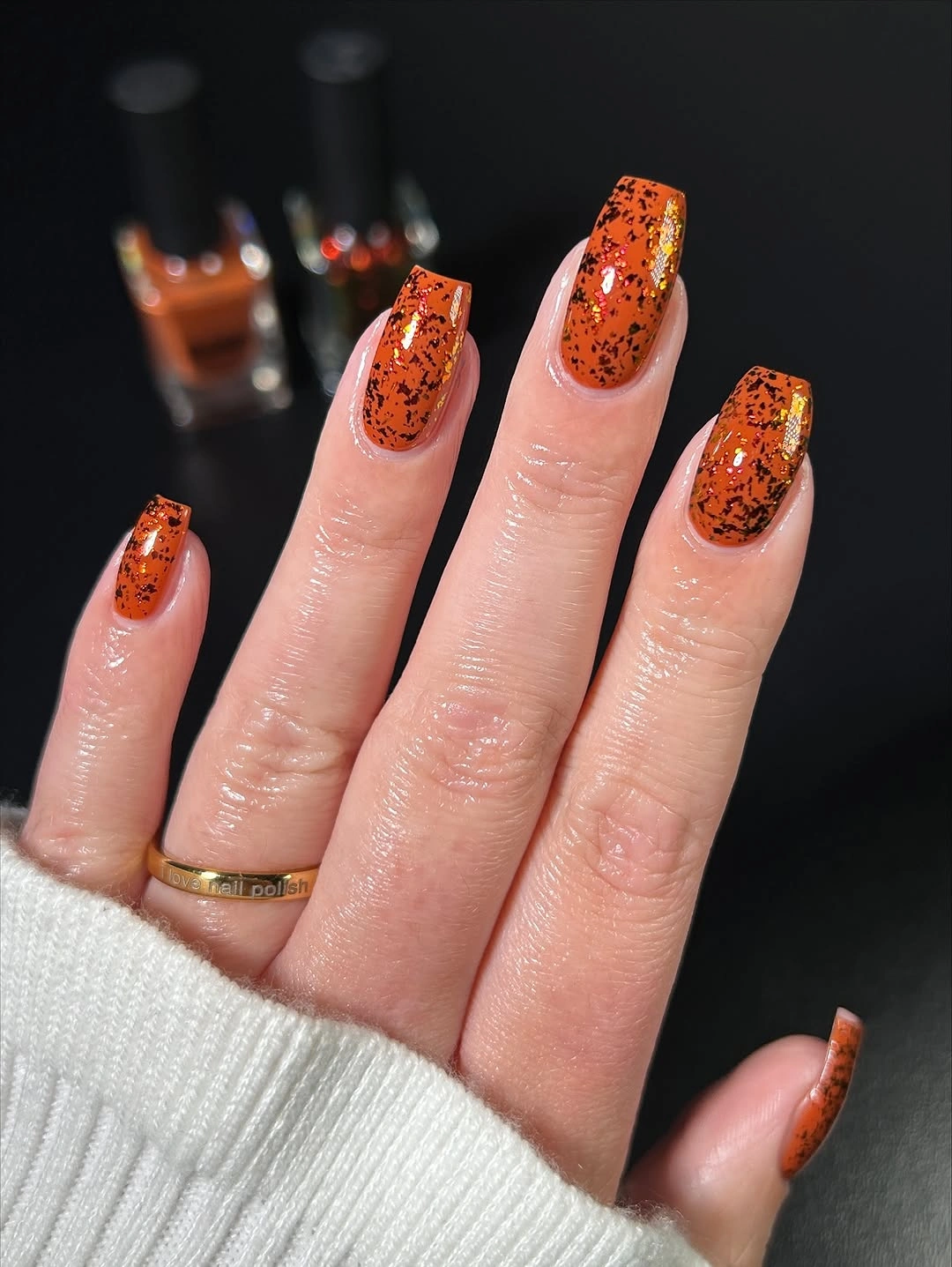
Controlled disorder is the main compositional decision. The black pieces establish an all-over texture, while the larger warm reflections appear only at intervals and prevent the surface from reading as flat speckle. Even the sparsest nail still carries enough marks to belong to the set.
Random distribution has a practical benefit because a repaired area would not need to duplicate an exact map. The long squared tips, however, require more care at the corners than rounded nails would. A shorter coffin shape could retain the contrast between rigid outline and scattered interior with less length to manage.
Looping Gold Lines Over Mottled Tips
Pale blush centers open into irregular amber, brown, black, and milky patches along the tips. A gold-colored line travels across each nail in a loose S curve, crossing the boundary between blank base and patterned edge. Some loops climb toward the cuticle, while others stay low and wide. The shifting routes make the nails coordinate without turning them into copies.
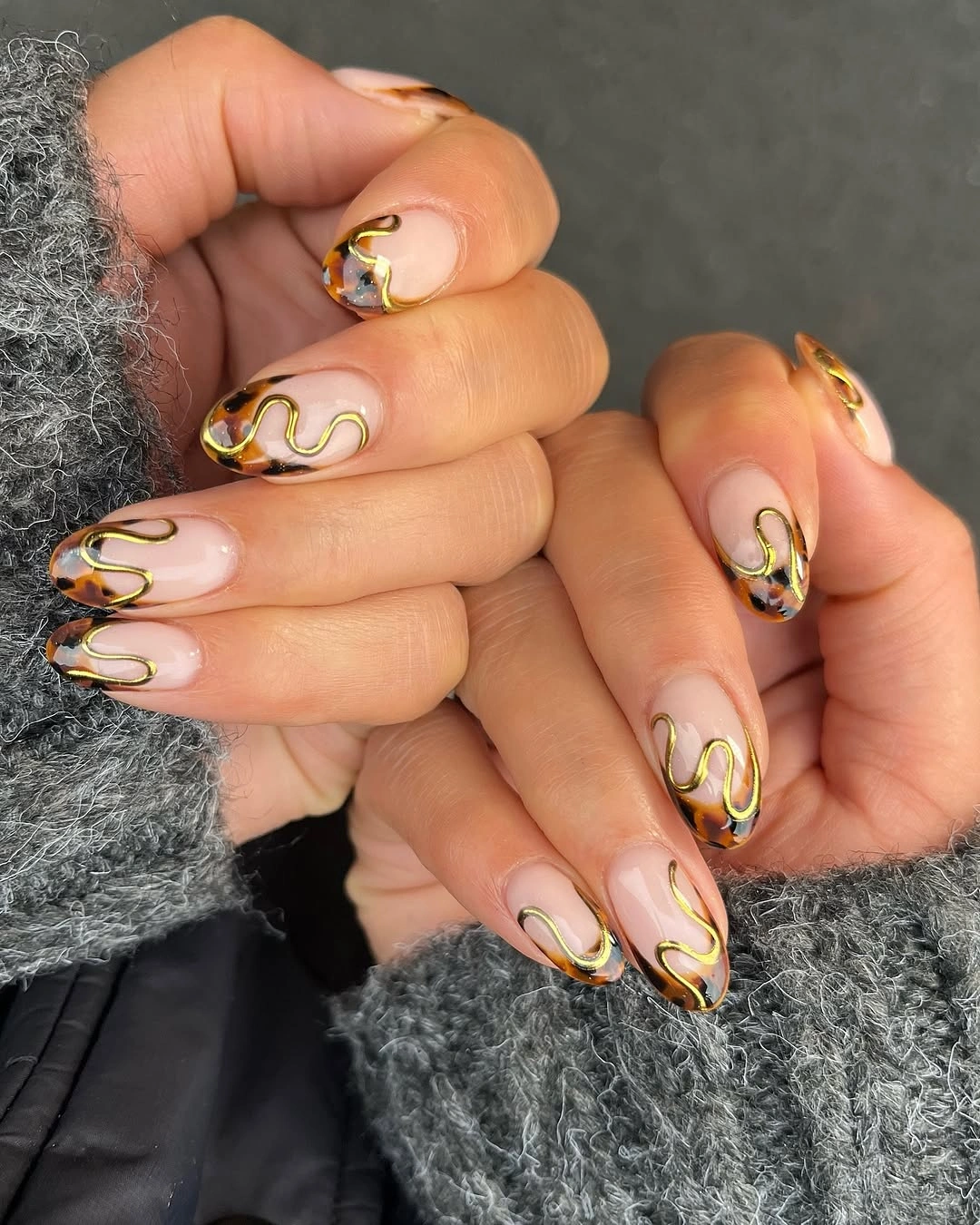
Without the loop, the tip pattern and open center would read as two separate zones. The continuous curve stitches them together, then adds a bright boundary wherever it crosses a dark patch. Warm mottling remains concentrated near the edge, so the line has ample quiet space to show its full bends.
The exposed cuticle area may soften the appearance of growth compared with a fully patterned nail. Because the looping detail looks dimensional, contact with textured fabric could demand extra care. Gray knit sleeves keep the surrounding color muted and let the gold-colored path serve as the narrator.
Sage Solids with Two Levels of Mottling
Muted sage green covers three medium almond nails, establishing a cool opaque foundation. One accent is filled with caramel, dark brown, and black patches from cuticle to tip. Another uses the same warm mottling only along a narrow rounded edge, leaving its blush center open. Showing full coverage beside a tip version makes the motif appear to expand and then retreat across the hand.
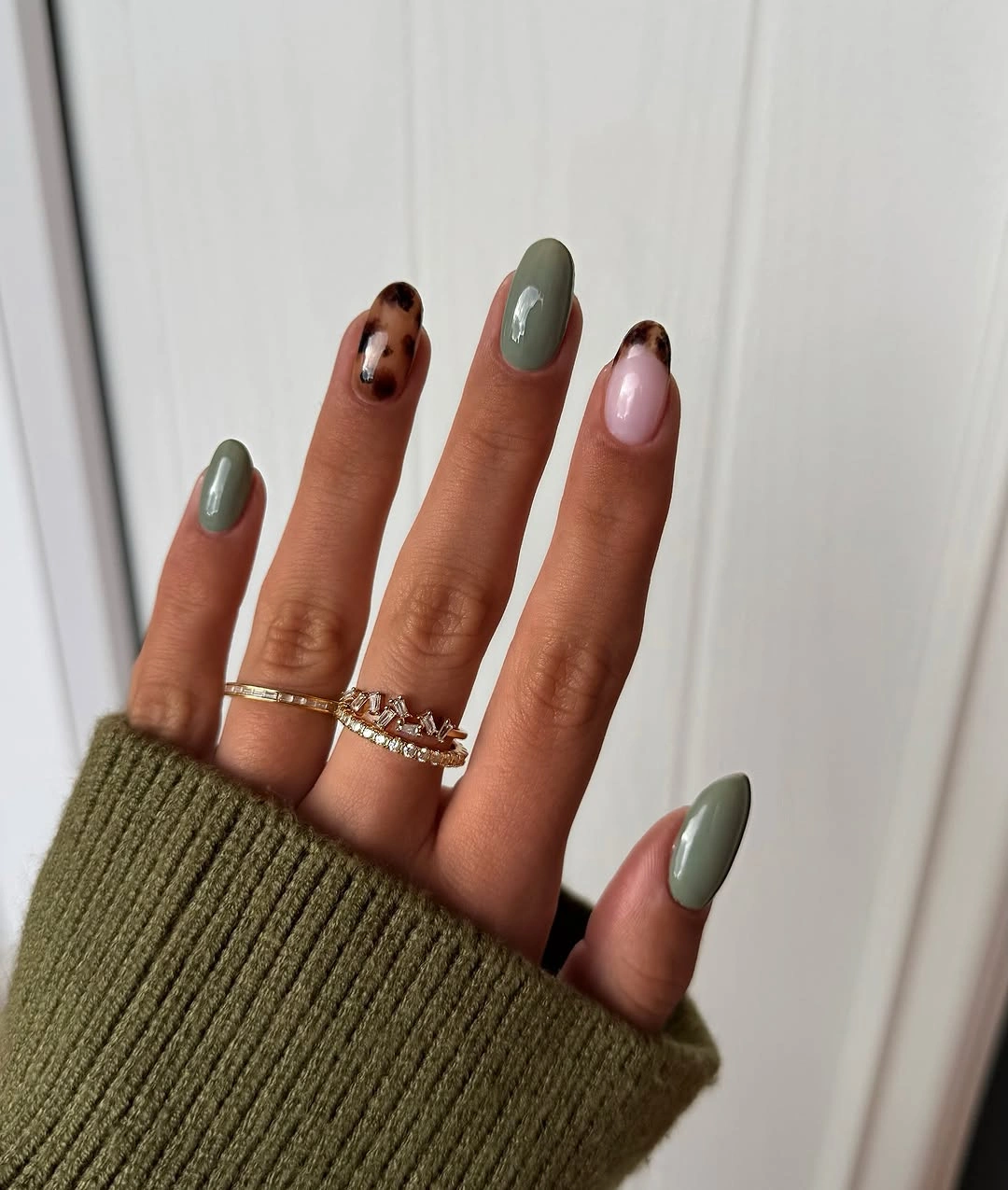
Sage gives the warm browns a calm counterweight, and the nearby olive sleeve strengthens that cool side of the exchange. Gloss remains consistent across every nail, which smooths the transition between solid and patterned surfaces. The tip-only accent is especially useful because it reveals how much open space changes the weight of the same color mix.
The central idea survives a substantial simplification. Three sage nails and one mottled tip already explain the relationship between cool color, warm pattern, and negative space. The medium length also offers enough room for the full accent while remaining less demanding than the longest almond sets.
Checks, Spots, and Olive in Symmetry
Short oval nails form a carefully ordered sampler of olive solids, black-and-cream checkerboards, amber-brown mottling, and irregular black spots. Both hands repeat the same sequence, so four very different surfaces still feel organized. The checks are large enough to stay crisp on a compact nail, while the spots vary freely in size. Warm blurred patches occupy the visual middle ground between those rigid and loose patterns.
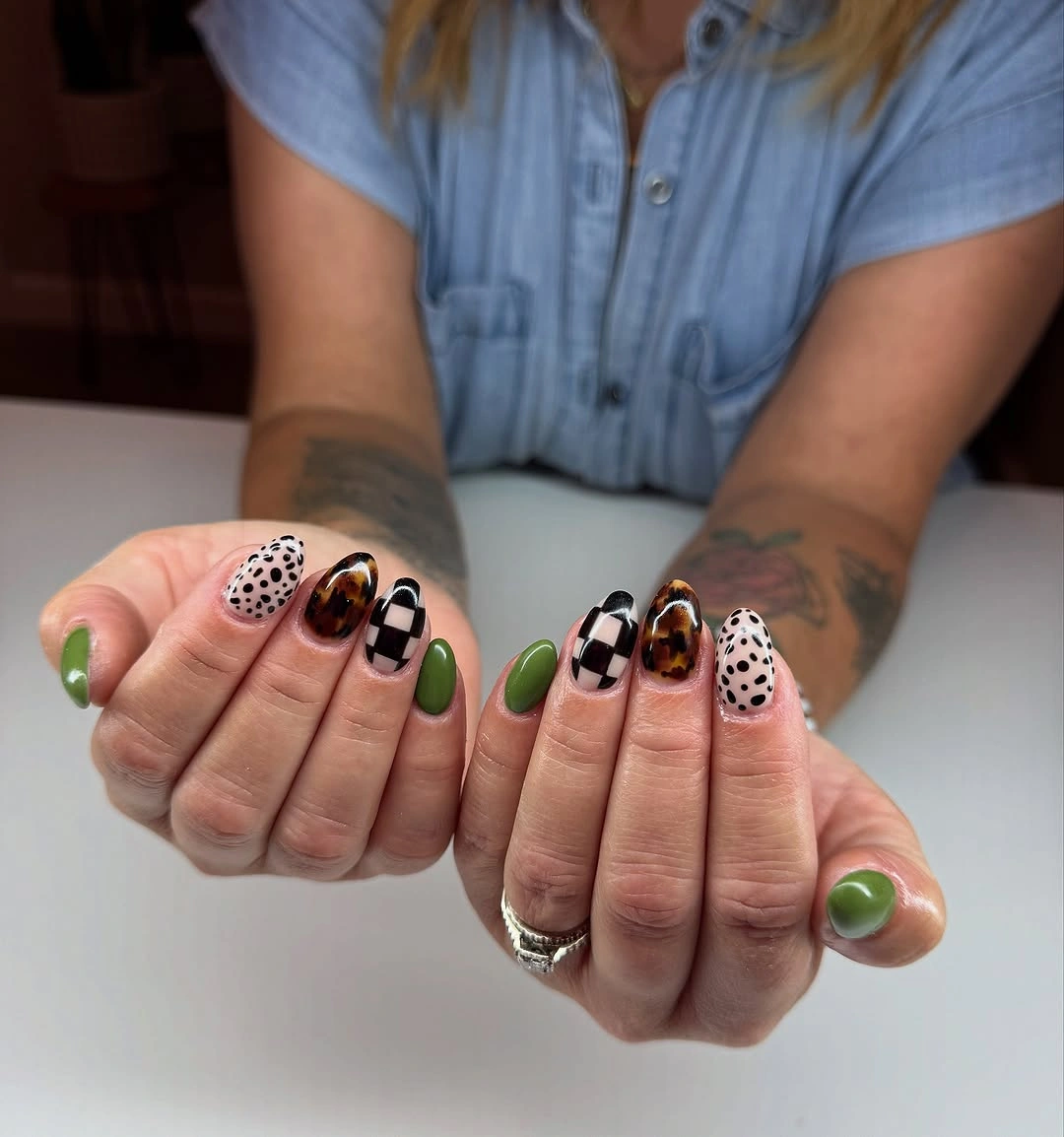
Olive nails bracket the louder central accents and create a clear beginning and end on each hand. A consistent glossy finish then becomes the common surface language for every motif. Without those two controls, the checks, dots, and mottling could easily read as unrelated samples.
The composition asks for two kinds of precision: clean square boundaries and intentionally uneven marks. Short lengths help by limiting the number of checks and keeping each pattern immediately legible. For a reduced version, olive outer nails and one checkerboard accent would preserve the strong symmetrical framework.
White Veins Across Layered Autumn Color
Long pointed nails hold overlapping patches of mustard, olive, orange, coral red, and smoky gray. The colors soften into one another at irregular boundaries, producing different intermediate tones on every finger. Fine white lines branch over the surface in paths that bend, split, and occasionally meet. Their pale tracery connects ten distinct color arrangements without forcing them into a single gradient.
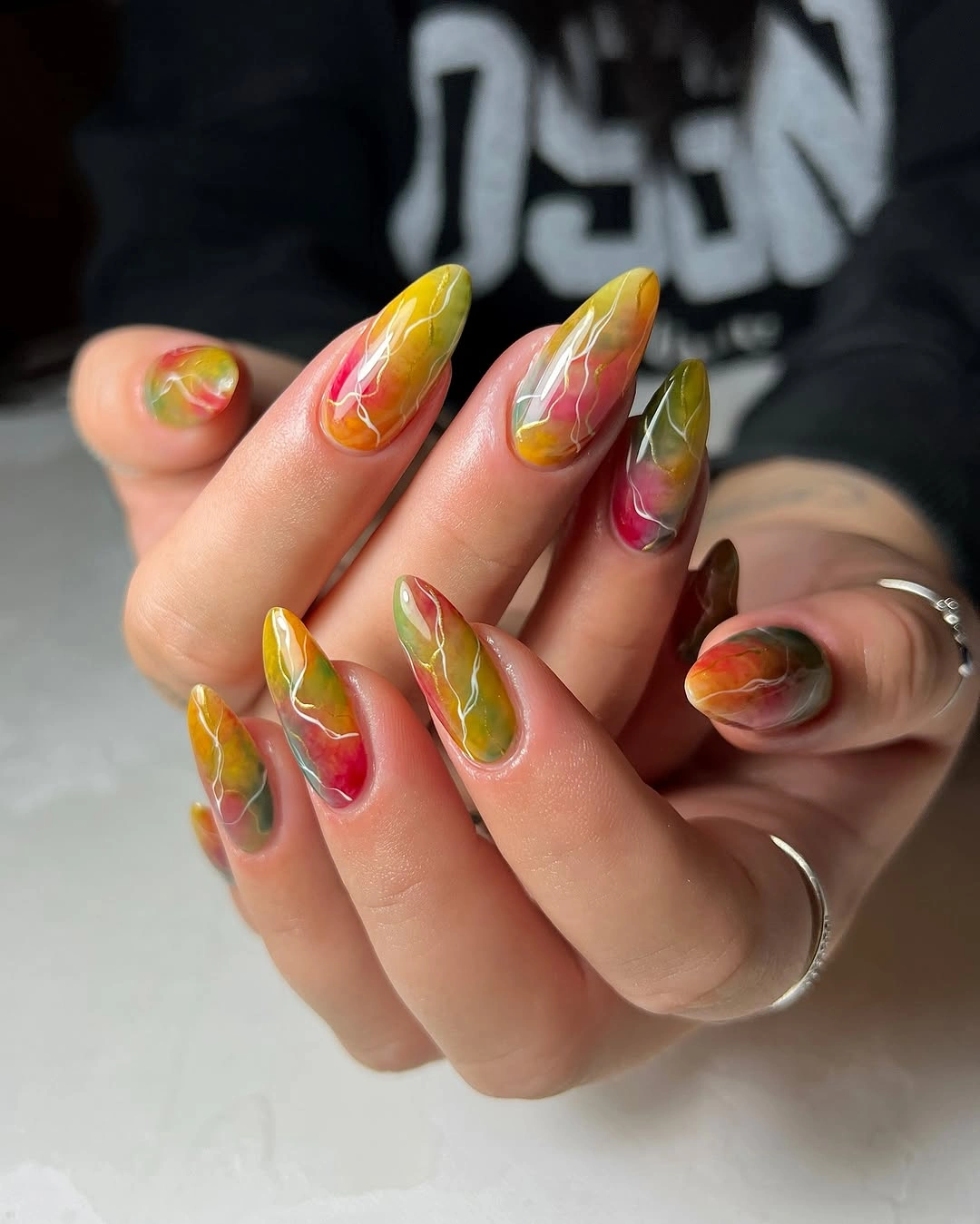
Some nails are dominated by yellow-green, while others give more room to red or deep olive. That shifting color weight creates a sequence of narrow landscapes rather than one repeated swatch. Glossy highlights run beside the white lines and add another pale current through the layered fields.
Irregular overlap makes exact duplication unnecessary, but the fine tracery still needs enough contrast to remain visible. The long almond points provide that room and pull each white branch upward. A shorter interpretation could use fewer color fields per nail so the same wandering line remains clear.
One Burgundy Branch Among Dusty Plum
Four short squoval nails stay uniformly dusty plum, giving one blush accent all of the narrative work. A curved burgundy stem crosses that pale nail diagonally and carries tight pairs of small leaves. The branch fills the middle while slim blush margins remain exposed around it. Those open edges prevent the dark motif from becoming a solid stripe.
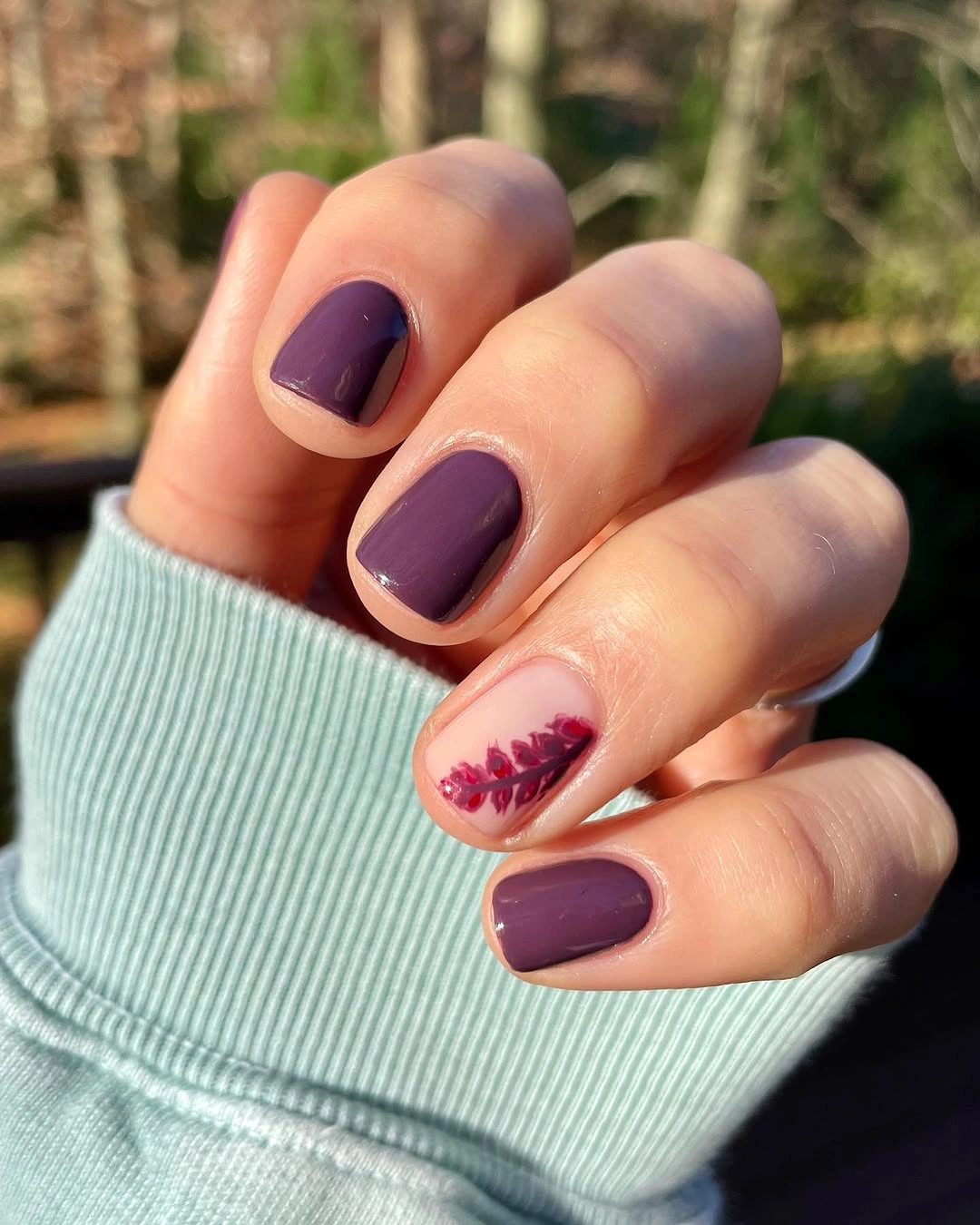
Restraint distinguishes this manicure from the fuller botanical sets. Instead of extending foliage across several fingers, it concentrates every leaf around one central stem and lets the solid nails hold the silence around it. The leaf color is deeper and redder than the plum, so the accent remains connected without disappearing.
A single decorated nail keeps detailed maintenance limited, and the short shape is practical for daily wear. The solid plum may show growth sooner than the pale accent, but its compact surface is straightforward to refresh. Pale blue-green fabric beside the nails adds a cool contrast that clarifies the muted purple tones.
Bronze Starbursts Beside Framed Amber Centers
Short oval nails alternate between radiating starbursts and deep amber-brown centers enclosed by wavy gold-colored outlines. The star nails sit on softly shimmering bronze grounds, and their points stretch in uneven lengths from tiny bright centers. On neighboring nails, glossy brown fills an oval interior while a darker edge and warm border contain it. One motif expands outward as the other pulls attention inward.
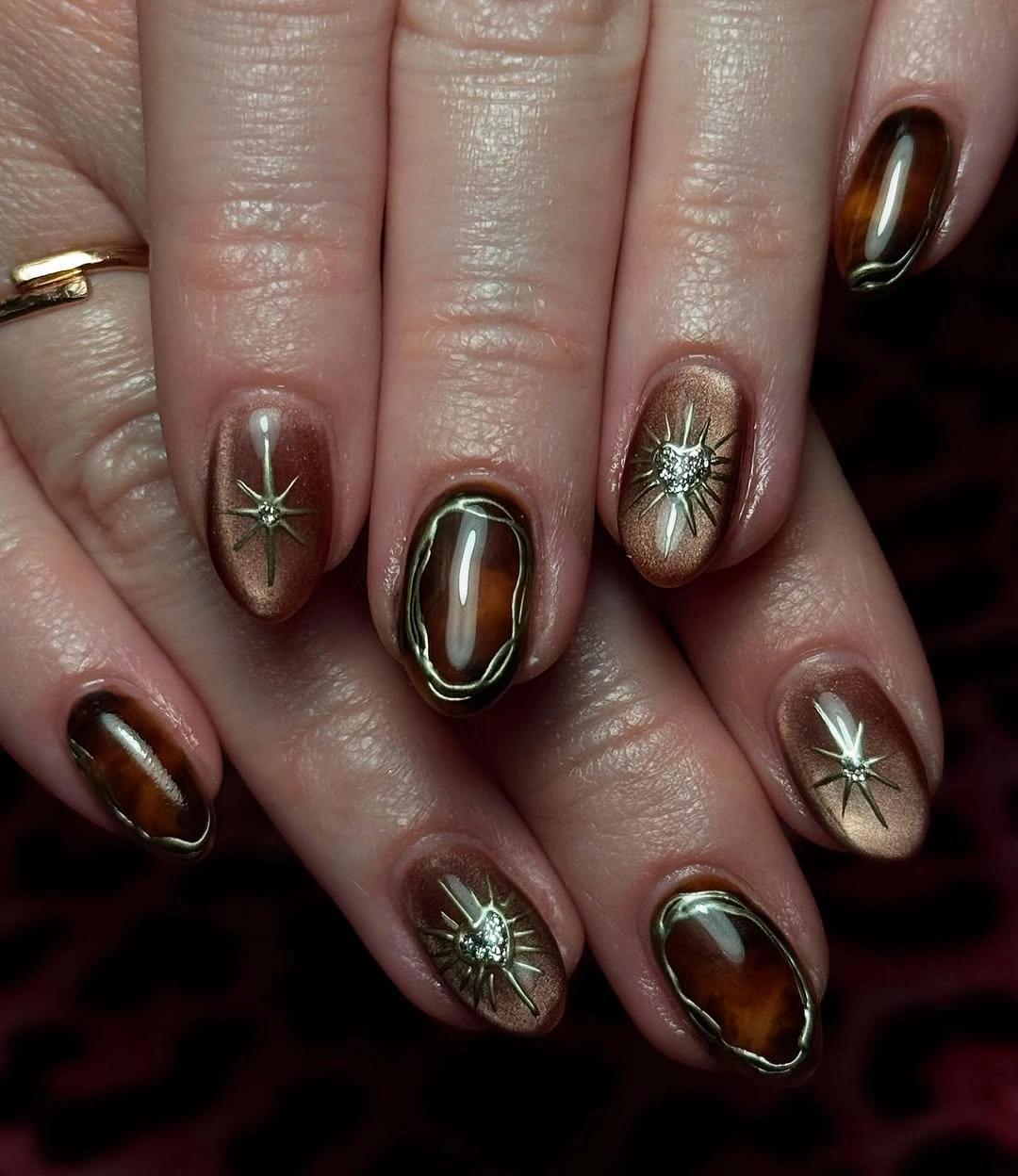
The alternating structure distributes those opposite actions evenly across both hands. Star centers vary from small points to larger textured circles, and the amber frames change shape instead of repeating one perfect oval. Bronze shimmer supplies diffuse light between the sharper border lines and radiating points.
Raised-looking centers and outlines may require care around textured fabrics, despite the manageable short length. The rounded nail shape naturally echoes the enclosed amber forms, while the long star points keep the bronze accents from feeling static. This final set tells its story through expansion and containment, using depth and direction rather than bright seasonal color.