Medium-length nails give fall color and small artwork enough room to read without turning every hand into a long, high-maintenance statement. The most useful designs in this group depend on placement, spacing, and contrast: a brown base can change with one pale flower, while a dark edge can define the shape more clearly than a crowded motif. That makes the length a working part of the design rather than a background measurement.
Use these fall medium length nails ideas as a visual editing guide. Notice which detail carries the idea, which solid color creates a pause, and which accent could be reduced for a shorter version; a good adaptation protects the relationship between those parts instead of copying every mark. The result can be seasonal, personal, and readable from the first glance.
Warm Brown with Small White Flowers
Medium almond nails use a glossy warm brown field with small white flowers placed on selected surfaces. The flowers sit near the tips and upper part of the nail, leaving enough brown visible to keep the design from becoming a full floral pattern. That spacing matters because the pale marks act as interruptions, not as a second dominant layer.
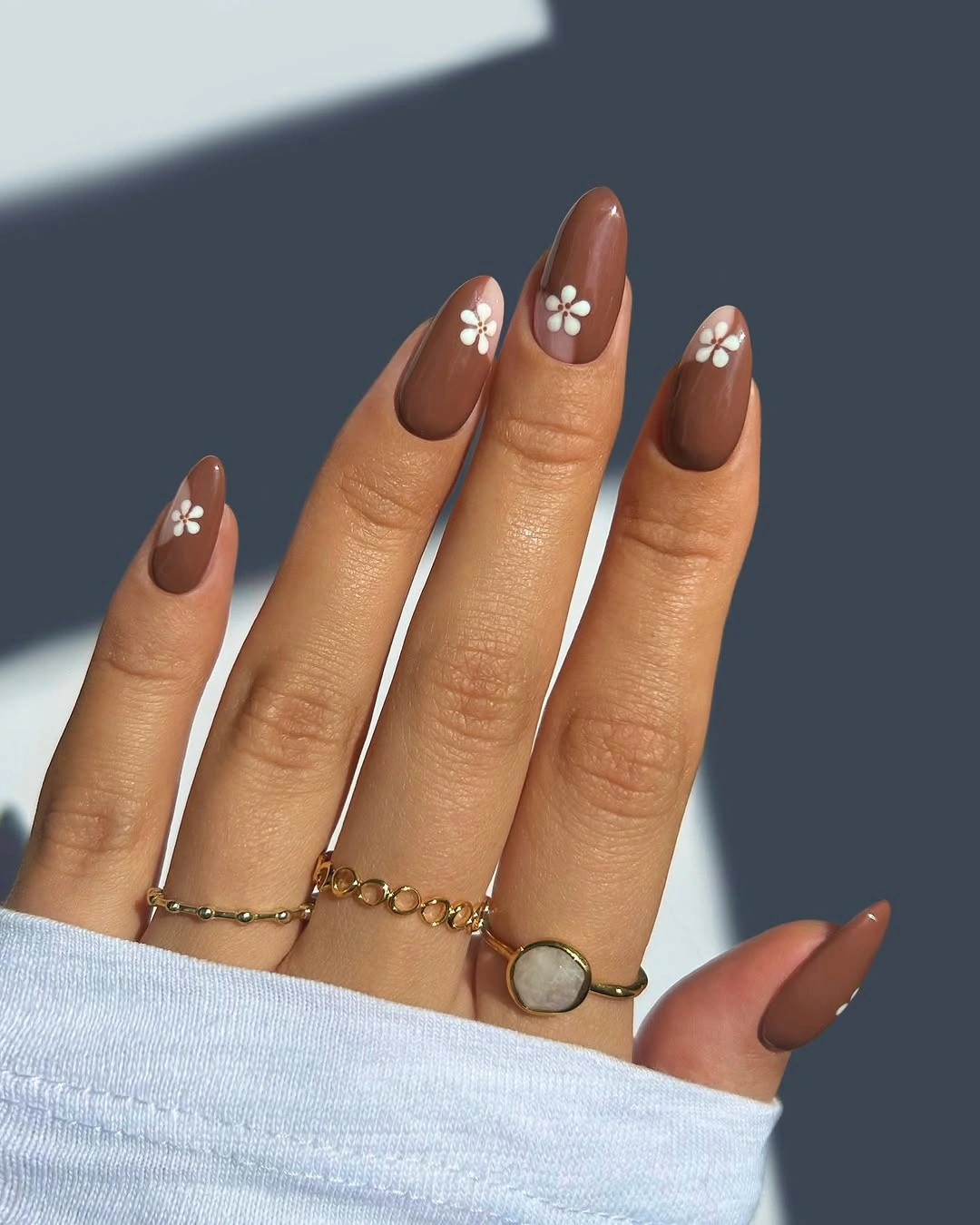
For a shorter adaptation, keep the brown on most nails and move one flower toward the center of a single accent. The white works because it has strong value contrast against the warm base, while repeating the motif on every nail would remove the quiet gaps that make each mark noticeable. The practical edit is therefore about placement before size.
This is a useful fall medium length nails direction when the goal is a seasonal note with a soft surface and a clear focal detail. A pale nude base could make the flowers gentler, but it would also reduce the graphic separation; keeping the brown preserves the visual weight. The design reads as considered because the flowers are allowed to remain small.
Burgundy, Curves, and One Plaid Accent
Deep burgundy solids anchor pale blush nails carrying curved white lines and one warm plaid-like accent. The darker color gives the decorative nails a frame, so the lines do not float as unrelated marks across the hand. Medium almond length supports both pattern roles, but their different directions are easier to appreciate when the burgundy has room to repeat.
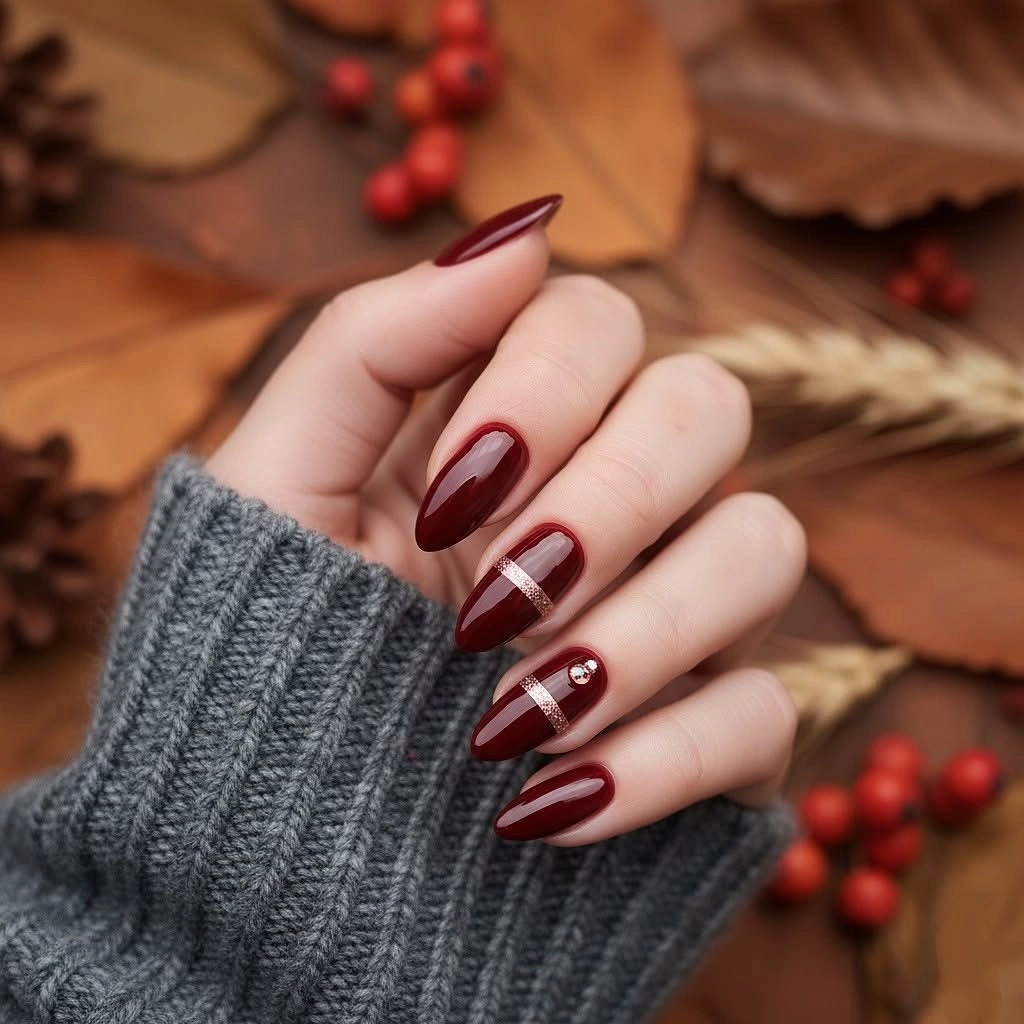
If the nail bed is shorter, choose the curved line or the plaid rather than compressing both into a small space. The pale base should stay open enough for the linear detail to keep its shape, while the burgundy can remain on several nails to preserve hierarchy. Removing one pattern makes the remaining accent more legible and does not erase the color story.
This combination suits someone deciding between plain fall color and visible art because it gives each side a defined job. Blush softens the wine shade, white creates a narrow graphic lift, and the plaid introduces a warmer surface without taking over. The design holds together through repeated burgundy, not through matching every accent exactly.
Tonal Purple with Subtle Surface Movement
Glossy medium almond nails stay within a deep purple, plum, and muted lavender family, using faint darker and lighter strokes instead of a bright motif. The eye follows changes in tone and reflection across the nails, so the set feels active even though the palette remains narrow. Its character comes from movement inside one color range rather than from a separate illustration.
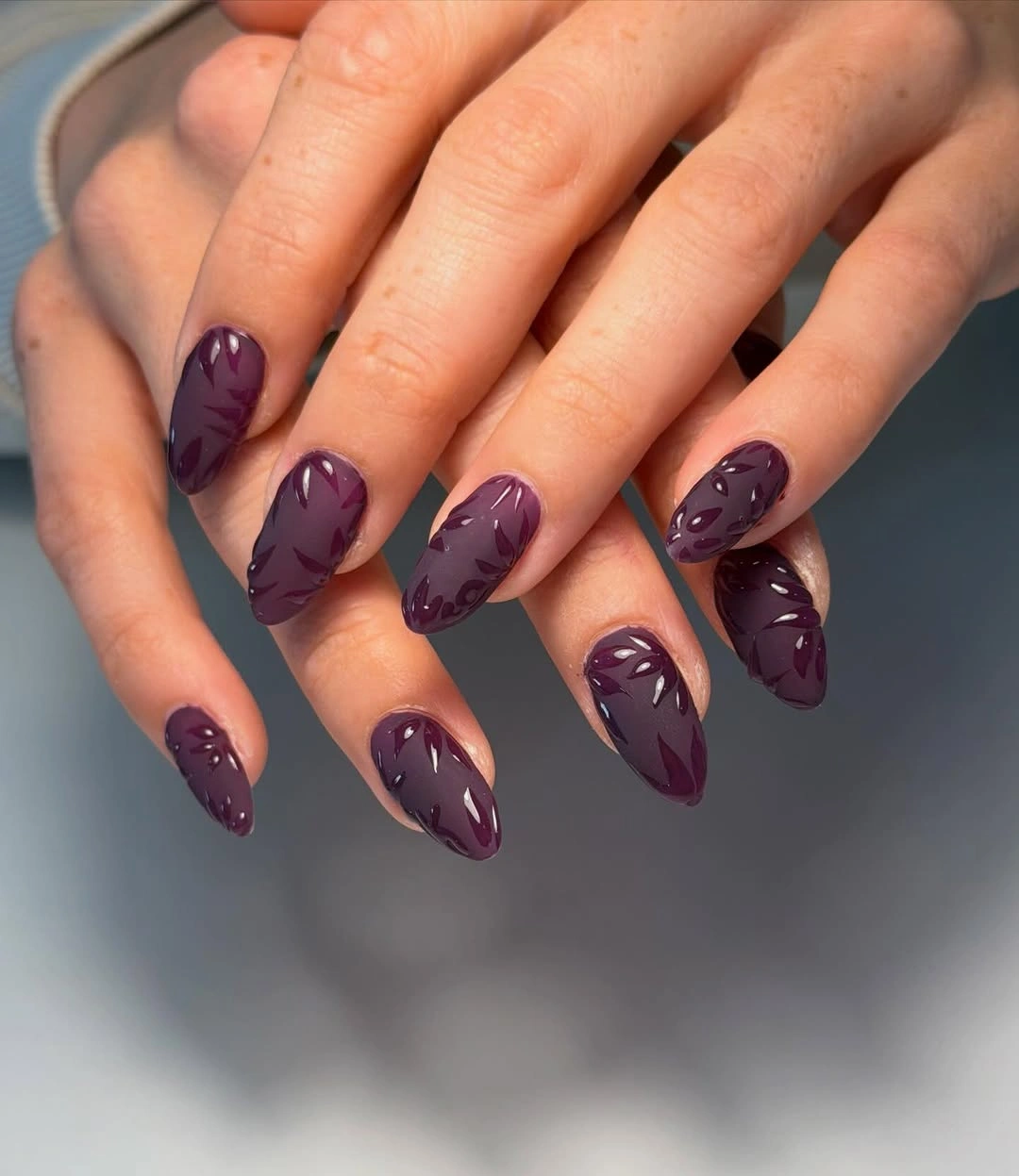
On a shorter shape, one lighter purple accent can preserve the same idea more clearly than several delicate strokes. The tonal marks are intentionally quiet, which means adding a high-contrast color would change the design from atmospheric variation to graphic pattern. Keep the value steps close if the goal is a restrained fall alternative to brown or orange.
This is a strong option for a reader who wants medium-length nails to look distinctive without relying on flowers, plaid, or icons. Deep purple brings seasonal weight, while the softer notes keep the surface from becoming a single heavy block. The design rewards close attention because the smallest change in value supplies the rhythm.
Muted Purple with Botanical Linework
Muted purple solids sit beside pale pink accents carrying thin dark branches and small leaf-like marks. The pale nails function as negative space for the linework, which lets the purple remain the stronger color block even when the drawing receives the first glance. The long center of the almond shape gives a vertical branch enough room to feel deliberate.
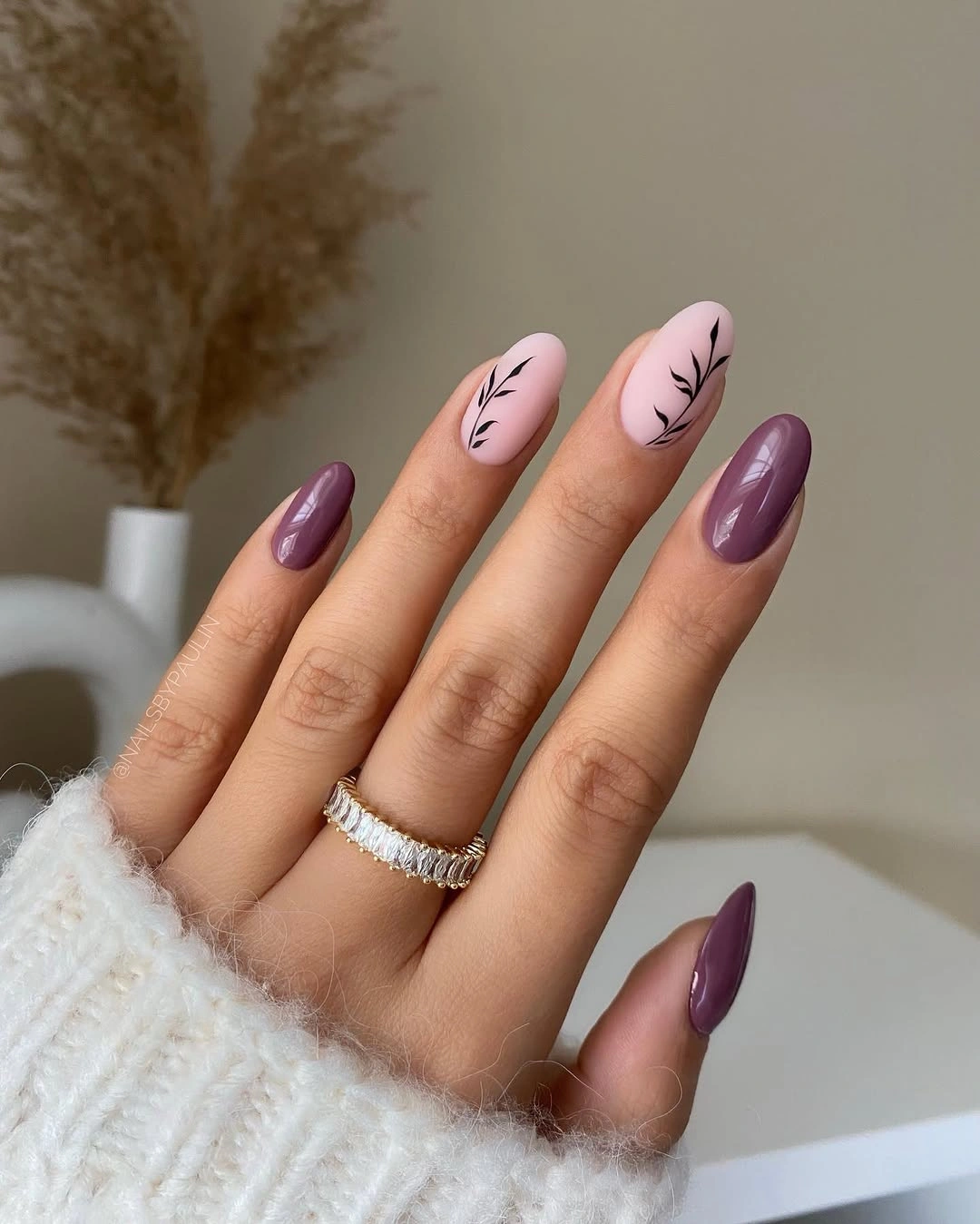
A shorter version should reduce the branch to one leaf, dot, or short stem on a single accent nail. Fine lines need open space to remain distinct, and adding more marks would make the pale panel look busy before the purple has a chance to establish the palette. The best adjustment protects the proportion between the dark solid nails and the light drawing surface.
The idea works for a reader who likes berry color but wants the fall reference to stay quiet. Black linework adds definition without introducing another bright shade, while pale pink gives the hand a visual pause between purple surfaces. The result feels precise because the drawing follows the nail rather than competing with its outline.
Black Solids Framing Dense Pale Florals
Glossy black nails alternate with pale gray or white accents filled with dark floral and leaf silhouettes. The pale panels carry more information than the black surfaces, so the solids are not empty spaces; they create the negative space needed for the dense accents to look intentional. Medium almond length can hold the detail, but the contrast remains the main organizing tool.
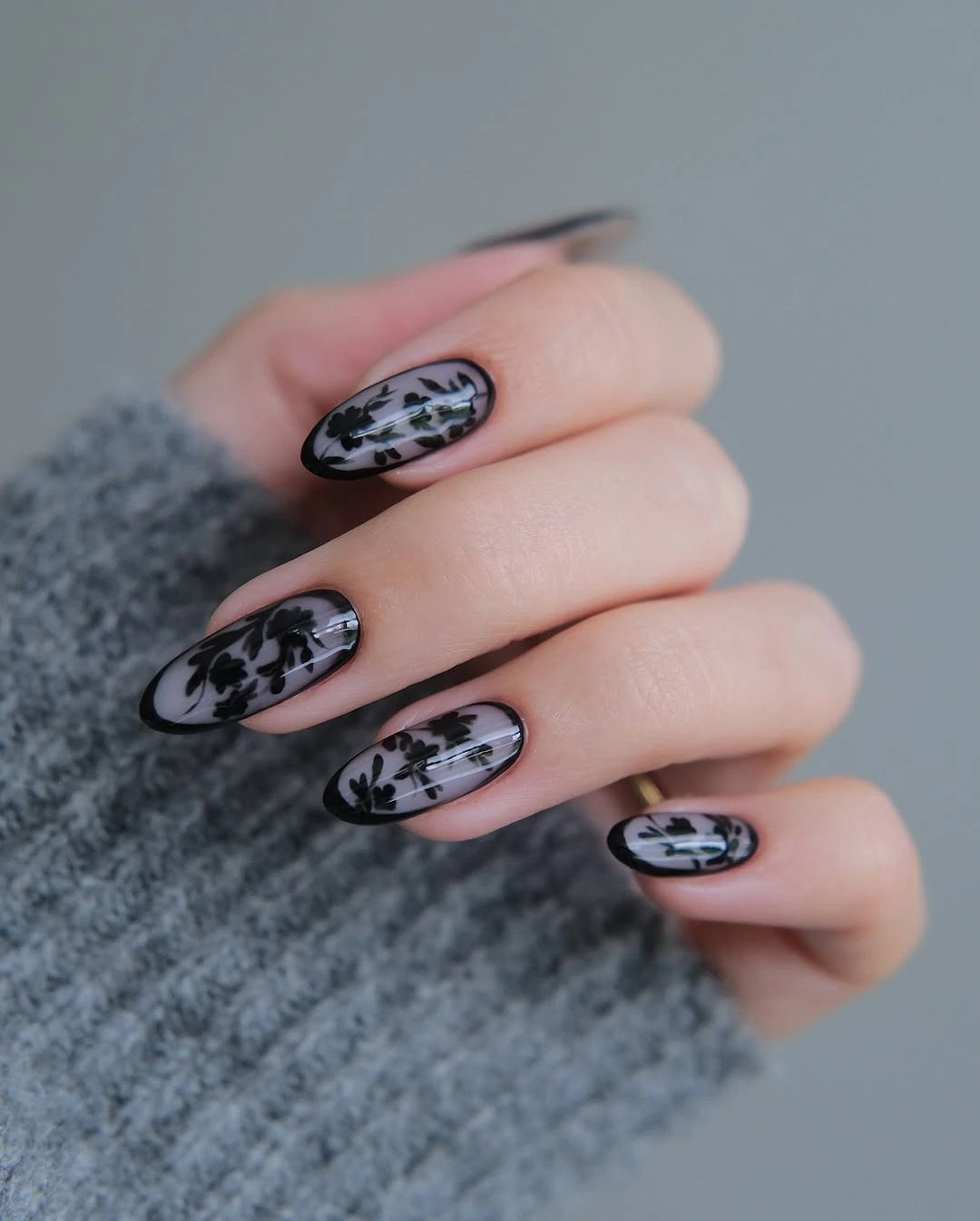
For a shorter set, keep the black field and reduce the pale art to a few leaves on one nail. The detail is expressive precisely because it occupies a limited number of surfaces, and spreading a dense pattern everywhere would flatten the difference between focal point and pause. Simplifying the drawing is more useful than shrinking every mark until it loses its shape.
This direction suits someone who prefers dark contrast to bright seasonal color. Pale gray softens the jump from black, while the dark marks inside the accent return the eye to the solid nails. The design remains graphic when the black sections are allowed to stay strong instead of being treated as spaces that need decoration.
Burgundy Florals Kept within One Color Family
Medium almond nails combine deep burgundy solids with pale pink accents carrying black and muted red flowers or leaves. Because the small drawings stay close to the wine palette, the set feels coordinated without matching every nail. The pale base is doing important structural work: it gives the floral marks room while the burgundy repeats the strongest color.
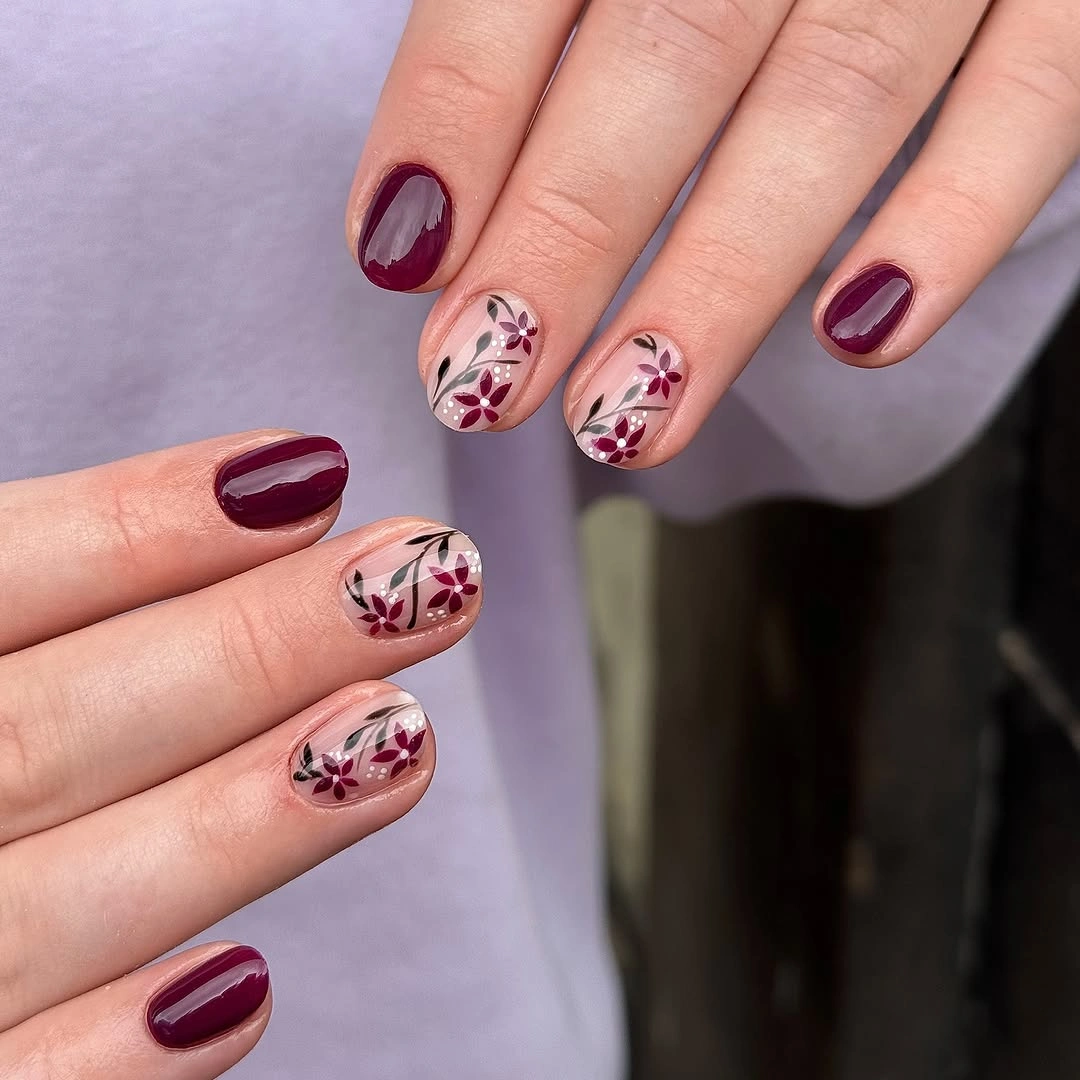
If the length is reduced, use one pale floral nail and let the remaining nails stay burgundy. A black line can add definition, but too many separate marks would make the accent compete with the color field; keeping the art close to the base shade preserves the quiet depth. The tradeoff is clear: fewer flowers mean less detail, but more readable contrast.
This is a balanced fall medium length nails idea for readers who want art without a multicolor effect. The wine base carries the seasonal mood, and the pale accent gives the hand a lighter center without turning sweet or overly decorative. The small difference between solid and illustrated nails is what keeps the arrangement composed.
A Single Floral Mark on Short Oval Nails
Short-to-medium oval nails use burgundy as the dominant color with one pale accent carrying a compact flower and leaf mark. The smaller shape changes the scale of the design: the accent is not trying to display a full drawing, only to interrupt the dark field at one clear point. That restraint lets the burgundy remain the first thing the eye registers.
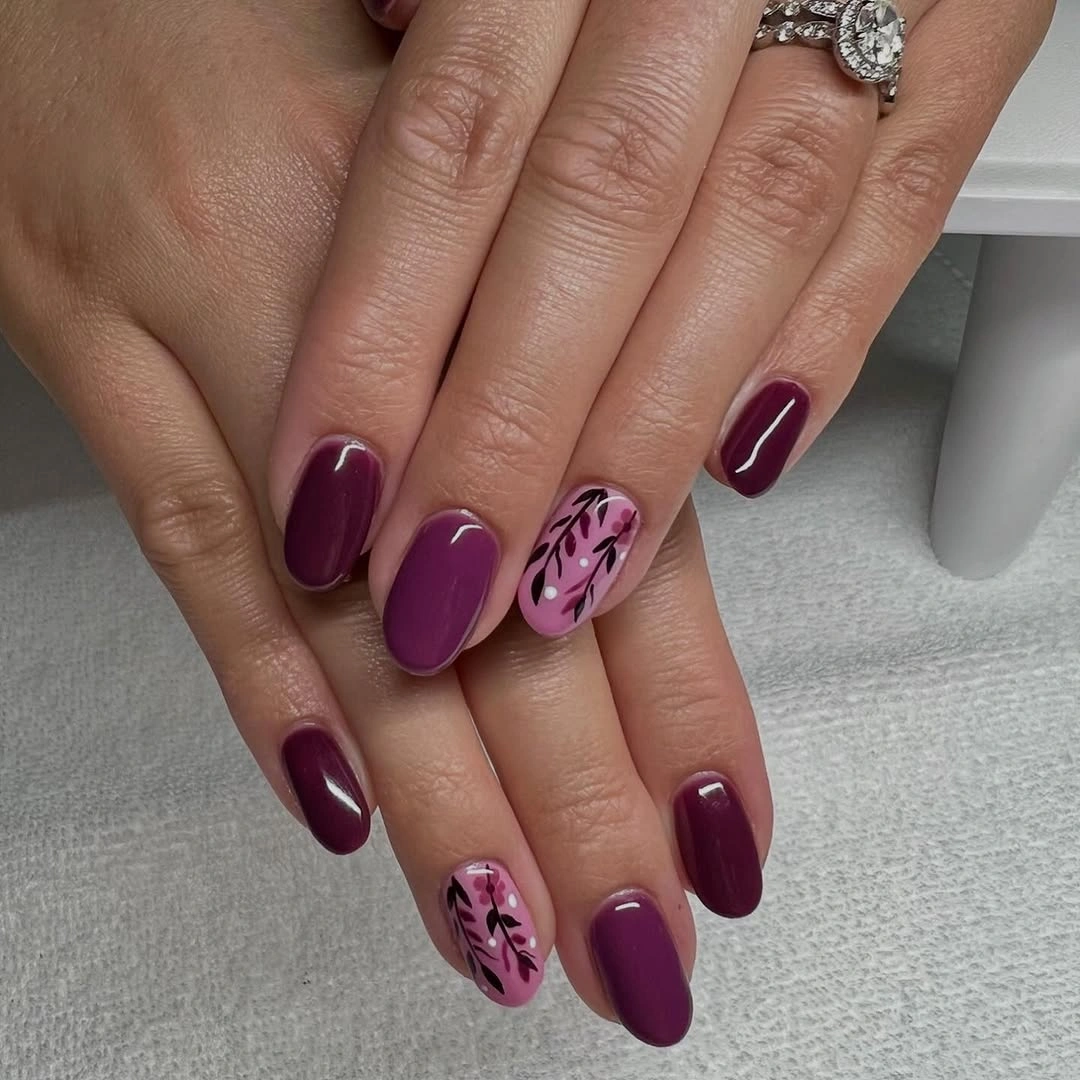
Keep the motif centered or close to the midpoint so it does not disappear into the edge of a short nail. Repeating the same mark across several surfaces would make the compact length feel crowded, while one light accent can create enough contrast to organize the set. A smaller flower is useful only when its outline remains distinct.
The result is practical for someone who wants the mood of fall medium length nails but prefers an oval silhouette with less visual commitment. Pale pink supplies relief, and muted rose details keep the accent connected to burgundy. The design gains its clarity from the decision to stop after one focal mark.
Burgundy to Orange with a Glitter Fade
Medium square nails move from deep burgundy into orange through a warm glitter fade repeated across the set. There is no separate icon competing with the transition, so the surface finish and color direction carry the full composition. The broad square gives the change in value enough width to read as a deliberate gradient rather than scattered shimmer.
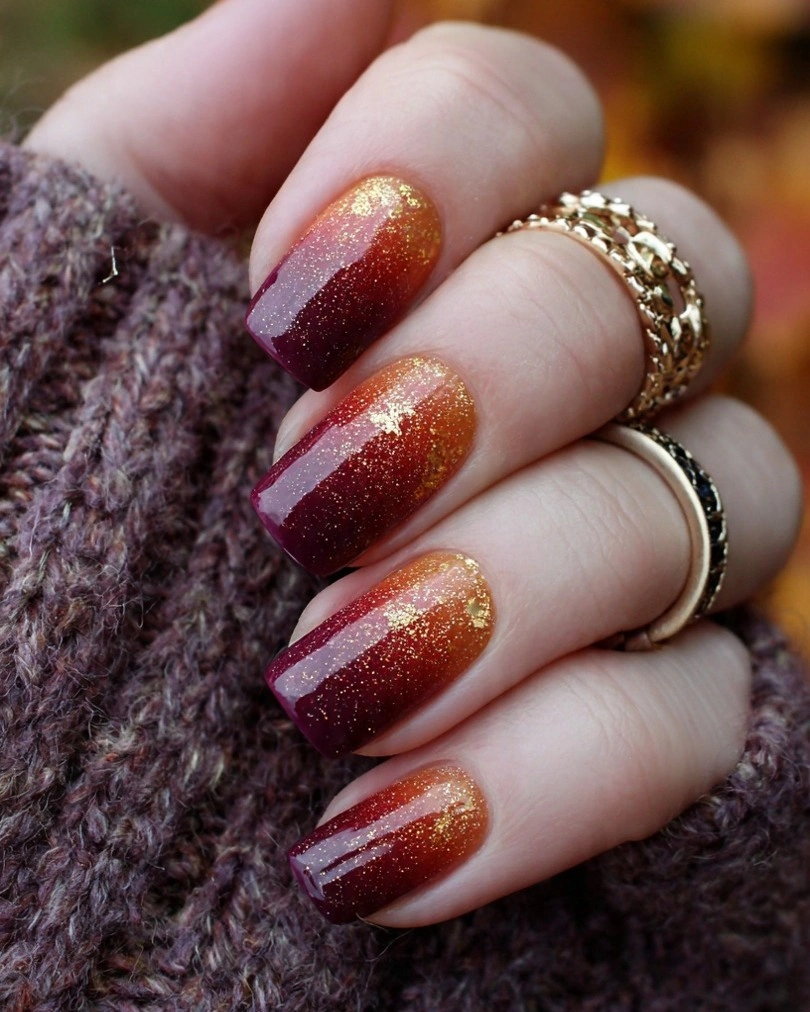
On a shorter nail, keep the darker burgundy near the base and concentrate the orange toward the tip, or reverse that order consistently across the hand. Adding a floral or plaid accent would introduce a second visual language and weaken the repeated fade; the useful edit is to simplify the direction, not to add a new focal point. A restrained shimmer still supplies the seasonal warmth.
This is a finish-led choice for readers who want fall color with visible light but no illustrated detail. Burgundy gives the set depth, orange brings the warmer shift, and the glitter links them across each square surface. The manicure feels organized because every nail repeats the same color problem and solves it in the same way.
Mauve with a Darker Textured Accent
Short rounded nails stay in a mauve, berry, and dark plum range, with one accent carrying a subtle knit-like linear texture. The tonal relationship keeps the pattern from breaking away from the base color, while the darker surface gives the compact set a point of interest. Since the shape is short, the texture reads as a close detail rather than a large design statement.
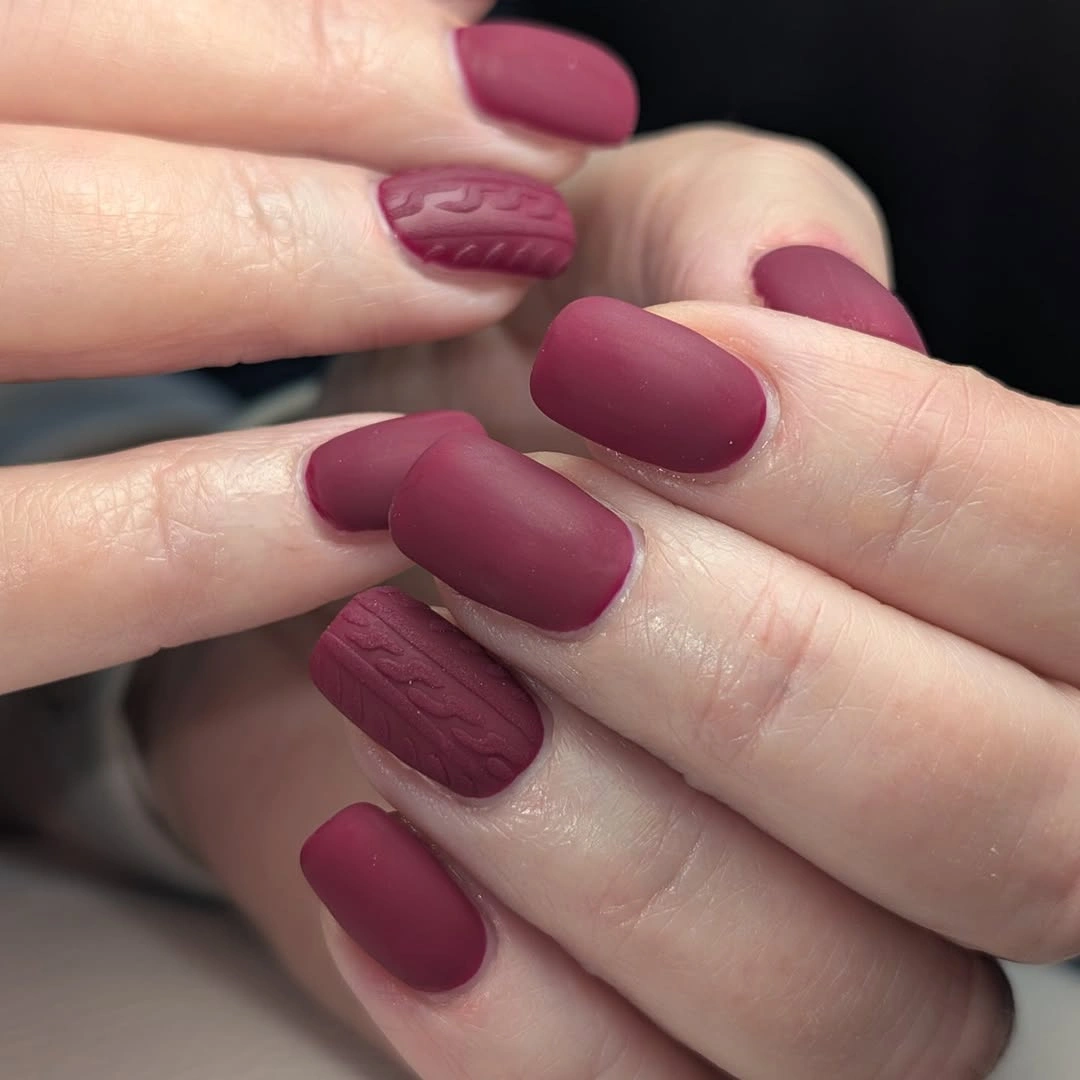
Use one darker accent and let the remaining nails stay close to the mauve family. If the pattern becomes too dense, remove a few lines rather than changing the color, because the appeal depends on tonal continuity; adding bright gold or white would make the texture more graphic than the reference suggests. The shape benefits from an edit that keeps the center open.
This direction offers a softer alternative to strong orange or black fall medium length nails. Berry depth keeps the palette seasonal, while the restrained texture adds interest for someone who does not want flowers or icons. The design works because the accent changes surface rhythm without abandoning the color family.
Dark French Edges on Long Almonds
Long almond nails leave most of the pale pink surface open and place deep burgundy or black along the French edge. The edge becomes the main detail, following the taper and making the silhouette more visible than a central motif would. Because the nail bed remains quiet, the dark line can carry the entire fall reference.
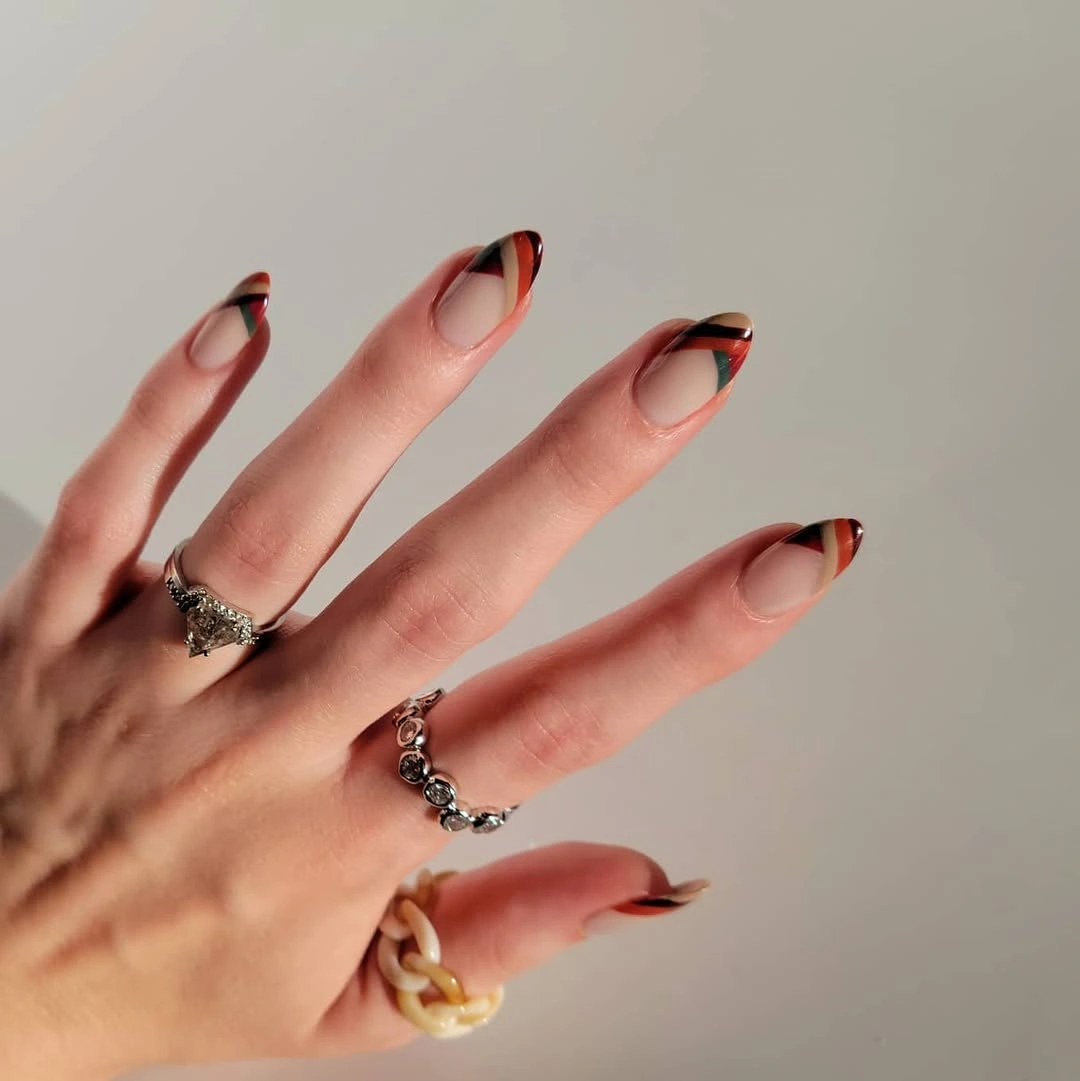
A medium-length adaptation can use a thinner burgundy curve that follows the natural square of the tip without trying to recreate the long taper. One dark edge is enough; adding dots, flowers, or glitter would compete with the shape-led idea and make the open base less useful. The line should define the outline, not cover the surface.
This is a clear choice for someone who wants a polished fall palette with very little internal decoration. Pale pink keeps the hand light, while burgundy or black gives the edge enough weight to be seen. The visual payoff comes from preserving the empty center and letting the contour do the work, with no extra symbol needed.
Olive and Burgundy with a Negative-Space Heart
Medium oval nails combine olive, burgundy, and pale nude solids with a small heart-shaped negative-space accent. The heart is a graphic interruption inside an otherwise muted palette, so the design does not depend on a bright icon or a full illustration. Olive supplies the seasonal color, burgundy adds depth, and nude gives the eye a place to reset.
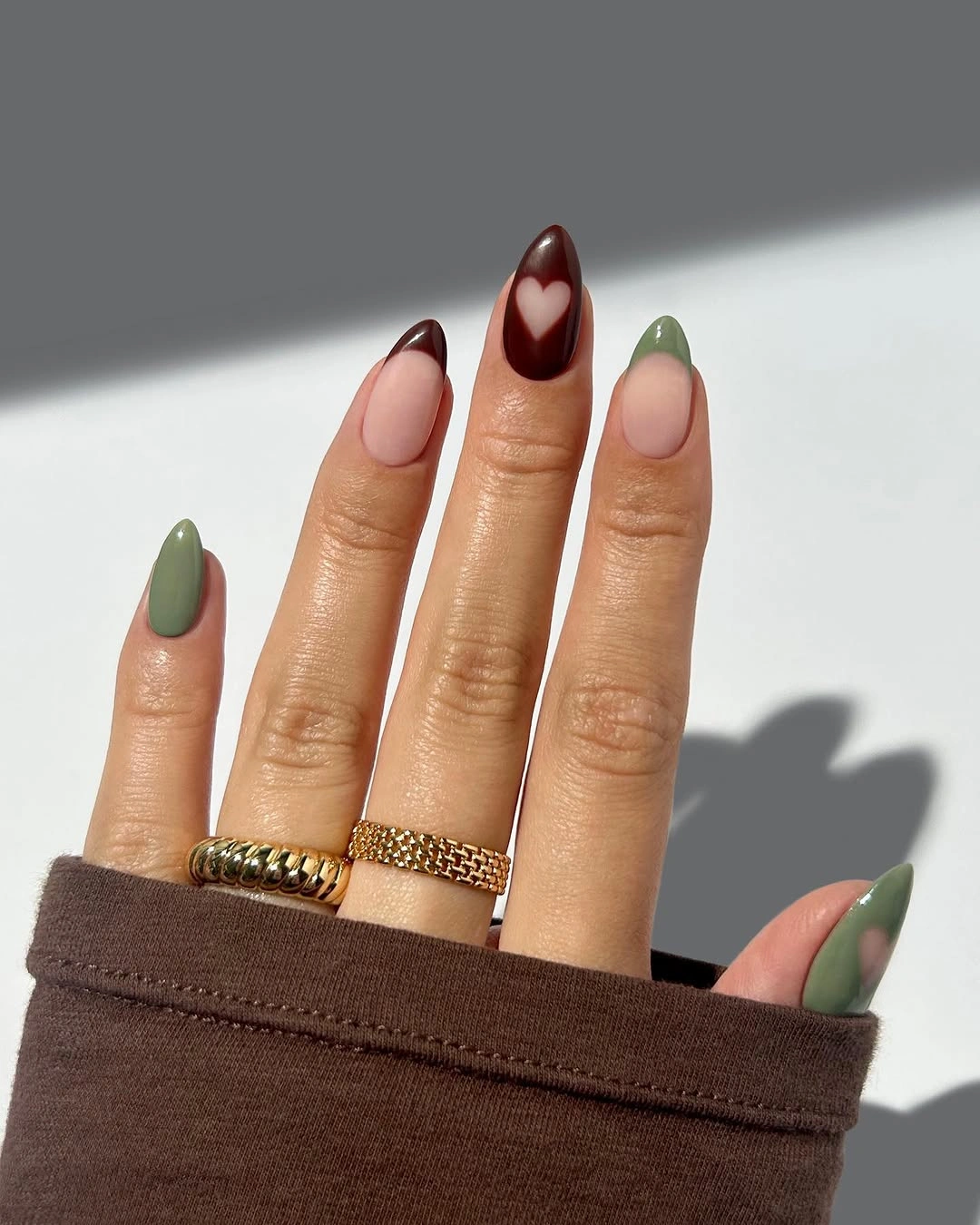
On a shorter nail, keep the heart on one pale surface and enlarge the open shape slightly so it does not disappear into the surrounding color. The negative space matters more than the symbol itself: filling the heart with another shade would turn the accent into a conventional motif and change the balance. Let the solid nails remain dominant.
This is an approachable fall medium length nails idea for readers who like a personal detail but do not want a full seasonal scene. The heart adds a small point of recognition, while the olive and wine colors keep the set grounded. It feels intentional because the one graphic break has a clearly different role from the solids.
Burgundy with Black Rose-Like Linework
Medium almond nails use burgundy as a glossy field and add black floral or rose-like linework across selected surfaces. The drawing stays inside the dark color family, so depth comes from line density and placement rather than from a bright contrasting accent. The almond shape gives curved petals and stems enough room to follow the nail without looking cramped.
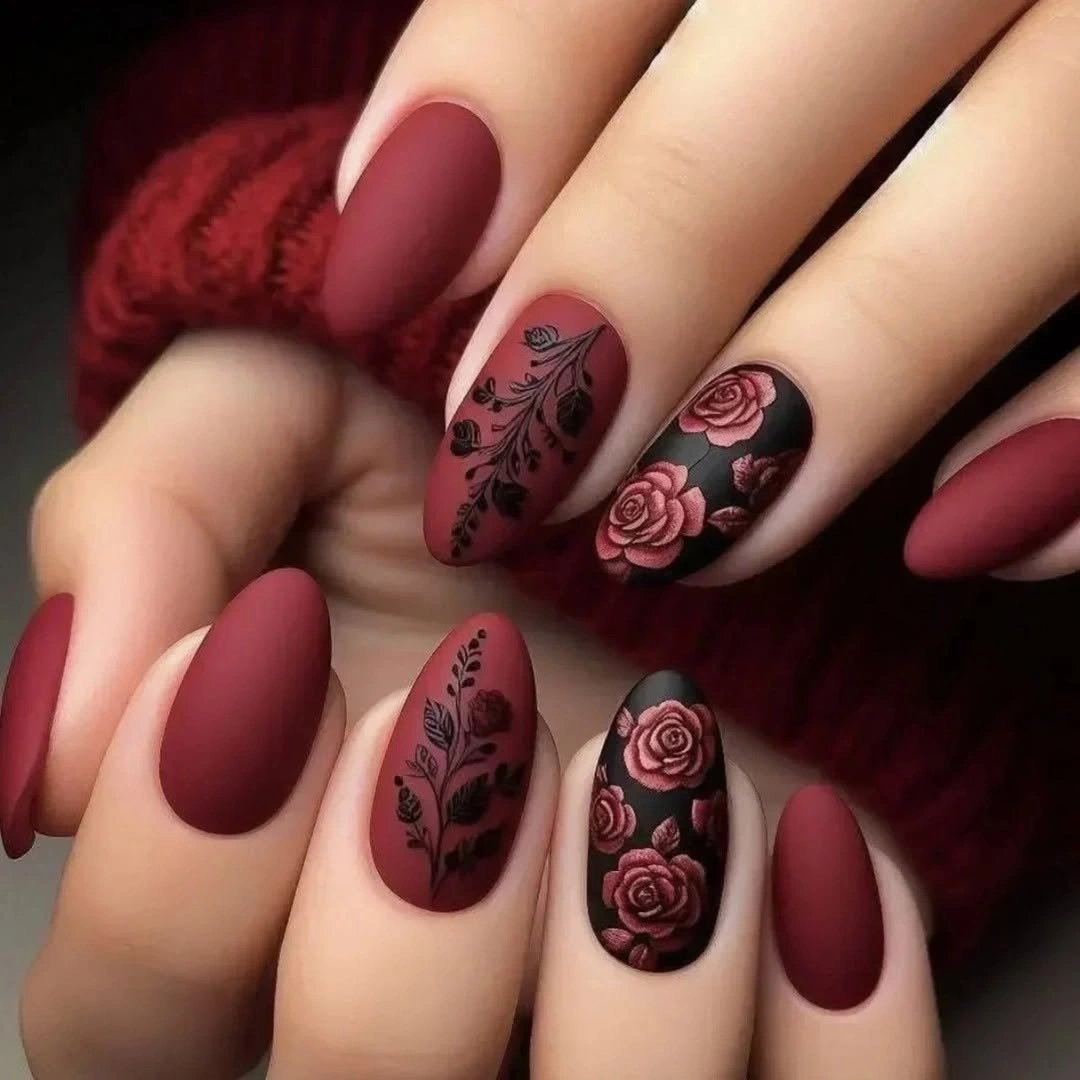
For a shorter set, choose one linework nail and keep the rest as burgundy solids. The black marks should remain open enough for the underlying color to show; filling every gap would turn the drawing into a dark block and erase the difference between surface and outline. A simplified stem or petal group preserves the same visual logic.
This option has more graphic weight than a pale floral accent but less palette contrast than a black-and-white design. Burgundy carries warmth, black supplies definition, and the repeated curved lines create a measured rhythm. The result is strongest when the art is treated as a change in density rather than a second color story.
Small Color Notes on Pale Rounded Nails
Short rounded nails mix pale pink and cream with burgundy plus small muted blue and soft gold accents. There is no dominant motif, so each little color note works like a separate polished mark within a restrained field. The compact shape benefits from that lack of clutter because the eye can register the palette before searching for a drawing.
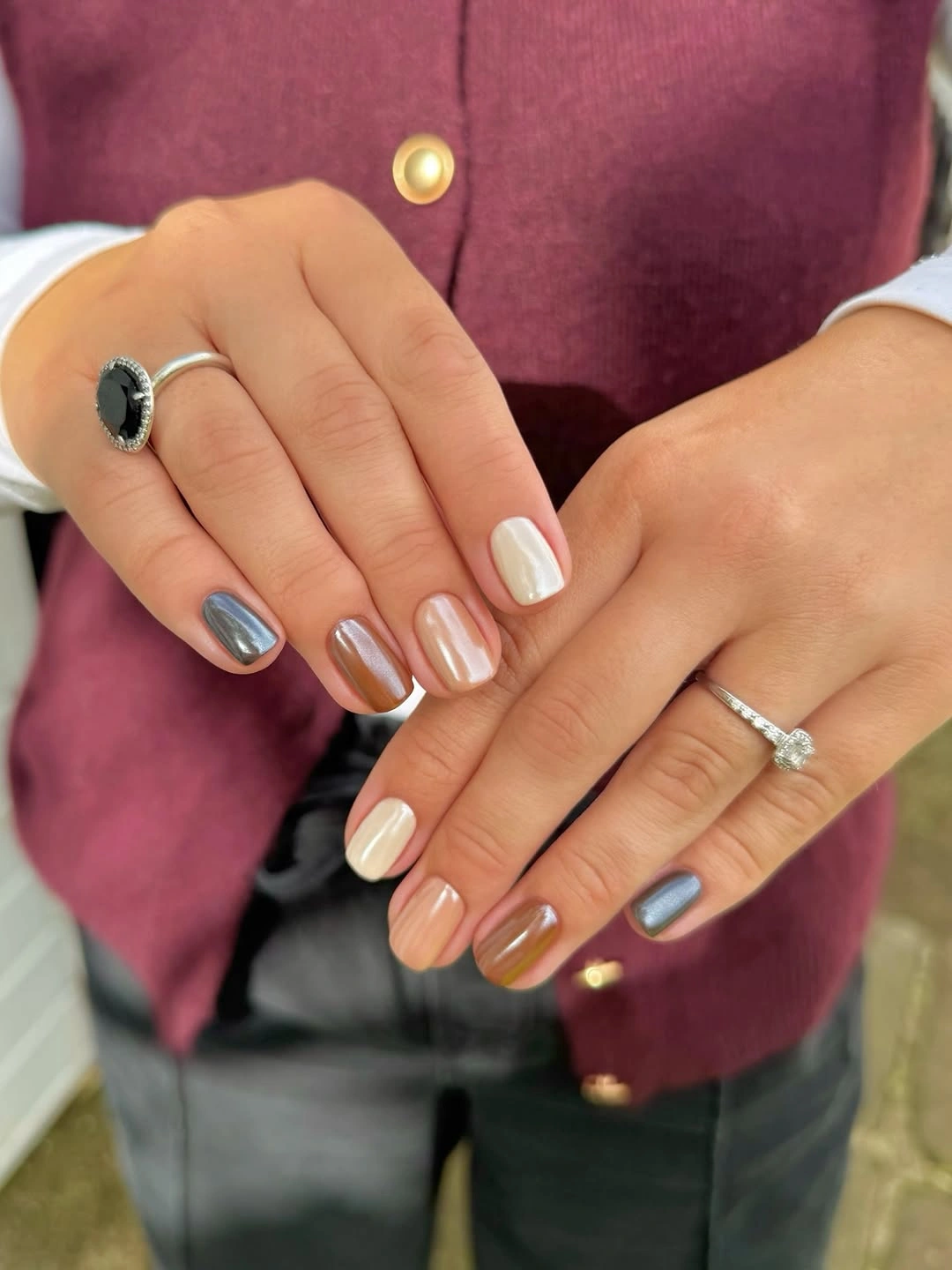
If the surface is even shorter, keep two accent colors at most and place them on separate nails. Combining every small note on one nail would make the arrangement look accidental, while repeating burgundy or soft gold can give the set a clearer anchor. The useful edit is to preserve color separation and reduce visual noise.
This is a quiet direction for readers who enjoy fall medium length nails but want a rounded shape that feels easy to wear. Cream and pale pink create the open base, burgundy adds a seasonal point, and muted blue prevents the palette from becoming predictable. Its personality comes from controlled variation rather than an obvious symbol.
Taupe Squares with Tortoiseshell Accents
Short-to-medium square nails pair taupe solids with selected tortoiseshell-like panels in caramel, brown, and deeper spots. The patterned nails carry the texture, while taupe acts as a quiet frame that keeps the warm marks from filling the entire hand. The square surface gives the abstract spots enough room to remain visible without needing a large length.
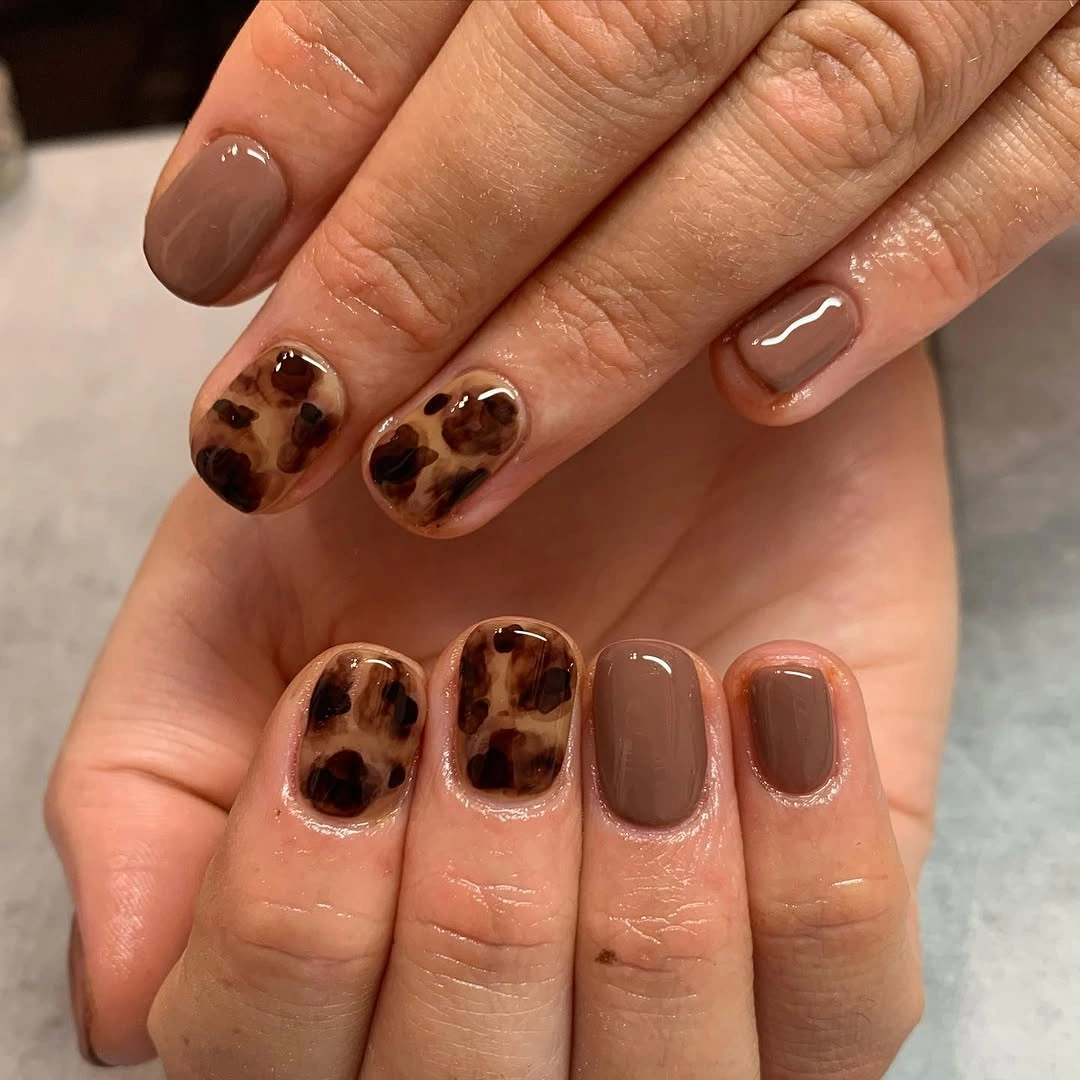
Keep the pattern to one or two nails if adapting the idea to a shorter version. The spots should remain irregular and contained, because making every surface equally busy would remove the contrast between texture and solid color; a plain taupe nail is part of the composition, not a missing detail. Warm brown can be deepened without adding a new motif.
This design gives a fall palette a tactile suggestion while staying abstract and wearable. Caramel and dark brown echo each other, and taupe lowers the overall contrast so the hand does not feel heavy. The visual structure is easy to understand: solids establish the field, and the tortoiseshell panels supply the change in rhythm.
Bright Leaf Accents on a Long Almond Palette
Long almond nails mix soft pink, red, and orange solids with pale accents carrying curved leaf-like marks. The decorative strokes echo the brighter solid colors, which keeps the set lively without making each nail unrelated to the next. The long silhouette gives the curves room to stretch and lets the color sequence become part of the design.
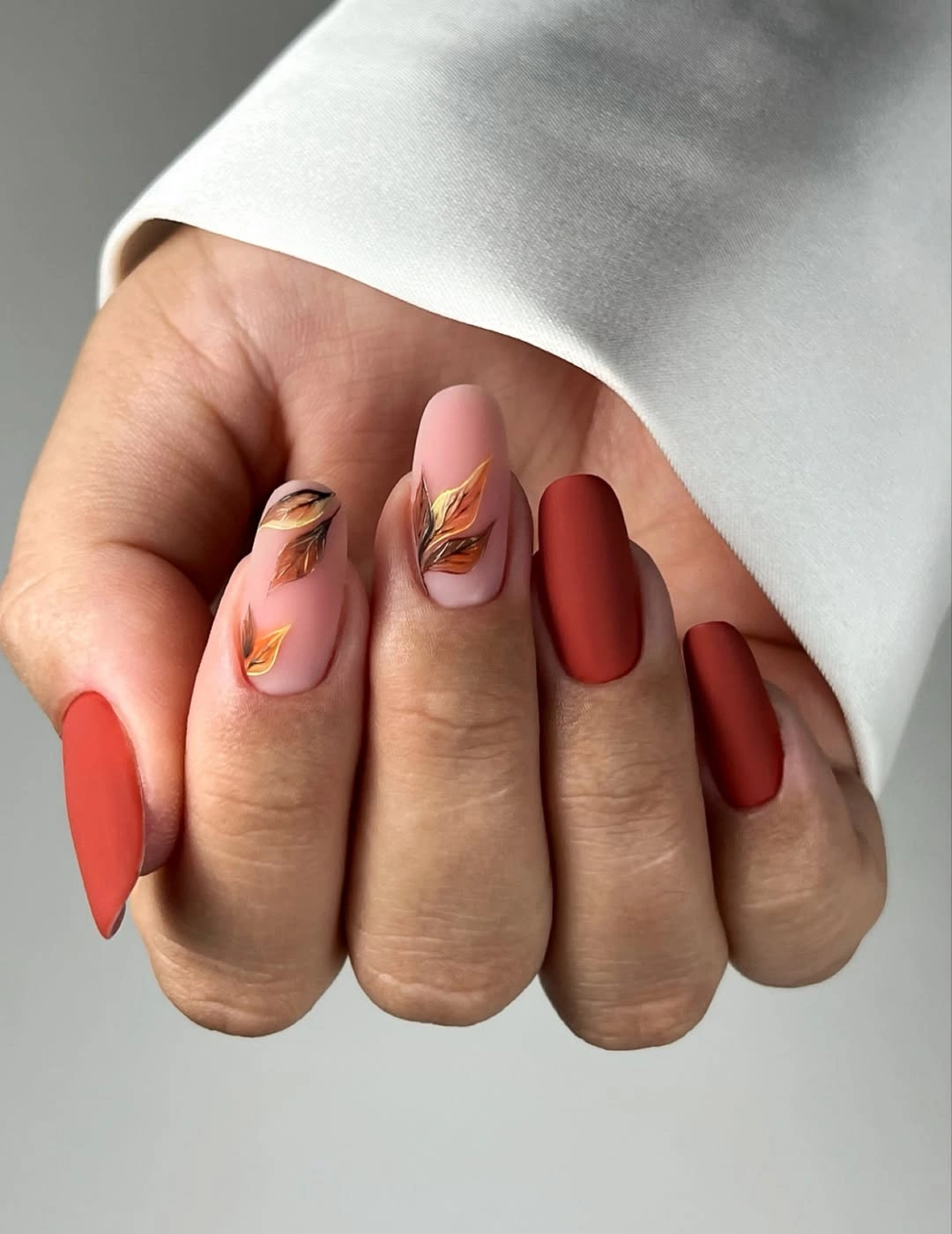
For medium length, preserve one red or orange solid and one pale accent instead of trying to repeat every color role. The curved marks are most readable when they have breathing space, while adding extra leaves would compete with the saturated blocks; reduce repetition before reducing contrast. A shorter version can keep the same energy through two clear color notes.
This is a more expressive fall direction for readers who want color to lead and art to support it. Soft pink prevents the red and orange from becoming a single hot field, and the leaf-like strokes connect the palette without requiring a literal scene. The hand feels coordinated because the accents repeat the colors that already have visual weight.
Berry, Glitter, and Pale Botanical Panels
Medium almond nails combine berry and burgundy solids with gold glitter and white botanical panels. The pale panels create a lighter center between strong color blocks, while the glitter adds a reflective break that is separate from the linework. Because each role has its own surface, the set can carry several details without becoming one continuous pattern.
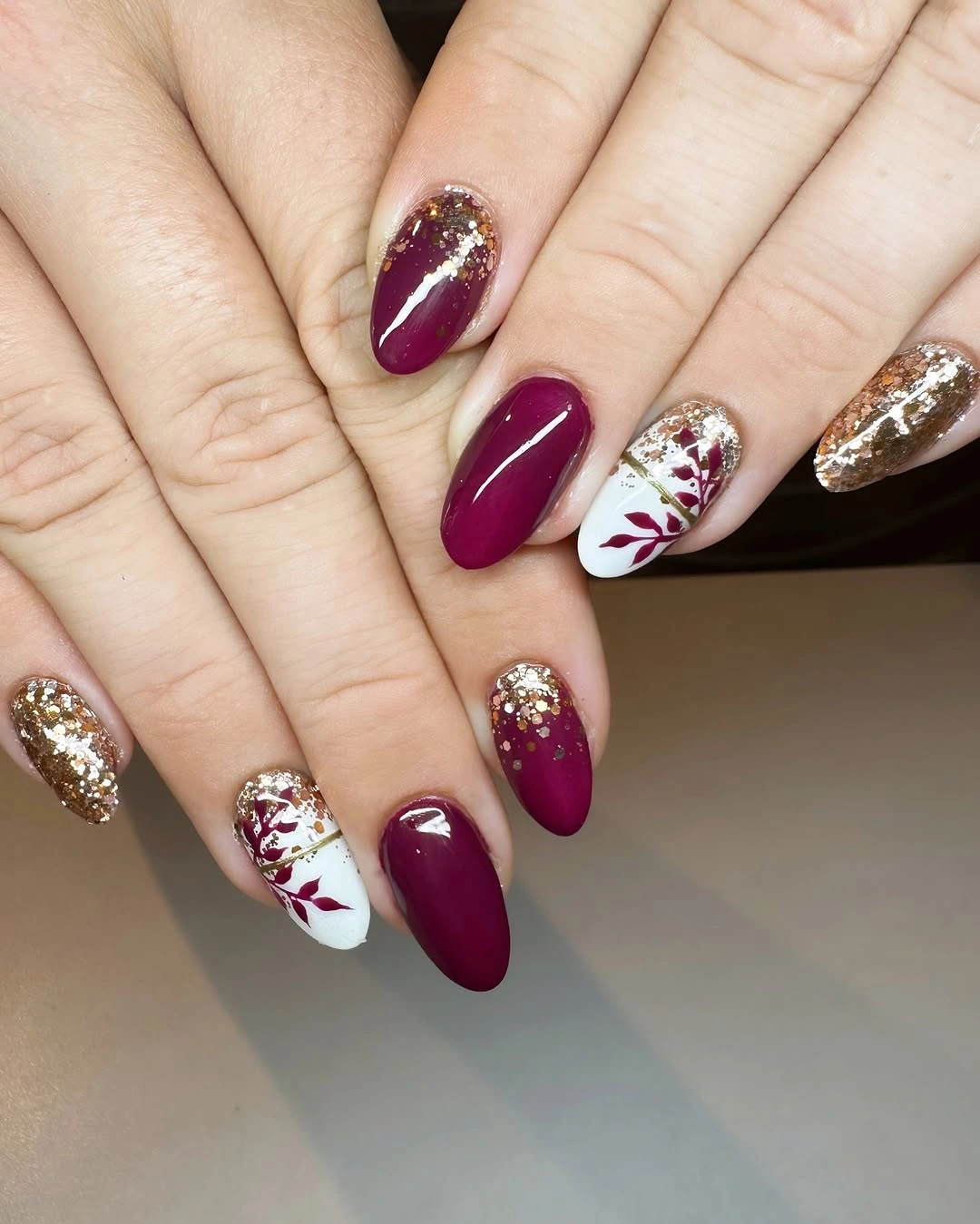
On a shorter shape, keep the white botanical panel and either the glitter or the strongest berry accent. Too many reflective and drawn details would compete for the same focal position, but removing one role allows the remaining contrast to stay clear. The important relationship is between a deep field, a light panel, and one controlled highlight.
This option suits someone who wants medium-length nails to feel festive without relying on bright orange. Berry tones provide depth, white opens the composition, and gold supplies a narrow flash of warmth. The design stays readable because the decorative panel is surrounded by quieter surfaces, so the accent has somewhere to settle.
Neutral Outlined French Tips
Medium almond nails use soft nude, brown, and black glossy French edges rather than filling the surface with a central design. The outlined tip follows the shape and gives the pale base a clear border, so the silhouette becomes the main visual feature. Brown keeps the contrast warm, while black can be reserved for the sharper accent.
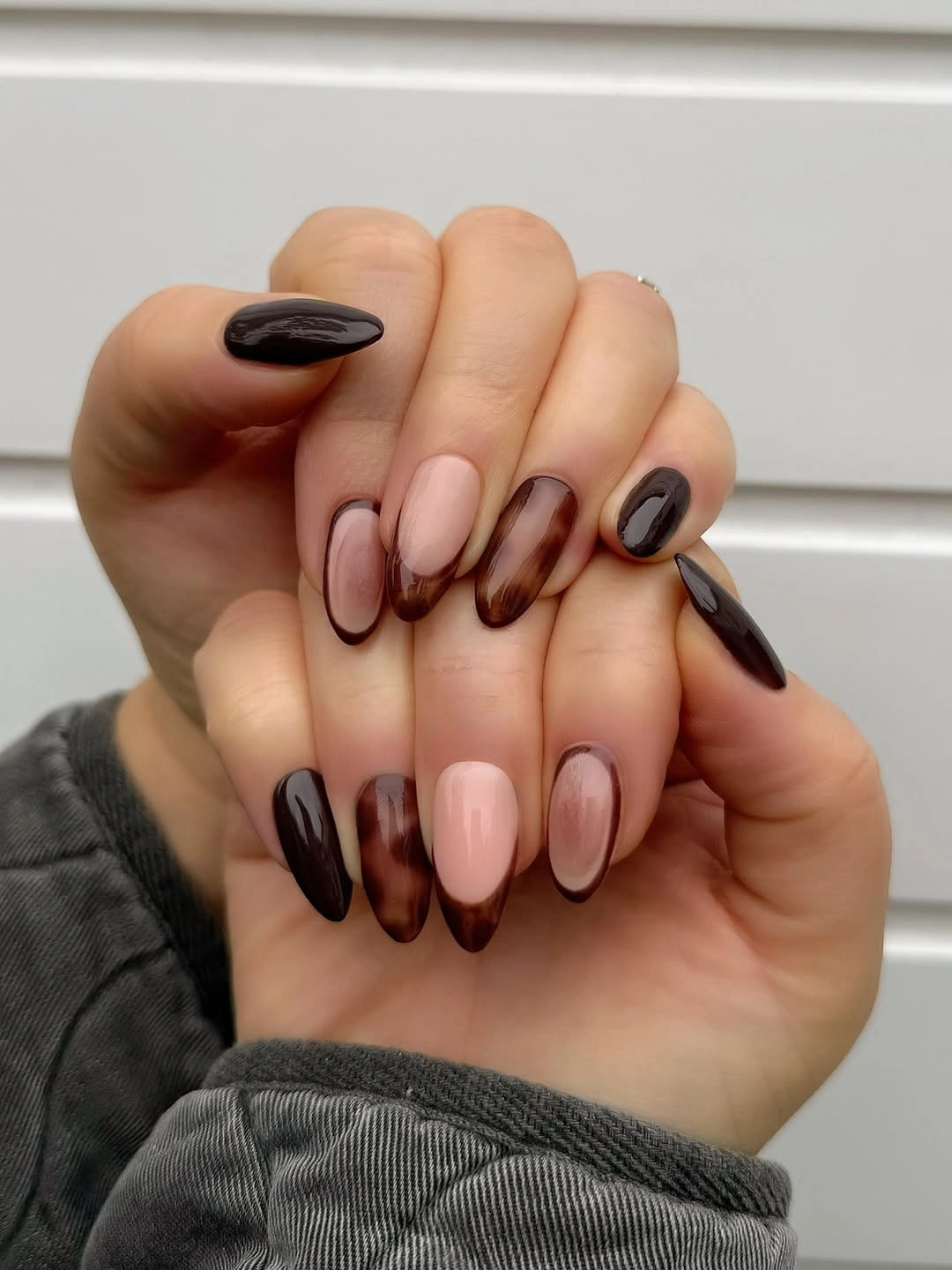
For a shorter nail, use one dark outline color or make the line thinner near the corners. The edge needs enough space to remain even; stacking multiple tip colors would make the compact surface look crowded and would take attention away from the clean nude center. The most useful change is a reduction in line complexity.
This is a practical fall medium length nails direction for readers who want a seasonal shift without art that announces itself. Nude pink leaves the hand open, and the brown-black edge adds definition through contrast and contour. The design feels finished because every detail follows the boundary of the nail.
Solid Forest Green as the Whole Statement
Long almond nails are covered in one glossy deep forest green with no separate motif or accent. The color itself carries the design, and the tapered silhouette makes the shade feel deliberate rather than plain. With no internal decoration to compete for attention, surface smoothness and the clean outline become the visible evidence of control.
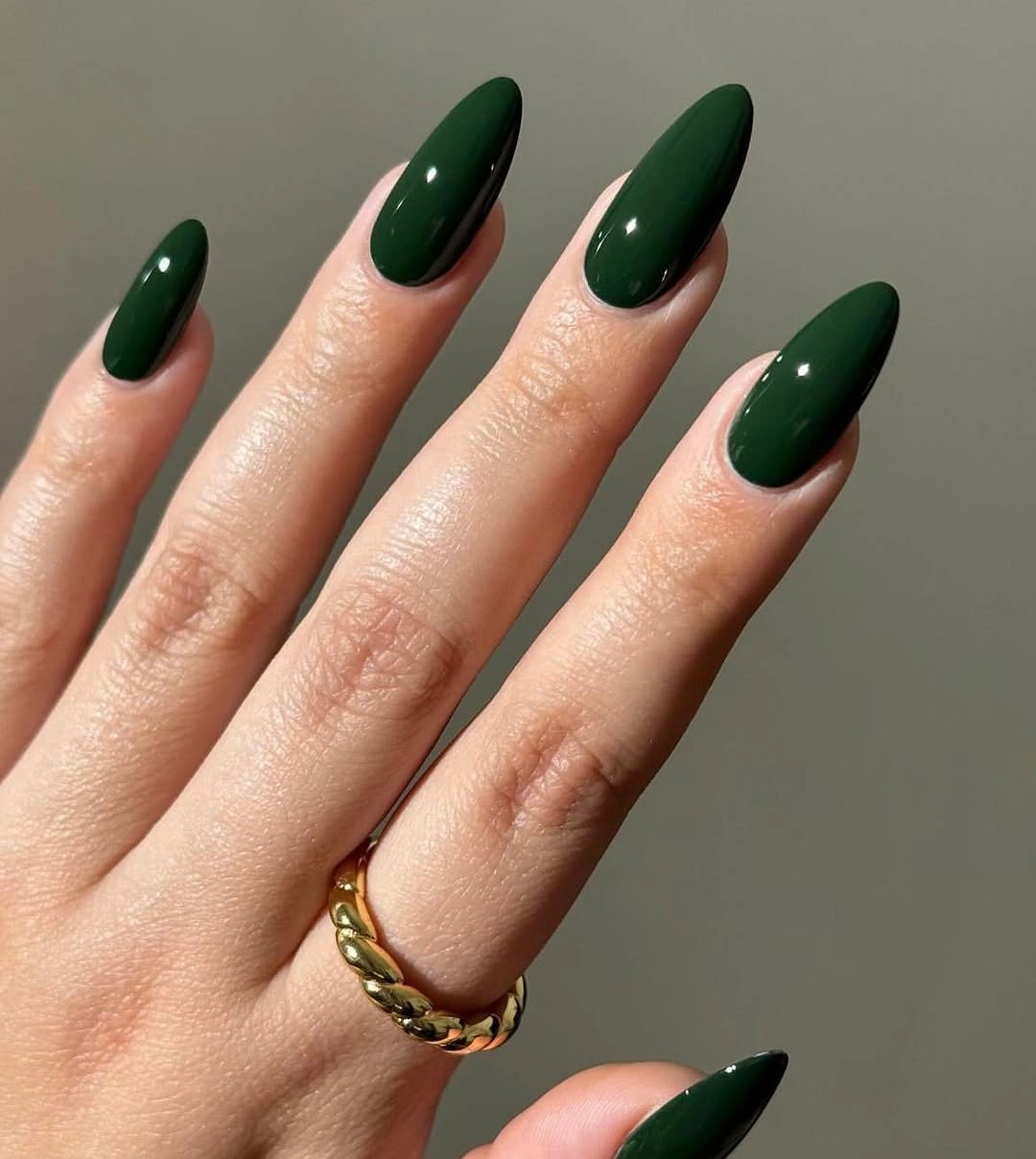
A medium-length adaptation can make the same green more everyday by shortening the silhouette or placing the shade on two or three nails beside nude. Adding a pattern is optional, not necessary; the strength of this reference comes from repeating one color consistently. If an accent is introduced, keep it pale and limited so the green remains the subject.
This is the direct answer for someone who wants fall color without linework, flowers, or glitter. Deep green has enough depth to replace burgundy, while the glossy surface keeps the result clear from a distance. The design works because it refuses to treat a solid color as unfinished, even on a long silhouette.
Floral Tip Borders with Teal and Berry Solids
Medium almond nails place small multicolor floral clusters around pale tips, then pair them with burgundy and teal solids. The open base lets orange, yellow, blue-green, and red details stay separate, while the solid nails give the hand calm surfaces between the decorative borders. The tip placement creates a repeated edge rhythm rather than full coverage.
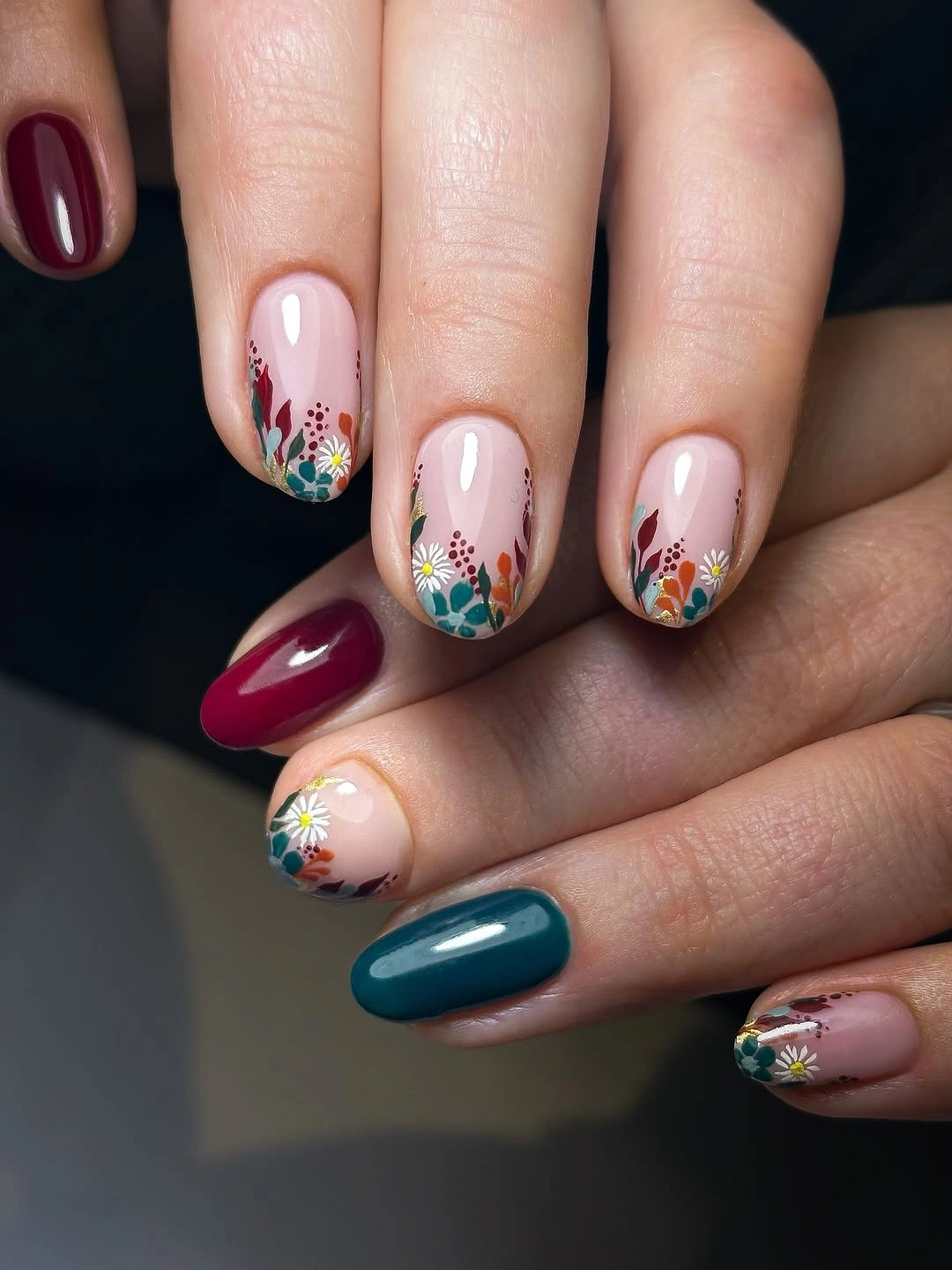
On shorter nails, use two floral colors instead of the entire cluster and keep the tip border narrow. Teal and burgundy can remain as solid anchors, but adding more marks to the pale nails would make the border lose its clean edge; the adaptation should protect the space around the flowers. One clear color bridge is better than many tiny repeats.
This is a lively fall direction for readers who want floral detail but dislike a fully painted surface. Teal cools the burgundy, while the warm tip colors make the pairing feel connected to autumn without narrowing the palette to orange and brown. The design stays readable because the pale base remains visible between the marks.
Sheer Pink, Wine, and a Fine Warm Line
Medium almond nails alternate sheer pink and deep wine solids, with one accent carrying a thin warm line or small reflective mark. The accent is narrow enough to act as a bridge rather than a new illustration, so the set keeps its restrained dark-light structure. The medium length gives the line room to curve without requiring dense decoration.
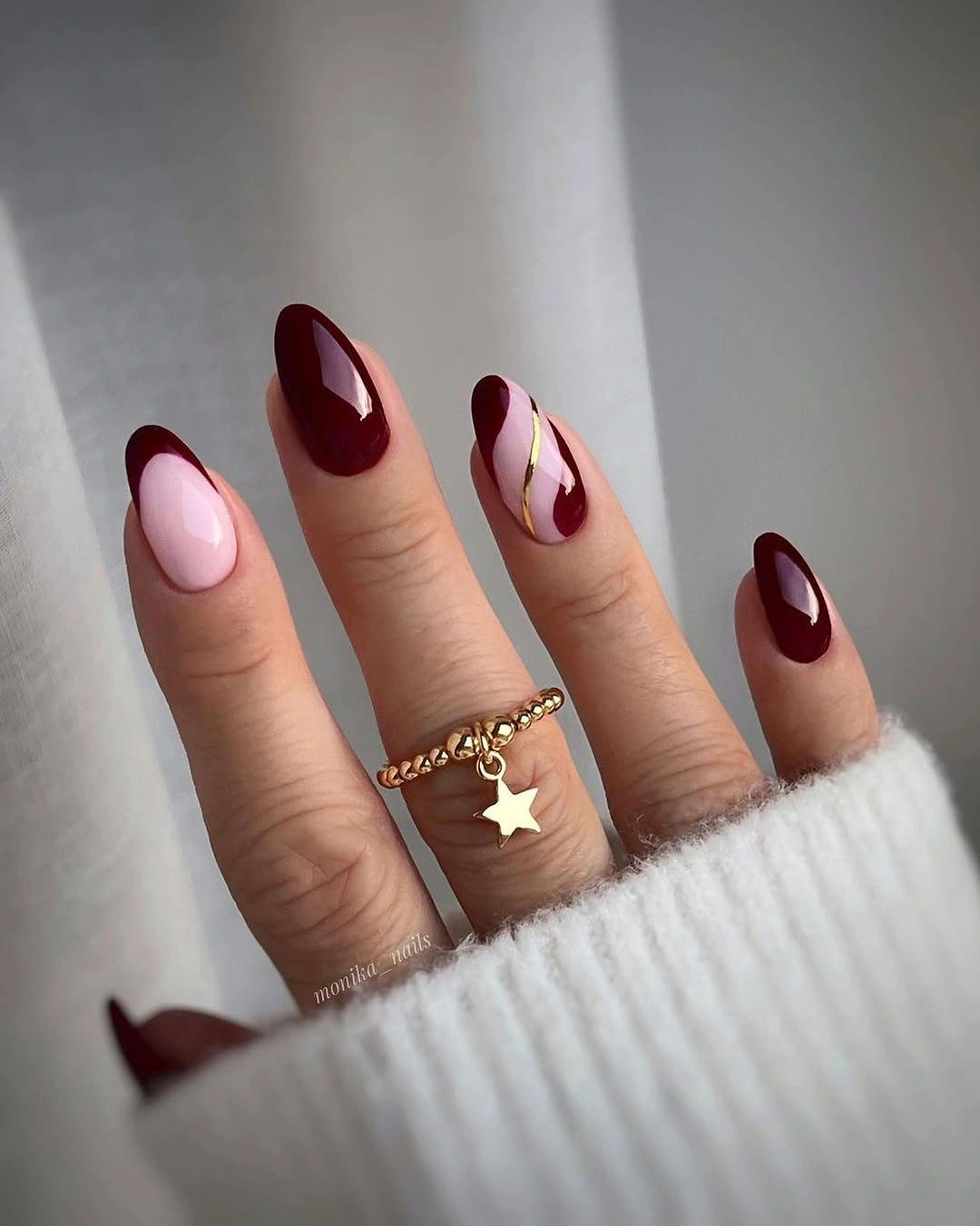
If the nail is shorter, use one curved line or a single dot on the pale surface. The fine mark should remain secondary to the pink and burgundy contrast; adding a cluster of symbols would change the design from quiet connection to visible art. Keep the warm note small enough that the eye still returns to the wine solids.
This is a useful choice for someone who wants a little detail but not a full floral or plaid treatment. Sheer pink supplies light, wine brings fall depth, and the narrow accent quietly explains why the two tones belong together. The set feels resolved because one small line is given a clear job, then allowed to stay quiet.
Deep Wine with One Pale Floral Pause
Long almond nails use deep wine solids across most of the hand and reserve one pale accent for small red and dark flower marks. The light nail creates a bright pause inside the darker field, while the repeated wine keeps that pause connected to the rest of the set. The long shape makes the accent easy to see, but it does not require multiple focal nails.
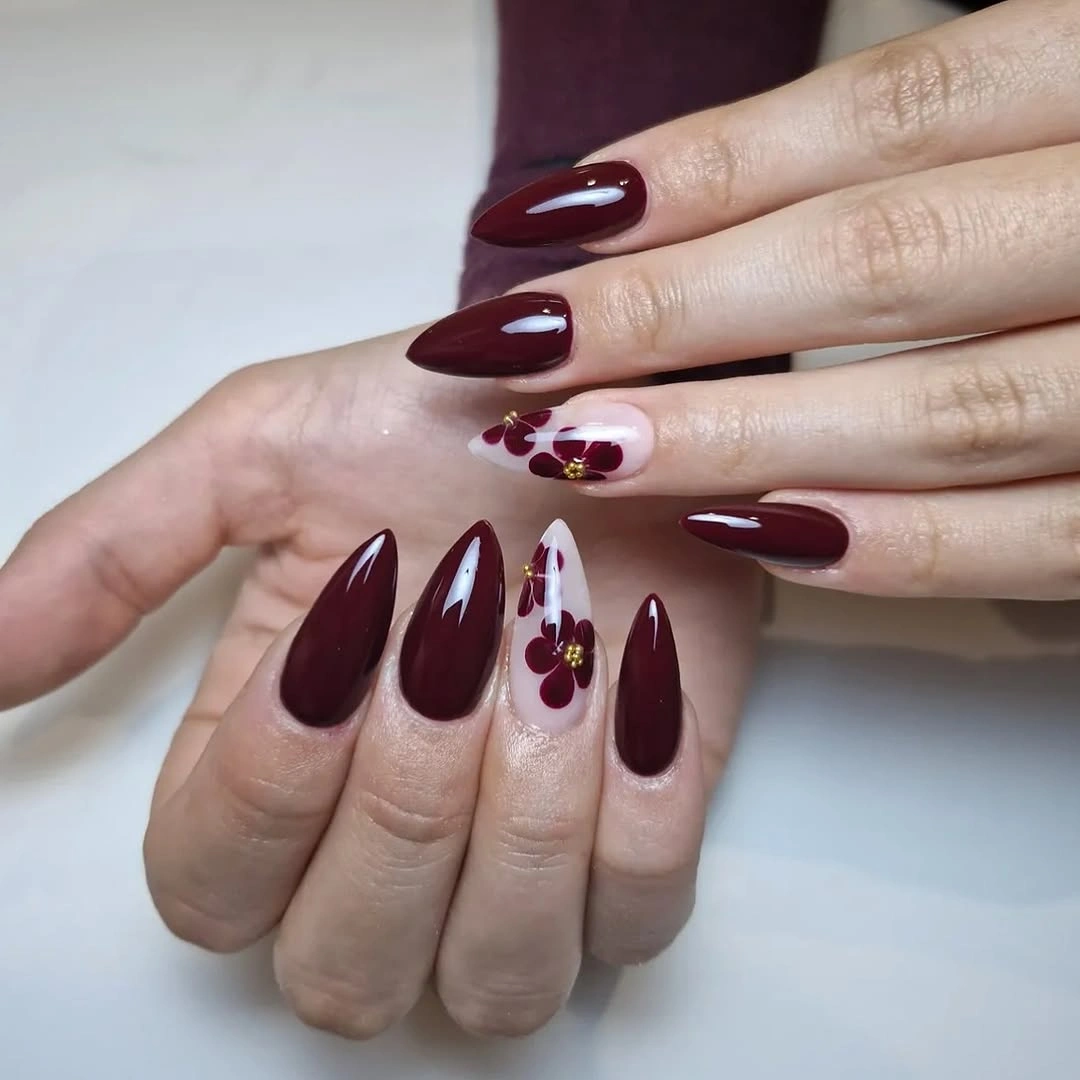
A shorter version can keep the same arrangement with one pale nail and a smaller flower or dot cluster. The light accent is doing the structural work, so adding more pale surfaces would reduce its focus; shortening the length is a more controlled change than multiplying the art. Dark wine should remain the dominant value.
This direction has a strong fall mood without becoming an all-over pattern. The pale center gives the eye relief, red repeats a warmer note inside the flower, and the wine field keeps the overall set deep. Its impact comes from the contrast between one interruption and many consistent surfaces, not from adding more art.
Mixed Burgundy, Orange, Botanicals, and French Tips
Medium almond nails bring together burgundy solids, pale nails with white curved tips, one glossy orange surface, and small orange-green botanical accents. Each nail has a different role, but the orange note repeats in both the solid and the details, which keeps the variety connected. The result is more editorial than minimal because several recognizable fall elements share the hand.
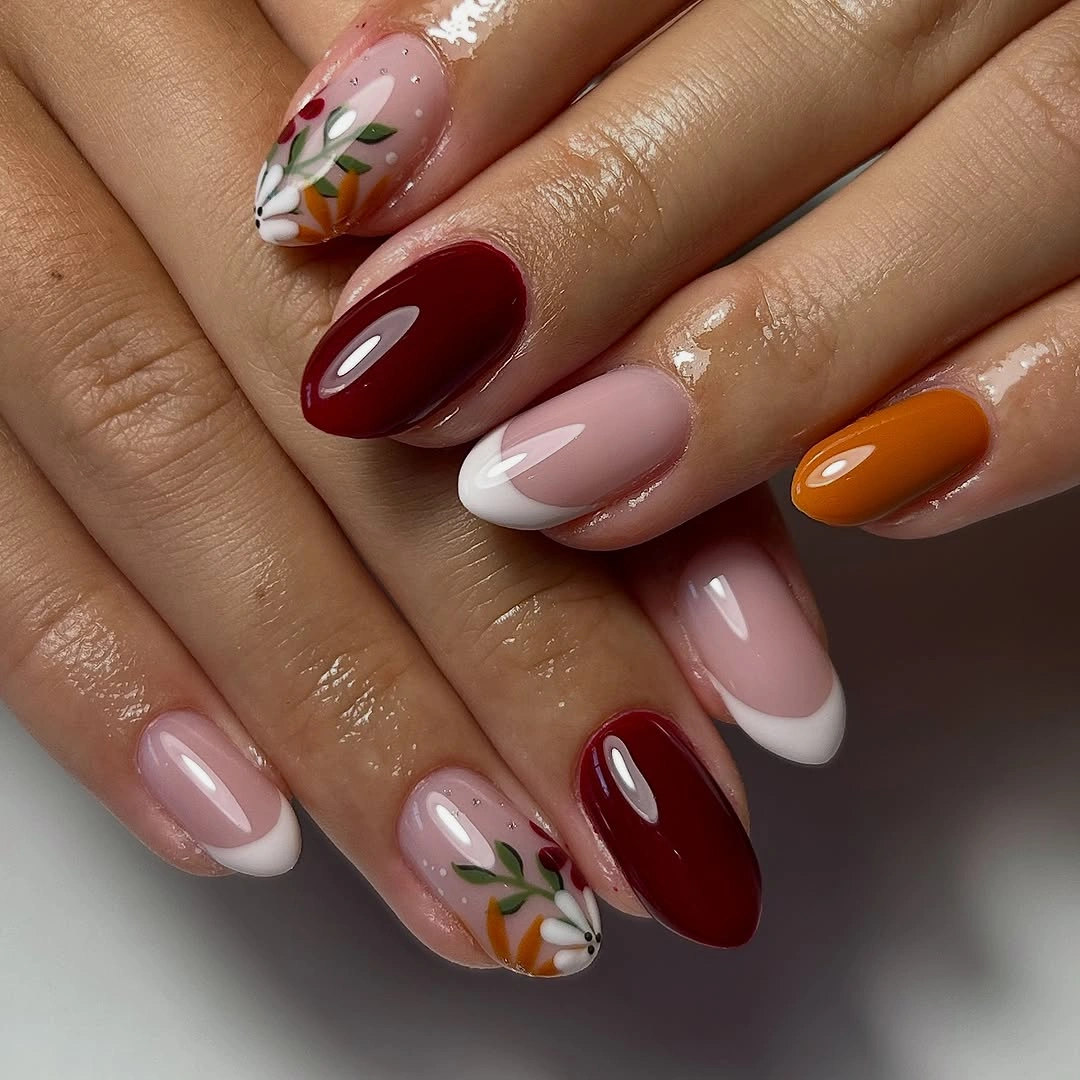
For a shorter adaptation, keep one orange accent and one pale botanical or French nail, then let burgundy handle the remaining surfaces. Trying to preserve every role at reduced scale would make the pattern hard to read and the color order difficult to follow; clear separation is more important than completeness. Choose the two details that best express the intended mood.
This is a useful reference for someone who wants a full fall palette rather than one isolated technique. Burgundy supplies depth, orange adds warmth, pale tips create open space, and botanical marks provide the small-scale finish. The design holds together when each detail stays in its lane and the repeated orange acts as the link.