Best Halloween Costume Ideas for a Memorable Night
Best halloween costume ideas are easiest to use when a reference makes its silhouette, color balance, and focal detail visible at the same time. This edit moves through a black palette with several variations, with each image treated as a specific composition rather than a label that demands an invented character, brand, or occasion. The goal is to notice what the eye reads first and what can be adapted with pieces you already understand.
Read the sections from the outside in: begin with the largest shape, notice where color or texture creates emphasis, and then decide which small detail is worth carrying into your own version. The selected editorial profile is a structural visual analysis focused on silhouette, scale, and placement, so the commentary stays grounded in proportion, placement, and visible styling choices. Use the images as practical prompts, especially when a full look feels inspiring but too specific to copy exactly.
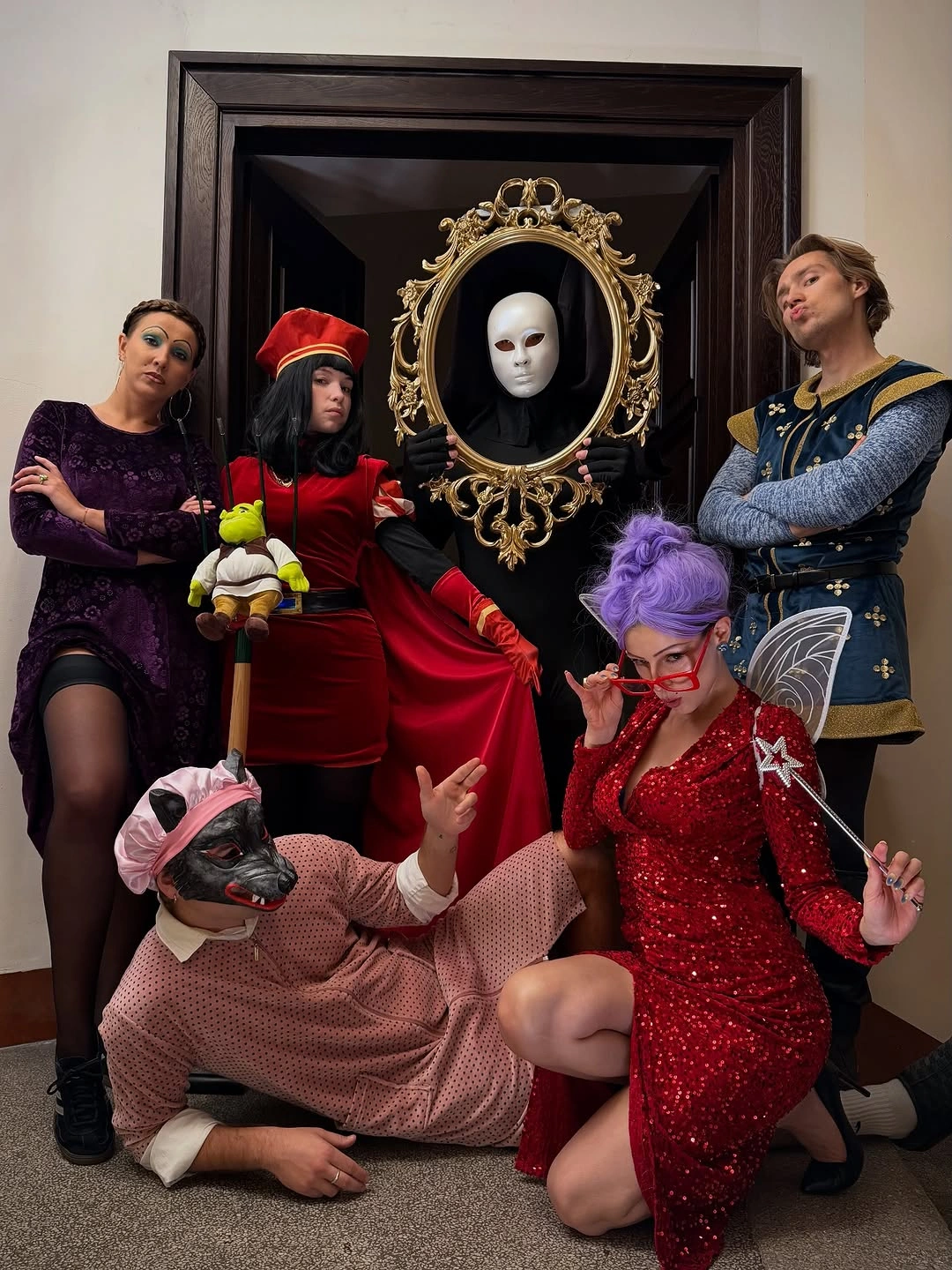
Black mixed fitted, hooded, tunic, and seated shapes built around theatrical character mix with mask + props
Costume frame 1 opens with Several figures use strong character silhouettes rather than matching garments. Costume frame 1 also shows Black, red, jewel purple, blue, tan, and pink create a deliberately crowded palette. Costume frame 1 color map: black, red, jewel purple. Frame 1 costume silhouette: mixed fitted, hooded, tunic, and seated shapes. Frame 1 costume focal language: theatrical character mix with mask and props. Frame 1 costume detail: The ornate mirror creates a second eerie face inside the group composition. Frame 1 costume angle: A group costume works through contrast, with the mirror and red-purple foreground figure anchoring the mix.
Costume frame 1 adaptation starts with The foreground red dress and purple hair pull attention toward the lower right. Costume frame 1 angle options: Building a group costume from contrasting silhouettes; Costume frame 1 second reading: Using one prop or frame as a visual anchor. Costume frame 1 thesis: Treat a group costume as a small cast: keep the silhouettes different, then connect them with one dramatic color story. Frame 1 costume practical note: preserve the foreground red dress and purple hair pull attention toward the lower right; compare building a group costume from contrasting silhouettes with using one prop or frame as a visual anchor in this frame. Frame 1 costume emphasis: keep the foreground red dress and purple hair pull attention toward the lower right.
Costume frame 1 comparison: Unlike the later coordinated duos, this look is intentionally ensemble-driven and visually crowded. Costume frame 1 evidence: A white face mask in the framed mirror, handheld props, a wand, and a plush-like headpiece add theatrical focal points. Costume frame 1 secondary detail: Different costume scales keep the group readable as a collection rather than one uniform look. Frame 1 costume finish: lace-like fabric, sequins, and patterned textiles. Frame 1 costume reading: a group costume works through contrast, with the mirror and red-purple foreground figure anchoring the mix explains the image’s particular emphasis.
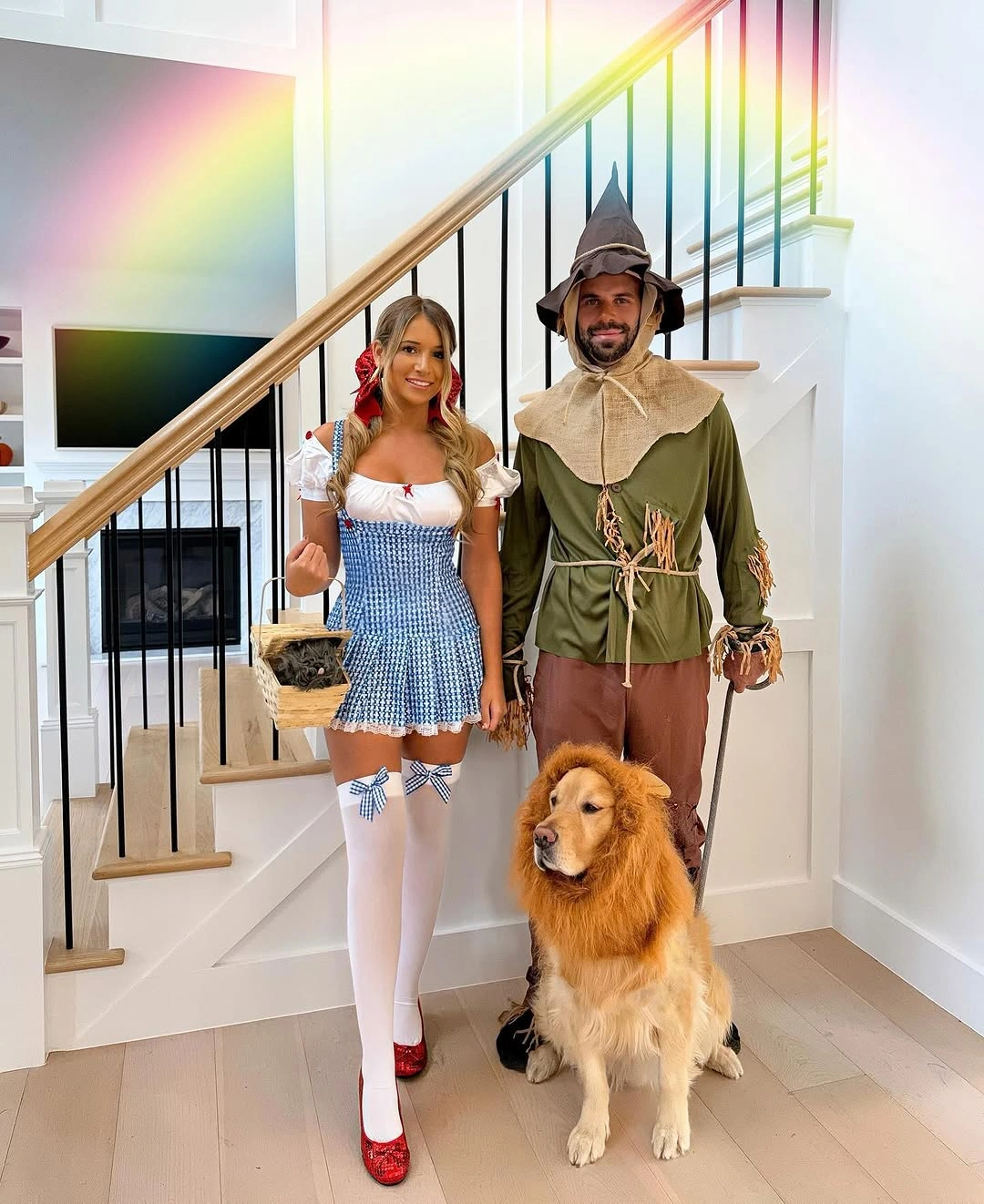
Blue short checked dress beside a loose tunic and tapered trousers built around storybook pairing with a companion animal
Costume frame 2 opens with The woman’s blue-and-white checked dress is paired with red footwear and small blue accents. Costume frame 2 also shows The man’s green and brown outfit uses a pointed hat and loose tunic proportions. Costume frame 2 color map: blue, white, red. Frame 2 costume silhouette: short checked dress beside a loose tunic and tapered trousers. Frame 2 costume focal language: storybook pairing with a companion animal. Frame 2 costume detail: The red shoes echo the small bright accents on the woman’s outfit. Frame 2 costume angle: A clear blue-red lead outfit and a green-brown partner keep this trio legible at a glance.
Costume frame 2 adaptation starts with The blue check and green-brown combination separates the two adult silhouettes clearly. Costume frame 2 angle options: Coordinating a couple with different silhouettes; Costume frame 2 second reading: Using a small red accent to finish a blue costume. Costume frame 2 thesis: Use distinct color blocks for a couple, then let the pet costume act as a warm punctuation mark. Frame 2 costume practical note: preserve the blue check and green-brown combination separates the two adult silhouettes clearly; compare coordinating a couple with different silhouettes with using a small red accent to finish a blue costume in this frame. Frame 2 costume emphasis: keep the blue check and green-brown combination separates the two adult silhouettes clearly.
Costume frame 2 comparison: This is a bright, friendly trio with a pet accent, unlike the darker gothic and horror looks that follow. Costume frame 2 evidence: The dog adds a warm tan-orange counterpoint and makes the group read as a storybook trio. Costume frame 2 secondary detail: The pet costume acts as a low, centered color block rather than competing with the people. Frame 2 costume finish: checked fabric, soft-looking fur-like pet costume, and layered costume pieces. Frame 2 costume reading: a clear blue-red lead outfit and a green-brown partner keep this trio legible at a glance explains the image’s particular emphasis.
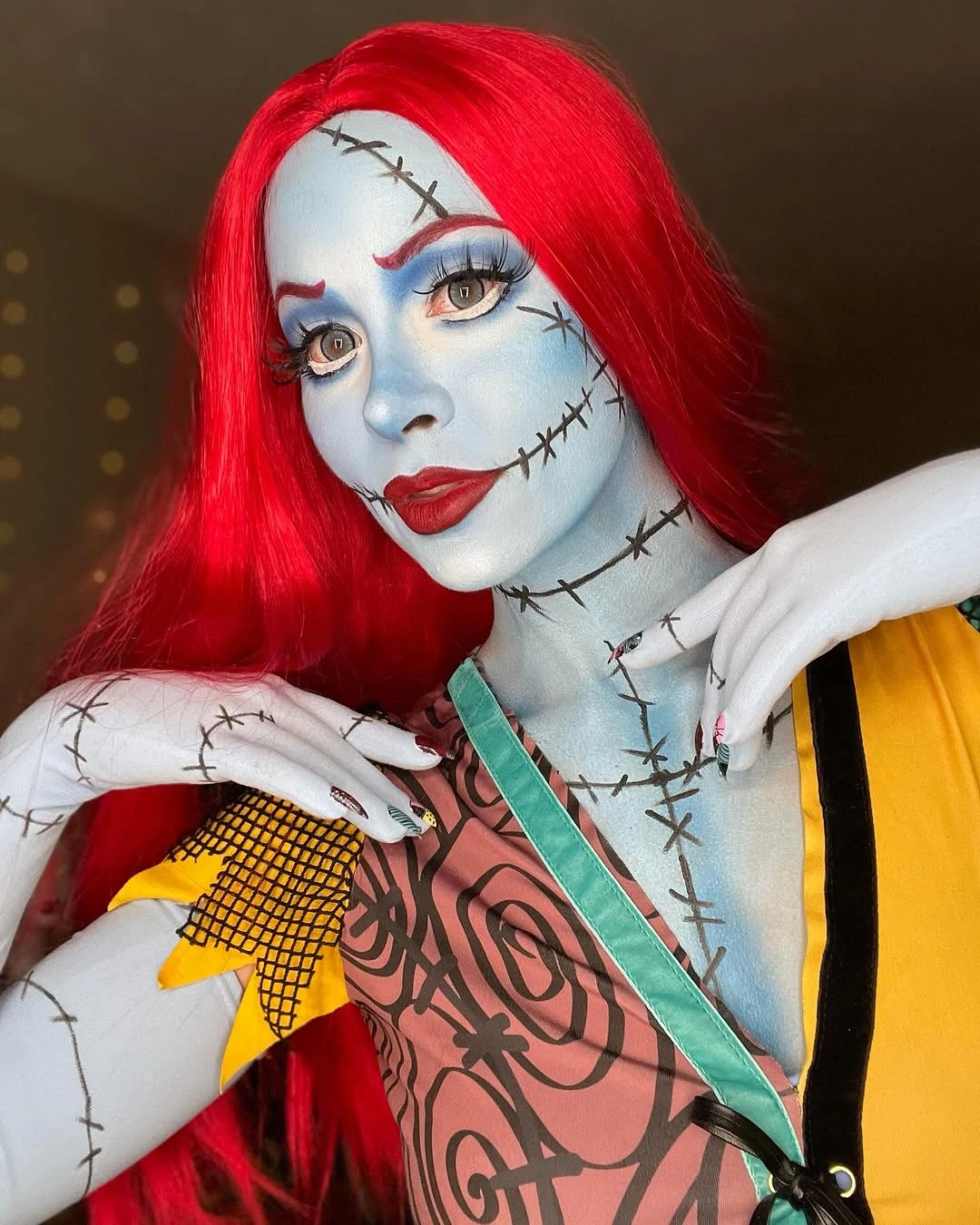
Red close-up upper-body look with visible straps and fitted graphic panels built around stitched doll-like graphic language
Costume frame 3 opens with The face and exposed arms carry repeated black stitch marks over a pale blue-white base. Costume frame 3 also shows The garment combines coral, yellow, teal, and dark linework in large graphic shapes. Costume frame 3 color map: red, pale blue-white, coral. Frame 3 costume silhouette: close-up upper-body look with visible straps and fitted graphic panels. Frame 3 costume focal language: stitched doll-like graphic language. Frame 3 costume detail: The repeated stitch motif links makeup and clothing without needing many accessories. Frame 3 costume angle: The costume is unified by repeated stitch lines and a red-blue-yellow color relationship.
Costume frame 3 adaptation starts with The high-contrast face is the main focal point, while yellow and teal keep the costume from becoming all red and black. Costume frame 3 angle options: Letting makeup and garment share one motif; Costume frame 3 second reading: Using a bright wig or hair color as the frame. Costume frame 3 thesis: When makeup is the anchor, echo its strongest graphic mark in the garment and leave the rest of the outfit simple. Frame 3 costume practical note: preserve the high-contrast face is the main focal point, while yellow and teal keep the costume from becoming all red and black; compare letting makeup and garment share one motif with using a bright wig or hair color as the frame in this frame. Frame 3 costume emphasis: keep the high-contrast face is the main focal point, while yellow and teal keep the costume from becoming all red and black.
Costume frame 3 comparison: This section is makeup- and portrait-led, not a full-body outfit or coordinated group system. Costume frame 3 evidence: Red hair creates a saturated frame around the makeup and garment. Costume frame 3 secondary detail: The tight portrait makes color placement more important than full-body silhouette. Frame 3 costume finish: smooth-looking colored panels and painted graphic lines. Frame 3 costume reading: the costume is unified by repeated stitch lines and a red-blue-yellow color relationship explains the image’s particular emphasis.
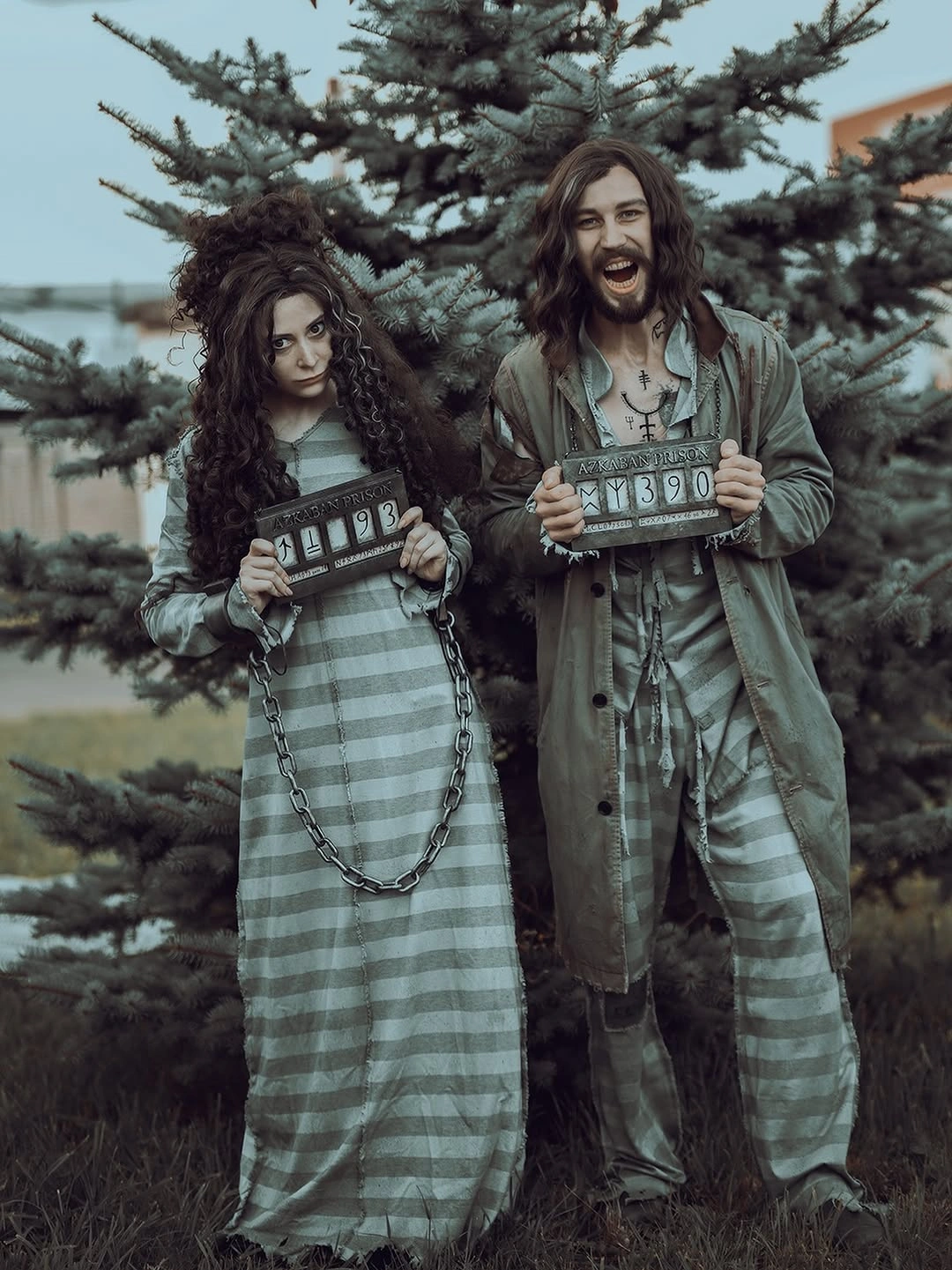
Gray-Green long dress beside relaxed trousers and layered outerwear built around coordinated monochrome duo with distressed styling
Costume frame 4 opens with Both outfits use horizontal gray-green stripes and a washed, monochrome palette. Costume frame 4 also shows The left figure has a long dress with dark hair and a raised prop; the right figure wears loose trousers and a layered jacket. Costume frame 4 color map: gray-green, charcoal, and faded neutral tones. Frame 4 costume silhouette: long dress beside relaxed trousers and layered outerwear. Frame 4 costume focal language: coordinated monochrome duo with distressed styling. Frame 4 costume detail: The matching stripes connect the pair even though one silhouette is dress-based and the other trouser-based. Frame 4 costume angle: A single stripe language gives the duo coherence while the different silhouettes keep it from looking like a uniform.
Costume frame 4 adaptation starts with The muted palette makes the pair feel intentionally weathered without requiring extra bright accessories. Costume frame 4 angle options: Matching a print without matching the full outfit; Costume frame 4 second reading: Using a muted palette for a darker costume. Costume frame 4 thesis: Repeat one print across two silhouettes, then let the accessories and proportions create the character contrast. Frame 4 costume practical note: preserve the muted palette makes the pair feel intentionally weathered without requiring extra bright accessories; compare matching a print without matching the full outfit with using a muted palette for a darker costume in this frame. Frame 4 costume emphasis: keep the muted palette makes the pair feel intentionally weathered without requiring extra bright accessories.
Costume frame 4 comparison: This duo relies on coordinated pattern and restrained color rather than bright character colors or elaborate makeup. Costume frame 4 evidence: Long hanging chains and rectangular handheld signs add a shared visual device. Costume frame 4 secondary detail: The props are held at similar height, creating a clean horizontal rhythm. Frame 4 costume finish: striped fabric, worn-looking layers, and chain-like trim. Frame 4 costume reading: a single stripe language gives the duo coherence while the different silhouettes keep it from looking like a uniform explains the image’s particular emphasis.
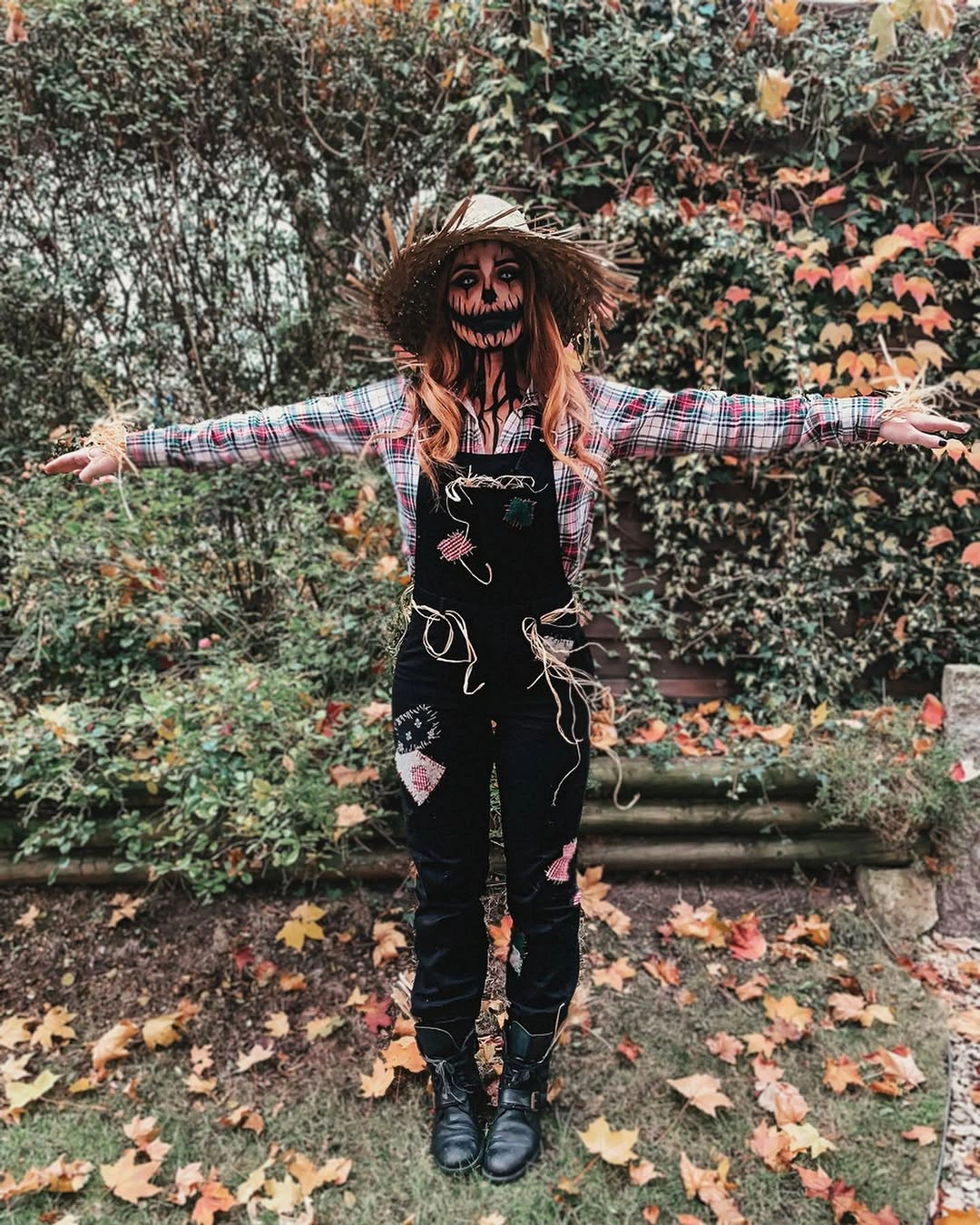
Black straight-legged overalls with a wide-brim hat and open-arm stance built around harvest scarecrow styling
Costume frame 5 opens with The plaid shirt supplies red, gray, and muted green lines beneath black overalls. Costume frame 5 also shows The overalls have visible decorative patches and dangling light-colored cords or straw-like details. Costume frame 5 color map: black, red, muted green. Frame 5 costume silhouette: straight-legged overalls with a wide-brim hat and open-arm stance. Frame 5 costume focal language: harvest scarecrow styling. Frame 5 costume detail: The hat creates a broad top silhouette while the overalls make a narrow vertical center. Frame 5 costume angle: The scarecrow effect comes from the relationship between plaid, dark overalls, straw-colored accessories, and graphic face detail.
Costume frame 5 adaptation starts with Bright patch shapes and cords break up the black base without adding a second dominant color. Costume frame 5 angle options: Building a costume from everyday separates; Costume frame 5 second reading: Using one headwear piece to change the silhouette. Costume frame 5 thesis: Start with familiar separates, then let a wide hat and a few harvest-colored details supply the costume signal. Frame 5 costume practical note: preserve bright patch shapes and cords break up the black base without adding a second dominant color; compare building a costume from everyday separates with using one headwear piece to change the silhouette in this frame. Frame 5 costume emphasis: keep bright patch shapes and cords break up the black base without adding a second dominant color.
Costume frame 5 comparison: This is a handmade harvest-inspired single costume built from separates, not a polished couple or glam makeup look. Costume frame 5 evidence: A wide straw hat and dark face treatment make the upper and lower halves read as one costume. Costume frame 5 secondary detail: The extended-arm pose shows how the costume moves beyond a basic shirt-and-jeans combination. Frame 5 costume finish: plaid, denim-like dark fabric, straw-like trim, and patchwork. Frame 5 costume reading: the scarecrow effect comes from the relationship between plaid, dark overalls, straw-colored accessories, and graphic face detail explains the image’s particular emphasis.
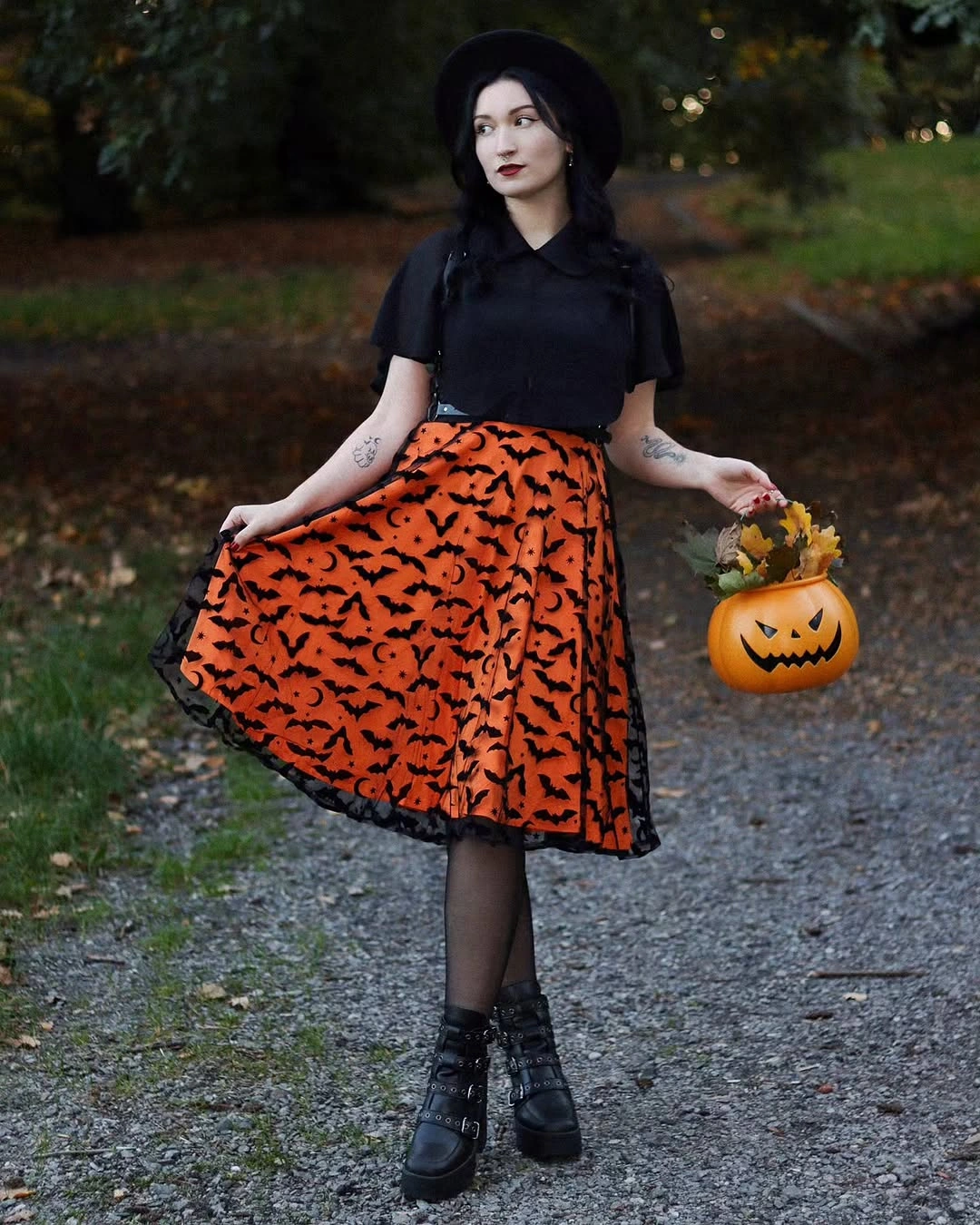
Black And Vivid Orange With Small Green-Brown Accessory Notes fitted top, full swing skirt, tights, and sturdy boots built around bats + pumpkin accent
Costume frame 6 opens with The skirt carries the strongest print and orange-black contrast. Costume frame 6 also shows A black top, tights, and boots create a clean dark frame around the patterned skirt. Costume frame 6 color map: black and vivid orange with small green-brown accessory notes. Frame 6 costume silhouette: fitted top, full swing skirt, tights, and sturdy boots. Frame 6 costume focal language: bats and pumpkin accent. Frame 6 costume detail: The repeated bat motif is readable across the full skirt without competing with the simple top. Frame 6 costume angle: The costume succeeds through one high-contrast printed skirt supported by a deliberately quiet black base.
Costume frame 6 adaptation starts with The skirt volume gives the outfit movement while the boots keep the lower half grounded. Costume frame 6 angle options: Using one printed anchor garment; Costume frame 6 second reading: Repeating the print color in a handheld accessory. Costume frame 6 thesis: Let one printed garment do the storytelling, then repeat its brightest color once so the costume feels finished. Frame 6 costume practical note: preserve the skirt volume gives the outfit movement while the boots keep the lower half grounded; compare using one printed anchor garment with repeating the print color in a handheld accessory in this frame. Frame 6 costume emphasis: keep the skirt volume gives the outfit movement while the boots keep the lower half grounded.
Costume frame 6 comparison: This costume is driven by a single graphic garment and clean color blocking rather than makeup or layered character pieces. Costume frame 6 evidence: A small orange pumpkin accessory repeats the skirt color near the hand. Costume frame 6 secondary detail: The pumpkin accessory connects the hand area to the central print. Frame 6 costume finish: printed skirt surface and opaque dark layers. Frame 6 costume reading: the costume succeeds through one high-contrast printed skirt supported by a deliberately quiet black base explains the image’s particular emphasis.
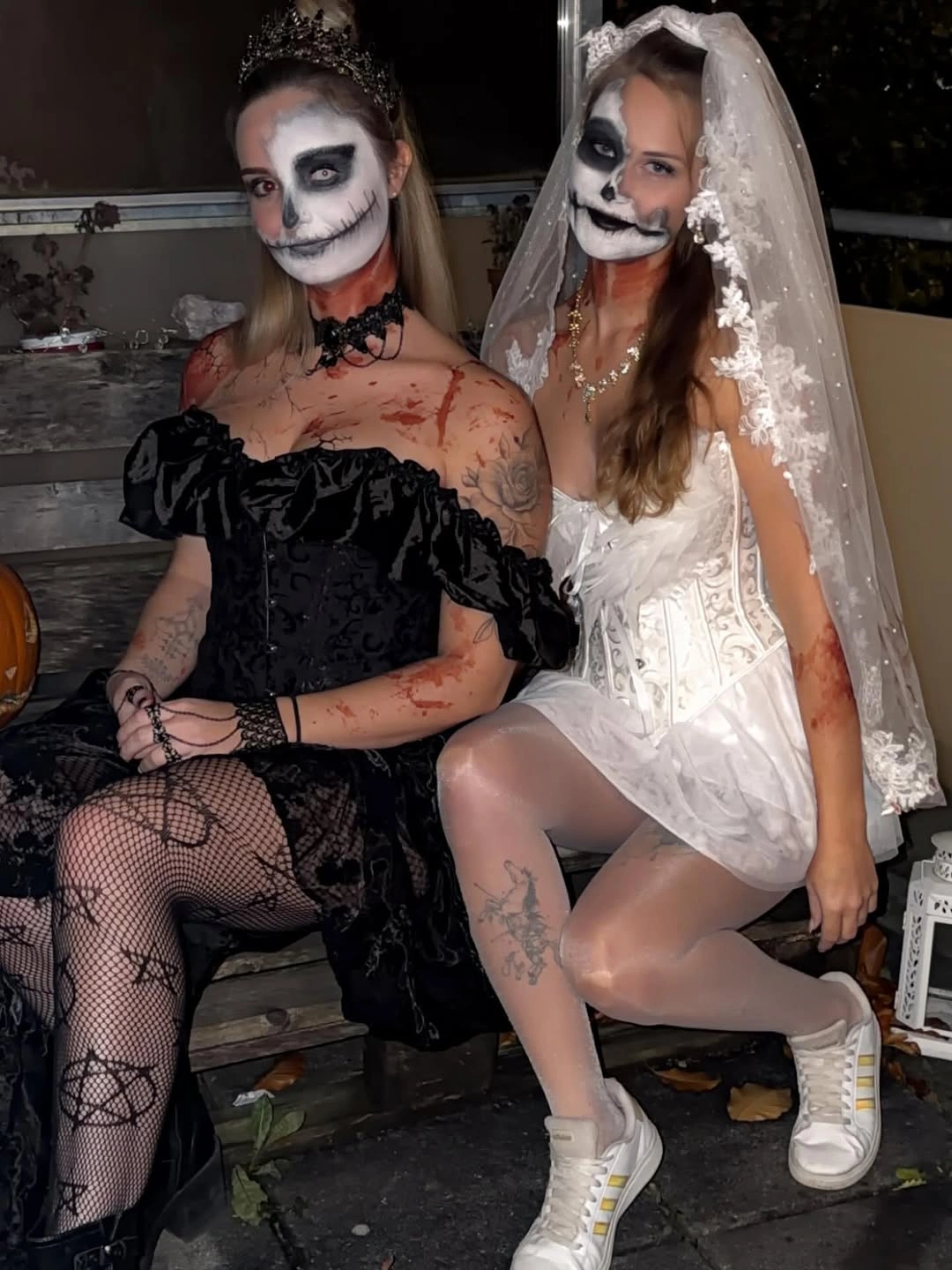
Black off-shoulder fitted black shape beside short light dress and veil built around contrasting dark-light pair with skeletal face graphics
Costume frame 7 opens with The pair is split into a black look and a white look, with matching high-contrast face makeup. Costume frame 7 also shows The left outfit includes a large black sleeve detail and patterned tights. Costume frame 7 color map: black, white, gray. Frame 7 costume silhouette: off-shoulder fitted black shape beside short light dress and veil. Frame 7 costume focal language: contrasting dark-light pair with skeletal face graphics. Frame 7 costume detail: The black-white division is immediately legible even in low light. Frame 7 costume angle: The pair feels connected because the faces match while the clothing divides into black and white.
Costume frame 7 adaptation starts with Different footwear choices keep the outfits from becoming costume-shop duplicates. Costume frame 7 angle options: Building a duo from opposite color stories; Costume frame 7 second reading: Using matching makeup instead of matching clothing. Costume frame 7 thesis: For a two-person costume, share one unmistakable detail and let the clothing split into opposite color stories. Frame 7 costume practical note: preserve different footwear choices keep the outfits from becoming costume-shop duplicates; compare building a duo from opposite color stories with using matching makeup instead of matching clothing in this frame. Frame 7 costume emphasis: keep different footwear choices keep the outfits from becoming costume-shop duplicates.
Costume frame 7 comparison: This is a black-and-white coordination strategy with shared makeup, unlike the color-saturated solo looks around it. Costume frame 7 evidence: The right outfit uses a light dress, veil, pale legwear, and casual white sneakers. Costume frame 7 secondary detail: The makeup repeats across both faces, providing the strongest shared element. Frame 7 costume finish: lace-like tights, smooth dress fabric, and layered veil. Frame 7 costume reading: the pair feels connected because the faces match while the clothing divides into black and white explains the image’s particular emphasis.
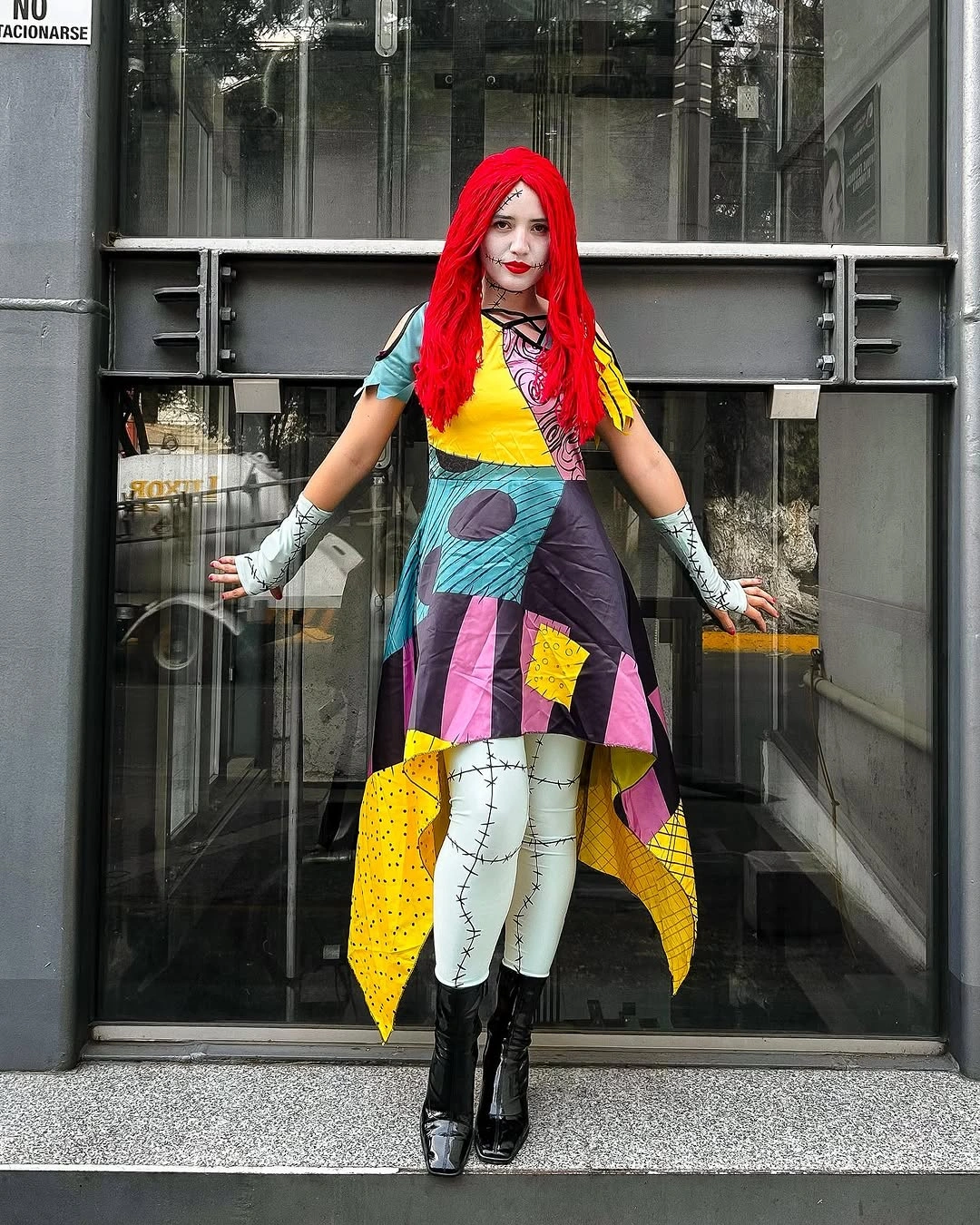
Yellow asymmetrical dress with layered or pointed hem over fitted tights built around patchwork doll-like geometry with stitch accents
Costume frame 8 opens with The dress uses multiple geometric and patch-like panels rather than one dominant print. Costume frame 8 also shows White tights show dark stitched or drawn motifs, and black boots visually anchor the hem. Costume frame 8 color map: yellow, lavender, teal. Frame 8 costume silhouette: asymmetrical dress with layered or pointed hem over fitted tights. Frame 8 costume focal language: patchwork doll-like geometry with stitch accents. Frame 8 costume detail: The irregular hem and color blocks keep the costume animated from shoulder to knee. Frame 8 costume angle: The patchwork dress is the anchor, while white tights and black boots provide the visual rests that keep it from becoming noise.
Costume frame 8 adaptation starts with The repeated white base of the tights gives the busy dress a visual pause. Costume frame 8 angle options: Making a costume from mixed color blocks; Costume frame 8 second reading: Using tights as a supporting canvas. Costume frame 8 thesis: When the main garment is busy, give it breathing room with one light base and one dark anchor. Frame 8 costume practical note: preserve the repeated white base of the tights gives the busy dress a visual pause; compare making a costume from mixed color blocks with using tights as a supporting canvas in this frame. Frame 8 costume emphasis: keep the repeated white base of the tights gives the busy dress a visual pause.
Costume frame 8 comparison: This look is graphic and playful, centered on patchwork geometry rather than dark gothic atmosphere. Costume frame 8 evidence: The red wig adds a saturated upper focal point that balances the bright skirt. Costume frame 8 secondary detail: A simple standing pose still reads strongly because the garment has built-in contrast. Frame 8 costume finish: graphic paneling, opaque tights, and smooth dark boots. Frame 8 costume reading: the patchwork dress is the anchor, while white tights and black boots provide the visual rests that keep it from becoming noise explains the image’s particular emphasis.
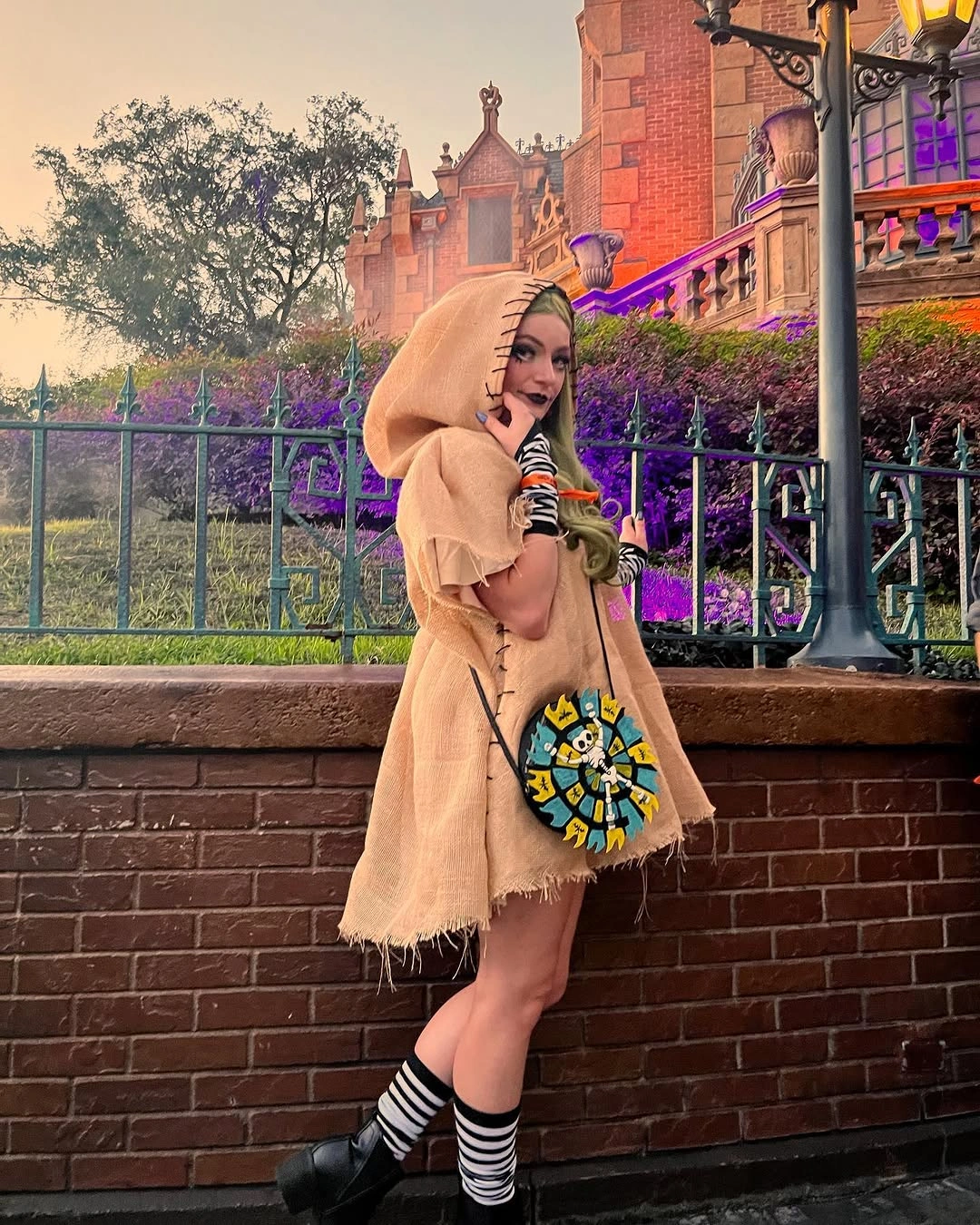
Tan short loose hooded layer with bare-leg gap and striped socks built around hooded fantasy-style shape with a circular emblem
Costume frame 9 opens with The tan hooded layer creates the largest silhouette and covers most of the torso. Costume frame 9 also shows A circular multicolor detail at the front acts as a focal point against the neutral base. Costume frame 9 color map: tan, cream, black. Frame 9 costume silhouette: short loose hooded layer with bare-leg gap and striped socks. Frame 9 costume focal language: hooded fantasy-style shape with a circular emblem. Frame 9 costume detail: The oversized hood frames the face and changes the proportion of the look. Frame 9 costume angle: The hood and fringe supply the shape, while the front circle and striped socks keep the neutral costume visually active.
Costume frame 9 adaptation starts with Frayed lower edges add movement and a handmade appearance without requiring many accessories. Costume frame 9 angle options: Using proportion instead of many accessories; Costume frame 9 second reading: Adding one emblem-like focal detail. Costume frame 9 thesis: Build a recognizable costume from one oversized shape, then add two small graphic anchors at the front and feet. Frame 9 costume practical note: preserve frayed lower edges add movement and a handmade appearance without requiring many accessories; compare using proportion instead of many accessories with adding one emblem-like focal detail in this frame. Frame 9 costume emphasis: keep frayed lower edges add movement and a handmade appearance without requiring many accessories.
Costume frame 9 comparison: This costume is silhouette-first and neutral-led, unlike the saturated patchwork and bright orange looks. Costume frame 9 evidence: Striped socks and black shoes add a graphic lower edge and keep the costume from reading as one solid block. Costume frame 9 secondary detail: The circular front detail and striped socks create two separate points of color. Frame 9 costume finish: rough-looking fringe and soft-looking solid fabric. Frame 9 costume reading: the hood and fringe supply the shape, while the front circle and striped socks keep the neutral costume visually active explains the image’s particular emphasis.
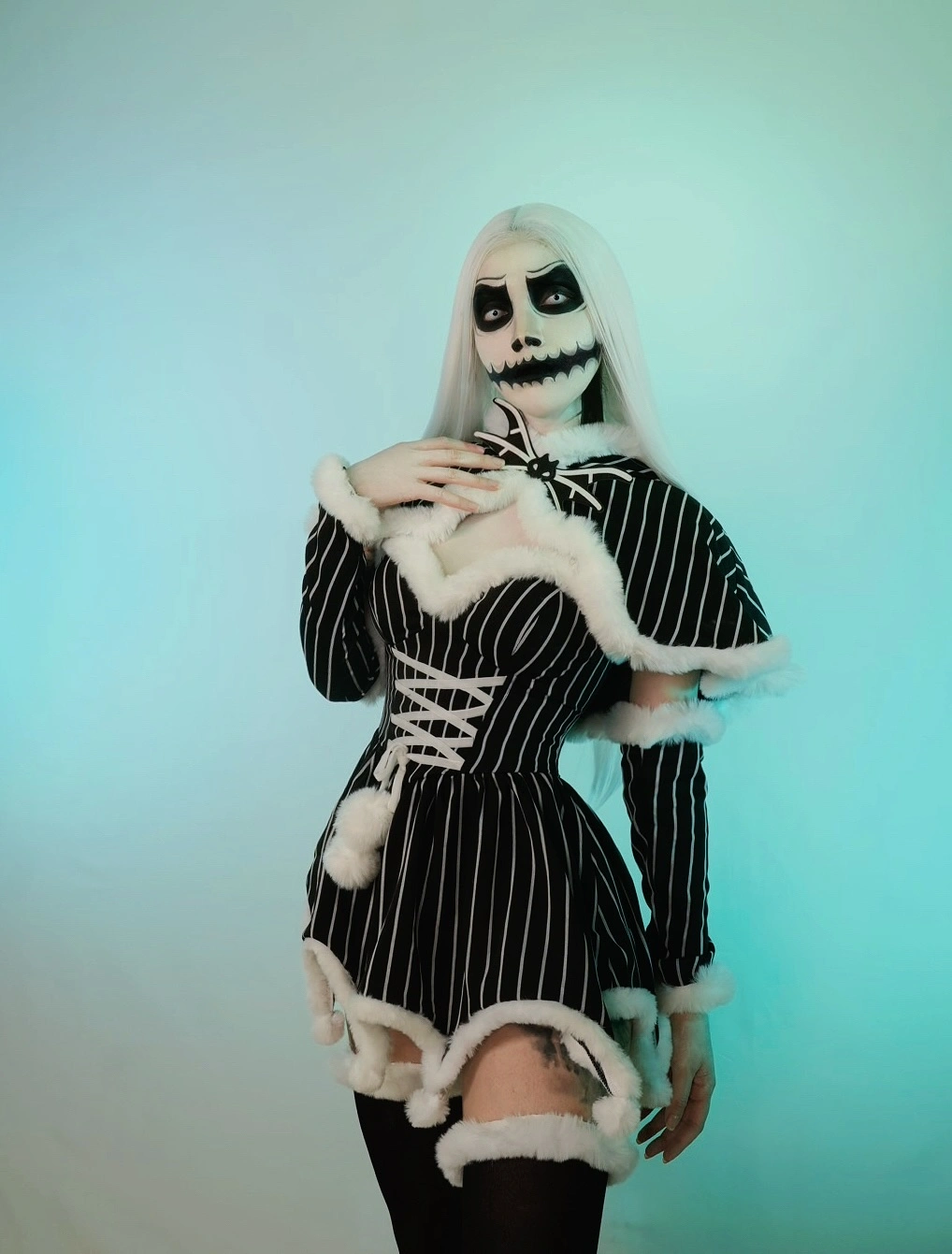
Black fitted short dress with defined waist, puffed trim, and dark hosiery built around graphic black-white costume with soft trim
Costume frame 10 opens with Vertical stripes run through the dress and visually lengthen the torso. Costume frame 10 also shows Pale trim outlines the neckline, sleeve edges, and lower hem, creating a repeated border. Costume frame 10 color map: black, white, pale cream. Frame 10 costume silhouette: fitted short dress with defined waist, puffed trim, and dark hosiery. Frame 10 costume focal language: graphic black-white costume with soft trim. Frame 10 costume detail: The trim softens a severe stripe pattern and adds a wintery contrast. Frame 10 costume angle: The outfit balances vertical stripes with pale trim and a defined waist so the costume reads graphic but not flat.
Costume frame 10 adaptation starts with The lacing interrupts the vertical lines at the waist, creating a clear center point. Costume frame 10 angle options: Mixing severe stripes with soft trim; Costume frame 10 second reading: Using waist detail to break a repeated print. Costume frame 10 thesis: Break a strong all-over stripe with a soft border and one waist interruption instead of adding more motifs. Frame 10 costume practical note: preserve the lacing interrupts the vertical lines at the waist, creating a clear center point; compare mixing severe stripes with soft trim with using waist detail to break a repeated print in this frame. Frame 10 costume emphasis: keep the lacing interrupts the vertical lines at the waist, creating a clear center point.
Costume frame 10 comparison: This is a polished monochrome garment study, unlike the casual plaid, patchwork, or outdoor harvest costumes. Costume frame 10 evidence: The fitted waist is emphasized by a corset-like lacing panel and the face makeup repeats the black-white palette. Costume frame 10 secondary detail: A bright turquoise background makes the monochrome outfit and pale hair stand out. Frame 10 costume finish: striped surface, fluffy-looking edging, and smooth dark layers. Frame 10 costume reading: the outfit balances vertical stripes with pale trim and a defined waist so the costume reads graphic but not flat explains the image’s particular emphasis.
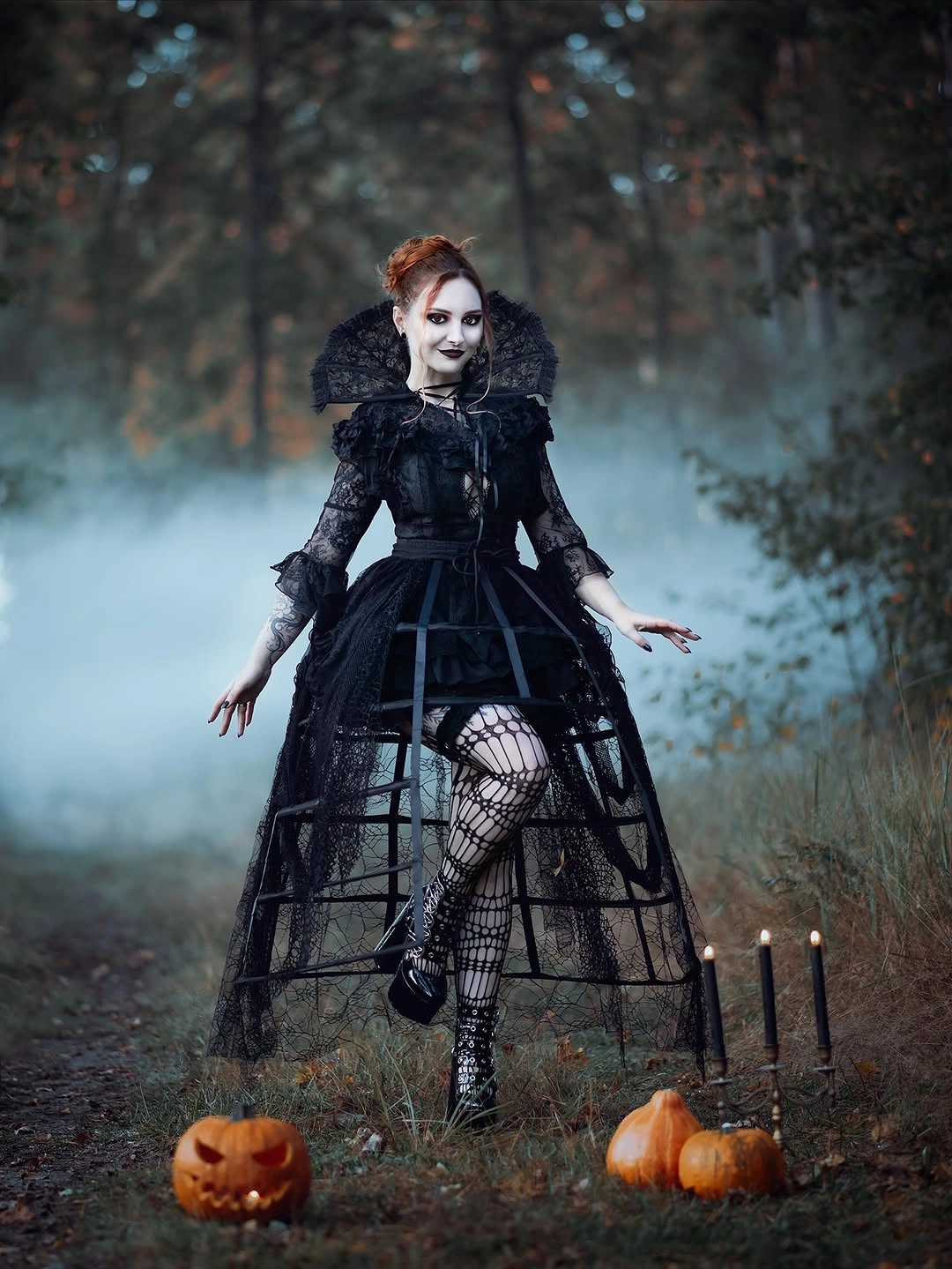
Black With Very Small Warm Red-Brown Background Notes defined bodice, layered skirt, high collar, and fitted leg line built around dark romantic period-inspired layering
Costume frame 11 opens with The high collar and shoulder volume frame the face and upper body. Costume frame 11 also shows A shorter inner hem is visible beneath a longer sheer or open overskirt. Costume frame 11 color map: black with very small warm red-brown background notes. Frame 11 costume silhouette: defined bodice, layered skirt, high collar, and fitted leg line. Frame 11 costume focal language: dark romantic period-inspired layering. Frame 11 costume detail: The layered skirt creates depth without introducing a new color. Frame 11 costume angle: The costume gains drama from layered black surfaces and a tall collar rather than from bright color or props.
Costume frame 11 adaptation starts with The ruffled collar is the strongest upper-body detail and gives the look a historical theatrical direction. Costume frame 11 angle options: Creating depth inside a single-color outfit; Costume frame 11 second reading: Using a collar as the focal point. Costume frame 11 thesis: For a dark costume, vary the layer lengths and surface transparency so one color still has a visible rhythm. Frame 11 costume practical note: preserve the ruffled collar is the strongest upper-body detail and gives the look a historical theatrical direction; compare creating depth inside a single-color outfit with using a collar as the focal point in this frame. Frame 11 costume emphasis: keep the ruffled collar is the strongest upper-body detail and gives the look a historical theatrical direction.
Costume frame 11 comparison: This section is built around monochrome texture and layer depth, not graphic prints or bright color blocking. Costume frame 11 evidence: Dark patterned tights and black footwear continue the vertical line from dress to ground. Costume frame 11 secondary detail: Small red-orange accents from the environment remain secondary to the all-black outfit. Frame 11 costume finish: lace-like sleeves, translucent-looking layers, and patterned tights. Frame 11 costume reading: the costume gains drama from layered black surfaces and a tall collar rather than from bright color or props explains the image’s particular emphasis.
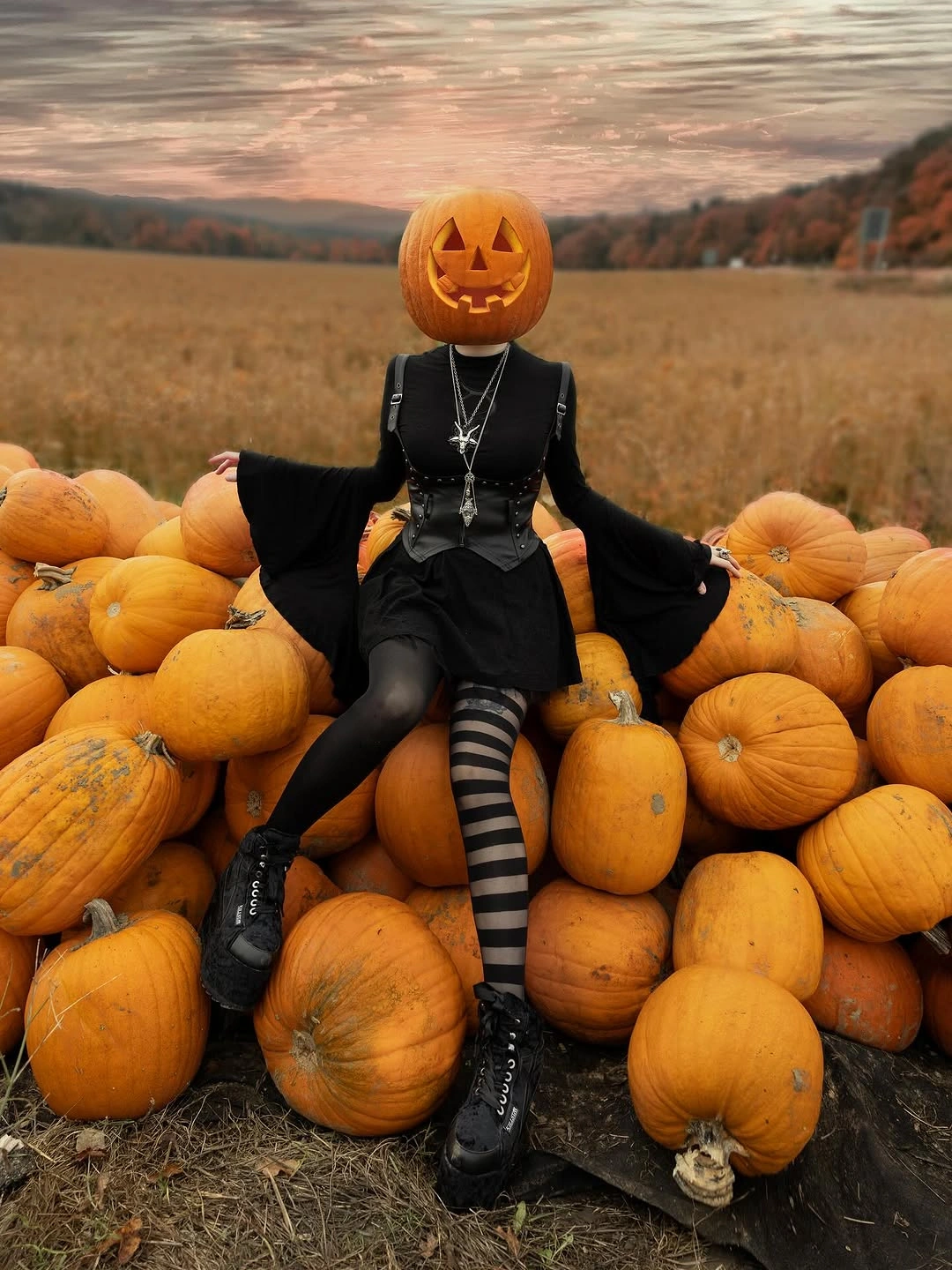
Black wide sleeves, short dark skirt, striped tights, and heavy boots built around pumpkin-headed monochrome costume
Costume frame 12 opens with The black outfit creates a strong base from torso through boots. Costume frame 12 also shows Wide sleeves and striped tights supply the most visible pattern and movement. Costume frame 12 color map: black, orange, gray. Frame 12 costume silhouette: wide sleeves, short dark skirt, striped tights, and heavy boots. Frame 12 costume focal language: pumpkin-headed monochrome costume. Frame 12 costume detail: The pumpkin head covering is the dominant upper focal point, while the striped tights provide the strongest lower contrast. Frame 12 costume angle: The look uses black as a practical base and distributes pumpkin orange at the head and surroundings for instant seasonal recognition.
Costume frame 12 adaptation starts with Flared sleeves widen the silhouette and make the seated pose readable. Costume frame 12 angle options: Using a strong headpiece with a simple base; Costume frame 12 second reading: Placing contrast at the legs. Costume frame 12 thesis: Let one oversized head detail state the theme, then keep the clothing dark and add one patterned zone for structure. Frame 12 costume practical note: preserve flared sleeves widen the silhouette and make the seated pose readable; compare using a strong headpiece with a simple base with placing contrast at the legs in this frame. Frame 12 costume emphasis: keep flared sleeves widen the silhouette and make the seated pose readable.
Costume frame 12 comparison: This costume is prop-led and autumnal, with the black base serving the oversized headpiece. Costume frame 12 evidence: Layered necklaces and the orange pumpkin head covering add small and large focal points at different heights. Costume frame 12 secondary detail: The orange pile beneath the figure repeats the head color, but the clothing remains black. Frame 12 costume finish: striped hosiery, layered jewelry, and matte-looking dark clothing. Frame 12 costume reading: the look uses black as a practical base and distributes pumpkin orange at the head and surroundings for instant seasonal recognition explains the image’s particular emphasis.
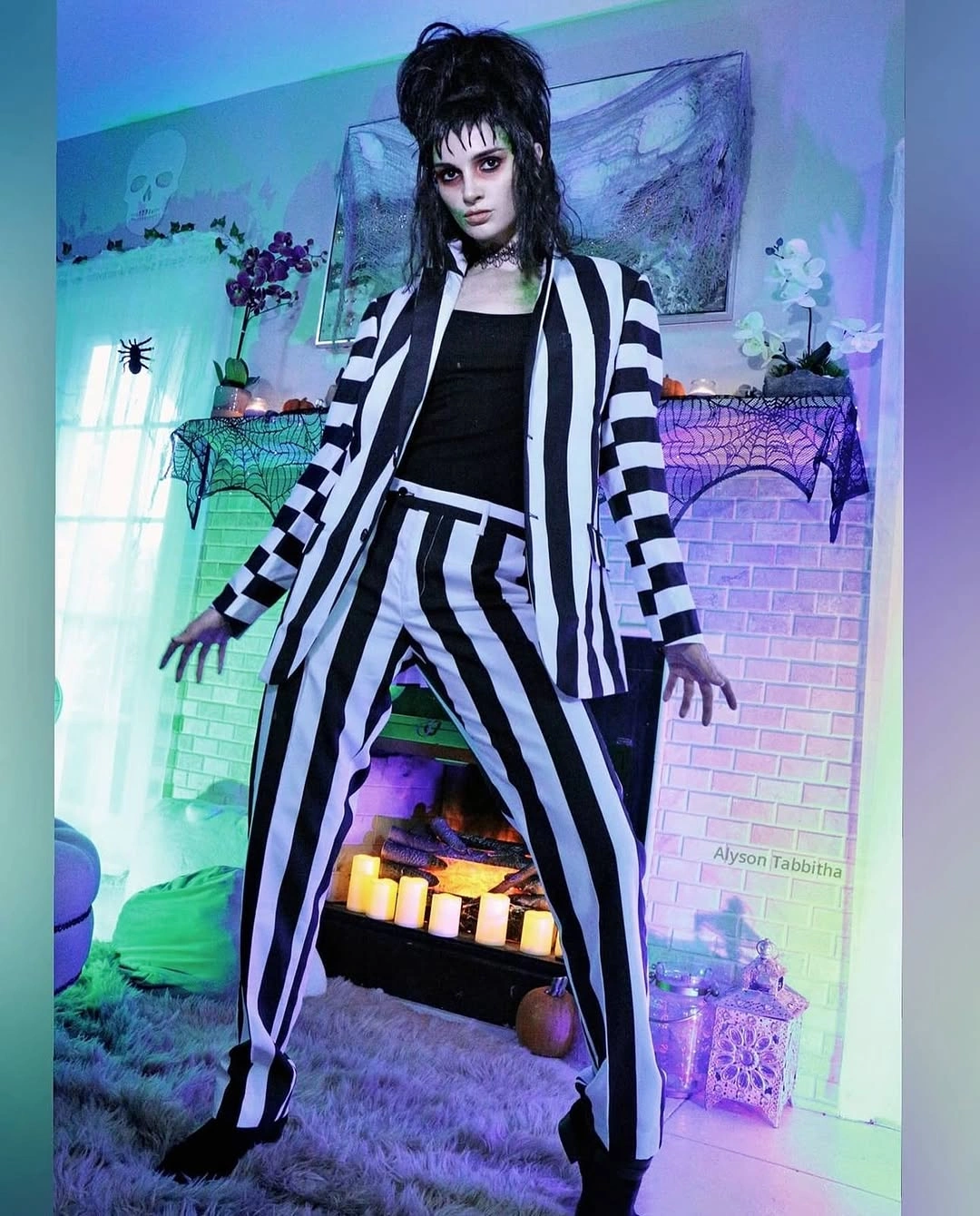
Black tailored blazer over wide-leg trousers with a long vertical line built around high-contrast directional stripes
Costume frame 13 opens with Vertical stripes run through the blazer while the trousers use broad horizontal or angled striping. Costume frame 13 also shows A plain black center layer separates the stripe patterns and gives the torso a calm anchor. Costume frame 13 color map: black, white, and small pale makeup accents. Frame 13 costume silhouette: tailored blazer over wide-leg trousers with a long vertical line. Frame 13 costume focal language: high-contrast directional stripes. Frame 13 costume detail: Mixing stripe directions creates a strong geometric effect without additional color. Frame 13 costume angle: The suit relies on directional stripes and a clean black center to create a graphic, elongated costume silhouette.
Costume frame 13 adaptation starts with The blazer and trousers establish a tall, tailored silhouette. Costume frame 13 angle options: Mixing stripe directions in a coordinated set; Costume frame 13 second reading: Using a plain center layer to control pattern density. Costume frame 13 thesis: A striped set becomes more interesting when the jacket and trousers change direction, while one plain layer keeps the middle readable. Frame 13 costume practical note: preserve the blazer and trousers establish a tall, tailored silhouette; compare mixing stripe directions in a coordinated set with using a plain center layer to control pattern density in this frame. Frame 13 costume emphasis: keep the blazer and trousers establish a tall, tailored silhouette.
Costume frame 13 comparison: This is a pattern-and-tailoring-led costume with no bright seasonal palette or large prop. Costume frame 13 evidence: The dark hair and makeup continue the black-white graphic theme. Costume frame 13 secondary detail: A dark center layer prevents the stripes from merging at the waist. Frame 13 costume finish: graphic striped fabric and smooth dark base layer. Frame 13 costume reading: the suit relies on directional stripes and a clean black center to create a graphic, elongated costume silhouette explains the image’s particular emphasis.
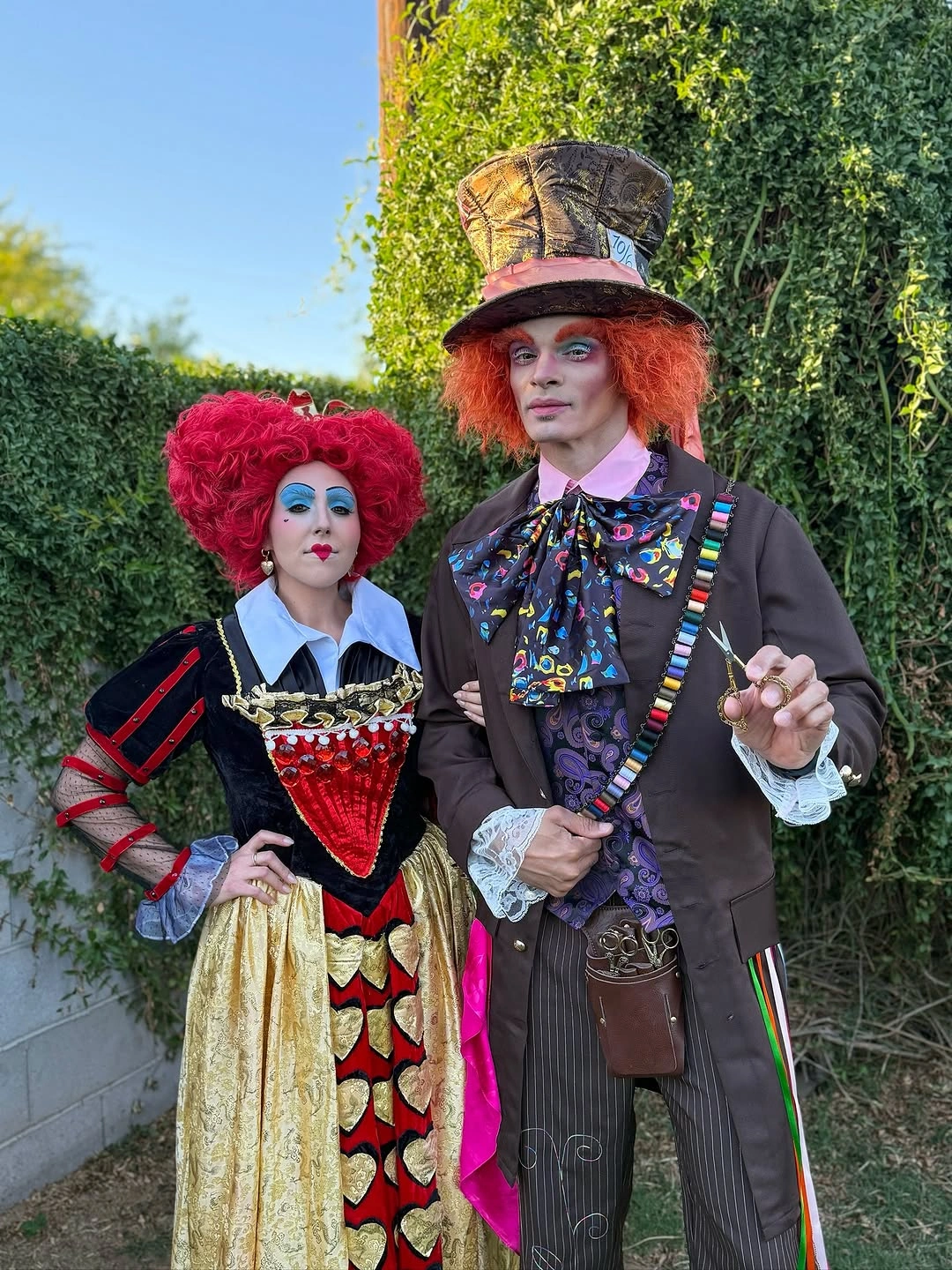
Red ornate short dress beside tall striped suit with top hat built around theatrical duo with exaggerated headwear + decorative color
Costume frame 14 opens with The shorter look centers red, gold, black, and pink in a decorative dress. Costume frame 14 also shows The taller look uses brown vertical striping, a tall hat, a large bow, and multicolor details at the chest. Costume frame 14 color map: red, gold, pink. Frame 14 costume silhouette: ornate short dress beside tall striped suit with top hat. Frame 14 costume focal language: theatrical duo with exaggerated headwear and decorative color. Frame 14 costume detail: The tall hat and oversized bow create a strong upper silhouette for the taller figure. Frame 14 costume angle: The pair is connected by theatrical proportions and elaborate accessories, not by matching colors.
Costume frame 14 adaptation starts with Gold and pink in the shorter outfit balance the brown and multicolor accents in the taller outfit. Costume frame 14 angle options: Coordinating through accessory scale; Costume frame 14 second reading: Pairing a decorative dress with a tailored suit. Costume frame 14 thesis: When costumes are elaborate, repeat the level of drama in the accessories so different palettes still feel like one pair. Frame 14 costume practical note: preserve gold and pink in the shorter outfit balance the brown and multicolor accents in the taller outfit; compare coordinating through accessory scale with pairing a decorative dress with a tailored suit in this frame. Frame 14 costume emphasis: keep gold and pink in the shorter outfit balance the brown and multicolor accents in the taller outfit.
Costume frame 14 comparison: This is an accessory-scale duo with tailored and ornate garments, not a print-repeat or monochrome pairing. Costume frame 14 evidence: The duo shares theatrical scale but not identical colors or garment shapes. Costume frame 14 secondary detail: Both looks use ornate accessories so the pair reads as a deliberate character duo. Frame 14 costume finish: velvet-like dark surfaces, patterned trim, and layered skirt fabric. Frame 14 costume reading: the pair is connected by theatrical proportions and elaborate accessories, not by matching colors explains the image’s particular emphasis.
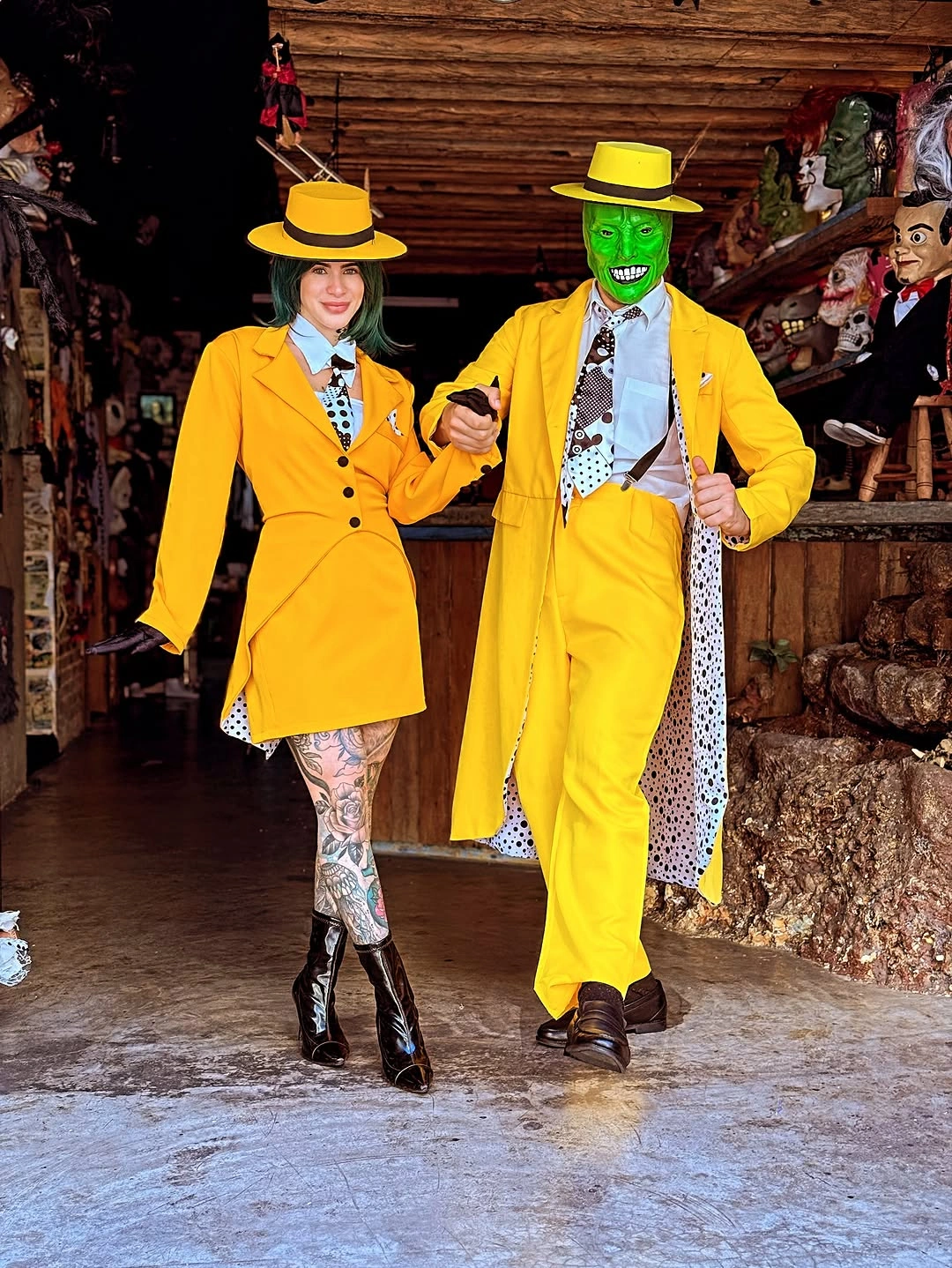
Vivid Yellow short tailored skirt suit beside longer trouser suit built around monochrome yellow couple with graphic contrast
Costume frame 15 opens with Both outfits repeat saturated yellow through the main garments and hats. Costume frame 15 also shows The woman uses a skirt-and-boot silhouette while the man uses trousers and a longer jacket. Costume frame 15 color map: vivid yellow, black, white. Frame 15 costume silhouette: short tailored skirt suit beside longer trouser suit. Frame 15 costume focal language: monochrome yellow couple with graphic contrast. Frame 15 costume detail: Matching color is the strongest connection, while skirt versus trouser proportions keep each outfit individual. Frame 15 costume angle: The yellow suits unify the duo immediately, while different lengths and the green accent keep the costumes from becoming identical.
Costume frame 15 adaptation starts with The hats make the shared color visible above the shoulders. Costume frame 15 angle options: Using one shared color for a couple; Costume frame 15 second reading: Changing skirt versus trouser proportions. Costume frame 15 thesis: Choose one unapologetic shared color, then vary the cut and use one contrasting detail to give each person a role. Frame 15 costume practical note: preserve the hats make the shared color visible above the shoulders; compare using one shared color for a couple with changing skirt versus trouser proportions in this frame. Frame 15 costume emphasis: keep the hats make the shared color visible above the shoulders.
Costume frame 15 comparison: This couple coordinates through a single saturated color, unlike the elaborate multicolor duo and dark single costumes. Costume frame 15 evidence: White-and-black patterned shirt sections and green face makeup add contrast inside the yellow pairing. Costume frame 15 secondary detail: The green face creates a single unexpected accent that shifts the pair toward theatrical costume. Frame 15 costume finish: tailored-looking suit surfaces and patterned shirt details. Frame 15 costume reading: the yellow suits unify the duo immediately, while different lengths and the green accent keep the costumes from becoming identical explains the image’s particular emphasis.
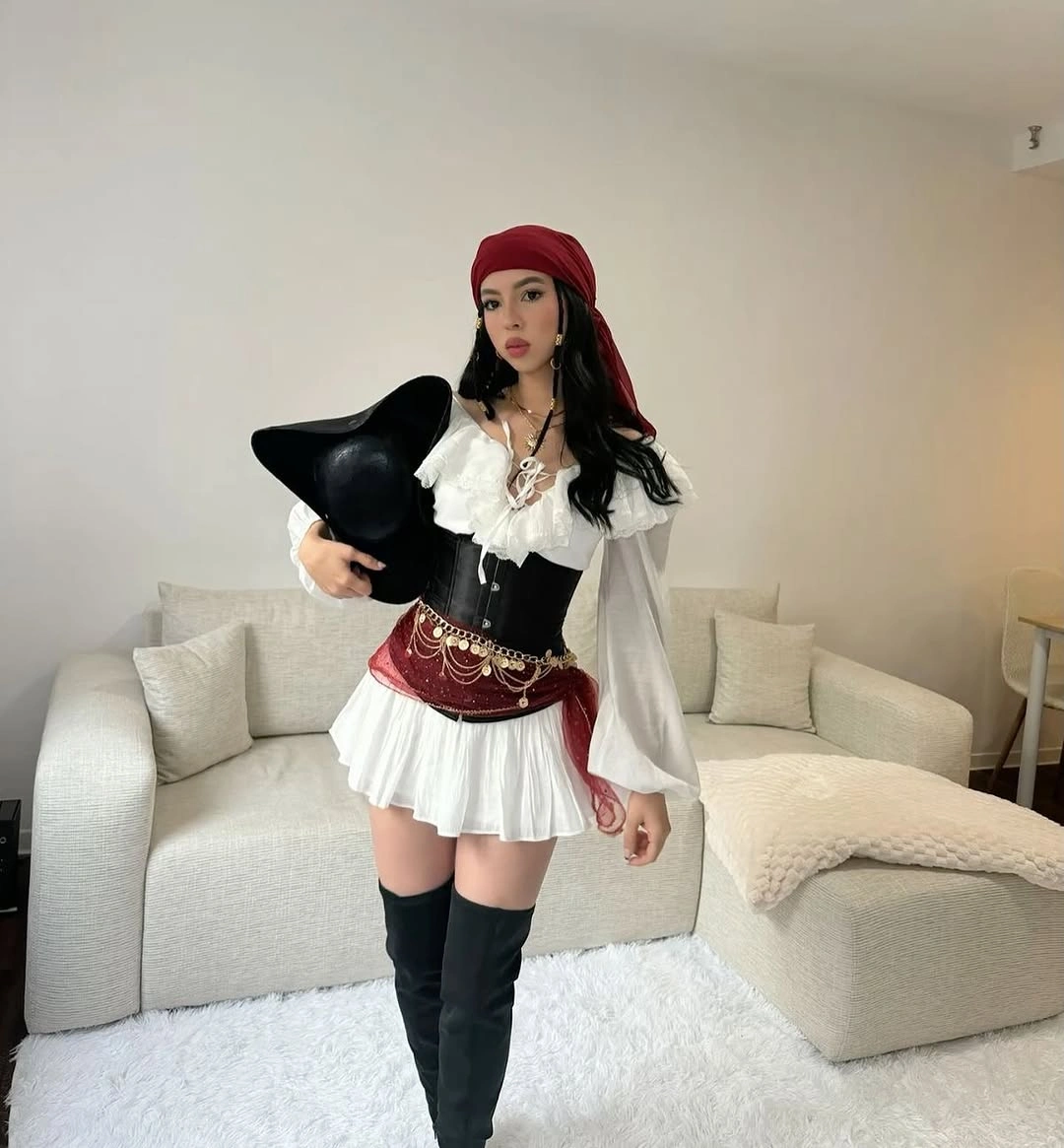
White short ruffled dress with cinched-looking waist and tall boots built around black-white costume with red head accent + witch hat
Costume frame 16 opens with White ruffles occupy the dress while the black waist and boots create a strong dark frame. Costume frame 16 also shows The red head covering supplies the only bright color and sits close to the face. Costume frame 16 color map: white, black, red. Frame 16 costume silhouette: short ruffled dress with cinched-looking waist and tall boots. Frame 16 costume focal language: black-white costume with red head accent and witch hat. Frame 16 costume detail: The black waist piece visually compresses the center between white dress volume and black boots. Frame 16 costume angle: The look is built from a crisp white-black contrast with a small red accent and an oversized hat cue.
Costume frame 16 adaptation starts with The red head accent creates a clear top focal point and repeats the warm tone of the makeup or lips. Costume frame 16 angle options: Using headwear as a second costume signal; Costume frame 16 second reading: Placing dark accessories above and below a light dress. Costume frame 16 thesis: Anchor a light dress with dark accessories at the waist and feet, then add one warm head accent for character. Frame 16 costume practical note: preserve the red head accent creates a clear top focal point and repeats the warm tone of the makeup or lips; compare using headwear as a second costume signal with placing dark accessories above and below a light dress in this frame. Frame 16 costume emphasis: keep the red head accent creates a clear top focal point and repeats the warm tone of the makeup or lips.
Costume frame 16 comparison: This is a crisp accessory-led black-white-red look, not a printed skirt, makeup portrait, or layered gothic dress. Costume frame 16 evidence: Holding the black hat adds a second costume cue without changing the main silhouette. Costume frame 16 secondary detail: The living-room setting is neutral, so the outfit’s color blocking carries the costume. Frame 16 costume finish: ruffled fabric, smooth dark boots, and structured waist detail. Frame 16 costume reading: the look is built from a crisp white-black contrast with a small red accent and an oversized hat cue explains the image’s particular emphasis.
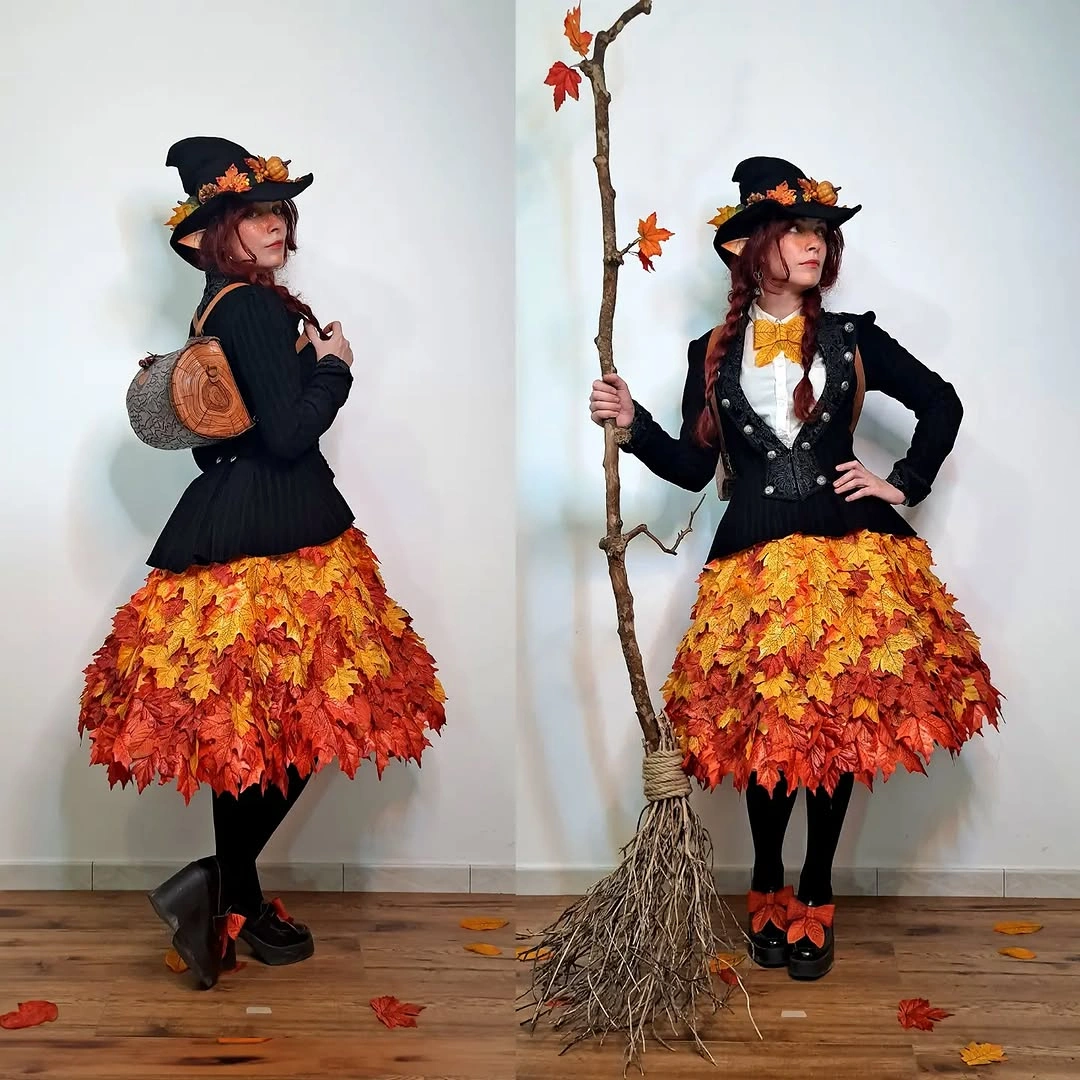
Orange fitted black tops over voluminous leaf-textured skirts built around autumn witch duo
Costume frame 17 opens with The skirt surfaces are dominated by orange, yellow, and red leaf-like shapes. Costume frame 17 also shows Black jackets, tights, and shoes make a repeated dark frame for both figures. Costume frame 17 color map: orange, yellow, red. Frame 17 costume silhouette: fitted black tops over voluminous leaf-textured skirts. Frame 17 costume focal language: autumn witch duo. Frame 17 costume detail: The two images show the same palette with different poses and accessory choices. Frame 17 costume angle: The duo is organized around the same leaf-like skirt volume, while the broom and backpack personalize each version.
Costume frame 17 adaptation starts with The broom functions as a long vertical prop that changes the right-hand silhouette. Costume frame 17 angle options: Using one shared textured anchor; Costume frame 17 second reading: Varying props within a matching pair. Costume frame 17 thesis: Match the anchor garment, then let each person choose a different practical prop so the pair stays coordinated but not cloned. Frame 17 costume practical note: preserve the broom functions as a long vertical prop that changes the right-hand silhouette; compare using one shared textured anchor with varying props within a matching pair in this frame. Frame 17 costume emphasis: keep the broom functions as a long vertical prop that changes the right-hand silhouette.
Costume frame 17 comparison: This duo is autumn-texture-led and uses repeated garments, unlike the contrasting black-white pair and yellow suits. Costume frame 17 evidence: The hats, broom, and backpack make the paired costumes feel like variations on one seasonal theme. Costume frame 17 secondary detail: The leaf-like skirt volume is the primary anchor and remains readable against the dark tops. Frame 17 costume finish: ruffled or layered leaf-like skirt surface and matte dark layers. Frame 17 costume reading: the duo is organized around the same leaf-like skirt volume, while the broom and backpack personalize each version explains the image’s particular emphasis.
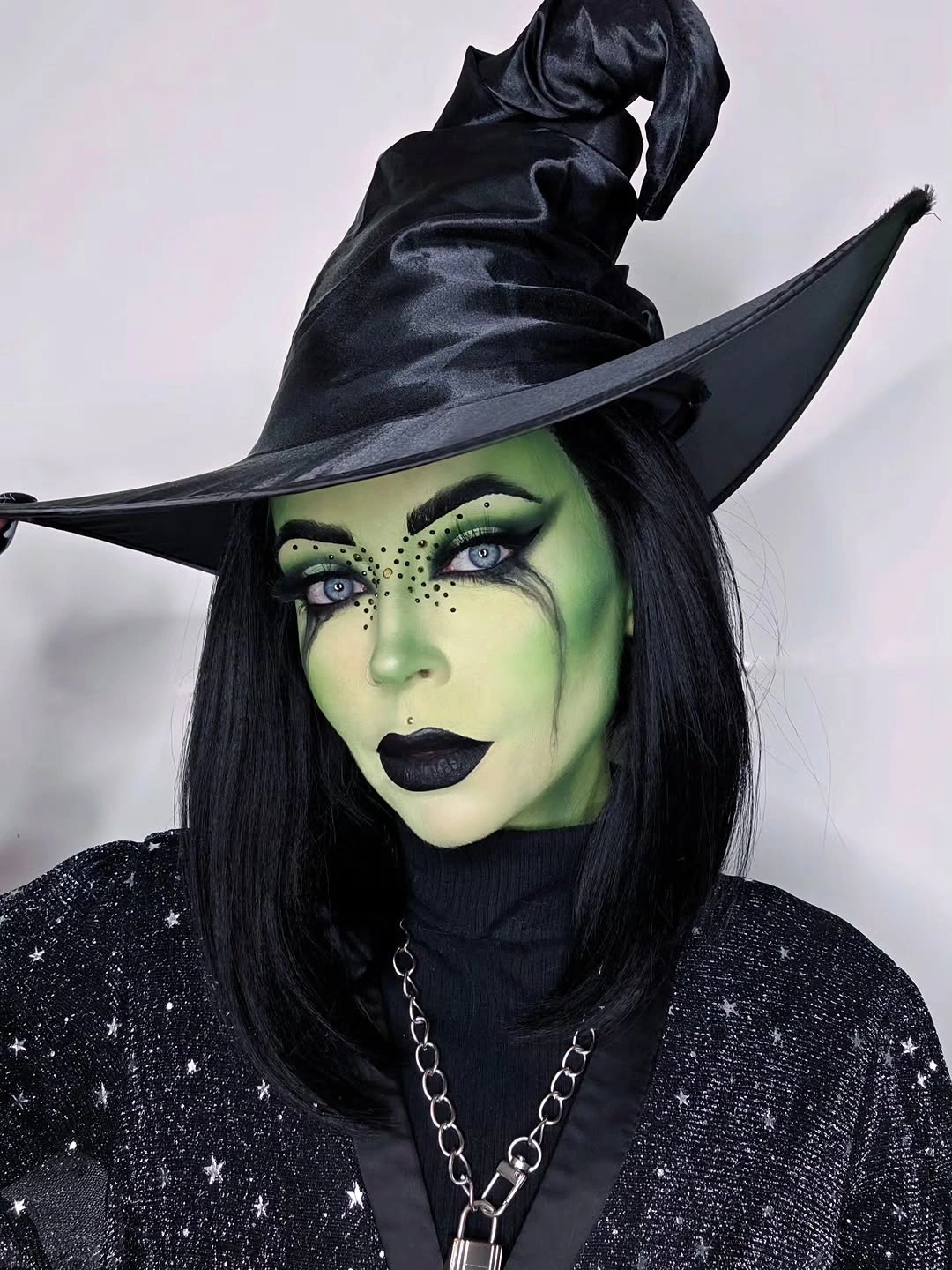
Black close-up head-and-shoulders shape with oversized pointed hat built around witch-inspired black + green graphic contrast
Costume frame 18 opens with The black hat creates a broad triangular silhouette above the head. Costume frame 18 also shows Green face makeup occupies the central focal area and is framed by black hair and dark lips. Costume frame 18 color map: black, green, silver-gray. Frame 18 costume silhouette: close-up head-and-shoulders shape with oversized pointed hat. Frame 18 costume focal language: witch-inspired black and green graphic contrast. Frame 18 costume detail: The hat and green face do most of the costume work, so the clothing remains intentionally quiet. Frame 18 costume angle: The outfit is intentionally minimal because the black hat and green face create the full graphic identity.
Costume frame 18 adaptation starts with The pointed hat changes the proportions of a close portrait and gives the look a strong vertical peak. Costume frame 18 angle options: Making headwear the main silhouette change; Costume frame 18 second reading: Using one saturated makeup color. Costume frame 18 thesis: If the headwear is oversized and the makeup is bold, keep the clothing dark and textured rather than adding another statement. Frame 18 costume practical note: preserve the pointed hat changes the proportions of a close portrait and gives the look a strong vertical peak; compare making headwear the main silhouette change with using one saturated makeup color in this frame. Frame 18 costume emphasis: keep the pointed hat changes the proportions of a close portrait and gives the look a strong vertical peak.
Costume frame 18 comparison: This is a close-up headpiece-led costume, unlike the full-body garment systems with printed skirts or tailored suits. Costume frame 18 evidence: The top has small reflective specks and the chain necklace adds a metallic line at the chest. Costume frame 18 secondary detail: The chain adds structure without introducing another bright color. Frame 18 costume finish: sparkled dark top, smooth hair, and metallic-looking chain. Frame 18 costume reading: the outfit is intentionally minimal because the black hat and green face create the full graphic identity explains the image’s particular emphasis.
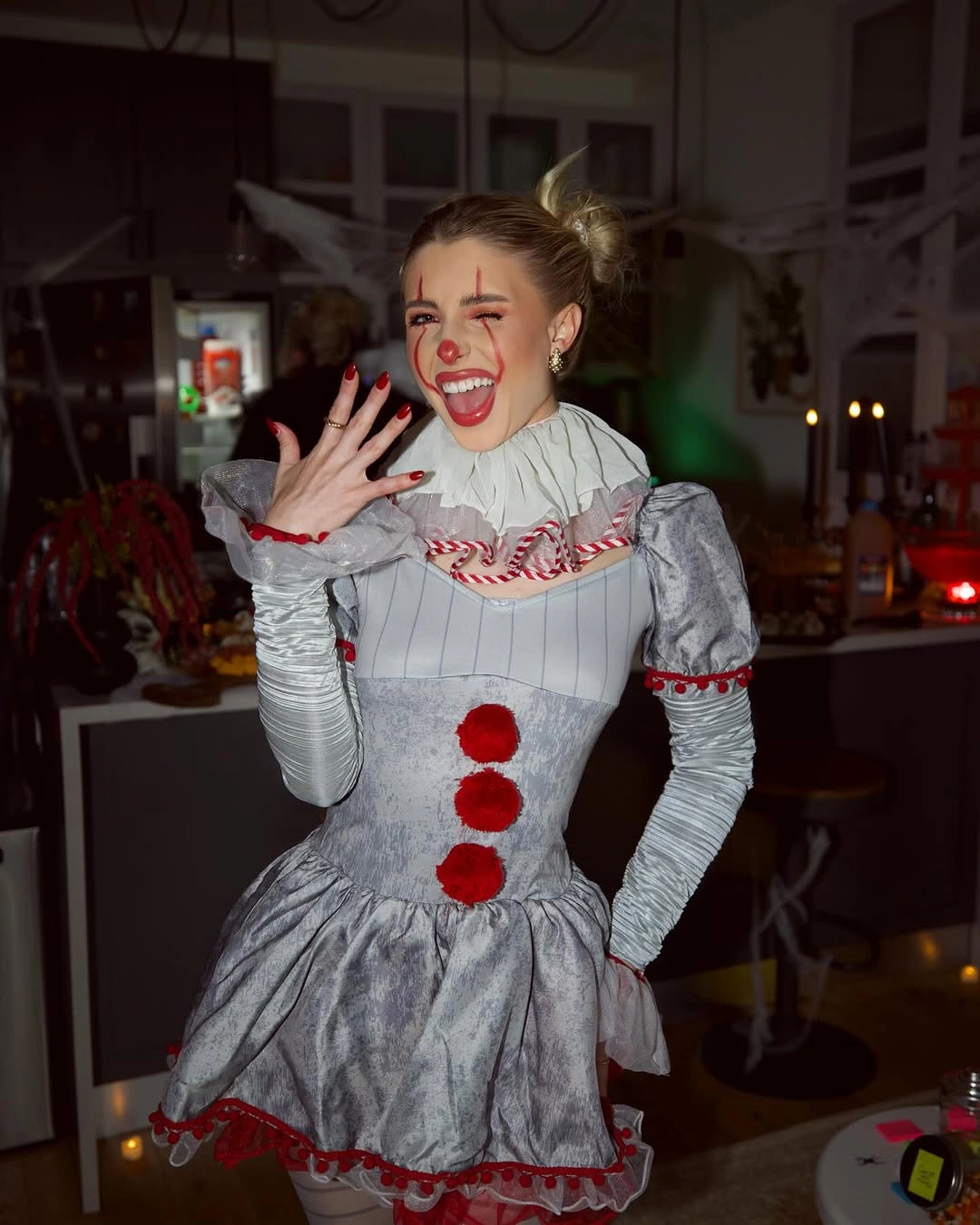
Pale Gray puffed sleeves, fitted bodice, gathered short skirt, and high collar built around circus-like pale costume with red graphic accents
Costume frame 19 opens with The dress uses a pale gray base with a white collar and red accents placed along the center and hem. Costume frame 19 also shows Puffed sleeves and a gathered skirt create a rounded silhouette. Costume frame 19 color map: pale gray, white, red. Frame 19 costume silhouette: puffed sleeves, fitted bodice, gathered short skirt, and high collar. Frame 19 costume focal language: circus-like pale costume with red graphic accents. Frame 19 costume detail: The red vertical accent line organizes the bodice and draws the eye through the center. Frame 19 costume angle: The pale gray base is made memorable by repeated red trim and an exaggerated collar-and-sleeve shape.
Costume frame 19 adaptation starts with The collar and sleeve volume make the costume read as theatrical even without visible props. Costume frame 19 angle options: Using a red accent line on a pale base; Costume frame 19 second reading: Building costume character through collar and sleeve volume. Costume frame 19 thesis: Give a light costume one strong accent line and repeat it at the hem so the shape reads clearly in dim light. Frame 19 costume practical note: preserve the collar and sleeve volume make the costume read as theatrical even without visible props; compare using a red accent line on a pale base with building costume character through collar and sleeve volume in this frame. Frame 19 costume emphasis: keep the collar and sleeve volume make the costume read as theatrical even without visible props.
Costume frame 19 comparison: This look is pale and ruffle-led with a red accent line, distinct from the nearby black cape and gray tutu costumes. Costume frame 19 evidence: The red details punctuate the otherwise pale outfit and connect to the dramatic face makeup. Costume frame 19 secondary detail: The low-light background lets the pale gray dress and white trim remain visible. Frame 19 costume finish: ruffled trim, gathered fabric, and smooth-looking pale surfaces. Frame 19 costume reading: the pale gray base is made memorable by repeated red trim and an exaggerated collar-and-sleeve shape explains the image’s particular emphasis.
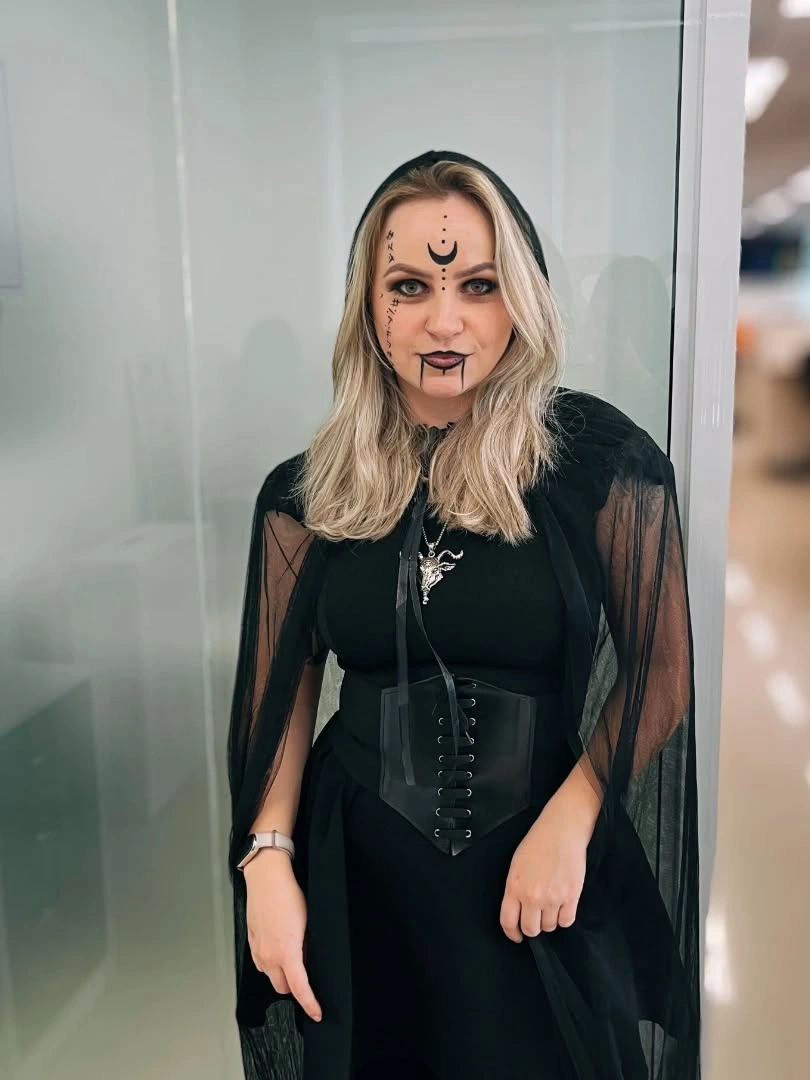
Black fitted black center with flowing cape-like arm panels built around dark celestial costume with crescent accent
Costume frame 20 opens with The main body of the dress is black and fitted through the torso. Costume frame 20 also shows The outer sleeves or panels create a wider, softer shape around the arms. Costume frame 20 color map: black, charcoal, pale silver. Frame 20 costume silhouette: fitted black center with flowing cape-like arm panels. Frame 20 costume focal language: dark celestial costume with crescent accent. Frame 20 costume detail: The sheer-looking panels move away from the body and create a wing-like outline. Frame 20 costume angle: The costume balances a corset-like center with drifting cape panels and one crescent detail.
Costume frame 20 adaptation starts with The laced waist gives the center a structured focal point beneath the loose sleeves. Costume frame 20 angle options: Using sleeve volume to change a simple dress; Costume frame 20 second reading: Adding one small celestial motif. Costume frame 20 thesis: Pair one structured waist point with loose arm layers so an all-black costume has both control and movement. Frame 20 costume practical note: preserve the laced waist gives the center a structured focal point beneath the loose sleeves; compare using sleeve volume to change a simple dress with adding one small celestial motif in this frame. Frame 20 costume emphasis: keep the laced waist gives the center a structured focal point beneath the loose sleeves.
Costume frame 20 comparison: This costume uses black layering and celestial detail, not pale ruffles, bright prints, or a large headpiece. Costume frame 20 evidence: A dark waist piece and pale crescent detail supply contrast inside the black base. Costume frame 20 secondary detail: A small crescent motif provides a clear detail without adding color. Frame 20 costume finish: translucent-looking sleeves, matte dark body, and structured waist detail. Frame 20 costume reading: the costume balances a corset-like center with drifting cape panels and one crescent detail explains the image’s particular emphasis.
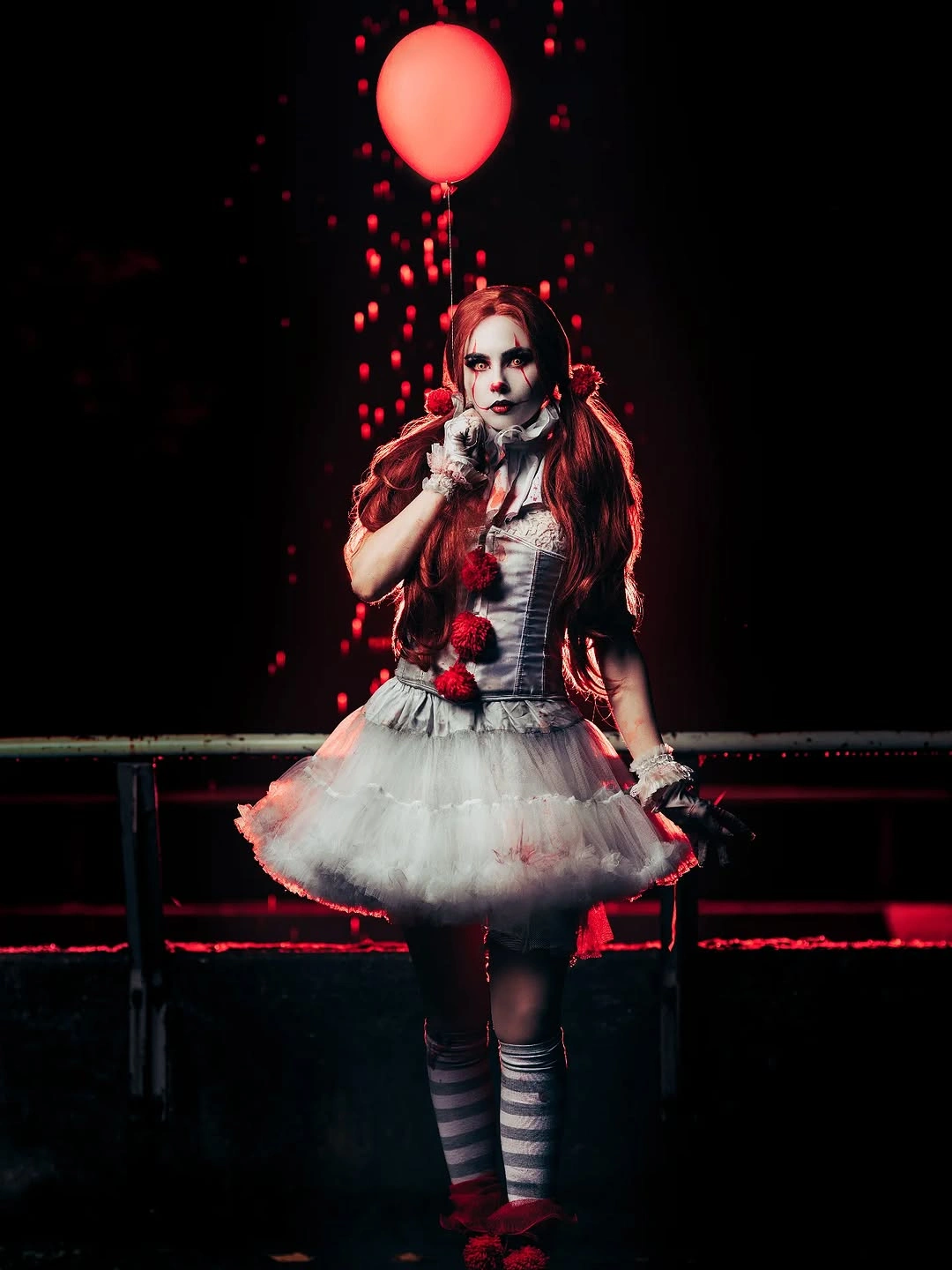
White fitted top, short rounded skirt, striped knee socks, and red hair built around doll or circus-style red-white contrast
Costume frame 21 opens with The top and skirt use a pale gray-white base with repeated red accents. Costume frame 21 also shows The short layered skirt creates a rounded, lightweight silhouette above striped socks. Costume frame 21 color map: white, gray, red. Frame 21 costume silhouette: fitted top, short rounded skirt, striped knee socks, and red hair. Frame 21 costume focal language: doll or circus-style red-white contrast. Frame 21 costume detail: The striped socks ground the airy skirt with a strong horizontal pattern. Frame 21 costume angle: The costume is held together by red repetition and a clear top-skirt-sock rhythm.
Costume frame 21 adaptation starts with The red accents appear at the hair, bodice, and lower styling, making the costume read across the full body. Costume frame 21 angle options: Repeating one accent color through the whole look; Costume frame 21 second reading: Using socks to control a short skirt silhouette. Costume frame 21 thesis: Repeat one bright accent at three heights, then use a pale skirt and patterned socks to keep the silhouette readable. Frame 21 costume practical note: preserve the red accents appear at the hair, bodice, and lower styling, making the costume read across the full body; compare repeating one accent color through the whole look with using socks to control a short skirt silhouette in this frame. Frame 21 costume emphasis: keep the red accents appear at the hair, bodice, and lower styling, making the costume read across the full body.
Costume frame 21 comparison: This look is airy and stage-like, distinct from the silver-gray ruffled dress and black cape-led outfits. Costume frame 21 evidence: Red hair and a red balloon-like prop or overhead accent continue the color story. Costume frame 21 secondary detail: The stage-like darkness makes the white skirt a bright central shape. Frame 21 costume finish: layered tulle-like skirt, smooth bodice, and striped hosiery. Frame 21 costume reading: the costume is held together by red repetition and a clear top-skirt-sock rhythm explains the image’s particular emphasis.
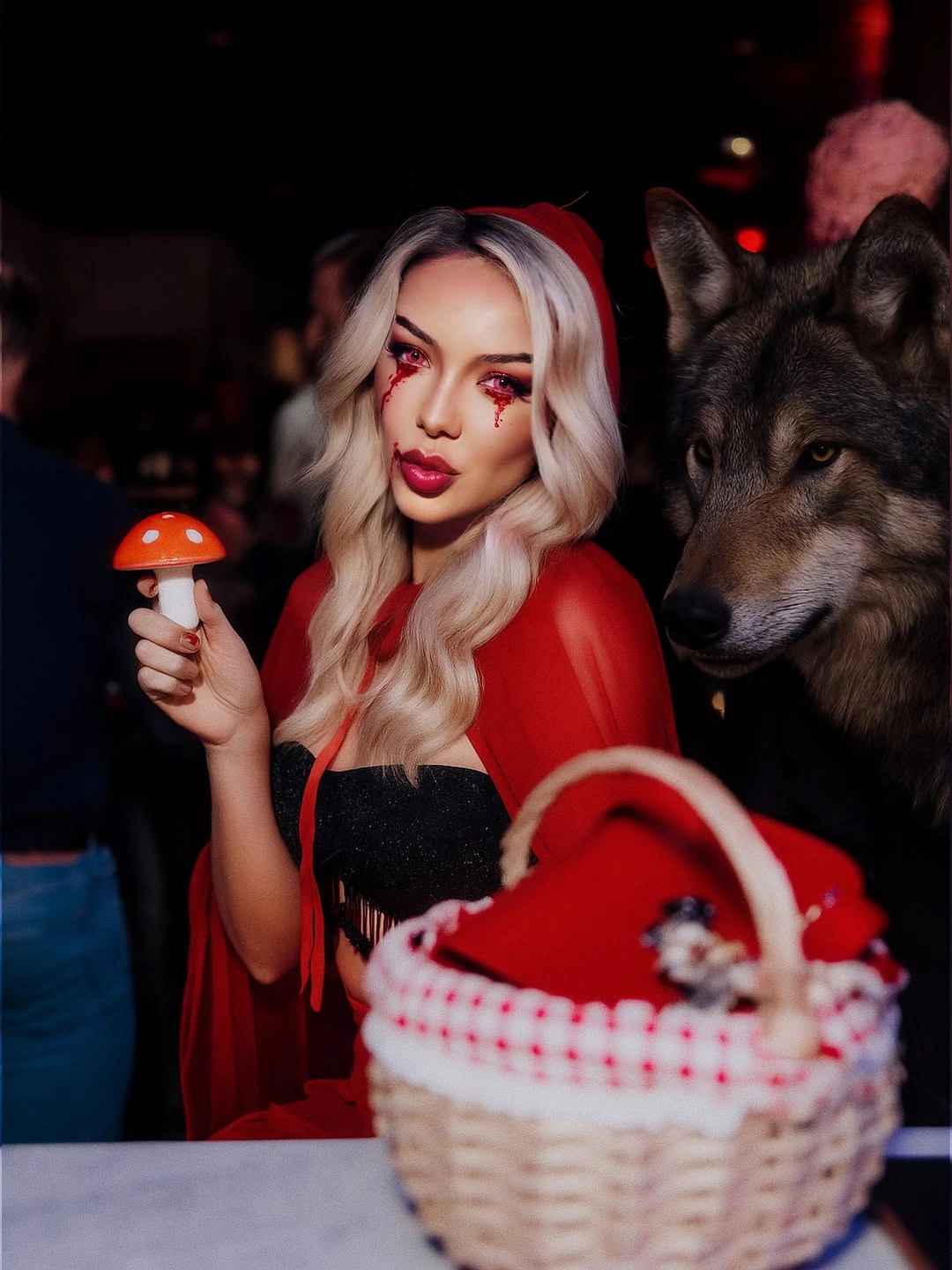
Red red cape around fitted black center with soft hair framing the face built around storybook red-black contrast with woodland prop
Costume frame 22 opens with The red outer layer frames the shoulders and creates the strongest color block. Costume frame 22 also shows A black fitted center provides contrast beneath the red fabric. Costume frame 22 color map: red, black, pale cream. Frame 22 costume silhouette: red cape around fitted black center with soft hair framing the face. Frame 22 costume focal language: storybook red-black contrast with woodland prop. Frame 22 costume detail: The red cape forms a recognizable frame around the black bodice. Frame 22 costume angle: The red cape and black center create a simple, readable costume frame, with the small prop reinforcing the color story.
Costume frame 22 adaptation starts with The mushroom prop repeats red and white near the hand, creating a small focal point. Costume frame 22 angle options: Framing a dark outfit with a bright cape; Costume frame 22 second reading: Repeating one prop color near the face or hands. Costume frame 22 thesis: Use a bright outer layer to frame a dark base, then repeat its color in one hand-held detail. Frame 22 costume practical note: preserve the mushroom prop repeats red and white near the hand, creating a small focal point; compare framing a dark outfit with a bright cape with repeating one prop color near the face or hands in this frame. Frame 22 costume emphasis: keep the mushroom prop repeats red and white near the hand, creating a small focal point.
Costume frame 22 comparison: This costume is outer-layer-led and storybook-toned, rather than print-based, tailored, or makeup-first. Costume frame 22 evidence: The pale hair, dark wolf-like background figure, and red-white prop expand the story without changing the outfit’s core palette. Costume frame 22 secondary detail: The background creature is large but remains separate from the wearer’s layered clothing. Frame 22 costume finish: flowing cape-like fabric, structured dark top, and smooth hair. Frame 22 costume reading: the red cape and black center create a simple, readable costume frame, with the small prop reinforcing the color story explains the image’s particular emphasis.
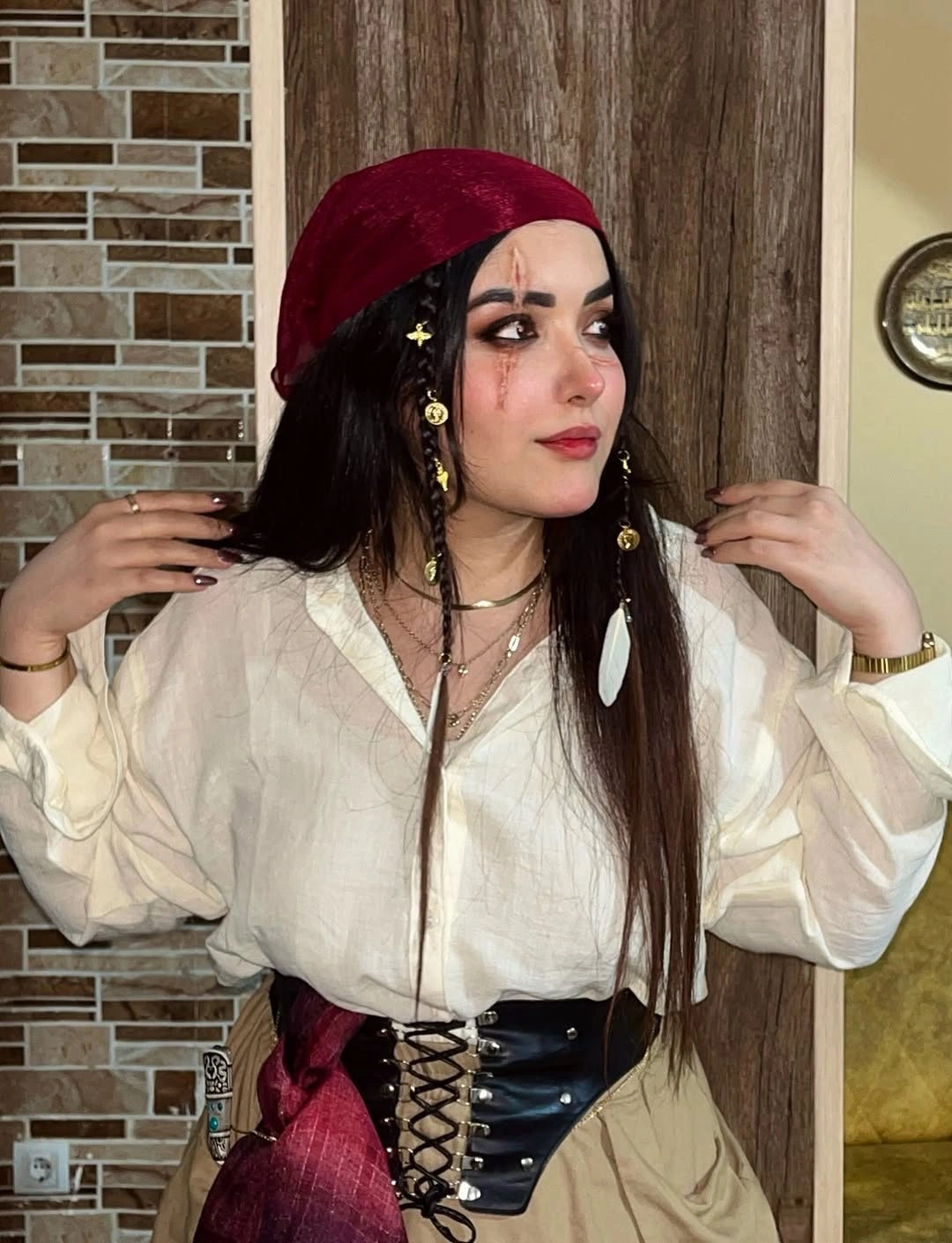
White voluminous blouse cinched by a dark waist piece with long hair framing the body built around pirate or folk-inspired styling without a named character
Costume frame 23 opens with The white blouse is gathered at the shoulders and sleeves, creating volume around a fitted-looking black waist. Costume frame 23 also shows Burgundy appears at the head and lower side accent, adding warmth to the white-black base. Costume frame 23 color map: white, black, burgundy. Frame 23 costume silhouette: voluminous blouse cinched by a dark waist piece with long hair framing the body. Frame 23 costume focal language: pirate or folk-inspired styling without a named character. Frame 23 costume detail: The black waist piece divides the loose blouse and creates a clear center line. Frame 23 costume angle: The look is made distinctive by the relationship between a full white blouse, black waist, and burgundy head accent.
Costume frame 23 adaptation starts with Burgundy headwear and side fabric connect the top and lower half with one accent color. Costume frame 23 angle options: Using a waist contrast to shape a loose blouse; Costume frame 23 second reading: Repeating one burgundy accent. Costume frame 23 thesis: Give a loose blouse a strong center line, then repeat one warm accent near the head and hip. Frame 23 costume practical note: preserve burgundy headwear and side fabric connect the top and lower half with one accent color; compare using a waist contrast to shape a loose blouse with repeating one burgundy accent in this frame. Frame 23 costume emphasis: keep burgundy headwear and side fabric connect the top and lower half with one accent color.
Costume frame 23 comparison: This look is soft, closet-based, and detail-led, unlike the high-contrast graphic dresses and large props. Costume frame 23 evidence: Long hair, small braids, earrings, and necklaces add detail around the face and neckline. Costume frame 23 secondary detail: The jewelry and braids supply narrative texture without a busy printed garment. Frame 23 costume finish: billowy woven-looking blouse, smooth dark waist layer, and layered jewelry. Frame 23 costume reading: the look is made distinctive by the relationship between a full white blouse, black waist, and burgundy head accent explains the image’s particular emphasis.
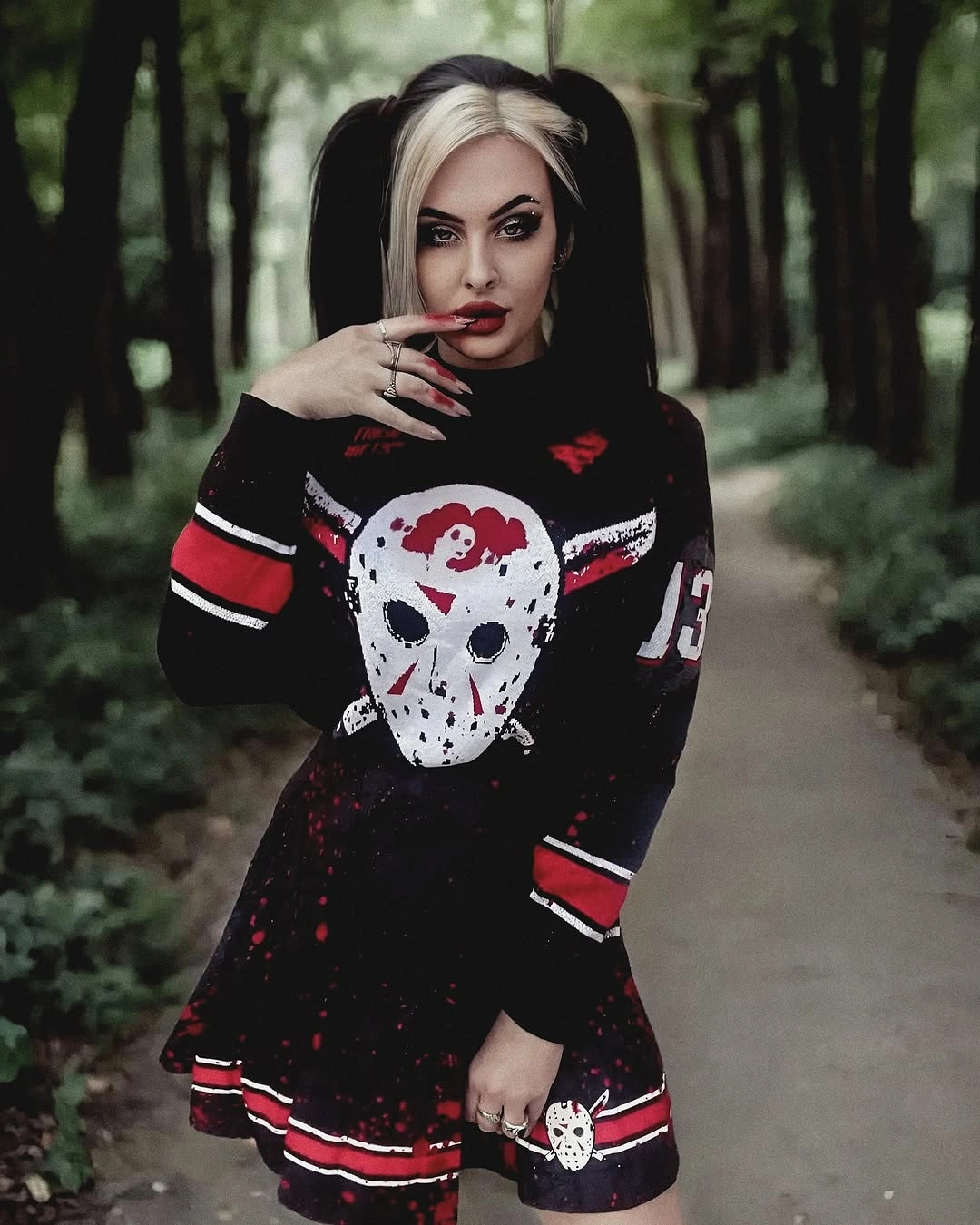
Black fitted long-sleeve bodice with flared short skirt built around skull graphic with red-white border details
Costume frame 24 opens with The white skull graphic is the dominant center of the dress. Costume frame 24 also shows Red-and-white stripes repeat at the sleeves and hem, framing the black base. Costume frame 24 color map: black, white, red. Frame 24 costume silhouette: fitted long-sleeve bodice with flared short skirt. Frame 24 costume focal language: skull graphic with red-white border details. Frame 24 costume detail: The graphic is large enough to carry the costume without extra props. Frame 24 costume angle: The black dress stays readable because the white center graphic and red-white borders create a controlled frame.
Costume frame 24 adaptation starts with Sport-like stripe bands soften the stark black-white center with narrow red accents. Costume frame 24 angle options: Letting one graphic garment do all the storytelling; Costume frame 24 second reading: Repeating border colors at sleeves and hem. Costume frame 24 thesis: Choose one large graphic, then repeat two of its accent colors at the edges so the garment reads as a complete costume. Frame 24 costume practical note: preserve sport-like stripe bands soften the stark black-white center with narrow red accents; compare letting one graphic garment do all the storytelling with repeating border colors at sleeves and hem in this frame. Frame 24 costume emphasis: keep sport-like stripe bands soften the stark black-white center with narrow red accents.
Costume frame 24 comparison: This is a single graphic garment with edge stripes, distinct from the layered capes, ruffles, and multi-person coordination. Costume frame 24 evidence: The hair repeats the black-white contrast from the garment and creates a strong upper focal point. Costume frame 24 secondary detail: The flared skirt moves away from the body, giving the graphic dress a clear full-body shape. Frame 24 costume finish: smooth graphic surface and ribbed-looking stripe bands. Frame 24 costume reading: the black dress stays readable because the white center graphic and red-white borders create a controlled frame explains the image’s particular emphasis.